Japan Smart Building Products Market Size & Growth Rate
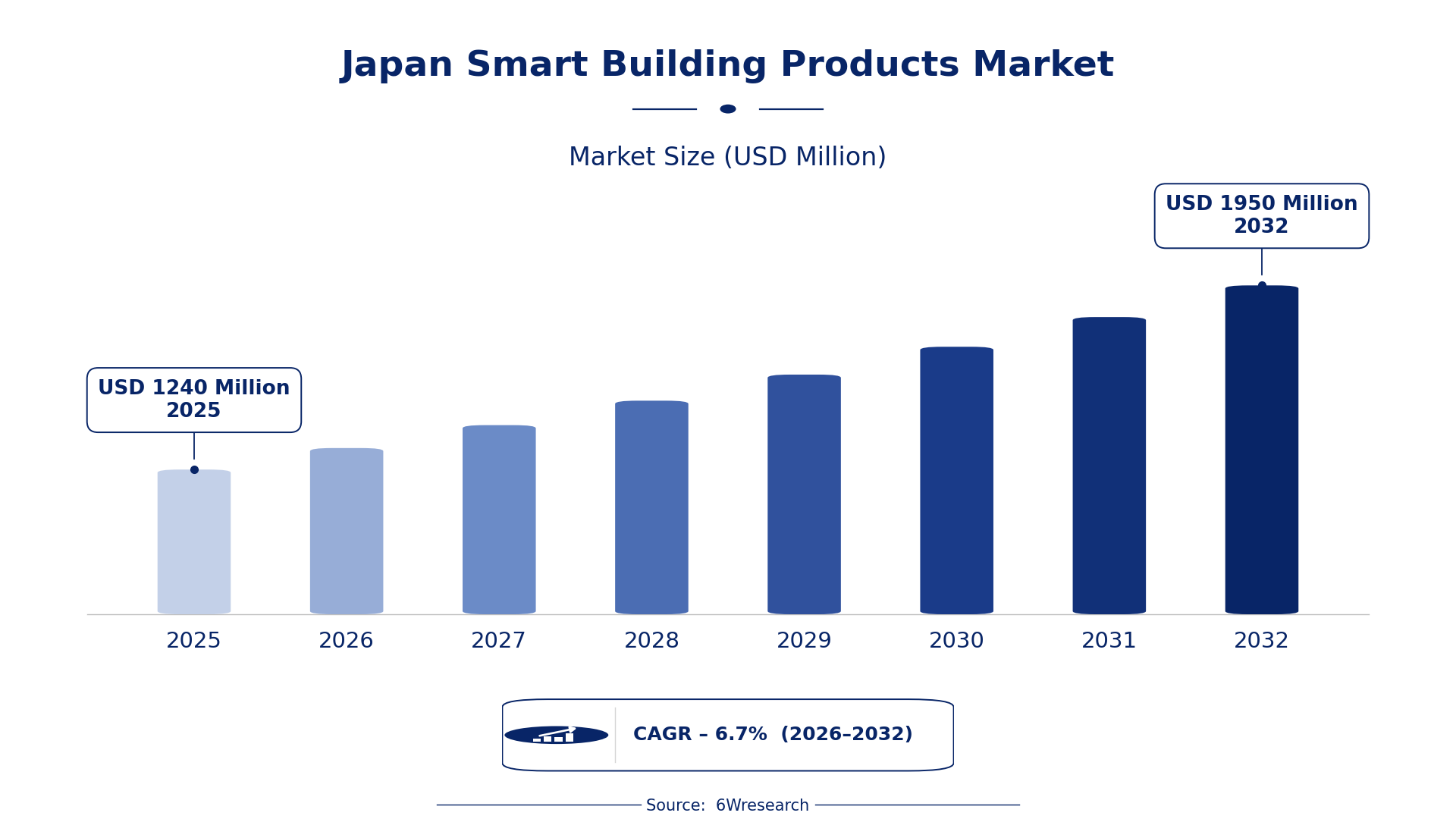
According to 6Wresearch internal database and industry insights, the Japan Smart Building Products Market was valued at USD 1,240 Million in 2025 and is projected to reach USD 1,950 Million by 2032, growing at a CAGR of approximately 6.7% during 2026–2032.
Japan Smart Building Products Market Highlights
| Report Metric | Details |
| Report Name | Japan Smart Building Products Market (2026-2032) |
| Market Size 2025 | USD 1,240 Million |
| Market Size 2032 | USD 1,950 Million |
| Absolute Growth 2025–2032 | USD 710 Million |
| CAGR 2026–2032 | 6.7% |
| Peak Annual Growth | 7.4% in 2032 |
| Forecast Period | 2026–2032 |
| Historical Data | 2022–2025 |
| Base Year | 2025 |
| Leading Product Type, 2025 | Smart HVAC Systems (45% share) |
| Leading Functionality, 2025 | Energy-Efficient Climate (41% share) |
| Leading Application Area, 2025 | Commercial Complexes (41% share) |
| Leading End User, 2025 | Building Contractors (54% share) |
| Fastest-Growing Product Type | Smart Glass Panels (9.9% CAGR) |
| Fastest-Growing Functionality | AI Routing + Touchless (9.3% CAGR) |
| Fastest-Growing Application Area | Green Buildings (8.5% CAGR) |
| Fastest-Growing End User | Architects (9.1% CAGR) |
| Growing Sector | Commercial Complexes |
| Key End Users | Building Contractors, Architects, Electrical Consultants, Vertical Transport Firms |
Japan Smart Building Products Market Year-wise Growth Rate and Key Drivers (2022–2032)
This graph illustrates the annual growth rates of the market from 2022 to 2032, highlighting a steady upward trajectory and projected market expansion over the forecast period.
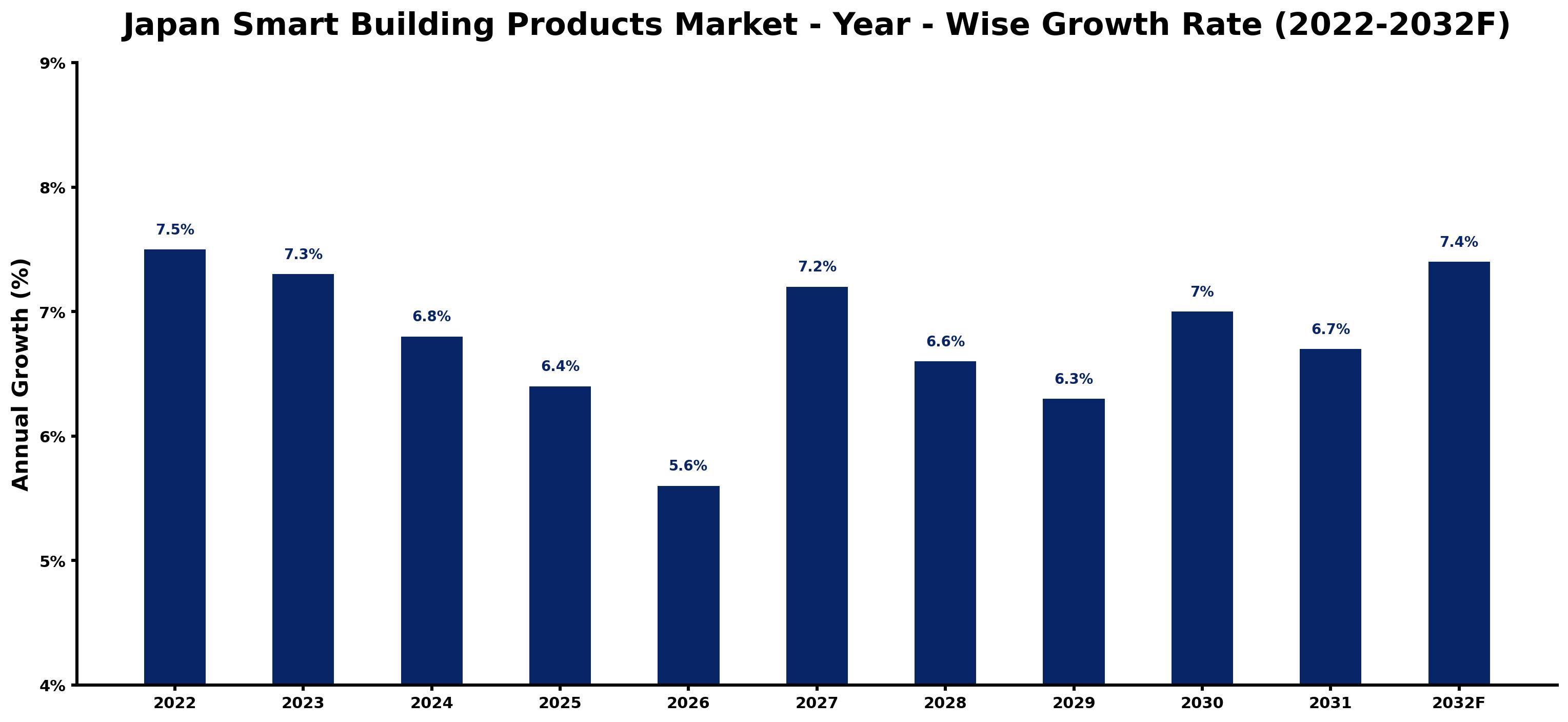
The table below sets out the estimated growth rate for each year and the main factor behind it.
| Year | Estimated Annual Growth (%) | Market Rationale |
| 2022 | 7.5 | The market showed strong demand as urban areas increasingly adopted smart technologies. |
| 2023 | 7.3 | Growth slowed slightly due to market saturation in some urban sectors. |
| 2024 | 6.8 | The market continued to expand, driven by rising energy efficiency standards. |
| 2025 | 6.4 | Demand remained steady as building contractors implemented smart solutions. |
| 2026 | 5.6 | Growth is expected to slow as the market adjusts to previous high rates of expansion. |
| 2027 | 7.2 | The market is projected to rebound with increased investment in smart technologies. |
| 2028 | 6.6 | Growth is anticipated to decelerate as competition intensifies among suppliers. |
| 2029 | 6.3 | The market is expected to experience a further slowdown as economic conditions stabilise. |
| 2030 | 7.0 | Demand will increase again as urban development projects resume. |
| 2031 | 6.7 | Growth is projected to moderate as the market matures and new technologies emerge. |
| 2032 | 7.4 | The market will peak with strong investments in sustainability initiatives. |
Note: Market size estimations and growth projections presented in this report are based on 6Wresearch's proprietary forecasting methodology, utilizing the latest available industry data, government publications, and primary research inputs.
Japan Smart Building Products Market Synopsis
Smart building products are advanced technologies designed to improve efficiency and occupant comfort through integrated systems that combine IoT devices, sensors, and automation software. The Japan Smart Building Products Market is expanding as construction and real estate sectors increasingly adopt these solutions, particularly in urban areas like Tokyo, which accounted for 40% of installations in 2023. Growth is driven by rising energy efficiency standards, government initiatives like the 'Green Building Program', and a target for a 46% reduction in greenhouse gas emissions by 2030.
Market Dynamics Impact Analysis (2026–2032)
| Factor | Type | Impact | Primary Segment Affected |
| Rising energy efficiency standards drive demand for smart technologies. | Driver | High | Smart HVAC Systems |
| The push for sustainable building practices creates opportunities for innovation. | Driver | High | Smart Glass Panels |
| Growing urbanisation leads to increased installations of smart building products. | Opportunity | High | Commercial Complexes |
| The increasing focus on energy management opens new markets for smart solutions. | Opportunity | High | Green Buildings |
| High initial costs of smart technologies may deter some buyers. | Restraint | Medium | Smart Lighting Systems |
| Limited awareness among smaller contractors restricts market penetration. | Restraint | Medium | Smart Elevators |
| Supply chain disruptions can delay project timelines for contractors. | Challenge | High | Building Contractors |
| Competition among suppliers can lead to price wars, affecting margins. | Challenge | Medium | Architects |
Evaluation of Drivers in Japan Smart Building Products Market (2026–2032)
The following drivers explain most of the expected growth.
| Drivers | Primary Segment Affected | Why It Matters (Evidence) |
| Increased urbanisation leads to higher demand for smart building products. | Smart HVAC Systems | Tokyo's population density drives the need for efficient climate control solutions. |
| Government initiatives promote energy-efficient buildings, boosting market growth. | Smart Glass Panels | The 'Green Building Program' encourages the adoption of energy-efficient materials. |
| Growing awareness of sustainability influences purchasing decisions. | Smart Lighting Systems | Adoption of smart lighting systems in educational institutions contributes to energy savings of up to 50% in commercial buildings. |
| Technological advancements improve the functionality of smart products. | Smart Elevators | The installed base of smart elevators reached 15,000 units nationwide, improving vertical transport efficiency. |
| Rising energy costs incentivise investments in energy management solutions. | Energy-Efficient Climate | The Tokyo Metropolitan Government targets a 30% reduction in energy consumption by 2030. |
Several shifts outside the market lift sales. Urbanisation in Japan, particularly in Tokyo, drives demand for efficient climate control systems, with over 60% of new commercial buildings adopting these technologies. Increased awareness of sustainability influences purchasing decisions, as seen in educational institutions adopting advanced lighting systems, which can contribute to energy savings of up to 50% in commercial buildings. Technological advancements are also improving the functionality of elevators, with a nationwide installed base of 15,000 units enhancing vertical transport efficiency.
Evaluation of Restraints in Japan Smart Building Products Market
The key brakes on demand, and where they bite hardest, are shown below.
| Market Restraint | Primary Segment Affected | Why It Matters (Evidence) |
| High initial costs of smart technologies deter smaller contractors from adoption. | Smart HVAC Systems | The upfront investment required for smart HVAC systems limits uptake among budget-conscious builders. |
| Limited awareness of smart technologies among smaller contractors restricts market growth. | Smart Glass Panels | Many smaller contractors lack knowledge of the benefits of smart glass, hindering sales. |
| Supply chain disruptions can lead to project delays, affecting timelines. | Smart Lighting Systems | Delays in obtaining components for smart lighting systems can postpone installations. |
| Competition among suppliers can lead to price wars, impacting margins. | Smart Elevators | Intense competition drives down prices, affecting profitability for elevator firms. |
| Economic fluctuations can impact investment in smart building projects. | Energy-Efficient Climate | Economic uncertainty may lead to reduced budgets for energy-efficient building upgrades. |
Japan Smart Building Products Market Challenges
High labour costs for producers arise from a shortage of skilled workers in smart building technologies, inflating project expenses by up to 15%. Buyers encounter elevated procurement prices due to limited competition among suppliers, raising costs by as much as 20%. Many existing buildings lack the necessary infrastructure for advanced smart systems, leading to retrofitting costs exceeding 10% of project budgets for buyers. Supply chain delays occur from reliance on imported components, which can postpone installations by several months, affecting project timelines for contractors.
Trends in the Japan Smart Building Products Market
These developments are changing demand patterns in the Japan Smart Building Products Market.
- Shift to Energy-Efficient Solutions: The 'Green Building Program' promotes energy-efficient technologies, resulting in increased installations of smart HVAC systems in urban areas. In 2023, these systems were prevalent in over 60% of new commercial buildings.
- Transition to Smart Lighting in Education: Since 2020, educational institutions have increasingly adopted smart lighting systems, improving energy savings and user comfort. Over 1,000 schools now utilise these advanced technologies.
- Emergence of AI-Driven Building Management: The integration of AI routing and touchless controls is becoming standard in new developments. This shift is evident in the growing adoption of AI technologies in urban commercial complexes.
- Focus on Sustainable Urban Development: The 'Smart City Strategy', aiming for implementation by 2025, prioritises sustainable urban living through technology integration. This initiative aligns with Japan's goal for net-zero emissions by 2050.
Investment Opportunities in the Japan Smart Building Products Market
Below are the investment opportunities with the strongest case in the Japan Smart Building Products Market.
- Joint Ventures with Local Contractors: Building contractors in urban areas are seeking partnerships to implement smart technologies. Collaborating with local firms can facilitate market entry and improve project efficiency.
- Investment in Green Building Technologies: Architects are increasingly focused on sustainable designs, creating demand for innovative smart products. Suppliers can enter this market by providing energy-efficient solutions tailored to new projects.
- Expansion into Educational Institutions: The growing number of schools adopting smart lighting systems presents a significant opportunity. Suppliers can target this sector by offering tailored solutions that improve energy efficiency.
- Development of Smart City Solutions: The 'Smart City Strategy' encourages investment in integrated smart technologies. Suppliers can engage with municipalities to provide solutions that align with urban development goals.
Government Initiatives in the Japan Smart Building Products Market
The Building Energy Efficiency Act, amended in 2022, mandates that all new buildings meet energy standards by April 2025. This law strengthens previous regulations by enforcing stricter compliance, ensuring that smart building products are integral to new constructions.
The Ministry of Land, Infrastructure, Transport and Tourism oversees building regulations and funds initiatives that promote smart technologies. It supports projects aimed at increasing energy efficiency and sustainability in urban developments.
Future Insight of the Japan Smart Building Products Market
By 2032, energy management standards like ISO 50001 will be widely adopted, improving operational efficiency for buyers and suppliers. The 'Green Building Program' will drive the construction of energy-efficient buildings, improving living conditions for urban residents. Smart glass panels will be increasingly used in over 200 high-rise buildings, contributing to reduced energy consumption. The Tokyo Metropolitan Government's energy consumption reduction targets will compel suppliers to innovate, resulting in more sustainable building practices across the market.
Market Segmentation Analysis
Japan Smart Building Products Market report covers a detailed analysis of the following market segments:
By Product Type – Smart HVAC Systems Lead, Smart Glass Panels Expected to Grow Fastest
According to Saurav Kr Singh, Senior Research Analyst at 6Wresearch, Smart HVAC Systems held 45% of the Japan Smart Building Products Market by product type in 2025. Smart HVAC systems dominate the market due to their critical role in climate control, with over 60% of new commercial buildings in Japan implementing these technologies. Their importance is underscored by the government's promotion of energy-efficient buildings through the 'Green Building Program'. The quickest growth will come from Smart Glass Panels, forecast to expand at a CAGR of 9.9% between 2026 and 2032. The swift rise of smart glass panels is fuelled by their dual benefits of energy efficiency and visual appeal, as seen in over 200 high-rise buildings in Tokyo. This trend is likely to gain momentum as urban developers strive to meet sustainability objectives. Suppliers must enhance the features of smart glass panels to meet the increasing demand from urban development projects.
By Functionality – Energy-Efficient Climate Leads, AI Routing + Touchless Expected to Grow Fastest
Energy-Efficient Climate took 41% of functionality revenue in 2025, more than any other category. Energy-efficient climate control is the leading functionality due to its vital role in minimising energy consumption, especially with regulations mandating such systems in new public buildings since 2021. This functionality is crucial for contractors aiming to adhere to energy efficiency standards. Over 2026–2032, AI Routing + Touchless is expected to post the fastest growth, at a CAGR of 9.3%. The growing demand for AI routing and touchless technology reflects the evolving expectations of building occupants, making these features increasingly sought after. This trend is expected to persist as more buildings adopt advanced automation to improve user experiences. Buyers should focus on solutions that integrate advanced functionalities to maintain competitiveness and operational efficiency.
By Application Area – Commercial Complexes Lead, Green Buildings Expected to Grow Fastest
Commercial Complexes accounted for 41% of the market by application area in 2025. Commercial complexes represent the primary application area for smart products, driven by the high demand for energy efficiency and user comfort in densely populated urban environments. The Tokyo Metropolitan Government's targets for energy consumption reduction further support this trend. Green Buildings are projected to grow fastest, at a CAGR of 8.5% during 2026–2032. The rise of green buildings is fuelled by alignment with sustainability goals, as seen in the 25% increase in green building certifications over the last five years. This growth reflects a broader commitment to environmentally responsible construction practices. Suppliers must adapt their offerings to meet the increasing demand for smart solutions in green building projects.
By End User – Building Contractors Lead, Architects Expected to Grow Fastest
With 54% of end user revenue in 2025, Building Contractors was the largest category. Building contractors are the leading end users as they play a key role in the implementation of smart building products, ensuring compliance with evolving regulations and standards. Their influence is critical in driving the adoption of these technologies across various projects. Architects are set to record the highest CAGR in this split, 9.1% over 2026–2032. Architects are rapidly becoming the fastest-growing end users due to their influential role in design and specification, particularly as over 70% of architects are incorporating smart technologies into their designs. This trend indicates a shift towards more technologically advanced building designs. Suppliers should engage with architects early in the design process to ensure their products are specified in new projects.
Key Attractiveness of the Report
- 10 Years of Market Numbers
- Historical Data Starting from 2022 to 2025
- Base Year 2025
- Forecast Data until 2032
- Key Performance Indicators Impacting the Market
- Major Upcoming Developments and Projects
Key Highlights of the Report:
- Japan Smart Building Products Market Outlook
- Market Size of Japan Smart Building Products Market, 2025
- Forecast of Japan Smart Building Products Market, 2032
- Historical Data and Forecast of Japan Smart Building Products Revenues & Volume for the Period 2022-2032F
- Japan Smart Building Products Market Trend Evolution
- Japan Smart Building Products Market Drivers and Challenges
- Japan Smart Building Products Price Trends
- Japan Smart Building Products Porter's Five Forces
- Japan Smart Building Products Industry Life Cycle
- Historical Data and Forecast of Japan Smart Building Products Market Revenues & Volume By Product Type for the Period 2022-2032F
- Historical Data and Forecast of Japan Smart Building Products Market Revenues & Volume By Smart HVAC Systems for the Period 2022-2032F
- Historical Data and Forecast of Japan Smart Building Products Market Revenues & Volume By Smart Glass Panels for the Period 2022-2032F
- Historical Data and Forecast of Japan Smart Building Products Market Revenues & Volume By Smart Lighting Systems for the Period 2022-2032F
- Historical Data and Forecast of Japan Smart Building Products Market Revenues & Volume By Smart Elevators for the Period 2022-2032F
- Historical Data and Forecast of Japan Smart Building Products Market Revenues & Volume By Functionality for the Period 2022-2032F
- Historical Data and Forecast of Japan Smart Building Products Market Revenues & Volume By Energy-Efficient Climate for the Period 2022-2032F
- Historical Data and Forecast of Japan Smart Building Products Market Revenues & Volume By Light Control + Tinting for the Period 2022-2032F
- Historical Data and Forecast of Japan Smart Building Products Market Revenues & Volume By Motion + Ambient Control for the Period 2022-2032F
- Historical Data and Forecast of Japan Smart Building Products Market Revenues & Volume By AI Routing + Touchless for the Period 2022-2032F
- Historical Data and Forecast of Japan Smart Building Products Market Revenues & Volume By Application Area for the Period 2022-2032F
- Historical Data and Forecast of Japan Smart Building Products Market Revenues & Volume By Commercial Complexes for the Period 2022-2032F
- Historical Data and Forecast of Japan Smart Building Products Market Revenues & Volume By Green Buildings for the Period 2022-2032F
- Historical Data and Forecast of Japan Smart Building Products Market Revenues & Volume By Offices/Schools for the Period 2022-2032F
- Historical Data and Forecast of Japan Smart Building Products Market Revenues & Volume By Skyscrapers/Malls for the Period 2022-2032F
- Historical Data and Forecast of Japan Smart Building Products Market Revenues & Volume By End User for the Period 2022-2032F
- Historical Data and Forecast of Japan Smart Building Products Market Revenues & Volume By Building Contractors for the Period 2022-2032F
- Historical Data and Forecast of Japan Smart Building Products Market Revenues & Volume By Architects for the Period 2022-2032F
- Historical Data and Forecast of Japan Smart Building Products Market Revenues & Volume By Electrical Consultants for the Period 2022-2032F
- Historical Data and Forecast of Japan Smart Building Products Market Revenues & Volume By Vertical Transport Firms for the Period 2022-2032F
- Japan Smart Building Products Import Export Trade Statistics
- Market Opportunity Assessment By Product Type
- Market Opportunity Assessment By Functionality
- Market Opportunity Assessment By Application Area
- Market Opportunity Assessment By End User
- Japan Smart Building Products Top Companies Market Share
- Japan Smart Building Products Competitive Benchmarking By Technical and Operational Parameters
- Japan Smart Building Products Company Profiles
- Japan Smart Building Products Key Strategic Recommendations
Market Covered
Coverage by segment is as follows.
By Product Type
- Smart HVAC Systems
- Smart Glass Panels
- Smart Lighting Systems
- Smart Elevators
By Functionality
- Energy-Efficient Climate
- Light Control + Tinting
- Motion + Ambient Control
- AI Routing + Touchless
By Application Area
- Commercial Complexes
- Green Buildings
- Offices/Schools
- Skyscrapers/Malls
By End User
- Building Contractors
- Architects
- Electrical Consultants
- Vertical Transport Firms































