Japan Smart Building Sensors Market Size & Growth Rate
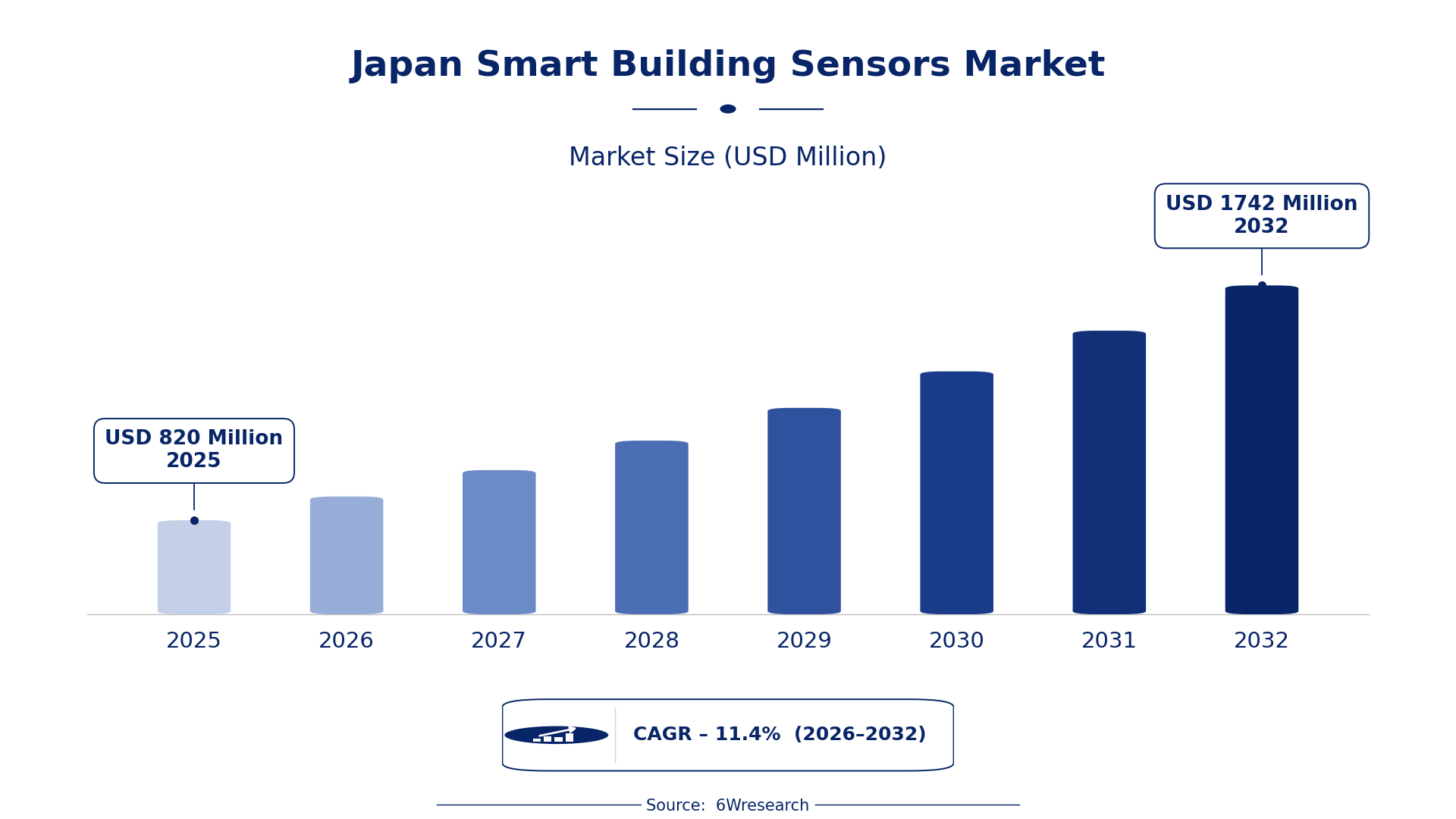
According to 6Wresearch internal database and industry insights, the Japan Smart Building Sensors Market was valued at USD 820 Million in 2025 and is projected to reach USD 1,742 Million by 2032, growing at a CAGR of approximately 11.4% during 2026–2032.
Japan Smart Building Sensors Market Highlights
| Report Metric | Details |
| Report Name | Japan Smart Building Sensors Market (2026-2032) |
| Market Size 2025 | USD 820 Million |
| Market Size 2032 | USD 1,742 Million |
| Absolute Growth 2025–2032 | USD 922 Million |
| CAGR 2026–2032 | 11.4% |
| Peak Annual Growth | 13.3% in 2032 |
| Forecast Period | 2026–2032 |
| Historical Data | 2022–2025 |
| Base Year | 2025 |
| Leading Sensor Type, 2025 | Motion Sensors (40% share) |
| Leading Measured Input, 2025 | Occupancy Detection (35% share) |
| Leading Output Platform, 2025 | Building Automation Systems (43% share) |
| Leading End User, 2025 | Security Integrators (48% share) |
| Fastest-Growing Sensor Type | Light Sensors (16.9% CAGR) |
| Fastest-Growing Measured Input | Ambient Light (15.0% CAGR) |
| Fastest-Growing Output Platform | Smart Lighting Controls (17.0% CAGR) |
| Fastest-Growing End User | Electrical OEMs (15.3% CAGR) |
| Growing Sector | Energy Management Solutions |
| Key End Users | Security Integrators, Facility Maintenance Teams, Building Safety Vendors |
Japan Smart Building Sensors Market Year-wise Growth Rate and Key Drivers (2022–2032)
This graph illustrates the annual growth rates of the market from 2022 to 2032, highlighting a steady upward trajectory and projected market expansion over the forecast period.
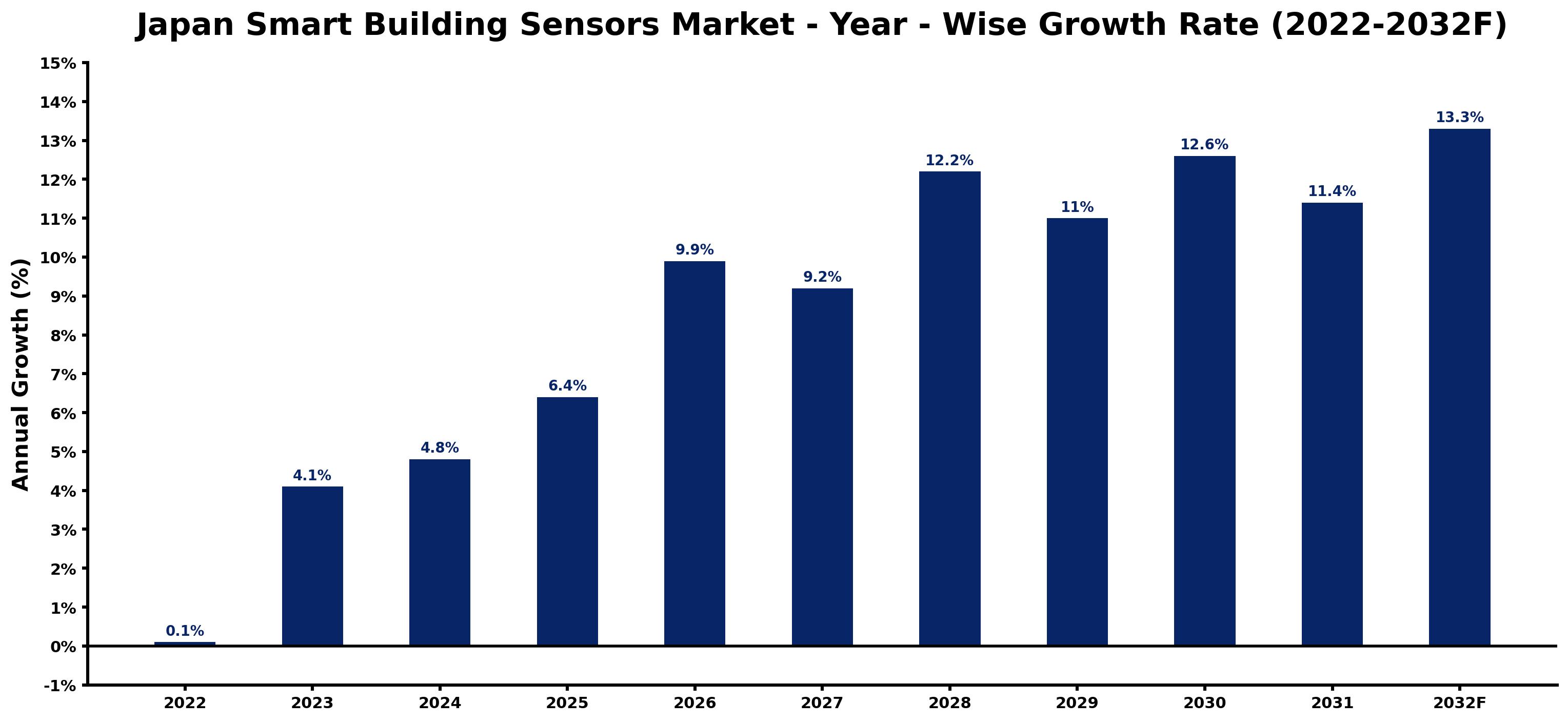
Below, each year's estimated growth is shown next to the factor that most influenced it.
| Year | Estimated Annual Growth (%) | Market Rationale |
| 2022 | 0.1 | The market experienced minimal growth as early adopters began integrating smart technologies. |
| 2023 | 4.1 | Increased awareness of energy efficiency drove faster adoption of smart building sensors. |
| 2024 | 4.8 | Growing urbanisation and demand for smart technologies contributed to higher growth rates. |
| 2025 | 6.4 | The introduction of new building standards boosted market activity. |
| 2026 | 9.9 | Rising investment in smart city initiatives is expected to accelerate demand for smart building sensors. |
| 2027 | 9.2 | Growth is projected to slow slightly as the market adjusts to previous rapid expansions. |
| 2028 | 12.2 | Technological advancements in sensor capabilities will lead to renewed interest and purchases. |
| 2029 | 11.0 | Market growth is anticipated to slow again as saturation in some segments begins to occur. |
| 2030 | 12.6 | A surge in energy efficiency mandates will revitalise demand for smart building solutions. |
| 2031 | 11.4 | The market is expected to continue growing, driven by ongoing urban development and smart initiatives. |
| 2032 | 13.3 | A peak in growth is projected as comprehensive smart building programmes are fully implemented. |
Note: Market size estimations and growth projections presented in this report are based on 6Wresearch's proprietary forecasting methodology, utilizing the latest available industry data, government publications, and primary research inputs.
Japan Smart Building Sensors Market Synopsis
Smart building sensors are advanced devices that monitor various environmental parameters, improving energy efficiency and safety in structures. The Japan Smart Building Sensors Market is growing due to urbanisation, government initiatives, and rising energy efficiency demands. With over 1,000 smart buildings in Tokyo and a government allocation of 10 billion yen for smart city projects, the market is set for expansion as more structures adopt these technologies and integrate smart solutions.
Market Dynamics Impact Analysis (2026–2032)
| Factor | Type | Impact | Primary Segment Affected |
| Urbanisation is increasing the demand for energy-efficient solutions in buildings. | Driver | High | Occupancy Detection |
| Government initiatives are promoting smart technologies for energy efficiency. | Driver | High | Building Automation Systems |
| The rapid growth of smart city projects presents significant investment opportunities. | Opportunity | High | Smart Lighting Controls |
| The increasing focus on sustainability creates a demand for advanced sensor technologies. | Opportunity | Medium | Thermal Sensors |
| High initial costs of installation may deter some potential buyers. | Restraint | Medium | Leak Detection Sensors |
| Limited awareness of smart building benefits may slow market penetration. | Restraint | Medium | Ambient Light |
| Supply chain disruptions can delay the availability of critical components. | Challenge | High | Motion Sensors |
| Competition from alternative energy management solutions may impact market share. | Challenge | Medium | Fire Safety Systems |
Evaluation of Drivers in Japan Smart Building Sensors Market (2026–2032)
Key forces behind demand, with the segment each one moves most, are listed below.
| Drivers | Primary Segment Affected | Why It Matters (Evidence) |
| Growing urbanisation is driving demand for energy-efficient building solutions. | Occupancy Detection | Tokyo's smart building initiatives are increasing occupancy detection sensor installations. |
| Government funding for smart city projects is boosting sensor adoption. | Building Automation Systems | The government allocated 10 billion yen for smart city projects in 2023. |
| Rising energy efficiency mandates are pushing building owners to adopt smart technologies. | Smart Lighting Controls | Japan targets a 46% cut in greenhouse-gas emissions by 2030. |
| Technological advancements are improving sensor capabilities and applications. | Thermal Sensors | New semiconductor technologies are improving the performance of thermal sensors. |
| Increased focus on safety regulations is driving demand for fire safety systems. | Fire Safety Systems | Fire safety systems are mandated in all commercial buildings under Japanese law. |
A wider customer base explains much of the growth, as urbanisation in regions like Tokyo drives demand for smart building sensors. The allocation of 10 billion yen for smart city projects in 2023 encourages building owners to invest in energy-efficient technologies. Japan's target of a 46% reduction in greenhouse-gas emissions by 2030 pushes for the adoption of smart lighting controls and occupancy detection systems. Advancements in semiconductor manufacturing improve the capabilities of thermal sensors, further stimulating market interest.
Evaluation of Restraints in Japan Smart Building Sensors Market
Below are the constraints most often cited by buyers and suppliers, with the segment each affects.
| Market Restraint | Primary Segment Affected | Why It Matters (Evidence) |
| High initial costs may deter building owners from adopting smart technologies. | Leak Detection Sensors | The average installation costs for smart sensors can exceed JPY 1 million per unit. |
| Limited awareness of the benefits of smart building sensors slows market penetration. | Ambient Light | Many building owners remain unaware of the advantages of integrating ambient light sensors. |
| Supply chain disruptions can delay the availability of critical components for sensors. | Motion Sensors | Global semiconductor shortages have affected the production timelines of motion sensors. |
| Competition from alternative energy management solutions may impact market share. | Fire Safety Systems | Traditional fire safety solutions remain prevalent, limiting the uptake of newer systems. |
| Regulatory compliance can complicate the installation of smart building technologies. | Building Automation Systems | New regulations require extensive testing and certification of smart systems. |
Japan Smart Building Sensors Market Challenges
Compliance with JIS Z 9901 presents a major hurdle for suppliers of smart building sensors, as extensive testing can delay product launches by six months for new entrants. Many existing buildings in Japan lack the infrastructure for technology integration, causing retrofit costs to exceed 30% of total project budgets for buyers. Rising minimum wage levels, now at JPY 1,055 per hour, inflate installation and maintenance expenses, straining budgets for buyers. Intense competition from imported sensors forces local producers to reduce prices by 15%, squeezing their profit margins and limiting their ability to invest in new technologies.
Trends in the Japan Smart Building Sensors Market
The shifts below are changing how Japan Smart Building Sensors Market products are bought and supplied.
- Shift from Traditional to Smart Building Technologies: Japan is experiencing a shift from conventional building systems to smart technologies, particularly in urban centres like Tokyo, where over 1,000 smart buildings have been established.
- Increase in Government Funding for Smart City Initiatives: In 2023, the Japanese government allocated 10 billion yen for smart city projects, significantly boosting investments in smart building sensors and technologies.
- Growing Adoption of Energy Management Solutions: Commercial buildings across Japan are increasingly adopting smart lighting controls, with a projected growth rate of 17.0% in the coming years, reflecting a strong demand for energy efficiency.
- Integration of Advanced Sensor Technologies in New Constructions: Ambient light sensors are becoming standard in new construction projects, improving energy efficiency and user comfort, with an estimated 1.5 million units installed nationwide.
Investment Opportunities in the Japan Smart Building Sensors Market
The following opportunities in the Japan Smart Building Sensors Market pair current demand with a clear way in.
- Timing for Investment in Smart Building Sensors: Security integrators are increasingly seeking advanced sensor solutions to improve building safety and efficiency, particularly as urbanisation accelerates demand.
- Partnerships for Smart City Development: Facility maintenance teams require advanced monitoring solutions for proactive management, especially as smart city initiatives expand across Japan.
- Focus on Energy Efficiency: Building safety vendors are looking for reliable solutions to ensure compliance with safety regulations, particularly with upcoming energy efficiency mandates.
- Expansion of Smart Lighting Controls: Electrical OEMs are integrating smart technologies into their product offerings to meet market demand for energy-efficient solutions.
Government Initiatives in the Japan Smart Building Sensors Market
The Building Energy Efficiency Act, amended in 2022, mandates that all new buildings meet energy standards starting April 2025. This law adds stringent requirements for energy efficiency, compelling producers to invest in advanced technologies and compliance measures.
In 2023, the government allocated 10 billion yen for smart city initiatives, administered by the Ministry of Land, Infrastructure, Transport and Tourism, to support the integration of smart building sensors and technologies in urban developments.
Future Insight of the Japan Smart Building Sensors Market
Japan's commitment to cutting greenhouse-gas emissions by 46% by 2030 will drive changes in the smart building sensors market by 2032. Government initiatives will allocate 10 billion yen for smart city projects, increasing the installed base of sensors to around 3 million units. The Tokyo Metropolitan Government's smart building program will promote energy-efficient technologies, while advancements in semiconductor technology will improve sensor performance. Buyers will benefit from enhanced energy management and safety features, supporting national sustainability goals.
Market Segmentation Analysis
Japan Smart Building Sensors Market report covers a detailed analysis of the following market segments:
By Sensor Type – Motion Sensors Lead, Light Sensors Expected to Grow Fastest
According to Saurav Kr Singh, Senior Research Analyst at 6Wresearch, in 2025, Motion Sensors led the sensor type split with a 40% share. Motion sensors are extensively used in Japan for occupancy detection, optimising energy use in smart buildings. The substantial number of smart buildings in urban areas, especially in Tokyo, reinforces this segment's leading position in the market. Light Sensors are set to record the highest CAGR in this split, 16.9% over 2026–2032. Light sensors are experiencing rapid growth due to their capability to adjust lighting based on ambient light levels, which is crucial for energy efficiency. The increasing integration of these sensors into new construction projects significantly drives their adoption. Suppliers should focus on advancing light sensor technologies to capitalise on this growth opportunity.
By Measured Input – Occupancy Detection Leads, Ambient Light Expected to Grow Fastest
Occupancy Detection took 35% of measured input revenue in 2025, more than any other category. Occupancy detection plays a vital role in energy management and security, making it a key component of smart building operations. Its widespread application in commercial buildings highlights its dominant market position in Japan. The quickest growth will come from Ambient Light, forecast to expand at a CAGR of 15.0% between 2026 and 2032. Ambient light sensors are gaining importance as they are essential for smart lighting systems, which are becoming more popular. The growing emphasis on energy efficiency in building designs is a primary driver of this segment's rapid growth. Buyers should consider incorporating ambient light sensors to improve their energy management capabilities.
By Output Platform – Building Automation Systems Lead, Smart Lighting Controls Expected to Grow Fastest
The largest output platform category in 2025 was Building Automation Systems, at 43% of revenue. Building automation systems are crucial for integrating various sensor types, making them indispensable for the functionality of smart buildings. Their prevalent use in urban centres underscores their critical role in effective building management. Over 2026–2032, Smart Lighting Controls are expected to post the fastest growth, at a CAGR of 17.0%. Smart lighting controls are witnessing significant growth as they enable efficient lighting management, aligning with energy-saving objectives. The increasing focus on energy efficiency in buildings is propelling this segment's expansion. Suppliers need to enhance their smart lighting control solutions to meet the rising market demand.
By End User – Security Integrators Lead, Electrical OEMs Expected to Grow Fastest
Security Integrators accounted for 48% of the market by end user in 2025. Security integrators are essential in leveraging sensors to provide advanced security solutions, positioning them as key players in the smart building sector. Their expertise in integrating technology into security frameworks solidifies their leading status in the market. Electrical OEMs are projected to grow fastest, at a CAGR of 15.3% during 2026–2032. Electrical OEMs are increasingly incorporating sensors into their products, indicating a trend towards smarter electrical solutions. This shift is expected to accelerate as the demand for smart technologies continues to grow. Buyers should collaborate with electrical OEMs to integrate advanced sensor technologies into their product offerings.
Key Attractiveness of the Report
- 10 Years of Market Numbers
- Historical Data Starting from 2022 to 2025
- Base Year 2025
- Forecast Data until 2032
- Key Performance Indicators Impacting the Market
- Major Upcoming Developments and Projects
Key Highlights of the Report:
- Japan Smart Building Sensors Market Outlook
- Market Size of Japan Smart Building Sensors Market, 2025
- Forecast of Japan Smart Building Sensors Market, 2032
- Historical Data and Forecast of Japan Smart Building Sensors Revenues & Volume for the Period 2022-2032F
- Japan Smart Building Sensors Market Trend Evolution
- Japan Smart Building Sensors Market Drivers and Challenges
- Japan Smart Building Sensors Price Trends
- Japan Smart Building Sensors Porter's Five Forces
- Japan Smart Building Sensors Industry Life Cycle
- Historical Data and Forecast of Japan Smart Building Sensors Market Revenues & Volume By Sensor Type for the Period 2022-2032F
- Historical Data and Forecast of Japan Smart Building Sensors Market Revenues & Volume By Motion Sensors for the Period 2022-2032F
- Historical Data and Forecast of Japan Smart Building Sensors Market Revenues & Volume By Light Sensors for the Period 2022-2032F
- Historical Data and Forecast of Japan Smart Building Sensors Market Revenues & Volume By Thermal Sensors for the Period 2022-2032F
- Historical Data and Forecast of Japan Smart Building Sensors Market Revenues & Volume By Leak Detection Sensors for the Period 2022-2032F
- Historical Data and Forecast of Japan Smart Building Sensors Market Revenues & Volume By Measured Input for the Period 2022-2032F
- Historical Data and Forecast of Japan Smart Building Sensors Market Revenues & Volume By Occupancy Detection for the Period 2022-2032F
- Historical Data and Forecast of Japan Smart Building Sensors Market Revenues & Volume By Ambient Light for the Period 2022-2032F
- Historical Data and Forecast of Japan Smart Building Sensors Market Revenues & Volume By Heat Detection for the Period 2022-2032F
- Historical Data and Forecast of Japan Smart Building Sensors Market Revenues & Volume By Water Ingress Alert for the Period 2022-2032F
- Historical Data and Forecast of Japan Smart Building Sensors Market Revenues & Volume By Output Platform for the Period 2022-2032F
- Historical Data and Forecast of Japan Smart Building Sensors Market Revenues & Volume By Building Automation Systems for the Period 2022-2032F
- Historical Data and Forecast of Japan Smart Building Sensors Market Revenues & Volume By Smart Lighting Controls for the Period 2022-2032F
- Historical Data and Forecast of Japan Smart Building Sensors Market Revenues & Volume By Fire Safety Systems for the Period 2022-2032F
- Historical Data and Forecast of Japan Smart Building Sensors Market Revenues & Volume By Mobile Notification for the Period 2022-2032F
- Historical Data and Forecast of Japan Smart Building Sensors Market Revenues & Volume By End User for the Period 2022-2032F
- Historical Data and Forecast of Japan Smart Building Sensors Market Revenues & Volume By Security Integrators for the Period 2022-2032F
- Historical Data and Forecast of Japan Smart Building Sensors Market Revenues & Volume By Electrical OEMs for the Period 2022-2032F
- Historical Data and Forecast of Japan Smart Building Sensors Market Revenues & Volume By Building Safety Vendors for the Period 2022-2032F
- Historical Data and Forecast of Japan Smart Building Sensors Market Revenues & Volume By Facility Maintenance Teams for the Period 2022-2032F
- Japan Smart Building Sensors Import Export Trade Statistics
- Market Opportunity Assessment By Sensor Type
- Market Opportunity Assessment By Measured Input
- Market Opportunity Assessment By Output Platform
- Market Opportunity Assessment By End User
- Japan Smart Building Sensors Top Companies Market Share
- Japan Smart Building Sensors Competitive Benchmarking By Technical and Operational Parameters
- Japan Smart Building Sensors Company Profiles
- Japan Smart Building Sensors Key Strategic Recommendations
Market Covered
The study includes the following segmentation.
By Sensor Type
- Motion Sensors
- Light Sensors
- Thermal Sensors
- Leak Detection Sensors
By Measured Input
- Occupancy Detection
- Ambient Light
- Heat Detection
- Water Ingress Alert
By Output Platform
- Building Automation Systems
- Smart Lighting Controls
- Fire Safety Systems
- Mobile Notification
By End User
- Security Integrators
- Electrical OEMs
- Building Safety Vendors
- Facility Maintenance Teams































