Japan Smart Building Solutions Market Size & Growth Rate
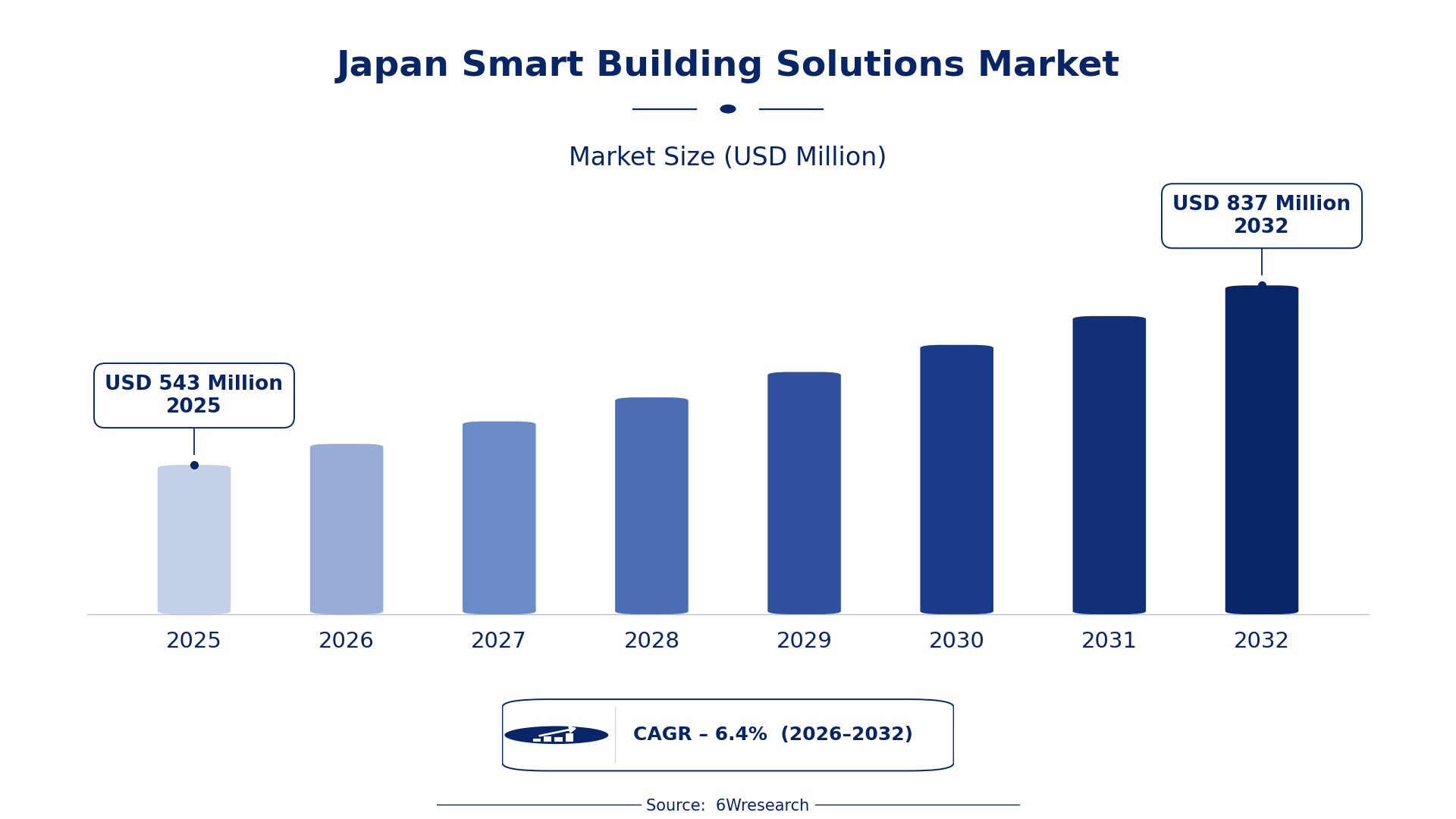
According to 6Wresearch internal database and industry insights, the Japan Smart Building Solutions Market was valued at USD 543 Million in 2025 and is projected to reach USD 837 Million by 2032, growing at a CAGR of approximately 6.4% during 2026–2032.
Japan Smart Building Solutions Market Highlights
| Report Metric | Details |
| Report Name | Japan Smart Building Solutions Market (2026-2032) |
| Market Size 2025 | USD 543 Million |
| Market Size 2032 | USD 837 Million |
| Absolute Growth 2025–2032 | USD 294 Million |
| CAGR 2026–2032 | 6.4% |
| Peak Annual Growth | 8.6% in 2026 |
| Forecast Period | 2026–2032 |
| Historical Data | 2022–2025 |
| Base Year | 2025 |
| Leading Solution Category, 2025 | Energy Management (47% share) |
| Leading Functionality, 2025 | Power Usage Optimization (40% share) |
| Leading Integration Platform, 2025 | AI + IoT (40% share) |
| Leading End User, 2025 | Green Builders (35% share) |
| Fastest-Growing Solution Category | Security Management (8.4% CAGR) |
| Fastest-Growing Functionality | Access Control (8.9% CAGR) |
| Fastest-Growing Integration Platform | Cloud + Edge (9.5% CAGR) |
| Fastest-Growing End User | Smart Cities (8.1% CAGR) |
| Growing Sector | Energy Management |
| Key End Users | Green Builders, Real Estate Developers, Office Complex Operators, Smart Cities |
Japan Smart Building Solutions Market Year-wise Growth Rate and Key Drivers (2022–2032)
This graph illustrates the annual growth rates of the market from 2022 to 2032, highlighting a steady upward trajectory and projected market expansion over the forecast period.
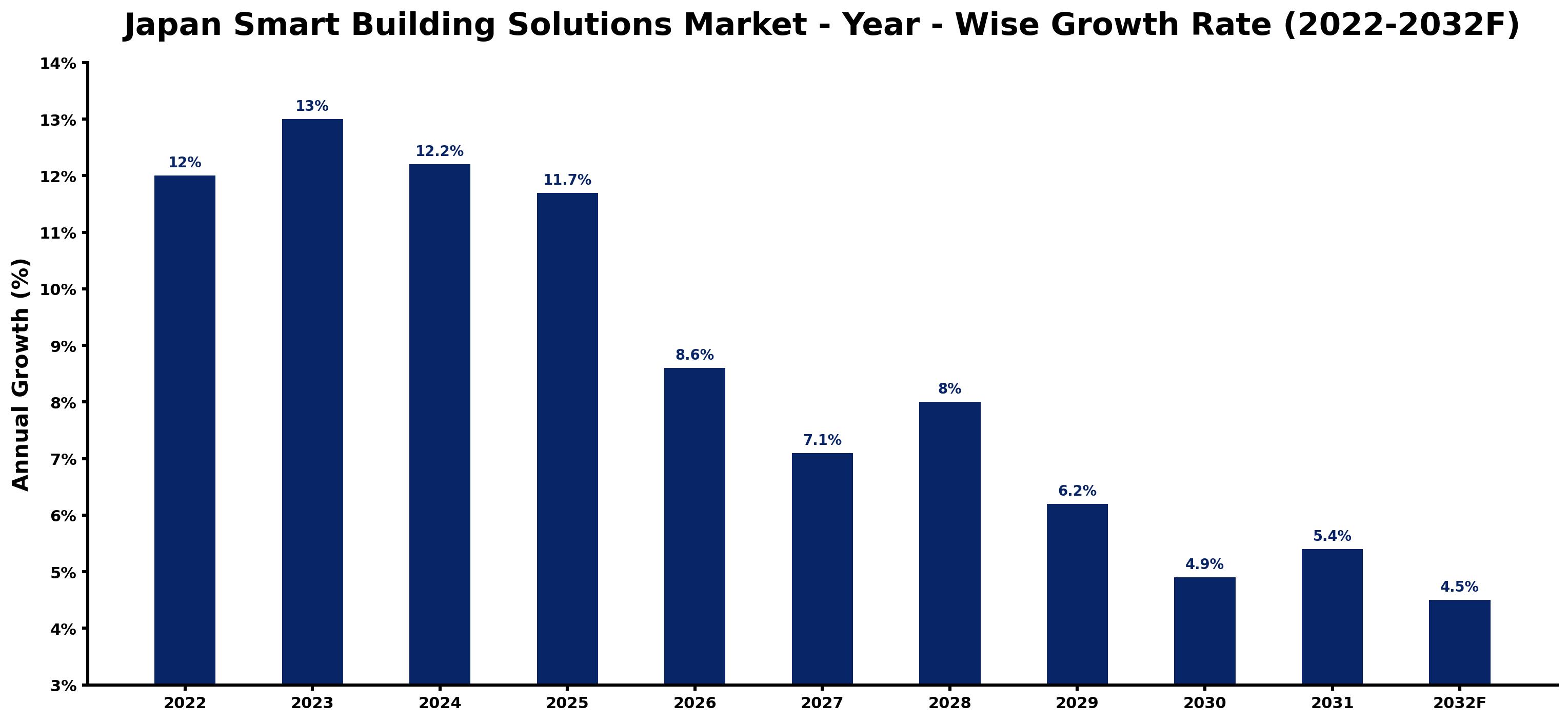
For each year, the table pairs the estimated growth rate with the leading influence on demand, showing how the drivers changed across the period.
| Year | Estimated Annual Growth (%) | Market Rationale |
| 2022 | 12.0 | The market showed strong growth due to increasing interest in energy efficiency. |
| 2023 | 13.0 | Demand surged as more developments integrated smart technologies, particularly in urban areas. |
| 2024 | 12.2 | Growth slowed slightly as projects faced delays in implementation and adoption. |
| 2025 | 11.7 | The market continued to grow, but at a slower pace due to market saturation in some regions. |
| 2026 | 8.6 | The peak growth rate is expected to decline as the market begins to stabilise and mature. |
| 2027 | 7.1 | Demand growth will slow further as the market adjusts to new standards and regulations. |
| 2028 | 8.0 | A rebound in growth is projected as new technologies gain traction in the market. |
| 2029 | 6.2 | Growth is expected to decelerate again as competition intensifies among solution providers. |
| 2030 | 4.9 | The market will see a further slowdown as economic factors influence investment decisions. |
| 2031 | 5.4 | An uptick in growth is anticipated as more projects are initiated in urban areas. |
| 2032 | 4.5 | The market is projected to stabilise with modest growth as demand reaches a more sustainable level. |
Note: Market size estimations and growth projections presented in this report are based on 6Wresearch's proprietary forecasting methodology, utilizing the latest available industry data, government publications, and primary research inputs.
Japan Smart Building Solutions Market Synopsis
Smart Building Solutions in Japan integrate advanced technologies like IoT and AI to improve efficiency and occupant experience. These solutions improve energy management, security, and HVAC optimisation. The Japan Smart Building Solutions Market is expanding due to urban sustainability efforts, with over 50% of new developments in Tokyo incorporating smart technologies. The Ministry of the Environment's Green Building Program and the Energy Efficiency Act drive this growth, aiming for a 46% reduction in greenhouse gas emissions by 2030.
Market Dynamics Impact Analysis (2026–2032)
| Factor | Type | Impact | Primary Segment Affected |
| Increased urbanisation and sustainability initiatives drive demand for energy management solutions. | Driver | High | Energy Management |
| The rise in energy costs necessitates efficient HVAC systems, boosting demand. | Driver | High | HVAC Optimization |
| Growing focus on energy-efficient buildings presents opportunities for new technology providers. | Opportunity | High | Green Builders |
| The Smart City Initiative in Fukuoka creates demand for integrated solutions. | Opportunity | Medium | Smart Cities |
| High initial investment costs can deter smaller developers from adopting smart solutions. | Restraint | High | Security Management |
| Regulatory compliance can be complex, impacting project timelines and costs. | Restraint | Medium | Energy Management |
| Supply chain disruptions can delay project implementations, affecting overall market growth. | Challenge | High | HVAC Optimization |
| Competition among solution providers can lead to price wars, impacting profitability. | Challenge | Medium | Smart Workspace Tools |
Evaluation of Drivers in Japan Smart Building Solutions Market (2026–2032)
Demand rests on the following drivers, each shown with the segment it touches most.
| Drivers | Primary Segment Affected | Why It Matters (Evidence) |
| Urban sustainability initiatives are increasing demand for energy management systems. | Energy Management | Tokyo's new developments incorporate smart technologies, driving energy efficiency improvements. |
| Rising energy costs are driving the adoption of HVAC optimization solutions. | HVAC Optimization | The average energy cost increase has prompted building operators to seek efficiencies. |
| Integration of AI and IoT is essential for modern smart building functionalities. | AI + IoT | 70% of new commercial buildings in Tokyo are adopting these technologies. |
| The push for compliance with energy regulations is boosting demand for smart solutions. | Security Management | The Energy Efficiency Act mandates energy management systems in commercial buildings. |
| The growing trend of remote work is increasing the need for smart workspace tools. | Smart Workspace Tools | Urban office complexes are enhancing productivity through advanced technologies. |
Rising energy costs drive demand for HVAC optimization, as energy management systems are expected in 80% of commercial buildings by 2025. The integration of AI and IoT is fundamental, with 70% of new commercial buildings adopting these solutions.
Evaluation of Restraints in Japan Smart Building Solutions Market
These restraints slow adoption and weigh on supplier margins.
| Market Restraint | Primary Segment Affected | Why It Matters (Evidence) |
| High initial investment costs deter smaller developers from adopting smart solutions. | Energy Management | The average cost of implementing energy management systems can be prohibitive for smaller projects. |
| Regulatory compliance can be complex, impacting project timelines and costs. | HVAC Optimization | Navigating multiple regulations can delay project approvals and increase costs. |
| Supply chain disruptions can delay project implementations, affecting overall market growth. | Security Management | Recent global supply chain issues have impacted the availability of smart technologies. |
| Competition among solution providers can lead to price wars, impacting profitability. | Smart Workspace Tools | Intense competition has driven down prices, affecting margins for providers. |
| Market saturation in urban areas can limit growth opportunities for new entrants. | AI + IoT | Established players dominate the market, making it challenging for newcomers. |
Japan Smart Building Solutions Market Challenges
Japan's producers encounter supply chain disruptions due to reliance on specific technology components, delaying project timelines by up to six months and affecting construction schedules. Distributors face difficulties with outdated technology, complicating integration efforts and increasing installation times for smart systems by an average of four weeks. Compliance with energy regulations can inflate project budgets by 15%, burdening buyers with higher expenses for energy-efficient upgrades. Buyers also struggle with securing financing for smart building projects, as stringent lending criteria can slow down investment decisions, delaying implementation by an average of three months.
Trends in the Japan Smart Building Solutions Market
The shifts below are changing how Japan Smart Building Solutions Market products are bought and supplied.
- Shift Towards Energy Management Systems: The Energy Efficiency Act mandates energy management systems in commercial buildings, targeting a 46% reduction in greenhouse gas emissions by 2030.
- Integration of AI and IoT in New Developments: In Tokyo, 70% of new commercial buildings are integrating AI and IoT solutions, improving operational efficiency and occupant experience.
- Increased Adoption of Automated Climate Control: Automated climate control systems are now standard in over 60% of newly constructed office buildings, reflecting a shift towards energy efficiency and comfort.
- Growing Demand for Smart Workspace Tools: Urban office complexes are increasingly adopting smart workspace tools, with a focus on improving employee productivity and satisfaction.
Investment Opportunities in the Japan Smart Building Solutions Market
Several openings in the Japan Smart Building Solutions Market merit attention from investors.
- Gap in Energy Management Solutions: With a target of 80% implementation of energy management systems by 2025, there is a notable opportunity for technology providers to fill this gap in commercial buildings.
- Supply of Smart Building Technologies: The demand for integrated smart building solutions is rising, particularly among green builders focusing on sustainability, creating opportunities for forward-thinking suppliers.
- Investment in Smart City Projects: The Ministry of Land, Infrastructure, Transport and Tourism supports smart city projects with a budget of ¥10 billion in 2023, presenting opportunities for technology providers to engage with local governments.
- Focus on Energy-Efficient Renovations: The Tokyo Metropolitan Government's subsidy program for energy-efficient building renovations in 2023 offers a chance for suppliers to cater to renovation projects.
Government Initiatives in the Japan Smart Building Solutions Market
The Building Energy Efficiency Act, amended in 2022, requires all new buildings to comply with energy standards starting April 2025. This law compels developers to invest in energy management systems, aligning with Japan's commitment to reduce greenhouse gas emissions by 46% by 2030. Additionally, the Act on the Rational Use of Energy obliges large energy users to report energy use, promoting efficiency across the sector.
The Ministry of Land, Infrastructure, Transport and Tourism supports smart city projects with a budget of ¥10 billion in 2023. This funding facilitates the integration of smart building solutions, allowing real estate developers to access resources for implementing energy-efficient technologies. The Tokyo Metropolitan Government's subsidy program for energy-efficient renovations further encourages compliance with energy standards.
Future Insight of the Japan Smart Building Solutions Market
By 2032, the investment pipeline will create substantial demand for smart building solutions, reshaping urban environments. Energy management systems are projected to be implemented in 80% of commercial buildings, significantly enhancing operational efficiency. The integration of advanced cloud platforms will facilitate real-time data processing, streamlining operations for suppliers. Smart workspace tools will transform work environments, creating more adaptive spaces for occupants, as seen in urban office complexes adopting innovative technologies.
Market Segmentation Analysis
Japan Smart Building Solutions Market report covers a detailed analysis of the following market segments:
By Solution Category – Energy Management Leads, Security Management Expected to Grow Fastest
According to Saurav Kr Singh, Senior Research Analyst at 6Wresearch, Energy Management accounted for 47% of the market by solution category in 2025. Energy Management holds the largest share as it is essential for optimising energy use across various building types in Japan. The installed base of energy management systems is projected to reach 80% implementation in commercial buildings by 2025, reflecting its critical importance. Security Management is projected to grow fastest, at a CAGR of 8.4% during 2026–2032. Security Management is experiencing rapid growth due to heightened safety concerns in urban environments. The Tokyo Metropolitan Government's subsidy programme for energy-efficient building renovations is increasing the focus on security measures, which will further drive its adoption. Suppliers should prioritise the integration of security features within energy management solutions to cater to the increasing market demand.
By Functionality – Power Usage Optimization Leads, Access Control Expected to Grow Fastest
Power Usage Optimization held 40% of the Japan Smart Building Solutions Market by functionality in 2025. Power Usage Optimization leads the market as it is crucial for reducing operational costs in both commercial and residential buildings. The Energy Efficiency Act mandates energy management systems, ensuring that power usage optimisation is a key focus for building operators. The quickest growth will come from Access Control, forecast to expand at a CAGR of 8.9% between 2026 and 2032. Access Control is growing quickly due to increasing emphasis on building security in urban settings. The requirement for enhanced security measures in new commercial buildings is propelling the demand for access control solutions, making it a priority. Buyers will gain significant advantages by investing in advanced access control systems to improve security and comply with evolving regulations.
By Integration Platform – AI + IoT Leads, Cloud + Edge Expected to Grow Fastest
With 40% of integration platform revenue in 2025, AI + IoT was the largest category. AI + IoT dominates the market as it is fundamental for enabling smart functionalities in modern buildings. With around 70% of new commercial buildings in Tokyo integrating these technologies, their role in operational efficiency is evident. Cloud + Edge is set to record the highest CAGR in this split, 9.5% over 2026–2032. The Cloud + Edge segment is rapidly expanding due to its crucial role in real-time data processing and storage. As the complexity of smart building solutions increases, the demand for efficient data management platforms will continue to grow, driving this segment's expansion. Suppliers must focus on developing Cloud + Edge solutions to address the rising complexity of smart building technologies.
By End User – Green Builders Lead, Smart Cities Expected to Grow Fastest
In 2025, Green Builders led the end user split with a 35% share. Green Builders represent the largest share as they focus on sustainable construction practices, aligning with Japan's environmental goals. The presence of over 300 certified green builders indicates a strong commitment to eco-friendly building solutions. Over 2026–2032, Smart Cities are expected to post the fastest growth, at a CAGR of 8.1%. Smart Cities are the fastest-growing segment, driven by initiatives aimed at integrating smart building solutions by 2025. The Ministry of Land, Infrastructure, Transport and Tourism's substantial budget allocation for smart city projects further fuels this growth. Suppliers should target smart city projects to capitalise on the increasing demand for integrated smart building solutions.
Key Attractiveness of the Report
- 10 Years of Market Numbers
- Historical Data Starting from 2022 to 2025
- Base Year 2025
- Forecast Data until 2032
- Key Performance Indicators Impacting the Market
- Major Upcoming Developments and Projects
Key Highlights of the Report:
- Japan Smart Building Solutions Market Outlook
- Market Size of Japan Smart Building Solutions Market, 2025
- Forecast of Japan Smart Building Solutions Market, 2032
- Historical Data and Forecast of Japan Smart Building Solutions Revenues & Volume for the Period 2022-2032F
- Japan Smart Building Solutions Market Trend Evolution
- Japan Smart Building Solutions Market Drivers and Challenges
- Japan Smart Building Solutions Price Trends
- Japan Smart Building Solutions Porter's Five Forces
- Japan Smart Building Solutions Industry Life Cycle
- Historical Data and Forecast of Japan Smart Building Solutions Market Revenues & Volume By Solution Category for the Period 2022-2032F
- Historical Data and Forecast of Japan Smart Building Solutions Market Revenues & Volume By Energy Management for the Period 2022-2032F
- Historical Data and Forecast of Japan Smart Building Solutions Market Revenues & Volume By Security Management for the Period 2022-2032F
- Historical Data and Forecast of Japan Smart Building Solutions Market Revenues & Volume By HVAC Optimization for the Period 2022-2032F
- Historical Data and Forecast of Japan Smart Building Solutions Market Revenues & Volume By Smart Workspace Tools for the Period 2022-2032F
- Historical Data and Forecast of Japan Smart Building Solutions Market Revenues & Volume By Functionality for the Period 2022-2032F
- Historical Data and Forecast of Japan Smart Building Solutions Market Revenues & Volume By Power Usage Optimization for the Period 2022-2032F
- Historical Data and Forecast of Japan Smart Building Solutions Market Revenues & Volume By Access Control, Surveillance for the Period 2022-2032F
- Historical Data and Forecast of Japan Smart Building Solutions Market Revenues & Volume By Automated Climate Control for the Period 2022-2032F
- Historical Data and Forecast of Japan Smart Building Solutions Market Revenues & Volume By Occupancy + Scheduling for the Period 2022-2032F
- Historical Data and Forecast of Japan Smart Building Solutions Market Revenues & Volume By Integration Platform for the Period 2022-2032F
- Historical Data and Forecast of Japan Smart Building Solutions Market Revenues & Volume By AI + IoT for the Period 2022-2032F
- Historical Data and Forecast of Japan Smart Building Solutions Market Revenues & Volume By Cloud + Edge for the Period 2022-2032F
- Historical Data and Forecast of Japan Smart Building Solutions Market Revenues & Volume By Building Management System for the Period 2022-2032F
- Historical Data and Forecast of Japan Smart Building Solutions Market Revenues & Volume By SaaS + IoT for the Period 2022-2032F
- Historical Data and Forecast of Japan Smart Building Solutions Market Revenues & Volume By End User for the Period 2022-2032F
- Historical Data and Forecast of Japan Smart Building Solutions Market Revenues & Volume By Green Builders for the Period 2022-2032F
- Historical Data and Forecast of Japan Smart Building Solutions Market Revenues & Volume By Smart Cities for the Period 2022-2032F
- Historical Data and Forecast of Japan Smart Building Solutions Market Revenues & Volume By Real Estate Developers for the Period 2022-2032F
- Historical Data and Forecast of Japan Smart Building Solutions Market Revenues & Volume By Office Complex Operators for the Period 2022-2032F
- Japan Smart Building Solutions Import Export Trade Statistics
- Market Opportunity Assessment By Solution Category
- Market Opportunity Assessment By Functionality
- Market Opportunity Assessment By Integration Platform
- Market Opportunity Assessment By End User
- Japan Smart Building Solutions Top Companies Market Share
- Japan Smart Building Solutions Competitive Benchmarking By Technical and Operational Parameters
- Japan Smart Building Solutions Company Profiles
- Japan Smart Building Solutions Key Strategic Recommendations
Market Covered
This report examines the market across the segments below.
By Solution Category
- Energy Management
- Security Management
- HVAC Optimization
- Smart Workspace Tools
By Functionality
- Power Usage Optimization
- Access Control
- Surveillance
- Automated Climate Control
- Occupancy + Scheduling
By Integration Platform
- AI + IoT
- Cloud + Edge
- Building Management System
- SaaS + IoT
By End User
- Green Builders
- Smart Cities
- Real Estate Developers
- Office Complex Operators































