Japan Smart Building Technology Market Size & Growth Rate
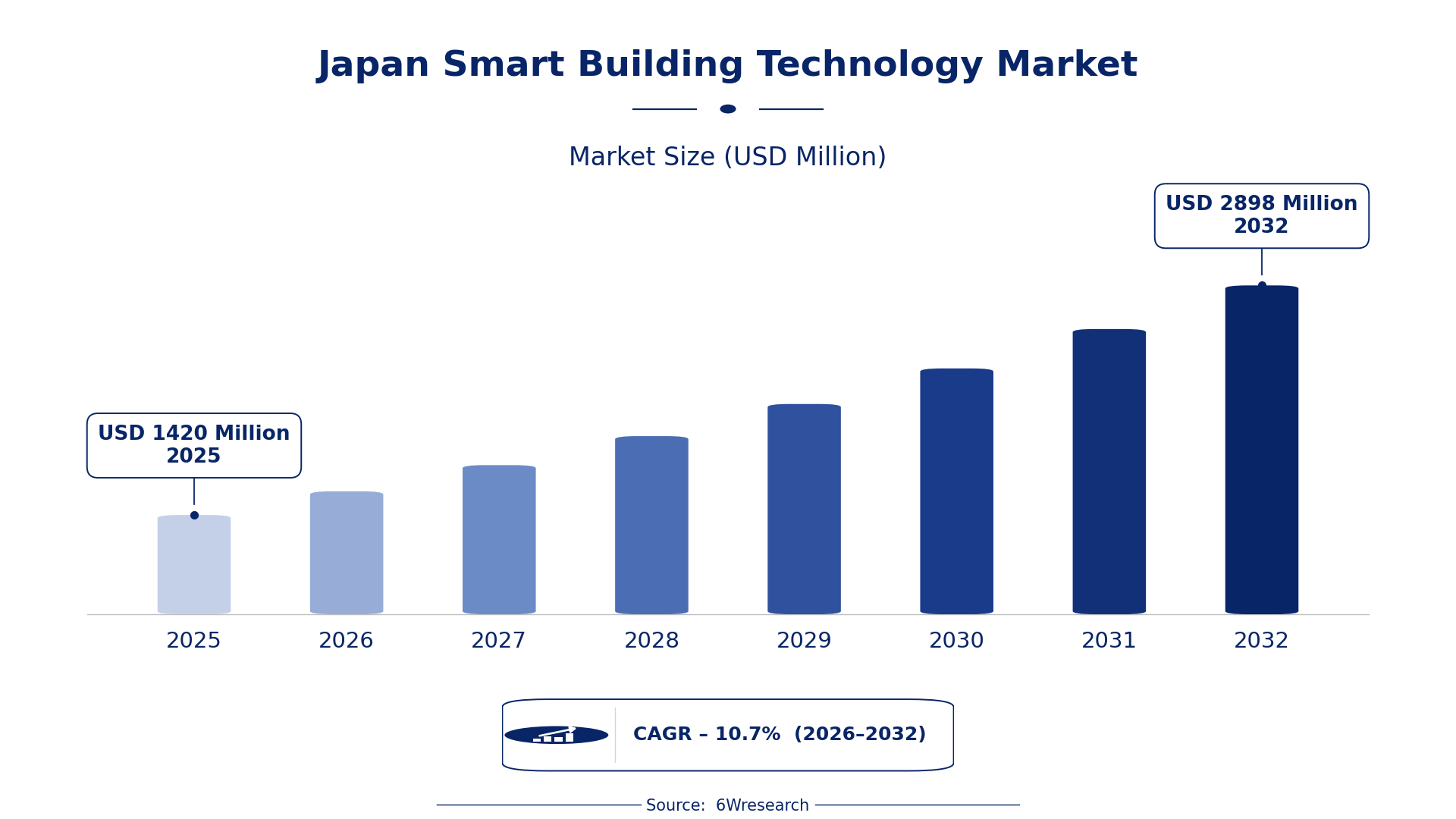
According to 6Wresearch internal database and industry insights, the Japan Smart Building Technology Market was valued at USD 1,420 Million in 2025 and is projected to reach USD 2,898 Million by 2032, growing at a CAGR of approximately 10.7% during 2026–2032.
Japan Smart Building Technology Market Highlights
| Report Metric | Details |
| Report Name | Japan Smart Building Technology Market (2026-2032) |
| Market Size 2025 | USD 1,420 Million |
| Market Size 2032 | USD 2,898 Million |
| Absolute Growth 2025–2032 | USD 1,478 Million |
| CAGR 2026–2032 | 10.7% |
| Peak Annual Growth | 11.9% in 2032 |
| Forecast Period | 2026–2032 |
| Historical Data | 2022–2025 |
| Base Year | 2025 |
| Leading Technology Type, 2025 | IoT Controllers (41% share) |
| Leading Smart Function, 2025 | Centralized Automation (41% share) |
| Leading Deployment Mode, 2025 | Wired/Wireless (48% share) |
| Leading End User, 2025 | Building Automation Firms (53% share) |
| Fastest-Growing Technology Type | Cloud-Based Platforms (15.6% CAGR) |
| Fastest-Growing Smart Function | Remote Monitoring + AI (14.8% CAGR) |
| Fastest-Growing Deployment Mode | SaaS Deployment (15.7% CAGR) |
| Fastest-Growing End User | Property Managers (14.1% CAGR) |
| Growing Sector | Building Automation |
| Key End Users | Building Automation Firms, Property Managers, Energy Efficiency Experts, Facility Operators |
Japan Smart Building Technology Market Year-wise Growth Rate and Key Drivers (2022–2032)
This graph illustrates the annual growth rates of the market from 2022 to 2032, highlighting a steady upward trajectory and projected market expansion over the forecast period.
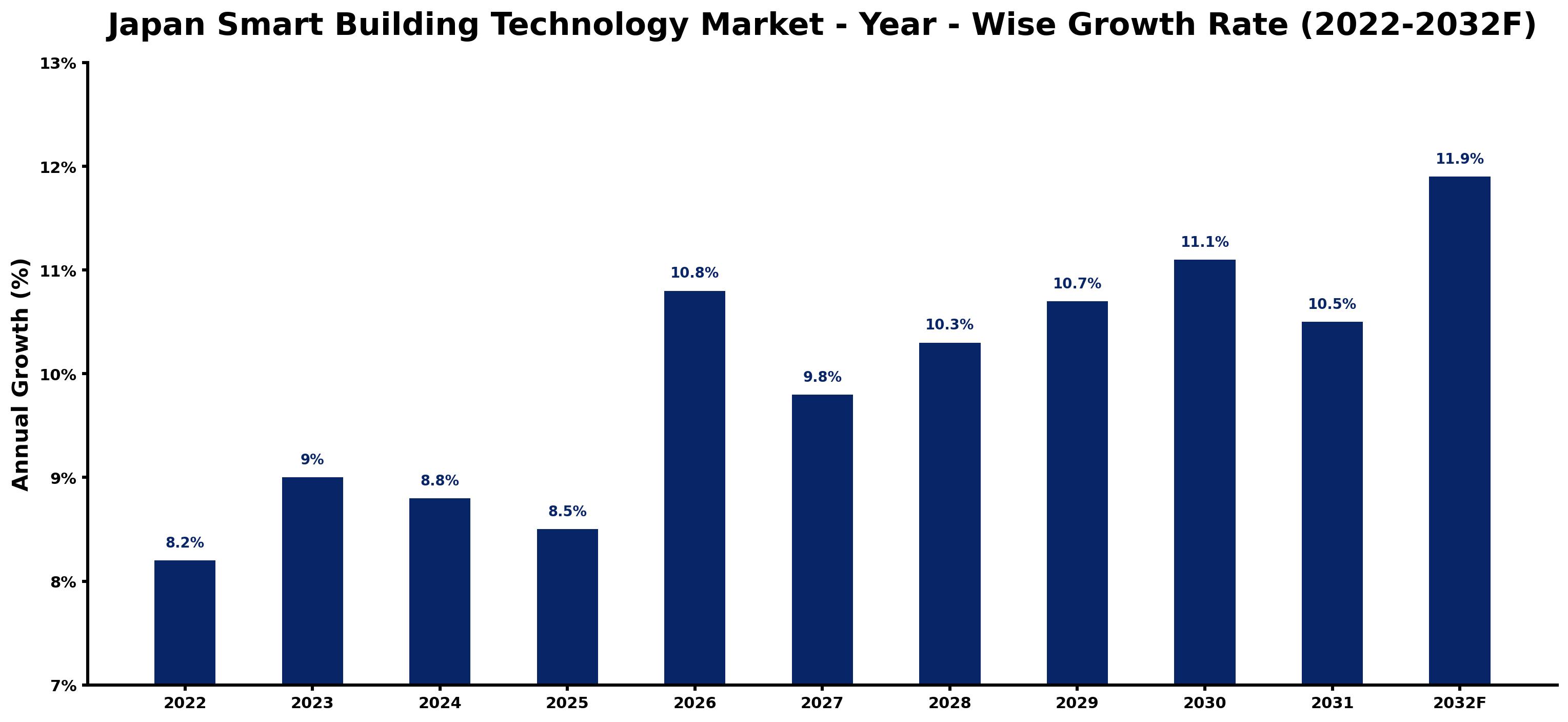
Year by year, the estimates below pair each growth rate with the development that shaped it.
| Year | Estimated Annual Growth (%) | Market Rationale |
| 2022 | 8.2 | The market exhibited steady growth due to increased awareness of energy efficiency measures. |
| 2023 | 9.0 | Growth accelerated as more buildings adopted smart technologies in urban areas like Tokyo. |
| 2024 | 8.8 | The market experienced a slowdown as some projects faced delays in implementation and funding. |
| 2025 | 8.5 | Demand continued to increase, driven by ongoing urban development initiatives and government support. |
| 2026 | 10.8 | Growth is expected to pick up again as investments in smart technologies surge across sectors. |
| 2027 | 9.8 | The market will see a slowdown as competition intensifies among technology providers and pricing pressures arise. |
| 2028 | 10.3 | Demand is projected to rise as more facilities adopt AI for improved building management capabilities. |
| 2029 | 10.7 | Growth will continue as energy efficiency becomes a priority for property managers and building owners. |
| 2030 | 11.1 | The market is expected to expand further due to government incentives for energy-efficient buildings and technologies. |
| 2031 | 10.5 | A slowdown is anticipated as the market matures and competition increases among existing players. |
| 2032 | 11.9 | Growth is projected to peak as smart building technology becomes standard in new developments and renovations. |
Note: Market size estimations and growth projections presented in this report are based on 6Wresearch's proprietary forecasting methodology, utilizing the latest available industry data, government publications, and primary research inputs.
Japan Smart Building Technology Market Synopsis
Smart Building Technology in Japan includes systems that improve building efficiency and occupant comfort through automation and data analytics, leveraging advanced technologies such as IoT, cloud computing, and AI. The Japan Smart Building Technology Market is experiencing rapid growth, driven by urban development, energy efficiency initiatives, and government support. With over 1,000 smart buildings anticipated by 2023 and substantial adoption expected by 2025, demand from building automation firms and property managers remains robust. The Tokyo metropolitan area is at the forefront of implementations, reflecting a broader trend towards sustainability and operational efficiency in Japan's real estate sector.
Market Dynamics Impact Analysis (2026–2032)
| Factor | Type | Impact | Primary Segment Affected |
| Increased urbanisation drives demand for smart building technologies. | Driver | High | IoT Controllers |
| Government initiatives promote energy-efficient technologies in buildings. | Driver | High | Cloud-Based Platforms |
| Growing need for energy-efficient solutions creates opportunities for automation. | Opportunity | High | Smart Edge Gateways |
| Rising adoption of AI technologies opens new market avenues. | Opportunity | Medium | Remote Monitoring + AI |
| High initial investment costs can deter smaller firms from adopting technology. | Restraint | High | Centralized Automation |
| Limited awareness of smart technologies among property managers restricts growth. | Restraint | Medium | Building Automation Firms |
| Competition among technology providers can lead to price wars affecting margins. | Challenge | High | Facility Operators |
| Rapid technological advancements may outpace current infrastructure capabilities. | Challenge | Medium | Energy Efficiency Experts |
Evaluation of Drivers in Japan Smart Building Technology Market (2026–2032)
The main growth drivers and the segments they affect most are set out below.
| Drivers | Primary Segment Affected | Why It Matters (Evidence) |
| Urban development projects increase demand for smart building solutions. | IoT Controllers | Over 50% of smart building projects incorporate IoT controllers to manage devices effectively. |
| Government energy efficiency targets stimulate technology adoption. | Cloud-Based Platforms | Cloud-based platforms are used in over 70% of new building projects, enhancing management capabilities. |
| The push for sustainability drives investments in smart technologies. | Smart Edge Gateways | The average energy savings reported by smart buildings is around 20-30%, attracting investments. |
| Increased focus on operational efficiency encourages automation solutions. | Remote Monitoring + AI | Remote monitoring systems are utilized in 60% of commercial buildings, improving management efficiency. |
| Growing interest in data security boosts demand for advanced systems. | Data Integrity & Security | Blockchain technology is being explored in pilot projects for building management, ensuring data integrity. |
Spending rises because urban development projects are increasingly incorporating smart building solutions, with over 50% of smart building projects using IoT controllers to manage devices effectively. Energy efficiency targets stimulate technology adoption, as cloud-based platforms are now used in over 70% of new building projects, enhancing management capabilities. The push for sustainability drives investments in smart technologies, with smart buildings reporting average energy savings of around 20-30%, attracting further investments. Increased focus on operational efficiency encourages automation solutions, as remote monitoring systems are utilized in 60% of commercial buildings, improving management efficiency. Growing interest in data security boosts demand for advanced systems, with blockchain technology being explored in pilot projects for building management, ensuring data integrity and security.
Evaluation of Restraints in Japan Smart Building Technology Market
These restraints slow adoption and weigh on supplier margins.
| Market Restraint | Primary Segment Affected | Why It Matters (Evidence) |
| High initial investment costs deter smaller firms from adopting technology. | Centralized Automation | Many smaller firms find it challenging to invest in advanced automation systems, limiting adoption. |
| Limited awareness of smart technologies among property managers restricts growth. | Building Automation Firms | Property managers often lack knowledge of available smart solutions, hindering market expansion. |
| Market maturity leads to increased competition, affecting profit margins. | Facility Operators | Intense competition among providers can squeeze margins for operators, impacting profitability. |
| Slow adoption of new technologies due to regulatory hurdles. | Energy Efficiency Experts | Regulations can delay the implementation of new solutions, affecting project timelines. |
| Concerns over data privacy may inhibit technology adoption. | Remote Monitoring + AI | Data security issues can make potential users hesitant to adopt new systems, limiting growth. |
Japan Smart Building Technology Market Challenges
Over 1,000 smart buildings are operational in Japan, but intense competition among producers compresses profit margins, limiting their ability to invest in advanced technologies. Many producers depend on outdated systems, with over 70% of new projects using cloud-based platforms, causing integration issues that can delay project timelines by up to six months. Buyers struggle to maximise technology benefits, as 60% of commercial buildings lack remote monitoring systems, resulting in missed energy savings opportunities. The reported average energy savings of 20-30% highlight the financial strain on buyers who defer upgrades, leading to unnecessary operational costs.
Trends in the Japan Smart Building Technology Market
The trends below show where the Japan Smart Building Technology Market is heading.
- Shift from Traditional to Smart Building Technologies: Since 2022, the trend towards smart building technologies has accelerated, particularly in urban areas like Tokyo, where over 1,000 smart buildings are now operational, improving energy efficiency and operational management.
- Transition from Manual to Automated Building Management: Building automation firms are increasingly adopting automated systems, with remote monitoring systems now utilised in 60% of commercial buildings, reflecting a growing preference for efficiency and real-time management capabilities.
- Emergence of AI in Building Operations: In 2023, the adoption of AI in building management increased by 25%, demonstrating a shift towards data-driven decision-making in facility operations and improving overall efficiency across various sectors.
- Rise of Cloud-Based Solutions for Building Management: The adoption of cloud-based platforms has surged, with over 70% of new building projects incorporating these solutions, reflecting a shift towards flexibility and scalability in managing building systems.
Investment Opportunities in the Japan Smart Building Technology Market
The following areas offer the clearest openings for investors and suppliers in the Japan Smart Building Technology Market.
- Invest in IoT Controllers for Smart Buildings: With over 1,000 smart buildings expected by 2023, there is a strong opportunity to supply IoT controllers, particularly in urban areas like Tokyo, where demand is high for efficient management solutions.
- Supply Cloud-Based Platforms for New Developments: The market for cloud-based platforms is expanding, with over 70% of new projects adopting these solutions, making it an ideal time to invest in this technology for building automation firms seeking to enhance operations.
- Provide AI Solutions for Improved Operations: The increasing adoption of AI in building management creates a demand for innovative solutions, especially among facility operators looking to improve efficiency and reduce operational costs in their buildings.
- Focus on Energy Efficiency Consulting Services: With Japan targeting a 46% reduction in greenhouse-gas emissions by 2030, energy efficiency experts are in high demand, presenting an opportunity for consulting services in this area to help firms comply with regulations.
Government Initiatives in the Japan Smart Building Technology Market
The Building Energy Efficiency Act, amended in 2022, mandates that all new buildings meet energy standards starting April 2025, ensuring compliance with energy efficiency measures. This law drives producers to invest in technologies that align with these standards, promoting the adoption of smart building solutions across the sector and benefiting buyers seeking efficiency.
The GX Basic Policy, adopted in 2023, aims for JPY 150 trillion of public-private decarbonisation investment over the next decade. The Ministry of the Environment oversees this initiative, which supports energy-efficient building technologies and encourages compliance with the latest standards, facilitating the transition to smart building solutions for buyers.
Future Insight of the Japan Smart Building Technology Market
Commercial buyers will increasingly adopt smart building technologies by 2032, driven by initiatives like the 2023 Green Building Program that emphasise energy efficiency. The integration of AI in building management will streamline operations, supported by a 25% increase in adoption last year. Standards such as ISO 50001 will become more prevalent, ensuring efficient energy management practices. With a target to reduce building energy consumption by 30% by 2030, suppliers must innovate to meet these demands, creating a more sustainable and efficient built environment.
Market Segmentation Analysis
Japan Smart Building Technology Market report covers a detailed analysis of the following market segments:
By Technology Type – IoT Controllers Lead, Cloud-Based Platforms Expected to Grow Fastest
According to Saurav Kr Singh, Senior Research Analyst at 6Wresearch, IoT Controllers took 41% of technology type revenue in 2025, more than any other category. IoT controllers play a crucial role in managing smart devices within buildings, ensuring efficient operation and connectivity. Their importance is underscored by their integration in over 50% of smart building projects, reflecting strong demand from developers. Cloud-Based Platforms are set to record the highest CAGR in this split, 15.6% over 2026–2032. Cloud-based platforms are experiencing rapid adoption due to their ability to enable remote management, with over 70% of new building projects incorporating this technology. As the focus on efficiency grows, the reliance on cloud solutions is expected to increase further. This suggests that suppliers should prioritise the development of advanced cloud-based technologies to meet the rising demand for flexible management solutions.
By Smart Function – Centralized Automation Leads, Remote Monitoring + AI Expected to Grow Fastest
Centralized Automation held 41% of the Japan Smart Building Technology Market by smart function in 2025. Centralized automation serves as the core function for controlling building systems from a single point, making it essential for operational efficiency. Its dominance is underscored by its integration in numerous smart buildings across Japan. The quickest growth will come from Remote Monitoring + AI, forecast to expand at a CAGR of 14.8% between 2026 and 2032. The combination of remote monitoring and AI is becoming increasingly vital for real-time data analysis and building management, reflecting a shift towards more intelligent systems. This growth aligns with the rising adoption of AI technologies in building management. Buyers will benefit from investing in integrated solutions that combine centralized automation with advanced monitoring capabilities.
By Deployment Mode – Wired/Wireless Leads, SaaS Deployment Expected to Grow Fastest
Wired/Wireless accounted for 48% of the market by deployment mode in 2025. Wired/wireless connectivity is fundamental for smart buildings, facilitating seamless communication among various systems and devices. This mode is widely implemented, ensuring reliable performance across numerous projects. SaaS Deployment is projected to grow fastest, at a CAGR of 15.7% during 2026–2032. SaaS deployment is swiftly becoming the preferred method for delivering smart building solutions, providing the flexibility and scalability that urban developments require. This trend indicates a growing preference for adaptable service models among stakeholders. Suppliers should enhance their SaaS offerings to align with the market's shift towards more flexible and scalable deployment options.
By End User – Building Automation Firms Lead, Property Managers Expected to Grow Fastest
With 53% of end user revenue in 2025, Building Automation Firms was the largest category. Building automation firms are the primary users responsible for developing and implementing smart solutions, significantly impacting market growth and technology integration. Their expertise is vital for ensuring the effective operation of smart buildings. Over 2026–2032, Property Managers are expected to post the fastest growth, at a CAGR of 14.1%. Property managers are increasingly recognised as essential in overseeing smart building technologies, indicating a trend towards professional management of these systems. Their growing involvement is likely to accelerate the adoption of smart solutions across various facilities. This highlights the need for suppliers to tailor their products and services to meet the specific needs of property managers, who are critical for the successful deployment of smart technologies.
Key Attractiveness of the Report
- 10 Years of Market Numbers
- Historical Data Starting from 2022 to 2025
- Base Year 2025
- Forecast Data until 2032
- Key Performance Indicators Impacting the Market
- Major Upcoming Developments and Projects
Key Highlights of the Report:
- Japan Smart Building Technology Market Outlook
- Market Size of Japan Smart Building Technology Market, 2025
- Forecast of Japan Smart Building Technology Market, 2032
- Historical Data and Forecast of Japan Smart Building Technology Revenues & Volume for the Period 2022-2032F
- Japan Smart Building Technology Market Trend Evolution
- Japan Smart Building Technology Market Drivers and Challenges
- Japan Smart Building Technology Price Trends
- Japan Smart Building Technology Porter's Five Forces
- Japan Smart Building Technology Industry Life Cycle
- Historical Data and Forecast of Japan Smart Building Technology Market Revenues & Volume By Technology Type for the Period 2022-2032F
- Historical Data and Forecast of Japan Smart Building Technology Market Revenues & Volume By IoT Controllers for the Period 2022-2032F
- Historical Data and Forecast of Japan Smart Building Technology Market Revenues & Volume By Cloud-Based Platforms for the Period 2022-2032F
- Historical Data and Forecast of Japan Smart Building Technology Market Revenues & Volume By Smart Edge Gateways for the Period 2022-2032F
- Historical Data and Forecast of Japan Smart Building Technology Market Revenues & Volume By Blockchain in BMS for the Period 2022-2032F
- Historical Data and Forecast of Japan Smart Building Technology Market Revenues & Volume By Smart Function for the Period 2022-2032F
- Historical Data and Forecast of Japan Smart Building Technology Market Revenues & Volume By Centralized Automation for the Period 2022-2032F
- Historical Data and Forecast of Japan Smart Building Technology Market Revenues & Volume By Remote Monitoring + AI for the Period 2022-2032F
- Historical Data and Forecast of Japan Smart Building Technology Market Revenues & Volume By Localized Processing for the Period 2022-2032F
- Historical Data and Forecast of Japan Smart Building Technology Market Revenues & Volume By Data Integrity & Security for the Period 2022-2032F
- Historical Data and Forecast of Japan Smart Building Technology Market Revenues & Volume By Deployment Mode for the Period 2022-2032F
- Historical Data and Forecast of Japan Smart Building Technology Market Revenues & Volume By Wired/Wireless for the Period 2022-2032F
- Historical Data and Forecast of Japan Smart Building Technology Market Revenues & Volume By SaaS Deployment for the Period 2022-2032F
- Historical Data and Forecast of Japan Smart Building Technology Market Revenues & Volume By Multi-Protocol Integration for the Period 2022-2032F
- Historical Data and Forecast of Japan Smart Building Technology Market Revenues & Volume By Distributed Ledger for the Period 2022-2032F
- Historical Data and Forecast of Japan Smart Building Technology Market Revenues & Volume By End User for the Period 2022-2032F
- Historical Data and Forecast of Japan Smart Building Technology Market Revenues & Volume By Building Automation Firms for the Period 2022-2032F
- Historical Data and Forecast of Japan Smart Building Technology Market Revenues & Volume By Property Managers for the Period 2022-2032F
- Historical Data and Forecast of Japan Smart Building Technology Market Revenues & Volume By Energy Efficiency Experts for the Period 2022-2032F
- Historical Data and Forecast of Japan Smart Building Technology Market Revenues & Volume By Facility Operators for the Period 2022-2032F
- Japan Smart Building Technology Import Export Trade Statistics
- Market Opportunity Assessment By Technology Type
- Market Opportunity Assessment By Smart Function
- Market Opportunity Assessment By Deployment Mode
- Market Opportunity Assessment By End User
- Japan Smart Building Technology Top Companies Market Share
- Japan Smart Building Technology Competitive Benchmarking By Technical and Operational Parameters
- Japan Smart Building Technology Company Profiles
- Japan Smart Building Technology Key Strategic Recommendations
Market Covered
The report covers the following segments.
By Technology Type
- IoT Controllers
- Cloud-Based Platforms
- Smart Edge Gateways
- Blockchain in BMS
By Smart Function
- Centralized Automation
- Remote Monitoring + AI
- Localized Processing
- Data Integrity & Security
By Deployment Mode
- Wired/Wireless
- SaaS Deployment
- Multi-Protocol Integration
- Distributed Ledger
By End User
- Building Automation Firms
- Property Managers
- Energy Efficiency Experts
- Facility Operators































