Japan Smart Card Reader Market Size & Growth Rate
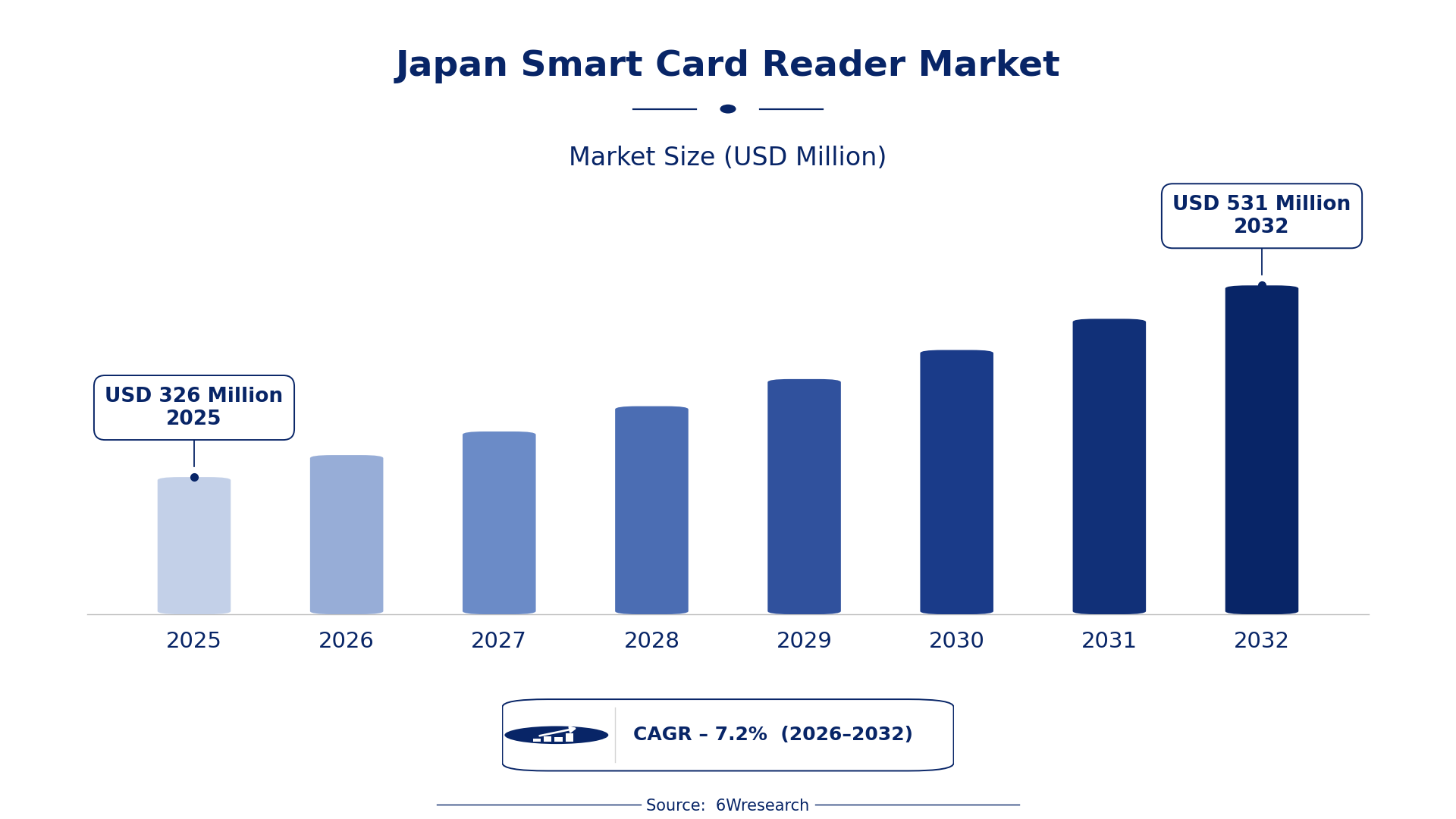
According to 6Wresearch internal database and industry insights, the Japan Smart Card Reader Market was valued at USD 326 Million in 2025 and is projected to reach USD 531 Million by 2032, growing at a CAGR of approximately 7.2% during 2026–2032.
Japan Smart Card Reader Market Highlights
| Report Metric | Details |
| Report Name | Japan Smart Card Reader Market (2026-2032) |
| Market Size 2025 | USD 326 Million |
| Market Size 2032 | USD 531 Million |
| Absolute Growth 2025–2032 | USD 205 Million |
| CAGR 2026–2032 | 7.2% |
| Peak Annual Growth | 8.4% in 2028 |
| Forecast Period | 2026–2032 |
| Historical Data | 2022–2025 |
| Base Year | 2025 |
| Leading Reader Type, 2025 | Contactless Readers (35% share) |
| Leading Interface Type, 2025 | RFID/NFC (43% share) |
| Leading Application Sector, 2025 | Banking Authentication (40% share) |
| Leading End User, 2025 | Public Transit Systems (48% share) |
| Fastest-Growing Reader Type | Dual Interface Readers (10.9% CAGR) |
| Fastest-Growing Application Sector | Mobile Payments (9.9% CAGR) |
| Fastest-Growing End User | FinTech Providers (9.1% CAGR) |
| Growing Sector | Public Transport Systems |
| Key End Users | Banking, Public Transport, Government Agencies, FinTech Providers |
Japan Smart Card Reader Market Year-wise Growth Rate and Key Drivers (2022–2032)
This graph illustrates the annual growth rates of the market from 2022 to 2032, highlighting a steady upward trajectory and projected market expansion over the forecast period.
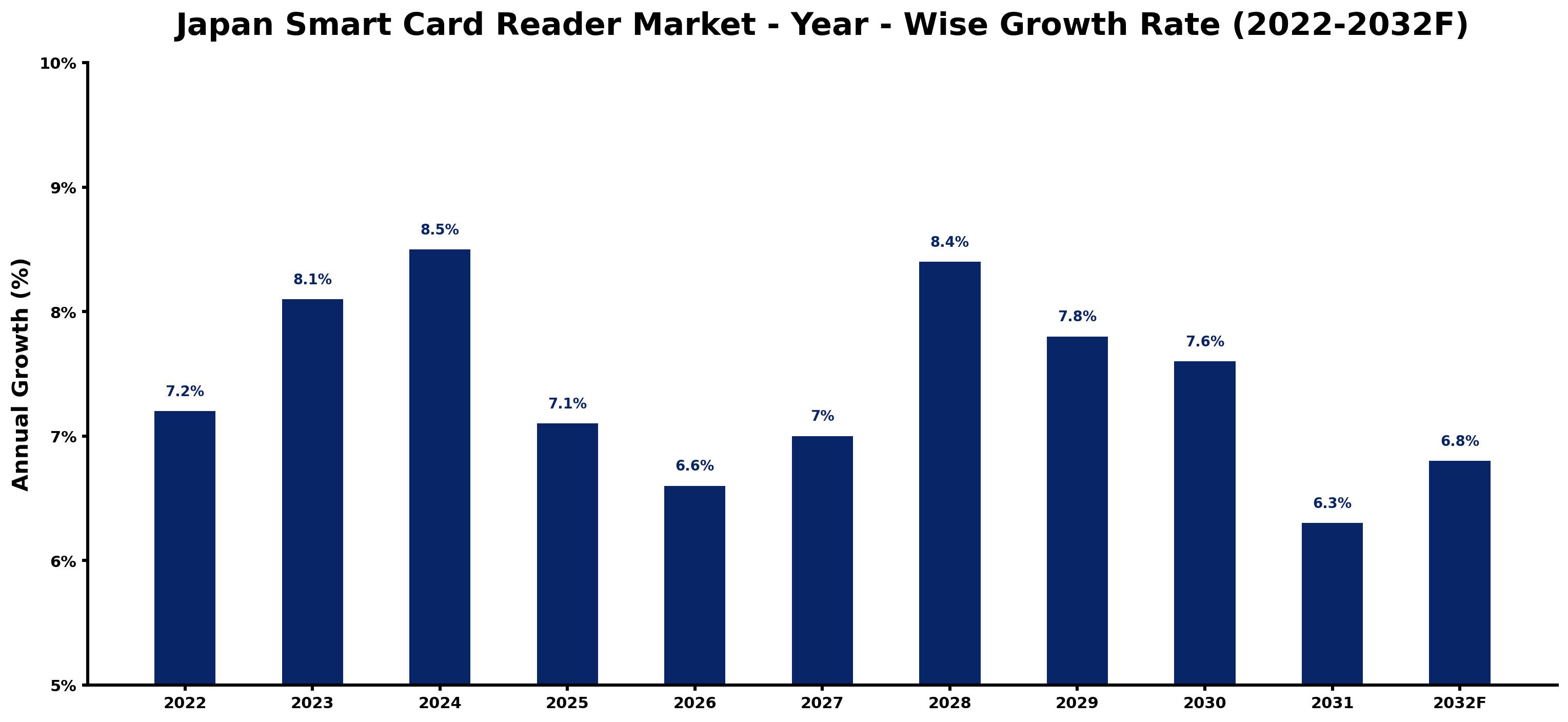
The yearly estimates that follow link every growth rate to its principal driver, so readers can see why the pace changed in each period.
| Year | Estimated Annual Growth (%) | Market Rationale |
| 2022 | 7.2 | The market experienced steady growth due to increasing adoption of secure payment solutions. |
| 2023 | 8.1 | Demand accelerated as contactless payment transactions surged to 1 billion. |
| 2024 | 8.5 | Continued investment in banking authentication technologies supported further growth. |
| 2025 | 7.1 | Growth slowed as the market adjusted to previous high demand levels. |
| 2026 | 6.6 | Demand growth is expected to slow as the market stabilises after rapid expansion. |
| 2027 | 7.0 | Increased adoption of dual interface readers will contribute to a recovery in growth. |
| 2028 | 8.4 | The market is projected to peak as mobile payments gain traction among users. |
| 2029 | 7.8 | Growth is expected to slow slightly as the market begins to normalise after peak levels. |
| 2030 | 7.6 | Demand will remain stable as new technologies enter the market. |
| 2031 | 6.3 | Growth is projected to continue decelerating as the market matures and competition intensifies. |
| 2032 | 6.8 | Demand is expected to rise again as new applications for smart card readers emerge. |
Note: Market size estimations and growth projections presented in this report are based on 6Wresearch's proprietary forecasting methodology, utilizing the latest available industry data, government publications, and primary research inputs.
Japan Smart Card Reader Market Synopsis
Smart card readers are electronic devices that read data from embedded integrated circuits in smart cards. In Japan, these devices play a crucial role in banking authentication and public transport systems, with the Tokyo Metropolitan Government actively promoting the integration of smart card technology. The Japan Smart Card Reader Market is expanding due to increasing demand for secure payment solutions, valued at approximately 150 billion yen as of 2023. The growth is further propelled by a rise in contactless payment transactions and various government initiatives.
Market Dynamics Impact Analysis (2026–2032)
| Factor | Type | Impact | Primary Segment Affected |
| Increasing adoption of contactless payment solutions | Driver | High | Contactless Readers |
| Government support for digital payment initiatives | Driver | High | Banking Authentication |
| Growing demand for mobile payment solutions | Opportunity | High | Mobile Payments |
| Expansion of public transit systems adopting smart card technology | Opportunity | High | Public Transit Systems |
| Competition from alternative payment technologies | Restraint | Medium | Mobile Payments |
| Regulatory compliance costs for manufacturers | Restraint | Medium | Contact Card Readers |
| Supply chain disruptions affecting component availability | Challenge | High | Dual Interface Readers |
| Need for continuous technological upgrades to meet market demands | Challenge | Medium | RFID/NFC |
Evaluation of Drivers in Japan Smart Card Reader Market (2026–2032)
The following drivers explain most of the expected growth.
| Drivers | Primary Segment Affected | Why It Matters (Evidence) |
| Rising contactless payment transactions | Contactless Readers | The number of contactless payment transactions reached 1 billion in 2023, driving demand for efficient transaction solutions. |
| Government initiatives promoting digital payments | Banking Authentication | The Ministry of Internal Affairs and Communications supports smart card technology, boosting security in financial transactions. |
| Increased investment in public transport systems | Public Transit Systems | Tokyo's public transport systems utilize smart card readers for over 10 million daily transactions, boosting demand. |
| Growing FinTech adoption | Mobile Payments | FinTech adoption in Japan is at 60%, increasing the need for mobile smart readers. |
| Rise in dual interface reader demand | Dual Interface Readers | The Japanese market has seen a rise in dual interface readers due to increased demand for flexibility. |
Spending rises as the number of contactless payment transactions reached 1 billion in 2023, prompting banks to invest in secure solutions. Public transport systems in Tokyo facilitate over 10 million daily transactions, which boosts the demand for smart card readers. The shift towards digital payments supports this trend, as smart card technology is being promoted across multiple sectors. The increase in dual interface readers reflects the need for versatile payment solutions, further driving market growth. A 60% rise in FinTech adoption fuels the market for mobile smart readers, increasing overall demand.
Evaluation of Restraints in Japan Smart Card Reader Market
These are the pressures that could keep growth below its potential.
| Market Restraint | Primary Segment Affected | Why It Matters (Evidence) |
| Competition from alternative payment technologies | Mobile Payments | The emergence of digital wallets and mobile apps creates competition, impacting smart card reader sales. |
| Regulatory compliance costs for manufacturers | Contact Card Readers | Manufacturers face increased costs to meet standards set by the Electrical Appliance and Material Safety Act. |
| Supply chain disruptions affecting component availability | Dual Interface Readers | Global supply chain issues have led to delays in obtaining necessary components, hindering production. |
| Technological obsolescence risks | RFID/NFC | Rapid advancements in technology may render existing smart card readers obsolete, affecting sales. |
| Market saturation in urban areas | Public Transit Systems | High penetration of smart card readers in major cities limits growth opportunities in those regions. |
Japan Smart Card Reader Market Challenges
Producers face high costs due to outdated technology, compelling them to invest heavily in upgrades to remain competitive, which can strain financial resources. Intense competition among suppliers results in aggressive pricing strategies, leading to reduced profit margins and threatening the viability of smaller manufacturers. A shortage of skilled technicians creates installation delays, particularly affecting banks that depend on timely deployment of smart card systems, potentially causing revenue losses. Stringent regulations on data security impose compliance costs on producers, which can inflate prices for buyers, especially in the public sector where funding is already limited.
Trends in the Japan Smart Card Reader Market
Four trends stand out in the Japan Smart Card Reader Market.
- Public Transit Systems Increasing Adoption of Smart Card Readers: Public transit systems are rapidly adopting smart card readers to facilitate cashless travel experiences, as seen in JR East's integration, which supports over 10 million daily transactions.
- Shift Towards Dual Interface Readers: The market is shifting towards dual interface readers, combining contact and contactless capabilities, driven by increased demand for flexibility and user convenience, with a projected CAGR of 10.9%.
- Growing Mobile Payments Sector: Mobile payments are becoming increasingly popular, with expected annual growth of 15% through 2025, reflecting changing consumer preferences for convenient transaction methods.
- Expansion of Government Initiatives: The Digital Agency's recent initiatives aim to promote digital payments across various sectors, supported by a 5 billion yen investment from the government.
Investment Opportunities in the Japan Smart Card Reader Market
The following areas offer the clearest openings for investors and suppliers in the Japan Smart Card Reader Market.
- Joint Ventures with Local Firms: Investing in joint ventures with local FinTech providers can tap into the growing mobile payments sector, which is expected to grow by 15% annually through 2025.
- Expansion in Public Transit Systems: The public transit sector is expanding, with over 30 systems using smart card technology, presenting opportunities for suppliers to meet increasing demand.
- Investment in Dual Interface Readers: The rising demand for dual interface readers, projected to grow at 10.9%, indicates a need for suppliers to invest in this technology to capture market share.
- Partnerships with Government Agencies: Collaborating with government agencies can facilitate entry into the smart card reader market, especially as the government allocates 5 billion yen for technology development.
Government Initiatives in the Japan Smart Card Reader Market
The 'Smart Card Initiative' launched in 2023 promotes digital payments, building on the Electrical Appliance and Material Safety Act's safety regulations. This initiative encourages the adoption of smart card technology across various sectors, ensuring compliance with established standards and improving transaction security.
In 2023, the government allocated 5 billion yen for smart card technology development, administered by the Digital Agency, which oversees the integration of digital solutions in public services. This funding supports projects that improve the efficiency and security of transactions.
Future Insight of the Japan Smart Card Reader Market
Government agencies will increasingly adopt smart card technology, enhancing security and efficiency in public services. By 2032, the number of contactless payment transactions in Japan will reach 1 billion, driving demand for advanced smart card readers. The implementation of standards like ISO/IEC 14443 will improve device interoperability, benefiting suppliers and users alike. With FinTech adoption projected to rise to 60%, the market will witness a growth in tailored payment solutions that cater to evolving consumer preferences.
Market Segmentation Analysis
Japan Smart Card Reader Market report covers a detailed analysis of the following market segments:
By Reader Type – Contactless Readers Lead, Dual Interface Readers Expected to Grow Fastest
According to Saurav Kr Singh, Senior Research Analyst at 6Wresearch, with 35% of reader type revenue in 2025, Contactless Readers was the largest category. Contactless readers hold the largest share due to their prevalent use in public transport systems, facilitating over 10 million transactions daily. This extensive application highlights their critical role in sectors requiring efficient and secure payment methods. Dual Interface Readers are projected to grow fastest, at a CAGR of 10.9% during 2026–2032. Dual interface readers are growing rapidly as they combine both contact and contactless functionalities, catering to a diverse range of user needs. The increasing demand for adaptable solutions in various environments is propelling their adoption. Suppliers should prioritise the development of dual interface readers to capitalise on the expanding market opportunities.
By Interface Type – RFID/NFC Leads and Records the Fastest Growth
The largest interface type category in 2025 was RFID/NFC, at 43% of revenue. RFID/NFC technology holds the largest share due to its extensive application in sectors like transport and access control, which are crucial for secure transactions. For instance, public transport systems leverage this technology for efficient fare collection and user convenience. The same category is also set to grow fastest, at a CAGR of 10.7% during 2026–2032. The RFID/NFC segment is expected to maintain its rapid growth as it caters to the increasing demand for contactless payment solutions, particularly in urban areas. Its established infrastructure and widespread adoption ensure its continued relevance in the market. Suppliers must prioritise RFID/NFC technology to align with the growing preference for contactless payment methods.
By Application Sector – Banking Authentication Leads, Mobile Payments Expected to Grow Fastest
Banking Authentication took 40% of application sector revenue in 2025, more than any other category. Banking authentication holds the largest share as it is critical for secure financial transactions, ensuring trust and safety in monetary exchanges. The increasing reliance on digital banking further solidifies its position in the market. The quickest growth will come from Mobile Payments, forecast to expand at a CAGR of 9.9% between 2026 and 2032. Mobile payments are rapidly gaining traction, driven by a 15% annual growth rate, as consumers increasingly prefer convenient and secure payment methods. This trend reflects a shift in consumer behaviour towards digital solutions. Suppliers must innovate in mobile payment technologies to capture the growing consumer interest.
By End User – Public Transit Systems Lead, FinTech Providers Expected to Grow Fastest
Public Transit Systems accounted for 48% of the market by end user in 2025. Public transit systems represent the largest end user, playing a vital role in facilitating cashless travel for millions of commuters daily. Their reliance on smart card technology for seamless transactions solidifies their position as market leaders. FinTech Providers are set to record the highest CAGR in this split, 9.1% over 2026–2032. FinTech providers are experiencing the fastest growth as they address the escalating demand for secure financial services, particularly in mobile payments. Their agility in adopting new technologies positions them for sustained expansion in the market. Suppliers should focus on partnerships with FinTech providers to tap into the burgeoning digital payment landscape.
Key Attractiveness of the Report
- 10 Years of Market Numbers
- Historical Data Starting from 2022 to 2025
- Base Year 2025
- Forecast Data until 2032
- Key Performance Indicators Impacting the Market
- Major Upcoming Developments and Projects
Key Highlights of the Report:
- Japan Smart Card Reader Market Outlook
- Market Size of Japan Smart Card Reader Market, 2025
- Forecast of Japan Smart Card Reader Market, 2032
- Historical Data and Forecast of Japan Smart Card Reader Revenues & Volume for the Period 2022-2032F
- Japan Smart Card Reader Market Trend Evolution
- Japan Smart Card Reader Market Drivers and Challenges
- Japan Smart Card Reader Price Trends
- Japan Smart Card Reader Porter's Five Forces
- Japan Smart Card Reader Industry Life Cycle
- Historical Data and Forecast of Japan Smart Card Reader Market Revenues & Volume By Reader Type for the Period 2022-2032F
- Historical Data and Forecast of Japan Smart Card Reader Market Revenues & Volume By Contact Card Readers for the Period 2022-2032F
- Historical Data and Forecast of Japan Smart Card Reader Market Revenues & Volume By Contactless Readers for the Period 2022-2032F
- Historical Data and Forecast of Japan Smart Card Reader Market Revenues & Volume By Dual Interface Readers for the Period 2022-2032F
- Historical Data and Forecast of Japan Smart Card Reader Market Revenues & Volume By Mobile Smart Readers for the Period 2022-2032F
- Historical Data and Forecast of Japan Smart Card Reader Market Revenues & Volume By Interface Type for the Period 2022-2032F
- Historical Data and Forecast of Japan Smart Card Reader Market Revenues & Volume By USB/Serial for the Period 2022-2032F
- Historical Data and Forecast of Japan Smart Card Reader Market Revenues & Volume By RFID/NFC for the Period 2022-2032F
- Historical Data and Forecast of Japan Smart Card Reader Market Revenues & Volume By Hybrid (Contact + NFC) for the Period 2022-2032F
- Historical Data and Forecast of Japan Smart Card Reader Market Revenues & Volume By Bluetooth/USB-C for the Period 2022-2032F
- Historical Data and Forecast of Japan Smart Card Reader Market Revenues & Volume By Application Sector for the Period 2022-2032F
- Historical Data and Forecast of Japan Smart Card Reader Market Revenues & Volume By Banking Authentication for the Period 2022-2032F
- Historical Data and Forecast of Japan Smart Card Reader Market Revenues & Volume By Transport/Access Control for the Period 2022-2032F
- Historical Data and Forecast of Japan Smart Card Reader Market Revenues & Volume By National ID/Corporate Use for the Period 2022-2032F
- Historical Data and Forecast of Japan Smart Card Reader Market Revenues & Volume By Mobile Payments for the Period 2022-2032F
- Historical Data and Forecast of Japan Smart Card Reader Market Revenues & Volume By End User for the Period 2022-2032F
- Historical Data and Forecast of Japan Smart Card Reader Market Revenues & Volume By ATM OEMs for the Period 2022-2032F
- Historical Data and Forecast of Japan Smart Card Reader Market Revenues & Volume By Public Transit Systems for the Period 2022-2032F
- Historical Data and Forecast of Japan Smart Card Reader Market Revenues & Volume By Government Agencies for the Period 2022-2032F
- Historical Data and Forecast of Japan Smart Card Reader Market Revenues & Volume By FinTech Providers for the Period 2022-2032F
- Japan Smart Card Reader Import Export Trade Statistics
- Market Opportunity Assessment By Reader Type
- Market Opportunity Assessment By Interface Type
- Market Opportunity Assessment By Application Sector
- Market Opportunity Assessment By End User
- Japan Smart Card Reader Top Companies Market Share
- Japan Smart Card Reader Competitive Benchmarking By Technical and Operational Parameters
- Japan Smart Card Reader Company Profiles
- Japan Smart Card Reader Key Strategic Recommendations
Market Covered
This report examines the market across the segments below.
By Reader Type
- Contact Card Readers
- Contactless Readers
- Dual Interface Readers
- Mobile Smart Readers
By Interface Type
- USB/Serial
- RFID/NFC
- Hybrid (Contact + NFC)
- Bluetooth/USB-C
By Application Sector
- Banking Authentication
- Transport/Access Control
- National ID/Corporate Use
- Mobile Payments
By End User
- ATM OEMs
- Public Transit Systems
- Government Agencies
- FinTech Providers































