Japan Smart Check-In Technology Market Size & Growth Rate
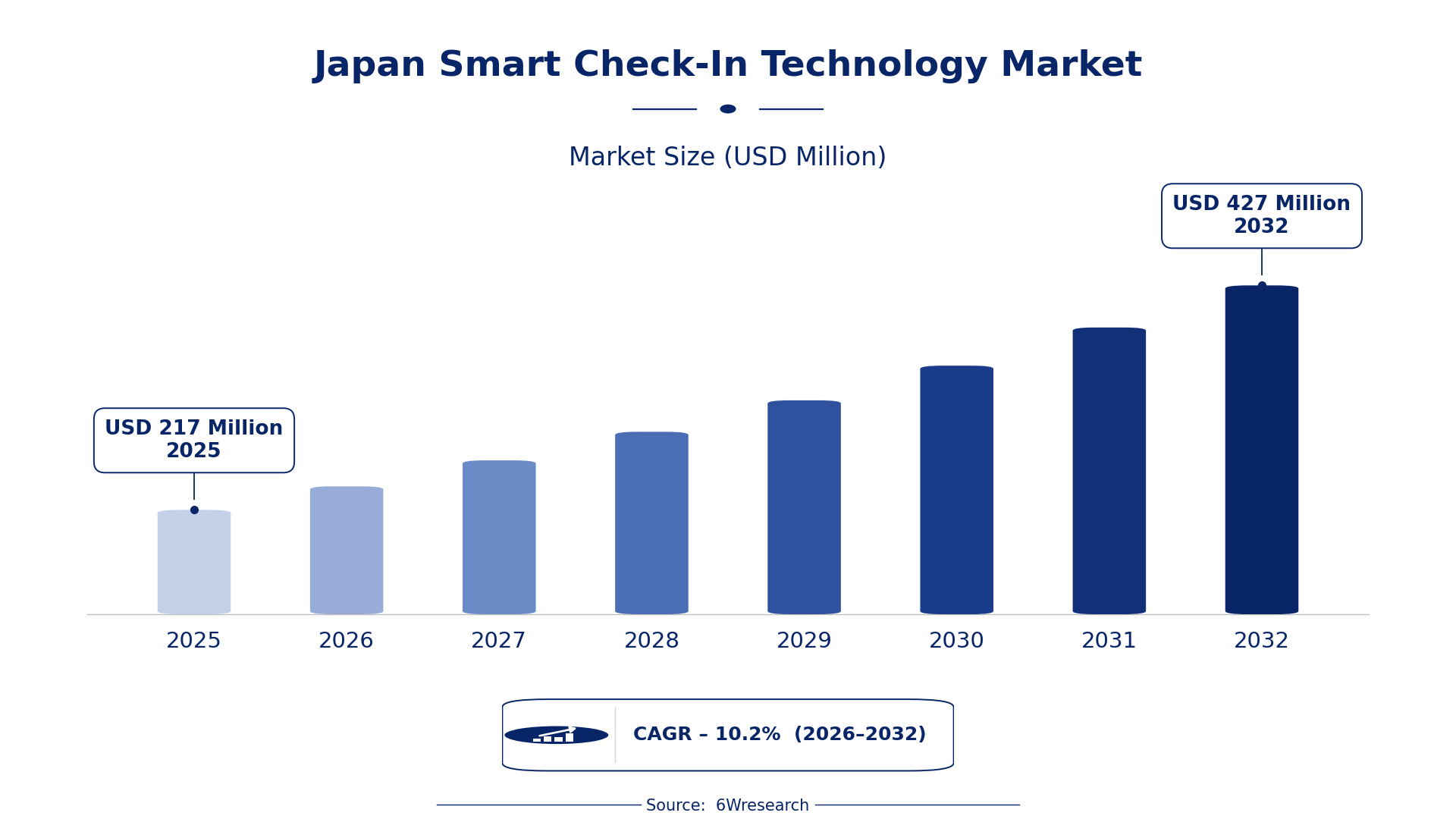
According to 6Wresearch internal database and industry insights, the Japan Smart Check-In Technology Market was valued at USD 217 Million in 2025 and is projected to reach USD 427 Million by 2032, growing at a CAGR of approximately 10.2% during 2026–2032.
Japan Smart Check-In Technology Market Highlights
| Report Metric | Details |
| Report Name | Japan Smart Check-In Technology Market (2026-2032) |
| Market Size 2025 | USD 217 Million |
| Market Size 2032 | USD 427 Million |
| Absolute Growth 2025–2032 | USD 210 Million |
| CAGR 2026–2032 | 10.2% |
| Peak Annual Growth | 11.3% in 2030 |
| Forecast Period | 2026–2032 |
| Historical Data | 2022–2025 |
| Base Year | 2025 |
| Leading Technology Type, 2025 | Facial Recognition (42% share) |
| Leading Contact Method, 2025 | Biometric Authentication (40% share) |
| Leading Industry Usage, 2025 | Airports/Hotels (43% share) |
| Leading End User, 2025 | Travel & Hospitality (41% share) |
| Fastest-Growing Technology Type | Contactless NFC Systems (14.4% CAGR) |
| Fastest-Growing Contact Method | Mobile-Based (14.9% CAGR) |
| Fastest-Growing Industry Usage | Events/Co-Working Spaces (14.2% CAGR) |
| Fastest-Growing End User | Venue Operators (13.5% CAGR) |
| Growing Sector | Events/Co-Working Spaces |
| Key End Users | Airports/Hotels, Events/Co-Working Spaces, Hospitals/Hotels, Corporate/Residential Entry |
Japan Smart Check-In Technology Market Year-wise Growth Rate and Key Drivers (2022–2032)
This graph illustrates the annual growth rates of the market from 2022 to 2032, highlighting a steady upward trajectory and projected market expansion over the forecast period.
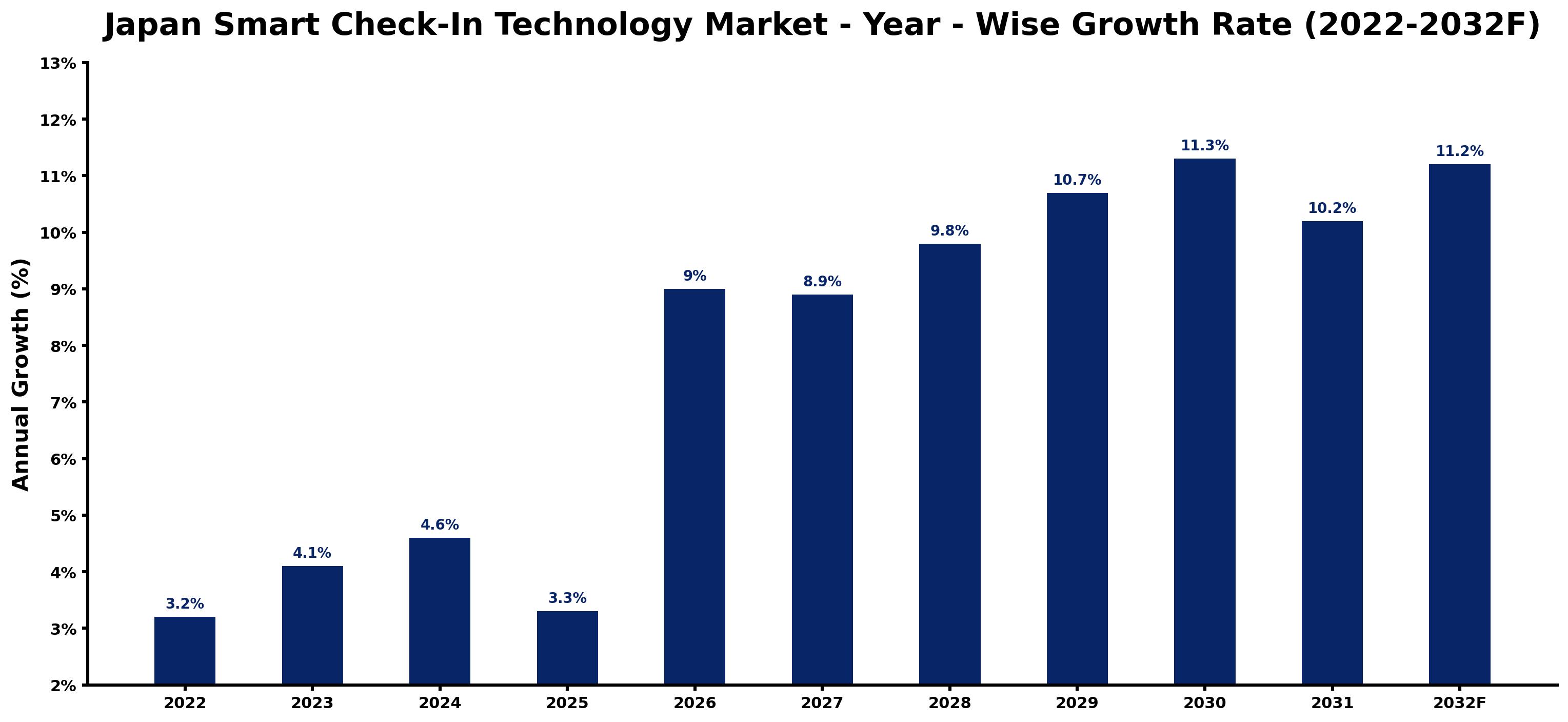
The yearly estimates that follow link every growth rate to its principal driver, so readers can see why the pace changed in each period.
| Year | Estimated Annual Growth (%) | Market Rationale |
| 2022 | 3.2 | The market experienced steady growth as demand for efficient check-in solutions increased. |
| 2023 | 4.1 | Growth accelerated due to rising international tourist arrivals and technology adoption. |
| 2024 | 4.6 | The market continued to expand as more hotels implemented smart check-in systems. |
| 2025 | 3.3 | Growth slowed as the market faced saturation in some urban areas. |
| 2026 | 9.0 | Demand is expected to surge with new airport projects integrating advanced check-in technologies. |
| 2027 | 8.9 | Growth is projected to moderate as competition intensifies among technology providers. |
| 2028 | 9.8 | The market is expected to rebound with increased investment in contactless solutions. |
| 2029 | 10.7 | Demand is projected to rise sharply as more venues adopt smart check-in technologies. |
| 2030 | 11.3 | The peak growth year will see widespread implementation of biometric systems. |
| 2031 | 10.2 | Growth is expected to decelerate slightly as the market matures and competition increases. |
| 2032 | 11.2 | Demand will remain strong as new projects continue to emerge across the sector. |
Note: Market size estimations and growth projections presented in this report are based on 6Wresearch's proprietary forecasting methodology, utilizing the latest available industry data, government publications, and primary research inputs.
Japan Smart Check-In Technology Market Synopsis
Smart Check-In Technology streamlines the check-in process using facial recognition, QR codes, and other technologies to improve customer experiences in airports, hotels, and events. The Japan Smart Check-In Technology Market is expanding due to a thriving travel industry, with over 30 million international tourists in 2023. The government's push for digital transformation in tourism, highlighted by the establishment of the 'Digital Agency' in 2021, drives demand for efficient solutions. Investments in smart technologies are set to rise significantly in the coming years as more facilities adopt these systems.
Market Dynamics Impact Analysis (2026–2032)
| Factor | Type | Impact | Primary Segment Affected |
| Increasing international tourism drives demand for efficient check-in solutions. | Driver | High | Airports/Hotels |
| The rise of contactless technology enhances user experience and safety. | Driver | High | Contactless NFC Systems |
| The growing number of international events creates a need for efficient attendee management. | Opportunity | Medium | Events/Co-Working Spaces |
| The push for smart city initiatives in urban areas presents new market potential. | Opportunity | Medium | Airports/Hotels |
| High initial investment costs may deter some smaller venues from adopting technology. | Restraint | High | Events/Co-Working Spaces |
| Limited awareness among smaller hotels about the benefits of smart check-in solutions. | Restraint | Medium | Airports/Hotels |
| Technological integration challenges can delay project timelines for venues. | Challenge | High | Events/Co-Working Spaces |
| Competition among technology providers can lead to price pressures in the market. | Challenge | Medium | Contactless NFC Systems |
Evaluation of Drivers in Japan Smart Check-In Technology Market (2026–2032)
The factors lifting demand, and the evidence behind each, are summarised below.
| Drivers | Primary Segment Affected | Why It Matters (Evidence) |
| Rising international tourist arrivals | Airports/Hotels | Japan hosted over 30 million international tourists in 2023, increasing demand for efficient check-in solutions. |
| Government initiatives promoting digital transformation | Contactless NFC Systems | The 'Digital Agency' established in 2021 supports the adoption of smart technologies in tourism. |
| Increased investment in airport infrastructure | Facial Recognition | Biometric authentication systems are being implemented in 70% of new airport projects in Japan. |
| Growing urbanisation and smart city initiatives | QR Code Check-In | The 'Smart City' initiative in Yokohama includes plans for advanced check-in technologies. |
| High demand for contactless solutions due to health concerns | Kiosk-Based Check-In | Contactless NFC systems are becoming standard in over 40% of urban hotels in Japan. |
Most of the extra volume comes from the rising international tourist arrivals, with Japan hosting over 30 million visitors in 2023, which boosts demand for efficient check-in solutions. Investment in airport infrastructure has led to biometric systems being implemented in 70% of new airport projects. Urbanisation and smart city developments create demand for advanced check-in technologies. Health concerns have driven the need for contactless solutions, with over 40% of urban hotels adopting these systems. Consequently, technology providers are responding to this increasing demand by improving their offerings.
Evaluation of Restraints in Japan Smart Check-In Technology Market
Below are the constraints most often cited by buyers and suppliers, with the segment each affects.
| Market Restraint | Primary Segment Affected | Why It Matters (Evidence) |
| Supply chain disruptions affecting technology deployment | Airports/Hotels | Delays in technology deployment can postpone system upgrades for buyers by up to six months. |
| Regulatory compliance burdens for biometric systems | Facial Recognition | Compliance with ISO/IEC 30107 for biometric authentication increases the time to market for new products. |
| Intense competition among technology providers | Contactless NFC Systems | Competition can lead to pricing pressures, impacting profit margins for suppliers. |
| Rising costs of advanced technology integration | QR Code Check-In | Integration costs can inflate prices for buyers, potentially increasing check-in fees by 15% in some urban hotels. |
| Market saturation in urban areas | Kiosk-Based Check-In | Saturation limits growth opportunities and can slow down new technology adoption. |
Japan Smart Check-In Technology Market Challenges
In 2023, Japan hosted over 30 million international tourists, intensifying competition among producers to provide efficient check-in solutions. Many distributors face supply chain disruptions, delaying technology deployment and postponing system upgrades for buyers by up to six months. Regulatory requirements, such as compliance with ISO/IEC 30107 for biometric authentication, impose additional burdens on suppliers, extending the time to market for new products. Rising costs associated with advanced technology integration can inflate prices for buyers, potentially increasing check-in fees by 15% in some urban hotels.
Trends in the Japan Smart Check-In Technology Market
The trends below show where the Japan Smart Check-In Technology Market is heading.
- Shift from Traditional to Contactless Check-In: The trend towards contactless check-in solutions is accelerating, with over 40% of urban hotels adopting contactless NFC systems. This shift improves customer convenience and safety, particularly in response to health concerns.
- Adoption of Biometric Systems in Airports: Biometric authentication is becoming standard in Japan's airports, with 70% of new projects implementing these systems. This change significantly enhances security and efficiency in passenger processing.
- Integration of Smart Technologies in Urban Hotels: The 'Smart City' initiative in Yokohama is integrating advanced check-in technologies into urban hotels, improving visitor experiences. This initiative supports the increasing need for efficient check-in processes.
- Growth of Self-Service Kiosks: Self-service kiosks are increasingly common in high-traffic areas, with over 60% of kiosks in Japanese airports featuring touchscreen interfaces. This trend reflects the demand for efficient customer interactions.
Investment Opportunities in the Japan Smart Check-In Technology Market
The following opportunities in the Japan Smart Check-In Technology Market pair current demand with a clear way in.
- Rising Demand for Contactless Solutions: With over 30 million international tourists in 2023, there is a growing need for contactless check-in solutions. Suppliers can target urban hotels seeking to improve guest experiences through technology.
- Investment in Airport Infrastructure: The Japanese government is investing in airport upgrades, creating opportunities for technology providers. By 2025, new projects will require advanced check-in technologies, offering a lucrative market for suppliers.
- Expansion of Smart City Initiatives: The 'Smart City' initiative in Yokohama presents opportunities for advanced check-in technology suppliers. With substantial investments planned, local partnerships can facilitate market entry.
- Growing Use of Biometric Authentication: As biometric systems become standard in 70% of new airport projects, technology providers can focus on developing innovative solutions. Collaborating with airport authorities can strengthen market presence.
Government Initiatives in the Japan Smart Check-In Technology Market
The Electrical Appliance and Material Safety Act (1961; METI) regulates the safety of electrical appliances and materials sold in Japan, ensuring that smart check-in technologies meet safety standards. Compliance with this act is essential for producers and importers to operate in the market effectively.
The Ministry of Health, Labour and Welfare oversees the Medical Care Act (1948), which sets standards for facilities, including those using smart check-in technologies in hospitals. This regulation ensures that facilities maintain high operational standards and safety for users.
Future Insight of the Japan Smart Check-In Technology Market
The Tokyo Metropolitan Government's programme will implement advanced airport technology by 2025, streamlining operations. By 2032, over 60% of kiosks in Japanese airports will feature touchscreen interfaces, improving user interaction. Biometric authentication will become standard in 70% of new airport projects, enhancing security measures. As contactless NFC systems gain traction in over 40% of urban hotels, suppliers must adapt to meet the evolving needs of buyers seeking efficient check-in experiences.
Market Segmentation Analysis
Japan Smart Check-In Technology Market report covers a detailed analysis of the following market segments:
By Technology Type – Facial Recognition Leads, Contactless NFC Systems Expected to Grow Fastest
According to Saurav Kr Singh, Senior Research Analyst at 6Wresearch, Facial Recognition held 42% of the Japan Smart Check-In Technology Market by technology type in 2025. Facial recognition technology holds the largest share due to its extensive application in secure identity verification, particularly in major airports and hotels across Tokyo. This technology is integral to enhancing security and streamlining the check-in process for millions of travellers. Contactless NFC Systems are set to record the highest CAGR in this split, 14.4% over 2026–2032. Contactless NFC systems are experiencing rapid growth as they enable seamless entry without physical contact, catering to the increasing demand for hygiene in public spaces. In Japan, over 40% of urban hotels are adopting these systems to improve guest experiences. Suppliers should prioritise the development of contactless solutions to meet the rising demand for hygienic check-in options.
By Contact Method – Biometric Authentication Leads, Mobile-Based Expected to Grow Fastest
With 40% of contact method revenue in 2025, Biometric Authentication was the largest category. Biometric authentication leads the market as it is widely embraced for secure access control, especially in airports and hotels. The adoption of ISO/IEC 30107 standards has solidified its position in Japan's smart check-in technology landscape. Mobile-Based is projected to grow fastest, at a CAGR of 14.9% during 2026–2032. Mobile-based check-in methods are witnessing swift growth due to their convenience and flexibility, appealing to a tech-savvy audience. This trend is supported by Japan's high smartphone penetration, facilitating easy access to mobile check-in solutions. Buyers should invest in mobile solutions to enhance customer convenience and stay competitive in the market.
By Industry Usage – Airports/Hotels Lead, Events/Co-Working Spaces Expected to Grow Fastest
Airports/Hotels accounted for 43% of the market by industry usage in 2025. Airports and hotels are the primary sectors utilising smart check-in technologies, aimed at improving operational efficiency and customer experiences. With Japan welcoming over 30 million international tourists in 2023, these sectors are under pressure to enhance their service offerings. Over 2026–2032, Events/Co-Working Spaces are expected to post the fastest growth, at a CAGR of 14.2%. Events and co-working spaces are witnessing the fastest growth as they increasingly require efficient attendee management solutions for large gatherings. The Tokyo Metropolitan Government's initiative to upgrade technology by 2025 is likely to accelerate this trend. Suppliers should tailor solutions for events and co-working spaces to capture this emerging market segment.
By End User – Travel & Hospitality Leads, Venue Operators Expected to Grow Fastest
Travel & Hospitality took 41% of end user revenue in 2025, more than any other category. The travel and hospitality sector is the largest user group for smart check-in solutions, driven by the need to enhance customer experiences and operational efficiency. The thriving tourism industry in Japan continues to invest in advanced check-in technologies to meet growing expectations. The quickest growth will come from Venue Operators, forecast to expand at a CAGR of 13.5% between 2026 and 2032. Venue operators are rapidly adopting smart check-in technology for improved event management, reflecting the increasing trend of digitisation in the events sector. This shift is evident as venues adapt to the expectations of modern attendees. Providers should create targeted offerings for venue operators to capitalise on the growing integration of technology in event management.
Key Attractiveness of the Report
- 10 Years of Market Numbers
- Historical Data Starting from 2022 to 2025
- Base Year 2025
- Forecast Data until 2032
- Key Performance Indicators Impacting the Market
- Major Upcoming Developments and Projects
Key Highlights of the Report:
- Japan Smart Check-In Technology Market Outlook
- Market Size of Japan Smart Check-In Technology Market, 2025
- Forecast of Japan Smart Check-In Technology Market, 2032
- Historical Data and Forecast of Japan Smart Check-In Technology Revenues & Volume for the Period 2022-2032F
- Japan Smart Check-In Technology Market Trend Evolution
- Japan Smart Check-In Technology Market Drivers and Challenges
- Japan Smart Check-In Technology Price Trends
- Japan Smart Check-In Technology Porter's Five Forces
- Japan Smart Check-In Technology Industry Life Cycle
- Historical Data and Forecast of Japan Smart Check-In Technology Market Revenues & Volume By Technology Type for the Period 2022-2032F
- Historical Data and Forecast of Japan Smart Check-In Technology Market Revenues & Volume By Facial Recognition for the Period 2022-2032F
- Historical Data and Forecast of Japan Smart Check-In Technology Market Revenues & Volume By QR Code Check-In for the Period 2022-2032F
- Historical Data and Forecast of Japan Smart Check-In Technology Market Revenues & Volume By Kiosk-Based Check-In for the Period 2022-2032F
- Historical Data and Forecast of Japan Smart Check-In Technology Market Revenues & Volume By Contactless NFC Systems for the Period 2022-2032F
- Historical Data and Forecast of Japan Smart Check-In Technology Market Revenues & Volume By Contact Method for the Period 2022-2032F
- Historical Data and Forecast of Japan Smart Check-In Technology Market Revenues & Volume By Biometric Authentication for the Period 2022-2032F
- Historical Data and Forecast of Japan Smart Check-In Technology Market Revenues & Volume By Mobile-Based for the Period 2022-2032F
- Historical Data and Forecast of Japan Smart Check-In Technology Market Revenues & Volume By Touchscreen Interface for the Period 2022-2032F
- Historical Data and Forecast of Japan Smart Check-In Technology Market Revenues & Volume By Tap & Go Entry for the Period 2022-2032F
- Historical Data and Forecast of Japan Smart Check-In Technology Market Revenues & Volume By Industry Usage for the Period 2022-2032F
- Historical Data and Forecast of Japan Smart Check-In Technology Market Revenues & Volume By Airports/Hotels for the Period 2022-2032F
- Historical Data and Forecast of Japan Smart Check-In Technology Market Revenues & Volume By Events/Co-Working Spaces for the Period 2022-2032F
- Historical Data and Forecast of Japan Smart Check-In Technology Market Revenues & Volume By Hospitals/Hotels for the Period 2022-2032F
- Historical Data and Forecast of Japan Smart Check-In Technology Market Revenues & Volume By Corporate/Residential Entry for the Period 2022-2032F
- Historical Data and Forecast of Japan Smart Check-In Technology Market Revenues & Volume By End User for the Period 2022-2032F
- Historical Data and Forecast of Japan Smart Check-In Technology Market Revenues & Volume By Travel & Hospitality for the Period 2022-2032F
- Historical Data and Forecast of Japan Smart Check-In Technology Market Revenues & Volume By Venue Operators for the Period 2022-2032F
- Historical Data and Forecast of Japan Smart Check-In Technology Market Revenues & Volume By Self-Service Tech Firms for the Period 2022-2032F
- Historical Data and Forecast of Japan Smart Check-In Technology Market Revenues & Volume By Access Control Providers for the Period 2022-2032F
- Japan Smart Check-In Technology Import Export Trade Statistics
- Market Opportunity Assessment By Technology Type
- Market Opportunity Assessment By Contact Method
- Market Opportunity Assessment By Industry Usage
- Market Opportunity Assessment By End User
- Japan Smart Check-In Technology Top Companies Market Share
- Japan Smart Check-In Technology Competitive Benchmarking By Technical and Operational Parameters
- Japan Smart Check-In Technology Company Profiles
- Japan Smart Check-In Technology Key Strategic Recommendations
Market Covered
This report examines the market across the segments below.
By Technology Type
- Facial Recognition
- QR Code Check-In
- Kiosk-Based Check-In
- Contactless NFC Systems
By Contact Method
- Biometric Authentication
- Mobile-Based
- Touchscreen Interface
- Tap & Go Entry
By Industry Usage
- Airports/Hotels
- Events/Co-Working Spaces
- Hospitals/Hotels
- Corporate/Residential Entry
By End User
- Travel & Hospitality
- Venue Operators
- Self-Service Tech Firms
- Access Control Providers































