Japan Smart City Imaging Market Size & Growth Rate
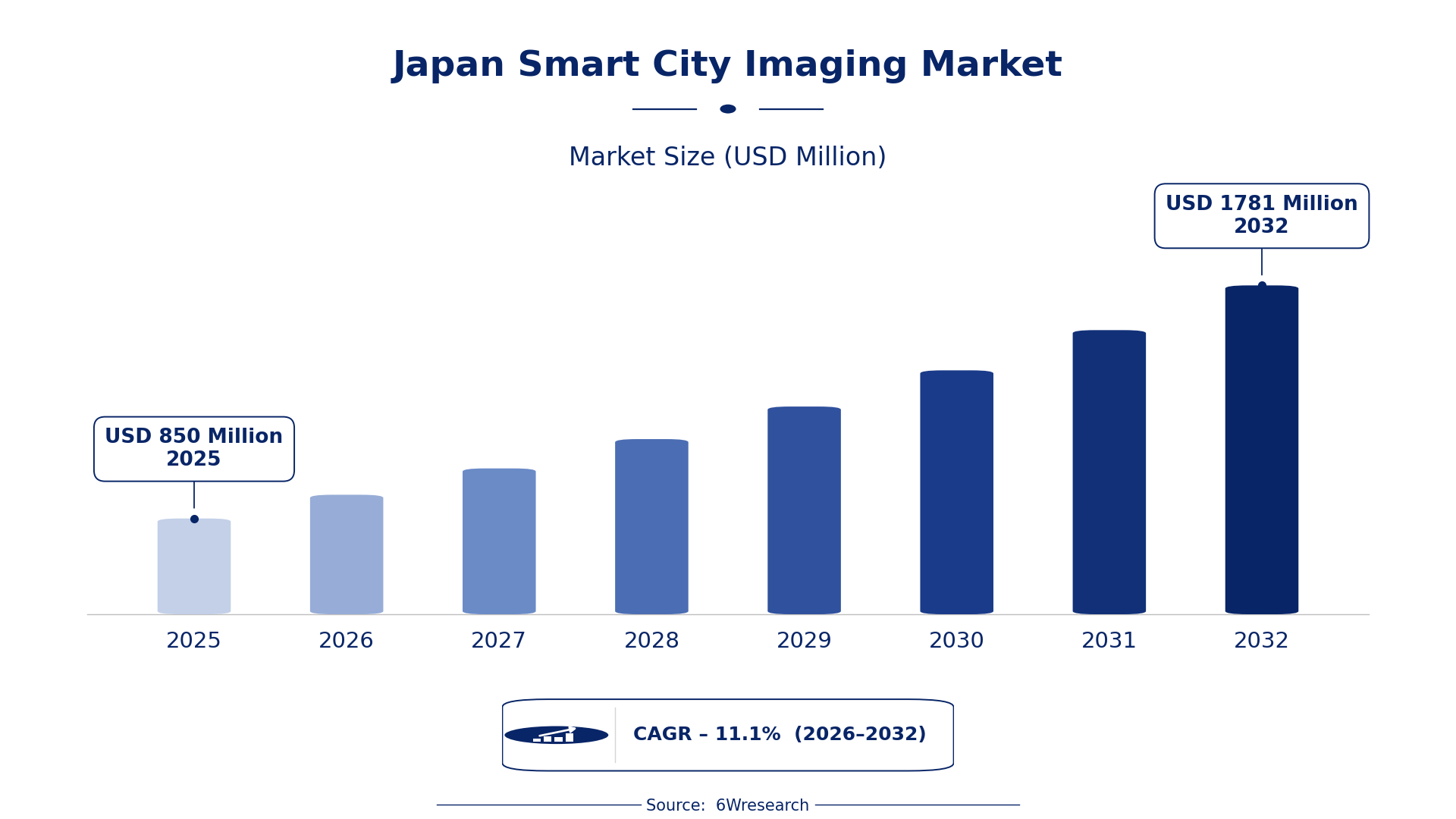
According to 6Wresearch internal database and industry insights, the Japan Smart City Imaging Market was valued at USD 850 Million in 2025 and is projected to reach USD 1,781 Million by 2032, growing at a CAGR of approximately 11.1% during 2026–2032.
Japan Smart City Imaging Market Highlights
| Report Metric | Details |
| Report Name | Japan Smart City Imaging Market (2026-2032) |
| Market Size 2025 | USD 850 Million |
| Market Size 2032 | USD 1,781 Million |
| Absolute Growth 2025–2032 | USD 931 Million |
| CAGR 2026–2032 | 11.1% |
| Peak Annual Growth | 13.1% in 2026 |
| Forecast Period | 2026–2032 |
| Historical Data | 2022–2025 |
| Base Year | 2025 |
| Leading Imaging Type, 2025 | Satellite Imaging (45% share) |
| Leading Use Case, 2025 | City-Wide Planning (45% share) |
| Leading Technology Used, 2025 | Remote Sensing (35% share) |
| Leading End User, 2025 | Urban Development Boards (40% share) |
| Fastest-Growing Imaging Type | Drone Imaging (15.0% CAGR) |
| Fastest-Growing Use Case | Traffic & Utilities (15.4% CAGR) |
| Fastest-Growing Technology Used | AI (15.8% CAGR) |
| Fastest-Growing End User | GIS/Mapping Firms (14.3% CAGR) |
| Growing Sector | Urban Planning |
| Key End Users | Urban Development Boards, Police/Municipalities, Infrastructure Agencies, GIS/Mapping Firms |
Japan Smart City Imaging Market Year-wise Growth Rate and Key Drivers (2022–2032)
This graph illustrates the annual growth rates of the market from 2022 to 2032, highlighting a steady upward trajectory and projected market expansion over the forecast period.
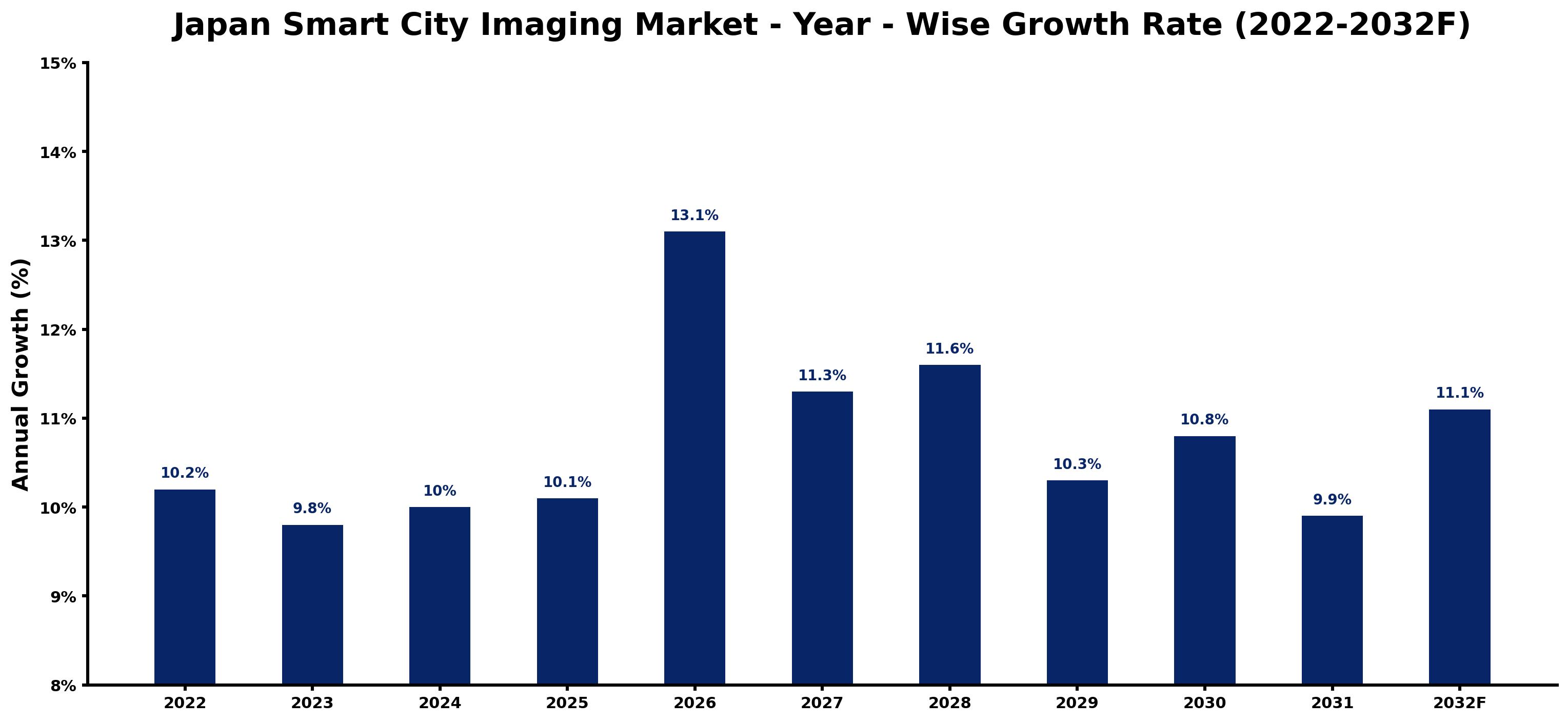
Annual growth estimates for each year appear below with the principal reason behind them, explaining the shifts that set the pace of the market.
| Year | Estimated Annual Growth (%) | Market Rationale |
| 2022 | 10.2 | The market experienced strong demand due to urban population growth and smart city initiatives. |
| 2023 | 9.8 | Growth slowed slightly as projects faced implementation challenges and resource allocation adjustments. |
| 2024 | 10.0 | Increased investments in urban planning technologies boosted growth as local governments expanded initiatives. |
| 2025 | 10.1 | Demand rose further as urban development boards initiated new smart city projects across regions. |
| 2026 | 13.1 | The peak growth year is anticipated to be driven by advancements in imaging technology and urban planning. |
| 2027 | 11.3 | Growth is projected to slow as market saturation begins to affect new project launches and funding availability. |
| 2028 | 11.6 | An increase in AI adoption for traffic management solutions will spur renewed interest in smart city imaging. |
| 2029 | 10.3 | Growth is anticipated to slow again as competition intensifies and project completions reduce new demand. |
| 2030 | 10.8 | A resurgence in infrastructure investments is expected to lead to increased demand for imaging technologies in urban planning. |
| 2031 | 9.9 | Growth will slow as the market stabilises following a period of rapid expansion and project completions. |
| 2032 | 11.1 | Demand is projected to rise again as new smart city strategies are implemented nationwide. |
Note: Market size estimations and growth projections presented in this report are based on 6Wresearch's proprietary forecasting methodology, utilizing the latest available industry data, government publications, and primary research inputs.
Japan Smart City Imaging Market Synopsis
Smart City Imaging employs advanced technologies such as satellite imagery, drones, and AI analytics to improve urban planning and management. In 2022, Japan's urban population reached approximately 92 million, driving demand for effective traffic monitoring and public safety solutions. The market is expanding due to local government initiatives, increased investments in smart city technologies, and the rising use of drone imaging in urban planning, which has surged by 30% since 2020. The Tokyo Metropolitan Government's smart city strategy launched in 2023 further underscores the commitment to urban development and infrastructure enhancement.
Market Dynamics Impact Analysis (2026–2032)
| Factor | Type | Impact | Primary Segment Affected |
| Rising urban population and smart city initiatives drive demand for advanced imaging technologies. | Driver | High | City-Wide Planning |
| Increased adoption of drone imaging technologies enhances urban planning capabilities. | Driver | High | Drone Imaging |
| Growing investments in urban development projects create opportunities for imaging technology providers. | Opportunity | High | Urban Development Boards |
| Local governments are increasingly seeking partnerships to implement smart city solutions. | Opportunity | Medium | CCTV Imaging |
| High costs associated with implementing advanced imaging technologies can limit access for smaller municipalities. | Restraint | High | CCTV Imaging |
| Competition among technology providers may lead to price wars, affecting profit margins. | Restraint | Medium | Drone Imaging |
| Limited funding for urban development projects can delay the adoption of smart city imaging solutions. | Challenge | High | Traffic & Utilities |
| Technological integration challenges may hinder the effectiveness of imaging solutions in urban planning. | Challenge | Medium | Remote Sensing |
Evaluation of Drivers in Japan Smart City Imaging Market (2026–2032)
Key forces behind demand, with the segment each one moves most, are listed below.
| Drivers | Primary Segment Affected | Why It Matters (Evidence) |
| Growing urban population necessitates advanced imaging for effective urban planning. | City-Wide Planning | In 2022, Japan's urban population reached approximately 92 million, increasing demand for smart city solutions. |
| Increased use of drone imaging provides detailed aerial views for urban planning. | Drone Imaging | The use of drone imaging in urban planning has increased by 30% since 2020, improving project accuracy. |
| Government initiatives promote smart city projects, driving technology adoption. | CCTV Imaging | The Tokyo Metropolitan Government launched a smart city strategy in 2023, boosting demand for imaging technologies. |
| Rising investments in smart city technologies support market growth. | Traffic & Utilities | The GX Basic Policy aims for approximately JPY 150 trillion in public-private decarbonisation investment over the next decade, promoting smart city initiatives. |
| Technological advancements in imaging technologies improve data collection and analysis. | Remote Sensing | Remote sensing technology is widely adopted for environmental monitoring, facilitating better urban planning. |
Orders keep climbing as the urban population in Japan reached approximately 92 million in 2022, driving demand for effective urban planning solutions. The increased use of drone imaging, which has risen by 30% since 2020, provides detailed aerial views that improve project accuracy. Investments in smart city technologies are rising, supporting the development of traffic management and public safety solutions. Advancements in remote sensing technologies facilitate better data collection and analysis, further driving demand for smart city imaging solutions.
Evaluation of Restraints in Japan Smart City Imaging Market
The key brakes on demand, and where they bite hardest, are shown below.
| Market Restraint | Primary Segment Affected | Why It Matters (Evidence) |
| High costs of advanced imaging technologies limit access for smaller municipalities. | CCTV Imaging | The total number of CCTV cameras in urban areas is estimated at over 1 million, leading to substantial investment requirements. |
| Intense competition among technology providers may lead to price wars. | Drone Imaging | As demand for drone imaging rises, providers face pressure to lower prices, impacting profitability. |
| Limited funding for urban development projects can delay technology adoption. | Traffic & Utilities | Budget constraints often hinder local governments from implementing smart city solutions effectively. |
| Technological integration challenges hinder the effectiveness of imaging solutions. | Remote Sensing | Complexities in integrating various imaging technologies can slow down project timelines and increase costs. |
| Regulatory hurdles may complicate the deployment of imaging technologies. | City-Wide Planning | Compliance with local regulations can add layers of complexity to the implementation of smart city initiatives. |
Japan Smart City Imaging Market Challenges
High demand for smart city imaging technologies leads to supply shortages, delaying project timelines for local governments. Urbanisation in Japan, with an urban population of approximately 92 million, creates competition for resources, potentially extending project durations by three months. Buyers face increased costs from compliance with standards set by JIS, which can inflate project budgets by 15%. A lack of skilled professionals in advanced imaging technologies hampers suppliers' ability to meet demand, resulting in a 20% rise in service delivery times for urban planners.
Trends in the Japan Smart City Imaging Market
Below are the shifts with the largest effect on the Japan Smart City Imaging Market.
- 30% Increase in Drone Imaging Use: The use of drone imaging in urban planning has surged by 30% since 2020, improving project accuracy and efficiency. This trend is particularly visible in Tokyo's smart city initiatives, where drones are now integral to traffic management.
- Shift Towards AI in Urban Planning: A growing shift towards AI technologies in urban planning is taking place, particularly for traffic management solutions. Local governments are increasingly adopting AI, which is anticipated to improve operational efficiency in urban areas.
- Remote Sensing Adoption Rising: Remote sensing technology is widely adopted for environmental monitoring in Japan, allowing for better data collection over large areas. This trend supports urban planning efforts and is being utilized by various infrastructure agencies.
- Integration of LiDAR Technology: LiDAR technology is becoming essential for accurate topographical mapping in urban development. Its adoption is increasing among urban development boards, providing precise data for planning.
Investment Opportunities in the Japan Smart City Imaging Market
The following areas offer the clearest openings for investors and suppliers in the Japan Smart City Imaging Market.
- Partnerships with Local Governments: Creating partnerships with local governments can facilitate the implementation of smart city solutions. Urban Development Boards are actively seeking collaborations to improve urban planning capabilities and enhance project outcomes.
- Supply of Advanced Imaging Technologies: There is a strong demand for advanced imaging technologies, particularly in urban planning. Local governments are investing in these technologies to improve traffic management and public safety, creating opportunities for suppliers.
- Focus on Infrastructure Agencies: Infrastructure agencies are increasingly looking for effective imaging solutions to support urban development. Suppliers can enter this market by providing advanced technologies that meet regulatory standards and improve project efficiency.
- Approval Pathways for New Technologies: Navigating approval pathways for new imaging technologies can create opportunities for suppliers. Engaging with the Japan Association of City Planning Engineers can facilitate compliance and market entry, enhancing project success.
Government Initiatives in the Japan Smart City Imaging Market
The Building Energy Efficiency Act, amended in 2022, mandates that new buildings comply with energy standards by April 2025. This law impacts producers by requiring adherence to energy efficiency measures, which is critical for smart city imaging technologies that monitor energy use in urban areas. The GX Basic Policy, adopted in 2023, aims for approximately JPY 150 trillion in public-private decarbonisation investment over the next decade, promoting the integration of smart technologies in urban planning.
The Ministry of Internal Affairs and Communications oversees the approval of smart city projects, funding initiatives that support urban development. This agency backs various programs aimed at enhancing urban infrastructure, which includes funding for imaging technologies that aid in traffic management and public safety monitoring.
Future Insight of the Japan Smart City Imaging Market
By 2032, a policy-driven focus on smart city initiatives will prompt local governments to enhance investments in advanced imaging technologies. The Tokyo Metropolitan Government's strategy will encourage the integration of AI for traffic management, leading to improved operational efficiency. Urban planners will increasingly utilise drone imaging for urban development, which has already seen a 30% increase since 2020. Collaboration among agencies, supported by the National Institute of Advanced Industrial Science and Technology, will streamline urban planning processes, benefiting both buyers and suppliers.
Market Segmentation Analysis
Japan Smart City Imaging Market report covers a detailed analysis of the following market segments:
By Imaging Type – Satellite Imaging Leads, Drone Imaging Expected to Grow Fastest
According to Saurav Kr Singh, Senior Research Analyst at 6Wresearch, the largest imaging type category in 2025 was Satellite Imaging, at 45% of revenue. Satellite imaging is vital for large-scale urban planning and monitoring, making it a preferred choice among urban development projects. Its extensive application in Tokyo's smart city initiatives underlines its significance in effectively managing urban environments. The quickest growth will come from Drone Imaging, forecast to expand at a CAGR of 15.0% between 2026 and 2032. The rise in drone imaging, which has increased by 30% since 2020, stems from its ability to provide detailed aerial views for specific areas. This trend indicates a growing demand for precise data collection in urban planning. Suppliers should focus on enhancing drone imaging capabilities to meet the increasing need for detailed urban analysis.
By Use Case – City-Wide Planning Leads, Traffic & Utilities Expected to Grow Fastest
City-Wide Planning took 45% of use case revenue in 2025, more than any other category. City-wide planning is crucial for comprehensive urban development strategies, addressing various aspects of urban management. This approach is particularly important in densely populated areas like Tokyo, where effective planning is essential for sustainability. Traffic & Utilities are set to record the highest CAGR in this split, 15.4% over 2026–2032. The traffic and utilities segment is experiencing rapid growth due to the pressing need for efficient management of urban traffic and utility services. Local governments are increasingly adopting solutions to optimise these operations, further driving this demand. Buyers will benefit from investing in technologies that improve traffic and utility management, thus enhancing urban efficiency.
By Technology Used – Remote Sensing Leads, AI Expected to Grow Fastest
In 2025, Remote Sensing led the technology used split with a 35% share. Remote sensing technology is widely used in Japan, enabling extensive data collection for urban analysis. This capability is especially valuable for urban development boards that require comprehensive insights for effective planning. Over 2026–2032, AI is expected to post the fastest growth, at a CAGR of 15.8%. The adoption of AI is accelerating as it enhances data processing and analysis capabilities, becoming essential for urban planning. Support from research institutions for AI applications indicates a promising future for this technology in the sector. Suppliers should prioritise AI integration in their products to address the rising demand for advanced data analysis in urban planning.
By End User – Urban Development Boards Lead, GIS/Mapping Firms Expected to Grow Fastest
Urban Development Boards held 40% of the Japan Smart City Imaging Market by end user in 2025. Urban development boards are primary users of smart city imaging technologies, playing a critical role in urban planning and development initiatives. Their involvement ensures that imaging solutions are effectively utilised for city management. GIS/Mapping Firms are projected to grow fastest, at a CAGR of 14.3% during 2026–2032. GIS/mapping firms are rapidly growing as they increasingly adopt imaging technologies for geographical data analysis. This trend highlights the rising importance of accurate mapping in urban development and planning. Suppliers must collaborate with GIS and mapping firms to capitalise on opportunities in the expanding market for geographical data analysis.
Key Attractiveness of the Report
- 10 Years of Market Numbers
- Historical Data Starting from 2022 to 2025
- Base Year 2025
- Forecast Data until 2032
- Key Performance Indicators Impacting the Market
- Major Upcoming Developments and Projects
Key Highlights of the Report:
- Japan Smart City Imaging Market Outlook
- Market Size of Japan Smart City Imaging Market, 2025
- Forecast of Japan Smart City Imaging Market, 2032
- Historical Data and Forecast of Japan Smart City Imaging Revenues & Volume for the Period 2022-2032F
- Japan Smart City Imaging Market Trend Evolution
- Japan Smart City Imaging Market Drivers and Challenges
- Japan Smart City Imaging Price Trends
- Japan Smart City Imaging Porter's Five Forces
- Japan Smart City Imaging Industry Life Cycle
- Historical Data and Forecast of Japan Smart City Imaging Market Revenues & Volume By Imaging Type for the Period 2022-2032F
- Historical Data and Forecast of Japan Smart City Imaging Market Revenues & Volume By Satellite Imaging for the Period 2022-2032F
- Historical Data and Forecast of Japan Smart City Imaging Market Revenues & Volume By Drone Imaging for the Period 2022-2032F
- Historical Data and Forecast of Japan Smart City Imaging Market Revenues & Volume By CCTV Imaging for the Period 2022-2032F
- Historical Data and Forecast of Japan Smart City Imaging Market Revenues & Volume By Aerial Mapping for the Period 2022-2032F
- Historical Data and Forecast of Japan Smart City Imaging Market Revenues & Volume By Use Case for the Period 2022-2032F
- Historical Data and Forecast of Japan Smart City Imaging Market Revenues & Volume By City-Wide Planning for the Period 2022-2032F
- Historical Data and Forecast of Japan Smart City Imaging Market Revenues & Volume By Traffic & Utilities for the Period 2022-2032F
- Historical Data and Forecast of Japan Smart City Imaging Market Revenues & Volume By Surveillance for the Period 2022-2032F
- Historical Data and Forecast of Japan Smart City Imaging Market Revenues & Volume By 3D Reconstruction for the Period 2022-2032F
- Historical Data and Forecast of Japan Smart City Imaging Market Revenues & Volume By Technology Used for the Period 2022-2032F
- Historical Data and Forecast of Japan Smart City Imaging Market Revenues & Volume By Remote Sensing, AI for the Period 2022-2032F
- Historical Data and Forecast of Japan Smart City Imaging Market Revenues & Volume By LiDAR, Thermal, RGB for the Period 2022-2032F
- Historical Data and Forecast of Japan Smart City Imaging Market Revenues & Volume By Facial Recognition for the Period 2022-2032F
- Historical Data and Forecast of Japan Smart City Imaging Market Revenues & Volume By UAV + Photogrammetry for the Period 2022-2032F
- Historical Data and Forecast of Japan Smart City Imaging Market Revenues & Volume By End User for the Period 2022-2032F
- Historical Data and Forecast of Japan Smart City Imaging Market Revenues & Volume By Urban Development Boards for the Period 2022-2032F
- Historical Data and Forecast of Japan Smart City Imaging Market Revenues & Volume By GIS/Mapping Firms for the Period 2022-2032F
- Historical Data and Forecast of Japan Smart City Imaging Market Revenues & Volume By Police/Municipalities for the Period 2022-2032F
- Historical Data and Forecast of Japan Smart City Imaging Market Revenues & Volume By Infrastructure Agencies for the Period 2022-2032F
- Japan Smart City Imaging Import Export Trade Statistics
- Market Opportunity Assessment By Imaging Type
- Market Opportunity Assessment By Use Case
- Market Opportunity Assessment By Technology Used
- Market Opportunity Assessment By End User
- Japan Smart City Imaging Top Companies Market Share
- Japan Smart City Imaging Competitive Benchmarking By Technical and Operational Parameters
- Japan Smart City Imaging Company Profiles
- Japan Smart City Imaging Key Strategic Recommendations
Market Covered
Coverage by segment is as follows.
By Imaging Type
- Satellite Imaging
- Drone Imaging
- CCTV Imaging
- Aerial Mapping
By Use Case
- City-Wide Planning
- Traffic & Utilities
- Surveillance
- 3D Reconstruction
By Technology Used
- Remote Sensing
- AI
- LiDAR
- Thermal
- RGB
- Facial Recognition
- UAV + Photogrammetry
By End User
- Urban Development Boards
- GIS/Mapping Firms
- Police/Municipalities
- Infrastructure Agencies































