Japan Smart City Infrastructure Market Size & Growth Rate
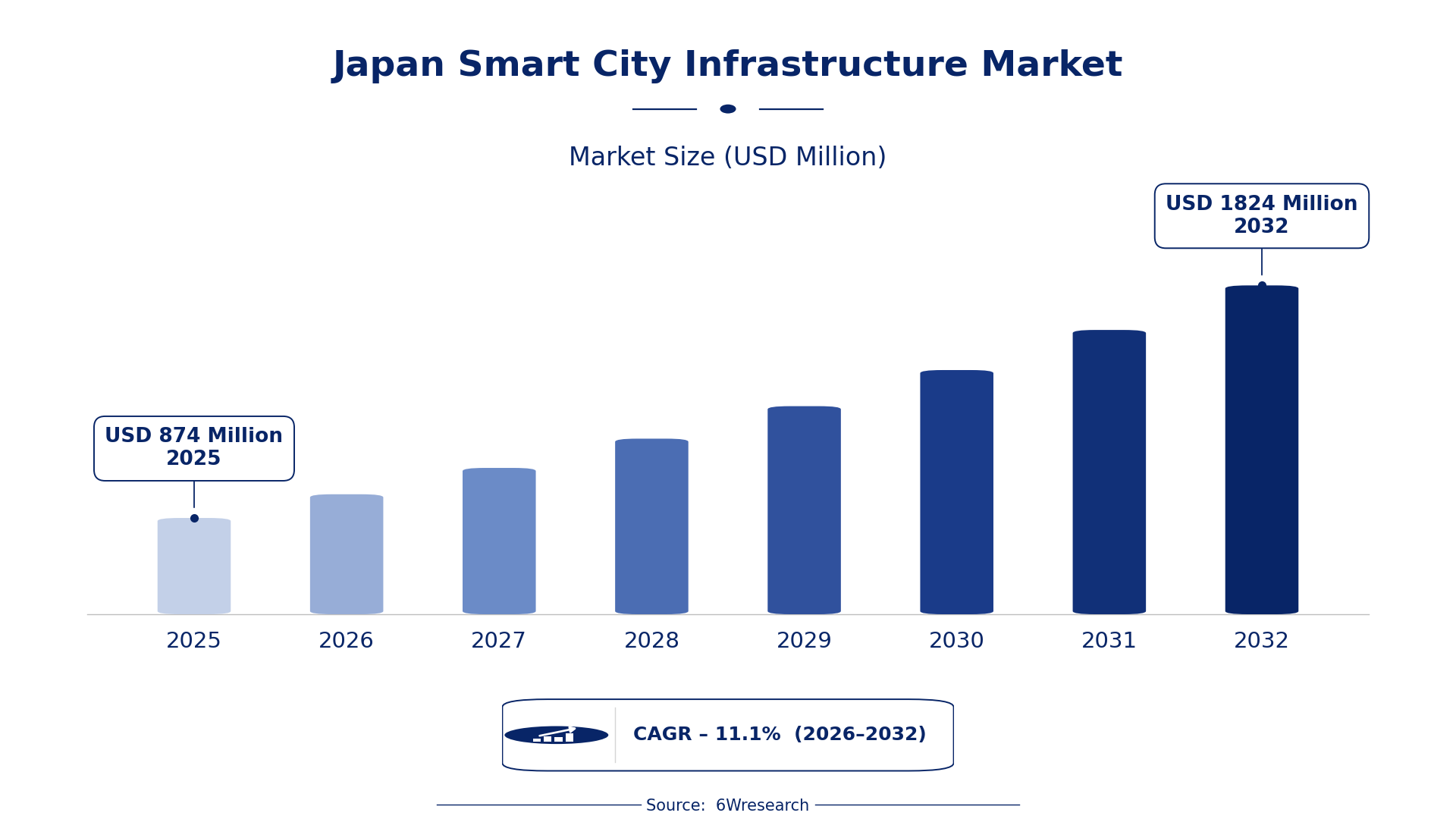
According to 6Wresearch internal database and industry insights, the Japan Smart City Infrastructure Market was valued at USD 874 Million in 2025 and is projected to reach USD 1,824 Million by 2032, growing at a CAGR of approximately 11.1% during 2026–2032.
Japan Smart City Infrastructure Market Highlights
| Report Metric | Details |
| Report Name | Japan Smart City Infrastructure Market (2026-2032) |
| Market Size 2025 | USD 874 Million |
| Market Size 2032 | USD 1,824 Million |
| Absolute Growth 2025–2032 | USD 950 Million |
| CAGR 2026–2032 | 11.1% |
| Peak Annual Growth | 11.8% in 2032 |
| Forecast Period | 2026–2032 |
| Historical Data | 2022–2025 |
| Base Year | 2025 |
| Leading Infrastructure Type, 2025 | Smart Roads (50% share) |
| Leading Smart Feature, 2025 | Sensor-Embedded Lanes (48% share) |
| Leading Technology Embedded, 2025 | Traffic & Vibration Data (38% share) |
| Leading End User, 2025 | Municipal Corporations (43% share) |
| Fastest-Growing Infrastructure Type | Smart Lighting (16.2% CAGR) |
| Fastest-Growing Smart Feature | Adaptive Brightness (14.5% CAGR) |
| Fastest-Growing Technology Embedded | Motion + AI (16.9% CAGR) |
| Fastest-Growing End User | Urban Planners (14.2% CAGR) |
| Growing Sector | Urban Planners |
| Key End Users | Municipal Corporations, Urban Planners, Utility Integrators, Transport Departments |
Japan Smart City Infrastructure Market Year-wise Growth Rate and Key Drivers (2022–2032)
This graph illustrates the annual growth rates of the market from 2022 to 2032, highlighting a steady upward trajectory and projected market expansion over the forecast period.
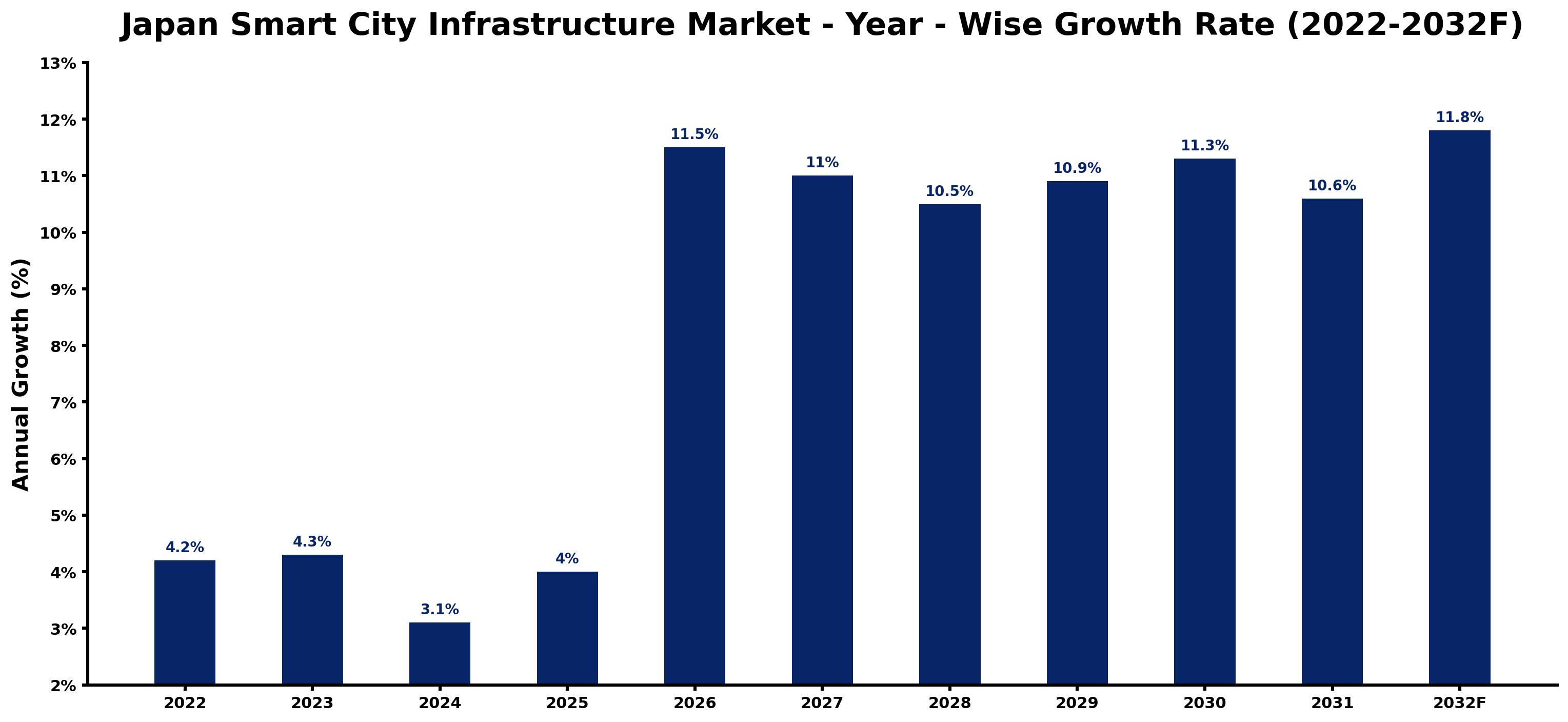
Each row of the following table gives one year's estimated growth and the event or demand shift that explains it.
| Year | Estimated Annual Growth (%) | Market Rationale |
| 2022 | 4.2 | The market experienced steady growth due to ongoing urban development initiatives. |
| 2023 | 4.3 | Growth accelerated as Tokyo implemented over 1,000 smart streetlights enhancing urban infrastructure. |
| 2024 | 3.1 | A slowdown occurred as projects faced delays in funding and implementation timelines. |
| 2025 | 4.0 | Demand increased again as municipalities focused on energy efficiency and sustainability. |
| 2026 | 11.5 | Growth surged with the launch of new AI integration initiatives in urban transport systems. |
| 2027 | 11.0 | The market continued to grow, although at a slower pace due to project completion cycles. |
| 2028 | 10.5 | Growth decelerated as the market stabilised after rapid expansions in previous years. |
| 2029 | 10.9 | Demand picked up again as urban planners sought advanced solutions for city management. |
| 2030 | 11.3 | Growth remained strong as the Tokyo Metropolitan Government aimed for significant energy reductions. |
| 2031 | 10.6 | A slight slowdown occurred as the market adjusted to new technological standards. |
| 2032 | 11.8 | The market peaked as smart city initiatives gained momentum across multiple municipalities. |
Note: Market size estimations and growth projections presented in this report are based on 6Wresearch's proprietary forecasting methodology, utilizing the latest available industry data, government publications, and primary research inputs.
Japan Smart City Infrastructure Market Synopsis
Smart City Infrastructure includes advanced technologies designed to improve urban living through IoT devices, data analytics, and sustainable practices. The market is growing due to initiatives like the Smart City Development Program, which allocates ¥10 billion annually for urban innovation projects, and the integration of AI in urban transport systems, driving demand for effective infrastructure solutions.
Market Dynamics Impact Analysis (2026–2032)
| Factor | Type | Impact | Primary Segment Affected |
| Increased investment in energy-efficient technologies | Driver | High | Smart Lighting |
| Growing urban population necessitating improved infrastructure | Driver | High | Smart Roads |
| Emerging demand for real-time traffic management solutions | Opportunity | High | Sensor-Embedded Lanes |
| Rising need for public safety enhancements | Opportunity | Medium | Smart Poles |
| High initial costs of smart infrastructure projects | Restraint | High | Smart Roads |
| Challenges in standardisation across municipalities | Restraint | Medium | Smart Lighting |
| Limited public awareness of smart city benefits | Challenge | High | Smart Poles |
| Dependence on technology providers for implementation | Challenge | Medium | Smart Roads |
Evaluation of Drivers in Japan Smart City Infrastructure Market (2026–2032)
The main growth drivers and the segments they affect most are set out below.
| Drivers | Primary Segment Affected | Why It Matters (Evidence) |
| Investment in smart lighting systems | Smart Lighting | Tokyo's implementation of over 1,000 smart streetlights enhances energy efficiency and public safety. |
| Integration of IoT for traffic management | Smart Roads | Osaka's sensor-embedded lanes provide real-time data, improving traffic flow and safety. |
| Government funding for smart city initiatives | Sensor-Embedded Lanes | The Smart City Development Program allocates ¥10 billion annually for urban innovation projects. |
| Focus on sustainability in urban planning | Smart Poles | The Tokyo Smart City Strategy aims for a 50% reduction in CO2 emissions by 2030. |
| Adoption of AI technologies in urban transport | Traffic & Vibration Data | The new initiative launched in 2023 integrates AI to enhance urban transport systems. |
What keeps demand rising is the increasing investment in smart lighting systems, as demonstrated by Tokyo's implementation of over 1,000 smart streetlights, which improves energy efficiency and public safety. The integration of IoT for traffic management is clear in Osaka's sensor-embedded lanes, providing real-time data that enhances traffic flow. A focus on sustainability in urban planning drives the Tokyo Smart City Strategy, targeting a 50% reduction in CO2 emissions by 2030.
Evaluation of Restraints in Japan Smart City Infrastructure Market
The table below lists the restraints and the evidence behind each.
| Market Restraint | Primary Segment Affected | Why It Matters (Evidence) |
| Regulatory inconsistencies delaying project approvals | Municipal Corporations | Over 200 municipalities are engaged in smart city projects, but inconsistencies hinder progress. |
| Supply chain disruptions affecting component availability | Utility Integrators | Delays in infrastructure deployment arise from shortages of essential components. |
| Integration challenges with advanced technologies | Transport Departments | Rapid technological changes lead to increased costs for municipalities implementing smart solutions. |
| Skills shortages in the workforce | Urban Planners | Projections indicate that over 100,000 jobs will be created by 2025, but training programs are insufficient. |
| Budget constraints limiting project scope | Municipal Corporations | Many initiatives face funding limitations, restricting the implementation of effective smart solutions. |
Japan Smart City Infrastructure Market Challenges
In 2023, regulatory inconsistencies affect over 200 municipalities engaged in smart city projects, delaying project approvals for urban planners. Supply chain disruptions hinder the availability of essential components, causing delays in infrastructure deployment for technology providers. Rapid technological advancements create integration challenges, leading to increased costs for municipalities as they work to implement new systems. Workforce skills shortages impede the adoption of advanced technologies, with projections indicating over 100,000 jobs will be created by 2025, yet current training programs are inadequate to meet this demand.
Trends in the Japan Smart City Infrastructure Market
The following changes are redrawing the Japan Smart City Infrastructure Market.
- Launch of Smart Streetlight Initiatives: Tokyo has implemented over 1,000 smart streetlights, improving energy efficiency and public safety. This initiative is part of a broader urban development strategy aimed at enhancing city infrastructure.
- Urban Planners Embracing AI Technologies: Urban planners are increasingly adopting AI technologies to streamline city management processes. This shift is evident in the integration of AI in urban transport systems, expected to improve traffic efficiency.
- Focus on Sustainability in Urban Development: Sustainability is becoming a priority in urban development, with initiatives targeting CO2 reductions. The Tokyo Smart City Strategy aims for a 50% reduction in emissions by 2030.
- Expansion of EV Charging Infrastructure: The installation of over 500 EV charging stations across major cities is facilitating the transition to electric vehicles. This expansion supports the growing demand for sustainable transportation options.
Investment Opportunities in the Japan Smart City Infrastructure Market
The opportunities below stand out in the Japan Smart City Infrastructure Market for new entrants and existing suppliers.
- Demand for Smart Lighting Solutions: With the increasing focus on energy efficiency, there is a strong need for smart lighting solutions. Municipal corporations are investing in these systems to improve public safety and reduce energy costs.
- Investment in AI-Driven Urban Transport Systems: The integration of AI in urban transport systems presents a significant opportunity for technology providers. Urban planners are seeking advanced solutions to improve traffic management and efficiency.
- Development of Multi-Utility Infrastructure: The trend towards multi-utility infrastructure is gaining traction, combining various services into a single framework. Municipal corporations are looking to invest in these systems for operational efficiency.
- Expansion of EV Charging Stations: The rising adoption of electric vehicles creates opportunities for expanding EV charging infrastructure. Utility integrators are focusing on developing charging solutions to meet increasing demand.
Government Initiatives in the Japan Smart City Infrastructure Market
The AI Promotion Act, established in 2025, sets a national framework for AI research and development, improving the regulatory environment for smart city technologies. This act complements existing laws like the Electrical Appliance and Material Safety Act, ensuring safety standards for electrical components used in smart infrastructures.
The Ministry of Land, Infrastructure, Transport and Tourism oversees smart city regulations and initiatives, approving funding for various projects. The Urban Renaissance Agency supports urban redevelopment projects that focus on integrating smart technologies, facilitating the implementation of innovative solutions in cities.
Future Insight of the Japan Smart City Infrastructure Market
Municipal corporations will increasingly adopt the ISO 37120 standard, which will improve performance metrics for city initiatives. By 2032, the integration of AI in urban transport systems will streamline traffic management, benefiting technology providers through enhanced operational efficiency. Annual funding of ¥10 billion for urban innovation will support the development of new solutions, benefiting buyers through improved infrastructure. With over 1,000 smart streetlights installed, the expansion of smart city infrastructure will further enhance energy efficiency and public safety.
Market Segmentation Analysis
Japan Smart City Infrastructure Market report covers a detailed analysis of the following market segments:
By Infrastructure Type – Smart Roads Lead, Smart Lighting Expected to Grow Fastest
According to Saurav Kr Singh, Senior Research Analyst at 6Wresearch, the largest infrastructure type category in 2025 was Smart Roads, at 50% of revenue. Smart Roads hold the largest share as they are crucial for enhancing traffic flow and safety through integrated technologies. For instance, Osaka's smart roads feature sensor-embedded lanes that provide real-time traffic data, making them essential for urban mobility. The quickest growth will come from Smart Lighting, forecast to expand at a CAGR of 16.2% between 2026 and 2032. Smart Lighting is experiencing rapid growth due to its emphasis on improving energy efficiency and public safety with adaptive lighting systems. The Tokyo Metropolitan Government's goal to reduce energy consumption by 30% by 2030 illustrates the increasing demand for these solutions. Suppliers should focus on developing energy-efficient technologies to meet the growing needs of urban municipalities.
By Smart Feature – Sensor-Embedded Lanes Lead, Adaptive Brightness Expected to Grow Fastest
Sensor-Embedded Lanes accounted for 48% of the market by smart feature in 2025. Sensor-Embedded Lanes dominate the market as they facilitate real-time traffic monitoring and management, which is vital for modern urban environments. Their implementation in cities like Osaka highlights their importance in optimising traffic systems and enhancing safety. Adaptive Brightness is set to record the highest CAGR in this split, 14.5% over 2026–2032. Adaptive Brightness is witnessing swift growth as it adjusts lighting based on environmental conditions, thereby improving efficiency. This feature is becoming increasingly relevant as cities strive for sustainable urban solutions. Buyers should invest in adaptive technologies to enhance urban infrastructure and achieve sustainability goals.
By Technology Embedded – Traffic & Vibration Data Leads, Motion + AI Expected to Grow Fastest
With 38% of technology embedded revenue in 2025, Traffic & Vibration Data was the largest category. Traffic & Vibration Data leads the segment by collecting essential data for urban planning and traffic management, which is critical for smart city projects. This data-driven approach is fundamental for municipalities aiming to optimise urban mobility. Over 2026–2032, Motion + AI is expected to post the fastest growth, at a CAGR of 16.9%. Motion + AI is gaining momentum as it improves traffic systems with predictive analytics, facilitating better management solutions. The integration of advanced technologies in urban transport systems is a key factor driving this growth. Suppliers must focus on advancing data analytics and technology to remain competitive in the market.
By End User – Municipal Corporations Lead, Urban Planners Expected to Grow Fastest
Municipal Corporations took 43% of end user revenue in 2025, more than any other category. Municipal Corporations are the primary users of smart city solutions, focusing on urban management and infrastructure development. Their active involvement in over 200 municipalities underscores their vital role in advancing smart city initiatives. Urban Planners are projected to grow fastest, at a CAGR of 14.2% during 2026–2032. Urban Planners are experiencing the fastest growth as they increasingly utilise smart infrastructure for effective city planning. Their role is critical in shaping future urban environments, reflecting the demand for integrated solutions. Suppliers should tailor their offerings to meet the specific needs of urban planners to capture this expanding market.
Key Attractiveness of the Report
- 10 Years of Market Numbers
- Historical Data Starting from 2022 to 2025
- Base Year 2025
- Forecast Data until 2032
- Key Performance Indicators Impacting the Market
- Major Upcoming Developments and Projects
Key Highlights of the Report:
- Japan Smart City Infrastructure Market Outlook
- Market Size of Japan Smart City Infrastructure Market, 2025
- Forecast of Japan Smart City Infrastructure Market, 2032
- Historical Data and Forecast of Japan Smart City Infrastructure Revenues & Volume for the Period 2022-2032F
- Japan Smart City Infrastructure Market Trend Evolution
- Japan Smart City Infrastructure Market Drivers and Challenges
- Japan Smart City Infrastructure Price Trends
- Japan Smart City Infrastructure Porter's Five Forces
- Japan Smart City Infrastructure Industry Life Cycle
- Historical Data and Forecast of Japan Smart City Infrastructure Market Revenues & Volume By Infrastructure Type for the Period 2022-2032F
- Historical Data and Forecast of Japan Smart City Infrastructure Market Revenues & Volume By Smart Roads for the Period 2022-2032F
- Historical Data and Forecast of Japan Smart City Infrastructure Market Revenues & Volume By Smart Lighting for the Period 2022-2032F
- Historical Data and Forecast of Japan Smart City Infrastructure Market Revenues & Volume By Smart Poles for the Period 2022-2032F
- Historical Data and Forecast of Japan Smart City Infrastructure Market Revenues & Volume By Digital Signage for the Period 2022-2032F
- Historical Data and Forecast of Japan Smart City Infrastructure Market Revenues & Volume By Smart Feature for the Period 2022-2032F
- Historical Data and Forecast of Japan Smart City Infrastructure Market Revenues & Volume By Sensor-Embedded Lanes for the Period 2022-2032F
- Historical Data and Forecast of Japan Smart City Infrastructure Market Revenues & Volume By Adaptive Brightness for the Period 2022-2032F
- Historical Data and Forecast of Japan Smart City Infrastructure Market Revenues & Volume By Multi-Utility for the Period 2022-2032F
- Historical Data and Forecast of Japan Smart City Infrastructure Market Revenues & Volume By Info Display for the Period 2022-2032F
- Historical Data and Forecast of Japan Smart City Infrastructure Market Revenues & Volume By Technology Embedded for the Period 2022-2032F
- Historical Data and Forecast of Japan Smart City Infrastructure Market Revenues & Volume By Traffic & Vibration Data for the Period 2022-2032F
- Historical Data and Forecast of Japan Smart City Infrastructure Market Revenues & Volume By Motion + AI for the Period 2022-2032F
- Historical Data and Forecast of Japan Smart City Infrastructure Market Revenues & Volume By Wi-Fi, EV Charging, CCTV for the Period 2022-2032F
- Historical Data and Forecast of Japan Smart City Infrastructure Market Revenues & Volume By Cloud Content Control for the Period 2022-2032F
- Historical Data and Forecast of Japan Smart City Infrastructure Market Revenues & Volume By End User for the Period 2022-2032F
- Historical Data and Forecast of Japan Smart City Infrastructure Market Revenues & Volume By Municipal Corporations for the Period 2022-2032F
- Historical Data and Forecast of Japan Smart City Infrastructure Market Revenues & Volume By Urban Planners for the Period 2022-2032F
- Historical Data and Forecast of Japan Smart City Infrastructure Market Revenues & Volume By Utility Integrators for the Period 2022-2032F
- Historical Data and Forecast of Japan Smart City Infrastructure Market Revenues & Volume By Transport Departments for the Period 2022-2032F
- Japan Smart City Infrastructure Import Export Trade Statistics
- Market Opportunity Assessment By Infrastructure Type
- Market Opportunity Assessment By Smart Feature
- Market Opportunity Assessment By Technology Embedded
- Market Opportunity Assessment By End User
- Japan Smart City Infrastructure Top Companies Market Share
- Japan Smart City Infrastructure Competitive Benchmarking By Technical and Operational Parameters
- Japan Smart City Infrastructure Company Profiles
- Japan Smart City Infrastructure Key Strategic Recommendations
Market Covered
Segments analysed in this report are listed below.
By Infrastructure Type
- Smart Roads
- Smart Lighting
- Smart Poles
- Digital Signage
By Smart Feature
- Sensor-Embedded Lanes
- Adaptive Brightness
- Multi-Utility
- Info Display
By Technology Embedded
- Traffic & Vibration Data
- Motion + AI
- Wi-Fi
- EV Charging
- CCTV
- Cloud Content Control
By End User
- Municipal Corporations
- Urban Planners
- Utility Integrators
- Transport Departments































