Japan Smart Climate Management Solutions Market Size & Growth Rate
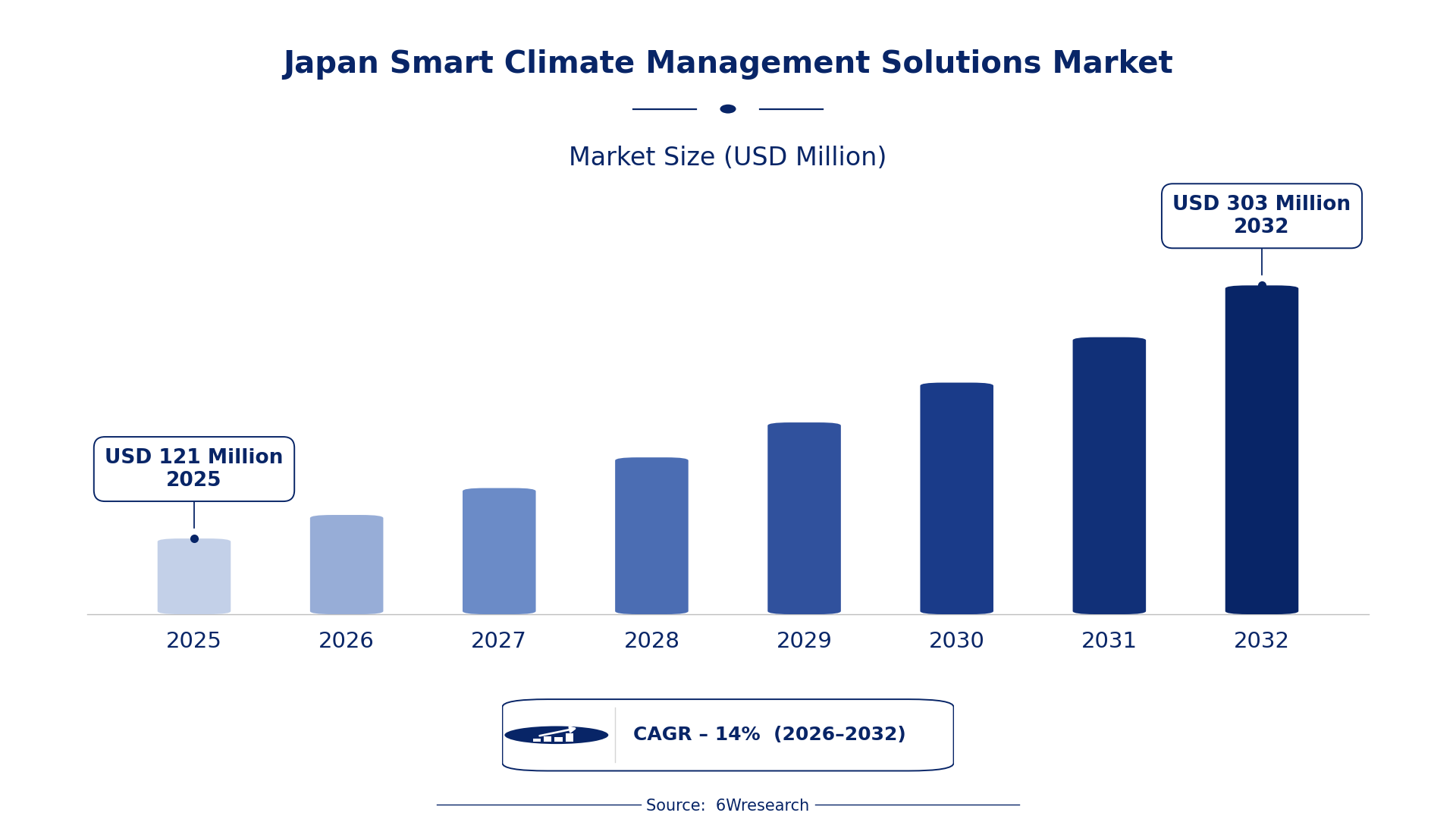
According to 6Wresearch internal database and industry insights, the Japan Smart Climate Management Solutions Market was valued at USD 121 Million in 2025 and is projected to reach USD 303 Million by 2032, growing at a CAGR of approximately 14% during 2026–2032.
Japan Smart Climate Management Solutions Market Highlights
| Report Metric | Details |
| Report Name | Japan Smart Climate Management Solutions Market (2026-2032) |
| Market Size 2025 | USD 121 Million |
| Market Size 2032 | USD 303 Million |
| Absolute Growth 2025–2032 | USD 182 Million |
| CAGR 2026–2032 | 14% |
| Peak Annual Growth | 15.0% in 2028 |
| Forecast Period | 2026–2032 |
| Historical Data | 2022–2025 |
| Base Year | 2025 |
| Leading Solution Type, 2025 | Smart Thermostats (47% share) |
| Leading Sensing Parameter, 2025 | Temperature/Humidity (41% share) |
| Leading Deployment Site, 2025 | Residential/Office Buildings (44% share) |
| Leading End User, 2025 | HVAC Integrators (35% share) |
| Fastest-Growing Solution Type | Climate Dashboards (20.3% CAGR) |
| Fastest-Growing Sensing Parameter | Energy Optimization (19.2% CAGR) |
| Fastest-Growing Deployment Site | Industrial Plants (19.0% CAGR) |
| Fastest-Growing End User | Green Building Consultants (18.7% CAGR) |
| Growing Sector | Energy Optimization |
| Key End Users | HVAC Integrators, Facility Managers, Green Building Consultants |
Japan Smart Climate Management Solutions Market Year-wise Growth Rate and Key Drivers (2022–2032)
This graph illustrates the annual growth rates of the market from 2022 to 2032, highlighting a steady upward trajectory and projected market expansion over the forecast period.
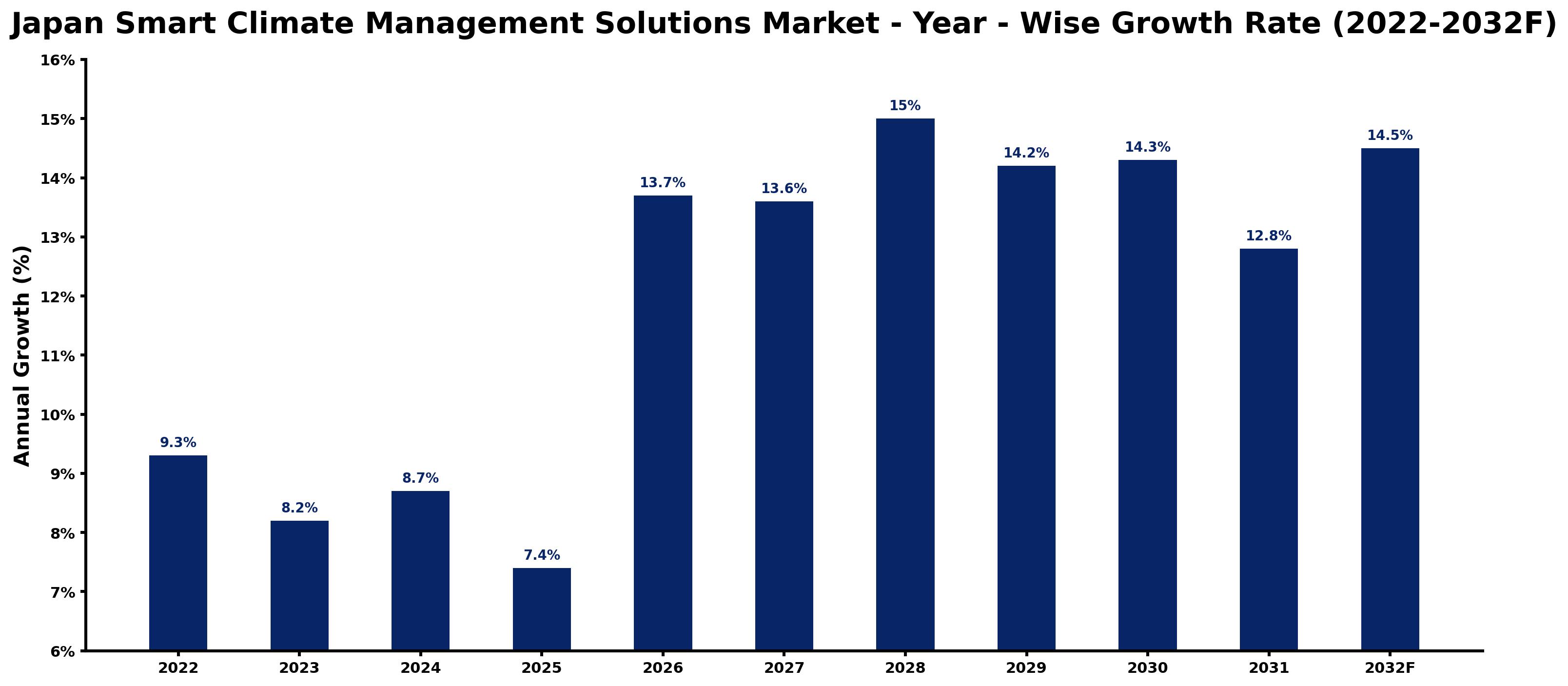
The following figures match every annual growth estimate with the main market development of that year, giving the reasoning behind each rise or slowdown.
| Year | Estimated Annual Growth (%) | Market Rationale |
| 2022 | 9.3 | The market showed strong demand due to energy conservation efforts in buildings. |
| 2023 | 8.2 | Growth slowed as the market adjusted to new energy efficiency standards. |
| 2024 | 8.7 | Increased adoption of smart thermostats boosted market performance. |
| 2025 | 7.4 | Demand continued to rise, but at a slower pace as competition intensified. |
| 2026 | 13.7 | Growth is expected to accelerate with new projects focusing on energy optimization technologies. |
| 2027 | 13.6 | A slight slowdown is projected as the market stabilises after rapid expansion. |
| 2028 | 15.0 | Peak growth will be driven by investments in smart climate solutions. |
| 2029 | 14.2 | A slowdown is expected as saturation begins in urban areas. |
| 2030 | 14.3 | Growth will rebound with renewed focus on energy efficiency in commercial buildings. |
| 2031 | 12.8 | The market will grow at a slower rate as competition increases among providers. |
| 2032 | 14.5 | Demand is projected to surge again with advancements in smart climate technologies. |
Note: Market size estimations and growth projections presented in this report are based on 6Wresearch's proprietary forecasting methodology, utilizing the latest available industry data, government publications, and primary research inputs.
Japan Smart Climate Management Solutions Market Synopsis
Smart Climate Management Solutions optimise energy use and improve indoor conditions through advanced software and hardware integration, primarily in energy efficiency for buildings. The Japan Smart Climate Management Solutions Market is expanding due to a growing focus on energy conservation, particularly in the Tokyo metropolitan area, where the government launched the 'Cool Japan' initiative in 2023. This initiative promotes energy-efficient technologies, driving demand from both residential and commercial sectors, with the HVAC market valued at around 2 trillion yen.
Market Dynamics Impact Analysis (2026–2032)
| Factor | Type | Impact | Primary Segment Affected |
| Growing focus on energy efficiency in buildings | Driver | High | Energy Optimization |
| Increased integration of smart thermostats in new developments | Driver | High | Smart Thermostats |
| Rising demand for energy-efficient solutions | Opportunity | High | Commercial Complexes |
| Significant government funding for energy projects | Opportunity | High | Green Buildings |
| High competition among providers leading to price pressures | Restraint | Medium | Smart Thermostats |
| Regulatory compliance costs for energy standards | Restraint | Medium | Energy Optimization |
| Talent shortages in skilled installation and maintenance | Challenge | High | HVAC Integrators |
| Rapid technological changes requiring constant adaptation | Challenge | Medium | Climate Dashboards |
Evaluation of Drivers in Japan Smart Climate Management Solutions Market (2026–2032)
The table below links each growth driver to the segment it affects and the evidence for it.
| Drivers | Primary Segment Affected | Why It Matters (Evidence) |
| Increased energy efficiency initiatives | Energy Optimization | Japan's population focus on energy efficiency drives demand for solutions, with the HVAC market valued at around 2 trillion yen. |
| Integration of smart thermostats in residential developments | Smart Thermostats | Smart thermostats are widely adopted in new residential projects, driving energy savings and control. |
| Growing urbanisation in the Tokyo metropolitan area | Commercial Complexes | The Tokyo area is a major hub for smart climate solutions, boosting demand for energy management technologies. |
| Government initiatives promoting energy-efficient technologies | Green Buildings | The 'Cool Japan' initiative launched in 2023 encourages the adoption of smart climate management solutions. |
| Rising awareness of environmental impact | Climate Dashboards | Increased focus on sustainability drives demand for real-time monitoring solutions in various sectors. |
The HVAC market, valued at around 2 trillion yen, reflects a strong demand for smart climate solutions. Urbanisation in major cities is boosting demand for energy management technologies, while facility managers increasingly adopt these solutions to improve operational efficiency.
Evaluation of Restraints in Japan Smart Climate Management Solutions Market
Several factors work against faster growth; the main ones are summarised below.
| Market Restraint | Primary Segment Affected | Why It Matters (Evidence) |
| High competition causing price pressures | Smart Thermostats | Intense competition among providers has resulted in reduced profit margins for suppliers. |
| Regulatory compliance costs for energy standards | Energy Optimization | Meeting Japan's energy conservation laws incurs additional costs for producers and buyers. |
| Limited availability of skilled technicians for installation | HVAC Integrators | A shortage of qualified professionals affects the timely installation of smart solutions. |
| Rapid technological changes requiring constant adaptation | Climate Dashboards | Suppliers face challenges in keeping up with evolving technologies, impacting their market position. |
| Market saturation in urban areas | Commercial Complexes | As the market matures, growth opportunities diminish in already saturated regions. |
Japan Smart Climate Management Solutions Market Challenges
Smart climate solutions in the Tokyo metropolitan area face fierce competition, leading to price wars that erode profit margins for suppliers. Supply chain disruptions, exacerbated by recent global events, delay project timelines for contractors, with some projects experiencing delays of up to six months. Regulatory compliance with Japan's energy conservation laws demands significant investment from producers, costing around 500 million yen to implement necessary upgrades. Skills shortages in advanced technology hinder adoption rates, forcing hospitals to rely on outdated systems, which can increase operational costs by 15%.
Trends in the Japan Smart Climate Management Solutions Market
Buyers and suppliers in the Japan Smart Climate Management Solutions Market are adjusting to the following trends.
- Shift from Traditional to Smart Climate Solutions: Since 2023, the adoption of smart climate management technologies has accelerated, particularly in the Tokyo metropolitan area, where energy efficiency is a priority. This shift is reflected in the growing integration of smart thermostats and climate dashboards into new buildings, improving energy control.
- Emergence of Energy Optimization Technologies: In 2023, energy optimization solutions gained traction, driven by the government's focus on sustainable practices. The Tokyo 2020 Olympics showcased advanced climate management technologies, highlighting their importance in energy conservation efforts, with many venues implementing these solutions.
- Increased Integration of IoT in Climate Management: Beginning in 2023, IoT devices have become integral to smart climate management solutions, enabling real-time monitoring and control. This trend is particularly prominent in residential and commercial buildings across Japan, improving operational efficiency.
- Growing Demand for Green Building Certifications: In 2023, the push for green building certifications has intensified, with urban areas leading the way. The Japan Green Building Council promotes sustainable practices, driving demand for compliant smart climate solutions, especially in new developments.
Investment Opportunities in the Japan Smart Climate Management Solutions Market
The opportunities below stand out in the Japan Smart Climate Management Solutions Market for new entrants and existing suppliers.
- 10 billion yen allocated for energy efficiency projects: With 10 billion yen allocated in 2023, there is an opportunity to supply energy-efficient technologies to government-funded projects, particularly in urban areas focusing on sustainability.
- Partnerships with local HVAC integrators: Now is the time to establish partnerships with HVAC integrators, who are key users of smart climate solutions, to expand market presence and reach new customers.
- Supply of advanced smart thermostats: Given the increasing integration of smart thermostats in residential developments, suppliers can capitalise on this trend by providing innovative products to meet rising demand.
- Focus on commercial complexes: With a significant portion of the HVAC market dedicated to smart solutions, targeting commercial complexes for energy management technologies presents a promising opportunity.
Government Initiatives in the Japan Smart Climate Management Solutions Market
The Building Energy Efficiency Act, amended in 2022, mandates that all new buildings meet stringent energy standards by April 2025. This legislation compels producers to invest in compliant technologies, ensuring that buyers benefit from improved energy efficiency and reduced operational costs.
In 2023, 10 billion yen was allocated for energy efficiency projects, administered by the Ministry of the Environment. This funding supports the implementation of energy-saving technologies, enabling buyers to access advanced solutions that comply with national standards.
Future Insight of the Japan Smart Climate Management Solutions Market
The emergence of smart city initiatives in urban areas will reshape the market by 2032, driving demand for advanced climate management technologies. Government funding of 10 billion yen for energy efficiency projects will catalyse innovation in smart solutions. Increased adoption of IoT devices will enhance energy optimisation, benefiting suppliers and buyers alike. Stricter energy efficiency targets set by the Tokyo Metropolitan Government will compel stakeholders to embrace sustainable practices in construction.
Market Segmentation Analysis
Japan Smart Climate Management Solutions Market report covers a detailed analysis of the following market segments:
By Solution Type – Smart Thermostats Lead, Climate Dashboards Expected to Grow Fastest
According to Saurav Kr Singh, Senior Research Analyst at 6Wresearch, the largest solution type category in 2025 was Smart Thermostats, at 47% of revenue. Smart thermostats dominate the market as they are widely adopted in residential developments, providing essential temperature control and energy savings. Their popularity is supported by government initiatives promoting energy-efficient technologies. The quickest growth will come from Climate Dashboards, forecast to expand at a CAGR of 20.3% between 2026 and 2032. Climate dashboards are experiencing rapid growth due to their ability to deliver real-time monitoring, which is crucial for effective energy management. The government's financial backing for energy efficiency projects is significantly driving this segment's expansion. Suppliers should prioritise developing advanced features in climate dashboards to align with the growing market demand.
By Sensing Parameter – Temperature/Humidity Leads, Energy Optimization Expected to Grow Fastest
With 41% of sensing parameter revenue in 2025, Temperature/Humidity was the largest category. Temperature and humidity sensing parameters hold the largest share as they are critical for effective climate control in residential and commercial buildings. Their importance is underscored by the strict energy efficiency targets set by the Tokyo Metropolitan Government. Energy Optimization is set to record the highest CAGR in this split, 19.2% over 2026–2032. Energy optimization is the fastest-growing segment, driven by the urgent need to reduce energy consumption across various sectors. The government's allocation of 10 billion yen for energy efficiency projects is a key factor boosting this growth. Buyers will benefit from investing in energy optimization technologies to align with regulatory requirements and reduce costs.
By Deployment Site – Residential/Office Buildings Lead, Industrial Plants Expected to Grow Fastest
Residential/Office Buildings accounted for 44% of the market by deployment site in 2025. Residential and office buildings serve as the primary deployment sites for smart climate management solutions, highlighting the strong demand for energy-efficient technologies in urban areas. The trend is reinforced by the increasing integration of smart solutions in new residential projects. Industrial Plants are projected to grow fastest, at a CAGR of 19.0% during 2026–2032. Industrial plants are the fastest-growing deployment site as companies seek to enhance operational efficiency and lower costs through advanced climate management technologies. The focus on energy efficiency in industrial operations is propelling this segment's growth. Suppliers should concentrate on industrial plants to capitalise on the rising interest in energy-efficient solutions.
By End User – HVAC Integrators Lead, Green Building Consultants Expected to Grow Fastest
HVAC Integrators took 35% of end user revenue in 2025, more than any other category. HVAC integrators lead the end user segment, playing a vital role in the installation and maintenance of smart climate solutions across various environments. Their expertise is crucial for ensuring compliance with energy efficiency regulations. Over 2026–2032, Green Building Consultants are expected to post the fastest growth, at a CAGR of 18.7%. Green building consultants are the fastest-growing end users, as they provide essential advice on implementing smart climate technologies in new construction projects. The increasing demand for green building certifications is accelerating their adoption of these solutions. Suppliers should engage with green building consultants to strengthen their market presence and influence.
Key Attractiveness of the Report
- 10 Years of Market Numbers
- Historical Data Starting from 2022 to 2025
- Base Year 2025
- Forecast Data until 2032
- Key Performance Indicators Impacting the Market
- Major Upcoming Developments and Projects
Key Highlights of the Report:
- Japan Smart Climate Management Solutions Market Outlook
- Market Size of Japan Smart Climate Management Solutions Market, 2025
- Forecast of Japan Smart Climate Management Solutions Market, 2032
- Historical Data and Forecast of Japan Smart Climate Management Solutions Revenues & Volume for the Period 2022-2032F
- Japan Smart Climate Management Solutions Market Trend Evolution
- Japan Smart Climate Management Solutions Market Drivers and Challenges
- Japan Smart Climate Management Solutions Price Trends
- Japan Smart Climate Management Solutions Porter's Five Forces
- Japan Smart Climate Management Solutions Industry Life Cycle
- Historical Data and Forecast of Japan Smart Climate Management Solutions Market Revenues & Volume By Solution Type for the Period 2022-2032F
- Historical Data and Forecast of Japan Smart Climate Management Solutions Market Revenues & Volume By Smart Thermostats for the Period 2022-2032F
- Historical Data and Forecast of Japan Smart Climate Management Solutions Market Revenues & Volume By Climate Dashboards for the Period 2022-2032F
- Historical Data and Forecast of Japan Smart Climate Management Solutions Market Revenues & Volume By Airflow Automation for the Period 2022-2032F
- Historical Data and Forecast of Japan Smart Climate Management Solutions Market Revenues & Volume By Smart Window Systems for the Period 2022-2032F
- Historical Data and Forecast of Japan Smart Climate Management Solutions Market Revenues & Volume By Sensing Parameter for the Period 2022-2032F
- Historical Data and Forecast of Japan Smart Climate Management Solutions Market Revenues & Volume By Temperature/Humidity for the Period 2022-2032F
- Historical Data and Forecast of Japan Smart Climate Management Solutions Market Revenues & Volume By Energy Optimization for the Period 2022-2032F
- Historical Data and Forecast of Japan Smart Climate Management Solutions Market Revenues & Volume By Ventilation Control for the Period 2022-2032F
- Historical Data and Forecast of Japan Smart Climate Management Solutions Market Revenues & Volume By Solar Load Tracking for the Period 2022-2032F
- Historical Data and Forecast of Japan Smart Climate Management Solutions Market Revenues & Volume By Deployment Site for the Period 2022-2032F
- Historical Data and Forecast of Japan Smart Climate Management Solutions Market Revenues & Volume By Residential/Office Buildings for the Period 2022-2032F
- Historical Data and Forecast of Japan Smart Climate Management Solutions Market Revenues & Volume By Industrial Plants for the Period 2022-2032F
- Historical Data and Forecast of Japan Smart Climate Management Solutions Market Revenues & Volume By Commercial Complexes for the Period 2022-2032F
- Historical Data and Forecast of Japan Smart Climate Management Solutions Market Revenues & Volume By Green Buildings for the Period 2022-2032F
- Historical Data and Forecast of Japan Smart Climate Management Solutions Market Revenues & Volume By End User for the Period 2022-2032F
- Historical Data and Forecast of Japan Smart Climate Management Solutions Market Revenues & Volume By HVAC Integrators for the Period 2022-2032F
- Historical Data and Forecast of Japan Smart Climate Management Solutions Market Revenues & Volume By Green Building Consultants for the Period 2022-2032F
- Historical Data and Forecast of Japan Smart Climate Management Solutions Market Revenues & Volume By Facility Managers for the Period 2022-2032F
- Historical Data and Forecast of Japan Smart Climate Management Solutions Market Revenues & Volume By Smart Infra Providers for the Period 2022-2032F
- Japan Smart Climate Management Solutions Import Export Trade Statistics
- Market Opportunity Assessment By Solution Type
- Market Opportunity Assessment By Sensing Parameter
- Market Opportunity Assessment By Deployment Site
- Market Opportunity Assessment By End User
- Japan Smart Climate Management Solutions Top Companies Market Share
- Japan Smart Climate Management Solutions Competitive Benchmarking By Technical and Operational Parameters
- Japan Smart Climate Management Solutions Company Profiles
- Japan Smart Climate Management Solutions Key Strategic Recommendations
Market Covered
Segments analysed in this report are listed below.
By Solution Type
- Smart Thermostats
- Climate Dashboards
- Airflow Automation
- Smart Window Systems
By Sensing Parameter
- Temperature/Humidity
- Energy Optimization
- Ventilation Control
- Solar Load Tracking
By Deployment Site
- Residential/Office Buildings
- Industrial Plants
- Commercial Complexes
- Green Buildings
By End User
- HVAC Integrators
- Green Building Consultants
- Facility Managers
- Smart Infra Providers































