Japan Smart Commuter Solutions Market Size & Growth Rate
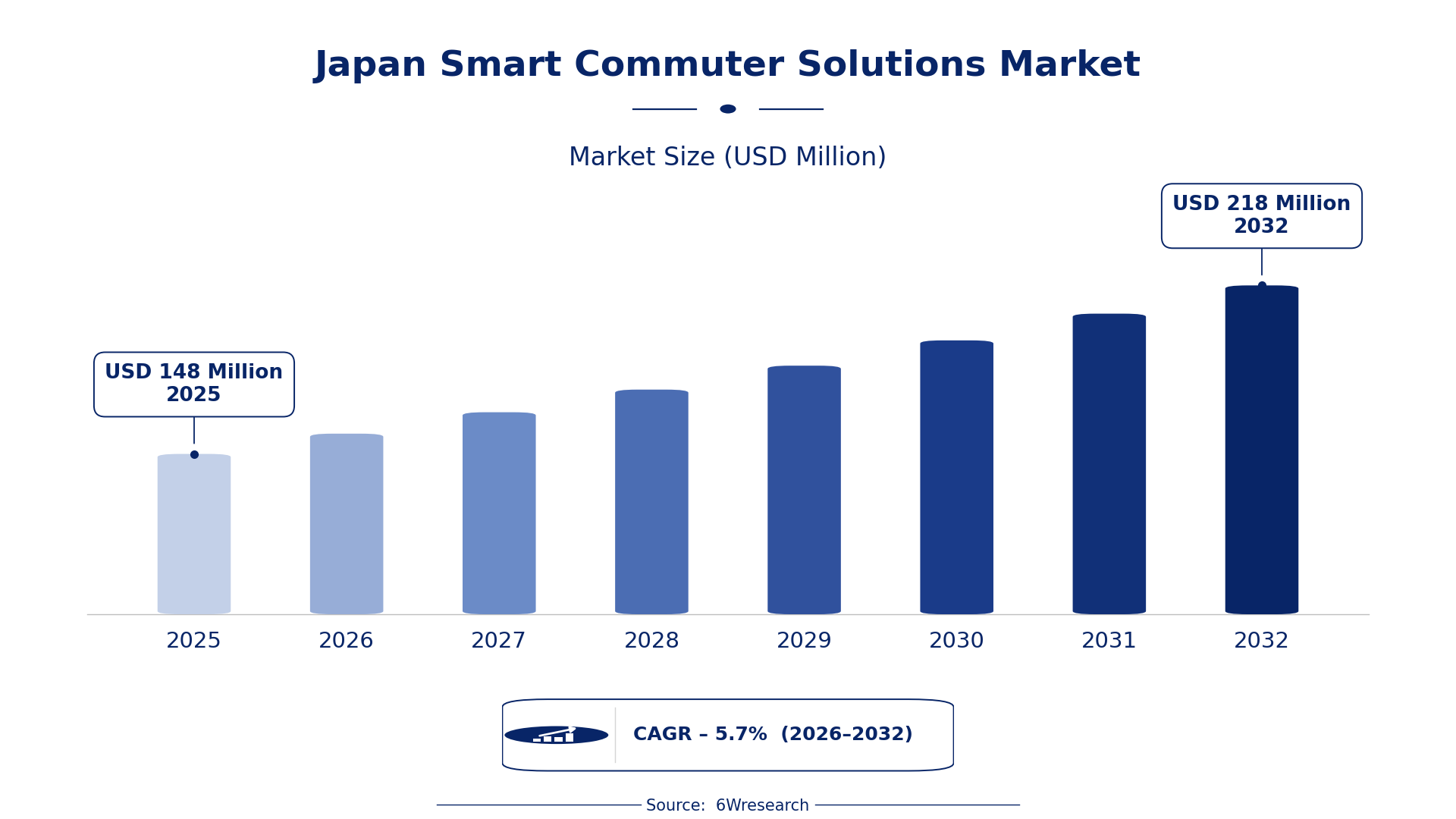
According to 6Wresearch internal database and industry insights, the Japan Smart Commuter Solutions Market was valued at USD 148 Million in 2025 and is projected to reach USD 218 Million by 2032, growing at a CAGR of approximately 5.7% during 2026–2032.
Japan Smart Commuter Solutions Market Highlights
| Report Metric | Details |
| Report Name | Japan Smart Commuter Solutions Market (2026-2032) |
| Market Size 2025 | USD 148 Million |
| Market Size 2032 | USD 218 Million |
| Absolute Growth 2025–2032 | USD 70 Million |
| CAGR 2026–2032 | 5.7% |
| Peak Annual Growth | 6.3% in 2032 |
| Forecast Period | 2026–2032 |
| Historical Data | 2022–2025 |
| Base Year | 2025 |
| Leading Solution Type, 2025 | Multi-Modal Apps (46% share) |
| Leading Core Feature, 2025 | Real-Time Scheduling (36% share) |
| Leading Transportation Mode, 2025 | Trains + Buses (41% share) |
| Leading End User, 2025 | Urban Commuters (46% share) |
| Fastest-Growing Solution Type | eBike & eScooter Apps (8.6% CAGR) |
| Fastest-Growing Core Feature | Crowd Prediction/Analytics (7.7% CAGR) |
| Fastest-Growing Transportation Mode | Personal/Micro-Mobility (7.9% CAGR) |
| Fastest-Growing End User | Transit Authorities (7.4% CAGR) |
| Growing Sector | urban mobility solutions |
| Key End Users | urban commuters, transit authorities, government urban agencies |
Japan Smart Commuter Solutions Market Year-wise Growth Rate and Key Drivers (2022–2032)
This graph illustrates the annual growth rates of the market from 2022 to 2032, highlighting a steady upward trajectory and projected market expansion over the forecast period.
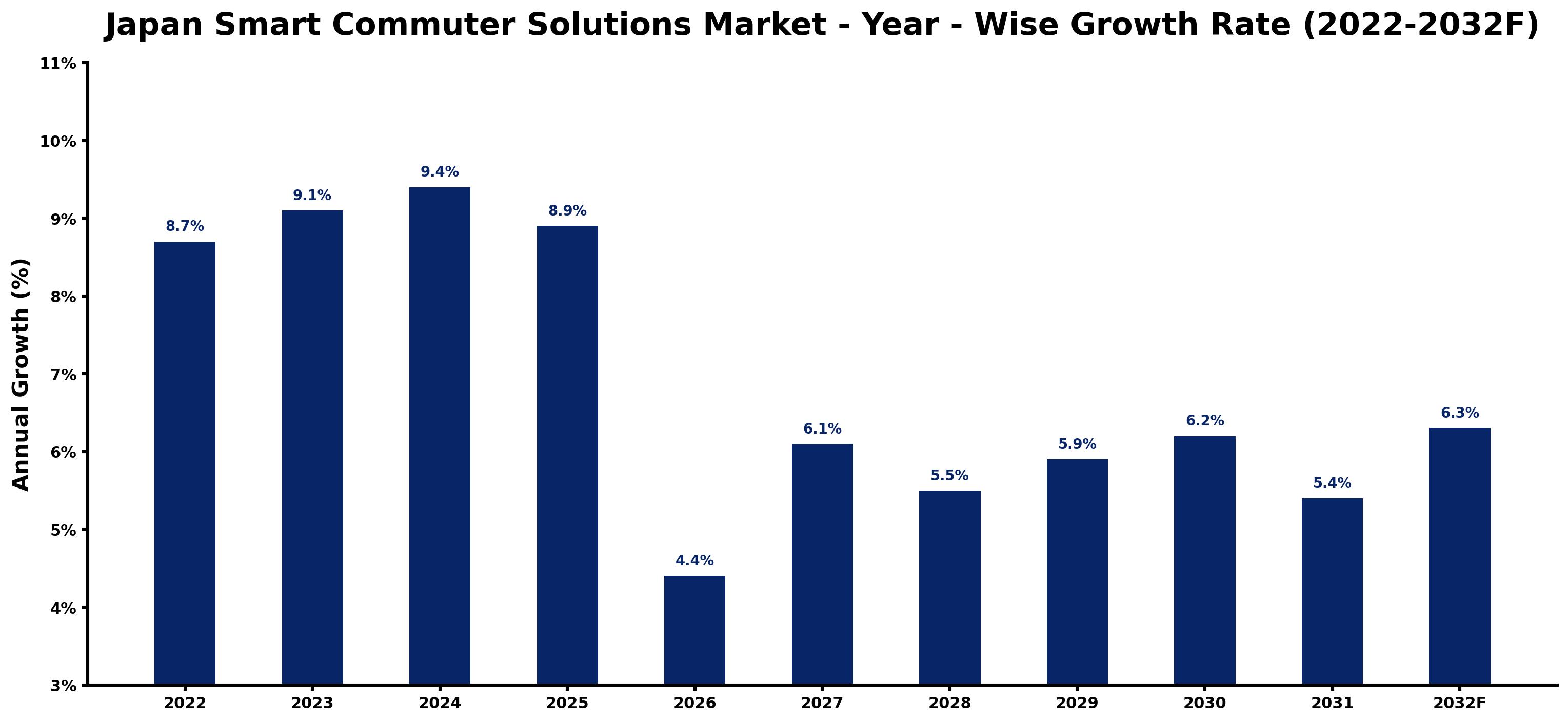
For each year, the table pairs the estimated growth rate with the leading influence on demand, showing how the drivers changed across the period.
| Year | Estimated Annual Growth (%) | Market Rationale |
| 2022 | 8.7 | The market exhibited strong performance, supported by urban population growth and reliance on public transport. |
| 2023 | 9.1 | Demand surged due to the introduction of new transport solutions and increased commuter engagement. |
| 2024 | 9.4 | Growth accelerated as urban commuters embraced new technologies and ticketing systems. |
| 2025 | 8.9 | The market experienced a slowdown as competition intensified and growth stabilised. |
| 2026 | 4.4 | Demand growth is expected to slow further as market maturation and adoption rates normalise. |
| 2027 | 6.1 | Growth is projected to rebound as urban mobility projects gain traction and investment increases. |
| 2028 | 5.5 | The market is expected to see a slight slowdown as demand stabilises amid evolving commuter preferences. |
| 2029 | 5.9 | Growth is expected to pick up again as new technologies and solutions attract urban commuters. |
| 2030 | 6.2 | Demand is projected to rise as urban authorities implement smart mobility initiatives to improve transport. |
| 2031 | 5.4 | The market is expected to experience a slowdown as growth rates adjust to a more sustainable level. |
| 2032 | 6.3 | Demand is expected to peak as urban mobility solutions become increasingly mainstream. |
Note: Market size estimations and growth projections presented in this report are based on 6Wresearch's proprietary forecasting methodology, utilizing the latest available industry data, government publications, and primary research inputs.
Japan Smart Commuter Solutions Market Synopsis
Smart Commuter Solutions in Japan improve urban mobility through technology-driven applications that integrate various transport modes and provide real-time information. This growth is further supported by the increasing adoption of smart ticketing and mobile applications among commuters, with over 60% of urban commuters using these technologies.
Market Dynamics Impact Analysis (2026–2032)
| Factor | Type | Impact | Primary Segment Affected |
| Increased urban population drives demand for efficient commuting solutions. | Driver | High | Multi-Modal Apps |
| Technological advancements in smart ticketing systems streamline fare collection. | Driver | High | Smart Ticketing |
| Growing interest in micro-mobility solutions creates opportunities for new applications. | Opportunity | Medium | eBike & eScooter Apps |
| Urban authorities are investing in smart transport infrastructure to reduce congestion. | Opportunity | High | Real-Time Scheduling |
| High competition among service providers may limit market entry for new players. | Restraint | Medium | Commuter AI Dashboards |
| Limited awareness of smart solutions among older demographics restricts adoption. | Restraint | High | QR/Contactless Pass |
| Rising operational costs challenge service providers to maintain competitive pricing. | Challenge | High | Navigation + Booking |
| Compliance with evolving regulations can delay product launches and market entry. | Challenge | Medium | Crowd Prediction/Analytics |
Evaluation of Drivers in Japan Smart Commuter Solutions Market (2026–2032)
The following drivers explain most of the expected growth.
| Drivers | Primary Segment Affected | Why It Matters (Evidence) |
| Urban population growth increases demand for integrated transport solutions. | Multi-Modal Apps | Japan's urban population is approximately 37 million, leading to higher commuting needs. |
| Technological advancements in ticketing improve user experience. | Smart Ticketing | In 2023, Tokyo introduced a QR-based ticketing system, improving commuter convenience. |
| Rising interest in micro-mobility options boosts demand for eBike and eScooter apps. | eBike & eScooter Apps | More than 70% of urban commuters use mobile apps, indicating a shift towards micro-mobility. |
| Real-time scheduling improves public transport efficiency, attracting more users. | Real-Time Scheduling | The Tokyo Metropolitan Government aims to reduce traffic congestion by 20% by 2025. |
| Crowd analytics help manage capacity, improving service efficiency. | Crowd Prediction/Analytics | Urban transport authorities are increasingly adopting analytics to optimise commuter flows. |
A wider customer base explains much of the growth, as urban population expansion fuels demand for integrated transport solutions. Approximately 37 million people reside in urban areas, leading to increased commuting needs. The introduction of a QR-based ticketing system in 2023 improved user experience, resulting in higher adoption rates. The goal to reduce traffic congestion by 20% by 2025 drives investment in real-time scheduling applications. More than 70% of urban commuters use mobile apps, indicating a shift towards micro-mobility solutions. This trend increases demand for eBike and eScooter applications, as commuters seek efficient short-distance travel options.
Evaluation of Restraints in Japan Smart Commuter Solutions Market
The following restraints limit how fast demand can grow.
| Market Restraint | Primary Segment Affected | Why It Matters (Evidence) |
| High competition limits market entry for new service providers. | Multi-Modal Apps | The presence of established players makes it challenging for newcomers to gain market share. |
| Limited awareness among older demographics restricts technology adoption. | Smart Ticketing | Older commuters may prefer traditional methods, hindering the uptake of smart solutions. |
| Rising operational costs impact service providers' pricing strategies. | eBike & eScooter Apps | Increased costs can lead to higher fares, discouraging potential users from adopting new services. |
| Compliance with evolving regulations can delay product launches. | Real-Time Scheduling | Service providers must navigate complex regulations, which can slow down market entry. |
| Insufficient infrastructure for micro-mobility options limits their effectiveness. | Personal/Micro-Mobility | Lack of dedicated lanes and facilities can deter commuters from using eBikes and scooters. |
Japan Smart Commuter Solutions Market Challenges
Urban commuters in Tokyo lose an average of ¥1,500 per month due to inefficient transport systems, which delays their productivity. Supply chain disruptions occur when technology providers struggle to integrate various transport modes, leading to slower deployment of smart commuter solutions. Buyers face rising costs as regulatory hurdles from the Ministry of Land, Infrastructure, Transport and Tourism prolong project approvals, resulting in a backlog of urban mobility projects worth ¥10 billion allocated in 2023. Compliance with ISO 37120 standards complicates development for suppliers, extending project timelines and increasing costs for urban mobility initiatives.
Trends in the Japan Smart Commuter Solutions Market
These developments are changing demand patterns in the Japan Smart Commuter Solutions Market.
- Introduction of QR-Based Ticketing Systems: Tokyo's introduction of a QR-based ticketing system in 2023 improves commuter convenience and efficiency. This shift aligns with the growing trend of contactless payments, with over 60% of commuters using such systems.
- Rise of Micro-Mobility Solutions: Urban areas are increasingly adopting micro-mobility solutions, such as eBikes and eScooters, to address short-distance travel needs. This trend is reflected in the 8.6% CAGR of eBike and eScooter apps from 2026 to 2032.
- Focus on Real-Time Scheduling: Real-time scheduling applications are gaining traction as cities strive to optimise public transport operations. The Tokyo Metropolitan Government's efforts to reduce congestion by 20% by 2025 highlight this trend.
- Increased Adoption of Smart Mobility Solutions: Urban commuters are increasingly embracing smart mobility solutions, with over 70% using mobile apps for navigation and scheduling. This growing trend indicates a shift towards more efficient commuting options.
Investment Opportunities in the Japan Smart Commuter Solutions Market
The following opportunities in the Japan Smart Commuter Solutions Market pair current demand with a clear way in.
- Urban Commuters Seeking Efficient Solutions: Urban commuters in Japan are increasingly looking for efficient transport solutions. Suppliers can tap into this demand by offering integrated multi-modal apps that cater to the needs of approximately 37 million urban residents.
- Investment in Smart Mobility Infrastructure: The Japanese government allocated ¥10 billion for urban mobility projects in 2023, creating opportunities for suppliers to invest in smart transport solutions that improve commuter experiences.
- Expansion of eBike and eScooter Services: With a growing demand for micro-mobility solutions, particularly in urban areas, there is an opportunity to supply eBike and eScooter apps. This trend is expected to grow as cities adapt to changing commuting preferences.
- Development of Advanced Crowd Analytics: Transit authorities are increasingly adopting crowd analytics to manage capacity and improve service efficiency. Suppliers can invest in advanced analytics solutions to meet this growing demand.
Government Initiatives in the Japan Smart Commuter Solutions Market
The GX Basic Policy, adopted in 2023, aims for approximately JPY 150 trillion of public-private decarbonisation investment over the next decade, strengthening the framework for smart commuter solutions. This builds on the Industrial Standardization Act, which governs product standards and ensures quality in smart transport technologies.
Urban authorities utilise the Smart Mobility Challenge launched in 2023 to implement transport solutions. This initiative encourages local governments to adopt smart technologies, directly benefiting urban commuters by improving transport efficiency and user experience.
Future Insight of the Japan Smart Commuter Solutions Market
A policy-driven shift will reshape urban mobility by 2032 as the Japanese government invests significantly in smart transport solutions. The Smart Mobility Challenge initiated in 2023 will encourage collaboration among technology providers and local governments, fostering innovation in the sector. Adoption of standards like ISO 37120 will promote sustainability in transport systems, benefiting both buyers and suppliers. Tokyo's introduction of a QR-based ticketing system will streamline commuter experiences, directly impacting the daily routines of millions.
Market Segmentation Analysis
Japan Smart Commuter Solutions Market report covers a detailed analysis of the following market segments:
By Solution Type – Multi-Modal Apps Lead, eBike & eScooter Apps Expected to Grow Fastest
According to Saurav Kr Singh, Senior Research Analyst at 6Wresearch, with 46% of solution type revenue in 2025, Multi-Modal Apps was the largest category. Multi-modal apps dominate the market as they effectively integrate various transport modes, catering to the diverse needs of urban commuters. The Tokyo Metropolitan Government promotes these apps to enhance public transport efficiency and user satisfaction, making them essential for daily commuters. eBike & eScooter Apps are projected to grow fastest, at a CAGR of 8.6% during 2026–2032. The rapid growth of eBike and eScooter apps is driven by the increasing demand for micro-mobility solutions in densely populated areas. This trend is particularly evident in urban centres like Tokyo, where commuters are seeking convenient options for short-distance travel. Suppliers should focus on enhancing integration and user experience features to meet the rising demand.
By Core Feature – Real-Time Scheduling Leads, Crowd Prediction/Analytics Expected to Grow Fastest
In 2025, Real-Time Scheduling led the core feature split with a 36% share. Real-time scheduling is the leading feature as it plays a crucial role in optimising public transport operations, ensuring timely services for commuters. This capability is vital in urban environments like Tokyo, where millions rely on efficient transport solutions daily. Crowd Prediction/Analytics is set to record the highest CAGR in this split, 7.7% over 2026–2032. Crowd prediction and analytics are gaining traction as they allow transport providers to manage capacity effectively, improving service efficiency. This focus is increasingly important as urban areas aim to enhance commuter experiences and reduce congestion. Investing in advanced analytics capabilities will be essential for suppliers to address the evolving demands of urban transport systems.
By Transportation Mode – Trains + Buses Lead, Personal/Micro-Mobility Expected to Grow Fastest
Trains + Buses accounted for 41% of the market by transportation mode in 2025. Trains and buses are the backbone of Japan's public transport system, serving millions of commuters daily and ensuring a high level of connectivity. Their established infrastructure and reliability make them the preferred choice for urban mobility. The quickest growth will come from Personal/Micro-Mobility, forecast to expand at a CAGR of 7.9% between 2026 and 2032. Personal and micro-mobility options are rapidly gaining popularity, particularly for short trips in urban settings. This shift is supported by the growing trend of commuters seeking flexible and convenient travel solutions. Suppliers should consider expanding their offerings to include micro-mobility solutions to capture this emerging market.
By End User – Urban Commuters Lead, Transit Authorities Expected to Grow Fastest
Urban Commuters took 46% of end user revenue in 2025, more than any other category. Urban commuters represent the largest user group for smart commuter solutions, heavily relying on efficient transport for their daily activities. Their significant presence in Japan's urban areas drives the demand for enhanced commuting experiences. Over 2026–2032, Transit Authorities are expected to post the fastest growth, at a CAGR of 7.4%. Transit authorities are increasingly adopting smart solutions to improve service delivery and manage urban transport systems effectively. This trend is expected to accelerate as cities modernise their transport infrastructure. Suppliers must engage with transit authorities to ensure their solutions meet the changing needs of urban transport management.
Key Attractiveness of the Report
- 10 Years of Market Numbers
- Historical Data Starting from 2022 to 2025
- Base Year 2025
- Forecast Data until 2032
- Key Performance Indicators Impacting the Market
- Major Upcoming Developments and Projects
Key Highlights of the Report:
- Japan Smart Commuter Solutions Market Outlook
- Market Size of Japan Smart Commuter Solutions Market, 2025
- Forecast of Japan Smart Commuter Solutions Market, 2032
- Historical Data and Forecast of Japan Smart Commuter Solutions Revenues & Volume for the Period 2022-2032F
- Japan Smart Commuter Solutions Market Trend Evolution
- Japan Smart Commuter Solutions Market Drivers and Challenges
- Japan Smart Commuter Solutions Price Trends
- Japan Smart Commuter Solutions Porter's Five Forces
- Japan Smart Commuter Solutions Industry Life Cycle
- Historical Data and Forecast of Japan Smart Commuter Solutions Market Revenues & Volume By Solution Type for the Period 2022-2032F
- Historical Data and Forecast of Japan Smart Commuter Solutions Market Revenues & Volume By Multi-Modal Apps for the Period 2022-2032F
- Historical Data and Forecast of Japan Smart Commuter Solutions Market Revenues & Volume By Smart Ticketing for the Period 2022-2032F
- Historical Data and Forecast of Japan Smart Commuter Solutions Market Revenues & Volume By eBike & eScooter Apps for the Period 2022-2032F
- Historical Data and Forecast of Japan Smart Commuter Solutions Market Revenues & Volume By Commuter AI Dashboards for the Period 2022-2032F
- Historical Data and Forecast of Japan Smart Commuter Solutions Market Revenues & Volume By Core Feature for the Period 2022-2032F
- Historical Data and Forecast of Japan Smart Commuter Solutions Market Revenues & Volume By Real-Time Scheduling for the Period 2022-2032F
- Historical Data and Forecast of Japan Smart Commuter Solutions Market Revenues & Volume By QR/Contactless Pass for the Period 2022-2032F
- Historical Data and Forecast of Japan Smart Commuter Solutions Market Revenues & Volume By Navigation + Booking for the Period 2022-2032F
- Historical Data and Forecast of Japan Smart Commuter Solutions Market Revenues & Volume By Crowd Prediction/Analytics for the Period 2022-2032F
- Historical Data and Forecast of Japan Smart Commuter Solutions Market Revenues & Volume By Transportation Mode for the Period 2022-2032F
- Historical Data and Forecast of Japan Smart Commuter Solutions Market Revenues & Volume By Trains + Buses for the Period 2022-2032F
- Historical Data and Forecast of Japan Smart Commuter Solutions Market Revenues & Volume By Metro, BRT for the Period 2022-2032F
- Historical Data and Forecast of Japan Smart Commuter Solutions Market Revenues & Volume By Personal/Micro-Mobility for the Period 2022-2032F
- Historical Data and Forecast of Japan Smart Commuter Solutions Market Revenues & Volume By Rail & Bus Terminals for the Period 2022-2032F
- Historical Data and Forecast of Japan Smart Commuter Solutions Market Revenues & Volume By End User for the Period 2022-2032F
- Historical Data and Forecast of Japan Smart Commuter Solutions Market Revenues & Volume By Urban Commuters for the Period 2022-2032F
- Historical Data and Forecast of Japan Smart Commuter Solutions Market Revenues & Volume By Transit Authorities for the Period 2022-2032F
- Historical Data and Forecast of Japan Smart Commuter Solutions Market Revenues & Volume By Ride-Sharing Operators for the Period 2022-2032F
- Historical Data and Forecast of Japan Smart Commuter Solutions Market Revenues & Volume By Government Urban Agencies for the Period 2022-2032F
- Japan Smart Commuter Solutions Import Export Trade Statistics
- Market Opportunity Assessment By Solution Type
- Market Opportunity Assessment By Core Feature
- Market Opportunity Assessment By Transportation Mode
- Market Opportunity Assessment By End User
- Japan Smart Commuter Solutions Top Companies Market Share
- Japan Smart Commuter Solutions Competitive Benchmarking By Technical and Operational Parameters
- Japan Smart Commuter Solutions Company Profiles
- Japan Smart Commuter Solutions Key Strategic Recommendations
Market Covered
Coverage by segment is as follows.
By Solution Type
- Multi-Modal Apps
- Smart Ticketing
- eBike & eScooter Apps
- Commuter AI Dashboards
By Core Feature
- Real-Time Scheduling
- QR/Contactless Pass
- Navigation + Booking
- Crowd Prediction/Analytics
By Transportation Mode
- Trains + Buses
- Metro
- BRT
- Personal/Micro-Mobility
- Rail & Bus Terminals
By End User
- Urban Commuters
- Transit Authorities
- Ride-Sharing Operators
- Government Urban Agencies































