Japan Smart Contact Lens Market Size & Growth Rate
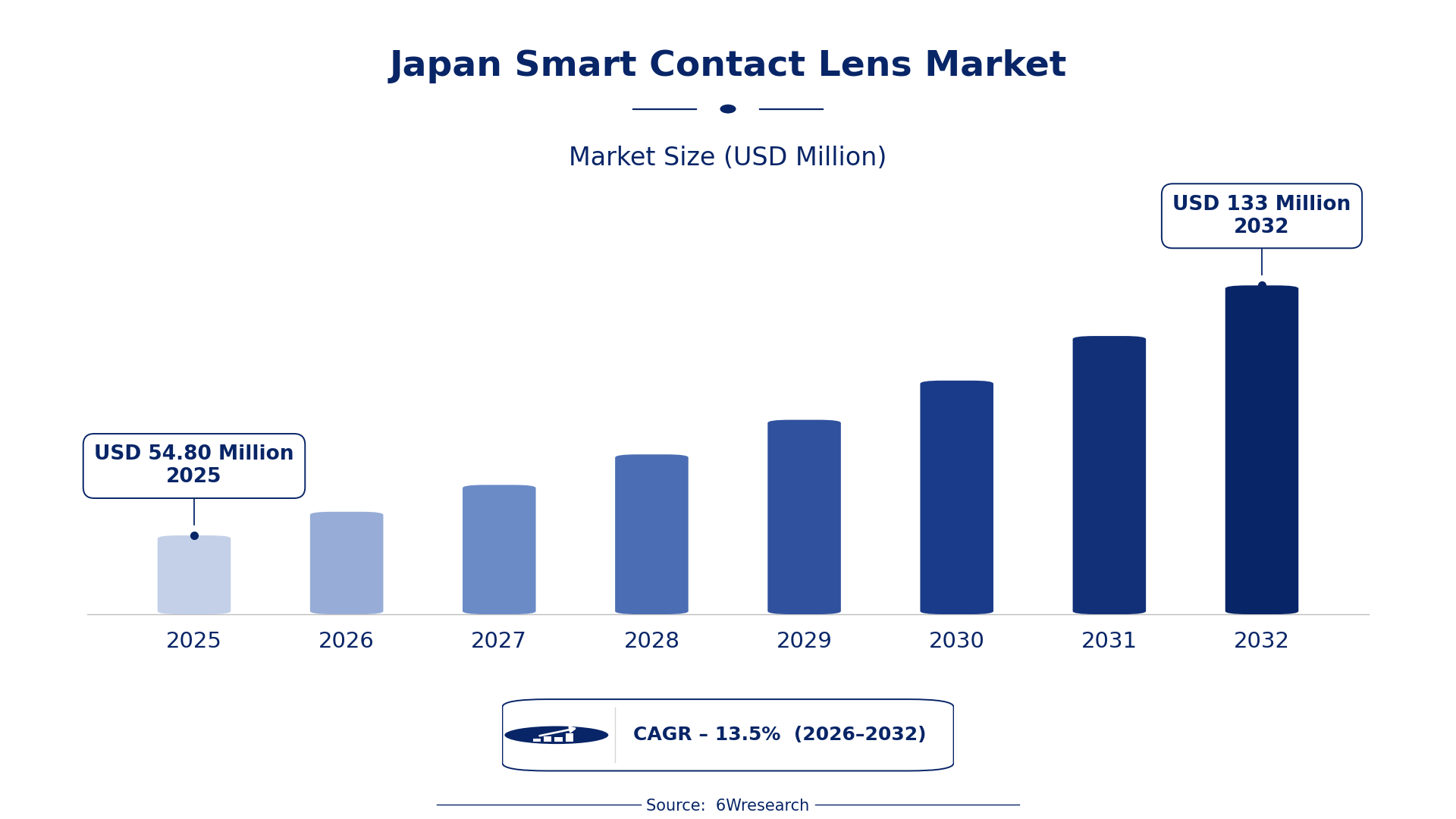
According to 6Wresearch internal database and industry insights, the Japan Smart Contact Lens Market was valued at USD 54.80 Million in 2025 and is projected to reach USD 133 Million by 2032, growing at a CAGR of approximately 13.5% during 2026–2032.
Japan Smart Contact Lens Market Highlights
| Report Metric | Details |
| Report Name | Japan Smart Contact Lens Market (2026-2032) |
| Market Size 2025 | USD 54.80 Million |
| Market Size 2032 | USD 133 Million |
| Absolute Growth 2025–2032 | USD 78.20 Million |
| CAGR 2026–2032 | 13.5% |
| Peak Annual Growth | 15.1% in 2032 |
| Forecast Period | 2026–2032 |
| Historical Data | 2022–2025 |
| Base Year | 2025 |
| Leading Material, 2025 | Poly (2-Hydroxyethyl Methacrylate) (PHEMA) (42% share) |
| Leading Application, 2025 | Monitoring (45% share) |
| Leading Usablity, 2025 | Extended use (67% share) |
| Leading Technology, 2025 | Electrochemical-based technologies (49% share) |
| Leading Population Type, 2025 | Adult (56% share) |
| Fastest-Growing Material | Polydimethylsiloxane (PDMS) (19.4% CAGR) |
| Fastest-Growing Application | Therapeutics (17.6% CAGR) |
| Fastest-Growing Technology | Fluorescence-based sensing technology (19.1% CAGR) |
| Fastest-Growing Population Type | Geriatric (18.7% CAGR) |
| Growing Sector | Therapeutics |
| Key End Users | Monitoring, Therapeutics |
Japan Smart Contact Lens Market Year-wise Growth Rate and Key Drivers (2022–2032)
This graph illustrates the annual growth rates of the market from 2022 to 2032, highlighting a steady upward trajectory and projected market expansion over the forecast period.
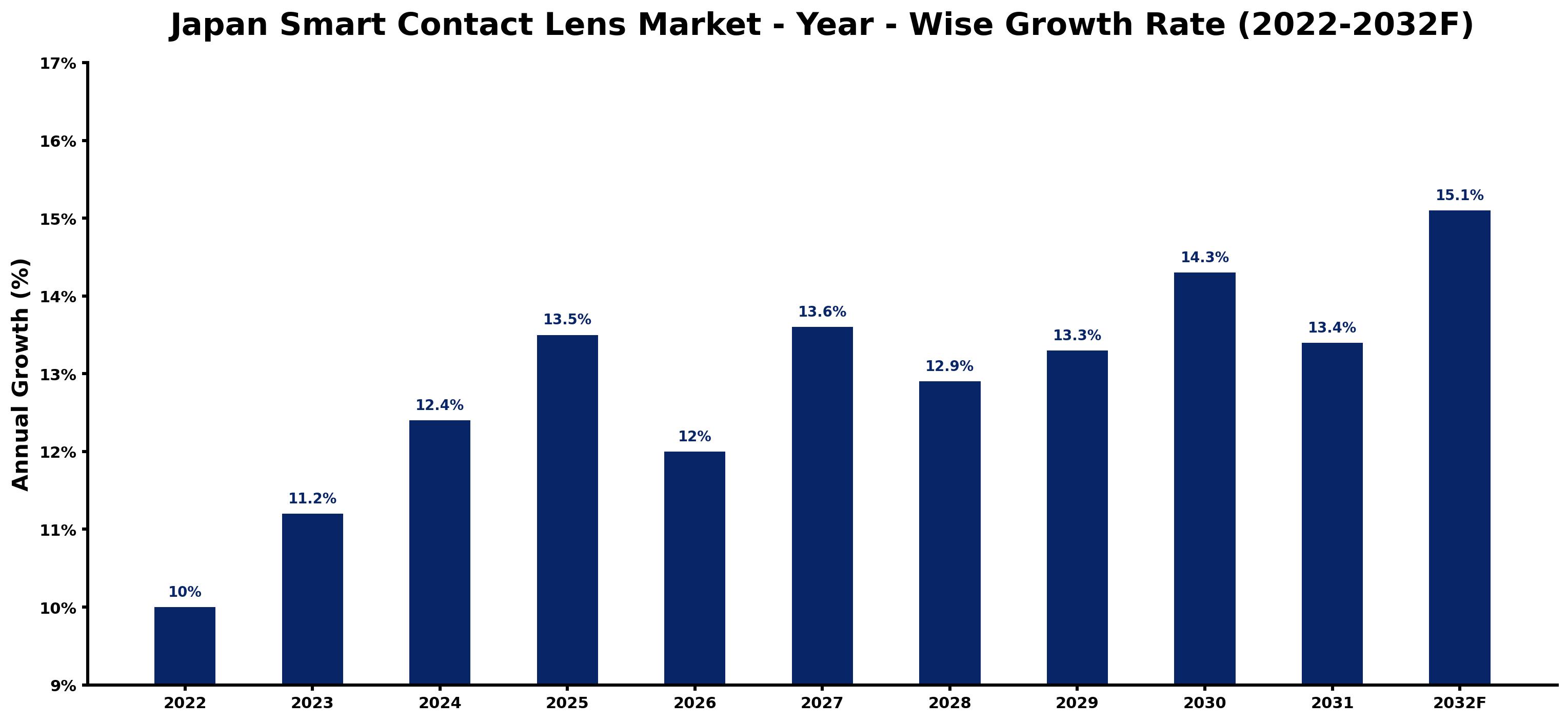
For each year, the table pairs the estimated growth rate with the leading influence on demand, showing how the drivers changed across the period.
| Year | Estimated Annual Growth (%) | Market Rationale |
| 2022 | 10.0 | The market exhibited steady growth due to increasing awareness of health monitoring solutions. |
| 2023 | 11.2 | Demand surged as more consumers adopted wearable health technologies and smart lenses. |
| 2024 | 12.4 | Growth continued with rising interest in diabetes management and health tracking. |
| 2025 | 13.5 | The market peaked as the population aged 65 and over increased. |
| 2026 | 12.0 | Growth is expected to slow slightly as the market adjusts to previous high rates of expansion. |
| 2027 | 13.6 | Demand is projected to pick up again with advancements in lens technology and applications. |
| 2028 | 12.9 | Growth is anticipated to moderate as competition intensifies among manufacturers and suppliers. |
| 2029 | 13.3 | The market is expected to see renewed interest as health monitoring becomes more mainstream. |
| 2030 | 14.3 | Demand is projected to increase as new technologies improve the functionality of smart lenses. |
| 2031 | 13.4 | Growth is anticipated to slow again as market saturation begins to affect new customer acquisition. |
| 2032 | 15.1 | Demand is expected to accelerate with the introduction of advanced health monitoring features. |
Note: Market size estimations and growth projections presented in this report are based on 6Wresearch's proprietary forecasting methodology, utilizing the latest available industry data, government publications, and primary research inputs.
Japan Smart Contact Lens Market Synopsis
Smart contact lenses are advanced optical devices designed for health monitoring and therapeutic applications. They are made from biocompatible materials and utilise various sensing technologies. According to projections, the Japan Smart Contact Lens Market is expanding due to an ageing population, with 36% expected to be over 65 by 2040, alongside a notable portion of adults wearing corrective lenses. The Ministry of Health, Labour and Welfare's 2023 programme to promote digital health technologies is driving demand for these solutions, coupled with the increasing prevalence of diabetes among the population.
Market Dynamics Impact Analysis (2026–2032)
| Factor | Type | Impact | Primary Segment Affected |
| Increasing adoption of wearable health technologies | Driver | High | Monitoring |
| Growing prevalence of diabetes among the population | Driver | High | Monitoring |
| Rising interest in health monitoring solutions among older adults | Opportunity | High | Adult |
| Emerging applications in drug delivery systems | Opportunity | Medium | Therapeutics |
| High production costs of advanced materials | Restraint | High | Poly (2-Hydroxyethyl Methacrylate) (PHEMA) |
| Limited consumer awareness of smart contact lens benefits | Restraint | Medium | Monitoring |
| Supply chain disruptions affecting material availability | Challenge | High | Poly (2-Hydroxyethyl Methacrylate) (PHEMA) |
| Intense competition among manufacturers leading to price wars | Challenge | Medium | Monitoring |
Evaluation of Drivers in Japan Smart Contact Lens Market (2026–2032)
Key forces behind demand, with the segment each one moves most, are listed below.
| Drivers | Primary Segment Affected | Why It Matters (Evidence) |
| Growing demand for continuous health monitoring | Monitoring | Approximately 15% of the Japanese population suffers from diabetes, increasing the need for monitoring solutions. |
| Rising number of adults wearing corrective lenses | Monitoring | About 30% of adults in Japan wear corrective lenses, indicating a potential market for smart lenses. |
| Advancements in electrochemical-based technologies | Electrochemical-based technologies | These technologies enable real-time monitoring, appealing to health-conscious consumers. |
| Increased funding for health technology innovation | Monitoring | The government allocated 1 billion yen for health technology innovation in 2023, supporting product development. |
| Research initiatives focused on diabetes management | Therapeutics | Ongoing research on smart lenses for diabetes management is driving demand. |
Purchasing is picking up as the Japanese population increasingly seeks health monitoring solutions. The adoption rate of wearable health technology stands at 25% among adults, indicating a growing market. Approximately 15% of the population suffers from diabetes, creating strong demand for smart contact lenses that provide continuous monitoring.
Evaluation of Restraints in Japan Smart Contact Lens Market
The main factors holding the market back are set out below.
| Market Restraint | Primary Segment Affected | Why It Matters (Evidence) |
| High production costs of biocompatible materials | Poly (2-Hydroxyethyl Methacrylate) (PHEMA) | The cost of advanced materials affects pricing and market entry for new products. |
| Limited consumer awareness of smart lens benefits | Monitoring | Many potential users remain unaware of the advantages of smart contact lenses. |
| Supply chain disruptions impacting material availability | Poly (2-Hydroxyethyl Methacrylate) (PHEMA) | Disruptions can delay production and increase costs for manufacturers. |
| Regulatory hurdles for new product approvals | Therapeutics | Stringent regulations can slow down the introduction of new products. |
| Competition leading to price wars among manufacturers | Monitoring | Intense competition can erode profit margins and affect sustainability. |
Japan Smart Contact Lens Market Challenges
Buyers of smart contact lenses encounter a shortage of skilled workers in optical technology, which delays production timelines and raises costs by approximately 15%. High production costs arise from the need for biocompatible materials, pushing retail prices up to 20% for consumers. Compliance with ISO 13485 standards complicates the regulatory landscape, causing delays in product launches that hinder suppliers' market entry. Limited adoption of digital health technologies stifles innovation, resulting in fewer options for consumers and impeding overall market growth.
Trends in the Japan Smart Contact Lens Market
The trends below show where the Japan Smart Contact Lens Market is heading.
- Initiative to Promote Digital Health Technologies: The Ministry of Health, Labour and Welfare initiated a programme in 2023 to promote digital health technologies, aiming to integrate smart contact lenses into healthcare. This initiative is projected to support the adoption of health monitoring solutions.
- Adult Population Increasingly Adopting Smart Lenses: Adults are increasingly adopting smart contact lenses for health monitoring, driven by the rising prevalence of diabetes. Approximately 15% of the population suffers from this condition, creating a notable market opportunity.
- Shift Towards Extended Use Lenses: There is a growing trend towards extended use smart contact lenses, which offer convenience and comfort. This shift is supported by advancements in materials and designs that improve wearability.
- Emergence of Therapeutic Applications: Therapeutic applications for smart contact lenses are gaining traction, particularly for drug delivery systems. Research highlights the potential for these lenses to manage diabetes effectively.
Investment Opportunities in the Japan Smart Contact Lens Market
Several openings in the Japan Smart Contact Lens Market merit attention from investors.
- Growing Market for Health Monitoring: With the ageing population projected to reach 36% by 2040, there is an opportunity to supply smart contact lenses. Collaborating with healthcare providers can facilitate market entry.
- Investment in Innovative Materials: As production costs rise, investing in alternative biocompatible materials can reduce expenses. Partnering with research institutions can enhance product development.
- Expansion of Therapeutic Applications: The increasing interest in drug delivery systems presents an opportunity to develop smart lenses for therapeutic uses. Engaging with medical professionals can help in product validation.
- Rising Demand for Extended Use Lenses: With a growing preference for extended wear, supplying advanced extended use lenses can meet market needs. Collaborating with eye care professionals can aid in distribution.
Government Initiatives in the Japan Smart Contact Lens Market
The PRTR Law requires businesses to report releases and transfers of designated chemical substances, impacting producers of smart contact lenses by ensuring compliance with environmental standards. This law promotes transparency and safety in the production process, which is crucial for gaining consumer trust. The Chemical Substances Control Law mandates the evaluation and control of new and existing chemical substances in manufacture and import, compelling manufacturers to adhere to safety regulations that affect product development and market entry.
The Japanese government allocated 1 billion yen for health technology innovation in 2023, administered by the Ministry of Health, Labour and Welfare. This funding supports projects that enhance the development and integration of smart contact lenses into healthcare systems, facilitating advancements in technology and accessibility for consumers.
Future Insight of the Japan Smart Contact Lens Market
Advancements in sensing technology will transform demand for smart contact lenses, particularly as research at Tokyo Medical University progresses in diabetes management. By 2032, the Japanese population aged 65 and over will reach 36%, significantly increasing the market for health monitoring solutions. The government's budget of 1 billion yen for health technology innovation will drive new developments in the sector. As wearable health tech adoption rises to 40% among adults, suppliers will need to adapt their products to meet the needs of health-conscious consumers.
Market Segmentation Analysis
Japan Smart Contact Lens Market report covers a detailed analysis of the following market segments:
By Material – Poly (2-Hydroxyethyl Methacrylate) (PHEMA) Leads, Polydimethylsiloxane (PDMS) Expected to Grow Fastest
According to Summon Dutta, Assistant Manager at 6Wresearch, in 2025, Poly (2-Hydroxyethyl Methacrylate) (PHEMA) led the material split with a 42% share. Poly (2-Hydroxyethyl Methacrylate) (PHEMA) holds the largest market share due to its widespread use in lens manufacturing, primarily attributed to its biocompatibility. This material is essential for producing smart contact lenses that adhere to rigorous health and safety regulations. Polydimethylsiloxane (PDMS) is projected to grow fastest, at a CAGR of 19.4% during 2026–2032. Polydimethylsiloxane (PDMS) is experiencing rapid growth because it offers flexibility and oxygen permeability, crucial for user comfort and lens effectiveness. Its unique properties are increasingly sought after for the creation of advanced lens designs. Suppliers should focus on increasing production capabilities for PHEMA and PDMS to satisfy the rising demand in the smart contact lens market.
By Application – Monitoring Leads, Therapeutics Expected to Grow Fastest
Monitoring took 45% of application revenue in 2025, more than any other category. Monitoring is the leading application for smart contact lenses, as they are primarily designed for continuous health tracking, catering to users who require regular health metrics. This application is particularly pertinent given Japan's ageing population and the increasing focus on health management. Over 2026–2032, Therapeutics are expected to post the fastest growth, at a CAGR of 17.6%. Therapeutics is the fastest-growing application, propelled by the potential for smart lenses to administer medication directly to the eye, becoming a key area of healthcare advancement. Ongoing research in this domain is expected to significantly enhance adoption rates. Buyers can anticipate improved health outcomes and convenience from developments in therapeutic applications.
By Usablity – Extended use Leads and Records the Fastest Growth
Extended use held 67% of the Japan Smart Contact Lens Market by usablity in 2025. Extended use is the predominant usability segment, as many smart lenses are designed for prolonged wear, appealing to users who prioritise comfort and convenience. This aligns well with the lifestyle preferences of the Japanese population. Extended use is also forecast to expand faster than any other category, at a CAGR of 14.8% over 2026–2032. Extended use is also the fastest-growing usability segment, as advancements in materials and technology improve comfort for longer durations. This trend is likely to persist as user preferences shift towards more convenient options. Suppliers must concentrate on developing extended-use lenses to capture the growing market demand.
By Technology – Electrochemical-based technologies Lead, Fluorescence-based sensing technology Expected to Grow Fastest
The largest technology category in 2025 was Electrochemical-based technologies, at 49% of revenue. Electrochemical-based technologies dominate the market due to their essential role in real-time health monitoring, making them crucial for the functionality of smart lenses. This technology is highly regarded for its reliability across various health applications. The quickest growth will come from Fluorescence-based sensing technology, forecast to expand at a CAGR of 19.1% between 2026 and 2032. Fluorescence-based sensing technology is witnessing rapid growth due to its effectiveness in detecting specific biomarkers, which is increasingly vital for health monitoring. Its incorporation into smart lenses is expected to expand significantly in the near future. Suppliers should invest in the advancement of fluorescence-based technologies to remain competitive in the market.
By Population Type – Adult Leads, Geriatric Expected to Grow Fastest
Adult accounted for 56% of the market by population type in 2025. The adult population constitutes the largest user demographic for smart lenses, representing a substantial market segment seeking both corrective and health-monitoring solutions. This group is actively adopting new health technologies, driving demand. Geriatric is projected to grow fastest, at a CAGR of 18.7% during 2026–2032. The geriatric population is the fastest-growing segment, propelled by the increasing need for health monitoring solutions among older adults. As this demographic continues to expand, demand for tailored products will rise correspondingly. Suppliers should adjust their marketing strategies to effectively address the specific needs of the geriatric population.
Key Attractiveness of the Report
- 10 Years of Market Numbers
- Historical Data Starting from 2022 to 2025
- Base Year 2025
- Forecast Data until 2032
- Key Performance Indicators Impacting the Market
- Major Upcoming Developments and Projects
Key Highlights of the Report:
- Japan Smart Contact Lens Market Outlook
- Market Size of Japan Smart Contact Lens Market, 2025
- Forecast of Japan Smart Contact Lens Market, 2032
- Historical Data and Forecast of Japan Smart Contact Lens Revenues & Volume for the Period 2022-2032
- Japan Smart Contact Lens Market Trend Evolution
- Japan Smart Contact Lens Market Drivers and Challenges
- Japan Smart Contact Lens Price Trends
- Japan Smart Contact Lens Porter's Five Forces
- Japan Smart Contact Lens Industry Life Cycle
- Historical Data and Forecast of Japan Smart Contact Lens Market Revenues & Volume By Material for the Period 2022-2032
- Historical Data and Forecast of Japan Smart Contact Lens Market Revenues & Volume By Poly (2-Hydroxyethyl Methacrylate) (PHEMA) for the Period 2022-2032
- Historical Data and Forecast of Japan Smart Contact Lens Market Revenues & Volume By Polyvinyl Alcohol (PVA) for the Period 2022-2032
- Historical Data and Forecast of Japan Smart Contact Lens Market Revenues & Volume By Polyacrylamide (PA) for the Period 2022-2032
- Historical Data and Forecast of Japan Smart Contact Lens Market Revenues & Volume By Polyethylene Terephthalate (PET) for the Period 2022-2032
- Historical Data and Forecast of Japan Smart Contact Lens Market Revenues & Volume By Polydimethylsiloxane (PDMS) for the Period 2022-2032
- Historical Data and Forecast of Japan Smart Contact Lens Market Revenues & Volume By Other for the Period 2022-2032
- Historical Data and Forecast of Japan Smart Contact Lens Market Revenues & Volume By Application for the Period 2022-2032
- Historical Data and Forecast of Japan Smart Contact Lens Market Revenues & Volume By Monitoring for the Period 2022-2032
- Historical Data and Forecast of Japan Smart Contact Lens Market Revenues & Volume By Therapeutics for the Period 2022-2032
- Historical Data and Forecast of Japan Smart Contact Lens Market Revenues & Volume By Other for the Period 2022-2032
- Historical Data and Forecast of Japan Smart Contact Lens Market Revenues & Volume By Usablity for the Period 2022-2032
- Historical Data and Forecast of Japan Smart Contact Lens Market Revenues & Volume By Single use for the Period 2022-2032
- Historical Data and Forecast of Japan Smart Contact Lens Market Revenues & Volume By Extended use for the Period 2022-2032
- Historical Data and Forecast of Japan Smart Contact Lens Market Revenues & Volume By Technology for the Period 2022-2032
- Historical Data and Forecast of Japan Smart Contact Lens Market Revenues & Volume By Fluorescence-based sensing technology for the Period 2022-2032
- Historical Data and Forecast of Japan Smart Contact Lens Market Revenues & Volume By Holographic sensing technology for the Period 2022-2032
- Historical Data and Forecast of Japan Smart Contact Lens Market Revenues & Volume By Colorimetric based sensing technology for the Period 2022-2032
- Historical Data and Forecast of Japan Smart Contact Lens Market Revenues & Volume By Electrochemical-based technologies for the Period 2022-2032
- Historical Data and Forecast of Japan Smart Contact Lens Market Revenues & Volume By Other for the Period 2022-2032
- Historical Data and Forecast of Japan Smart Contact Lens Market Revenues & Volume By Population Type for the Period 2022-2032
- Historical Data and Forecast of Japan Smart Contact Lens Market Revenues & Volume By Pediatric for the Period 2022-2032
- Historical Data and Forecast of Japan Smart Contact Lens Market Revenues & Volume By Adult for the Period 2022-2032
- Historical Data and Forecast of Japan Smart Contact Lens Market Revenues & Volume By Geriatric for the Period 2022-2032
- Historical Data and Forecast of Japan Smart Contact Lens Market Revenues & Volume By End User for the Period 2022-2032
- Historical Data and Forecast of Japan Smart Contact Lens Market Revenues & Volume By Eye hospital for the Period 2022-2032
- Historical Data and Forecast of Japan Smart Contact Lens Market Revenues & Volume By Ophthalmology clinics for the Period 2022-2032
- Historical Data and Forecast of Japan Smart Contact Lens Market Revenues & Volume By Homecare setting for the Period 2022-2032
- Historical Data and Forecast of Japan Smart Contact Lens Market Revenues & Volume By Other for the Period 2022-2032
- Historical Data and Forecast of Japan Smart Contact Lens Market Revenues & Volume By Distribution Channel for the Period 2022-2032
- Historical Data and Forecast of Japan Smart Contact Lens Market Revenues & Volume By Retail stores for the Period 2022-2032
- Historical Data and Forecast of Japan Smart Contact Lens Market Revenues & Volume By Online stores for the Period 2022-2032
- Historical Data and Forecast of Japan Smart Contact Lens Market Revenues & Volume By Eye care practitioners for the Period 2022-2032
- Historical Data and Forecast of Japan Smart Contact Lens Market Revenues & Volume By Other for the Period 2022-2032
- Japan Smart Contact Lens Import Export Trade Statistics
- Market Opportunity Assessment By Material
- Market Opportunity Assessment By Application
- Market Opportunity Assessment By Usablity
- Market Opportunity Assessment By Technology
- Market Opportunity Assessment By Population Type
- Market Opportunity Assessment By End User
- Market Opportunity Assessment By Distribution Channel
- Japan Smart Contact Lens Top Companies Market Share
- Japan Smart Contact Lens Competitive Benchmarking By Technical and Operational Parameters
- Japan Smart Contact Lens Company Profiles
- Japan Smart Contact Lens Key Strategic Recommendations
Market Covered
Segments analysed in this report are listed below.
By Material
- Poly (2-Hydroxyethyl Methacrylate) (PHEMA)
- Polyvinyl Alcohol (PVA)
- Polyacrylamide (PA)
- Polyethylene Terephthalate (PET)
- Polydimethylsiloxane (PDMS)
- Other
By Application
- Monitoring
- Therapeutics
- Other
By Usablity
- Single use
- Extended use
By Technology
- Fluorescence-based sensing technology
- Holographic sensing technology
- Colorimetric based sensing technology
- Electrochemical-based technologies
- Other
By Population Type
- Pediatric
- Adult
- Geriatric






































