Japan Smart Cooking Appliance Market Size & Growth Rate
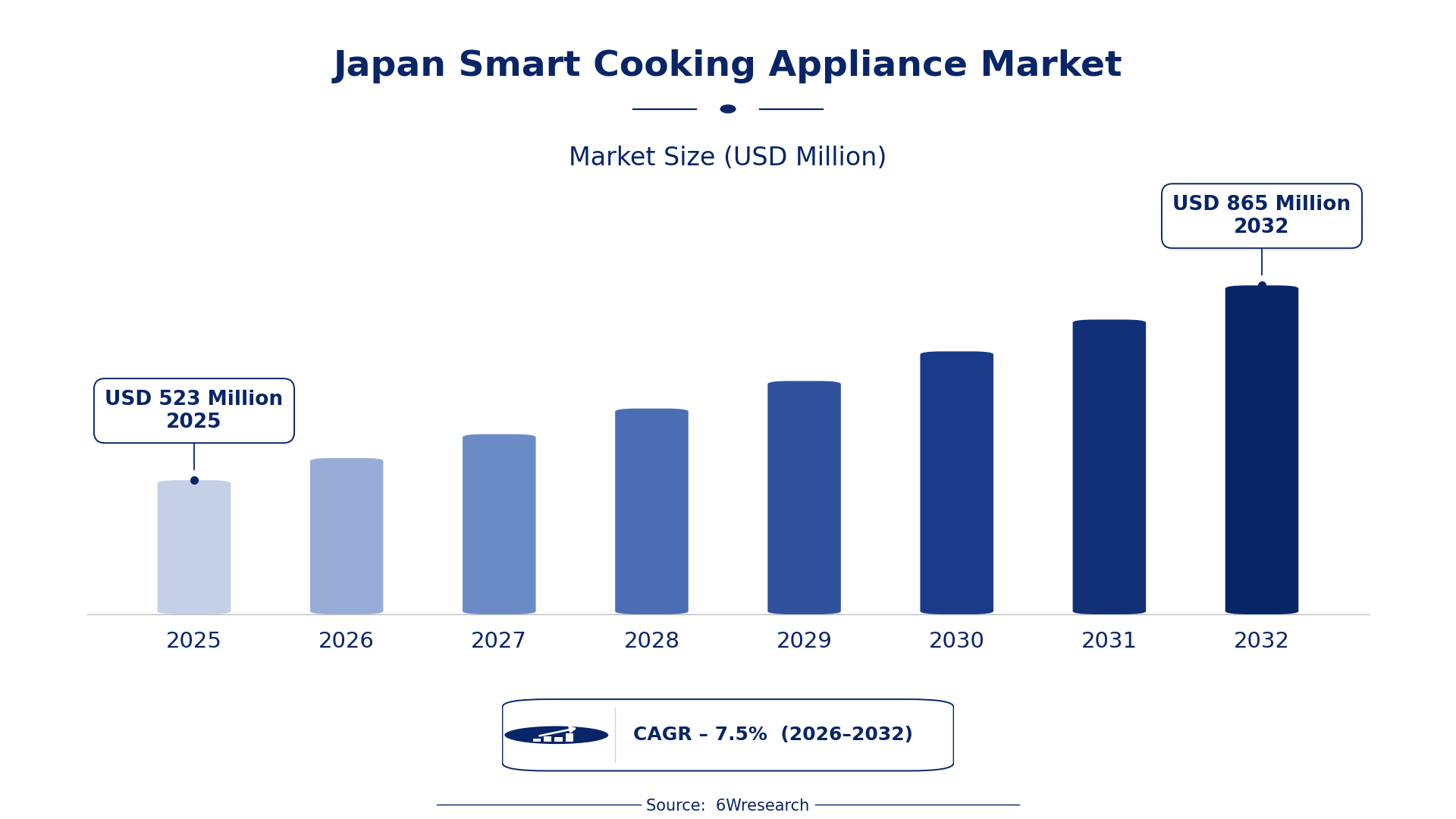
According to 6Wresearch internal database and industry insights, the Japan Smart Cooking Appliance Market was valued at USD 523 Million in 2025 and is projected to reach USD 865 Million by 2032, growing at a CAGR of approximately 7.5% during 2026–2032.
Japan Smart Cooking Appliance Market Highlights
| Report Metric | Details |
| Report Name | Japan Smart Cooking Appliance Market (2026-2032) |
| Market Size 2025 | USD 523 Million |
| Market Size 2032 | USD 865 Million |
| Absolute Growth 2025–2032 | USD 342 Million |
| CAGR 2026–2032 | 7.5% |
| Peak Annual Growth | 8.4% in 2026 |
| Forecast Period | 2026–2032 |
| Historical Data | 2022–2025 |
| Base Year | 2025 |
| Leading Appliance Type, 2025 | Smart Ovens (49% share) |
| Leading Smart Functionality, 2025 | Auto Recipe Settings (46% share) |
| Leading Connectivity Type, 2025 | Wi-Fi/App (37% share) |
| Leading End User, 2025 | Connected Home Kitchens (38% share) |
| Fastest-Growing Appliance Type | Smart Cooktops (10.3% CAGR) |
| Fastest-Growing Smart Functionality | Temperature + Safety Control (9.3% CAGR) |
| Fastest-Growing Connectivity Type | IoT + Sensors (11.2% CAGR) |
| Fastest-Growing End User | Smart Appliance Brands (9.5% CAGR) |
| Growing Sector | Smart Appliance Brands |
| Key End Users | Connected Home Kitchens, Smart Appliance Brands, Home Cooks, Health-Conscious Consumers |
Japan Smart Cooking Appliance Market Year-wise Growth Rate and Key Drivers (2022–2032)
This graph illustrates the annual growth rates of the market from 2022 to 2032, highlighting a steady upward trajectory and projected market expansion over the forecast period.
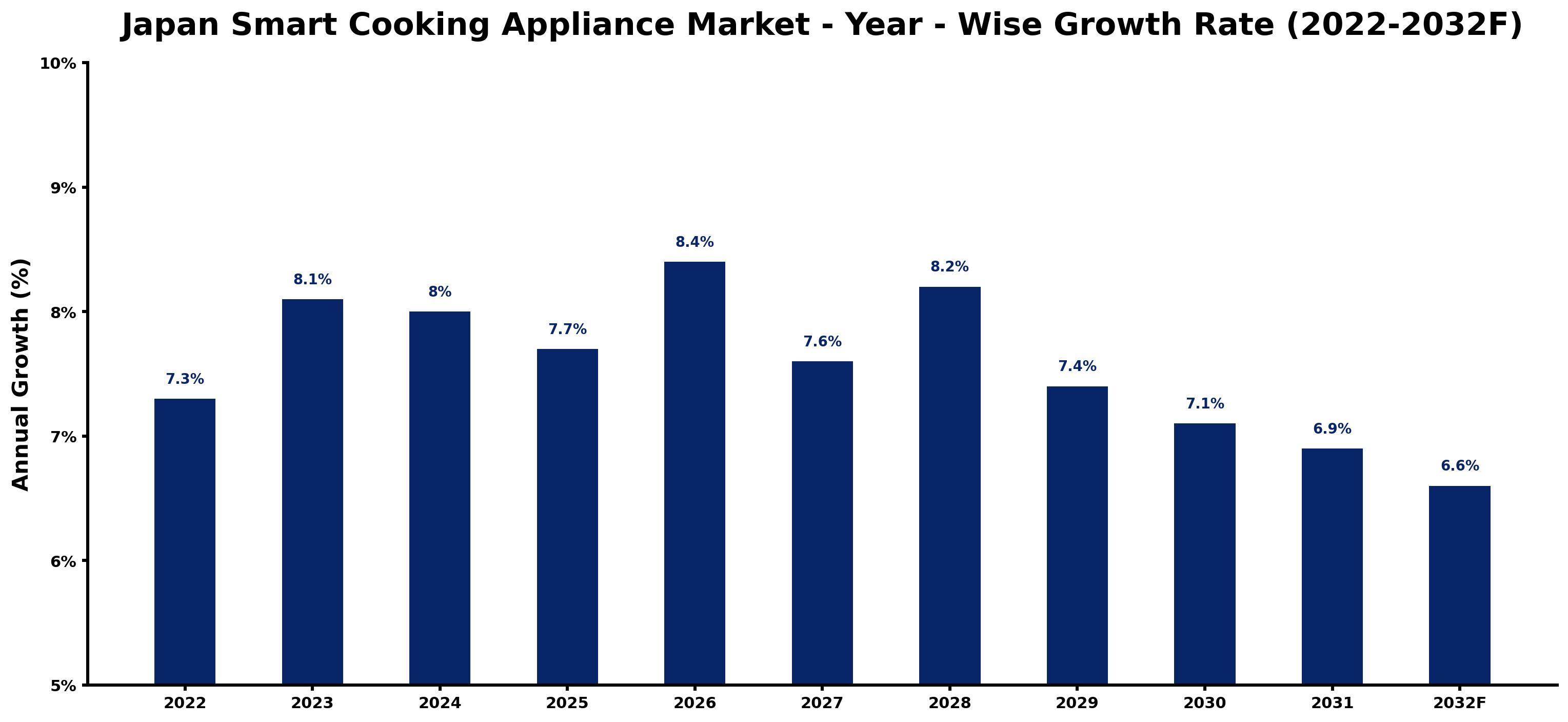
For each year, the table pairs the estimated growth rate with the leading influence on demand, showing how the drivers changed across the period.
| Year | Estimated Annual Growth (%) | Market Rationale |
| 2022 | 7.3 | The market experienced moderate growth, driven by increasing urban adoption of smart cooking appliances. |
| 2023 | 8.1 | Demand accelerated as health-conscious consumers sought efficient cooking solutions and convenience. |
| 2024 | 8.0 | Growth slowed slightly, reflecting market saturation in some urban areas and a focus on product differentiation. |
| 2025 | 7.7 | The trend of health-conscious cooking continued, but growth rates moderated due to market maturity. |
| 2026 | 8.4 | A surge in investment in smart home technology propelled the market to its peak growth rate. |
| 2027 | 7.6 | Growth decelerated as consumer preferences shifted towards more advanced functionalities in appliances. |
| 2028 | 8.2 | Demand increased again, driven by innovations in IoT and new cooking features. |
| 2029 | 7.4 | The market saw slower growth as competition intensified among appliance manufacturers. |
| 2030 | 7.1 | Continued consumer interest in health and convenience maintained positive growth, albeit at a reduced rate. |
| 2031 | 6.9 | The market's growth rate slowed further as saturation in urban areas became more pronounced. |
| 2032 | 6.6 | Growth is expected to stabilise as the market matures and consumer preferences evolve. |
Note: Market size estimations and growth projections presented in this report are based on 6Wresearch's proprietary forecasting methodology, utilizing the latest available industry data, government publications, and primary research inputs.
Japan Smart Cooking Appliance Market Synopsis
Smart cooking appliances are advanced kitchen devices that utilise connectivity and automation to improve cooking efficiency. Their main uses include simplifying meal preparation and promoting healthier cooking methods. The Japan Smart Cooking Appliance Market is expanding due to increased urban adoption, with over 10 million smart home devices currently in use. Health-conscious consumers are driving demand, as 30% of households invest in these technologies. Government initiatives further support this trend, encouraging innovation and consumer interest in smart cooking solutions.
Market Dynamics Impact Analysis (2026–2032)
| Factor | Type | Impact | Primary Segment Affected |
| Rising urbanisation and health consciousness among consumers | Driver | High | Smart Ovens |
| Technological advancements in IoT and automation | Driver | High | Smart Cooktops |
| Growing demand for healthier cooking alternatives | Opportunity | High | Air Fryers |
| Increasing integration with smart home systems | Opportunity | High | Connected Home Kitchens |
| Market saturation in urban areas | Restraint | Medium | Smart Ovens |
| High initial costs of smart cooking appliances | Restraint | Medium | Multicookers |
| Consumer hesitance to adopt new technology | Challenge | High | Smart Ovens |
| Intense competition among appliance manufacturers | Challenge | High | Smart Cooktops |
Evaluation of Drivers in Japan Smart Cooking Appliance Market (2026–2032)
Below are the drivers that matter most for revenue growth, with supporting evidence.
| Drivers | Primary Segment Affected | Why It Matters (Evidence) |
| Increased urbanisation | Smart Ovens | Approximately 40% of smart appliance sales occur in urban areas like Tokyo, driving demand for efficient cooking solutions. |
| Technological advancements in IoT | Smart Cooktops | IoT-enabled devices are projected to grow by 15% annually, improving user interaction and functionality. |
| Health-conscious consumer trends | Air Fryers | 30% of households are investing in smart cooking technology, seeking healthier cooking alternatives. |
| Integration with smart home systems | Connected Home Kitchens | The growing trend of smart home technology adoption supports increased sales of connected appliances. |
| Government support for smart technology | Multicookers | The Japanese government allocated 2 billion JPY for smart home technology initiatives, boosting market growth. |
Volumes grow on the back of increasing urbanisation, with approximately 40% of smart appliance sales occurring in urban areas. Technological advancements in IoT are projected to drive a 15% annual increase in IoT-enabled cooking devices. Many households are seeking healthier alternatives, leading to increased investments in smart cooking technology.
Evaluation of Restraints in Japan Smart Cooking Appliance Market
These restraints slow adoption and weigh on supplier margins.
| Market Restraint | Primary Segment Affected | Why It Matters (Evidence) |
| Market saturation in urban areas | Smart Ovens | As urban areas become saturated, growth potential diminishes, limiting new customer acquisition. |
| High initial costs of smart cooking appliances | Multicookers | The premium pricing of smart appliances can deter budget-conscious consumers from making purchases. |
| Consumer hesitance to adopt new technology | Smart Cooktops | Some consumers remain cautious about integrating new technologies into their cooking routines. |
| Intense competition among manufacturers | Smart Cooktops | Increased competition can lead to price wars, impacting profit margins for manufacturers. |
| Limited awareness of smart cooking benefits | Air Fryers | Many consumers are unaware of the advantages of smart cooking appliances, hindering market growth. |
Japan Smart Cooking Appliance Market Challenges
Health-conscious households investing in smart cooking technology face high upfront costs, with average monthly spending around 1,500 JPY, limiting broader adoption. Stringent JIS standards for safety and performance can delay product launches, causing suppliers to miss market opportunities and reducing choices for buyers. Urban areas like Tokyo and Osaka experience supply chain disruptions, leading to shortages of key components that can increase prices and limit availability for consumers. The rapid growth of smart home technology creates confusion among buyers, as they struggle to navigate numerous options, risking dissatisfaction with their purchases.
Trends in the Japan Smart Cooking Appliance Market
The following changes are redrawing the Japan Smart Cooking Appliance Market.
- Shift towards Health-Conscious Cooking: Health-conscious consumers are increasingly choosing smart cooking appliances, with air fryers gaining popularity. In 2023, air fryers accounted for a notable share of smart appliance sales, reflecting a growing demand for healthier cooking alternatives.
- Integration of Smart Home Technology: Connected home kitchens are becoming more prevalent, with over 10 million smart home devices in Japan. This trend supports the adoption of smart cooking appliances, improving user convenience and efficiency.
- Increase in IoT-Enabled Devices: The rise of IoT-enabled cooking devices is transforming kitchen experiences, with an expected annual growth of 15%. This shift is evident in the increasing popularity of smart cooktops equipped with advanced features.
- Focus on User-Friendly Features: Auto Recipe Settings are becoming essential for improving user experience in smart cooking appliances. This functionality simplifies meal preparation, appealing to busy consumers seeking convenience.
Investment Opportunities in the Japan Smart Cooking Appliance Market
Where to invest in the Japan Smart Cooking Appliance Market: the main openings are set out below.
- Timing for Investment: With 30% of households investing in smart cooking technology, suppliers can focus on developing user-friendly appliances. Collaborating with local retailers in urban areas can facilitate market entry.
- Entry through Partnerships: Local partnerships with appliance retailers can improve market access, especially in urban areas where demand is high. This strategy allows for tailored marketing and distribution.
- Targeting Health-Conscious Consumers: Health-conscious consumers represent a significant market segment, with many seeking healthier cooking solutions. Suppliers can focus on promoting the health benefits of smart cooking appliances.
- Expansion in Urban Areas: Urban centres like Tokyo and Osaka are key markets for smart cooking appliances, with high adoption rates. Suppliers should consider establishing local distribution channels to meet growing demand.
Government Initiatives in the Japan Smart Cooking Appliance Market
The Japanese government's allocation of 2 billion JPY for smart home technology initiatives supports the development of smart cooking appliances. This funding encourages manufacturers to innovate and improve product offerings, ensuring compliance with safety standards.
The Ministry of Economy, Trade and Industry oversees the implementation of the Electrical Appliance and Material Safety Act, which regulates the safety of electrical appliances. This ensures that smart cooking appliances meet stringent safety and performance criteria, benefiting both producers and consumers.
Future Insight of the Japan Smart Cooking Appliance Market
The rollout of smart kitchen technology initiatives will transform user experiences in households by 2032. IoT-enabled cooking devices are projected to grow by 20% annually, significantly broadening the market. Government support for smart home technology will drive innovation and improve accessibility for buyers. As urban areas embrace these appliances, suppliers will need to focus on developing intuitive interfaces and robust connectivity to align with evolving consumer expectations.
Market Segmentation Analysis
Japan Smart Cooking Appliance Market report covers a detailed analysis of the following market segments:
By Appliance Type – Smart Ovens Lead, Smart Cooktops Expected to Grow Fastest
According to Saurav Kr Singh, Senior Research Analyst at 6Wresearch, with 49% of appliance type revenue in 2025, Smart Ovens was the largest category. Smart ovens command the largest share in the market due to their essential role in modern cooking techniques, appealing to a diverse range of users from urban households to professional chefs. Their significance is underscored by the high adoption rates in cities like Tokyo, where efficient cooking solutions are in demand. Over 2026–2032, Smart Cooktops are expected to post the fastest growth, at a CAGR of 10.3%. Smart cooktops are witnessing rapid growth because they offer precise temperature control, which is crucial for consumers focused on culinary precision. This trend is further supported by the increasing popularity of health-conscious cooking practices among Japanese households. Suppliers should focus on enhancing the features of smart cooktops to cater to the growing demand and strengthen their market position.
By Smart Functionality – Auto Recipe Settings Lead, Temperature + Safety Control Expected to Grow Fastest
Auto Recipe Settings took 46% of smart functionality revenue in 2025, more than any other category. Auto recipe settings lead the market as they simplify cooking processes, making them particularly attractive to busy consumers who prioritise convenience. Their popularity is evident in households where efficient meal preparation is essential, reflecting a shift towards user-friendly cooking solutions. Temperature + Safety Control is set to record the highest CAGR in this split, 9.3% over 2026–2032. Temperature and safety control features are gaining momentum as they are vital for ensuring safe cooking practices, especially among health-conscious users. This emphasis on safety aligns with the broader consumer trend towards health and wellness in cooking habits. Manufacturers need to invest in advanced safety features to appeal to consumers who prioritise health and security in their kitchen appliances.
By Connectivity Type – Wi-Fi/App Leads, IoT + Sensors Expected to Grow Fastest
In 2025, Wi-Fi/App led the connectivity type split with a 37% share. Wi-Fi and app connectivity dominate the market as they enable users to remotely control and monitor their cooking appliances, enhancing overall convenience. This feature is particularly valued in urban environments, where effective time management is crucial for consumers. IoT + Sensors are projected to grow fastest, at a CAGR of 11.2% during 2026–2032. The rise of IoT and sensor technologies is accelerating due to their ability to significantly enhance appliance functionality and user interaction, attracting tech-savvy consumers. This trend reflects a broader movement towards smarter home ecosystems that integrate advanced technologies. Suppliers should concentrate on incorporating IoT capabilities into their products to meet the expectations of increasingly connected consumers.
By End User – Connected Home Kitchens Lead, Smart Appliance Brands Expected to Grow Fastest
Connected Home Kitchens held 38% of the Japan Smart Cooking Appliance Market by end user in 2025. Connected home kitchens account for the largest user segment, illustrating the trend of integrating smart appliances into everyday living spaces. This shift is especially evident in urban areas, where consumers seek seamless connectivity and efficiency in their cooking routines. The quickest growth will come from Smart Appliance Brands, forecast to expand at a CAGR of 9.5% between 2026 and 2032. Smart appliance brands are rapidly growing as they signify the presence of advanced technology in kitchen devices, appealing to consumers eager for the latest innovations. This growth is bolstered by rising consumer awareness of smart home technologies. Brands must continue to innovate and highlight their smart features to attract the attention of tech-savvy consumers in the market.
Key Attractiveness of the Report
- 10 Years of Market Numbers
- Historical Data Starting from 2022 to 2025
- Base Year 2025
- Forecast Data until 2032
- Key Performance Indicators Impacting the Market
- Major Upcoming Developments and Projects
Key Highlights of the Report:
- Japan Smart Cooking Appliance Market Outlook
- Market Size of Japan Smart Cooking Appliance Market, 2025
- Forecast of Japan Smart Cooking Appliance Market, 2032
- Historical Data and Forecast of Japan Smart Cooking Appliance Revenues & Volume for the Period 2022-2032F
- Japan Smart Cooking Appliance Market Trend Evolution
- Japan Smart Cooking Appliance Market Drivers and Challenges
- Japan Smart Cooking Appliance Price Trends
- Japan Smart Cooking Appliance Porter's Five Forces
- Japan Smart Cooking Appliance Industry Life Cycle
- Historical Data and Forecast of Japan Smart Cooking Appliance Market Revenues & Volume By Appliance Type for the Period 2022-2032F
- Historical Data and Forecast of Japan Smart Cooking Appliance Market Revenues & Volume By Smart Ovens for the Period 2022-2032F
- Historical Data and Forecast of Japan Smart Cooking Appliance Market Revenues & Volume By Smart Cooktops for the Period 2022-2032F
- Historical Data and Forecast of Japan Smart Cooking Appliance Market Revenues & Volume By Multicookers for the Period 2022-2032F
- Historical Data and Forecast of Japan Smart Cooking Appliance Market Revenues & Volume By Air Fryers for the Period 2022-2032F
- Historical Data and Forecast of Japan Smart Cooking Appliance Market Revenues & Volume By Smart Functionality for the Period 2022-2032F
- Historical Data and Forecast of Japan Smart Cooking Appliance Market Revenues & Volume By Auto Recipe Settings for the Period 2022-2032F
- Historical Data and Forecast of Japan Smart Cooking Appliance Market Revenues & Volume By Temperature + Safety Control for the Period 2022-2032F
- Historical Data and Forecast of Japan Smart Cooking Appliance Market Revenues & Volume By Voice + App Control for the Period 2022-2032F
- Historical Data and Forecast of Japan Smart Cooking Appliance Market Revenues & Volume By Preset Programs for the Period 2022-2032F
- Historical Data and Forecast of Japan Smart Cooking Appliance Market Revenues & Volume By Connectivity Type for the Period 2022-2032F
- Historical Data and Forecast of Japan Smart Cooking Appliance Market Revenues & Volume By Wi-Fi/App for the Period 2022-2032F
- Historical Data and Forecast of Japan Smart Cooking Appliance Market Revenues & Volume By IoT + Sensors for the Period 2022-2032F
- Historical Data and Forecast of Japan Smart Cooking Appliance Market Revenues & Volume By Alexa/Google Assistant for the Period 2022-2032F
- Historical Data and Forecast of Japan Smart Cooking Appliance Market Revenues & Volume By Bluetooth/App for the Period 2022-2032F
- Historical Data and Forecast of Japan Smart Cooking Appliance Market Revenues & Volume By End User for the Period 2022-2032F
- Historical Data and Forecast of Japan Smart Cooking Appliance Market Revenues & Volume By Connected Home Kitchens for the Period 2022-2032F
- Historical Data and Forecast of Japan Smart Cooking Appliance Market Revenues & Volume By Smart Appliance Brands for the Period 2022-2032F
- Historical Data and Forecast of Japan Smart Cooking Appliance Market Revenues & Volume By Home Cooks for the Period 2022-2032F
- Historical Data and Forecast of Japan Smart Cooking Appliance Market Revenues & Volume By Health-Conscious Consumers for the Period 2022-2032F
- Japan Smart Cooking Appliance Import Export Trade Statistics
- Market Opportunity Assessment By Appliance Type
- Market Opportunity Assessment By Smart Functionality
- Market Opportunity Assessment By Connectivity Type
- Market Opportunity Assessment By End User
- Japan Smart Cooking Appliance Top Companies Market Share
- Japan Smart Cooking Appliance Competitive Benchmarking By Technical and Operational Parameters
- Japan Smart Cooking Appliance Company Profiles
- Japan Smart Cooking Appliance Key Strategic Recommendations
Market Covered
Segments analysed in this report are listed below.
By Appliance Type
- Smart Ovens
- Smart Cooktops
- Multicookers
- Air Fryers
By Smart Functionality
- Auto Recipe Settings
- Temperature + Safety Control
- Voice + App Control
- Preset Programs
By Connectivity Type
- Wi-Fi/App
- IoT + Sensors
- Alexa/Google Assistant
- Bluetooth/App
By End User
- Connected Home Kitchens
- Smart Appliance Brands
- Home Cooks
- Health-Conscious Consumers































