Japan Smart Defense Systems Market Size & Growth Rate
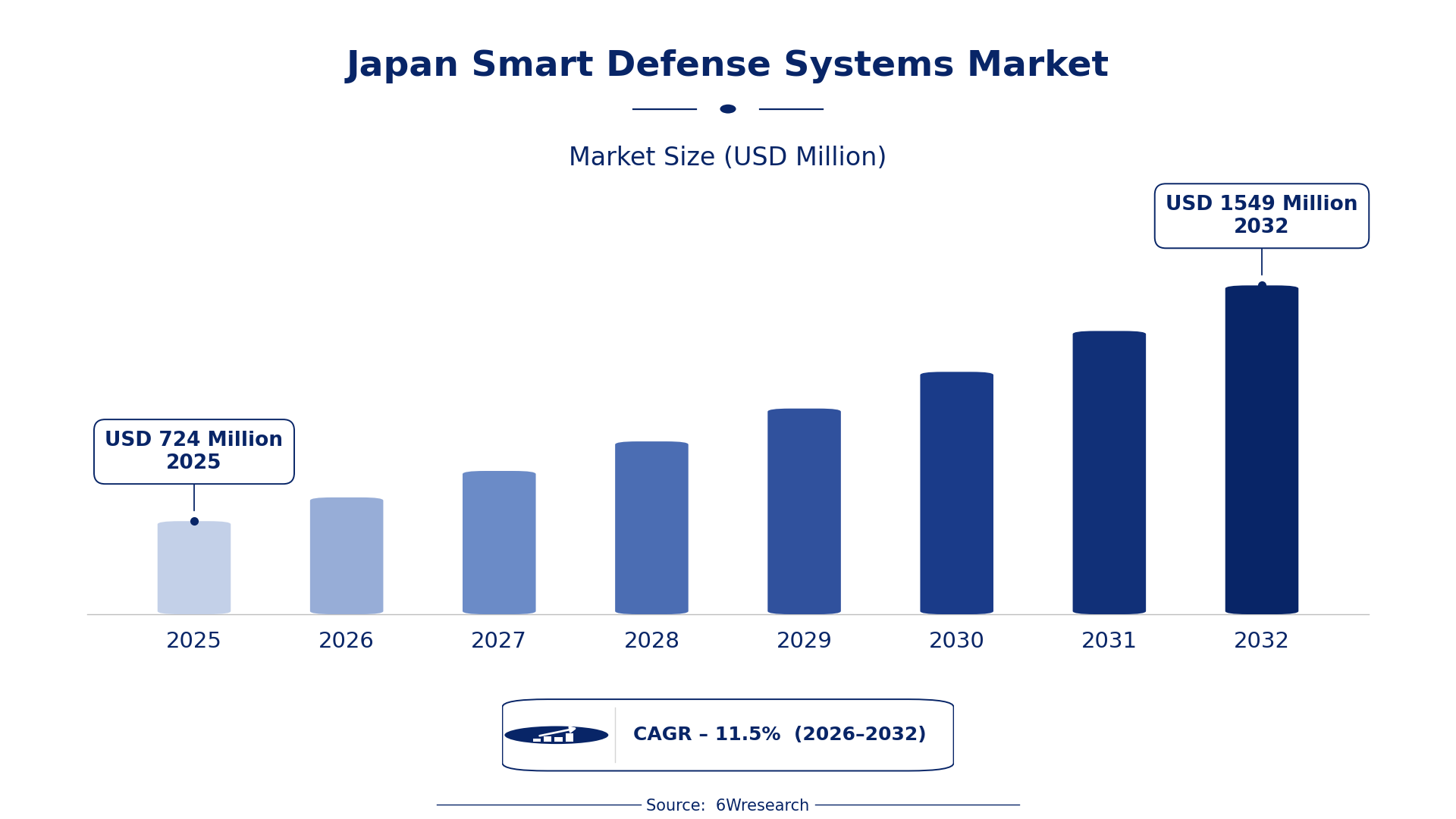
According to 6Wresearch internal database and industry insights, the Japan Smart Defense Systems Market was valued at USD 724 Million in 2025 and is projected to reach USD 1,549 Million by 2032, growing at a CAGR of approximately 11.5% during 2026–2032.
Japan Smart Defense Systems Market Highlights
| Report Metric | Details |
| Report Name | Japan Smart Defense Systems Market (2026-2032) |
| Market Size 2025 | USD 724 Million |
| Market Size 2032 | USD 1,549 Million |
| Absolute Growth 2025–2032 | USD 825 Million |
| CAGR 2026–2032 | 11.5% |
| Peak Annual Growth | 14.1% in 2026 |
| Forecast Period | 2026–2032 |
| Historical Data | 2022–2025 |
| Base Year | 2025 |
| Leading System Type, 2025 | Autonomous Weapon Systems (36% share) |
| Leading Smart Capability, 2025 | Target Identification AI (47% share) |
| Leading Deployment Area, 2025 | Ground/Sea/Air (38% share) |
| Leading End User, 2025 | Military R&D Units (36% share) |
| Fastest-Growing System Type | Smart Surveillance Drones (16.4% CAGR) |
| Fastest-Growing Smart Capability | Live Recon + AI Mapping (15.8% CAGR) |
| Fastest-Growing Deployment Area | Border Patrolling (14.2% CAGR) |
| Fastest-Growing End User | Homeland Security (15.2% CAGR) |
| Growing Sector | Defense Technology |
| Key End Users | Military R&D Units, National Security Agencies, Advanced Defense Tech Firms, Homeland Security |
Japan Smart Defense Systems Market Year-wise Growth Rate and Key Drivers (2022–2032)
This graph illustrates the annual growth rates of the market from 2022 to 2032, highlighting a steady upward trajectory and projected market expansion over the forecast period.
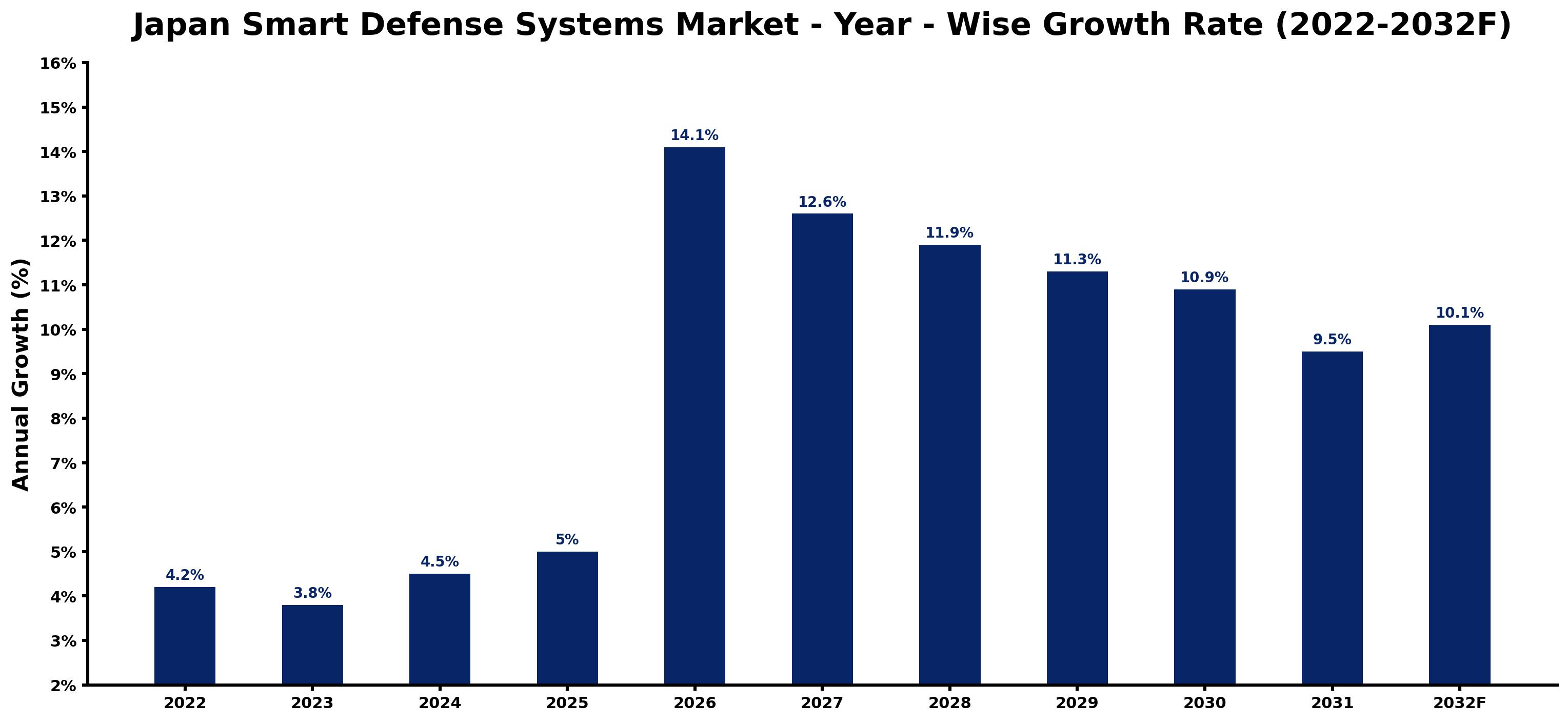
The yearly estimates that follow link every growth rate to its principal driver, so readers can see why the pace changed in each period.
| Year | Estimated Annual Growth (%) | Market Rationale |
| 2022 | 4.2 | The market showed steady growth due to ongoing military modernization efforts. |
| 2023 | 3.8 | Growth slowed as the government focused on budget allocations for advanced technology. |
| 2024 | 4.5 | Increased investment in AI integration spurred faster growth compared to the previous year. |
| 2025 | 5.0 | The market reached its historical peak as demand for smart systems surged. |
| 2026 | 14.1 | The forecast peak year saw a rise in demand driven by new defense initiatives. |
| 2027 | 12.6 | Growth is expected to slow as the market adjusts to the high demand of the previous year. |
| 2028 | 11.9 | Demand is projected to continue growing, though at a slightly reduced pace from the peak year. |
| 2029 | 11.3 | The market is expected to maintain growth, supported by ongoing military R&D investments. |
| 2030 | 10.9 | Growth is projected to slow further as the market stabilises after rapid expansion. |
| 2031 | 9.5 | The market will continue to grow, albeit at a slower rate than previous years. |
| 2032 | 10.1 | Demand is expected to rise again as new technologies are adopted in defense. |
Note: Market size estimations and growth projections presented in this report are based on 6Wresearch's proprietary forecasting methodology, utilizing the latest available industry data, government publications, and primary research inputs.
Japan Smart Defense Systems Market Synopsis
Smart Defense Systems in Japan encompass advanced technologies such as autonomous weaponry, surveillance, and cyber defense, aimed at improving national security and military readiness. The Japan Smart Defense Systems Market is expanding due to substantial government defense initiatives, with over 20% of the defense budget allocated to advanced technology. The focus on AI integration and the establishment of the Cyber Defense Unit further stimulate demand, ensuring market growth in the coming years.
Market Dynamics Impact Analysis (2026–2032)
| Factor | Type | Impact | Primary Segment Affected |
| Increased government spending on advanced technologies | Driver | High | Smart Surveillance Drones |
| Growing focus on cyber defense capabilities | Driver | High | Cyber Defense Platforms |
| Expansion of military R&D units | Opportunity | High | Military R&D Units |
| Rising demand for autonomous weapon systems in military operations | Opportunity | High | Autonomous Weapon Systems |
| Challenges in integrating new technologies into existing systems | Restraint | Medium | Smart Armor & Wearables |
| Dependence on foreign technology for certain components | Restraint | Medium | Cyber Defense Platforms |
| Limited domestic production capacity for advanced systems | Challenge | High | Smart Surveillance Drones |
| High costs associated with R&D and technology adoption | Challenge | High | Autonomous Weapon Systems |
Evaluation of Drivers in Japan Smart Defense Systems Market (2026–2032)
The following drivers explain most of the expected growth.
| Drivers | Primary Segment Affected | Why It Matters (Evidence) |
| Increased defense budget allocations | Smart Surveillance Drones | Japan's defense budget for 2023 is approximately 6.8 trillion yen, enabling more purchases of surveillance technology. |
| Focus on AI integration in defense systems | Cyber Defense Platforms | A program for AI integration has been initiated, boosting demand for cyber defense solutions. |
| Investment in autonomous systems | Autonomous Weapon Systems | Investment in autonomous systems is outlined by the strategy, increasing procurement. |
| Growing collaboration in defense technology research | Smart Armor & Wearables | Tokyo is a hub for defense technology research and development, driving innovation. |
| Rising cybersecurity threats | Cyber Defense Platforms | The establishment of the Cyber Defense Unit aims to enhance national security, prompting more investments. |
Much of the new demand traces back to increased defense budget allocations, with approximately 6.8 trillion yen earmarked for 2023. This funding enables the procurement of advanced technologies, particularly in Smart Surveillance Drones, which are crucial for reconnaissance. The emphasis on AI integration has sparked interest in Cyber Defense Platforms, necessary for safeguarding digital infrastructure. The establishment of the Cyber Defense Unit aims to strengthen national security, prompting more investments in cyber defense solutions.
Evaluation of Restraints in Japan Smart Defense Systems Market
These restraints slow adoption and weigh on supplier margins.
| Market Restraint | Primary Segment Affected | Why It Matters (Evidence) |
| Integration challenges with existing military systems | Smart Armor & Wearables | The complexity of integrating new technologies into existing frameworks limits adoption rates. |
| Reliance on foreign technology for advanced components | Cyber Defense Platforms | Dependence on imports for certain technologies can delay implementation and increase costs. |
| Limited domestic production capacity | Smart Surveillance Drones | Insufficient local manufacturing capabilities hinder the rapid deployment of new systems. |
| High research and development costs | Autonomous Weapon Systems | The investment required for R&D can deter smaller firms from entering the market. |
| Regulatory hurdles in technology approval | Cyber Defense Platforms | Stringent regulations can slow down the time to market for new technologies. |
Japan Smart Defense Systems Market Challenges
In 2023, Japan's defense budget allocates over 20% to advanced technology, which raises production costs for producers and limits their investment in new projects. Importers struggle with skills shortages as the demand for AI expertise outpaces the available workforce, delaying project timelines by several months. Distributors face challenges in technology adoption due to rapid innovation in smart defense systems, leading to increased costs and potential supply chain disruptions. Buyers encounter regulatory hurdles, as adhering to ISO/IEC 27001 for information security management complicates procurement processes and can extend lead times by up to 30 days.
Trends in the Japan Smart Defense Systems Market
Buyers and suppliers in the Japan Smart Defense Systems Market are adjusting to the following trends.
- Shift in Military Focus to Cyber Defense: National Security Agencies are prioritising cyber defense, as seen in the establishment of the Cyber Defense Unit in 2023. This initiative aims to protect Japan's digital infrastructure, with over 20% of the defense budget allocated to advanced technologies.
- Transition to Autonomous Systems in Military Operations: The strategy initiated in 2021 has led to a shift towards autonomous systems. By 2025, Japan aims to improve its military capabilities, with a projected investment of 6 trillion yen in autonomous technologies.
- Emergence of AI in Target Identification: Military R&D Units are increasingly adopting AI for target identification, with the Target Identification AI segment expected to grow significantly. This trend is driven by the need for improved accuracy in military operations, with a projected CAGR of 15.8%.
- Growing Demand for Smart Surveillance Drones: The demand for Smart Surveillance Drones has surged, particularly in border patrolling. In 2023, Japan launched a new initiative to enhance drone surveillance capabilities, reflecting a growing commitment to national security.
Investment Opportunities in the Japan Smart Defense Systems Market
Below are the investment opportunities with the strongest case in the Japan Smart Defense Systems Market.
- Gap in Domestic Production of Defense Technologies: With Japan aiming to double defense R&D spending by 2030, there is an opportunity to invest in local manufacturing capabilities for Smart Defense Systems, particularly in Tokyo, which is a hub for defense technology.
- Supply of Advanced Cyber Defense Solutions: The increasing focus on cybersecurity presents an opportunity to supply Cyber Defense Platforms. Military R&D Units are actively seeking advanced solutions to enhance national security, making this a timely investment area.
- Investment in Autonomous Weapon Systems: As the strategy targets autonomous systems, there is a pressing need for suppliers to provide advanced technologies. Military R&D Units are looking for partnerships to develop these systems, especially in Okinawa.
- Enhancement of Drone Surveillance Capabilities: The 2023 initiative to boost drone surveillance capabilities creates a demand for advanced Smart Surveillance Drones. Collaboration with local firms in Tokyo can facilitate market entry and meet this growing need.
Government Initiatives in the Japan Smart Defense Systems Market
The Semiconductor and Digital Industry Strategy, introduced in June 2021, supports domestic semiconductor manufacturing, ensuring a secure supply chain for critical components essential for Smart Defense Systems. This measure builds on previous laws by enhancing local production capabilities, which is vital for the industry.
The Japan Defense Agency oversees the procurement of defense technologies, ensuring compliance with the PMD Act. This law regulates the approval and quality of defense systems, allowing military R&D Units to access advanced technologies while maintaining high standards.
Future Insight of the Japan Smart Defense Systems Market
Japan's National Security Strategy will drive a shift towards advanced military capabilities, prompting suppliers to innovate and adapt. By 2030, the government aims to double defense R&D spending, which will stimulate advancements in smart defense systems. A 2023 initiative to enhance drone surveillance capabilities will improve situational awareness for military applications. The integration of AI in military operations is expected to progress significantly by 2026, enabling more effective national security strategies.
Market Segmentation Analysis
Japan Smart Defense Systems Market report covers a detailed analysis of the following market segments:
By System Type – Autonomous Weapon Systems Lead, Smart Surveillance Drones Expected to Grow Fastest
According to Saurav Kr Singh, Senior Research Analyst at 6Wresearch, Autonomous Weapon Systems held 36% of the Japan Smart Defense Systems Market by system type in 2025. Autonomous Weapon Systems hold the largest share as they are crucial for targeted military operations, particularly within Japan's Self-Defense Forces. This segment benefits from substantial government investment, highlighted by over 20% of the defense budget being allocated to advanced technology. Smart Surveillance Drones are set to record the highest CAGR in this split, 16.4% over 2026–2032. Smart Surveillance Drones are witnessing rapid growth due to their increasing use for reconnaissance and intelligence gathering, supported by a new initiative launched in 2023 to enhance drone capabilities. The demand for real-time surveillance will continue to propel this segment's expansion. Suppliers should concentrate on developing advanced autonomous systems to meet the rising military demands.
By Smart Capability – Target Identification AI Leads, Live Recon + AI Mapping Expected to Grow Fastest
Target Identification AI took 47% of smart capability revenue in 2025, more than any other category. Target Identification AI leads the market as it significantly enhances accuracy in military targeting, making it vital for operational success. The focus on integrating advanced technologies in defense systems further solidifies its position as a critical capability. The quickest growth will come from Live Recon + AI Mapping, forecast to expand at a CAGR of 15.8% between 2026 and 2032. Live Recon + AI Mapping is the fastest-growing segment, driven by the necessity for real-time situational awareness in military operations. The Ministry of Defense's objective to increase the use of advanced technologies by 2026 will further accelerate this segment's growth. Buyers will gain from investing in advanced capabilities to improve operational effectiveness.
By Deployment Area – Ground/Sea/Air Leads, Border Patrolling Expected to Grow Fastest
With 38% of deployment area revenue in 2025, Ground/Sea/Air was the largest category. Ground/Sea/Air dominates the market as it is essential for multi-domain operations, reflecting Japan's comprehensive defense strategy. The operations of the Self-Defense Forces across these domains highlight the importance of this segment. Border Patrolling is projected to grow fastest, at a CAGR of 14.2% during 2026–2032. Border Patrolling is the fastest-growing area, as it directly improves security along national borders, a priority outlined in Japan's National Security Strategy. Increased funding for border security initiatives will likely drive further growth in this segment. Suppliers should align their offerings with the increasing focus on border security solutions.
By End User – Military R&D Units Lead, Homeland Security Expected to Grow Fastest
In 2025, Military R&D Units led the end user split with a 36% share. Military R&D Units are the leading end users because they concentrate on developing new defense technologies crucial for Japan's military capabilities. Their key role in innovation is reinforced by the government's commitment to doubling defense R&D spending by 2030. Over 2026–2032, Homeland Security is expected to post the fastest growth, at a CAGR of 15.2%. Homeland Security is the fastest-growing end user segment, spurred by the rising need to ensure safety against domestic threats. The establishment of dedicated units underscores the urgency of enhancing homeland security measures. Buyers should prioritise solutions that address the evolving requirements of homeland security.
Key Attractiveness of the Report
- 10 Years of Market Numbers
- Historical Data Starting from 2022 to 2025
- Base Year 2025
- Forecast Data until 2032
- Key Performance Indicators Impacting the Market
- Major Upcoming Developments and Projects
Key Highlights of the Report:
- Japan Smart Defense Systems Market Outlook
- Market Size of Japan Smart Defense Systems Market, 2025
- Forecast of Japan Smart Defense Systems Market, 2032
- Historical Data and Forecast of Japan Smart Defense Systems Revenues & Volume for the Period 2022-2032F
- Japan Smart Defense Systems Market Trend Evolution
- Japan Smart Defense Systems Market Drivers and Challenges
- Japan Smart Defense Systems Price Trends
- Japan Smart Defense Systems Porter's Five Forces
- Japan Smart Defense Systems Industry Life Cycle
- Historical Data and Forecast of Japan Smart Defense Systems Market Revenues & Volume By System Type for the Period 2022-2032F
- Historical Data and Forecast of Japan Smart Defense Systems Market Revenues & Volume By Autonomous Weapon Systems for the Period 2022-2032F
- Historical Data and Forecast of Japan Smart Defense Systems Market Revenues & Volume By Smart Surveillance Drones for the Period 2022-2032F
- Historical Data and Forecast of Japan Smart Defense Systems Market Revenues & Volume By Cyber Defense Platforms for the Period 2022-2032F
- Historical Data and Forecast of Japan Smart Defense Systems Market Revenues & Volume By Smart Armor & Wearables for the Period 2022-2032F
- Historical Data and Forecast of Japan Smart Defense Systems Market Revenues & Volume By Smart Capability for the Period 2022-2032F
- Historical Data and Forecast of Japan Smart Defense Systems Market Revenues & Volume By Target Identification AI for the Period 2022-2032F
- Historical Data and Forecast of Japan Smart Defense Systems Market Revenues & Volume By Live Recon + AI Mapping for the Period 2022-2032F
- Historical Data and Forecast of Japan Smart Defense Systems Market Revenues & Volume By Threat Detection AI for the Period 2022-2032F
- Historical Data and Forecast of Japan Smart Defense Systems Market Revenues & Volume By Biometric + Condition Data for the Period 2022-2032F
- Historical Data and Forecast of Japan Smart Defense Systems Market Revenues & Volume By Deployment Area for the Period 2022-2032F
- Historical Data and Forecast of Japan Smart Defense Systems Market Revenues & Volume By Ground/Sea/Air for the Period 2022-2032F
- Historical Data and Forecast of Japan Smart Defense Systems Market Revenues & Volume By Border Patrolling for the Period 2022-2032F
- Historical Data and Forecast of Japan Smart Defense Systems Market Revenues & Volume By Digital Infrastructure for the Period 2022-2032F
- Historical Data and Forecast of Japan Smart Defense Systems Market Revenues & Volume By Field Troops for the Period 2022-2032F
- Historical Data and Forecast of Japan Smart Defense Systems Market Revenues & Volume By End User for the Period 2022-2032F
- Historical Data and Forecast of Japan Smart Defense Systems Market Revenues & Volume By Military R&D Units for the Period 2022-2032F
- Historical Data and Forecast of Japan Smart Defense Systems Market Revenues & Volume By Homeland Security for the Period 2022-2032F
- Historical Data and Forecast of Japan Smart Defense Systems Market Revenues & Volume By National Security Agencies for the Period 2022-2032F
- Historical Data and Forecast of Japan Smart Defense Systems Market Revenues & Volume By Advanced Defense Tech Firms for the Period 2022-2032F
- Japan Smart Defense Systems Import Export Trade Statistics
- Market Opportunity Assessment By System Type
- Market Opportunity Assessment By Smart Capability
- Market Opportunity Assessment By Deployment Area
- Market Opportunity Assessment By End User
- Japan Smart Defense Systems Top Companies Market Share
- Japan Smart Defense Systems Competitive Benchmarking By Technical and Operational Parameters
- Japan Smart Defense Systems Company Profiles
- Japan Smart Defense Systems Key Strategic Recommendations
Market Covered
The report covers the following segments.
By System Type
- Autonomous Weapon Systems
- Smart Surveillance Drones
- Cyber Defense Platforms
- Smart Armor & Wearables
By Smart Capability
- Target Identification AI
- Live Recon + AI Mapping
- Threat Detection AI
- Biometric + Condition Data
By Deployment Area
- Ground/Sea/Air
- Border Patrolling
- Digital Infrastructure
- Field Troops
By End User
- Military R&D Units
- Homeland Security
- National Security Agencies
- Advanced Defense Tech Firms






































