Japan Smart Device AI Market Size & Growth Rate
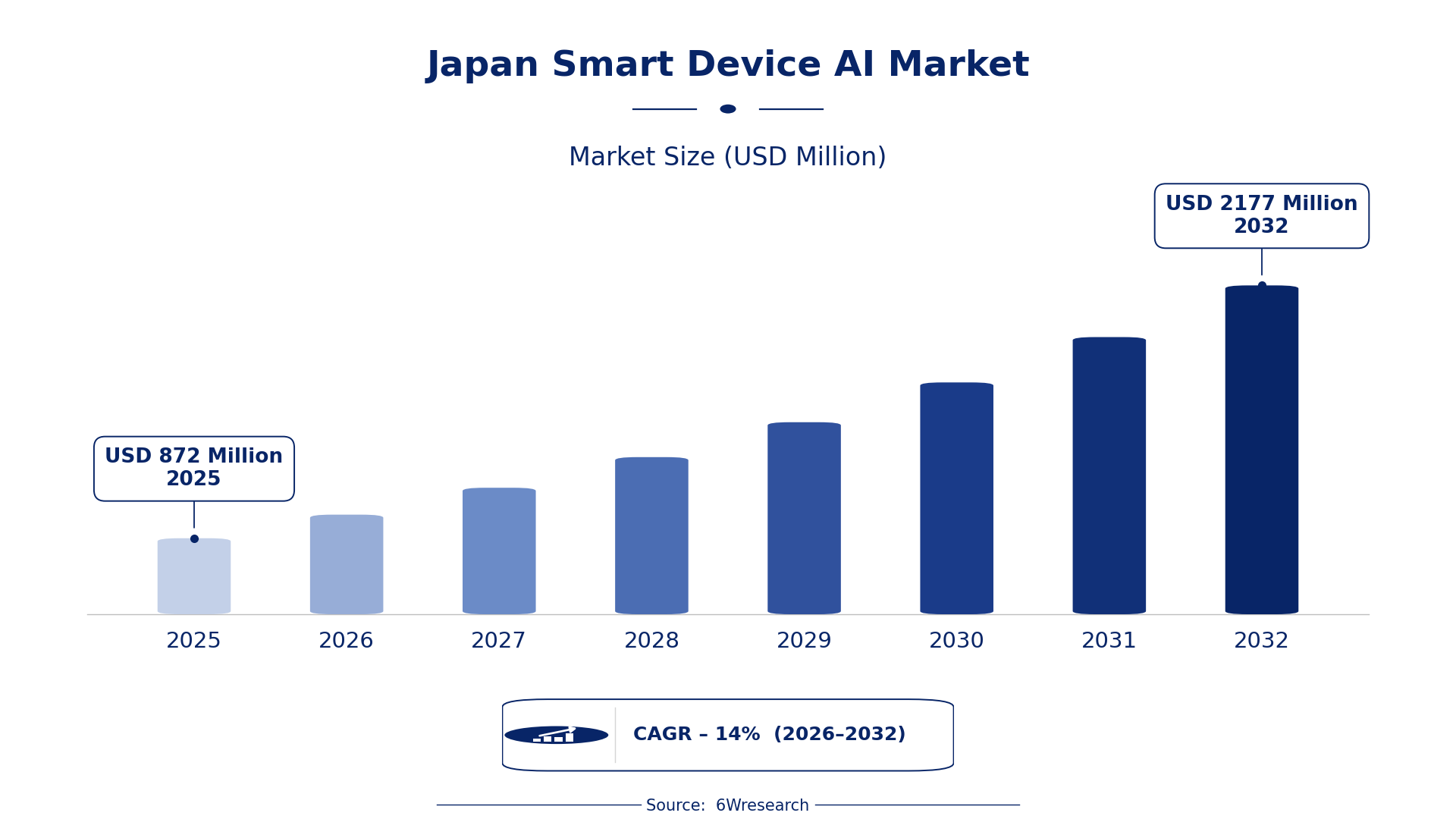
According to 6Wresearch internal database and industry insights, the Japan Smart Device AI Market was valued at USD 872 Million in 2025 and is projected to reach USD 2,177 Million by 2032, growing at a CAGR of approximately 14% during 2026–2032.
Japan Smart Device AI Market Highlights
| Report Metric | Details |
| Report Name | Japan Smart Device AI Market (2026-2032) |
| Market Size 2025 | USD 872 Million |
| Market Size 2032 | USD 2,177 Million |
| Absolute Growth 2025–2032 | USD 1,305 Million |
| CAGR 2026–2032 | 14% |
| Peak Annual Growth | 20.2% in 2032 |
| Forecast Period | 2026–2032 |
| Historical Data | 2022–2025 |
| Base Year | 2025 |
| Leading AI Feature Type, 2025 | Voice Recognition AI (41% share) |
| Leading Device Category, 2025 | Smart Speakers (41% share) |
| Leading Integration Mode, 2025 | On-Device + Cloud (50% share) |
| Leading End User, 2025 | Consumer Electronics Brands (39% share) |
| Fastest-Growing AI Feature Type | Predictive AI (15.5% CAGR) |
| Fastest-Growing Device Category | Wearables (19.1% CAGR) |
| Fastest-Growing Integration Mode | Embedded AI Chipsets (20.3% CAGR) |
| Fastest-Growing End User | Fitness Tech Companies (19.2% CAGR) |
| Growing Sector | Consumer Electronics |
| Key End Users | Consumer Electronics Brands, Fitness Tech Companies, Smart Home Developers, Surveillance Firms |
Japan Smart Device AI Market Year-wise Growth Rate and Key Drivers (2022–2032)
This graph illustrates the annual growth rates of the market from 2022 to 2032, highlighting a steady upward trajectory and projected market expansion over the forecast period.
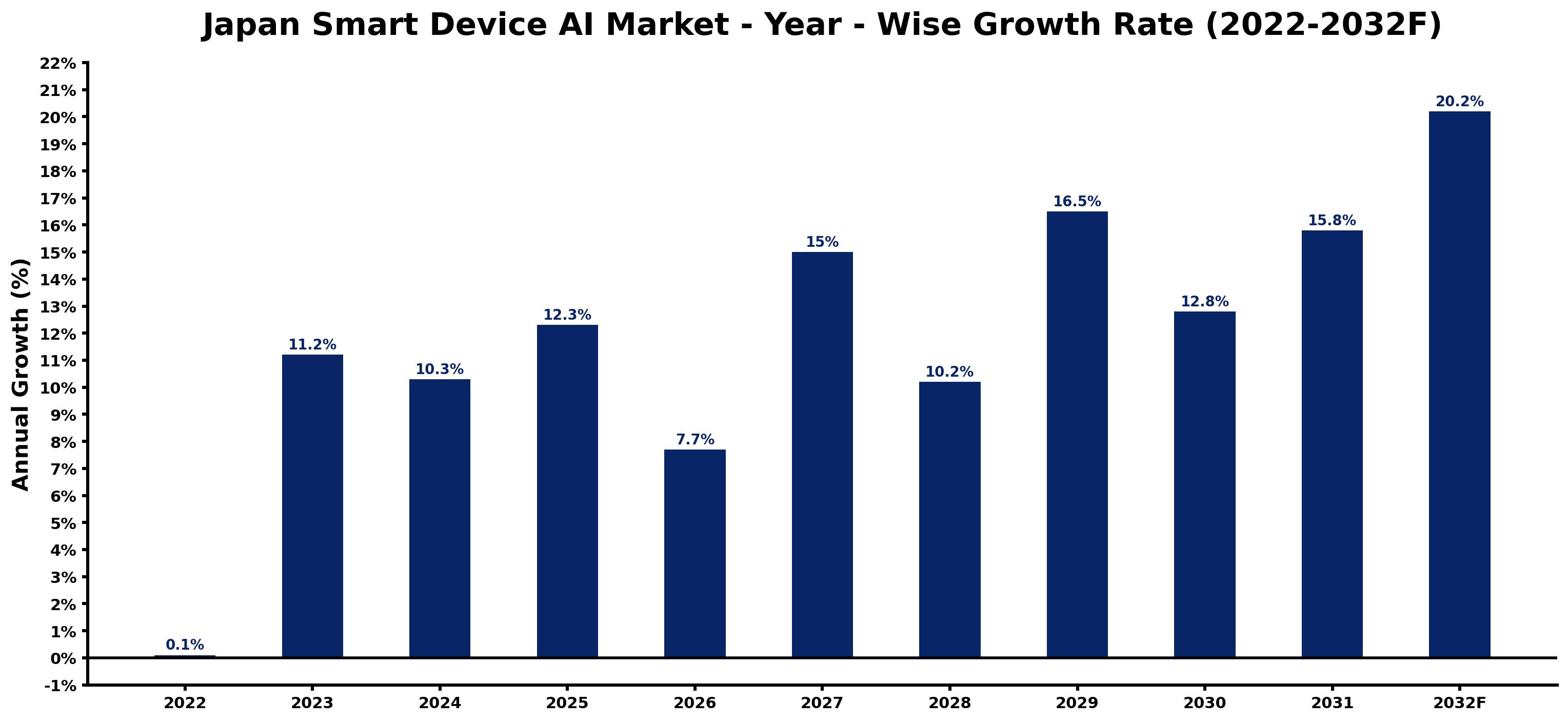
For each year, the table pairs the estimated growth rate with the leading influence on demand, showing how the drivers changed across the period.
| Year | Estimated Annual Growth (%) | Market Rationale |
| 2022 | 0.1 | The market showed minimal growth, reflecting initial adoption stages. |
| 2023 | 11.2 | Growth accelerated due to increased consumer interest in smart technologies. |
| 2024 | 10.3 | Growth slowed slightly as market saturation began affecting new purchases. |
| 2025 | 12.3 | A surge in demand occurred, driven by advancements in AI capabilities. |
| 2026 | 7.7 | Growth is expected to decelerate as the market adjusts to previous high rates. |
| 2027 | 15.0 | An increase in demand is projected, driven by more AI-integrated devices. |
| 2028 | 10.2 | Growth is anticipated to slow again as competition intensifies among manufacturers. |
| 2029 | 16.5 | Demand is expected to rise, propelled by urban smart city initiatives. |
| 2030 | 12.8 | Growth is projected to decelerate as the market matures and competition intensifies. |
| 2031 | 15.8 | A rebound in demand is expected, driven by new product launches. |
| 2032 | 20.2 | The market is projected to peak as consumer adoption of AI technologies surges. |
Note: Market size estimations and growth projections presented in this report are based on 6Wresearch's proprietary forecasting methodology, utilizing the latest available industry data, government publications, and primary research inputs.
Japan Smart Device AI Market Synopsis
Smart Device AI encompasses technologies that allow devices to execute tasks through artificial intelligence, including voice recognition and predictive analytics. The Japan Smart Device AI Market is growing swiftly, propelled by a tech-savvy population and substantial investment in AI technologies, which reached 1 billion USD in 2022. The uptake of smart speakers in approximately 30% of households and the incorporation of AI in consumer electronics are primary contributors to this expansion, generating new opportunities for manufacturers and developers.
Market Dynamics Impact Analysis (2026–2032)
| Factor | Type | Impact | Primary Segment Affected |
| Increased adoption of smart speakers and home assistants | Driver | High | Smart Speakers |
| Rising investment in AI technologies for consumer electronics | Driver | High | Consumer Electronics Brands |
| Growing demand for AI-enabled wearables in health monitoring | Opportunity | Medium | Wearables |
| Expansion of smart home technologies in new constructions | Opportunity | Medium | Smart Home Developers |
| Competition leading to price pressures on smart devices | Restraint | High | Smart Cameras |
| Market saturation affecting new product launches | Restraint | Medium | Home Assistants |
| Technological complexity hindering user adoption | Challenge | High | Natural Language AI |
| Regulatory hurdles delaying product approvals | Challenge | Medium | Embedded AI Chipsets |
Evaluation of Drivers in Japan Smart Device AI Market (2026–2032)
The main growth drivers and the segments they affect most are set out below.
| Drivers | Primary Segment Affected | Why It Matters (Evidence) |
| Increased consumer interest in smart home automation | Smart Speakers | The adoption rate of smart speakers is around 30% of households, resulting in higher purchases. |
| Investment in AI for personalized user experiences | Predictive AI | Predictive AI is increasingly used in retail, driving customer engagement and boosting sales. |
| Integration of AI in health monitoring devices | Wearables | The Japanese population using wearables is estimated at 10 million, increasing demand for health tech. |
| Rising security concerns driving smart camera sales | Smart Cameras | Smart cameras are expected to see a rise in demand due to growing security concerns. |
| Government initiatives promoting AI integration in consumer electronics | Consumer Electronics Brands | The Ministry of Internal Affairs and Communications promotes AI integration, encouraging manufacturers to innovate. |
Buyers are adding capacity as the adoption rate of smart speakers reaches around 30% of households, increasing the need for home automation solutions. Investment in AI technologies for personalized user experiences is rising, with predictive AI being used in retail to drive customer engagement. Approximately 10 million people in Japan are using wearables, boosting the market for health monitoring devices. Security concerns are pushing smart camera sales higher, as they are expected to see a notable increase in demand.
Evaluation of Restraints in Japan Smart Device AI Market
The table below lists the restraints and the evidence behind each.
| Market Restraint | Primary Segment Affected | Why It Matters (Evidence) |
| Intense competition leading to price pressures | Smart Cameras | Price competition among manufacturers is affecting profit margins and product viability. |
| Market saturation affecting new product launches | Home Assistants | As the market matures, fewer new products are being introduced, limiting growth opportunities. |
| Technological complexity hindering user adoption | Natural Language AI | Users often struggle with complex AI functionalities, which reduces market penetration. |
| Regulatory hurdles delaying product approvals | Embedded AI Chipsets | Strict regulations can slow down the introduction of new AI-integrated devices. |
| Consumer hesitance due to privacy concerns | Wearables | Privacy issues surrounding data collection deter potential buyers from adopting wearables. |
Japan Smart Device AI Market Challenges
A major obstacle in the smart device AI market is fierce competition, which compels producers to accelerate innovation cycles, resulting in increased R&D costs that can delay product launches for manufacturers. Supply chain disruptions, particularly in sourcing critical components, extend lead times, costing buyers up to 20% in potential market share as they struggle to meet consumer demand. A shortage of skilled professionals in AI development limits producers' capacity to implement advanced technologies, causing frustrating delays for buyers who expect timely product releases. Rising material costs are tightening margins, forcing hospitals to reconsider investments in smart medical devices due to financial constraints.
Trends in the Japan Smart Device AI Market
These developments are changing demand patterns in the Japan Smart Device AI Market.
- Shift towards Smart Home Technologies: Tokyo is experiencing a shift towards smart home technologies, with 20% of new home constructions incorporating these solutions. This trend reflects a growing consumer preference for automation and connectivity.
- Consumer Electronics Brands Integrating AI: Consumer Electronics Brands are increasingly integrating AI into their products, with over 60% of smart assistants utilising Natural Language AI. This change improves user interaction and drives sales.
- Rise of Edge AI in Urban Areas: Edge AI technology is gaining traction in urban areas for smart city applications, improving response times and efficiency. This trend is illustrated by initiatives from the Tokyo Metropolitan Government.
- Increased Adoption of Wearables for Health Monitoring: The integration of AI in wearables is rising, with 15% of fitness tech companies incorporating AI for better user engagement. This trend supports the growing health-conscious consumer base.
Investment Opportunities in the Japan Smart Device AI Market
Investors looking at the Japan Smart Device AI Market should consider the following areas.
- Supply of AI-Integrated Health Monitoring Devices: The demand for wearables is growing, with 10 million users in Japan. Companies can enter this market by partnering with health tech firms to develop effective solutions.
- Development of Smart Home Technologies: Smart home technologies are expanding in new constructions, with 20% of homes incorporating these solutions. Developers can invest in AI-driven home automation systems to meet rising demand.
- Provision of Embedded AI Chipsets for Devices: With the increasing integration of AI in devices, there is a notable opportunity in supplying embedded AI chipsets. Collaborating with consumer electronics brands can facilitate market entry.
- Investment in Predictive AI for Retail Applications: The retail sector is increasingly adopting predictive AI for consumer behaviour analysis. Companies can target retail firms to provide tailored AI solutions that improve customer experiences.
Government Initiatives in the Japan Smart Device AI Market
The PMD Act governs the approval and quality of pharmaceuticals and medical devices, ensuring that products meet safety standards. The Industrial Standardization Act promotes consistent quality across smart devices by regulating JIS product standards. These laws create a framework that supports the development and integration of Smart Device AI in Japan, ensuring compliance and safety for consumers and manufacturers alike.
Consumer Electronics Brands utilise funding from AMED to improve their AI capabilities. This agency supports research and development, enabling manufacturers to innovate and expand their product offerings in the Smart Device AI Market.
Future Insight of the Japan Smart Device AI Market
The government's 'AI Strategy 2025' programme will drive a policy shift towards enhanced AI capabilities, prompting suppliers to invest in advanced technologies. By 2032, smart home technology adoption is expected to reach 40% of new constructions, with urban areas seeing increased deployment of Edge AI for smart city applications. The integration of predictive AI in retail will transform consumer interactions, allowing suppliers to tailor their offerings more effectively. The rising demand for smart cameras due to security concerns will further shape the market.
Market Segmentation Analysis
Japan Smart Device AI Market report covers a detailed analysis of the following market segments:
By AI Feature Type – Voice Recognition AI Leads, Predictive AI Expected to Grow Fastest
According to Saurav Kr Singh, Senior Research Analyst at 6Wresearch, Voice Recognition AI took 41% of ai feature type revenue in 2025, more than any other category. Voice Recognition AI holds the largest share as it is extensively used in smart assistants, crucial for user interaction. For instance, over 60% of smart assistants in Japan utilise this technology, making it indispensable for enhancing user experience. Over 2026–2032, Predictive AI is expected to post the fastest growth, at a CAGR of 15.5%. Predictive AI is experiencing rapid growth due to its increasing application in retail for consumer behaviour analysis, which optimises shopping experiences. The demand for personalised recommendations across various sectors underscores this trend. Suppliers should prioritise the development of predictive features to meet changing consumer expectations.
By Device Category – Smart Speakers Lead, Wearables Expected to Grow Fastest
With 41% of device category revenue in 2025, Smart Speakers was the largest category. Smart Speakers dominate the market as they are widely favoured for home automation and entertainment, with approximately 30% of households adopting them. This high adoption rate signifies a growing integration of smart technology into daily life. Wearables are projected to grow fastest, at a CAGR of 19.1% during 2026–2032. Wearables are witnessing the fastest growth as they are increasingly used for health monitoring and fitness tracking, appealing to a tech-savvy audience. The estimated 10 million users of wearables in Japan further supports this trend. Manufacturers should focus on enhancing health and fitness tracking features to leverage the expanding wearable market.
By Integration Mode – On-Device + Cloud Leads, Embedded AI Chipsets Expected to Grow Fastest
On-Device + Cloud held 50% of the Japan Smart Device AI Market by integration mode in 2025. On-Device + Cloud integration leads the market by merging local processing with cloud capabilities, providing a seamless user experience. This approach supports various applications, making it attractive to both developers and consumers. Embedded AI Chipsets are set to record the highest CAGR in this split, 20.3% over 2026–2032. Embedded AI Chipsets are rapidly gaining popularity as they integrate functionalities directly into devices, enhancing performance and user convenience. This trend is driven by the demand for smarter, more efficient devices. Developers must invest in embedded technologies to remain competitive in the advancing smart device market.
By End User – Consumer Electronics Brands Lead, Fitness Tech Companies Expected to Grow Fastest
In 2025, Consumer Electronics Brands led the end user split with a 39% share. Consumer Electronics Brands hold the largest share as they play a crucial role in developing and marketing AI-enabled devices, driving market innovation. Their established presence and consumer trust reinforce their leading position. The quickest growth will come from Fitness Tech Companies, forecast to expand at a CAGR of 19.2% between 2026 and 2032. Fitness Tech Companies are growing swiftly as they leverage AI for personalised fitness solutions, catering to a health-conscious consumer base. This trend is evident with 15% of fitness tech companies integrating AI for improved user engagement. Brands should explore partnerships with fitness tech companies to enhance their product offerings and tap into new customer segments.
Key Attractiveness of the Report
- 10 Years of Market Numbers
- Historical Data Starting from 2022 to 2025
- Base Year 2025
- Forecast Data until 2032
- Key Performance Indicators Impacting the Market
- Major Upcoming Developments and Projects
Key Highlights of the Report:
- Japan Smart Device AI Market Outlook
- Market Size of Japan Smart Device AI Market, 2025
- Forecast of Japan Smart Device AI Market, 2032
- Historical Data and Forecast of Japan Smart Device AI Revenues & Volume for the Period 2022-2032F
- Japan Smart Device AI Market Trend Evolution
- Japan Smart Device AI Market Drivers and Challenges
- Japan Smart Device AI Price Trends
- Japan Smart Device AI Porter's Five Forces
- Japan Smart Device AI Industry Life Cycle
- Historical Data and Forecast of Japan Smart Device AI Market Revenues & Volume By AI Feature Type for the Period 2022-2032F
- Historical Data and Forecast of Japan Smart Device AI Market Revenues & Volume By Voice Recognition AI for the Period 2022-2032F
- Historical Data and Forecast of Japan Smart Device AI Market Revenues & Volume By Predictive AI for the Period 2022-2032F
- Historical Data and Forecast of Japan Smart Device AI Market Revenues & Volume By Visual Recognition AI for the Period 2022-2032F
- Historical Data and Forecast of Japan Smart Device AI Market Revenues & Volume By Natural Language AI for the Period 2022-2032F
- Historical Data and Forecast of Japan Smart Device AI Market Revenues & Volume By Device Category for the Period 2022-2032F
- Historical Data and Forecast of Japan Smart Device AI Market Revenues & Volume By Smart Speakers for the Period 2022-2032F
- Historical Data and Forecast of Japan Smart Device AI Market Revenues & Volume By Wearables for the Period 2022-2032F
- Historical Data and Forecast of Japan Smart Device AI Market Revenues & Volume By Smart Cameras for the Period 2022-2032F
- Historical Data and Forecast of Japan Smart Device AI Market Revenues & Volume By Home Assistants for the Period 2022-2032F
- Historical Data and Forecast of Japan Smart Device AI Market Revenues & Volume By Integration Mode for the Period 2022-2032F
- Historical Data and Forecast of Japan Smart Device AI Market Revenues & Volume By On-Device + Cloud for the Period 2022-2032F
- Historical Data and Forecast of Japan Smart Device AI Market Revenues & Volume By Embedded AI Chipsets for the Period 2022-2032F
- Historical Data and Forecast of Japan Smart Device AI Market Revenues & Volume By Edge AI for the Period 2022-2032F
- Historical Data and Forecast of Japan Smart Device AI Market Revenues & Volume By Cloud-Based AI Engines for the Period 2022-2032F
- Historical Data and Forecast of Japan Smart Device AI Market Revenues & Volume By End User for the Period 2022-2032F
- Historical Data and Forecast of Japan Smart Device AI Market Revenues & Volume By Consumer Electronics Brands for the Period 2022-2032F
- Historical Data and Forecast of Japan Smart Device AI Market Revenues & Volume By Fitness Tech Companies for the Period 2022-2032F
- Historical Data and Forecast of Japan Smart Device AI Market Revenues & Volume By Surveillance Firms for the Period 2022-2032F
- Historical Data and Forecast of Japan Smart Device AI Market Revenues & Volume By Smart Home Developers for the Period 2022-2032F
- Japan Smart Device AI Import Export Trade Statistics
- Market Opportunity Assessment By AI Feature Type
- Market Opportunity Assessment By Device Category
- Market Opportunity Assessment By Integration Mode
- Market Opportunity Assessment By End User
- Japan Smart Device AI Top Companies Market Share
- Japan Smart Device AI Competitive Benchmarking By Technical and Operational Parameters
- Japan Smart Device AI Company Profiles
- Japan Smart Device AI Key Strategic Recommendations
Market Covered
This report examines the market across the segments below.
By AI Feature Type
- Voice Recognition AI
- Predictive AI
- Visual Recognition AI
- Natural Language AI
By Device Category
- Smart Speakers
- Wearables
- Smart Cameras
- Home Assistants
By Integration Mode
- On-Device + Cloud
- Embedded AI Chipsets
- Edge AI
- Cloud-Based AI Engines
By End User
- Consumer Electronics Brands
- Fitness Tech Companies
- Surveillance Firms
- Smart Home Developers































