Japan Smart Devices Market Size & Growth Rate
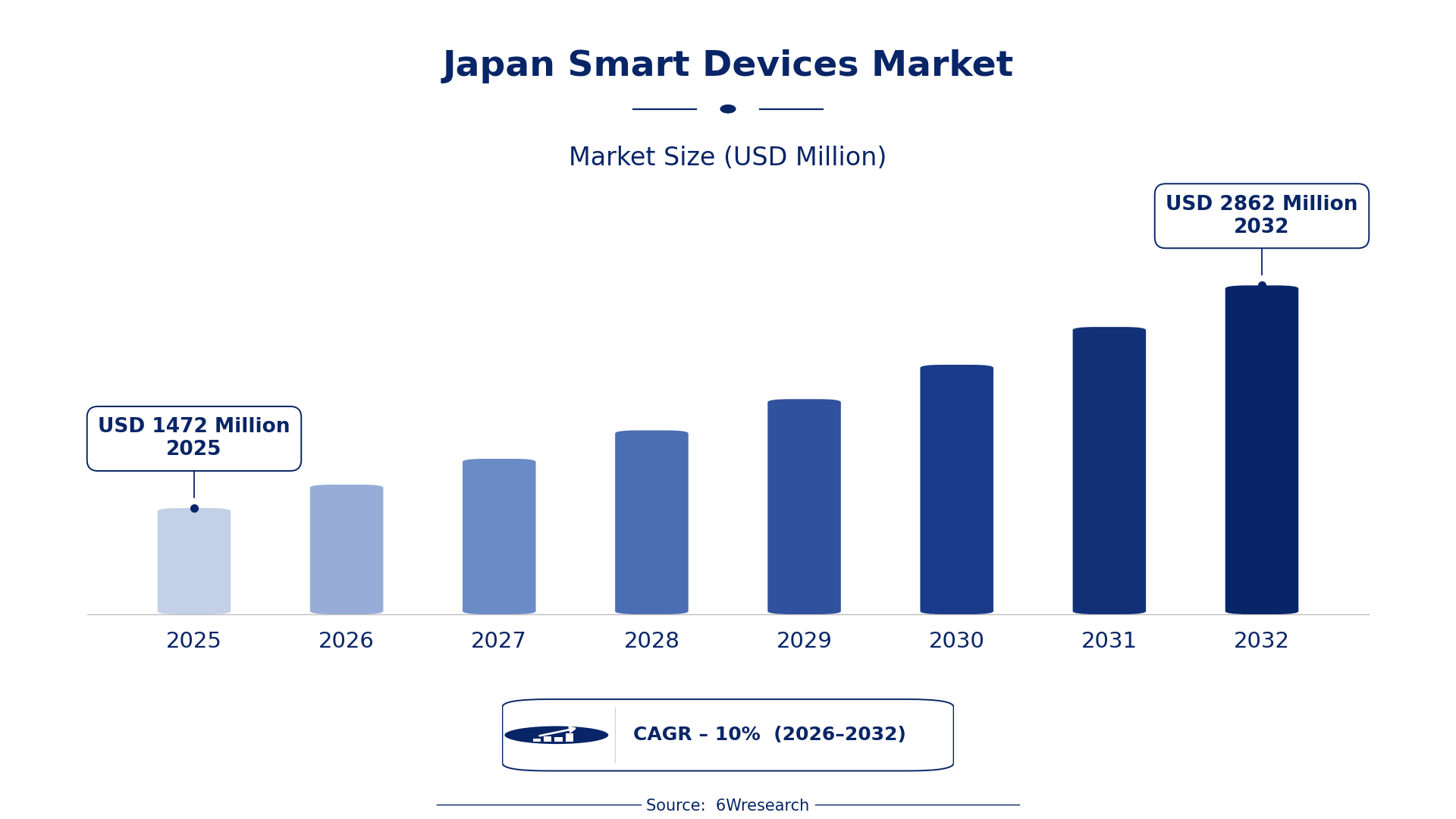
According to 6Wresearch internal database and industry insights, the Japan Smart Devices Market was valued at USD 1,472 Million in 2025 and is projected to reach USD 2,862 Million by 2032, growing at a CAGR of approximately 10% during 2026–2032.
Japan Smart Devices Market Highlights
| Report Metric | Details |
| Report Name | Japan Smart Devices Market (2026-2032) |
| Market Size 2025 | USD 1,472 Million |
| Market Size 2032 | USD 2,862 Million |
| Absolute Growth 2025–2032 | USD 1,390 Million |
| CAGR 2026–2032 | 10% |
| Peak Annual Growth | 13.9% in 2032 |
| Forecast Period | 2026–2032 |
| Historical Data | 2022–2025 |
| Base Year | 2025 |
| Leading Device Type, 2025 | Smart TVs (41% share) |
| Leading Smart Feature, 2025 | Streaming + Apps (40% share) |
| Leading Connectivity, 2025 | Wi-Fi/Bluetooth (34% share) |
| Leading End User, 2025 | Smart Home Users (49% share) |
| Fastest-Growing Device Type | Smart Watches (14.8% CAGR) |
| Fastest-Growing Smart Feature | Health + Notifications (13.1% CAGR) |
| Fastest-Growing Connectivity | IoT Cloud (15.0% CAGR) |
| Fastest-Growing End User | Wearable Consumers (13.4% CAGR) |
| Growing Sector | Smart Home Technology |
| Key End Users | Smart Home Users, Wearable Consumers, Entertainment Electronics |
Japan Smart Devices Market Year-wise Growth Rate and Key Drivers (2022–2032)
This graph illustrates the annual growth rates of the market from 2022 to 2032, highlighting a steady upward trajectory and projected market expansion over the forecast period.
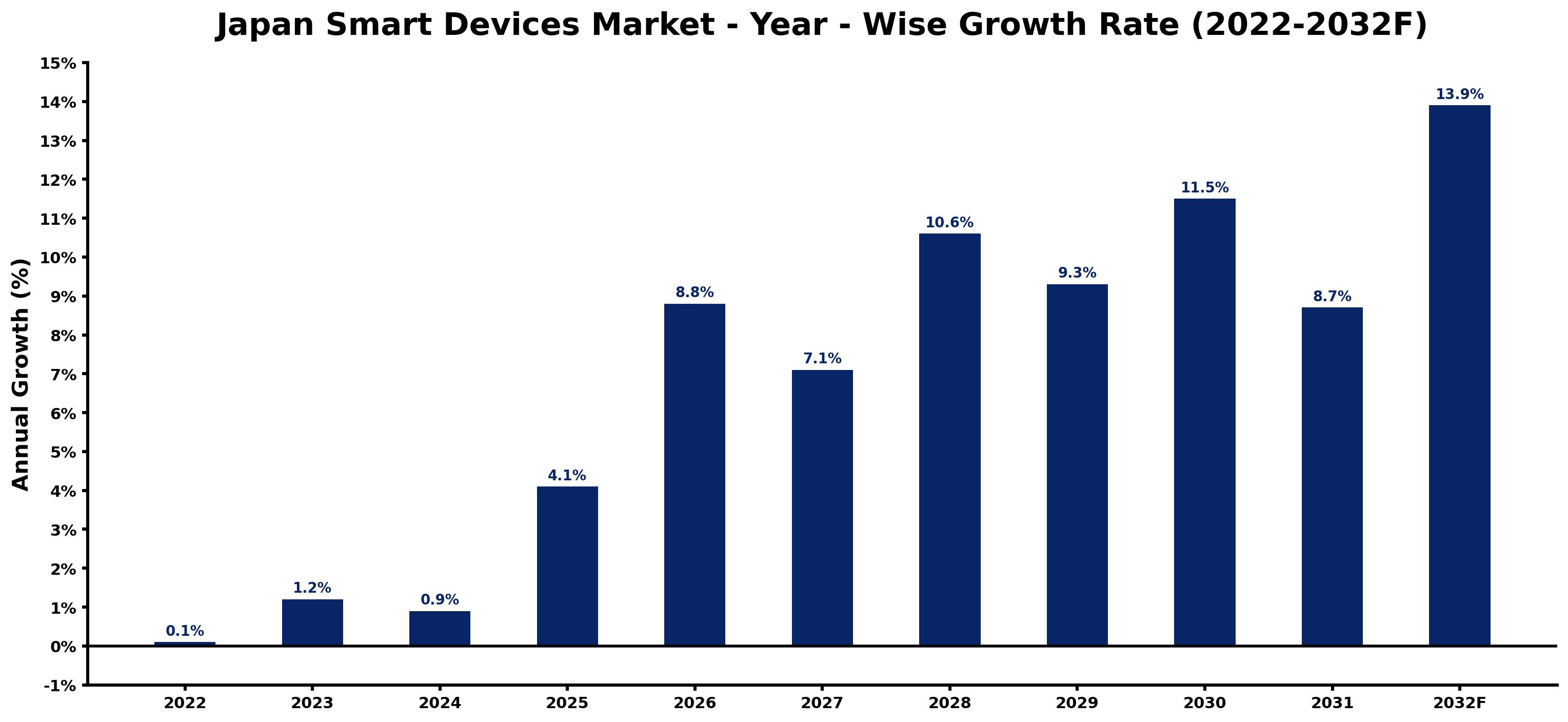
Each row of the following table gives one year's estimated growth and the event or demand shift that explains it.
| Year | Estimated Annual Growth (%) | Market Rationale |
| 2022 | 0.1 | The market showed minimal growth, reflecting initial adoption stages among consumers. |
| 2023 | 1.2 | Growth accelerated as more households integrated smart devices into their daily routines. |
| 2024 | 0.9 | The market experienced a slowdown as consumers became more selective in purchases. |
| 2025 | 4.1 | Growth surged as smart device penetration reached critical mass in urban areas. |
| 2026 | 8.8 | Demand is expected to continue rising due to increased health monitoring awareness among users. |
| 2027 | 7.1 | The market is projected to slow as saturation begins to impact growth rates in urban households. |
| 2028 | 10.6 | Growth is expected to pick up again as new smart technologies are introduced to consumers. |
| 2029 | 9.3 | The market will slow slightly as competition intensifies among device manufacturers. |
| 2030 | 11.5 | Growth is projected to accelerate due to rising interest in smart home energy management systems. |
| 2031 | 8.7 | The market is expected to slow as consumers become more discerning about device features. |
| 2032 | 13.9 | Growth will peak as smart devices become integral to daily life for many households. |
Note: Market size estimations and growth projections presented in this report are based on 6Wresearch's proprietary forecasting methodology, utilizing the latest available industry data, government publications, and primary research inputs.
Japan Smart Devices Market Synopsis
Smart devices encompass a variety of interconnected electronic products designed to improve convenience and efficiency in daily life. These products are increasingly adopted for home automation, health monitoring, and entertainment. The Japan Smart Devices Market is expanding due to rising consumer interest, particularly in urban areas like Tokyo and Osaka, where smart home integration is becoming common. With smart device penetration reaching 45% of households in 2023, the market is set for significant growth as more users embrace technology to enhance their quality of life.
Market Dynamics Impact Analysis (2026–2032)
| Factor | Type | Impact | Primary Segment Affected |
| Growing urbanisation and technological adoption drive demand for smart devices. | Driver | High | Smart Home Users |
| Increasing health awareness among consumers creates opportunities for health-focused devices. | Driver | High | Wearable Consumers |
| Rising energy efficiency concerns present opportunities for smart appliance manufacturers. | Opportunity | High | Smart Refrigerators |
| The expansion of IoT technologies opens new avenues for innovative smart device applications. | Opportunity | High | IoT Cloud |
| High competition among manufacturers may lead to price wars, affecting margins. | Restraint | Medium | Smart Speakers |
| Consumer hesitance to adopt new technologies can slow market growth. | Restraint | Medium | Smart Watches |
| Supply chain disruptions can delay product availability and affect sales. | Challenge | High | Smart TVs |
| Rapid technological changes require continuous innovation, posing a challenge for manufacturers. | Challenge | High | Smart Refrigerators |
Evaluation of Drivers in Japan Smart Devices Market (2026–2032)
The main growth drivers and the segments they affect most are set out below.
| Drivers | Primary Segment Affected | Why It Matters (Evidence) |
| Increased health monitoring features in smart devices. | Smart Watches | Health monitoring features are gaining traction, with 25% of wearable device sales attributed to smart watches in 2022. |
| Growing interest in home automation technologies. | Smart Speakers | The number of smart speakers sold in Japan reached approximately 3 million units in 2022, reflecting strong consumer interest. |
| Rising demand for energy-efficient appliances. | Smart Refrigerators | The market for smart refrigerators is projected to grow as consumers seek energy-efficient solutions. |
| Improved connectivity through Wi-Fi 6 technology. | Wi-Fi/Bluetooth | Integration of Wi-Fi 6 technology improves connectivity, making smart devices more appealing to consumers. |
| Increased penetration of smart devices in urban households. | Smart Home Users | Smart device penetration reached 45% of households in 2023, indicating widespread adoption. |
Orders keep climbing as urban households increasingly adopt smart devices for convenience. In 2023, smart device penetration reached 45% of households, driven by growing interest in home automation. Approximately 3 million smart speakers were sold in 2022, reflecting heightened consumer demand. The integration of Wi-Fi 6 technology improves connectivity, making devices more attractive to users. Health monitoring features in smart watches accounted for 25% of wearable device sales, further boosting their popularity.
Evaluation of Restraints in Japan Smart Devices Market
Several factors work against faster growth; the main ones are summarised below.
| Market Restraint | Primary Segment Affected | Why It Matters (Evidence) |
| High competition may lead to price reductions, impacting profitability. | Smart Speakers | Intense competition among manufacturers can result in lower prices, squeezing profit margins. |
| Consumer hesitance towards adopting new technologies can limit growth. | Smart Watches | Many potential users remain cautious about integrating new technologies into their lives. |
| Supply chain disruptions can delay product launches and availability. | Smart TVs | Global supply chain issues have affected the timely delivery of smart devices. |
| Rapid technological advancements necessitate constant innovation. | Smart Refrigerators | Manufacturers must continuously invest in R&D to keep pace with evolving consumer preferences. |
| Market saturation in urban areas can slow growth rates. | Smart Home Users | As more households adopt smart devices, the potential for new customers diminishes. |
Japan Smart Devices Market Challenges
Homeowners face high costs due to a shortage of skilled technicians for installation and maintenance, delaying smart device deployment and potentially costing them up to JPY 500,000 in lost productivity. Suppliers encounter increased production costs stemming from advanced technology requirements, which inflate retail prices by 15% for consumers. Outdated infrastructure leads to integration challenges, causing compatibility issues that can delay product launches by several months, impacting suppliers' market entry. Local producers contend with fierce competition from international brands, forcing them to reduce margins by up to 10%, limiting their capacity for innovation.
Trends in the Japan Smart Devices Market
The trends below show where the Japan Smart Devices Market is heading.
- Shift towards Energy-Efficient Smart Appliances: The 'Smart Life Project' launched in 2023 promotes energy-efficient smart appliances, with approximately 60% of smart device users reporting improved quality of life.
- Increase in Health Monitoring Features: In 2022, health monitoring features became increasingly popular, with smart watches capturing 25% of wearable device sales, reflecting a growing consumer focus on health.
- Expansion of IoT Cloud Services: The IoT Cloud segment is expected to grow, with a CAGR of 15.0% from 2026 to 2032, driven by increasing demand for data processing solutions.
- Integration of Wi-Fi 6 Technology: As of 2023, new smart devices are increasingly integrating Wi-Fi 6 technology for better connectivity, improving user experience and encouraging adoption.
Investment Opportunities in the Japan Smart Devices Market
The following areas offer the clearest openings for investors and suppliers in the Japan Smart Devices Market.
- Supply of Smart Home Energy Management Systems: The demand for smart home energy management systems is rising, with urban areas showing a need. Smart home users are expected to increase by 30% by 2025, presenting a significant opportunity.
- Investment in Health-Focused Smart Devices: With health monitoring becoming a priority, there is a strong market for health-focused smart devices. Wearable consumers are increasingly seeking devices that provide health insights, creating a promising investment avenue.
- Development of IoT-Enabled Solutions: The growing IoT market presents opportunities for innovative solutions. Urban areas are ideal for deploying IoT-enabled devices, allowing for improved user experience.
- Expansion of Smart Device Offerings: With smart device penetration at 45%, there is room for new product offerings. Smart home users are a key buyer group, indicating a need for diverse smart device solutions.
Government Initiatives in the Japan Smart Devices Market
The PMD Act, established in 2014, regulates the approval and quality of medical devices, impacting the production of health-related smart devices. The GX Basic Policy adopted in 2023 aims for JPY 150 trillion in public-private investment, driving innovation in smart technologies and benefiting manufacturers and consumers alike.
The Pharmaceuticals and Medical Devices Agency (PMDA) reviews and monitors medical devices, ensuring safety and efficacy for smart health devices. The Japan Agency for Medical Research and Development (AMED) funds projects to advance medical technologies, supporting the smart device sector and facilitating new product development.
Future Insight of the Japan Smart Devices Market
Investment in smart device technology will increase significantly by 2032, with government initiatives like the 'Smart Life Project' and the adoption of standards such as ISO/IEC 30141:2018 driving this change. This surge in investment will create demand for advanced home solutions, particularly in urban areas. The number of smart home users is expected to grow by 30% by 2025, expanding opportunities for suppliers. The integration of Wi-Fi 6 technology will improve connectivity, enabling more efficient user experiences and encouraging broader adoption.
Market Segmentation Analysis
Japan Smart Devices Market report covers a detailed analysis of the following market segments:
By Device Type – Smart TVs Lead, Smart Watches Expected to Grow Fastest
According to Saurav Kr Singh, Senior Research Analyst at 6Wresearch, with 41% of device type revenue in 2025, Smart TVs was the largest category. Smart TVs dominate the market as they are widely used for streaming and entertainment, appealing to a diverse demographic. With approximately 3 million units sold in 2022, they have become a common fixture in Japanese households. Smart Watches are projected to grow fastest, at a CAGR of 14.8% during 2026–2032. Smart Watches are rapidly gaining traction, driven by a surge in demand for health tracking capabilities, which represented 25% of wearable device sales in 2022. This growth indicates that as health consciousness increases, Smart Watches will likely capture an even larger market share. Suppliers should focus on enhancing health tracking features and entertainment functionalities to attract a broader consumer base.
By Smart Feature – Streaming + Apps Lead, Health + Notifications Expected to Grow Fastest
In 2025, Streaming + Apps led the smart feature split with a 40% share. Streaming + Apps lead the segment as they are integral for entertainment purposes, aligning with consumer preferences for on-demand content. The high penetration of smart devices in households supports the popularity of this feature. The quickest growth will come from Health + Notifications, forecast to expand at a CAGR of 13.1% between 2026 and 2032. Health + Notifications are experiencing the fastest growth, driven by the increasing use of wearable devices for health monitoring, reflecting a shift towards health-conscious technology. This trend is likely to accelerate as consumers seek more integrated health solutions. Suppliers should prioritise the development of health-related functionalities to meet the growing consumer demand in this area.
By Connectivity – Wi-Fi/Bluetooth Leads, IoT Cloud Expected to Grow Fastest
Wi-Fi/Bluetooth held 34% of the Japan Smart Devices Market by connectivity in 2025. Wi-Fi/Bluetooth technologies are essential for the effective operation of smart devices, ensuring seamless connectivity within homes. With 45% of households adopting smart devices, these connectivity solutions are vital for their functionality. Over 2026–2032, IoT Cloud is expected to post the fastest growth, at a CAGR of 15.0%. The IoT Cloud is experiencing significant growth as it plays a critical role in data processing and storage, enabling advanced features for smart devices. As the smart home market expands, the demand for IoT Cloud services will likely increase. Providers must prioritise the development of reliable IoT Cloud solutions to cater to the expanding smart device market.
By End User – Smart Home Users Lead, Wearable Consumers Expected to Grow Fastest
Smart Home Users took 49% of end user revenue in 2025, more than any other category. Smart Home Users represent the largest segment of smart device consumers, primarily seeking improved convenience and efficiency in their daily routines. Initiatives such as the 'Smart Life Project' are actively promoting this user base. Wearable Consumers are set to record the highest CAGR in this split, 13.4% over 2026–2032. Wearable Consumers are the fastest-growing segment, propelled by increasing interest in smart watches, particularly for health monitoring purposes. This trend aligns with the rising consumer focus on personal health and wellness. Suppliers should tailor their marketing strategies to address the unique needs of wearable consumers to capitalise on this growth.
Key Attractiveness of the Report
- 10 Years of Market Numbers
- Historical Data Starting from 2022 to 2025
- Base Year 2025
- Forecast Data until 2032
- Key Performance Indicators Impacting the Market
- Major Upcoming Developments and Projects
Key Highlights of the Report:
- Japan Smart Devices Market Outlook
- Market Size of Japan Smart Devices Market, 2025
- Forecast of Japan Smart Devices Market, 2032
- Historical Data and Forecast of Japan Smart Devices Revenues & Volume for the Period 2022-2032F
- Japan Smart Devices Market Trend Evolution
- Japan Smart Devices Market Drivers and Challenges
- Japan Smart Devices Price Trends
- Japan Smart Devices Porter's Five Forces
- Japan Smart Devices Industry Life Cycle
- Historical Data and Forecast of Japan Smart Devices Market Revenues & Volume By Device Type for the Period 2022-2032F
- Historical Data and Forecast of Japan Smart Devices Market Revenues & Volume By Smart Speakers for the Period 2022-2032F
- Historical Data and Forecast of Japan Smart Devices Market Revenues & Volume By Smart Watches for the Period 2022-2032F
- Historical Data and Forecast of Japan Smart Devices Market Revenues & Volume By Smart TVs for the Period 2022-2032F
- Historical Data and Forecast of Japan Smart Devices Market Revenues & Volume By Smart Refrigerators for the Period 2022-2032F
- Historical Data and Forecast of Japan Smart Devices Market Revenues & Volume By Smart Feature for the Period 2022-2032F
- Historical Data and Forecast of Japan Smart Devices Market Revenues & Volume By Voice Assistant for the Period 2022-2032F
- Historical Data and Forecast of Japan Smart Devices Market Revenues & Volume By Health + Notifications for the Period 2022-2032F
- Historical Data and Forecast of Japan Smart Devices Market Revenues & Volume By Streaming + Apps for the Period 2022-2032F
- Historical Data and Forecast of Japan Smart Devices Market Revenues & Volume By Inventory + Alerts for the Period 2022-2032F
- Historical Data and Forecast of Japan Smart Devices Market Revenues & Volume By Connectivity for the Period 2022-2032F
- Historical Data and Forecast of Japan Smart Devices Market Revenues & Volume By Wi-Fi/Bluetooth for the Period 2022-2032F
- Historical Data and Forecast of Japan Smart Devices Market Revenues & Volume By LTE/Bluetooth for the Period 2022-2032F
- Historical Data and Forecast of Japan Smart Devices Market Revenues & Volume By Wi-Fi + OS Integration for the Period 2022-2032F
- Historical Data and Forecast of Japan Smart Devices Market Revenues & Volume By IoT Cloud for the Period 2022-2032F
- Historical Data and Forecast of Japan Smart Devices Market Revenues & Volume By End User for the Period 2022-2032F
- Historical Data and Forecast of Japan Smart Devices Market Revenues & Volume By Smart Home Users for the Period 2022-2032F
- Historical Data and Forecast of Japan Smart Devices Market Revenues & Volume By Wearable Consumers for the Period 2022-2032F
- Historical Data and Forecast of Japan Smart Devices Market Revenues & Volume By Entertainment Electronics for the Period 2022-2032F
- Historical Data and Forecast of Japan Smart Devices Market Revenues & Volume By Kitchen Appliance Makers for the Period 2022-2032F
- Japan Smart Devices Import Export Trade Statistics
- Market Opportunity Assessment By Device Type
- Market Opportunity Assessment By Smart Feature
- Market Opportunity Assessment By Connectivity
- Market Opportunity Assessment By End User
- Japan Smart Devices Top Companies Market Share
- Japan Smart Devices Competitive Benchmarking By Technical and Operational Parameters
- Japan Smart Devices Company Profiles
- Japan Smart Devices Key Strategic Recommendations
Market Covered
Segments analysed in this report are listed below.
By Device Type
- Smart Speakers
- Smart Watches
- Smart TVs
- Smart Refrigerators
By Smart Feature
- Voice Assistant
- Health + Notifications
- Streaming + Apps
- Inventory + Alerts
By Connectivity
- Wi-Fi/Bluetooth
- LTE/Bluetooth
- Wi-Fi + OS Integration
- IoT Cloud
By End User
- Smart Home Users
- Wearable Consumers
- Entertainment Electronics
- Kitchen Appliance Makers































