Japan Smart Door Systems Market Size & Growth Rate
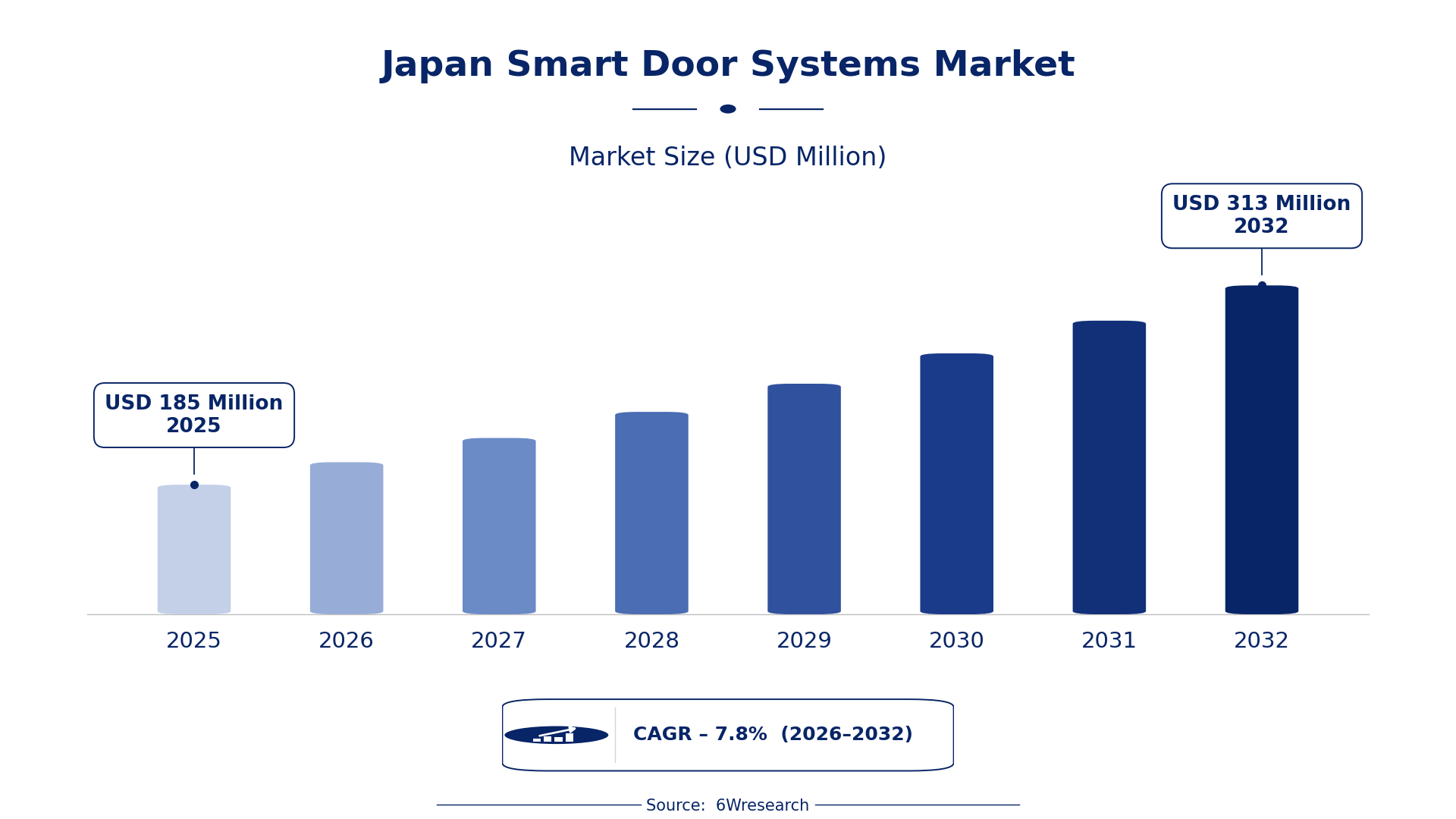
According to 6Wresearch internal database and industry insights, the Japan Smart Door Systems Market was valued at USD 185 Million in 2025 and is projected to reach USD 313 Million by 2032, growing at a CAGR of approximately 7.8% during 2026–2032.
Japan Smart Door Systems Market Highlights
| Report Metric | Details |
| Report Name | Japan Smart Door Systems Market (2026-2032) |
| Market Size 2025 | USD 185 Million |
| Market Size 2032 | USD 313 Million |
| Absolute Growth 2025–2032 | USD 128 Million |
| CAGR 2026–2032 | 7.8% |
| Peak Annual Growth | 8.5% in 2030 |
| Forecast Period | 2026–2032 |
| Historical Data | 2022–2025 |
| Base Year | 2025 |
| Leading Door System Type, 2025 | Biometric Door Locks (54% share) |
| Leading Security Feature, 2025 | Fingerprint (37% share) |
| Leading Connectivity, 2025 | Wi-Fi/Bluetooth (38% share) |
| Leading End User, 2025 | Residential Builders (50% share) |
| Fastest-Growing Door System Type | Smart Keypad Locks (11.3% CAGR) |
| Fastest-Growing Security Feature | Face Unlock (10.6% CAGR) |
| Fastest-Growing Connectivity | App-Based (11.0% CAGR) |
| Fastest-Growing End User | Homeowners & Hotels (10.9% CAGR) |
| Growing Sector | Residential Security Solutions |
| Key End Users | Homeowners, Residential Builders, Office Complexes, Smart Security Vendors |
Japan Smart Door Systems Market Year-wise Growth Rate and Key Drivers (2022–2032)
This graph illustrates the annual growth rates of the market from 2022 to 2032, highlighting a steady upward trajectory and projected market expansion over the forecast period.
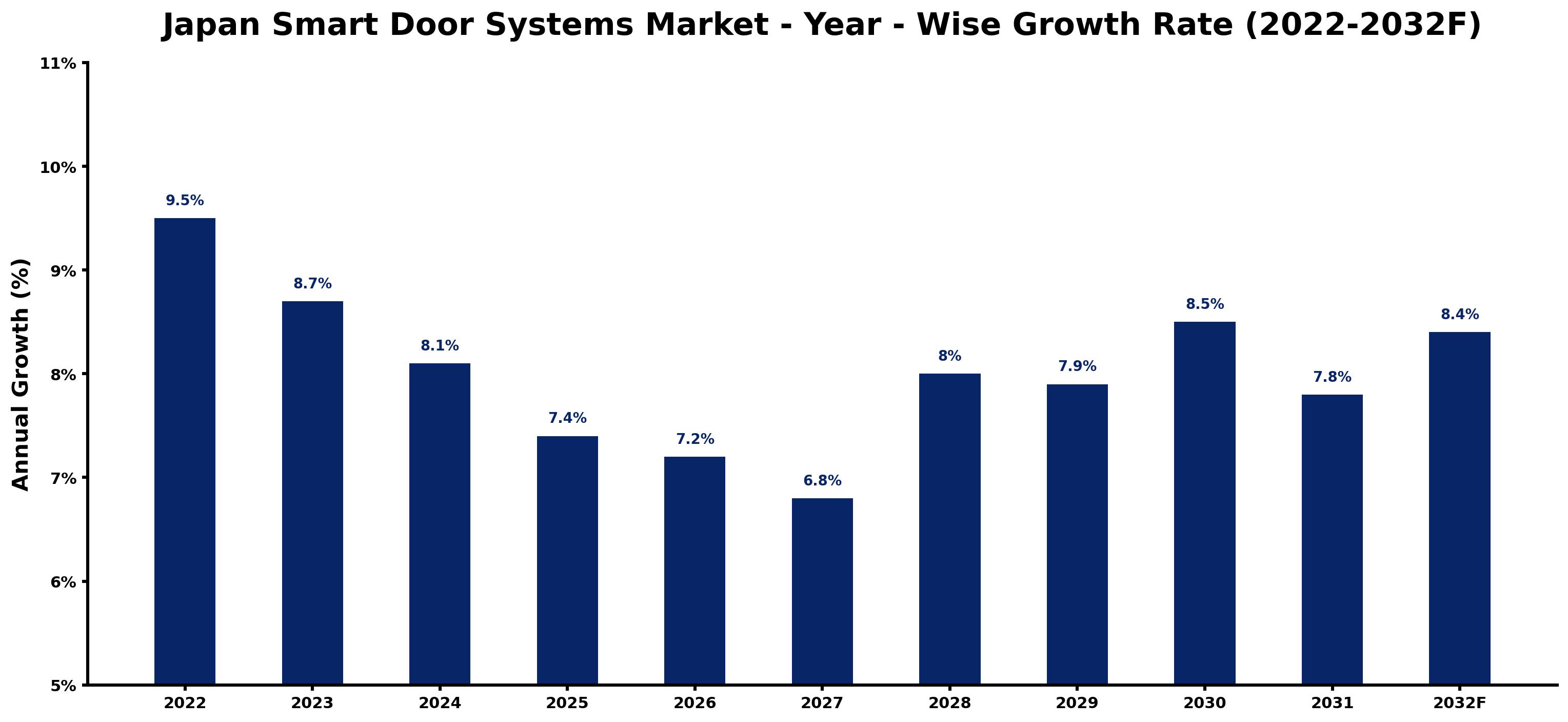
The table below sets out the estimated growth rate for each year and the main factor behind it.
| Year | Estimated Annual Growth (%) | Market Rationale |
| 2022 | 9.5 | The market demonstrated strong demand with widespread adoption of smart technologies. |
| 2023 | 8.7 | Growth slowed as the market adjusted to previous high adoption rates. |
| 2024 | 8.1 | Interest in smart security solutions continued to support market expansion. |
| 2025 | 7.4 | Slower growth occurred due to market saturation in urban areas. |
| 2026 | 7.2 | Demand is expected to stabilise as new technologies begin to emerge in the sector. |
| 2027 | 6.8 | Growth is projected to slow further as competition intensifies among suppliers. |
| 2028 | 8.0 | Demand is expected to increase as smart home integration becomes more prevalent. |
| 2029 | 7.9 | Steady growth will be maintained, driven by urbanisation trends. |
| 2030 | 8.5 | Demand is projected to surge with the introduction of new smart door technologies. |
| 2031 | 7.8 | Growth will moderate as the market matures and consumer choices expand. |
| 2032 | 8.4 | The market is expected to grow as smart home initiatives gain traction. |
Note: Market size estimations and growth projections presented in this report are based on 6Wresearch's proprietary forecasting methodology, utilizing the latest available industry data, government publications, and primary research inputs.
Japan Smart Door Systems Market Synopsis
Smart door systems are advanced security solutions that integrate technology for access control, typically made from electronic components and software. With over 70% of new residential buildings featuring smart security features, the Japan Smart Door Systems Market is experiencing robust growth. This expansion is driven by urbanisation, a rising interest in smart home technologies, and government initiatives promoting smart living, particularly in the Tokyo metropolitan area, which leads in adoption rates.
Market Dynamics Impact Analysis (2026–2032)
| Factor | Type | Impact | Primary Segment Affected |
| Rising urbanisation and population density drive demand for enhanced security solutions. | Driver | High | Biometric Door Locks |
| The increasing focus on smart home technologies encourages investment in advanced security systems. | Driver | High | Smart Keypad Locks |
| The shift towards smart home integration creates opportunities for suppliers of smart door systems. | Opportunity | High | Remote-Controlled Doors |
| The growing interest in home automation presents a chance for expansion in smart door technology. | Opportunity | High | Doorbell Camera Combo |
| High installation costs can deter some homeowners from adopting smart door systems. | Restraint | Medium | Fingerprint |
| Market saturation in urban areas limits growth potential for new entrants. | Restraint | Medium | Face Unlock |
| Intense competition among suppliers may lead to price wars, affecting profitability. | Challenge | High | Passcode Authentication |
| Technological advancements require continuous investment, straining smaller suppliers. | Challenge | Medium | Voice/Remote App Control |
Evaluation of Drivers in Japan Smart Door Systems Market (2026–2032)
The table below links each growth driver to the segment it affects and the evidence for it.
| Drivers | Primary Segment Affected | Why It Matters (Evidence) |
| Urbanisation is increasing demand for security solutions in densely populated areas. | Biometric Door Locks | Over 70% of new residential buildings in Japan are equipped with smart security features. |
| Investment in smart home technologies is rising, boosting demand for smart door systems. | Smart Keypad Locks | The government supports research and development in smart technology through grants. |
| Consumer preference for convenience drives the adoption of biometric locks. | Fingerprint | The demand for biometric locks is rising due to increased security concerns. |
| Integration with home automation systems increases the appeal of smart door systems. | Face Unlock | Smart door systems are commonly integrated with home automation systems in Japan. |
| Growing security concerns lead to increased demand for remote-controlled door systems. | Remote-Controlled Doors | The average household in urban areas has 2-3 smart security devices installed. |
The strongest pull on demand comes from urbanisation, which increases the need for security solutions in densely populated areas. Over 70% of new residential buildings are equipped with smart security features, reflecting strong market interest. Preference for convenience drives the adoption of biometric locks, which are increasingly integrated with home automation systems. Security concerns are pushing demand for remote-controlled door systems, with urban households averaging 2-3 smart security devices installed.
Evaluation of Restraints in Japan Smart Door Systems Market
The table below lists the restraints and the evidence behind each.
| Market Restraint | Primary Segment Affected | Why It Matters (Evidence) |
| High installation costs can deter homeowners from adopting smart door systems. | Fingerprint | The average installation cost of smart door systems ranges from 30,000 to 100,000 JPY. |
| Market saturation in urban areas limits growth potential for new entrants. | Face Unlock | The Tokyo metropolitan area has the highest adoption of smart door systems. |
| Intense competition among suppliers may lead to price wars, affecting profitability. | Passcode Authentication | The demand for smart door systems is growing, attracting numerous suppliers. |
| Technological advancements require continuous investment, straining smaller suppliers. | Voice/Remote App Control | Suppliers must invest in R&D to keep pace with evolving technologies. |
| Consumer awareness of security features may lag behind product availability. | Video + Two-Way Audio | The Japan Smart Home Association advocates for the adoption of smart technologies. |
Japan Smart Door Systems Market Challenges
In Tokyo, many installers struggle to find skilled technicians for smart door system installations, delaying projects by up to three months for residential builders. Supply chain disruptions have increased lead times for electronic components, causing delays of approximately four weeks for suppliers. Buyers face rising installation costs, with average prices ranging from 30,000 to 100,000 JPY, which can deter adoption among homeowners. Inconsistent implementation of technology standards like ISO/IEC 27001 results in security gaps that undermine trust among users and hinder market growth.
Trends in the Japan Smart Door Systems Market
Four trends stand out in the Japan Smart Door Systems Market.
- Shift from Traditional to Smart Security Solutions: In 2023, a government initiative led to increased adoption of smart door systems. Over 70% of new residential buildings now feature these technologies, reflecting changing consumer preferences.
- Transition from Keyed Entry to Keyless Solutions: The rise of smart keypad locks has transformed access control methods, with a CAGR of 11.3% expected for this segment. This shift is evident among residential builders, who increasingly prefer keyless entry systems.
- Emergence of Biometric Technologies in Security: Fingerprint locks have gained popularity, accounting for 37% of the security feature market in 2025. The growing emphasis on security is driving demand for these advanced access solutions.
- Increased Integration of Smart Door Systems with Home Automation: Smart door systems are increasingly integrated with home automation, improving convenience for users. The average household in urban areas has 2-3 smart security devices, showcasing this trend.
Investment Opportunities in the Japan Smart Door Systems Market
Below are the investment opportunities with the strongest case in the Japan Smart Door Systems Market.
- Partnering with Residential Builders for Installation: With 50% of the end-user market comprising residential builders, forming partnerships can facilitate access to new projects. The average installation cost of smart door systems ranges from 30,000 to 100,000 JPY.
- Investing in Smart Home Integration Solutions: Homeowners and hotels are increasingly seeking smart door systems, presenting an opportunity to supply integrated solutions. The Tokyo metropolitan area leads in smart technology adoption.
- Supplying Biometric Security Features: The rising demand for biometric locks, driven by security concerns, presents an opportunity to supply advanced security features. The Japan Security Systems Association provides guidelines for installations.
- Entering the Market through Smart City Initiatives: The government allocated funds for promoting smart city projects in urban areas, creating opportunities for suppliers. Engaging with local partners can facilitate market entry.
Government Initiatives in the Japan Smart Door Systems Market
The Building Energy Efficiency Act, amended in 2022, mandates that all new buildings meet energy standards starting April 2025. This impacts buyers of smart door systems by ensuring compliance with energy efficiency regulations, thus encouraging the adoption of smart technologies in construction and improving overall building security.
The Digital Agency, established in September 2021, leads efforts to promote smart home technologies. This initiative supports buyers by providing guidelines for integrating smart door systems into residential and commercial properties, ensuring compliance with national standards.
Future Insight of the Japan Smart Door Systems Market
By 2032, smart city projects will enhance urban living through advanced access control technologies. Urban areas will increasingly adopt smart door systems integrated with home automation, supported by government funding. Over 70% of new residential buildings will feature enhanced security systems, reflecting a notable shift in construction practices. The average lifespan of smart door systems, estimated at 5-10 years, will create a growing replacement market, benefiting suppliers and installers.
Market Segmentation Analysis
Japan Smart Door Systems Market report covers a detailed analysis of the following market segments:
By Door System Type – Biometric Door Locks Lead, Smart Keypad Locks Expected to Grow Fastest
According to Saurav Kr Singh, Senior Research Analyst at 6Wresearch, Biometric Door Locks accounted for 54% of the market by door system type in 2025. Biometric door locks dominate the market due to their advanced security features, appealing to residential builders and users prioritising safety. Their effectiveness in secure access control is particularly valued in urban areas with high security concerns. Smart Keypad Locks are set to record the highest CAGR in this split, 11.3% over 2026–2032. Smart keypad locks are experiencing rapid growth as they cater to the increasing demand for keyless entry solutions, especially in newly built homes. This trend is underscored by the fact that over 70% of new residential buildings now include smart security features. Suppliers should prioritise the development of user-friendly and secure smart door systems to align with evolving consumer preferences.
By Security Feature – Fingerprint Leads, Face Unlock Expected to Grow Fastest
Fingerprint took 37% of security feature revenue in 2025, more than any other category. Fingerprint technology holds the largest share as it is widely recognised for its accuracy in secure identification, making it essential for both residential and commercial applications. Its adoption in over 70% of new residential buildings in Japan underscores its dominance in the market. Over 2026–2032, Face Unlock is expected to post the fastest growth, at a CAGR of 10.6%. Face unlock technology is experiencing rapid growth due to its contactless nature, which appeals to consumers prioritising hygiene and convenience. The increasing integration of face unlock features in new smart door systems indicates a shift towards more user-friendly security options. Suppliers should invest in advanced biometric technologies to align with consumer preferences and maintain a competitive edge in the market.
By Connectivity – Wi-Fi/Bluetooth Leads, App-Based Expected to Grow Fastest
In 2025, Wi-Fi/Bluetooth led the connectivity split with a 38% share. Wi-Fi and Bluetooth connectivity are essential for enabling remote access and control, making them the backbone of smart door systems. Their widespread adoption among residential builders underscores their importance in modern installations. The quickest growth will come from App-Based, forecast to expand at a CAGR of 11.0% between 2026 and 2032. App-based connectivity is becoming increasingly popular as it allows users to manage their smart door systems conveniently through mobile applications. The rise of smartphone usage in Japan supports this trend, driving demand for app-based solutions. Developers should prioritise app integration to cater to the growing consumer preference for mobile management of smart home technologies.
By End User – Residential Builders Lead, Homeowners & Hotels Expected to Grow Fastest
Residential Builders held 50% of the Japan Smart Door Systems Market by end user in 2025. Residential builders dominate the market as they are directly involved in the installation of smart door systems in newly constructed homes, particularly in urban regions. Their pivotal role is highlighted by the fact that over 70% of new residential buildings now incorporate smart security features. Homeowners & Hotels are projected to grow fastest, at a CAGR of 10.9% during 2026–2032. Homeowners and hotels are rapidly adopting smart door systems as they seek improved security solutions, reflecting a growing trend towards smart home integration. The government's initiative to promote smart home technologies further accelerates this demand among these end users. Suppliers should tailor their offerings to meet the specific needs of homeowners and the hospitality industry to capitalise on the increasing market opportunities.
Key Attractiveness of the Report
- 10 Years of Market Numbers
- Historical Data Starting from 2022 to 2025
- Base Year 2025
- Forecast Data until 2032
- Key Performance Indicators Impacting the Market
- Major Upcoming Developments and Projects
Key Highlights of the Report:
- Japan Smart Door Systems Market Outlook
- Market Size of Japan Smart Door Systems Market, 2025
- Forecast of Japan Smart Door Systems Market, 2032
- Historical Data and Forecast of Japan Smart Door Systems Revenues & Volume for the Period 2022-2032F
- Japan Smart Door Systems Market Trend Evolution
- Japan Smart Door Systems Market Drivers and Challenges
- Japan Smart Door Systems Price Trends
- Japan Smart Door Systems Porter's Five Forces
- Japan Smart Door Systems Industry Life Cycle
- Historical Data and Forecast of Japan Smart Door Systems Market Revenues & Volume By Door System Type for the Period 2022-2032F
- Historical Data and Forecast of Japan Smart Door Systems Market Revenues & Volume By Biometric Door Locks for the Period 2022-2032F
- Historical Data and Forecast of Japan Smart Door Systems Market Revenues & Volume By Smart Keypad Locks for the Period 2022-2032F
- Historical Data and Forecast of Japan Smart Door Systems Market Revenues & Volume By Remote-Controlled Doors for the Period 2022-2032F
- Historical Data and Forecast of Japan Smart Door Systems Market Revenues & Volume By Doorbell Camera Combo for the Period 2022-2032F
- Historical Data and Forecast of Japan Smart Door Systems Market Revenues & Volume By Security Feature for the Period 2022-2032F
- Historical Data and Forecast of Japan Smart Door Systems Market Revenues & Volume By Fingerprint, Face Unlock for the Period 2022-2032F
- Historical Data and Forecast of Japan Smart Door Systems Market Revenues & Volume By Passcode Authentication for the Period 2022-2032F
- Historical Data and Forecast of Japan Smart Door Systems Market Revenues & Volume By Voice/Remote App Control for the Period 2022-2032F
- Historical Data and Forecast of Japan Smart Door Systems Market Revenues & Volume By Video + Two-Way Audio for the Period 2022-2032F
- Historical Data and Forecast of Japan Smart Door Systems Market Revenues & Volume By Connectivity for the Period 2022-2032F
- Historical Data and Forecast of Japan Smart Door Systems Market Revenues & Volume By Wi-Fi/Bluetooth for the Period 2022-2032F
- Historical Data and Forecast of Japan Smart Door Systems Market Revenues & Volume By App-Based for the Period 2022-2032F
- Historical Data and Forecast of Japan Smart Door Systems Market Revenues & Volume By Cloud Integration for the Period 2022-2032F
- Historical Data and Forecast of Japan Smart Door Systems Market Revenues & Volume By Smart Hubs for the Period 2022-2032F
- Historical Data and Forecast of Japan Smart Door Systems Market Revenues & Volume By End User for the Period 2022-2032F
- Historical Data and Forecast of Japan Smart Door Systems Market Revenues & Volume By Residential Builders for the Period 2022-2032F
- Historical Data and Forecast of Japan Smart Door Systems Market Revenues & Volume By Homeowners & Hotels for the Period 2022-2032F
- Historical Data and Forecast of Japan Smart Door Systems Market Revenues & Volume By Office Complexes for the Period 2022-2032F
- Historical Data and Forecast of Japan Smart Door Systems Market Revenues & Volume By Smart Security Vendors for the Period 2022-2032F
- Japan Smart Door Systems Import Export Trade Statistics
- Market Opportunity Assessment By Door System Type
- Market Opportunity Assessment By Security Feature
- Market Opportunity Assessment By Connectivity
- Market Opportunity Assessment By End User
- Japan Smart Door Systems Top Companies Market Share
- Japan Smart Door Systems Competitive Benchmarking By Technical and Operational Parameters
- Japan Smart Door Systems Company Profiles
- Japan Smart Door Systems Key Strategic Recommendations
Market Covered
The following segment groups are covered in the report.
By Door System Type
- Biometric Door Locks
- Smart Keypad Locks
- Remote-Controlled Doors
- Doorbell Camera Combo
By Security Feature
- Fingerprint
- Face Unlock
- Passcode Authentication
- Voice/Remote App Control
- Video + Two-Way Audio
By Connectivity
- Wi-Fi/Bluetooth
- App-Based
- Cloud Integration
- Smart Hubs
By End User
- Residential Builders
- Homeowners & Hotels
- Office Complexes
- Smart Security Vendors































