Japan Smart Electric Meter Market Size & Growth Rate
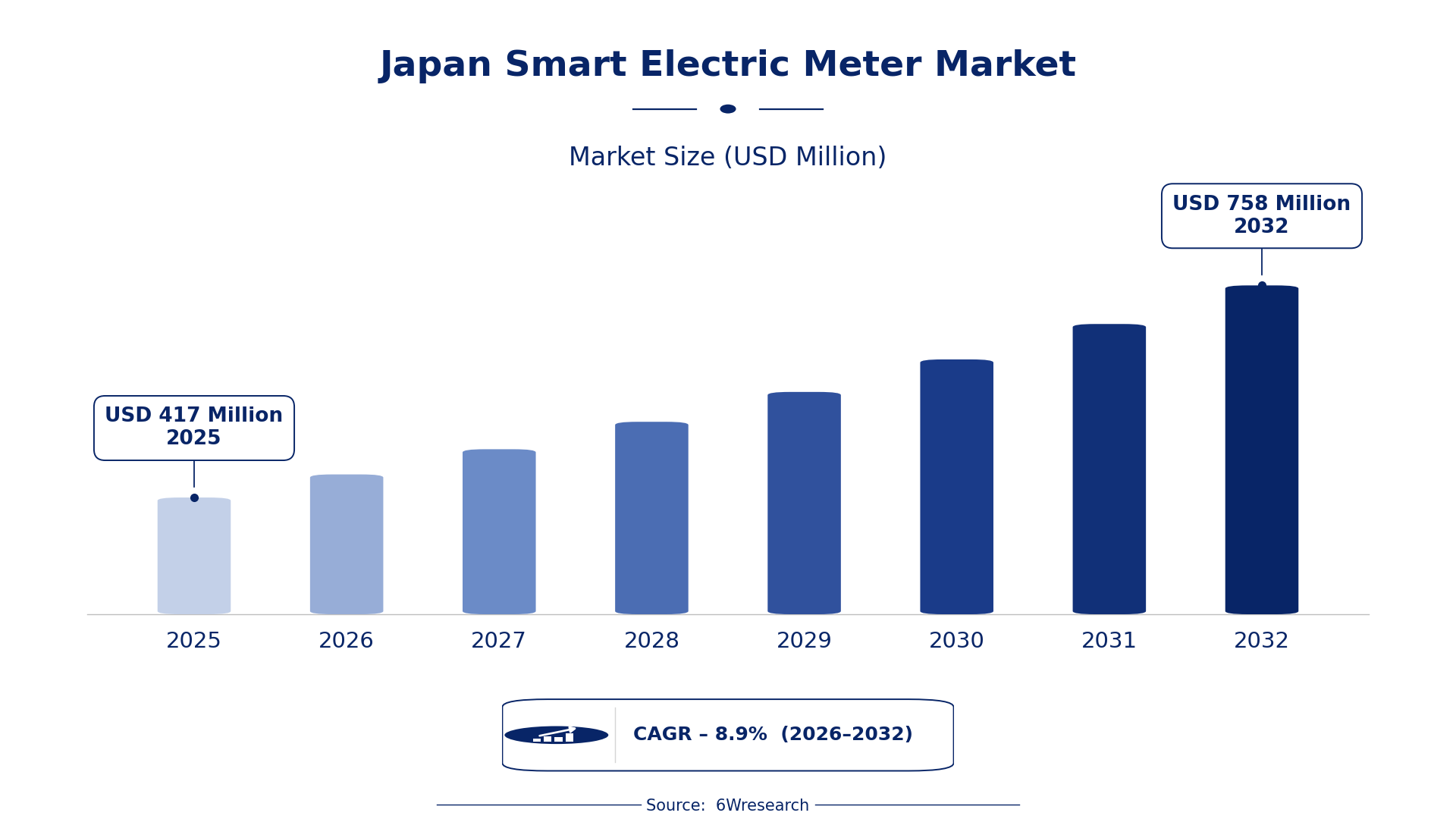
According to 6Wresearch internal database and industry insights, the Japan Smart Electric Meter Market was valued at USD 417 Million in 2025 and is projected to reach USD 758 Million by 2032, growing at a CAGR of approximately 8.9% during 2026–2032.
Japan Smart Electric Meter Market Highlights
| Report Metric | Details |
| Report Name | Japan Smart Electric Meter Market (2026-2032) |
| Market Size 2025 | USD 417 Million |
| Market Size 2032 | USD 758 Million |
| Absolute Growth 2025–2032 | USD 341 Million |
| CAGR 2026–2032 | 8.9% |
| Peak Annual Growth | 9.7% in 2028 |
| Forecast Period | 2026–2032 |
| Historical Data | 2022–2025 |
| Base Year | 2025 |
| Leading Phase, 2025 | Single (55% share) |
| Leading Communication Technology Type, 2025 | Power Line Communication (PLC) (58% share) |
| Leading End-Users, 2025 | Industrial (54% share) |
| Fastest-Growing Phase | Three (10.8% CAGR) |
| Fastest-Growing Communication Technology Type | Radio Frequency (RF) (11.9% CAGR) |
| Fastest-Growing End-Users | Commercial (10.9% CAGR) |
| Growing Sector | Residential |
| Key End Users | Residential, Commercial, Industrial |
Japan Smart Electric Meter Market Year-wise Growth Rate and Key Drivers (2022–2032)
This graph illustrates the annual growth rates of the market from 2022 to 2032, highlighting a steady upward trajectory and projected market expansion over the forecast period.
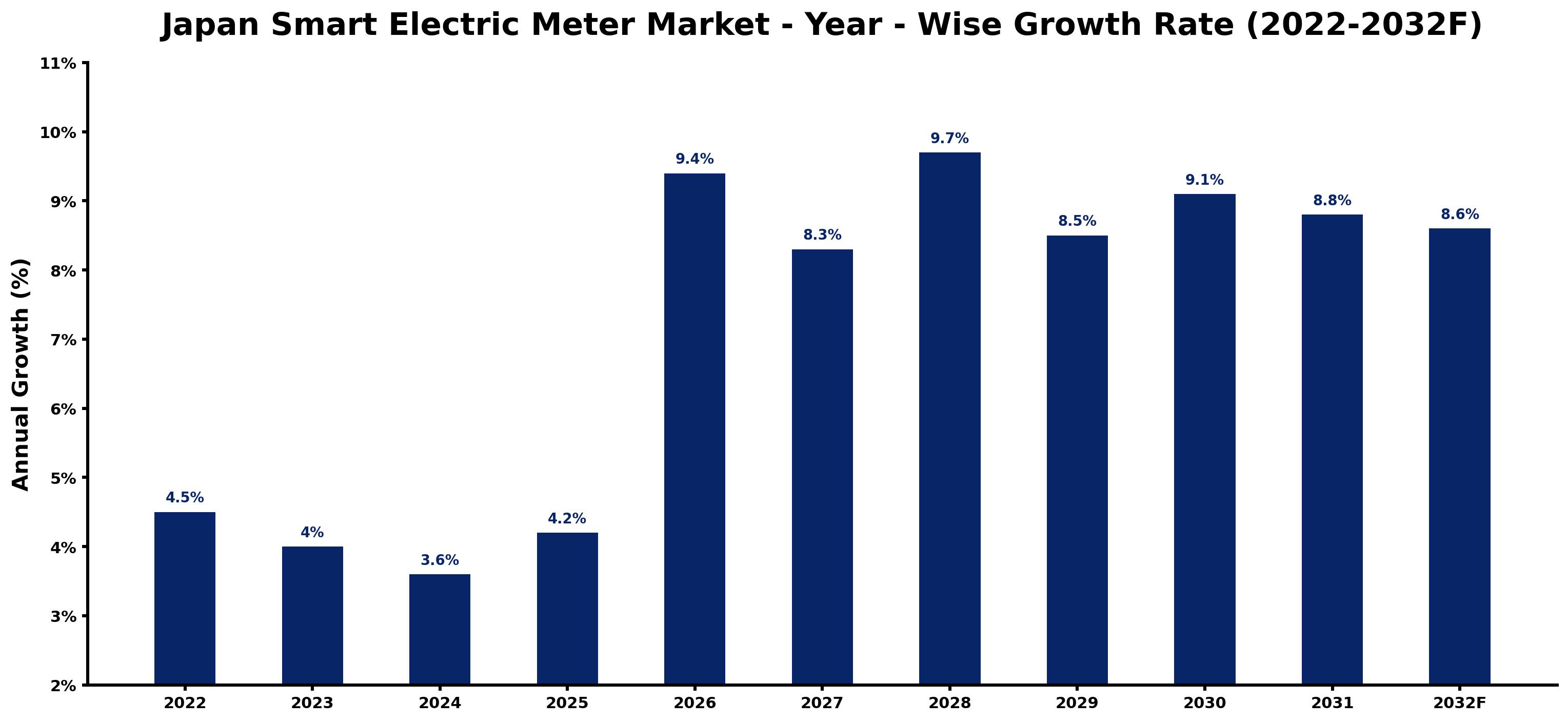
The following figures match every annual growth estimate with the main market development of that year, giving the reasoning behind each rise or slowdown.
| Year | Estimated Annual Growth (%) | Market Rationale |
| 2022 | 4.5 | The market was characterised by steady growth due to increasing awareness of energy efficiency. |
| 2023 | 4.0 | Demand growth slowed as the market adjusted to earlier expansions and technology integration. |
| 2024 | 3.6 | The market continued to experience a slowdown as adoption rates stabilised across sectors. |
| 2025 | 4.2 | Growth accelerated as utility companies expanded their smart meter deployments across urban areas. |
| 2026 | 9.4 | The market is expected to surge as technological advancements and government initiatives boost adoption rates. |
| 2027 | 8.3 | Growth will slow slightly as the market matures and competition intensifies. |
| 2028 | 9.7 | Demand is projected to peak due to heightened investments in smart grid technologies and energy management. |
| 2029 | 8.5 | The market is expected to experience a slowdown as saturation in urban areas begins to impact growth rates. |
| 2030 | 9.1 | Demand will rise again as new energy efficiency targets prompt further investments in smart meters. |
| 2031 | 8.8 | Growth is projected to slow as the market stabilises, reflecting a more mature adoption phase. |
| 2032 | 8.6 | The market is expected to continue growing steadily as ongoing energy efficiency initiatives drive demand. |
Note: Market size estimations and growth projections presented in this report are based on 6Wresearch's proprietary forecasting methodology, utilizing the latest available industry data, government publications, and primary research inputs.
Japan Smart Electric Meter Market Synopsis
Smart electric meters measure electricity consumption in real-time, allowing two-way communication between consumers and utility providers. Japan Smart Electric Meter Market has seen over 30 million units implemented by 2023, primarily driven by residential users and commercial sectors. Growth is propelled by government measures like the GX Promotion Act and rising consumer awareness of energy efficiency, which encourage the adoption of smart meters across the country.
Market Dynamics Impact Analysis (2026–2032)
| Factor | Type | Impact | Primary Segment Affected |
| Increasing residential energy consumption | Driver | High | Residential |
| Government initiatives promoting energy efficiency | Driver | High | Commercial |
| Growing need for energy management solutions | Opportunity | High | Industrial |
| Rising demand for smart grid technologies | Opportunity | High | Commercial |
| High initial investment costs for smart meters | Restraint | Medium | Residential |
| Limited awareness in rural areas | Restraint | Medium | Residential |
| Compliance with stringent safety regulations | Challenge | High | Commercial |
| Capacity constraints in manufacturing | Challenge | Medium | Industrial |
Evaluation of Drivers in Japan Smart Electric Meter Market (2026–2032)
The factors lifting demand, and the evidence behind each, are summarised below.
| Drivers | Primary Segment Affected | Why It Matters (Evidence) |
| Rising residential energy consumption | Residential | The average household in Japan consumes approximately 290 kWh per month, increasing demand for smart meters. |
| Government initiatives promoting energy efficiency | Commercial | The GX Promotion Act supports smart meter deployment, driving demand for advanced energy management solutions. |
| Growing need for energy management solutions | Industrial | Smart meters help reduce peak demand by approximately 15% in urban areas, appealing to large facilities seeking efficiency. |
| Technological advancements in smart meters | Commercial | Integration of smart meters in over 5 million households by utility providers enhances operational efficiency and reliability. |
| Increased consumer awareness of energy usage | Residential | Advocacy for smart grid technologies boosts consumer interest in smart meters, leading to higher adoption rates. |
Spending rises because the average household in Japan consumes approximately 290 kWh per month, which drives demand for smart meters. Smart meters help reduce peak demand by approximately 15% in urban areas, appealing to large facilities that require efficient energy management. Integration in over 5 million households enhances operational reliability, leading to more purchases of smart meters. Rising consumer awareness of energy usage, supported by advocacy for smart grid technologies, results in increased purchases across residential sectors.
Evaluation of Restraints in Japan Smart Electric Meter Market
These are the pressures that could keep growth below its potential.
| Market Restraint | Primary Segment Affected | Why It Matters (Evidence) |
| High initial investment costs for smart meters | Residential | The upfront costs deter some consumers from adopting smart meters, limiting market penetration. |
| Limited awareness in rural areas | Residential | Many rural consumers remain unaware of the benefits of smart meters, hindering adoption. |
| Compliance with stringent safety regulations | Commercial | Producers must adhere to the Electrical Appliance and Material Safety Act, increasing operational costs due to compliance requirements. |
| Capacity constraints in manufacturing | Industrial | Manufacturers face challenges in scaling production to meet rising demand, delaying supply and affecting market availability. |
| Market saturation in urban areas | Residential | As urban installations increase, growth potential diminishes, impacting overall market expansion. |
Japan Smart Electric Meter Market Challenges
Over 30 million smart meters have been implemented in Japan, but intense competition among utility providers drives prices down, reducing profit margins for suppliers. A shortage of skilled technicians in the smart meter sector leads to project delays, costing utilities approximately ¥2 billion annually due to extended deployment times. Disruptions in the supply chain for electronic components can delay production by up to six months for producers, limiting their capacity to meet demand. Buyers face rising costs as utilities pass on inefficiencies, with average household electricity bills expected to increase by 10% in the near term.
Trends in the Japan Smart Electric Meter Market
Below are the shifts with the largest effect on the Japan Smart Electric Meter Market.
- Residential Users Increasingly Adopting Smart Meters: Residential users are adopting smart meters rapidly, with over 30 million installed by 2023. This trend highlights the growing consumer awareness of energy efficiency and cost management.
- Shift Towards Energy Management Solutions: In 2023, the government allocated ¥10 billion for energy efficiency programs, driving demand for smart meters. This investment reflects a broader commitment to improving energy management across sectors.
- Commercial Sector Prioritising Smart Technologies: The commercial sector is prioritising smart technologies, with a 20% increase in operational efficiency reported by utility providers. This shift indicates a growing recognition of the benefits of smart meters.
- Integration of Smart Meters in Industrial Facilities: Industrial facilities are increasingly integrating smart meters, with significant demand driven by the need for energy management. This trend supports Japan's goal of reducing greenhouse gas emissions by 26% by 2030.
Investment Opportunities in the Japan Smart Electric Meter Market
Below are the investment opportunities with the strongest case in the Japan Smart Electric Meter Market.
- Supply of Advanced Smart Meters for Residential Use: With over 30 million smart meters installed, there is a strong opportunity to supply advanced models to residential users. The residential sector is increasingly aware of energy efficiency benefits, creating a demand for improved technologies.
- Energy Management Solutions for Commercial Buyers: Commercial buyers are seeking energy management solutions to optimise costs, creating opportunities for suppliers. The GX Promotion Act supports these initiatives, making it an ideal time to enter the market with innovative products.
- Partnerships for Smart Meter Deployment: Now is the time to invest in smart meter technology and form partnerships with utility providers. Collaborating with local utilities can facilitate smoother market entry and improve distribution channels for new technologies.
- Investing in Smart Meter Technology: The growing demand for smart meters presents an opportunity to invest in technology development. The commercial sector's increasing adoption rates signal a need for advanced solutions to meet energy management requirements.
Government Initiatives in the Japan Smart Electric Meter Market
The GX Promotion Act (2023) strengthens the legal framework for energy efficiency, building on earlier laws like the Act on the Rational Use of Energy. This new law mandates improvements in energy efficiency, compelling producers to adopt advanced technologies and comply with stricter standards, thus enhancing market growth.
Utility providers benefit from the GX Promotion Act as it incentivises energy-efficient practices. The Ministry of Economy, Trade and Industry oversees the implementation, ensuring that businesses can access funding for smart meter installations, thereby promoting wider adoption and improving energy management.
Future Insight of the Japan Smart Electric Meter Market
The rollout of smart grid technologies will reshape demand for smart meters, enhancing real-time data collection capabilities. By 2032, the adoption of ISO 50001 standards will improve operational efficiency for utilities, enabling better energy management. A government investment of ¥10 billion in energy efficiency programs will further promote smart meter implementation. Urban areas will experience enhanced grid reliability, leading to reduced operational costs and improved service quality for both buyers and suppliers.
Market Segmentation Analysis
Japan Smart Electric Meter Market report covers a detailed analysis of the following market segments:
By Phase – Single Leads, Three Expected to Grow Fastest
According to Shubham Deep, Research Manager at 6Wresearch, the largest phase category in 2025 was Single, at 55% of revenue. Single phase smart meters dominate the market owing to their prevalent application in residential and small commercial settings, with over 30 million units deployed throughout Japan. This high penetration is primarily influenced by the average household's monthly electricity consumption of around 290 kWh, which necessitates effective monitoring solutions. The quickest growth will come from Three, forecast to expand at a CAGR of 10.8% between 2026 and 2032. Three phase smart meters are witnessing rapid adoption as larger commercial and industrial facilities increasingly implement them for enhanced energy management. This surge is driven by the necessity for businesses to optimise energy use and improve operational efficiency, particularly in densely populated urban areas. Suppliers should focus on developing three phase solutions to meet the growing demands of larger commercial and industrial clients.
By Communication Technology Type – Power Line Communication (PLC) Leads, Radio Frequency (RF) Expected to Grow Fastest
With 58% of communication technology type revenue in 2025, Power Line Communication (PLC) was the largest category. Power Line Communication (PLC) leads the communication technology segment as it utilises existing power lines for efficient data transmission. This method is particularly advantageous for utilities looking to minimise infrastructure costs while deploying smart meters. Over 2026–2032, Radio Frequency (RF) is expected to post the fastest growth, at a CAGR of 11.9%. Radio Frequency (RF) technology is gaining traction due to its application in specific scenarios where wireless communication is beneficial. As more utilities explore alternative communication methods, RF is expected to see increased adoption in niche markets. Suppliers may need to diversify their offerings to include both PLC and RF technologies to meet varying utility requirements.
By End-Users – Industrial Leads, Commercial Expected to Grow Fastest
In 2025, Industrial led the end-users split with a 54% share. The industrial sector holds the largest share of the end-user market, largely due to substantial demand from manufacturing and large facilities that require precise energy monitoring. This segment benefits from various initiatives aimed at enhancing operational efficiency and lowering energy costs across multiple industries. Commercial is projected to grow fastest, at a CAGR of 10.9% during 2026–2032. The commercial sector is experiencing the highest growth rate as businesses prioritise energy management to control costs and improve sustainability. This trend is fuelled by the increasing need for effective energy solutions in a competitive marketplace. Vendors must tailor their offerings to meet the specific needs of commercial users, focusing on energy efficiency and cost management.
Key Attractiveness of the Report
- 10 Years of Market Numbers
- Historical Data Starting from 2022 to 2025
- Base Year 2025
- Forecast Data until 2032
- Key Performance Indicators Impacting the Market
- Major Upcoming Developments and Projects
Key Highlights of the Report:
- Japan Smart Electric Meter Market Outlook
- Market Size of Japan Smart Electric Meter Market, 2025
- Forecast of Japan Smart Electric Meter Market, 2032
- Historical Data and Forecast of Japan Smart Electric Meter Revenues & Volume for the Period 2022-2032
- Japan Smart Electric Meter Market Trend Evolution
- Japan Smart Electric Meter Market Drivers and Challenges
- Japan Smart Electric Meter Price Trends
- Japan Smart Electric Meter Porter's Five Forces
- Japan Smart Electric Meter Industry Life Cycle
- Historical Data and Forecast of Japan Smart Electric Meter Market Revenues & Volume By Phase for the Period 2022-2032
- Historical Data and Forecast of Japan Smart Electric Meter Market Revenues & Volume By Single for the Period 2022-2032
- Historical Data and Forecast of Japan Smart Electric Meter Market Revenues & Volume By Three for the Period 2022-2032
- Historical Data and Forecast of Japan Smart Electric Meter Market Revenues & Volume By Communication Technology Type for the Period 2022-2032
- Historical Data and Forecast of Japan Smart Electric Meter Market Revenues & Volume By Power Line Communication (PLC) for the Period 2022-2032
- Historical Data and Forecast of Japan Smart Electric Meter Market Revenues & Volume By Radio Frequency (RF) for the Period 2022-2032
- Historical Data and Forecast of Japan Smart Electric Meter Market Revenues & Volume By Cellular for the Period 2022-2032
- Historical Data and Forecast of Japan Smart Electric Meter Market Revenues & Volume By End-Users for the Period 2022-2032
- Historical Data and Forecast of Japan Smart Electric Meter Market Revenues & Volume By Industrial for the Period 2022-2032
- Historical Data and Forecast of Japan Smart Electric Meter Market Revenues & Volume By Commercial for the Period 2022-2032
- Historical Data and Forecast of Japan Smart Electric Meter Market Revenues & Volume By Residential for the Period 2022-2032
- Japan Smart Electric Meter Import Export Trade Statistics
- Market Opportunity Assessment By Phase
- Market Opportunity Assessment By Communication Technology Type
- Market Opportunity Assessment By End-Users
- Japan Smart Electric Meter Top Companies Market Share
- Japan Smart Electric Meter Competitive Benchmarking By Technical and Operational Parameters
- Japan Smart Electric Meter Company Profiles
- Japan Smart Electric Meter Key Strategic Recommendations
Market Covered
This report examines the market across the segments below.
By Phase
- Single
- Three
By Communication Technology Type
- Power Line Communication (PLC)
- Radio Frequency (RF)
- Cellular
By End-Users
- Industrial
- Commercial
- Residential






































