Japan Smart Energy Forecasting Market Size & Growth Rate
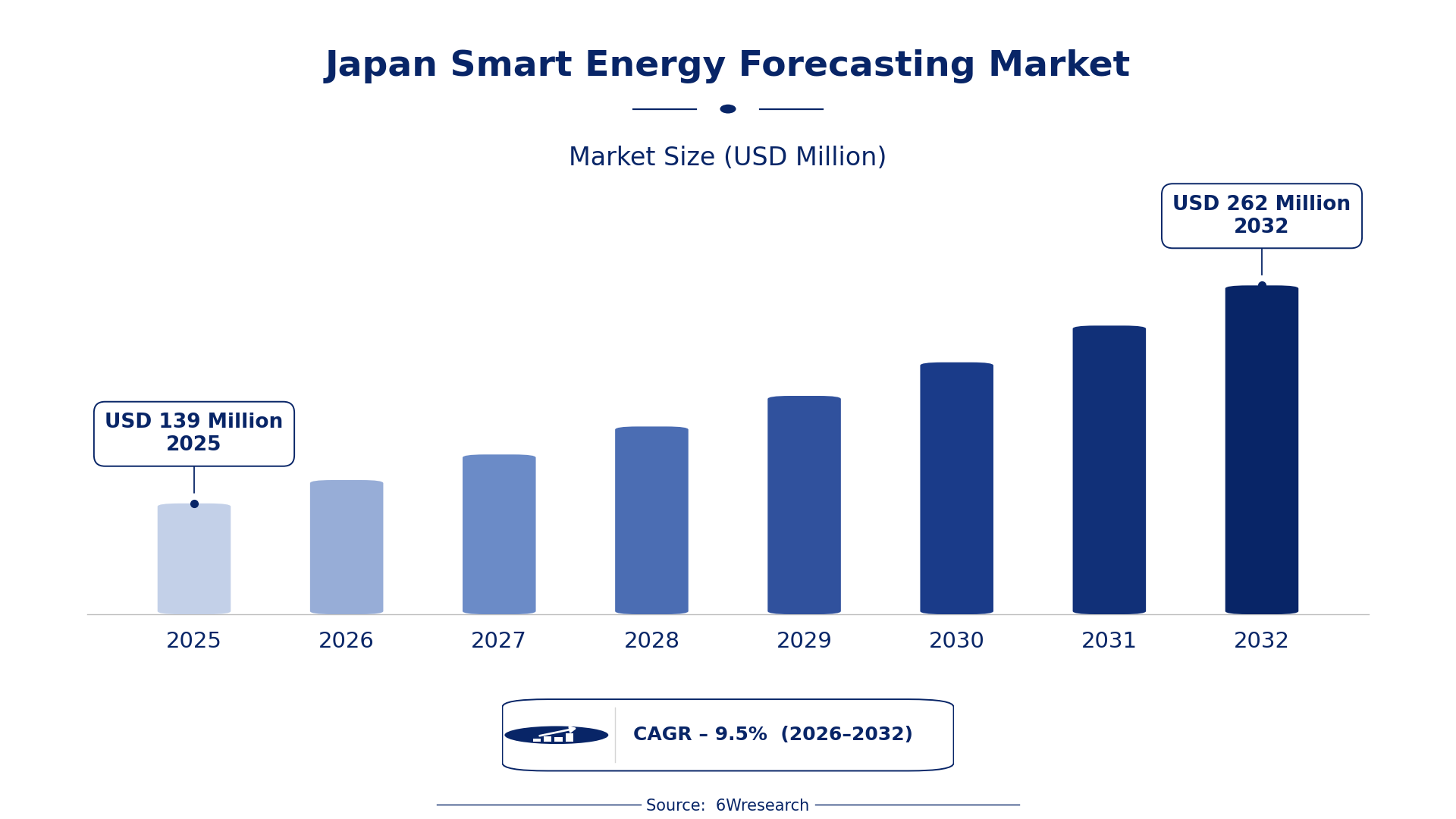
According to 6Wresearch internal database and industry insights, the Japan Smart Energy Forecasting Market was valued at USD 139 Million in 2025 and is projected to reach USD 262 Million by 2032, growing at a CAGR of approximately 9.5% during 2026–2032.
Japan Smart Energy Forecasting Market Highlights
| Report Metric | Details |
| Report Name | Japan Smart Energy Forecasting Market (2026-2032) |
| Market Size 2025 | USD 139 Million |
| Market Size 2032 | USD 262 Million |
| Absolute Growth 2025–2032 | USD 123 Million |
| CAGR 2026–2032 | 9.5% |
| Peak Annual Growth | 10.1% in 2027 |
| Forecast Period | 2026–2032 |
| Historical Data | 2022–2025 |
| Base Year | 2025 |
| Leading Forecast Type, 2025 | Solar Generation Forecast (45% share) |
| Leading Data Source, 2025 | Weather + Radiation Data (40% share) |
| Leading AI Model Used, 2025 | Machine Learning (47% share) |
| Leading End User, 2025 | Solar Plant Operators (40% share) |
| Fastest-Growing Forecast Type | Load Forecasting (14.0% CAGR) |
| Fastest-Growing Data Source | Grid Demand Data (14.4% CAGR) |
| Fastest-Growing AI Model Used | Predictive Analytics (12.7% CAGR) |
| Fastest-Growing End User | Utility Providers (12.8% CAGR) |
| Growing Sector | Renewable Energy |
| Key End Users | Solar Plant Operators, Utility Providers, Renewable Energy Firms, Smart Grid Developers |
Japan Smart Energy Forecasting Market Year-wise Growth Rate and Key Drivers (2022–2032)
This graph illustrates the annual growth rates of the market from 2022 to 2032, highlighting a steady upward trajectory and projected market expansion over the forecast period.
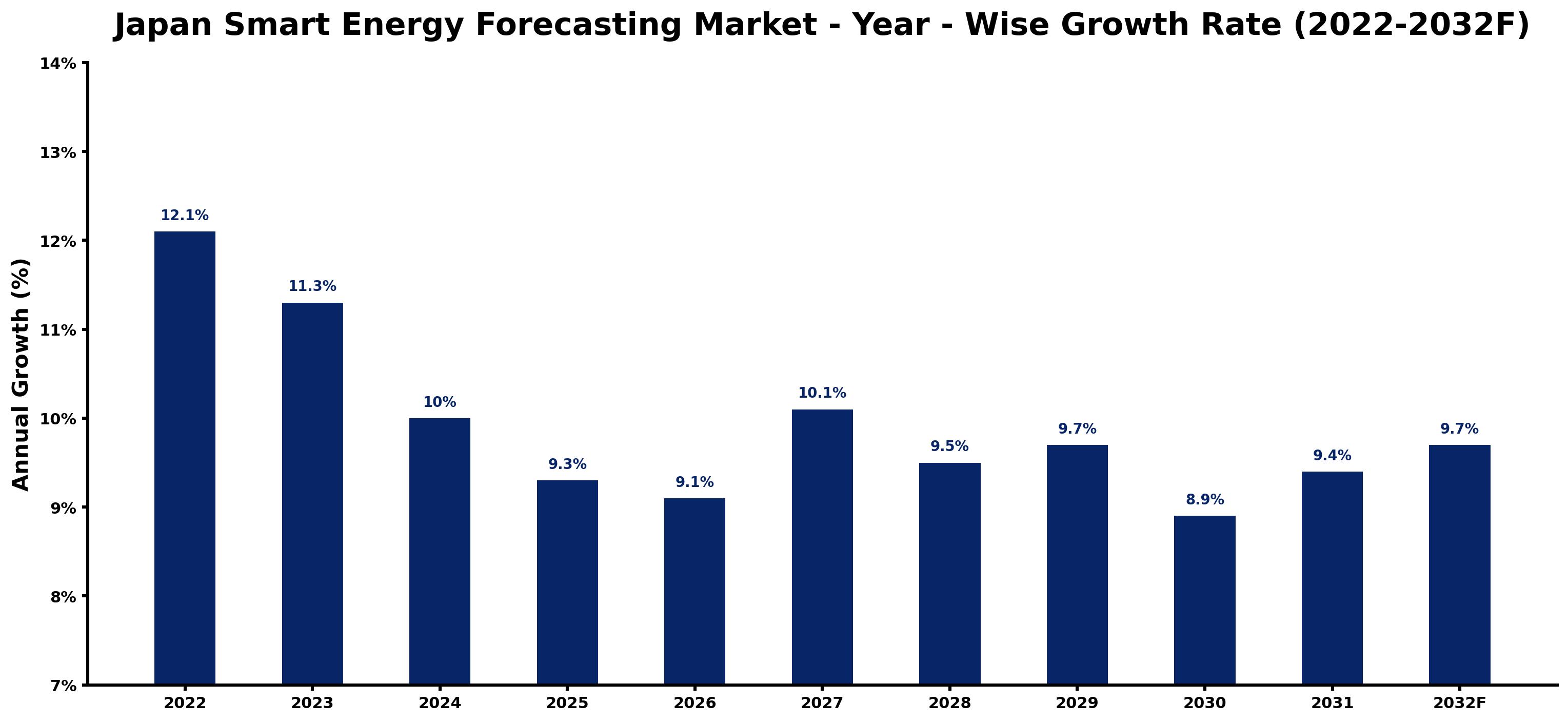
The following figures match every annual growth estimate with the main market development of that year, giving the reasoning behind each rise or slowdown.
| Year | Estimated Annual Growth (%) | Market Rationale |
| 2022 | 12.1 | The market experienced strong growth due to rising investments in renewable energy. |
| 2023 | 11.3 | Growth slowed as the market adjusted to previous high rates of expansion. |
| 2024 | 10.0 | The market continued to grow, albeit at a reduced pace, reflecting ongoing demand. |
| 2025 | 9.3 | The growth rate decelerated further as the market stabilised after rapid increases. |
| 2026 | 9.1 | A slight slowdown occurred, yet the market maintained positive growth amid steady demand. |
| 2027 | 10.1 | Growth accelerated again, driven by increased adoption of smart energy solutions. |
| 2028 | 9.5 | The market saw a slowdown as growth rates normalised after the peak. |
| 2029 | 9.7 | An uptick in growth was observed, indicating renewed interest in energy forecasting. |
| 2030 | 8.9 | Growth slowed again, reflecting maturity in the market and stabilising demand. |
| 2031 | 9.4 | The market rebounded with faster growth as new technologies gained traction. |
| 2032 | 9.7 | Growth continued to rise, supported by ongoing investments in renewable energy. |
Note: Market size estimations and growth projections presented in this report are based on 6Wresearch's proprietary forecasting methodology, utilizing the latest available industry data, government publications, and primary research inputs.
Japan Smart Energy Forecasting Market Synopsis
Smart Energy Forecasting employs advanced analytics and AI to predict energy generation and consumption patterns, optimising distribution and improving grid reliability. The Japan Smart Energy Forecasting Market is growing as the country aims for a 46% reduction in greenhouse gas emissions by 2030, with JPY 150 trillion earmarked for renewable energy investments over the next decade. With over 70,000 solar installations and an anticipated 90% smart metering adoption by 2025, demand from solar plant operators and utility providers is propelling this market forward.
Market Dynamics Impact Analysis (2026–2032)
| Factor | Type | Impact | Primary Segment Affected |
| Increasing investments in renewable energy infrastructure | Driver | High | Solar Generation Forecast |
| Growing need for accurate load forecasting due to fluctuating energy demand | Driver | High | Load Forecasting |
| Emerging demand for predictive analytics in energy management | Opportunity | High | Predictive Analytics |
| Rising interest in smart grid solutions among utility providers | Opportunity | High | Utility Providers |
| Challenges in integrating diverse data sources for accurate forecasting | Restraint | Medium | Weather + Radiation Data |
| Limited awareness of forecasting technologies among smaller operators | Restraint | Medium | Solar Plant Operators |
| High initial investment costs for advanced forecasting systems | Challenge | High | Utility Providers |
| Shortage of skilled professionals in data analytics and AI | Challenge | Medium | Renewable Energy Firms |
Evaluation of Drivers in Japan Smart Energy Forecasting Market (2026–2032)
These are the developments adding the most demand over the forecast period.
| Drivers | Primary Segment Affected | Why It Matters (Evidence) |
| Investment in renewable energy projects | Solar Generation Forecast | Japan's renewable energy share reached 18% in 2022, prompting solar operators to seek forecasting tools. |
| Demand for grid reliability | Load Forecasting | The Act on the Rational Use of Energy obliges large users to report and improve efficiency, driving demand for accurate load forecasts. |
| Adoption of smart metering technologies | Smart Metering Data | Projected smart metering adoption will reach 90% by 2025, facilitating real-time consumption forecasting. |
| Regulatory support for energy efficiency | Consumption Forecasting | The Act on the Rational Use of Energy obliges large users to report and improve efficiency, driving demand for consumption forecasts. |
| Technological advancements in AI and machine learning | Predictive Analytics | Machine Learning is leading the AI model used in forecasting, with a 47% share in 2025, improving predictive capabilities. |
Much of the new demand traces back to Japan's commitment to increasing its renewable energy share, which reached 18% in 2022. Projected smart metering adoption will reach 90% by 2025, enabling real-time consumption forecasting for solar plant operators. Technological advancements in AI and machine learning are also improving predictive analytics capabilities, enhancing the overall forecasting process.
Evaluation of Restraints in Japan Smart Energy Forecasting Market
The main factors holding the market back are set out below.
| Market Restraint | Primary Segment Affected | Why It Matters (Evidence) |
| Integration challenges with diverse data sources | Weather + Radiation Data | The complexity of integrating various data sources can hinder accurate forecasting, affecting utility providers' operations. |
| Limited awareness of forecasting technologies | Solar Plant Operators | Many smaller solar operators lack knowledge about forecasting tools, resulting in slower adoption rates. |
| High initial investment costs for advanced systems | Utility Providers | The upfront costs associated with implementing sophisticated forecasting systems can deter investment from utility providers. |
| Dependence on accurate weather data | Wind Power Prediction | Forecasting accuracy heavily relies on precise weather data, which can be inconsistent or unavailable. |
| Shortage of skilled professionals in data analytics | Renewable Energy Firms | A lack of qualified personnel in data analytics limits the ability of renewable energy firms to implement advanced forecasting solutions. |
Japan Smart Energy Forecasting Market Challenges
Regulatory requirements pose challenges for smart energy forecasting, as compliance with standards like ISO 50001 necessitates extensive documentation, delaying implementation for energy operators. Limited access to advanced analytics tools constrains the supply chain, potentially extending project timelines by up to six months for renewable energy firms. Rising operational costs impact buyers, with inflation in project budgets reaching 20% due to high demand for skilled professionals in energy management. Skills shortages in data analytics hinder clinics and hospitals from optimising energy consumption, resulting in inefficiencies and increased operational expenses.
Trends in the Japan Smart Energy Forecasting Market
The following changes are redrawing the Japan Smart Energy Forecasting Market.
- Shift towards Real-Time Data Integration: Japan is integrating real-time data into energy forecasting models, improving accuracy and responsiveness. The Smart Grid Development Program supports this shift, targeting grid efficiency improvements by 2025.
- Transition from Traditional to Predictive Analytics: Predictive analytics is replacing traditional methods in energy forecasting, driven by advancements in AI. Adoption of Machine Learning models is projected to rise, with a share of 47% by 2025.
- Utility Providers Embracing Smart Technologies: Utility providers are adopting smart technologies to improve energy management. As of 2023, smart metering adoption is expected to reach 90%, facilitating better consumption forecasting.
- Increased Focus on Renewable Energy Forecasting: There is a growing emphasis on forecasting for renewable energy sources, particularly solar and wind. Japan's renewable energy share reached 18% in 2022, driving demand for accurate forecasting tools.
Investment Opportunities in the Japan Smart Energy Forecasting Market
Where to invest in the Japan Smart Energy Forecasting Market: the main openings are set out below.
- Partnerships with Local Technology Firms: Forming joint ventures with local technology firms can ease market entry. Japan's renewable energy sector is projected to attract JPY 150 trillion in investments over the next decade.
- Investment in Smart Metering Infrastructure: With smart metering adoption expected to reach 90% by 2025, investing in related technologies offers a strong opportunity for suppliers in Japan's energy sector.
- Development of AI-Driven Forecasting Solutions: The demand for AI-driven forecasting solutions is on the rise, especially among utility providers. This sector is likely to expand as the market matures, concentrating on predictive analytics.
- Expansion into Renewable Energy Forecasting: Utility providers are increasingly pursuing advanced forecasting tools. The ongoing shift towards renewable energy in Japan creates opportunities for suppliers to fulfil this demand.
Government Initiatives in the Japan Smart Energy Forecasting Market
The Act on the Rational Use of Energy, established in 1979, requires large energy users to improve energy efficiency and report their energy consumption. This law has laid the groundwork for energy management practices in Japan, encouraging the adoption of forecasting technologies among utility providers and renewable energy firms.
The Battery Industry Strategy, initiated by METI in August 2022, aims for 150 GWh of domestic battery manufacturing capacity by 2030. This initiative supports the development of energy storage solutions, which are important for effective energy forecasting and management.
Future Insight of the Japan Smart Energy Forecasting Market
By 2032, suppliers will adapt to a growing demand for smart energy forecasting driven by the Smart Grid Development Program, which aims to enhance grid efficiency by 2025. The total installed capacity for wind energy is around 4.3 GW, contributing to improved energy reliability. Smart metering adoption will reach 90% by 2025, enabling real-time data integration for better energy management. Buyers will gain from enhanced forecasting capabilities as the renewable energy sector expands, propelled by government initiatives promoting decarbonisation.
Market Segmentation Analysis
Japan Smart Energy Forecasting Market report covers a detailed analysis of the following market segments:
By Forecast Type – Solar Generation Forecast Leads, Load Forecasting Expected to Grow Fastest
According to Saurav Kr Singh, Senior Research Analyst at 6Wresearch, Solar Generation Forecast held 45% of the Japan Smart Energy Forecasting Market by forecast type in 2025. Solar Generation Forecast holds the largest share because it is essential for predicting solar energy output, which is crucial for operators managing over 70,000 solar installations in Japan. This segment's importance is underscored by the country's commitment to increasing its renewable energy share, which reached 18% in 2022. Load Forecasting is projected to grow fastest, at a CAGR of 14.0% during 2026–2032. Load Forecasting is experiencing rapid growth due to its critical role in accurately predicting energy demand, especially in high-demand areas like the Tokyo metropolitan region. The increasing necessity for precise demand forecasting aligns with Japan's goal of enhancing grid efficiency by 2025. Suppliers should focus on developing advanced forecasting tools to meet the rising demand from energy operators.
By Data Source – Weather + Radiation Data Leads, Grid Demand Data Expected to Grow Fastest
Weather + Radiation Data accounted for 40% of the market by data source in 2025. Weather + Radiation Data dominates the market as it provides crucial inputs for forecasting models, essential for optimising solar energy output. This data is integral to the operations of solar plant operators who depend heavily on accurate weather predictions. Grid Demand Data is set to record the highest CAGR in this split, 14.4% over 2026–2032. Grid Demand Data is the fastest growing segment, propelled by the need for precise load forecasting to manage energy supply effectively. With Japan's energy landscape changing, utility providers increasingly rely on real-time demand data to ensure grid stability. Buyers must invest in comprehensive data integration solutions to improve forecasting accuracy and operational efficiency.
By AI Model Used – Machine Learning Leads, Predictive Analytics Expected to Grow Fastest
With 47% of ai model used revenue in 2025, Machine Learning was the largest category. Machine Learning is the leading model in the market, extensively applied in developing predictive models that enhance forecasting accuracy. Its widespread adoption among energy operators reflects the growing reliance on advanced analytics to optimise energy management. Over 2026–2032, Predictive Analytics is expected to post the fastest growth, at a CAGR of 12.7%. Predictive Analytics is growing rapidly because it allows for the analysis of historical data to make future predictions, which is crucial for utility providers managing fluctuating energy demands. As the market expands, the integration of predictive analytics will further refine forecasting capabilities. Suppliers should prioritise AI model development to cater to the increasing sophistication of forecasting needs.
By End User – Solar Plant Operators Lead, Utility Providers Expected to Grow Fastest
The largest end user category in 2025 was Solar Plant Operators, at 40% of revenue. Solar Plant Operators represent the largest user group of forecasting tools, requiring accurate predictions to manage their extensive solar installations effectively. Their significant role in Japan's renewable energy sector underscores the importance of tailored forecasting solutions. The quickest growth will come from Utility Providers, forecast to expand at a CAGR of 12.8% between 2026 and 2032. Utility Providers are the fastest growing segment, increasingly depending on accurate forecasts for effective grid management amidst rising energy demands. This trend highlights the critical need for reliable forecasting tools to support their operations. Providers should tailor their offerings to meet the specific needs of utility providers for improved grid management.
Key Attractiveness of the Report
- 10 Years of Market Numbers
- Historical Data Starting from 2022 to 2025
- Base Year 2025
- Forecast Data until 2032
- Key Performance Indicators Impacting the Market
- Major Upcoming Developments and Projects
Key Highlights of the Report:
- Japan Smart Energy Forecasting Market Outlook
- Market Size of Japan Smart Energy Forecasting Market, 2025
- Forecast of Japan Smart Energy Forecasting Market, 2032
- Historical Data and Forecast of Japan Smart Energy Forecasting Revenues & Volume for the Period 2022-2032F
- Japan Smart Energy Forecasting Market Trend Evolution
- Japan Smart Energy Forecasting Market Drivers and Challenges
- Japan Smart Energy Forecasting Price Trends
- Japan Smart Energy Forecasting Porter's Five Forces
- Japan Smart Energy Forecasting Industry Life Cycle
- Historical Data and Forecast of Japan Smart Energy Forecasting Market Revenues & Volume By Forecast Type for the Period 2022-2032F
- Historical Data and Forecast of Japan Smart Energy Forecasting Market Revenues & Volume By Solar Generation Forecast for the Period 2022-2032F
- Historical Data and Forecast of Japan Smart Energy Forecasting Market Revenues & Volume By Load Forecasting for the Period 2022-2032F
- Historical Data and Forecast of Japan Smart Energy Forecasting Market Revenues & Volume By Wind Power Prediction for the Period 2022-2032F
- Historical Data and Forecast of Japan Smart Energy Forecasting Market Revenues & Volume By Consumption Forecasting for the Period 2022-2032F
- Historical Data and Forecast of Japan Smart Energy Forecasting Market Revenues & Volume By Data Source for the Period 2022-2032F
- Historical Data and Forecast of Japan Smart Energy Forecasting Market Revenues & Volume By Weather + Radiation Data for the Period 2022-2032F
- Historical Data and Forecast of Japan Smart Energy Forecasting Market Revenues & Volume By Grid Demand Data for the Period 2022-2032F
- Historical Data and Forecast of Japan Smart Energy Forecasting Market Revenues & Volume By Turbine + Wind Sensor Data for the Period 2022-2032F
- Historical Data and Forecast of Japan Smart Energy Forecasting Market Revenues & Volume By Smart Metering Data for the Period 2022-2032F
- Historical Data and Forecast of Japan Smart Energy Forecasting Market Revenues & Volume By AI Model Used for the Period 2022-2032F
- Historical Data and Forecast of Japan Smart Energy Forecasting Market Revenues & Volume By Machine Learning for the Period 2022-2032F
- Historical Data and Forecast of Japan Smart Energy Forecasting Market Revenues & Volume By Predictive Analytics for the Period 2022-2032F
- Historical Data and Forecast of Japan Smart Energy Forecasting Market Revenues & Volume By AI/ML Regression Models for the Period 2022-2032F
- Historical Data and Forecast of Japan Smart Energy Forecasting Market Revenues & Volume By Time Series Models for the Period 2022-2032F
- Historical Data and Forecast of Japan Smart Energy Forecasting Market Revenues & Volume By End User for the Period 2022-2032F
- Historical Data and Forecast of Japan Smart Energy Forecasting Market Revenues & Volume By Solar Plant Operators for the Period 2022-2032F
- Historical Data and Forecast of Japan Smart Energy Forecasting Market Revenues & Volume By Utility Providers for the Period 2022-2032F
- Historical Data and Forecast of Japan Smart Energy Forecasting Market Revenues & Volume By Renewable Energy Firms for the Period 2022-2032F
- Historical Data and Forecast of Japan Smart Energy Forecasting Market Revenues & Volume By Smart Grid Developers for the Period 2022-2032F
- Japan Smart Energy Forecasting Import Export Trade Statistics
- Market Opportunity Assessment By Forecast Type
- Market Opportunity Assessment By Data Source
- Market Opportunity Assessment By AI Model Used
- Market Opportunity Assessment By End User
- Japan Smart Energy Forecasting Top Companies Market Share
- Japan Smart Energy Forecasting Competitive Benchmarking By Technical and Operational Parameters
- Japan Smart Energy Forecasting Company Profiles
- Japan Smart Energy Forecasting Key Strategic Recommendations
Market Covered
Coverage by segment is as follows.
By Forecast Type
- Solar Generation Forecast
- Load Forecasting
- Wind Power Prediction
- Consumption Forecasting
By Data Source
- Weather + Radiation Data
- Grid Demand Data
- Turbine + Wind Sensor Data
- Smart Metering Data
By AI Model Used
- Machine Learning
- Predictive Analytics
- AI/ML Regression Models
- Time Series Models
By End User
- Solar Plant Operators
- Utility Providers
- Renewable Energy Firms
- Smart Grid Developers































