Japan Smart Energy Services Market Size & Growth Rate
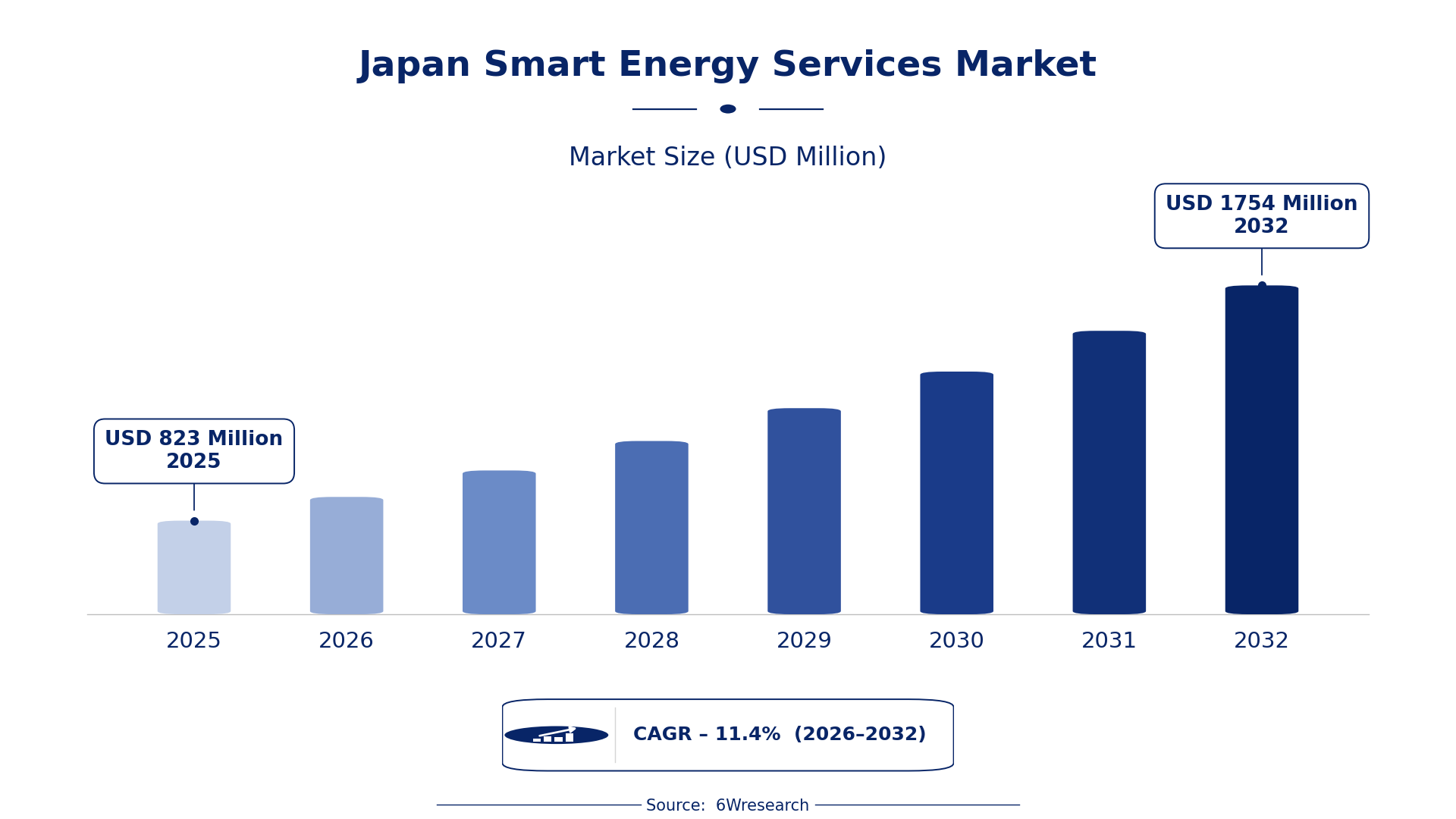
According to 6Wresearch internal database and industry insights, the Japan Smart Energy Services Market was valued at USD 823 Million in 2025 and is projected to reach USD 1,754 Million by 2032, growing at a CAGR of approximately 11.4% during 2026–2032.
Japan Smart Energy Services Market Highlights
| Report Metric | Details |
| Report Name | Japan Smart Energy Services Market (2026-2032) |
| Market Size 2025 | USD 823 Million |
| Market Size 2032 | USD 1,754 Million |
| Absolute Growth 2025–2032 | USD 931 Million |
| CAGR 2026–2032 | 11.4% |
| Peak Annual Growth | 12.9% in 2026 |
| Forecast Period | 2026–2032 |
| Historical Data | 2022–2025 |
| Base Year | 2025 |
| Leading Service Type, 2025 | Demand Response Systems (40% share) |
| Leading Smart Feature, 2025 | Real-Time Insights (47% share) |
| Leading Delivery Model, 2025 | SaaS (41% share) |
| Leading End User, 2025 | Utilities (41% share) |
| Fastest-Growing Smart Feature | Dynamic Tariff Calculation (15.3% CAGR) |
| Fastest-Growing Delivery Model | Cloud-Based Platform (15.8% CAGR) |
| Fastest-Growing End User | Energy Retailers (14.6% CAGR) |
| Growing Sector | Energy Retailers |
| Key End Users | Utilities, Smart Building Owners, Energy Retailers, Industrial Energy Managers |
Japan Smart Energy Services Market Year-wise Growth Rate and Key Drivers (2022–2032)
This graph illustrates the annual growth rates of the market from 2022 to 2032, highlighting a steady upward trajectory and projected market expansion over the forecast period.
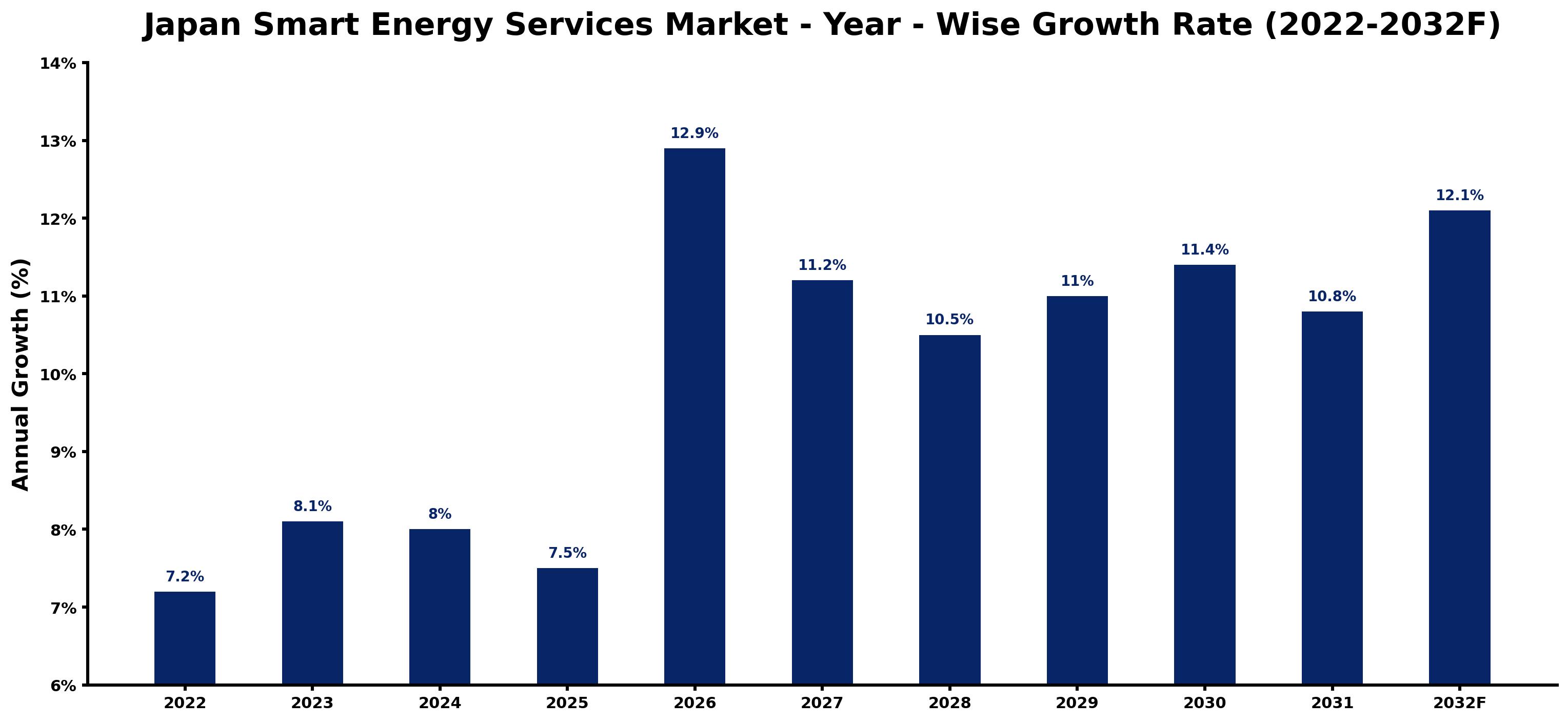
Year by year, the estimates below pair each growth rate with the development that shaped it.
| Year | Estimated Annual Growth (%) | Market Rationale |
| 2022 | 7.2 | The market experienced steady growth with increased adoption of energy management technologies. |
| 2023 | 8.1 | Growth accelerated as demand for smart energy solutions rose among utilities and industrial sectors. |
| 2024 | 8.0 | Growth slowed slightly due to market saturation in certain areas of energy services. |
| 2025 | 7.5 | The market continued to grow, but at a slower pace as competition intensified. |
| 2026 | 12.9 | Growth surged as new technologies and investments in energy efficiency gained traction. |
| 2027 | 11.2 | Growth moderated as the market adjusted to new technological implementations and standards. |
| 2028 | 10.5 | The market experienced a further slowdown as competition continued to increase among service providers. |
| 2029 | 11.0 | Growth picked up again as demand for innovative energy solutions expanded among end users. |
| 2030 | 11.4 | Growth remained strong as public and private investments in decarbonisation strategies increased. |
| 2031 | 10.8 | The market saw a slight slowdown as the focus shifted towards stabilising existing solutions. |
| 2032 | 12.1 | Growth accelerated again as new initiatives and technologies were introduced to the market. |
Note: Market size estimations and growth projections presented in this report are based on 6Wresearch's proprietary forecasting methodology, utilizing the latest available industry data, government publications, and primary research inputs.
Japan Smart Energy Services Market Synopsis
Smart Energy Services encompass technologies that optimise energy consumption and improve efficiency through advanced analytics and IoT integration. The market is expanding in Japan, driven by rising energy demands, particularly in urban areas like Tokyo, which accounts for 30% of total energy demand. Substantial investments, such as the JPY 150 trillion earmarked for decarbonisation, are further propelling this growth, as utilities and industrial sectors seek effective solutions to manage energy more efficiently.
Market Dynamics Impact Analysis (2026–2032)
| Factor | Type | Impact | Primary Segment Affected |
| Rising energy consumption in urban areas drives demand for efficient energy management solutions. | Driver | High | Energy Usage Analytics |
| The push for decarbonisation creates opportunities for innovative energy solutions. | Opportunity | High | Demand Response Systems |
| The Energy Conservation Law mandates energy audits, increasing demand for smart services. | Restraint | High | Smart Billing Solutions |
| Competition among service providers may limit market share for new entrants. | Challenge | Medium | Remote Energy Audits |
| Utilities are increasingly adopting smart energy services to enhance operational efficiency. | Driver | High | Demand Response Systems |
| The growing number of smart buildings creates a need for advanced energy management solutions. | Opportunity | Medium | Real-Time Insights |
| High initial investment costs can deter small businesses from adopting smart energy services. | Restraint | Medium | Automated Load Shifting |
| Technological integration challenges can slow down the implementation of new systems. | Challenge | Medium | Dynamic Tariff Calculation |
Evaluation of Drivers in Japan Smart Energy Services Market (2026–2032)
Key forces behind demand, with the segment each one moves most, are listed below.
| Drivers | Primary Segment Affected | Why It Matters (Evidence) |
| Increased energy consumption in urban areas drives demand for energy usage analytics. | Energy Usage Analytics | In 2023, Japan's energy consumption was approximately 870 million MWh, prompting utilities to seek efficient management solutions. |
| The push for decarbonisation is driving demand for demand response systems. | Demand Response Systems | Japan targets a 46% cut in greenhouse-gas emissions by fiscal 2030, encouraging utilities to adopt effective technologies. |
| The implementation of the Act on the Rational Use of Energy mandates energy audits, increasing demand for smart billing solutions. | Smart Billing Solutions | This regulation requires large facilities to improve energy efficiency, leading to greater adoption of smart services. |
| The rise of smart building projects is creating a need for real-time insights. | Real-Time Insights | The number of smart buildings in Japan is projected to reach 10,000 by 2025, driving demand for advanced analytics. |
| The increasing number of renewable energy installations is boosting demand for automated load shifting. | Automated Load Shifting | The total installed capacity of renewable energy in Japan reached 100 GW in 2023, necessitating efficient energy management. |
Spending rises because urban energy consumption is increasing, with Japan's total reaching approximately 870 million MWh in 2023. This rise drives utilities to adopt energy usage analytics, improving efficiency. The push for decarbonisation, targeting a 46% reduction in greenhouse gases by 2030, is driving demand for demand response systems. The projected growth of smart buildings, expected to reach 10,000 by 2025, further boosts demand for real-time insights, while the installed renewable energy capacity of 100 GW necessitates automated load shifting solutions.
Evaluation of Restraints in Japan Smart Energy Services Market
The following restraints limit how fast demand can grow.
| Market Restraint | Primary Segment Affected | Why It Matters (Evidence) |
| High initial investment costs can deter small businesses from adopting smart energy services. | Automated Load Shifting | The average energy cost for businesses in Japan is around 20 JPY per kWh, making investments in smart services challenging. |
| Integration complexities can hinder the adoption of new systems. | Dynamic Tariff Calculation | Many utilities face challenges in merging new technologies with existing systems, delaying implementation. |
| Market saturation in certain areas may limit growth potential for new entrants. | Remote Energy Audits | With over 500 companies already utilizing remote energy audits, competition is intensifying. |
| Regulatory compliance can impose additional burdens on service providers. | Smart Billing Solutions | The Act on the Rational Use of Energy requires large energy users to improve efficiency, increasing operational costs for providers. |
| Limited awareness among smaller enterprises about available smart energy solutions. | Energy Usage Analytics | Many small businesses lack knowledge of the benefits of energy analytics, hindering market growth. |
Japan Smart Energy Services Market Challenges
Buyers face high technology integration costs, as many smart energy solutions require substantial upfront investments, delaying returns on investment for up to three years. Supply chain disruptions arise from reliance on imported components, potentially causing project delays of six months for producers. Rising energy costs, averaging 20 JPY per kWh, strain budgets for businesses and compel them to reassess their consumption strategies. Increasing competition emerges as the number of smart buildings is projected to reach 10,000 by 2025, forcing buyers to adopt advanced technologies to stay competitive.
Trends in the Japan Smart Energy Services Market
Several trends are reshaping the Japan Smart Energy Services Market; the most important are set out below.
- Shift from Traditional to Smart Energy Management Solutions: The Smart City initiative in Fukuoka, launched in 2023, is promoting the integration of smart energy solutions. This shift is reflected in the 15% increase in mobile application adoption for energy management, indicating a growing trend towards digital solutions.
- Transition from Static to Dynamic Tariff Structures: Beginning in 2026, utilities are increasingly adopting dynamic tariff calculations to optimise energy pricing. This change is evidenced by the growing demand for automated load shifting solutions, as businesses seek to reduce costs based on usage patterns.
- Emergence of Real-Time Data Analytics in Energy Management: Since 2023, real-time insights have become essential for energy management decisions. The projected growth of smart buildings to 10,000 by 2025 underscores the importance of immediate data for optimising energy consumption.
- Prioritisation of Decarbonisation in Energy Strategies: Japan's GX Basic Policy, updated in 2023, emphasises the need for decarbonisation investments. This policy aims for JPY 150 trillion in public and private investment over ten years, driving demand for effective energy solutions.
Investment Opportunities in the Japan Smart Energy Services Market
Investors looking at the Japan Smart Energy Services Market should consider the following areas.
- Smart Energy Services for Small Businesses: With the average energy cost at 20 JPY per kWh, small businesses are seeking affordable smart energy solutions. The Japan Smart Energy Association can facilitate partnerships to supply these services, addressing the growing need for efficiency.
- Demand Response Systems for Utilities: Utilities are increasingly adopting demand response systems to manage peak loads effectively. The government has allocated 50 billion JPY for energy efficiency programs, presenting a timely opportunity for suppliers to engage with utilities.
- Real-Time Insights for Smart Buildings: The projected growth of smart buildings highlights the need for real-time insights. Suppliers can enter this market by collaborating with building owners to provide tailored analytics solutions.
- Automated Load Shifting for Renewable Energy Users: As the installed capacity of renewable energy reaches 100 GW, there is a pressing need for automated load shifting solutions. Energy retailers can benefit from investing in these technologies to optimise energy management.
Government Initiatives in the Japan Smart Energy Services Market
The Act on the Rational Use of Energy requires large energy users to improve efficiency and report their energy consumption, impacting buyers of smart energy services. This regulation ensures that facilities undertake energy audits, which can increase the demand for smart billing solutions and energy usage analytics.
The Ministry of Economy, Trade and Industry (METI) funds various initiatives that promote energy efficiency and sustainability. It supports projects aimed at advancing energy management technologies and approves certifications for energy-efficient products, benefiting both producers and buyers in the smart energy services market.
Future Insight of the Japan Smart Energy Services Market
A policy-driven shift towards decarbonisation will reshape the market by 2032, prompting suppliers to innovate in response. The GX Basic Policy aims for JPY 150 trillion in investments over the next decade, catalysing advancements in smart technologies. Standards like ISO 50001 will become more prevalent, enhancing operational efficiency for buyers. The Smart City initiative in Fukuoka will showcase integrated solutions, establishing new benchmarks for urban energy practices across Japan.
Market Segmentation Analysis
Japan Smart Energy Services Market report covers a detailed analysis of the following market segments:
By Service Type – Demand Response Systems Lead and Record the Fastest Growth
According to Saurav Kr Singh, Senior Research Analyst at 6Wresearch, the largest service type category in 2025 was Demand Response Systems, at 40% of revenue. Demand Response Systems hold the largest share due to their critical role in managing peak loads and reducing energy costs for consumers. For example, major utilities across Japan have implemented these systems to optimise energy distribution during high demand periods. Demand Response Systems are also forecast to expand faster than any other category, at a CAGR of 12.6% over 2026–2032. The growth of Demand Response Systems is propelled by the increasing need for efficient energy management, particularly as Japan targets a 46% reduction in greenhouse gas emissions by 2030. This focus on sustainability will likely widen the lead of this segment as more facilities adopt these systems. Suppliers should prioritise developing and marketing Demand Response Systems to capitalise on the growing demand for efficient energy solutions.
By Smart Feature – Real-Time Insights Lead, Dynamic Tariff Calculation Expected to Grow Fastest
Real-Time Insights took 47% of smart feature revenue in 2025, more than any other category. Real-Time Insights hold a dominant position as they provide immediate data for energy management decisions, allowing users to optimise consumption effectively. This feature is particularly advantageous for facilities striving to meet Japan's ambitious energy efficiency targets, such as the government's goal of a 46% reduction in greenhouse gas emissions by 2030. Dynamic Tariff Calculation is projected to grow fastest, at a CAGR of 15.3% during 2026–2032. Dynamic Tariff Calculation is witnessing rapid growth because it enables cost-effective energy pricing based on real-time usage patterns, attracting consumers aiming to manage their energy costs. The increase in mobile application adoption for energy management indicates a growing interest in tailored energy solutions, further driving this segment's expansion. Buyers will gain from investing in smart features that improve energy management capabilities, especially those that provide real-time data and dynamic pricing.
By Delivery Model – SaaS Lead, Cloud-Based Platform Expected to Grow Fastest
SaaS held 41% of the Japan Smart Energy Services Market by delivery model in 2025. SaaS leads the market due to its widespread adoption for delivering smart energy solutions, enabling users to access services without substantial upfront costs. This model is particularly appealing to utilities and energy managers seeking scalable and flexible solutions, aligning with Japan's push for decarbonisation investments. The quickest growth will come from Cloud-Based Platform, forecast to expand at a CAGR of 15.8% between 2026 and 2032. Cloud-Based Platforms are experiencing rapid growth as they are crucial for data storage and analytics in smart energy services, facilitating real-time monitoring and management. The increasing number of smart buildings projected to reach 10,000 by 2025 will likely accelerate the demand for cloud-based solutions. Suppliers should prioritise enhancing their cloud-based offerings to satisfy the increasing demand for scalable and efficient smart energy services.
By End User – Utilities Lead, Energy Retailers Expected to Grow Fastest
Utilities accounted for 41% of the market by end user in 2025. Utilities account for the largest share as essential players in implementing smart energy services, directly impacting energy distribution and management throughout Japan. Their critical role in the energy sector ensures consistent demand for smart solutions. Energy Retailers are set to record the highest CAGR in this split, 14.6% over 2026–2032. Energy Retailers are growing at the fastest rate as they utilise smart services for competitive pricing and improved customer management, particularly in a market prioritising energy efficiency. Their rising adoption of these technologies is expected to spur further innovation in the sector. Suppliers should customise their solutions to address the specific requirements of energy retailers, who are vital for broadening the reach of smart energy services.
Key Attractiveness of the Report
- 10 Years of Market Numbers
- Historical Data Starting from 2022 to 2025
- Base Year 2025
- Forecast Data until 2032
- Key Performance Indicators Impacting the Market
- Major Upcoming Developments and Projects
Key Highlights of the Report:
- Japan Smart Energy Services Market Outlook
- Market Size of Japan Smart Energy Services Market, 2025
- Forecast of Japan Smart Energy Services Market, 2032
- Historical Data and Forecast of Japan Smart Energy Services Revenues & Volume for the Period 2022-2032F
- Japan Smart Energy Services Market Trend Evolution
- Japan Smart Energy Services Market Drivers and Challenges
- Japan Smart Energy Services Price Trends
- Japan Smart Energy Services Porter's Five Forces
- Japan Smart Energy Services Industry Life Cycle
- Historical Data and Forecast of Japan Smart Energy Services Market Revenues & Volume By Service Type for the Period 2022-2032F
- Historical Data and Forecast of Japan Smart Energy Services Market Revenues & Volume By Energy Usage Analytics for the Period 2022-2032F
- Historical Data and Forecast of Japan Smart Energy Services Market Revenues & Volume By Demand Response Systems for the Period 2022-2032F
- Historical Data and Forecast of Japan Smart Energy Services Market Revenues & Volume By Smart Billing Solutions for the Period 2022-2032F
- Historical Data and Forecast of Japan Smart Energy Services Market Revenues & Volume By Remote Energy Audits for the Period 2022-2032F
- Historical Data and Forecast of Japan Smart Energy Services Market Revenues & Volume By Smart Feature for the Period 2022-2032F
- Historical Data and Forecast of Japan Smart Energy Services Market Revenues & Volume By Real-Time Insights for the Period 2022-2032F
- Historical Data and Forecast of Japan Smart Energy Services Market Revenues & Volume By Automated Load Shifting for the Period 2022-2032F
- Historical Data and Forecast of Japan Smart Energy Services Market Revenues & Volume By Dynamic Tariff Calculation for the Period 2022-2032F
- Historical Data and Forecast of Japan Smart Energy Services Market Revenues & Volume By AI-Based Inspection for the Period 2022-2032F
- Historical Data and Forecast of Japan Smart Energy Services Market Revenues & Volume By Delivery Model for the Period 2022-2032F
- Historical Data and Forecast of Japan Smart Energy Services Market Revenues & Volume By SaaS for the Period 2022-2032F
- Historical Data and Forecast of Japan Smart Energy Services Market Revenues & Volume By Cloud-Based Platform for the Period 2022-2032F
- Historical Data and Forecast of Japan Smart Energy Services Market Revenues & Volume By Mobile Apps for the Period 2022-2032F
- Historical Data and Forecast of Japan Smart Energy Services Market Revenues & Volume By IoT + Remote Tech for the Period 2022-2032F
- Historical Data and Forecast of Japan Smart Energy Services Market Revenues & Volume By End User for the Period 2022-2032F
- Historical Data and Forecast of Japan Smart Energy Services Market Revenues & Volume By Smart Building Owners for the Period 2022-2032F
- Historical Data and Forecast of Japan Smart Energy Services Market Revenues & Volume By Utilities for the Period 2022-2032F
- Historical Data and Forecast of Japan Smart Energy Services Market Revenues & Volume By Energy Retailers for the Period 2022-2032F
- Historical Data and Forecast of Japan Smart Energy Services Market Revenues & Volume By Industrial Energy Managers for the Period 2022-2032F
- Japan Smart Energy Services Import Export Trade Statistics
- Market Opportunity Assessment By Service Type
- Market Opportunity Assessment By Smart Feature
- Market Opportunity Assessment By Delivery Model
- Market Opportunity Assessment By End User
- Japan Smart Energy Services Top Companies Market Share
- Japan Smart Energy Services Competitive Benchmarking By Technical and Operational Parameters
- Japan Smart Energy Services Company Profiles
- Japan Smart Energy Services Key Strategic Recommendations
Market Covered
This report examines the market across the segments below.
By Service Type
- Energy Usage Analytics
- Demand Response Systems
- Smart Billing Solutions
- Remote Energy Audits
By Smart Feature
- Real-Time Insights
- Automated Load Shifting
- Dynamic Tariff Calculation
- AI-Based Inspection
By Delivery Model
- SaaS
- Cloud-Based Platform
- Mobile Apps
- IoT + Remote Tech
By End User
- Smart Building Owners
- Utilities
- Energy Retailers
- Industrial Energy Managers































