Japan Smart Factory 3D Printing Market Size & Growth Rate
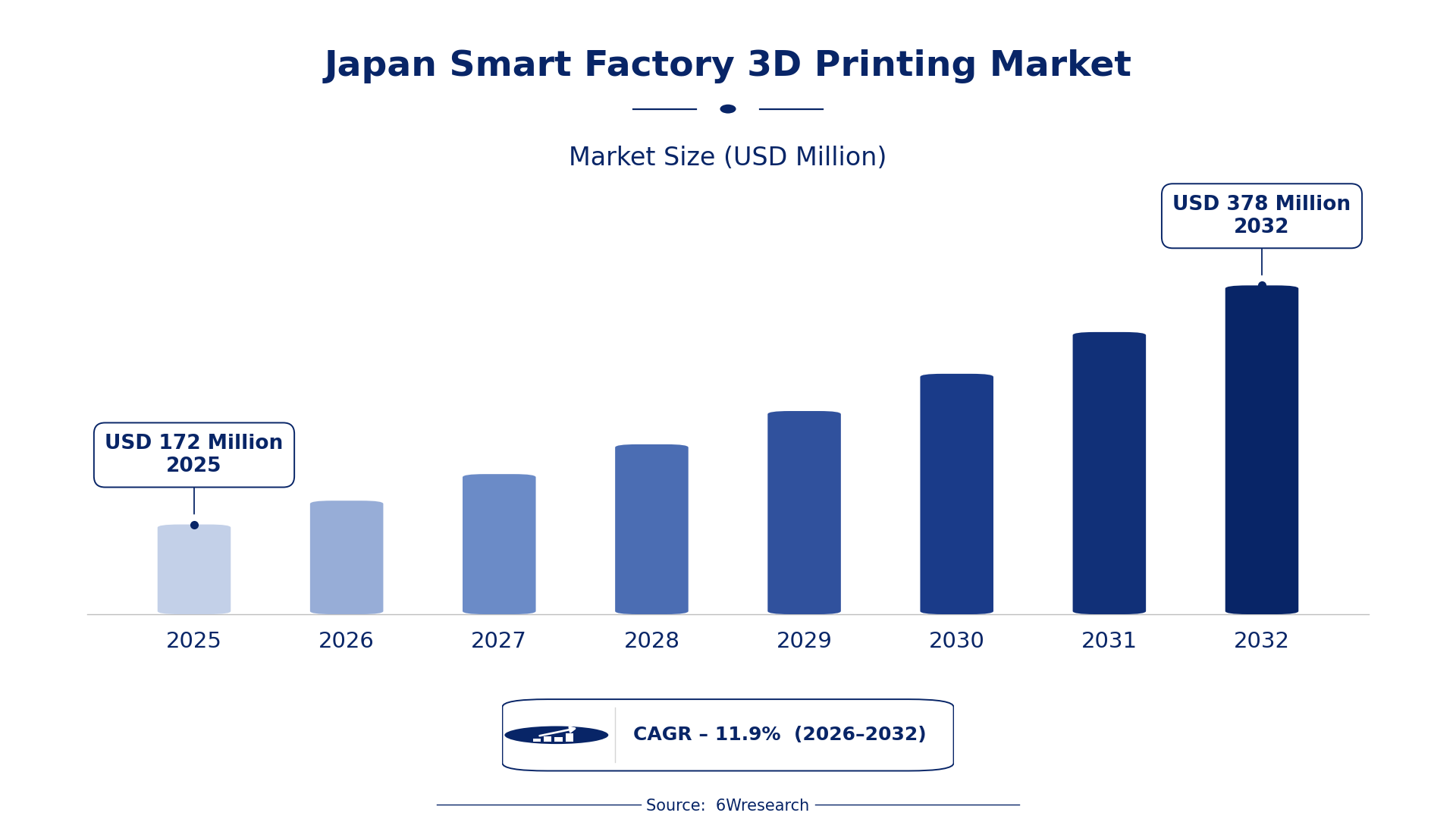
According to 6Wresearch internal database and industry insights, the Japan Smart Factory 3D Printing Market was valued at USD 172 Million in 2025 and is projected to reach USD 378 Million by 2032, growing at a CAGR of approximately 11.9% during 2026–2032.
Japan Smart Factory 3D Printing Market Highlights
| Report Metric | Details |
| Report Name | Japan Smart Factory 3D Printing Market (2026-2032) |
| Market Size 2025 | USD 172 Million |
| Market Size 2032 | USD 378 Million |
| Absolute Growth 2025–2032 | USD 206 Million |
| CAGR 2026–2032 | 11.9% |
| Peak Annual Growth | 16.0% in 2026 |
| Forecast Period | 2026–2032 |
| Historical Data | 2022–2025 |
| Base Year | 2025 |
| Leading Printing Type, 2025 | FDM Smart Printers (36% share) |
| Leading Smart Feature, 2025 | Predictive Maintenance (40% share) |
| Leading Integration System, 2025 | IoT Cloud Platforms (46% share) |
| Leading End User, 2025 | Automotive Plants (44% share) |
| Fastest-Growing Printing Type | Metal AM Systems (16.4% CAGR) |
| Fastest-Growing Integration System | Digital Twin Integration (17.1% CAGR) |
| Fastest-Growing End User | Aerospace Factories (15.5% CAGR) |
| Growing Sector | Aerospace Factories |
| Key End Users | Automotive Plants, Electronics Manufacturers, Aerospace Factories, Advanced Manufacturing |
Japan Smart Factory 3D Printing Market Year-wise Growth Rate and Key Drivers (2022–2032)
This graph illustrates the annual growth rates of the market from 2022 to 2032, highlighting a steady upward trajectory and projected market expansion over the forecast period.
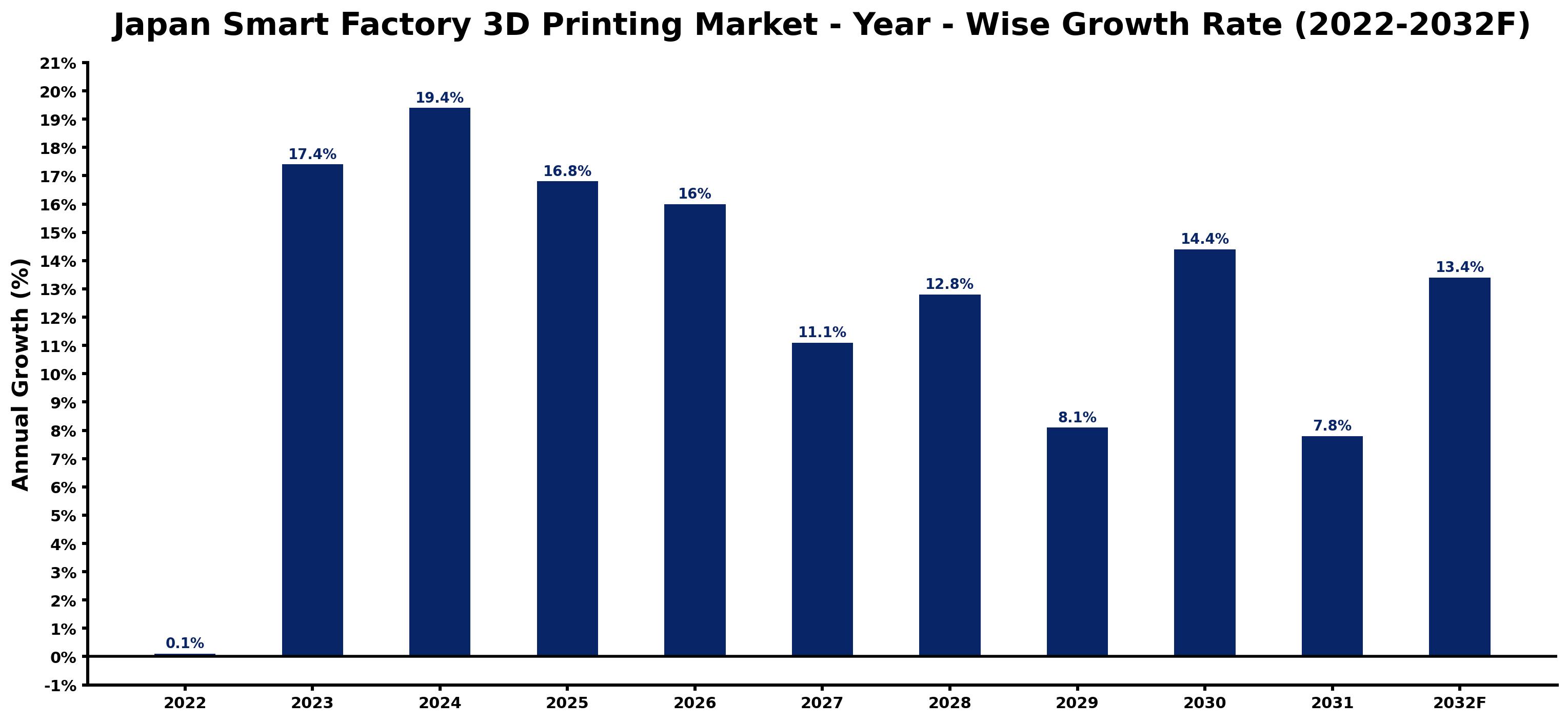
The yearly estimates that follow link every growth rate to its principal driver, so readers can see why the pace changed in each period.
| Year | Estimated Annual Growth (%) | Market Rationale |
| 2022 | 0.1 | The market showed minimal activity with a slight growth rate. |
| 2023 | 17.4 | Demand surged due to increased adoption of advanced manufacturing technologies. |
| 2024 | 19.4 | Growth accelerated as more sectors integrated 3D printing into their processes. |
| 2025 | 16.8 | A slowdown occurred as the market adjusted after rapid expansion in previous years. |
| 2026 | 16.0 | Growth continued but at a reduced rate as the market stabilised. |
| 2027 | 11.1 | Demand growth slowed further as the market matured and competition intensified. |
| 2028 | 12.8 | A renewed interest in innovative applications drove growth higher again. |
| 2029 | 8.1 | The market experienced a slowdown as adoption rates began to plateau. |
| 2030 | 14.4 | Growth picked up as technological advancements reinvigorated interest in 3D printing. |
| 2031 | 7.8 | A slowdown was observed as the market reached a more stable phase. |
| 2032 | 13.4 | Demand rose again due to increasing investments in smart factory technologies. |
Note: Market size estimations and growth projections presented in this report are based on 6Wresearch's proprietary forecasting methodology, utilizing the latest available industry data, government publications, and primary research inputs.
Japan Smart Factory 3D Printing Market Synopsis
Smart Factory 3D Printing involves advanced additive manufacturing technologies that create parts layer by layer using digital models. The market is projected to reach 1.5 trillion yen by 2025, driven by strong demand from automotive plants and aerospace factories. The integration of IoT Cloud Platforms into 70% of smart factories improves operational efficiency, while the Society 5.0 initiative promotes innovation in manufacturing processes, creating new opportunities for growth in this sector.
Market Dynamics Impact Analysis (2026–2032)
| Factor | Type | Impact | Primary Segment Affected |
| Increased adoption of FDM printers in automotive plants | Driver | High | FDM Smart Printers |
| Growing demand for high-precision applications using SLA printers | Driver | High | SLA Printers with AI |
| Expansion of aerospace manufacturing capabilities in Japan | Opportunity | High | Metal AM Systems |
| Rising need for customized production solutions in various sectors | Opportunity | High | Multi-Material Printers |
| Limited availability of skilled workforce in advanced manufacturing | Restraint | Medium | Metal AM Systems |
| High initial investment costs for advanced 3D printing technologies | Restraint | Medium | SLA Printers with AI |
| Supply chain disruptions affecting material availability | Challenge | High | FDM Smart Printers |
| Technological advancements outpacing current manufacturing capabilities | Challenge | High | SLA Printers with AI |
Evaluation of Drivers in Japan Smart Factory 3D Printing Market (2026–2032)
Demand rests on the following drivers, each shown with the segment it touches most.
| Drivers | Primary Segment Affected | Why It Matters (Evidence) |
| Increased production efficiency | FDM Smart Printers | FDM printers are widely used in over 200 automotive plants, improving production speed and reducing lead times. |
| Demand for precision manufacturing | SLA Printers with AI | SLA printers are utilized in precision manufacturing for electronics, ensuring high-quality outputs and reducing waste. |
| Investment in aerospace facilities | Metal AM Systems | The aerospace sector employs over 300 advanced manufacturing facilities, driving demand for complex components produced with Metal AM Systems. |
| Customization in manufacturing processes | Multi-Material Printers | Growing customization needs in various sectors encourage investment in multi-material printing technologies, enhancing production flexibility. |
| Integration of IoT technologies | IoT Cloud Platforms | IoT Cloud Platforms are integrated into 70% of smart factories, improving data management and connectivity, which boosts operational efficiency. |
What keeps demand rising is the increasing production efficiency achieved through FDM printers, which are widely used in over 200 automotive plants, improving production speed and reducing lead times. The demand for precision manufacturing is also notable, as SLA printers are utilized in precision manufacturing for electronics, ensuring high-quality outputs and reducing waste. Investment in aerospace facilities drives demand for complex components produced with Metal AM Systems, while growing customization needs in various sectors encourage investment in multi-material printing technologies. The integration of IoT technologies into 70% of smart factories improves data management and connectivity, which boosts operational efficiency.
Evaluation of Restraints in Japan Smart Factory 3D Printing Market
These restraints slow adoption and weigh on supplier margins.
| Market Restraint | Primary Segment Affected | Why It Matters (Evidence) |
| Limited availability of skilled workforce | Metal AM Systems | The shortage of skilled workers in advanced manufacturing hampers the growth of Metal AM Systems, with 70% of smart factories struggling to find qualified personnel. |
| High initial investment costs | SLA Printers with AI | High upfront costs for SLA printers deter potential buyers from investing, impacting market growth significantly. |
| Supply chain disruptions | FDM Smart Printers | Supply chain disruptions affect the availability of materials needed for FDM printing, leading to production delays. |
| Technological advancements outpacing capabilities | SLA Printers with AI | Rapid technological changes create challenges for manufacturers to keep up with new standards, affecting production timelines. |
| Regulatory compliance costs | Multi-Material Printers | Compliance with various standards increases operational costs for manufacturers, impacting pricing strategies. |
Japan Smart Factory 3D Printing Market Challenges
Material costs escalate for buyers, with 3D printing filaments increasing by 25% this year, raising production expenses significantly. Compliance with ISO/ASTM 52900 standards burdens manufacturers, adding up to 15% in costs for training and delaying project timelines. A skills gap exists, as 70% of smart factories report difficulties in sourcing qualified workers, causing project delays that can extend lead times by weeks. Technology adoption lags, with only 65% of facilities implementing predictive maintenance, risking equipment failures that can disrupt production schedules.
Trends in the Japan Smart Factory 3D Printing Market
Several trends are reshaping the Japan Smart Factory 3D Printing Market; the most important are set out below.
- Shift in Focus to Aerospace Manufacturing: The Tokyo region is emerging as a hub for aerospace manufacturing, with over 300 advanced facilities. This shift supports a growing demand for lightweight and complex components, driving innovation in 3D printing technology.
- Emergence of Digital Twin Integration: Digital Twin Integration has gained traction in smart factories, improving simulation and optimization processes. This trend reflects the 70% adoption rate of IoT Cloud Platforms, which facilitate real-time data analysis.
- Rise of Predictive Maintenance Solutions: Predictive Maintenance has become essential in minimizing downtime, with an adoption rate of 65% in manufacturing. This trend is clear in automotive plants, where efficiency is critical for production.
- Transition to Multi-Material Printing: The demand for customized production solutions has led to a transition towards Multi-Material Printers. This trend is driven by the need for parts with varied material properties in sectors like aerospace.
Investment Opportunities in the Japan Smart Factory 3D Printing Market
The following areas offer the clearest openings for investors and suppliers in the Japan Smart Factory 3D Printing Market.
- Investment in Automotive Plants: The automotive sector is currently investing heavily in advanced 3D printing technologies, with over 200 plants adopting new solutions. This presents a chance for suppliers to provide essential printing materials and services.
- Expansion of Aerospace Facilities: With over 300 advanced manufacturing facilities in aerospace, there is a growing need for specialised 3D printing solutions. Suppliers can enter this market by partnering with local manufacturers to meet specific requirements.
- Enhancing IoT Integration in Factories: As IoT Cloud Platforms are integrated into 70% of smart factories, there is a demand for advanced data management solutions. Companies can supply software and hardware that improve connectivity and efficiency.
- Development of Multi-Material Printers: The increasing demand for customised production solutions creates opportunities for suppliers of Multi-Material Printers. Engaging with aerospace manufacturers can lead to fruitful collaborations.
Government Initiatives in the Japan Smart Factory 3D Printing Market
The Economic Security Promotion Act (2022) supports supply-chain resilience for designated critical products and materials, allowing manufacturers to maintain production levels. This law complements existing regulations by providing additional resources for developing advanced manufacturing technologies, ensuring a stable supply of necessary materials.
The Ministry of Economy, Trade and Industry (METI) funds various initiatives to promote innovation in manufacturing, including a 5 billion yen fund launched in 2023 aimed at supporting research and development in advanced manufacturing processes. This initiative is important for improving the capabilities of producers in the Smart Factory 3D Printing sector.
Future Insight of the Japan Smart Factory 3D Printing Market
By 2032, Japan's manufacturing landscape will transform due to the government's push for advanced technologies under the 'Society 5.0' initiative. The integration of quality analysis tools in 80% of smart factories will improve real-time monitoring and operational efficiency. Buyers will benefit from a wider array of production options, supported by over 500 registered 3D printing service providers. The 5 billion yen fund for manufacturing innovation will encourage advancements in additive manufacturing techniques, driving competitiveness in the sector.
Market Segmentation Analysis
Japan Smart Factory 3D Printing Market report covers a detailed analysis of the following market segments:
By Printing Type – FDM Smart Printers Lead, Metal AM Systems Expected to Grow Fastest
According to Saurav Kr Singh, Senior Research Analyst at 6Wresearch, the largest printing type category in 2025 was FDM Smart Printers, at 36% of revenue. FDM Smart Printers dominate the market due to their widespread use in over 200 automotive plants across Japan, where they are essential for prototyping and producing plastic parts. This extensive installed base highlights the critical role of FDM technology in supporting efficient manufacturing processes. The quickest growth will come from Metal AM Systems, forecast to expand at a CAGR of 16.4% between 2026 and 2032. Metal AM Systems are rapidly gaining traction as they are crucial for producing complex metal components in the aerospace sector, which includes more than 300 advanced manufacturing facilities. This increasing reliance on sophisticated manufacturing techniques will further solidify FDM's leading position. Suppliers should focus on enhancing FDM capabilities while also exploring opportunities in metal additive manufacturing to meet evolving industry needs.
By Smart Feature – Predictive Maintenance Leads and Records the Fastest Growth
With 40% of smart feature revenue in 2025, Predictive Maintenance was the largest category. Predictive Maintenance holds the largest share as it is vital for minimising downtime in manufacturing, directly influencing productivity and operational efficiency. Its extensive implementation across smart factories underscores its importance for manufacturers aiming for seamless operations. The same category is also set to grow fastest, at a CAGR of 14.8% during 2026–2032. The growth of Predictive Maintenance is fuelled by its effectiveness in reducing operational disruptions, with a 65% adoption rate in Japan's manufacturing sector. This trend indicates that as automation increases, the demand for predictive solutions will continue to strengthen, reinforcing its market lead. Buyers must invest in predictive technologies to maintain competitive advantages in manufacturing efficiency.
By Integration System – IoT Cloud Platforms Lead, Digital Twin Integration Expected to Grow Fastest
IoT Cloud Platforms took 46% of integration system revenue in 2025, more than any other category. IoT Cloud Platforms lead the market as they facilitate data management and connectivity in factories, which are essential for integrating various manufacturing processes. Their integration in 70% of smart factories in Japan highlights their critical role in modern manufacturing environments. Digital Twin Integration is projected to grow fastest, at a CAGR of 17.1% during 2026–2032. Digital Twin Integration is gaining momentum due to its ability to enable simulation and optimisation of manufacturing processes, increasingly vital in a competitive landscape. This growth reflects a broader trend towards digital transformation in manufacturing, further cementing the position of IoT Cloud Platforms. Suppliers should prioritise the development of IoT solutions that enhance connectivity and data utilisation in smart factories.
By End User – Automotive Plants Lead, Aerospace Factories Expected to Grow Fastest
Automotive Plants accounted for 44% of the market by end user in 2025. Automotive Plants are the largest end users of 3D printing, extensively employing the technology for parts and tooling in their production lines. This sector's reliance on advanced manufacturing techniques ensures a steady demand for 3D printing solutions. Over 2026–2032, Aerospace Factories are expected to post the fastest growth, at a CAGR of 15.5%. Aerospace Factories are witnessing the fastest growth as they leverage 3D printing for lightweight and complex components, which are crucial for modern aircraft design. This trend indicates a heightened focus on efficiency and innovation within the aerospace sector, contributing to overall market expansion. Manufacturers targeting the aerospace sector should tailor their offerings to meet the specific requirements for lightweight and complex component production.
Key Attractiveness of the Report
- 10 Years of Market Numbers
- Historical Data Starting from 2022 to 2025
- Base Year 2025
- Forecast Data until 2032
- Key Performance Indicators Impacting the Market
- Major Upcoming Developments and Projects
Key Highlights of the Report:
- Japan Smart Factory 3D Printing Market Outlook
- Market Size of Japan Smart Factory 3D Printing Market, 2025
- Forecast of Japan Smart Factory 3D Printing Market, 2032
- Historical Data and Forecast of Japan Smart Factory 3D Printing Revenues & Volume for the Period 2022-2032F
- Japan Smart Factory 3D Printing Market Trend Evolution
- Japan Smart Factory 3D Printing Market Drivers and Challenges
- Japan Smart Factory 3D Printing Price Trends
- Japan Smart Factory 3D Printing Porter's Five Forces
- Japan Smart Factory 3D Printing Industry Life Cycle
- Historical Data and Forecast of Japan Smart Factory 3D Printing Market Revenues & Volume By Printing Type for the Period 2022-2032F
- Historical Data and Forecast of Japan Smart Factory 3D Printing Market Revenues & Volume By FDM Smart Printers for the Period 2022-2032F
- Historical Data and Forecast of Japan Smart Factory 3D Printing Market Revenues & Volume By SLA Printers with AI for the Period 2022-2032F
- Historical Data and Forecast of Japan Smart Factory 3D Printing Market Revenues & Volume By Metal AM Systems for the Period 2022-2032F
- Historical Data and Forecast of Japan Smart Factory 3D Printing Market Revenues & Volume By Multi-Material Printers for the Period 2022-2032F
- Historical Data and Forecast of Japan Smart Factory 3D Printing Market Revenues & Volume By Smart Feature for the Period 2022-2032F
- Historical Data and Forecast of Japan Smart Factory 3D Printing Market Revenues & Volume By Predictive Maintenance for the Period 2022-2032F
- Historical Data and Forecast of Japan Smart Factory 3D Printing Market Revenues & Volume By Quality Analysis for the Period 2022-2032F
- Historical Data and Forecast of Japan Smart Factory 3D Printing Market Revenues & Volume By Real-Time Layer Monitoring for the Period 2022-2032F
- Historical Data and Forecast of Japan Smart Factory 3D Printing Market Revenues & Volume By Adaptive Feed Controls for the Period 2022-2032F
- Historical Data and Forecast of Japan Smart Factory 3D Printing Market Revenues & Volume By Integration System for the Period 2022-2032F
- Historical Data and Forecast of Japan Smart Factory 3D Printing Market Revenues & Volume By IoT Cloud Platforms for the Period 2022-2032F
- Historical Data and Forecast of Japan Smart Factory 3D Printing Market Revenues & Volume By Edge AI for the Period 2022-2032F
- Historical Data and Forecast of Japan Smart Factory 3D Printing Market Revenues & Volume By Digital Twin Integration for the Period 2022-2032F
- Historical Data and Forecast of Japan Smart Factory 3D Printing Market Revenues & Volume By MES-Integrated for the Period 2022-2032F
- Historical Data and Forecast of Japan Smart Factory 3D Printing Market Revenues & Volume By End User for the Period 2022-2032F
- Historical Data and Forecast of Japan Smart Factory 3D Printing Market Revenues & Volume By Automotive Plants for the Period 2022-2032F
- Historical Data and Forecast of Japan Smart Factory 3D Printing Market Revenues & Volume By Electronics Manufacturers for the Period 2022-2032F
- Historical Data and Forecast of Japan Smart Factory 3D Printing Market Revenues & Volume By Aerospace Factories for the Period 2022-2032F
- Historical Data and Forecast of Japan Smart Factory 3D Printing Market Revenues & Volume By Advanced Manufacturing for the Period 2022-2032F
- Japan Smart Factory 3D Printing Import Export Trade Statistics
- Market Opportunity Assessment By Printing Type
- Market Opportunity Assessment By Smart Feature
- Market Opportunity Assessment By Integration System
- Market Opportunity Assessment By End User
- Japan Smart Factory 3D Printing Top Companies Market Share
- Japan Smart Factory 3D Printing Competitive Benchmarking By Technical and Operational Parameters
- Japan Smart Factory 3D Printing Company Profiles
- Japan Smart Factory 3D Printing Key Strategic Recommendations
Market Covered
Segments analysed in this report are listed below.
By Printing Type
- FDM Smart Printers
- SLA Printers with AI
- Metal AM Systems
- Multi-Material Printers
By Smart Feature
- Predictive Maintenance
- Quality Analysis
- Real-Time Layer Monitoring
- Adaptive Feed Controls
By Integration System
- IoT Cloud Platforms
- Edge AI
- Digital Twin Integration
- MES-Integrated
By End User
- Automotive Plants
- Electronics Manufacturers
- Aerospace Factories
- Advanced Manufacturing































