Japan Smart Factory Equipment Market Size & Growth Rate
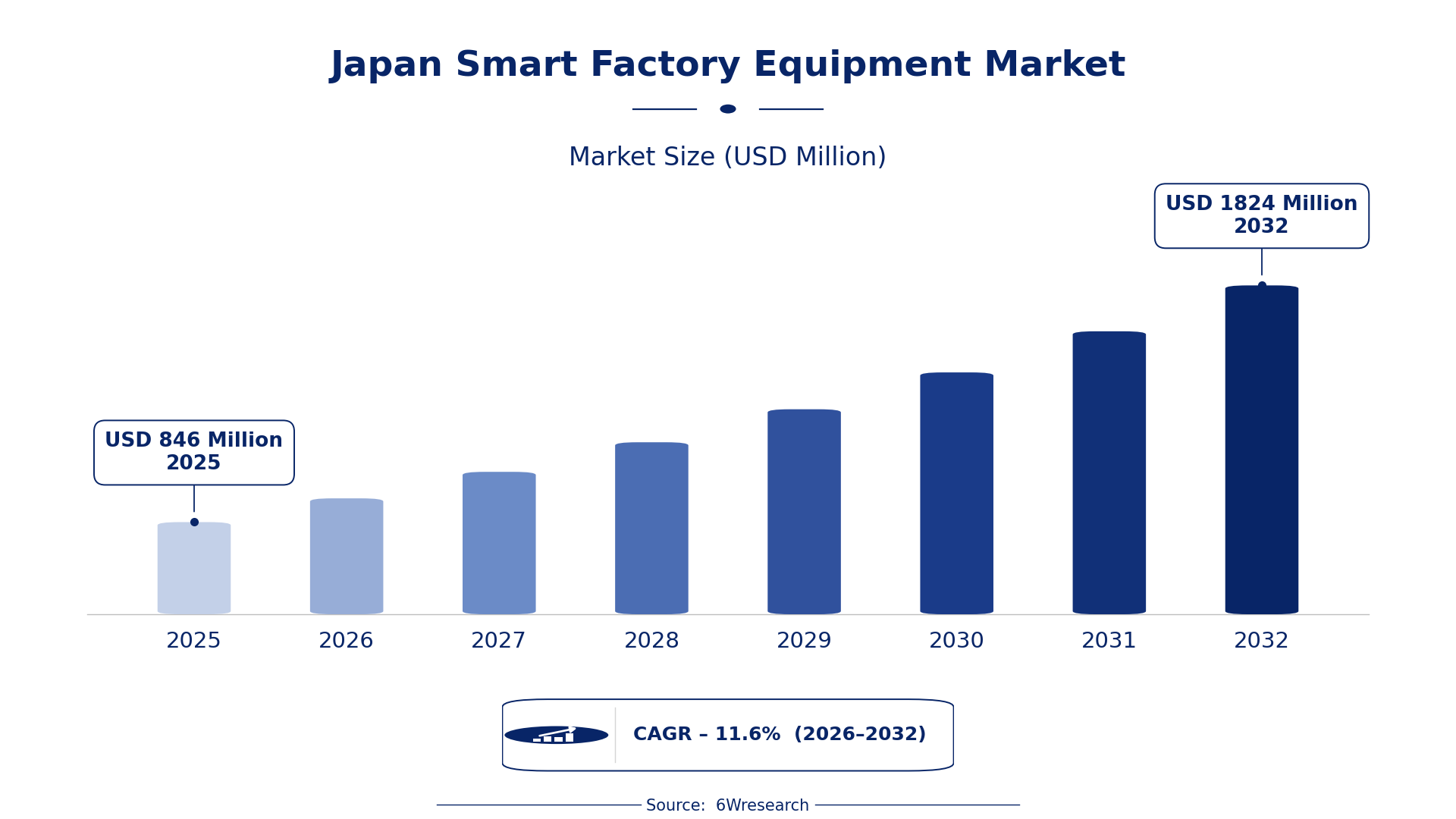
According to 6Wresearch internal database and industry insights, the Japan Smart Factory Equipment Market was valued at USD 846 Million in 2025 and is projected to reach USD 1,824 Million by 2032, growing at a CAGR of approximately 11.6% during 2026–2032.
Japan Smart Factory Equipment Market Highlights
| Report Metric | Details |
| Report Name | Japan Smart Factory Equipment Market (2026-2032) |
| Market Size 2025 | USD 846 Million |
| Market Size 2032 | USD 1,824 Million |
| Absolute Growth 2025–2032 | USD 978 Million |
| CAGR 2026–2032 | 11.6% |
| Peak Annual Growth | 12.3% in 2030 |
| Forecast Period | 2026–2032 |
| Historical Data | 2022–2025 |
| Base Year | 2025 |
| Leading Equipment Type, 2025 | CNC Machines (42% share) |
| Leading Smart Feature, 2025 | AI-Based Optimization (38% share) |
| Leading Integration Type, 2025 | PLC + Sensors (38% share) |
| Leading End User, 2025 | Automotive Production Lines (34% share) |
| Fastest-Growing Equipment Type | Robotic Arms (16.9% CAGR) |
| Fastest-Growing Integration Type | Cloud Manufacturing (17.0% CAGR) |
| Fastest-Growing End User | Assembly Line Operators (14.8% CAGR) |
| Growing Sector | automotive manufacturing |
| Key End Users | industrial OEMs, automotive production lines, assembly line operators, metal forming companies |
Japan Smart Factory Equipment Market Year-wise Growth Rate and Key Drivers (2022–2032)
This graph illustrates the annual growth rates of the market from 2022 to 2032, highlighting a steady upward trajectory and projected market expansion over the forecast period.
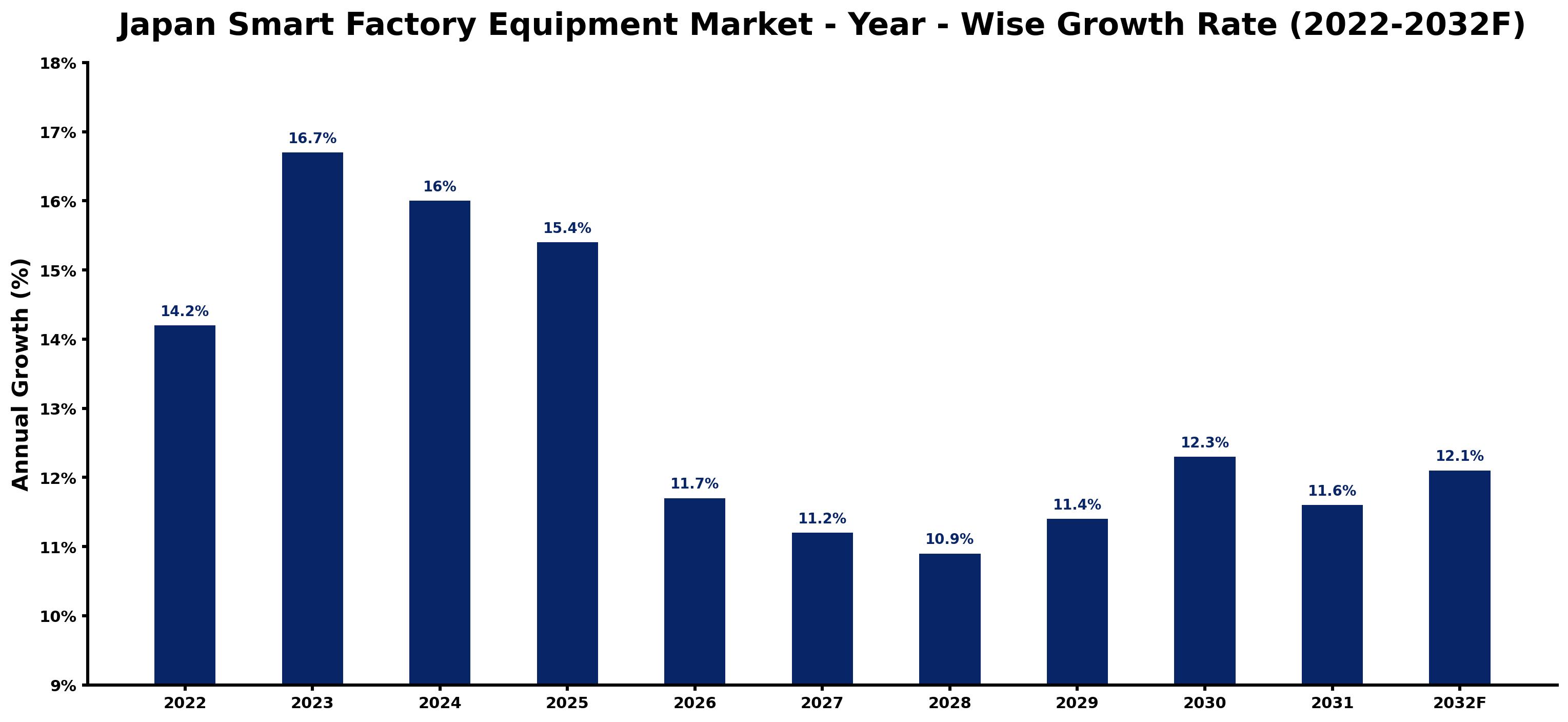
For each year, the table pairs the estimated growth rate with the leading influence on demand, showing how the drivers changed across the period.
| Year | Estimated Annual Growth (%) | Market Rationale |
| 2022 | 14.2 | The market experienced solid growth driven by strong demand from manufacturers. |
| 2023 | 16.7 | Growth accelerated as investments in automation surged across sectors. |
| 2024 | 16.0 | A slight slowdown occurred due to market saturation in some areas. |
| 2025 | 15.4 | Demand remained strong, but growth rates began to decelerate. |
| 2026 | 11.7 | Investment in smart technologies is expected to continue, although at a slower pace. |
| 2027 | 11.2 | The market will show signs of stabilisation amid ongoing technological upgrades. |
| 2028 | 10.9 | Growth will slow further as companies focus on optimising existing systems. |
| 2029 | 11.4 | Increased adoption of smart technologies will lead to a rebound in growth rates. |
| 2030 | 12.3 | The market is expected to peak as new technologies gain traction. |
| 2031 | 11.6 | Growth rates will normalise as the market matures and competition intensifies. |
| 2032 | 12.1 | Demand is projected to rise again as innovation drives new investments. |
Note: Market size estimations and growth projections presented in this report are based on 6Wresearch's proprietary forecasting methodology, utilizing the latest available industry data, government publications, and primary research inputs.
Japan Smart Factory Equipment Market Synopsis
Smart Factory Equipment encompasses advanced machinery and systems that improve manufacturing processes through automation and data exchange. The Japan Smart Factory Equipment Market thrives on robust demand from the automotive and electronics sectors, which heavily depend on these technologies. A skilled workforce, substantial investments in automation, and government backing for smart manufacturing initiatives are driving growth. The automotive industry, which represents 20% of manufacturing output, highlights the necessity for smart factory solutions, with Tokyo emerging as a pivotal technology development hub.
Market Dynamics Impact Analysis (2026–2032)
| Factor | Type | Impact | Primary Segment Affected |
| Investment in automation technologies is increasing, driven by the need for efficiency. | Driver | High | CNC Machines |
| The automotive sector's demand for precision manufacturing fuels equipment purchases. | Driver | High | Robotic Arms |
| The push for AI integration in manufacturing presents lucrative opportunities. | Opportunity | High | AI-Based Optimization |
| Growing interest in smart factory solutions in Tokyo creates new market avenues. | Opportunity | Medium | Smart Conveyors |
| Aging manufacturing equipment necessitates upgrades, limiting immediate investments. | Restraint | High | CNC Machines |
| High initial costs of smart factory implementations can deter smaller firms. | Restraint | Medium | Robotic Arms |
| Competition among manufacturers can lead to price wars, impacting margins. | Challenge | High | CNC Machines |
| Technological complexity may hinder adoption for less experienced firms. | Challenge | Medium | Robotic Arms |
Evaluation of Drivers in Japan Smart Factory Equipment Market (2026–2032)
Key forces behind demand, with the segment each one moves most, are listed below.
| Drivers | Primary Segment Affected | Why It Matters (Evidence) |
| Increased investment in automation technologies drives production efficiency. | CNC Machines | Japan's manufacturing sector employs over 8 million workers, increasing demand for precision machining. |
| Rising demand for high-quality automotive components necessitates advanced robotics. | Robotic Arms | The automotive industry accounts for 20% of Japan's manufacturing output, propelling robotic arm usage. |
| Government initiatives promote AI integration in manufacturing processes. | AI-Based Optimization | In 2023, Japan launched a program supporting AI integration, boosting demand for smart solutions. |
| Technological advancements in IoT facilitate real-time monitoring and control. | IoT-Integrated Presses | The average age of manufacturing equipment exceeds 10 years, highlighting the need for upgrades. |
| The need for energy efficiency drives investment in smart factory solutions. | PLC + Sensors | The Act on the Rational Use of Energy mandates improvements in energy efficiency for large users. |
Much of the new demand stems from increased investment in automation technologies, as Japan's manufacturing sector employs over 8 million workers, fuelling the need for CNC machines. The automotive industry, accounting for 20% of manufacturing output, requires advanced robotics for high-quality components. Technological advancements in IoT enable real-time monitoring and control, with the average age of manufacturing equipment surpassing 10 years, underscoring the urgent need for upgrades.
Evaluation of Restraints in Japan Smart Factory Equipment Market
The table below lists the restraints and the evidence behind each.
| Market Restraint | Primary Segment Affected | Why It Matters (Evidence) |
| Aging manufacturing equipment necessitates upgrades, limiting immediate investments. | CNC Machines | The average age of manufacturing equipment in Japan is over 10 years, prompting urgent upgrades. |
| High initial costs of smart factory implementations can deter smaller firms. | Robotic Arms | Smaller manufacturers may struggle with the financial burden of advanced robotics adoption. |
| Market saturation in certain sectors can limit growth opportunities. | IoT-Integrated Presses | As sectors mature, the demand for IoT-integrated solutions may plateau, affecting growth. |
| Technological complexity may hinder adoption for less experienced firms. | Robotic Arms | Less experienced manufacturers may find it challenging to integrate complex robotic systems. |
| Increased competition in the CNC machine sector pressures prices, affecting profitability. | CNC Machines | Price wars among manufacturers can erode profit margins. |
Japan Smart Factory Equipment Market Challenges
Producers encounter supply chain disruptions due to Japan's rising minimum wage of JPY 1,055 per hour, which increases operational costs and compresses profit margins. Compliance with ISO 9001 standards necessitates considerable investments in quality control, potentially delaying project timelines by up to six months for manufacturers. Cost pressures escalate as production expenses rise, resulting in a 10% price increase for end-users in the automotive sector. Technology obsolescence is apparent, with an average equipment age exceeding 10 years, leading to inefficiencies that hamper productivity for over 8 million workers in manufacturing.
Trends in the Japan Smart Factory Equipment Market
Below are the shifts with the largest effect on the Japan Smart Factory Equipment Market.
- Transition from Traditional to Smart Manufacturing: Tokyo is leading the transition to smart manufacturing, with over 500 industrial OEMs adopting advanced technologies. This shift is driven by the need for efficiency, with manufacturing output valued at approximately 80 trillion yen in 2022.
- Emergence of AI-Driven Solutions: In 2023, Japan launched a program to support AI integration in manufacturing, reflecting a broader trend towards automation. This initiative is expected to improve production efficiency across various sectors.
- Increased Use of Robotics in Automotive Production: Since 2022, Aichi Prefecture has seen a rise in robotic arms used in automotive production lines, improving assembly speed and precision. This trend underscores the automotive sector's reliance on smart factory technologies.
- Focus on Energy Efficiency in Manufacturing: The Act on the Rational Use of Energy has prompted manufacturers to adopt energy-efficient technologies. This regulatory push is reshaping investment priorities in smart factory equipment.
Investment Opportunities in the Japan Smart Factory Equipment Market
The opportunities below stand out in the Japan Smart Factory Equipment Market for new entrants and existing suppliers.
- Investment in Smart Factory Technologies in Tokyo: Tokyo's focus on smart manufacturing initiatives creates opportunities for suppliers of advanced machinery. With over 500 industrial OEMs, the demand for advanced solutions is rising, making partnerships essential.
- Growing Demand for AI Integration: The recent program supporting AI integration in manufacturing presents a timely opportunity for technology providers. Suppliers can target automotive production lines, where efficiency improvements are critical.
- Expansion of Robotics in Automotive Sector: The automotive industry's reliance on robotic arms offers a substantial investment opportunity. Suppliers should consider collaborating with assembly line operators in Aichi Prefecture to meet rising demand.
- Development of IoT-Integrated Solutions: The increasing need for real-time monitoring in manufacturing creates demand for IoT-integrated presses. Suppliers can enter the market by partnering with local industrial OEMs.
Government Initiatives in the Japan Smart Factory Equipment Market
The Act on the Rational Use of Energy mandates large energy users to enhance energy efficiency and report energy consumption. This legislation affects manufacturers by requiring investments in technologies that improve energy performance, thereby increasing the demand for smart factory equipment. The Industrial Safety and Health Act establishes employer responsibilities for hazardous substances and machinery, ensuring that manufacturers comply with safety standards while adopting new technologies.
In 2023, the Government of Japan allocated funding for the GX Basic Policy, targeting approximately JPY 150 trillion of public-private decarbonisation investment over 10 years. The Ministry of Economy, Trade and Industry oversees this initiative, which supports manufacturers in embracing sustainable practices.
Future Insight of the Japan Smart Factory Equipment Market
A new initiative concentrating on smart factory technology implementation will commence in 2024, paving the way for transformative changes in production processes. By 2032, advancements in smart manufacturing will be widespread, driven by increased funding from local governments and the Ministry of Economy, Trade and Industry. The integration of AI and robotics will improve operational capabilities, leading to enhanced product quality. Manufacturers can anticipate a 15% reduction in downtime, which will strengthen supply chain reliability for buyers.
Market Segmentation Analysis
Japan Smart Factory Equipment Market report covers a detailed analysis of the following market segments:
By Equipment Type – CNC Machines Lead, Robotic Arms Expected to Grow Fastest
According to Saurav Kr Singh, Senior Research Analyst at 6Wresearch, in 2025, CNC Machines led the equipment type split with a 42% share. CNC machines are essential in precision machining, particularly in sectors such as automotive and electronics that require high accuracy. Their widespread adoption is evident from the over 500 industrial OEMs in Japan that rely on these machines for quality production. The quickest growth will come from Robotic Arms, forecast to expand at a CAGR of 16.9% between 2026 and 2032. Robotic arms are increasingly being integrated into automotive production lines, especially in Aichi Prefecture, where the demand for precision and speed is critical. This segment's growth is expected to continue as manufacturers seek to enhance operational efficiency. Suppliers should focus on developing advanced robotic solutions to cater to the growing needs of the automotive sector.
By Smart Feature – AI-Based Optimization Leads and Records the Fastest Growth
AI-Based Optimization held 38% of the Japan Smart Factory Equipment Market by smart feature in 2025. AI-based optimisation leads the market due to its significant impact on manufacturing efficiency, making it vital for productivity-focused manufacturers. The support from the Ministry of Economy, Trade and Industry for AI integration further solidifies its position in the market. AI-Based Optimization is also forecast to expand faster than any other category, at a CAGR of 15.6% over 2026–2032. As the leader, AI-based optimisation is projected to maintain its growth trajectory, driven by continuous advancements in AI technologies that further integrate into manufacturing processes. This will likely strengthen its dominance as more manufacturers recognise its benefits. Buyers should invest in AI-based solutions to enhance their competitiveness and improve manufacturing processes.
By Integration Type – PLC + Sensors Lead, Cloud Manufacturing Expected to Grow Fastest
The largest integration type category in 2025 was PLC + Sensors, at 38% of revenue. PLC and sensors are key components in the market as they are integral to automation and control in manufacturing, ensuring efficient operations. Their critical role is highlighted by their extensive application across various manufacturing facilities in Japan. Cloud Manufacturing is projected to grow fastest, at a CAGR of 17.0% during 2026–2032. Cloud manufacturing is rapidly gaining traction as it facilitates real-time data sharing and collaboration among manufacturers, which is essential for modern production strategies. The increasing adoption of digital solutions positions this segment for notable growth. Suppliers need to enhance cloud integration capabilities to meet the evolving demands of manufacturers.
By End User – Automotive Production Lines Lead, Assembly Line Operators Expected to Grow Fastest
With 34% of end user revenue in 2025, Automotive Production Lines was the largest category. Automotive production lines capture the largest share as they heavily rely on smart equipment to optimise manufacturing processes, reflecting the sector's robust output. This reliance is particularly strong in regions like Aichi Prefecture, known for its automotive industry. Assembly Line Operators are set to record the highest CAGR in this split, 14.8% over 2026–2032. Assembly line operators are experiencing growth as they directly utilise smart equipment to boost efficiency, indicating a shift towards more automated manufacturing processes. This trend is likely to accelerate as manufacturers aim to optimise their operations. Suppliers must focus on providing tailored solutions that specifically address the requirements of assembly line operators.
Key Attractiveness of the Report
- 10 Years of Market Numbers
- Historical Data Starting from 2022 to 2025
- Base Year 2025
- Forecast Data until 2032
- Key Performance Indicators Impacting the Market
- Major Upcoming Developments and Projects
Key Highlights of the Report:
- Japan Smart Factory Equipment Market Outlook
- Market Size of Japan Smart Factory Equipment Market, 2025
- Forecast of Japan Smart Factory Equipment Market, 2032
- Historical Data and Forecast of Japan Smart Factory Equipment Revenues & Volume for the Period 2022-2032F
- Japan Smart Factory Equipment Market Trend Evolution
- Japan Smart Factory Equipment Market Drivers and Challenges
- Japan Smart Factory Equipment Price Trends
- Japan Smart Factory Equipment Porter's Five Forces
- Japan Smart Factory Equipment Industry Life Cycle
- Historical Data and Forecast of Japan Smart Factory Equipment Market Revenues & Volume By Equipment Type for the Period 2022-2032F
- Historical Data and Forecast of Japan Smart Factory Equipment Market Revenues & Volume By CNC Machines for the Period 2022-2032F
- Historical Data and Forecast of Japan Smart Factory Equipment Market Revenues & Volume By Smart Conveyors for the Period 2022-2032F
- Historical Data and Forecast of Japan Smart Factory Equipment Market Revenues & Volume By Robotic Arms for the Period 2022-2032F
- Historical Data and Forecast of Japan Smart Factory Equipment Market Revenues & Volume By IoT-Integrated Presses for the Period 2022-2032F
- Historical Data and Forecast of Japan Smart Factory Equipment Market Revenues & Volume By Smart Feature for the Period 2022-2032F
- Historical Data and Forecast of Japan Smart Factory Equipment Market Revenues & Volume By AI-Based Optimization for the Period 2022-2032F
- Historical Data and Forecast of Japan Smart Factory Equipment Market Revenues & Volume By Load + Motion Tracking for the Period 2022-2032F
- Historical Data and Forecast of Japan Smart Factory Equipment Market Revenues & Volume By Vision + AI Navigation for the Period 2022-2032F
- Historical Data and Forecast of Japan Smart Factory Equipment Market Revenues & Volume By Predictive Diagnostics for the Period 2022-2032F
- Historical Data and Forecast of Japan Smart Factory Equipment Market Revenues & Volume By Integration Type for the Period 2022-2032F
- Historical Data and Forecast of Japan Smart Factory Equipment Market Revenues & Volume By Cloud Manufacturing for the Period 2022-2032F
- Historical Data and Forecast of Japan Smart Factory Equipment Market Revenues & Volume By PLC + Sensors for the Period 2022-2032F
- Historical Data and Forecast of Japan Smart Factory Equipment Market Revenues & Volume By MES-Connected for the Period 2022-2032F
- Historical Data and Forecast of Japan Smart Factory Equipment Market Revenues & Volume By Sensor Mesh for the Period 2022-2032F
- Historical Data and Forecast of Japan Smart Factory Equipment Market Revenues & Volume By End User for the Period 2022-2032F
- Historical Data and Forecast of Japan Smart Factory Equipment Market Revenues & Volume By Industrial OEMs for the Period 2022-2032F
- Historical Data and Forecast of Japan Smart Factory Equipment Market Revenues & Volume By Assembly Line Operators for the Period 2022-2032F
- Historical Data and Forecast of Japan Smart Factory Equipment Market Revenues & Volume By Automotive Production Lines for the Period 2022-2032F
- Historical Data and Forecast of Japan Smart Factory Equipment Market Revenues & Volume By Metal Forming Companies for the Period 2022-2032F
- Japan Smart Factory Equipment Import Export Trade Statistics
- Market Opportunity Assessment By Equipment Type
- Market Opportunity Assessment By Smart Feature
- Market Opportunity Assessment By Integration Type
- Market Opportunity Assessment By End User
- Japan Smart Factory Equipment Top Companies Market Share
- Japan Smart Factory Equipment Competitive Benchmarking By Technical and Operational Parameters
- Japan Smart Factory Equipment Company Profiles
- Japan Smart Factory Equipment Key Strategic Recommendations
Market Covered
This report examines the market across the segments below.
By Equipment Type
- CNC Machines
- Smart Conveyors
- Robotic Arms
- IoT-Integrated Presses
By Smart Feature
- AI-Based Optimization
- Load + Motion Tracking
- Vision + AI Navigation
- Predictive Diagnostics
By Integration Type
- Cloud Manufacturing
- PLC + Sensors
- MES-Connected
- Sensor Mesh
By End User
- Industrial OEMs
- Assembly Line Operators
- Automotive Production Lines
- Metal Forming Companies































