Japan Smart Factory Network Market Size & Growth Rate
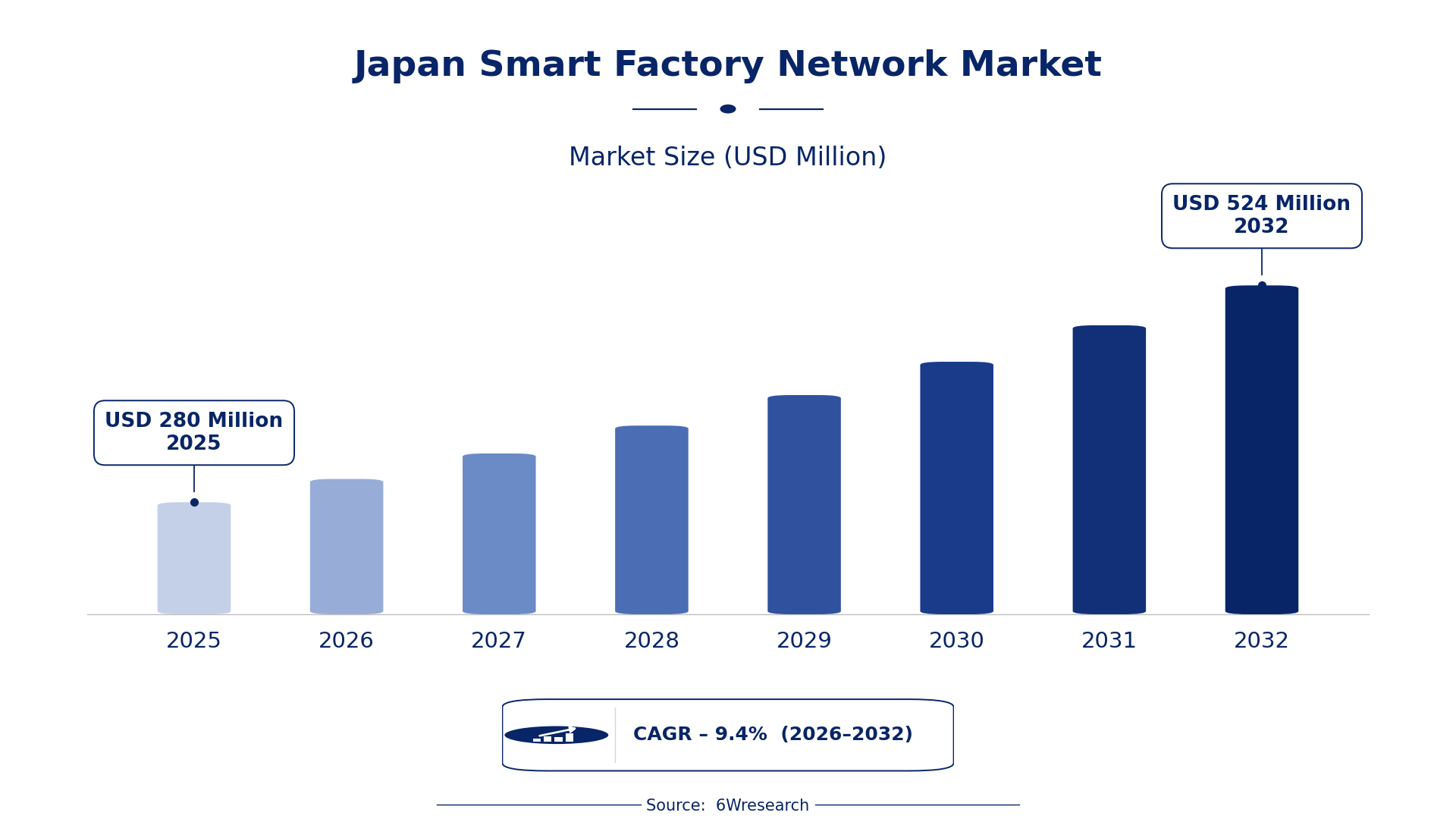
According to 6Wresearch internal database and industry insights, the Japan Smart Factory Network Market was valued at USD 280 Million in 2025 and is projected to reach USD 524 Million by 2032, growing at a CAGR of approximately 9.4% during 2026–2032.
Japan Smart Factory Network Market Highlights
| Report Metric | Details |
| Report Name | Japan Smart Factory Network Market (2026-2032) |
| Market Size 2025 | USD 280 Million |
| Market Size 2032 | USD 524 Million |
| Absolute Growth 2025–2032 | USD 244 Million |
| CAGR 2026–2032 | 9.4% |
| Peak Annual Growth | 10.4% in 2030 |
| Forecast Period | 2026–2032 |
| Historical Data | 2022–2025 |
| Base Year | 2025 |
| Leading Network Type, 2025 | 5G Private Network (49% share) |
| Leading Key Features, 2025 | Ultra-Reliable Low Latency (53% share) |
| Leading Supported Tech, 2025 | Industrial IoT (43% share) |
| Leading End User, 2025 | Smart Factory Operators (42% share) |
| Fastest-Growing Network Type | Wi-Fi 6 Enterprise LAN (13.2% CAGR) |
| Fastest-Growing Key Features | High-Speed Local Coverage (12.7% CAGR) |
| Fastest-Growing Supported Tech | Connected Equipment (12.8% CAGR) |
| Fastest-Growing End User | Manufacturing Hubs (12.5% CAGR) |
| Growing Sector | Smart Manufacturing |
| Key End Users | Smart Factory Operators, Manufacturing Hubs, Factory Automation Experts |
Japan Smart Factory Network Market Year-wise Growth Rate and Key Drivers (2022–2032)
This graph illustrates the annual growth rates of the market from 2022 to 2032, highlighting a steady upward trajectory and projected market expansion over the forecast period.
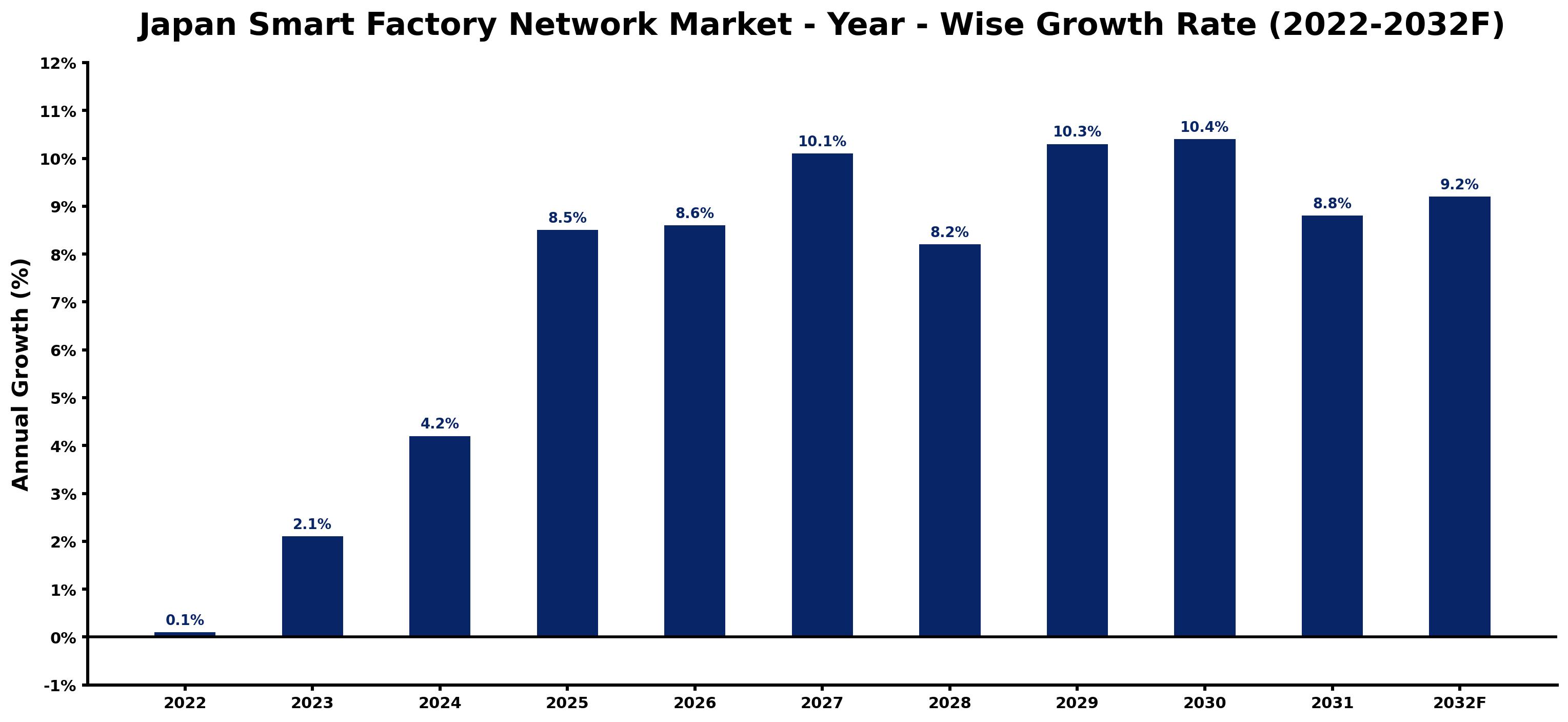
Annual growth estimates for each year appear below with the principal reason behind them, explaining the shifts that set the pace of the market.
| Year | Estimated Annual Growth (%) | Market Rationale |
| 2022 | 0.1 | The market showed minimal activity with initial implementations in select facilities. |
| 2023 | 2.1 | Growth accelerated as more manufacturers adopted smart technologies for efficiency. |
| 2024 | 4.2 | Demand increased with the rollout of 5G networks in major production sites. |
| 2025 | 8.5 | The market peaked as smart factory solutions became mainstream in manufacturing. |
| 2026 | 8.6 | Continued investment in smart technologies drove further growth in the sector. |
| 2027 | 10.1 | Demand surged as companies sought to improve automation and connectivity. |
| 2028 | 8.2 | Growth slowed slightly as the market began to stabilise after rapid expansion. |
| 2029 | 10.3 | A resurgence in investment led to faster growth as new projects launched. |
| 2030 | 10.4 | The market peaked again with advancements in smart technologies. |
| 2031 | 8.8 | Growth moderated as the market adjusted to new operational standards. |
| 2032 | 9.2 | Demand remained strong as manufacturers focused on sustainability and efficiency. |
Note: Market size estimations and growth projections presented in this report are based on 6Wresearch's proprietary forecasting methodology, utilizing the latest available industry data, government publications, and primary research inputs.
Japan Smart Factory Network Market Synopsis
The Japan Smart Factory Network Market integrates advanced communication networks and IoT devices to improve operational efficiency in manufacturing. In 2023, Japan's manufacturing sector employed approximately 8 million people, driving demand for smart factory solutions. Market expansion stems from government initiatives, including the 2023 programme aimed at enhancing manufacturing efficiency, and the adoption of ISO 50001 standards that support energy management in smart factories.
Market Dynamics Impact Analysis (2026–2032)
| Factor | Type | Impact | Primary Segment Affected |
| Increased adoption of 5G networks enhances connectivity in manufacturing environments. | Driver | High | 5G Private Network |
| Growing focus on energy efficiency drives demand for smart technologies. | Driver | High | Ultra-Reliable Low Latency |
| A gap in smart manufacturing technology presents opportunities for new entrants. | Opportunity | High | Edge Computing Mesh |
| Investment in logistics centers boosts the need for advanced wireless communication. | Opportunity | Medium | Wi-Fi 6 Enterprise LAN |
| High initial investment costs can deter smaller manufacturers from adopting smart solutions. | Restraint | High | Smart Factory Operators |
| Limited awareness of smart factory benefits restricts market growth. | Restraint | Medium | Manufacturing Hubs |
| Competition among technology providers can lead to price wars, affecting margins. | Challenge | High | Factory Automation Experts |
| Rapid technological advancements may outpace some manufacturers' ability to adapt. | Challenge | Medium | Logistics & Inventory Heads |
Evaluation of Drivers in Japan Smart Factory Network Market (2026–2032)
The factors lifting demand, and the evidence behind each, are summarised below.
| Drivers | Primary Segment Affected | Why It Matters (Evidence) |
| Deployment of 5G networks improves operational efficiency and connectivity. | 5G Private Network | In 2023, 5G networks were rolled out in 50% of major manufacturing facilities, improving data transfer speeds. |
| Focus on energy management encourages adoption of smart technologies. | Ultra-Reliable Low Latency | The government aims to reduce manufacturing energy consumption by 20% by 2030, driving demand for efficient solutions. |
| Increased investment in smart factory technologies boosts demand. | Edge Computing Mesh | The government allocated ¥10 billion in 2023 for smart manufacturing technology development, supporting innovation. |
| Growing need for real-time data analysis drives technology adoption. | Industrial IoT | Approximately 8 million people are employed in Japan's manufacturing sector, increasing the demand for connected solutions. |
| Rising consumer expectations for efficiency and quality push manufacturers to innovate. | Connected Equipment | Tokyo and Aichi are leading regions for smart factory implementations, reflecting the demand for advanced technologies. |
Several shifts outside the market lift sales. The rollout of 5G networks in 2023 across 50% of major manufacturing facilities improves connectivity, driving demand for smart factory solutions. The workforce of 8 million in Japan's manufacturing sector increases the need for connected devices and systems. The aim to reduce energy consumption by 20% by 2030 encourages the adoption of energy-efficient technologies, further stimulating market growth.
Evaluation of Restraints in Japan Smart Factory Network Market
The main factors holding the market back are set out below.
| Market Restraint | Primary Segment Affected | Why It Matters (Evidence) |
| High initial investment costs deter smaller manufacturers from adopting smart technologies. | Smart Factory Operators | Investment costs can exceed ¥100 million for full smart factory implementations, limiting participation. |
| Limited awareness of smart factory benefits restricts market growth. | Manufacturing Hubs | Many manufacturers remain unaware of the potential efficiency gains, slowing adoption. |
| Complex integration processes can hinder implementation timelines. | Factory Automation Experts | Integration of new technologies often requires extensive training and system adjustments. |
| Shortage of skilled workforce impacts technology deployment. | Logistics & Inventory Heads | The manufacturing sector faces a talent gap, delaying the adoption of smart solutions. |
| Rapid technological advancements may lead to obsolescence of existing systems. | Edge Computing Mesh | Manufacturers may hesitate to invest in technologies that could quickly become outdated. |
Japan Smart Factory Network Market Challenges
Producers face escalating costs due to the integration of advanced technologies, which can raise expenses by 30% for manufacturers. Limited availability of skilled workers in smart manufacturing leads to supply chain disruptions, delaying projects and adding an average of ¥5 million in costs for producers. Compliance with ISO 50001 standards requires significant investments in energy management systems, costing facilities around ¥2 million each. Competition intensifies as firms rush to implement smart technologies, forcing smaller manufacturers to invest heavily or risk losing market share.
Trends in the Japan Smart Factory Network Market
Buyers and suppliers in the Japan Smart Factory Network Market are adjusting to the following trends.
- Shift from Traditional to Smart Manufacturing: In 2023, 5G networks were rolled out in 50% of major manufacturing facilities, improving operational efficiency. This shift is leading to increased automation and connectivity in production processes.
- Transition to Energy-Efficient Technologies: The government aims to reduce manufacturing energy consumption by 20% by 2030, prompting manufacturers to adopt smart technologies. This trend is reflected in the growing implementation of ISO 50001 standards.
- Emergence of IoT-Enabled Solutions: Smart Factory Operators are increasingly adopting Industrial IoT solutions, with a 43% market share in 2025. This trend reflects the need for improved connectivity and data analysis in manufacturing.
- Prioritisation of Real-Time Data Analysis: Real-Time Local Analysis is becoming essential in manufacturing environments, with increasing deployments across logistics centres. This shift supports immediate decision-making based on actionable data.
Investment Opportunities in the Japan Smart Factory Network Market
Investors looking at the Japan Smart Factory Network Market should consider the following areas.
- Gap in Smart Manufacturing Technology: With the smart factory market projected to grow, there is a gap for new entrants to provide solutions. Manufacturing Hubs are ideal for investment, allowing companies to partner with local firms for technology deployment.
- Investment in Logistics Centers: The logistics sector is expanding, with a growing need for advanced wireless communication. Companies can enter this market by forming joint ventures with logistics providers to improve connectivity.
- Development of Energy Management Solutions: The government's target to reduce energy consumption by 20% by 2030 creates opportunities for energy-efficient technologies. Smart Factory Operators can benefit from partnerships focused on energy management solutions.
- Expansion of 5G Infrastructure: As 5G networks continue to roll out, there is a significant opportunity for technology providers to supply infrastructure. Collaborating with local telecommunications firms can facilitate market entry.
Government Initiatives in the Japan Smart Factory Network Market
The Semiconductor and Digital Industry Strategy, initiated by the Ministry of Economy, Trade and Industry in June 2021, aims to secure domestic semiconductor manufacturing. This measure supports smart factory producers by promoting the development of essential technologies needed for efficient operations.
The National Institute of Advanced Industrial Science and Technology funds research and development projects in smart manufacturing. In 2023, this agency approved several initiatives aimed at improving smart factory capabilities, providing financial support to innovators in the sector.
Future Insight of the Japan Smart Factory Network Market
The rollout of smart factory facilities will accelerate by 2032, driven by government initiatives and technological advancements. By 2030, 5G networks will be installed in 50% of major manufacturing sites, enhancing connectivity and data analysis capabilities. New research centres will emerge to promote innovation in smart factory technologies, benefiting both suppliers and buyers. Energy consumption in manufacturing is projected to decrease by 20% through the adoption of smart technologies, leading to cost savings and improved operational efficiency.
Market Segmentation Analysis
Japan Smart Factory Network Market report covers a detailed analysis of the following market segments:
By Network Type – 5G Private Network Leads, Wi-Fi 6 Enterprise LAN Expected to Grow Fastest
According to Saurav Kr Singh, Senior Research Analyst at 6Wresearch, in 2025, 5G Private Network led the network type split with a 49% share. The 5G Private Network holds the largest market share due to its ability to provide high-speed connectivity, which is crucial for smart factories, particularly in regions like Tokyo. This network type supports essential functions such as real-time data analysis and automation, vital for maintaining operational efficiency. The quickest growth will come from Wi-Fi 6 Enterprise LAN, forecast to expand at a CAGR of 13.2% between 2026 and 2032. The Wi-Fi 6 Enterprise LAN is experiencing rapid growth as it enables robust wireless communication in manufacturing environments, addressing the increasing need for seamless connectivity. With 5G already established in half of major facilities, the integration of Wi-Fi 6 will further optimise existing infrastructure. Suppliers should consider integrating Wi-Fi 6 capabilities alongside 5G to effectively meet the connectivity demands of smart factories.
By Key Features – Ultra-Reliable Low Latency Leads, High-Speed Local Coverage Expected to Grow Fastest
The largest key features category in 2025 was Ultra-Reliable Low Latency, at 53% of revenue. Ultra-Reliable Low Latency leads the market because it is critical for time-sensitive manufacturing processes, ensuring operations proceed without delays. This feature is particularly important for manufacturers who rely on instantaneous data processing to uphold efficiency. Over 2026–2032, High-Speed Local Coverage is expected to post the fastest growth, at a CAGR of 12.7%. High-Speed Local Coverage is growing rapidly as it guarantees seamless connectivity across factory floors, which is increasingly necessary with the rise of connected devices. The demand for reliable communication will make this feature essential for operational success. Buyers should prioritise solutions that offer high-speed local coverage to enhance their manufacturing capabilities.
By Supported Tech – Industrial IoT Leads, Connected Equipment Expected to Grow Fastest
Industrial IoT held 43% of the Japan Smart Factory Network Market by supported tech in 2025. Industrial IoT is the leading technology because it is fundamental for connecting devices and systems within smart factories, allowing for comprehensive data collection and analysis. Its widespread adoption across various manufacturing sectors ensures improved operational efficiency and productivity. Connected Equipment is set to record the highest CAGR in this split, 12.8% over 2026–2032. Connected Equipment is the fastest-growing technology as it enhances interoperability among factory machines, facilitating better integration and communication. The increasing implementation of smart technologies in factories will drive the demand for connected equipment. Suppliers must focus on solutions that improve interoperability to cater to the needs of modern manufacturing environments.
By End User – Smart Factory Operators Lead, Manufacturing Hubs Expected to Grow Fastest
Smart Factory Operators took 42% of end user revenue in 2025, more than any other category. Smart Factory Operators constitute the largest user group, being the primary users of smart factory technologies that directly influence market growth. Their demand for advanced manufacturing solutions propels the need for smart factory networks across Japan. Manufacturing Hubs are projected to grow fastest, at a CAGR of 12.5% during 2026–2032. Manufacturing Hubs are the fastest-growing end user segment, serving as key locations for implementing smart factory networks and attracting substantial technology investments. The concentration of manufacturing activities in these hubs accelerates the adoption of smart solutions. Suppliers should target manufacturing hubs to maximise their reach and impact in the smart factory market.
Key Attractiveness of the Report
- 10 Years of Market Numbers
- Historical Data Starting from 2022 to 2025
- Base Year 2025
- Forecast Data until 2032
- Key Performance Indicators Impacting the Market
- Major Upcoming Developments and Projects
Key Highlights of the Report:
- Japan Smart Factory Network Market Outlook
- Market Size of Japan Smart Factory Network Market, 2025
- Forecast of Japan Smart Factory Network Market, 2032
- Historical Data and Forecast of Japan Smart Factory Network Revenues & Volume for the Period 2022-2032F
- Japan Smart Factory Network Market Trend Evolution
- Japan Smart Factory Network Market Drivers and Challenges
- Japan Smart Factory Network Price Trends
- Japan Smart Factory Network Porter's Five Forces
- Japan Smart Factory Network Industry Life Cycle
- Historical Data and Forecast of Japan Smart Factory Network Market Revenues & Volume By Network Type for the Period 2022-2032F
- Historical Data and Forecast of Japan Smart Factory Network Market Revenues & Volume By 5G Private Network for the Period 2022-2032F
- Historical Data and Forecast of Japan Smart Factory Network Market Revenues & Volume By Wi-Fi 6 Enterprise LAN for the Period 2022-2032F
- Historical Data and Forecast of Japan Smart Factory Network Market Revenues & Volume By Edge Computing Mesh for the Period 2022-2032F
- Historical Data and Forecast of Japan Smart Factory Network Market Revenues & Volume By LPWAN Industrial Mesh for the Period 2022-2032F
- Historical Data and Forecast of Japan Smart Factory Network Market Revenues & Volume By Key Features for the Period 2022-2032F
- Historical Data and Forecast of Japan Smart Factory Network Market Revenues & Volume By Ultra-Reliable Low Latency for the Period 2022-2032F
- Historical Data and Forecast of Japan Smart Factory Network Market Revenues & Volume By High-Speed Local Coverage for the Period 2022-2032F
- Historical Data and Forecast of Japan Smart Factory Network Market Revenues & Volume By Real-Time Local Analysis for the Period 2022-2032F
- Historical Data and Forecast of Japan Smart Factory Network Market Revenues & Volume By Low Power Sensors Support for the Period 2022-2032F
- Historical Data and Forecast of Japan Smart Factory Network Market Revenues & Volume By Supported Tech for the Period 2022-2032F
- Historical Data and Forecast of Japan Smart Factory Network Market Revenues & Volume By Industrial IoT for the Period 2022-2032F
- Historical Data and Forecast of Japan Smart Factory Network Market Revenues & Volume By Connected Equipment for the Period 2022-2032F
- Historical Data and Forecast of Japan Smart Factory Network Market Revenues & Volume By Robotics, AI for the Period 2022-2032F
- Historical Data and Forecast of Japan Smart Factory Network Market Revenues & Volume By Asset Tracking for the Period 2022-2032F
- Historical Data and Forecast of Japan Smart Factory Network Market Revenues & Volume By End User for the Period 2022-2032F
- Historical Data and Forecast of Japan Smart Factory Network Market Revenues & Volume By Smart Factory Operators for the Period 2022-2032F
- Historical Data and Forecast of Japan Smart Factory Network Market Revenues & Volume By Manufacturing Hubs for the Period 2022-2032F
- Historical Data and Forecast of Japan Smart Factory Network Market Revenues & Volume By Factory Automation Experts for the Period 2022-2032F
- Historical Data and Forecast of Japan Smart Factory Network Market Revenues & Volume By Logistics & Inventory Heads for the Period 2022-2032F
- Japan Smart Factory Network Import Export Trade Statistics
- Market Opportunity Assessment By Network Type
- Market Opportunity Assessment By Key Features
- Market Opportunity Assessment By Supported Tech
- Market Opportunity Assessment By End User
- Japan Smart Factory Network Top Companies Market Share
- Japan Smart Factory Network Competitive Benchmarking By Technical and Operational Parameters
- Japan Smart Factory Network Company Profiles
- Japan Smart Factory Network Key Strategic Recommendations
Market Covered
This report examines the market across the segments below.
By Network Type
- 5G Private Network
- Wi-Fi 6 Enterprise LAN
- Edge Computing Mesh
- LPWAN Industrial Mesh
By Key Features
- Ultra-Reliable Low Latency
- High-Speed Local Coverage
- Real-Time Local Analysis
- Low Power Sensors Support
By Supported Tech
- Industrial IoT
- Connected Equipment
- Robotics
- AI
- Asset Tracking
By End User
- Smart Factory Operators
- Manufacturing Hubs
- Factory Automation Experts
- Logistics & Inventory Heads































