Japan Smart Factory Technology Market Size & Growth Rate
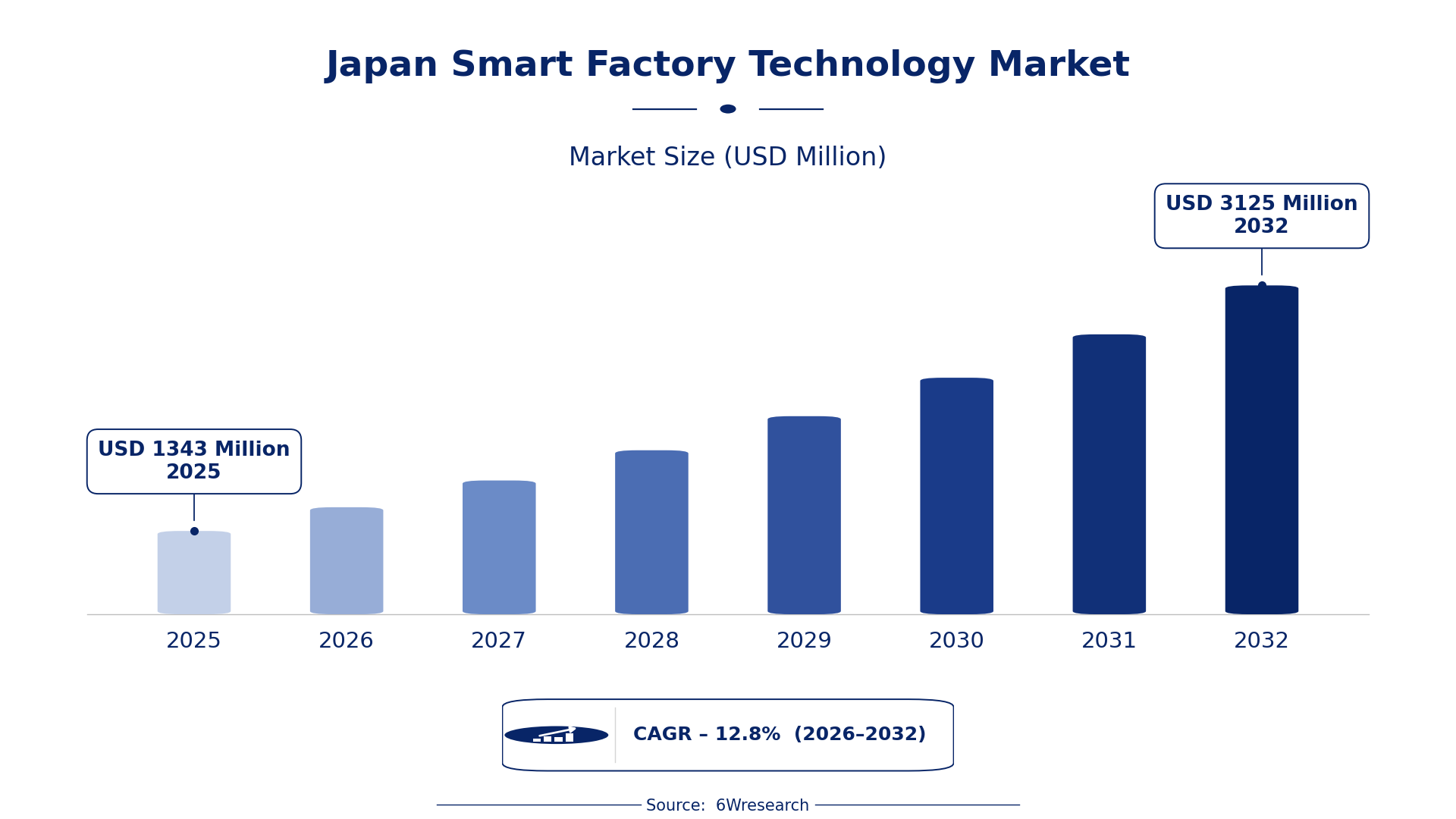
According to 6Wresearch internal database and industry insights, the Japan Smart Factory Technology Market was valued at USD 1,343 Million in 2025 and is projected to reach USD 3,125 Million by 2032, growing at a CAGR of approximately 12.8% during 2026–2032.
Japan Smart Factory Technology Market Highlights
| Report Metric | Details |
| Report Name | Japan Smart Factory Technology Market (2026-2032) |
| Market Size 2025 | USD 1,343 Million |
| Market Size 2032 | USD 3,125 Million |
| Absolute Growth 2025–2032 | USD 1,782 Million |
| CAGR 2026–2032 | 12.8% |
| Peak Annual Growth | 14.1% in 2032 |
| Forecast Period | 2026–2032 |
| Historical Data | 2022–2025 |
| Base Year | 2025 |
| Leading Technology Type, 2025 | Digital Twin Systems (41% share) |
| Leading Functionality, 2025 | Real-Time Simulation (41% share) |
| Leading Integration Platform, 2025 | IoT + AI (37% share) |
| Leading End User, 2025 | Manufacturing Plants (40% share) |
| Fastest-Growing Technology Type | Smart PLC Controllers (14.3% CAGR) |
| Fastest-Growing Functionality | Adaptive Control (16.7% CAGR) |
| Fastest-Growing Integration Platform | Cloud + Edge (19.2% CAGR) |
| Fastest-Growing End User | Factory Automation Firms (17.1% CAGR) |
| Growing Sector | Manufacturing |
| Key End Users | Manufacturing Plants, Automotive OEMs, Factory Automation Firms, Industrial Engineers |
Japan Smart Factory Technology Market Year-wise Growth Rate and Key Drivers (2022–2032)
This graph illustrates the annual growth rates of the market from 2022 to 2032, highlighting a steady upward trajectory and projected market expansion over the forecast period.
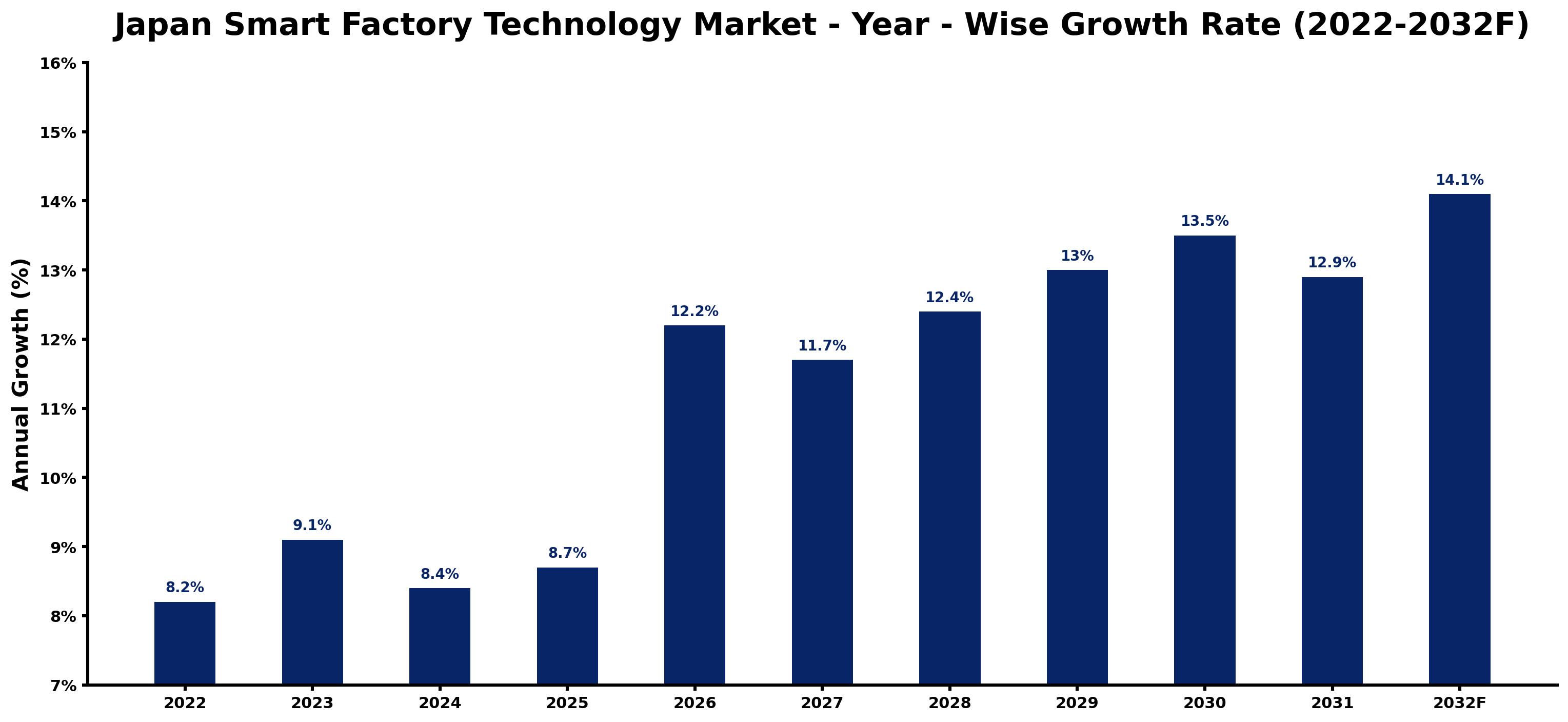
Year by year, the estimates below pair each growth rate with the development that shaped it.
| Year | Estimated Annual Growth (%) | Market Rationale |
| 2022 | 8.2 | The market showed steady demand from domestic manufacturers and exports. |
| 2023 | 9.1 | Growth was driven by increased investments in automation technologies. |
| 2024 | 8.4 | A slight slowdown occurred as companies adjusted to new technologies. |
| 2025 | 8.7 | Demand rose again as manufacturers sought efficiency improvements. |
| 2026 | 12.2 | Growth accelerated with the adoption of advanced digital solutions. |
| 2027 | 11.7 | A slowdown was noted as the market stabilised after rapid expansion. |
| 2028 | 12.4 | Demand surged again due to improved factory automation capabilities. |
| 2029 | 13.0 | Growth continued as manufacturers focused on predictive maintenance solutions. |
| 2030 | 13.5 | The market experienced strong growth with new technology implementations. |
| 2031 | 12.9 | A slowdown occurred as the market matured and competition intensified. |
| 2032 | 14.1 | The peak growth was driven by extensive smart factory initiatives. |
Note: Market size estimations and growth projections presented in this report are based on 6Wresearch's proprietary forecasting methodology, utilizing the latest available industry data, government publications, and primary research inputs.
Japan Smart Factory Technology Market Synopsis
Smart Factory Technology encompasses advanced automation and data exchange in manufacturing environments, primarily integrating IoT devices, AI algorithms, and cloud computing. The Japan Smart Factory Technology Market is expanding due to rising demand from the automotive and electronics sectors, with the government promoting initiatives like the Semiconductor and Digital Industry Strategy, which aims to secure domestic semiconductor manufacturing. This strategy is driving further investments in automation technologies across various manufacturing facilities, improving operational efficiency and product quality.
Market Dynamics Impact Analysis (2026–2032)
| Factor | Type | Impact | Primary Segment Affected |
| Increased automation investments in manufacturing processes | Driver | High | Smart PLC Controllers |
| Growing demand for real-time data analytics in production | Driver | High | Data Analytics Dashboards |
| High demand for predictive maintenance solutions | Opportunity | High | Predictive Maintenance AI |
| Emerging need for cloud integration in factory setups | Opportunity | Medium | Cloud + Edge |
| Aging manufacturing equipment requiring upgrades | Restraint | High | Smart MES Systems |
| High initial investment costs for advanced technologies | Restraint | Medium | Digital Twin Systems |
| Competition from lower-cost manufacturing regions | Challenge | High | Manufacturing Plants |
| Rapid technological changes requiring constant adaptation | Challenge | Medium | Factory Automation Firms |
Evaluation of Drivers in Japan Smart Factory Technology Market (2026–2032)
The main growth drivers and the segments they affect most are set out below.
| Drivers | Primary Segment Affected | Why It Matters (Evidence) |
| Rising investments in automation technologies | Smart PLC Controllers | The automotive sector, accounting for 20% of manufacturing output, drives demand for automation solutions. |
| Increased focus on data analytics for operational efficiency | Data Analytics Dashboards | Manufacturing plants use dashboards to track performance, with 60% already implementing this technology. |
| Growing adoption of predictive maintenance solutions | Predictive Maintenance AI | This technology is projected to reduce maintenance costs by up to 30%, appealing to manufacturers. |
| Demand for real-time monitoring systems | Digital Twin Systems | The Aichi Prefecture is increasingly adopting Digital Twin technology to improve manufacturing processes. |
| Shift towards cloud-based solutions in factories | Cloud + Edge | New factory setups across Japan prioritise cloud integration for better data management. |
Orders keep climbing as manufacturers increasingly invest in automation technologies to boost efficiency. The automotive sector, which constitutes approximately 20% of total manufacturing output, drives demand for these solutions. Data Analytics Dashboards are used in 60% of manufacturing plants, enabling effective performance tracking. Predictive Maintenance AI is projected to reduce maintenance costs by up to 30%, encouraging more manufacturers to adopt this technology. In the Aichi Prefecture, the growing use of Digital Twin Systems supports real-time monitoring and simulation, further increasing demand for advanced manufacturing solutions.
Evaluation of Restraints in Japan Smart Factory Technology Market
These restraints slow adoption and weigh on supplier margins.
| Market Restraint | Primary Segment Affected | Why It Matters (Evidence) |
| Aging manufacturing equipment needing replacement | Smart MES Systems | The average age of manufacturing equipment in Japan exceeds 10 years, necessitating upgrades. |
| High initial costs for implementing smart technologies | Digital Twin Systems | Manufacturers face significant upfront investments that limit adoption rates. |
| Limited skilled workforce for advanced technologies | Predictive Maintenance AI | A shortage of skilled workers hampers effective implementation of predictive solutions. |
| Competition from lower-cost manufacturing countries | Manufacturing Plants | Manufacturers in Japan face challenges from competitors in regions with lower operational costs. |
| Slow adaptation to rapid technological changes | Factory Automation Firms | Companies struggle to keep pace with evolving technologies, affecting their market position. |
Japan Smart Factory Technology Market Challenges
Manufacturers incur high costs from intense competition in Japan's market, consuming up to 20% of their annual revenue. Buyers experience delays due to outdated manufacturing equipment, averaging over 10 years old, which can extend production timelines significantly. Rising operational costs from the need for advanced automation can inflate expenses by as much as 30% for producers, forcing them to adjust pricing strategies. A shortage of skilled workers in advanced technologies hampers factories' ability to implement smart solutions effectively, impacting productivity for over 8 million workers in the sector.
Trends in the Japan Smart Factory Technology Market
The following changes are redrawing the Japan Smart Factory Technology Market.
- Shift towards Predictive Maintenance Solutions: Manufacturers are increasingly adopting predictive maintenance technologies to improve equipment reliability. In 2023, predictive maintenance solutions are projected to reduce costs by up to 30%, encouraging widespread implementation across various sectors.
- Transition from Traditional to Smart Manufacturing: The Tokyo Metropolitan area is experiencing a shift towards smart manufacturing practices, with many factories implementing Smart MES Systems. This change supports improved management and operational efficiency in production environments.
- Emergence of Cloud-Based Solutions: Cloud + Edge integration is becoming a priority in new factory setups across Japan. This trend is driven by the need for efficient data storage and processing capabilities, facilitating smarter manufacturing operations.
- Growing Adoption of Digital Twin Technology: Digital Twin technology has gained traction in the Aichi Prefecture, enabling real-time monitoring and simulation of manufacturing processes. This trend supports improved operational efficiency and quality control.
Investment Opportunities in the Japan Smart Factory Technology Market
The openings below show where demand in the Japan Smart Factory Technology Market is visible and how suppliers can enter.
- Investment in Predictive Maintenance Solutions: With predictive maintenance projected to reduce costs by up to 30%, there is a strong opportunity for investment in this technology. Automotive OEMs are particularly interested in improving production efficiency.
- Supply of Automation Solutions: The demand for automation solutions is rising as manufacturers seek to improve operational efficiency. Collaborating with factory automation firms can facilitate entry into this growing market.
- Development of Cloud + Edge Solutions: The shift towards cloud integration in factory setups presents an opportunity to supply cloud-based solutions. Targeting manufacturing plants in the Tokyo Metropolitan area can yield substantial returns.
- Enhancing Data Analytics Capabilities: The growing use of Data Analytics Dashboards in 60% of manufacturing plants indicates a need for advanced analytics solutions. Partnering with industrial engineers can help meet this demand.
Government Initiatives in the Japan Smart Factory Technology Market
The Semiconductor and Digital Industry Strategy, established by METI in June 2021, aims to secure domestic semiconductor manufacturing. This law encourages investment in advanced technologies, directly impacting Smart Factory Technology producers. The Battery Industry Strategy, launched in August 2022, targets 150 GWh of domestic battery manufacturing capacity by 2030, further supporting the growth of smart technologies in factories.
The Ministry of Economy, Trade and Industry supports automation through various funding programs, including the Green Growth Strategy. This strategy promotes the adoption of advanced technologies, benefiting manufacturers looking to improve operational efficiency.
Future Insight of the Japan Smart Factory Technology Market
New smart manufacturing facilities will prioritise integration of IoT devices by 2032, improving data exchange and operational efficiency. The 'Smart Manufacturing Initiative' will drive the adoption of advanced technologies, enabling manufacturers to enhance production processes. The implementation of ISO 50001 across many factories will improve energy efficiency, reducing operational costs for buyers and suppliers. Predictive Maintenance AI is projected to reduce maintenance costs by up to 30%, allowing manufacturers to allocate resources more effectively.
Market Segmentation Analysis
Japan Smart Factory Technology Market report covers a detailed analysis of the following market segments:
By Technology Type – Digital Twin Systems Lead, Smart PLC Controllers Expected to Grow Fastest
According to Saurav Kr Singh, Senior Research Analyst at 6Wresearch, Digital Twin Systems accounted for 41% of the market by technology type in 2025. Digital Twin Systems hold the largest share due to their critical role in real-time monitoring and simulation of manufacturing processes. Their extensive adoption in regions like Aichi Prefecture highlights their importance in optimising operational efficiency. Smart PLC Controllers are set to record the highest CAGR in this split, 14.3% over 2026–2032. This trend indicates a widening lead as automation becomes more prevalent in the sector. Suppliers must focus on enhancing automation technologies to meet the increasing demand from manufacturers.
By Functionality – Real-Time Simulation Leads, Adaptive Control Expected to Grow Fastest
With 41% of functionality revenue in 2025, Real-Time Simulation was the largest category. Real-Time Simulation is the leading functionality because it enables manufacturers to test scenarios without impacting production, which is essential for maintaining operational efficiency. This capability is particularly crucial as factories adopt new technologies and processes. The quickest growth will come from Adaptive Control, forecast to expand at a CAGR of 16.7% between 2026 and 2032. Adaptive Control is experiencing the fastest growth as it allows for immediate adjustments to processes based on real-time data, which is vital for manufacturers aiming to enhance production efficiency. This responsiveness is increasingly important in today's competitive manufacturing landscape. Buyers should prioritise investments in adaptive technologies to improve flexibility and efficiency in their operations.
By Integration Platform – IoT + AI Leads, Cloud + Edge Expected to Grow Fastest
The largest integration platform category in 2025 was IoT + AI, at 37% of revenue. IoT combined with advanced technologies is the leading integration platform as it facilitates smarter decision-making through effective data analysis. This integration is becoming essential for factories seeking to enhance operational performance and competitiveness. Cloud + Edge is projected to grow fastest, at a CAGR of 19.2% during 2026–2032. Cloud and Edge technologies are rapidly expanding due to their ability to improve data storage and processing capabilities, allowing factories to manage data more efficiently. This shift towards decentralised data management is crucial for streamlining operations. Suppliers should concentrate on developing solutions that incorporate cloud and edge technologies to address the evolving needs of manufacturers.
By End User – Manufacturing Plants Lead, Factory Automation Firms Expected to Grow Fastest
Manufacturing Plants took 40% of end user revenue in 2025, more than any other category. Manufacturing Plants are the primary users of smart factory technologies, directly implementing these advanced systems to enhance efficiency. With over 8 million workers in the sector, the demand for smart solutions remains significant. Over 2026–2032, Factory Automation Firms are expected to post the fastest growth, at a CAGR of 17.1%. Factory Automation Firms are experiencing the fastest growth as they implement a variety of solutions for manufacturing processes, driven by the need for improved operational efficiency. Their rising importance reflects the broader trend towards automation in the industry. Suppliers should seek partnerships with factory automation firms to capitalise on the growing demand for automation solutions in manufacturing.
Key Attractiveness of the Report
- 10 Years of Market Numbers
- Historical Data Starting from 2022 to 2025
- Base Year 2025
- Forecast Data until 2032
- Key Performance Indicators Impacting the Market
- Major Upcoming Developments and Projects
Key Highlights of the Report:
- Japan Smart Factory Technology Market Outlook
- Market Size of Japan Smart Factory Technology Market, 2025
- Forecast of Japan Smart Factory Technology Market, 2032
- Historical Data and Forecast of Japan Smart Factory Technology Revenues & Volume for the Period 2022-2032F
- Japan Smart Factory Technology Market Trend Evolution
- Japan Smart Factory Technology Market Drivers and Challenges
- Japan Smart Factory Technology Price Trends
- Japan Smart Factory Technology Porter's Five Forces
- Japan Smart Factory Technology Industry Life Cycle
- Historical Data and Forecast of Japan Smart Factory Technology Market Revenues & Volume By Technology Type for the Period 2022-2032F
- Historical Data and Forecast of Japan Smart Factory Technology Market Revenues & Volume By Digital Twin Systems for the Period 2022-2032F
- Historical Data and Forecast of Japan Smart Factory Technology Market Revenues & Volume By Smart PLC Controllers for the Period 2022-2032F
- Historical Data and Forecast of Japan Smart Factory Technology Market Revenues & Volume By Predictive Maintenance AI for the Period 2022-2032F
- Historical Data and Forecast of Japan Smart Factory Technology Market Revenues & Volume By Smart MES Systems for the Period 2022-2032F
- Historical Data and Forecast of Japan Smart Factory Technology Market Revenues & Volume By Functionality for the Period 2022-2032F
- Historical Data and Forecast of Japan Smart Factory Technology Market Revenues & Volume By Real-Time Simulation for the Period 2022-2032F
- Historical Data and Forecast of Japan Smart Factory Technology Market Revenues & Volume By Adaptive Control for the Period 2022-2032F
- Historical Data and Forecast of Japan Smart Factory Technology Market Revenues & Volume By Equipment Health Insights for the Period 2022-2032F
- Historical Data and Forecast of Japan Smart Factory Technology Market Revenues & Volume By Production Optimization for the Period 2022-2032F
- Historical Data and Forecast of Japan Smart Factory Technology Market Revenues & Volume By Integration Platform for the Period 2022-2032F
- Historical Data and Forecast of Japan Smart Factory Technology Market Revenues & Volume By IoT + AI for the Period 2022-2032F
- Historical Data and Forecast of Japan Smart Factory Technology Market Revenues & Volume By Cloud + Edge for the Period 2022-2032F
- Historical Data and Forecast of Japan Smart Factory Technology Market Revenues & Volume By Machine Learning Models for the Period 2022-2032F
- Historical Data and Forecast of Japan Smart Factory Technology Market Revenues & Volume By Data Analytics Dashboards for the Period 2022-2032F
- Historical Data and Forecast of Japan Smart Factory Technology Market Revenues & Volume By End User for the Period 2022-2032F
- Historical Data and Forecast of Japan Smart Factory Technology Market Revenues & Volume By Manufacturing Plants for the Period 2022-2032F
- Historical Data and Forecast of Japan Smart Factory Technology Market Revenues & Volume By Factory Automation Firms for the Period 2022-2032F
- Historical Data and Forecast of Japan Smart Factory Technology Market Revenues & Volume By Industrial Engineers for the Period 2022-2032F
- Historical Data and Forecast of Japan Smart Factory Technology Market Revenues & Volume By Automotive OEMs for the Period 2022-2032F
- Japan Smart Factory Technology Import Export Trade Statistics
- Market Opportunity Assessment By Technology Type
- Market Opportunity Assessment By Functionality
- Market Opportunity Assessment By Integration Platform
- Market Opportunity Assessment By End User
- Japan Smart Factory Technology Top Companies Market Share
- Japan Smart Factory Technology Competitive Benchmarking By Technical and Operational Parameters
- Japan Smart Factory Technology Company Profiles
- Japan Smart Factory Technology Key Strategic Recommendations
Market Covered
Coverage by segment is as follows.
By Technology Type
- Digital Twin Systems
- Smart PLC Controllers
- Predictive Maintenance AI
- Smart MES Systems
By Functionality
- Real-Time Simulation
- Adaptive Control
- Equipment Health Insights
- Production Optimization
By Integration Platform
- IoT + AI
- Cloud + Edge
- Machine Learning Models
- Data Analytics Dashboards
By End User
- Manufacturing Plants
- Factory Automation Firms
- Industrial Engineers
- Automotive OEMs































