Japan Smart Fertilizers Market Size & Growth Rate
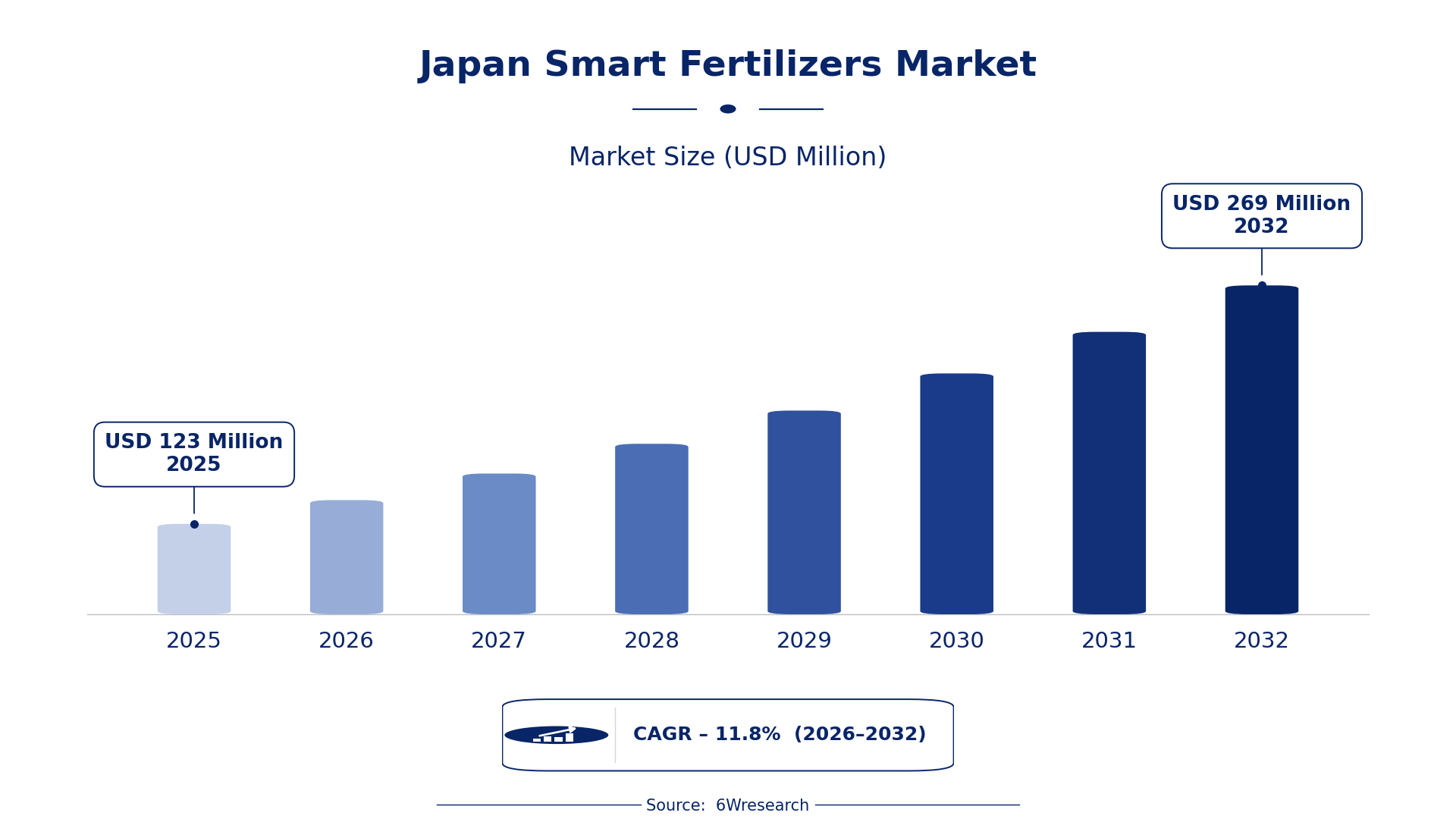
According to 6Wresearch internal database and industry insights, the Japan Smart Fertilizers Market was valued at USD 123 Million in 2025 and is projected to reach USD 269 Million by 2032, growing at a CAGR of approximately 11.8% during 2026–2032.
Japan Smart Fertilizers Market Highlights
| Report Metric | Details |
| Report Name | Japan Smart Fertilizers Market (2026-2032) |
| Market Size 2025 | USD 123 Million |
| Market Size 2032 | USD 269 Million |
| Absolute Growth 2025–2032 | USD 146 Million |
| CAGR 2026–2032 | 11.8% |
| Peak Annual Growth | 12.9% in 2026 |
| Forecast Period | 2026–2032 |
| Historical Data | 2022–2025 |
| Base Year | 2025 |
| Leading Fertilizer Type, 2025 | Controlled-release (45% share) |
| Leading Technology, 2025 | Polymer Coating (37% share) |
| Leading Application Area, 2025 | Precision Farming (47% share) |
| Leading Distribution Channel, 2025 | Agro Dealers (46% share) |
| Leading End User, 2025 | Farmers (45% share) |
| Fastest-Growing Fertilizer Type | Bio-based Fertilizers (16.7% CAGR) |
| Fastest-Growing Technology | Microbial Tech (16.9% CAGR) |
| Fastest-Growing Application Area | Organic Farming (14.6% CAGR) |
| Fastest-Growing Distribution Channel | Direct Sales (15.1% CAGR) |
| Fastest-Growing End User | Agricultural Producers (15.6% CAGR) |
| Growing Sector | sustainable agriculture |
| Key End Users | Farmers, Agricultural Producers, Commercial Farms, Greenhouse Operators |
Japan Smart Fertilizers Market Year-wise Growth Rate and Key Drivers (2022–2032)
This graph illustrates the annual growth rates of the market from 2022 to 2032, highlighting a steady upward trajectory and projected market expansion over the forecast period.
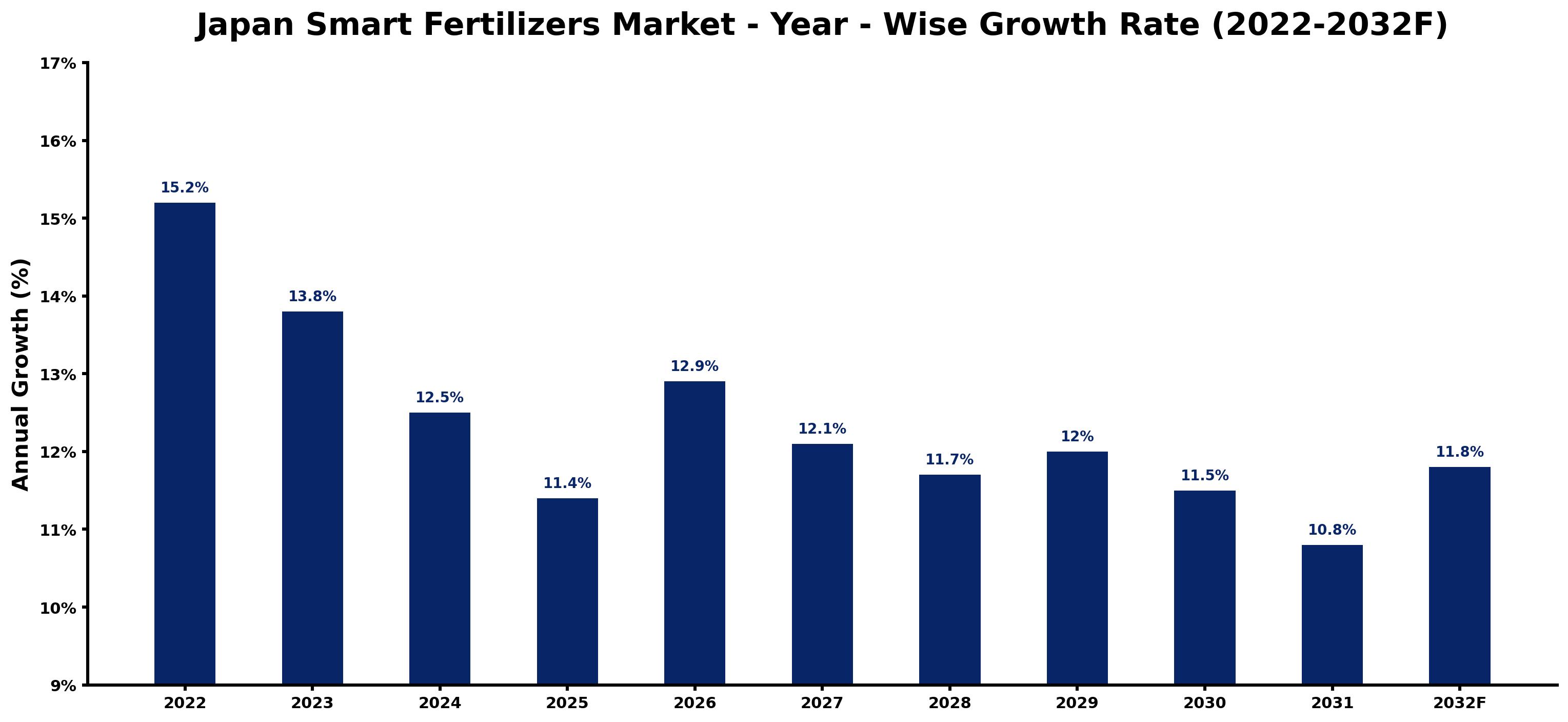
Year by year, the estimates below pair each growth rate with the development that shaped it.
| Year | Estimated Annual Growth (%) | Market Rationale |
| 2022 | 15.2 | The market experienced strong growth due to increased adoption of smart farming technologies. |
| 2023 | 13.8 | Growth slowed as farmers adjusted to evolving market conditions and technology integration. |
| 2024 | 12.5 | Demand continued to rise, but at a slower pace as market saturation began to set in. |
| 2025 | 11.4 | The market showed a further slowdown as competition intensified among suppliers in the sector. |
| 2026 | 12.9 | Growth is expected to accelerate again as investments in smart fertilizers gain momentum. |
| 2027 | 12.1 | Demand growth will slow slightly as the market stabilises after rapid expansion phases. |
| 2028 | 11.7 | The market will continue to grow, driven by ongoing advancements in agricultural technology. |
| 2029 | 12.0 | Growth is projected to pick up as more farmers adopt precision farming techniques. |
| 2030 | 11.5 | The market will experience another slowdown as the rate of new adoptions decreases. |
| 2031 | 10.8 | Growth will slow further as the market reaches a more mature phase with established practices. |
| 2032 | 11.8 | The market is expected to see renewed growth as innovative solutions are introduced. |
Note: Market size estimations and growth projections presented in this report are based on 6Wresearch's proprietary forecasting methodology, utilizing the latest available industry data, government publications, and primary research inputs.
Japan Smart Fertilizers Market Synopsis
Smart fertilizers are advanced agricultural products designed to improve crop yield and efficiency through controlled-release mechanisms and nanotechnology. The Japan Smart Fertilizers Market is expanding due to over 1.5 million farmers who are increasingly focusing on sustainable practices. Adoption of precision farming technologies in over 30% of commercial farms, along with government initiatives promoting smart farming technologies, will further drive demand in the coming years.
Market Dynamics Impact Analysis (2026–2032)
| Factor | Type | Impact | Primary Segment Affected |
| Rising adoption of precision farming techniques | Driver | High | Precision Farming |
| Increased investment in sustainable agriculture | Driver | High | Bio-based Fertilizers |
| Growing demand for organic farming solutions | Opportunity | High | Organic Farming |
| Expansion of distribution channels for smart fertilizers | Opportunity | Medium | Agro Dealers |
| High initial costs of smart fertilizers | Restraint | High | Controlled-release |
| Limited awareness among small-scale farmers | Restraint | Medium | Nano-fertilizers |
| Supply chain disruptions affecting availability | Challenge | High | Water-soluble |
| Competition from traditional fertilizers | Challenge | Medium | Bio-based Fertilizers |
Evaluation of Drivers in Japan Smart Fertilizers Market (2026–2032)
The table below links each growth driver to the segment it affects and the evidence for it.
| Drivers | Primary Segment Affected | Why It Matters (Evidence) |
| Investment in precision farming technologies | Precision Farming | Over 30% of commercial farms in Japan have adopted precision farming, increasing demand for smart fertilizers and related products. |
| Government subsidies for sustainable practices | Bio-based Fertilizers | Government support encourages sustainable farming, leading to increased use of bio-based fertilizers among farmers across the country. |
| Rising consumer preference for organic produce | Organic Farming | Consumer demand for organic products drives farmers to adopt organic farming methods, thereby increasing smart fertilizer usage significantly. |
| Technological advancements in fertilizer production | Nano-fertilizers | Nanotechnology is projected to improve nutrient delivery efficiency by 25%, boosting demand for nano-fertilizers in agricultural applications. |
| Growth of greenhouse operations | Greenhouse Operators | The Tokyo metropolitan area has seen a rise in greenhouse operations utilizing smart fertilizers to enhance production in controlled environments. |
Buyers are adding capacity as investment in precision farming technologies rises, with over 30% of commercial farms adopting these methods. Support for sustainable practices encourages the use of bio-based fertilizers, driving demand among farmers. The preference for organic produce pushes agricultural producers towards organic farming, increasing the use of smart fertilizers. Advancements in fertilizer production, particularly in nanotechnology, are projected to improve nutrient delivery efficiency by 25%. The expansion of greenhouse operations in urban areas further fuels demand for these advanced agricultural products.
Evaluation of Restraints in Japan Smart Fertilizers Market
The main factors holding the market back are set out below.
| Market Restraint | Primary Segment Affected | Why It Matters (Evidence) |
| High initial costs of smart fertilizers | Controlled-release | The high costs deter small-scale farmers from adopting smart fertilizers, limiting market growth opportunities. |
| Limited awareness among small-scale farmers | Nano-fertilizers | Many small-scale farmers are unaware of the benefits of nano-fertilizers, hindering their adoption rates. |
| Supply chain disruptions affecting availability | Water-soluble | Supply chain issues can lead to shortages of water-soluble fertilizers, impacting their market presence and accessibility. |
| Competition from traditional fertilizers | Bio-based Fertilizers | Traditional fertilizers are often cheaper and more familiar to farmers, limiting the market share of bio-based options. |
| Regulatory hurdles for new formulations | Microbial Tech | New microbial fertilizer formulations face stringent regulations, delaying market entry and adoption among producers. |
Japan Smart Fertilizers Market Challenges
Farmers face rising costs as raw material prices increased by 15% last year, which pressures their budgets and limits investments in smart fertilizers. Producers struggle to compete with cheaper imported fertilizers, forcing them to lower prices and potentially sacrificing quality. Supply chain disruptions have led to delays, with some producers waiting up to three months for critical inputs, which reduces their operational efficiency. Compliance with JIS standards adds extra costs for smaller producers, diminishing their competitiveness and restricting their ability to adopt new technologies.
Trends in the Japan Smart Fertilizers Market
The trends below show where the Japan Smart Fertilizers Market is heading.
- Shift towards Organic Farming: Organic farming is gaining traction in Japan, with organic farming accounting for approximately 15% of the total fertilizer market. This shift reflects increasing consumer demand for organic produce, prompting farmers to adopt sustainable practices.
- Rise in Precision Farming Adoption: Precision farming is becoming more prevalent, with over 30% of commercial farms implementing these technologies. This trend is reshaping how fertilizers are applied, resulting in more efficient usage and improved crop yields.
- Growth of Greenhouse Operations: The Tokyo metropolitan area has seen a rise in greenhouse operations utilizing smart fertilizers to maximise yield. This trend aligns with urban agriculture initiatives aimed at improving local food production and sustainability.
- Increased Investment in Smart Farming Technologies: In 2023, Japan launched a program to increase the adoption of smart farming technologies by 20%. This initiative aims to modernise agriculture and enhance sustainability across the sector.
Investment Opportunities in the Japan Smart Fertilizers Market
The opportunities below stand out in the Japan Smart Fertilizers Market for new entrants and existing suppliers.
- Increased Demand for Bio-based Fertilizers: With rising consumer interest in organic products, there is an opportunity for suppliers of bio-based fertilizers to enter the market, particularly among farmers focused on sustainability and environmental impact.
- Educational Initiatives for Smart Fertilizers: With over 1.5 million farmers in Japan, there is a significant gap in awareness about smart fertilizers. Educating farmers can lead to increased adoption, particularly in rural areas where traditional methods dominate.
- Investment in Urban Greenhouse Technologies: The rise in greenhouse operations presents an opportunity for suppliers of smart fertilizers to cater to this growing segment, especially in urban areas like Tokyo where demand is increasing.
- Strengthening Distribution Partnerships: As agro dealers account for 60% of fertilizer distribution, investing in partnerships with these dealers can enhance market reach and facilitate the adoption of smart fertilizers among farmers.
Government Initiatives in the Japan Smart Fertilizers Market
The Economic Security Promotion Act (2022) supports supply-chain resilience for critical agricultural products, including smart fertilizers. This measure complements existing laws like the Chemical Substances Control Law (1973), which regulates the safety of fertilizer formulations, ensuring that producers adhere to strict quality standards and practices.
In 2023, the Ministry of Agriculture, Forestry and Fisheries allocated USD 10 million to promote smart farming technologies. This funding aims to increase adoption rates among farmers and is administered by the ministry to ensure effective implementation of these initiatives.
Future Insight of the Japan Smart Fertilizers Market
Investment in smart farming technologies will grow significantly by 2032, driven by government initiatives and private sector projects. Demand for advanced fertilizers will increase as urban greenhouse operations expand, addressing sustainability needs in densely populated areas. The Tohoku region will see a rise in the use of smart fertilizers, enhancing agricultural efficiency. Improved nutrient delivery methods will lead to better crop yields, encouraging producers to adopt these technologies more widely.
Market Segmentation Analysis
Japan Smart Fertilizers Market report covers a detailed analysis of the following market segments:
By Fertilizer Type – Controlled-release Leads, Bio-based Fertilizers Expected to Grow Fastest
According to Ayushi Shukla, Senior Research Analyst at 6Wresearch, with 45% of fertilizer type revenue in 2025, Controlled-release was the largest category. Controlled-release fertilizers hold the largest market share due to their ability to provide a steady nutrient supply, which is essential for maximising crop yields. Their use is particularly prevalent among farmers in regions like Tohoku, where advanced agricultural practices are common. Bio-based Fertilizers are set to record the highest CAGR in this split, 16.7% over 2026–2032. Bio-based fertilizers are experiencing rapid growth as they align with sustainable farming initiatives promoted by the government, encouraging farmers to adopt eco-friendly practices. The increasing emphasis on improving soil health is significantly contributing to this segment's expansion. Suppliers must focus on bio-based fertilizers to meet the growing demand for sustainable agricultural solutions.
By Technology – Polymer Coating Leads, Microbial Tech Expected to Grow Fastest
Polymer Coating accounted for 37% of the market by technology in 2025. Polymer coating technology leads the market as it is crucial for controlled-release fertilizers, ensuring nutrients are efficiently delivered over extended periods. This technology is widely utilised in commercial farms across Japan, enhancing agricultural productivity. The quickest growth will come from Microbial Tech, forecast to expand at a CAGR of 16.9% between 2026 and 2032. Microbial technology is growing quickly due to its effectiveness in improving soil microbiomes, leading to better crop health and yields. The government's backing for research in this area is facilitating its rapid adoption among farmers. Manufacturers should invest in microbial technologies to cater to the rising demand for sustainable agricultural practices.
By Application Area – Precision Farming Leads, Organic Farming Expected to Grow Fastest
Precision Farming took 47% of application area revenue in 2025, more than any other category. Precision farming dominates the market as it enables targeted application of fertilizers, optimising resource use and increasing crop yields. This method is increasingly adopted by over 30% of commercial farms in Japan, reflecting its effectiveness. Organic Farming is projected to grow fastest, at a CAGR of 14.6% during 2026–2032. Organic farming is rapidly expanding as it aligns with the growing consumer demand for sustainable food production. The government's initiatives to promote organic practices are also contributing to this growth. Suppliers must adapt their product offerings to cater to the rising interest in organic farming solutions.
By Distribution Channel – Agro Dealers Lead, Direct Sales Expected to Grow Fastest
In 2025, Agro Dealers led the distribution channel split with a 46% share. Agro dealers are the primary distribution channel for farmers, accounting for a significant portion of fertilizer sales in rural areas. Their established networks and understanding of local agricultural needs make them essential for effective product distribution. Over 2026–2032, Direct Sales is expected to post the fastest growth, at a CAGR of 15.1%. Direct sales are emerging as the fastest-growing channel as manufacturers seek to establish direct relationships with large farms, ensuring better service and product accessibility. This trend reflects a shift towards more personalised customer engagement strategies. Companies should enhance their direct sales strategies to strengthen relationships with larger agricultural producers.
By End User – Farmers Lead, Agricultural Producers Expected to Grow Fastest
Farmers held 45% of the Japan Smart Fertilizers Market by end user in 2025. Farmers represent the largest end-user group as they are the primary consumers of smart fertilizers, directly utilising these products to improve crop yields. With over 1.5 million farmers in Japan, their demand drives the market. Agricultural Producers are set to record the highest CAGR in this split, 15.6% over 2026–2032. Agricultural producers are the fastest-growing segment as they increasingly adopt smart fertilizers for large-scale production, responding to market pressures for efficiency and sustainability. This trend is supported by government initiatives aimed at modernising agriculture. Suppliers should tailor their marketing efforts to address the specific needs of agricultural producers.
Key Attractiveness of the Report
- 10 Years of Market Numbers
- Historical Data Starting from 2022 to 2025
- Base Year 2025
- Forecast Data until 2032
- Key Performance Indicators Impacting the Market
- Major Upcoming Developments and Projects
Key Highlights of the Report:
- Japan Smart Fertilizers Market Outlook
- Market Size of Japan Smart Fertilizers Market, 2025
- Forecast of Japan Smart Fertilizers Market, 2032
- Historical Data and Forecast of Japan Smart Fertilizers Market Revenues & Volume for the Period 2022-2032F
- Japan Smart Fertilizers Market Trend Evolution
- Japan Smart Fertilizers Market Drivers and Challenges
- Japan Smart Fertilizers Market Price Trends
- Japan Smart Fertilizers Market Porter's Five Forces
- Japan Smart Fertilizers Market Industry Life Cycle
- Historical Data and Forecast of Japan Smart Fertilizers Market Revenues & Volume By Fertilizer Type for the Period 2022-2032F
- Historical Data and Forecast of Japan Smart Fertilizers Market Revenues & Volume By Controlled-release for the Period 2022-2032F
- Historical Data and Forecast of Japan Smart Fertilizers Market Revenues & Volume By Bio-based Fertilizers for the Period 2022-2032F
- Historical Data and Forecast of Japan Smart Fertilizers Market Revenues & Volume By Nano-fertilizers for the Period 2022-2032F
- Historical Data and Forecast of Japan Smart Fertilizers Market Revenues & Volume By Water-soluble for the Period 2022-2032F
- Historical Data and Forecast of Japan Smart Fertilizers Market Revenues & Volume By Technology for the Period 2022-2032F
- Historical Data and Forecast of Japan Smart Fertilizers Market Revenues & Volume By Polymer Coating for the Period 2022-2032F
- Historical Data and Forecast of Japan Smart Fertilizers Market Revenues & Volume By Microbial Tech for the Period 2022-2032F
- Historical Data and Forecast of Japan Smart Fertilizers Market Revenues & Volume By Nanotechnology for the Period 2022-2032F
- Historical Data and Forecast of Japan Smart Fertilizers Market Revenues & Volume By Sensor-integrated for the Period 2022-2032F
- Historical Data and Forecast of Japan Smart Fertilizers Market Revenues & Volume By Application Area for the Period 2022-2032F
- Historical Data and Forecast of Japan Smart Fertilizers Market Revenues & Volume By Precision Farming for the Period 2022-2032F
- Historical Data and Forecast of Japan Smart Fertilizers Market Revenues & Volume By Organic Farming for the Period 2022-2032F
- Historical Data and Forecast of Japan Smart Fertilizers Market Revenues & Volume By Yield Enhancement for the Period 2022-2032F
- Historical Data and Forecast of Japan Smart Fertilizers Market Revenues & Volume By Smart Irrigation for the Period 2022-2032F
- Historical Data and Forecast of Japan Smart Fertilizers Market Revenues & Volume By Distribution Channel for the Period 2022-2032F
- Historical Data and Forecast of Japan Smart Fertilizers Market Revenues & Volume By Agro Dealers for the Period 2022-2032F
- Historical Data and Forecast of Japan Smart Fertilizers Market Revenues & Volume By Direct Sales for the Period 2022-2032F
- Historical Data and Forecast of Japan Smart Fertilizers Market Revenues & Volume By Online Platforms for the Period 2022-2032F
- Historical Data and Forecast of Japan Smart Fertilizers Market Revenues & Volume By Distributors for the Period 2022-2032F
- Historical Data and Forecast of Japan Smart Fertilizers Market Revenues & Volume By End User for the Period 2022-2032F
- Historical Data and Forecast of Japan Smart Fertilizers Market Revenues & Volume By Farmers for the Period 2022-2032F
- Historical Data and Forecast of Japan Smart Fertilizers Market Revenues & Volume By Agricultural Producers for the Period 2022-2032F
- Historical Data and Forecast of Japan Smart Fertilizers Market Revenues & Volume By Commercial Farms for the Period 2022-2032F
- Historical Data and Forecast of Japan Smart Fertilizers Market Revenues & Volume By Greenhouse Operators for the Period 2022-2032F
- Japan Smart Fertilizers Market Import Export Trade Statistics
- Market Opportunity Assessment By Fertilizer Type
- Market Opportunity Assessment By Technology
- Market Opportunity Assessment By Application Area
- Market Opportunity Assessment By Distribution Channel
- Market Opportunity Assessment By End User
- Japan Smart Fertilizers Market Top Companies Market Share
- Japan Smart Fertilizers Market Competitive Benchmarking By Technical and Operational Parameters
- Japan Smart Fertilizers Market Company Profiles
- Japan Smart Fertilizers Market Key Strategic Recommendations
Market Covered
Segments analysed in this report are listed below.
By Fertilizer Type
- Controlled-release
- Bio-based Fertilizers
- Nano-fertilizers
- Water-soluble
By Technology
- Polymer Coating
- Microbial Tech
- Nanotechnology
- Sensor-integrated
By Application Area
- Precision Farming
- Organic Farming
- Yield Enhancement
- Smart Irrigation
By Distribution Channel
- Agro Dealers
- Direct Sales
- Online Platforms
- Distributors
By End User
- Farmers
- Agricultural Producers
- Commercial Farms
- Greenhouse Operators






































