Japan Smart Greenhouse Market Size & Growth Rate
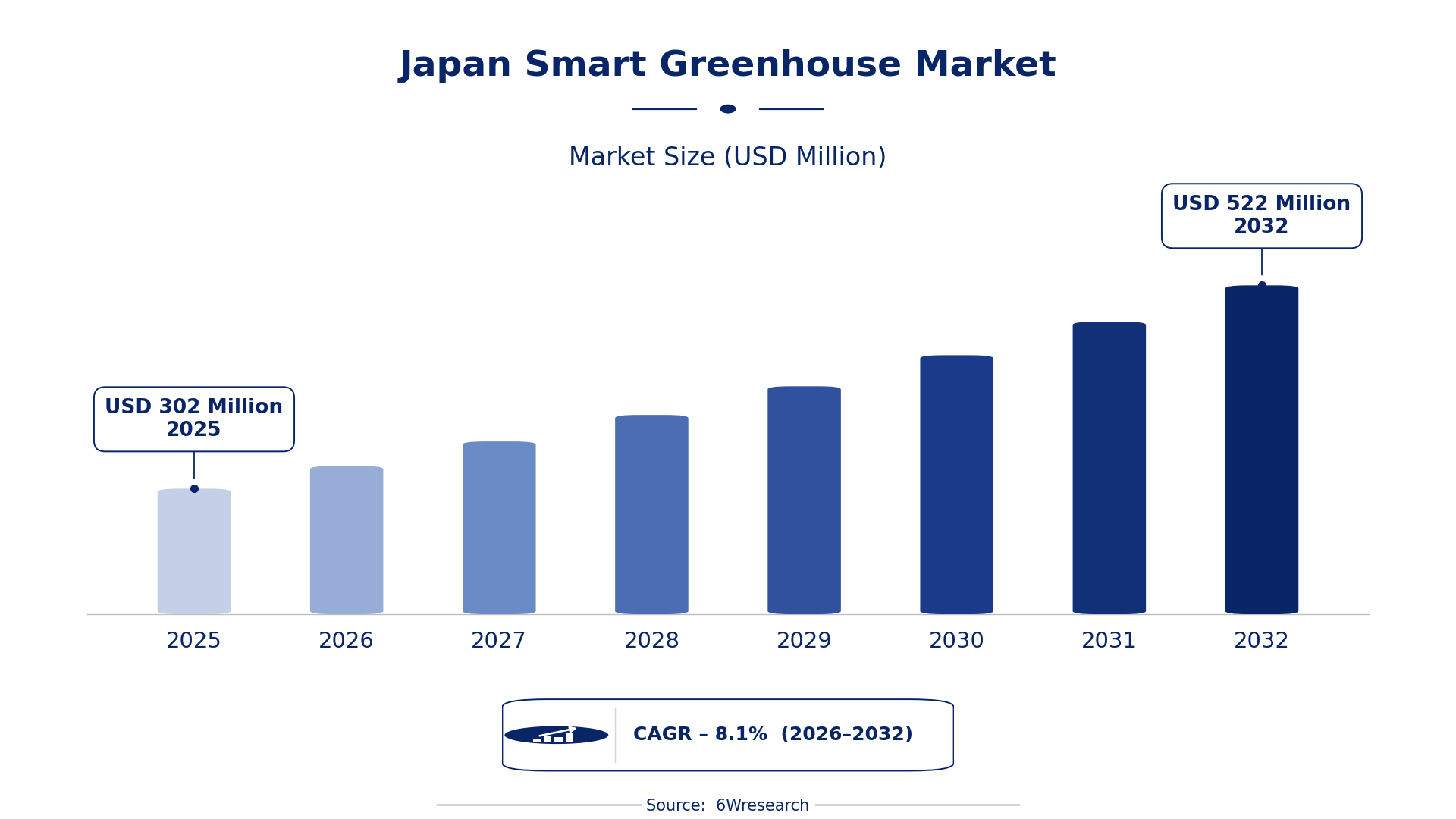
According to 6Wresearch internal database and industry insights, the Japan Smart Greenhouse Market was valued at USD 302 Million in 2025 and is projected to reach USD 522 Million by 2032, growing at a CAGR of approximately 8.1% during 2026–2032.
Japan Smart Greenhouse Market Highlights
| Report Metric | Details |
| Report Name | Japan Smart Greenhouse Market (2026-2032) |
| Market Size 2025 | USD 302 Million |
| Market Size 2032 | USD 522 Million |
| Absolute Growth 2025–2032 | USD 220 Million |
| CAGR 2026–2032 | 8.1% |
| Peak Annual Growth | 9.0% in 2032 |
| Forecast Period | 2026–2032 |
| Historical Data | 2022–2025 |
| Base Year | 2025 |
| Leading Type, 2025 | Hydroponics (68% share) |
| Leading Covering Material Type, 2025 | Polyethylene (45% share) |
| Leading Offering, 2025 | Hardware (63% share) |
| Leading Component, 2025 | HVAC Systems (34% share) |
| Leading End User, 2025 | Commercial Growers (44% share) |
| Fastest-Growing Covering Material Type | Polycarbonate (11.2% CAGR) |
| Fastest-Growing Offering | Software & Services (11.7% CAGR) |
| Fastest-Growing Component | Sensor & Control System (12.5% CAGR) |
| Fastest-Growing End User | Research & Educational Institutes (10.6% CAGR) |
| Growing Sector | Commercial Agriculture |
| Key End Users | Commercial Growers, Research & Educational Institutes, Retail Gardens |
Japan Smart Greenhouse Market Year-wise Growth Rate and Key Drivers (2022–2032)
This graph illustrates the annual growth rates of the market from 2022 to 2032, highlighting a steady upward trajectory and projected market expansion over the forecast period.
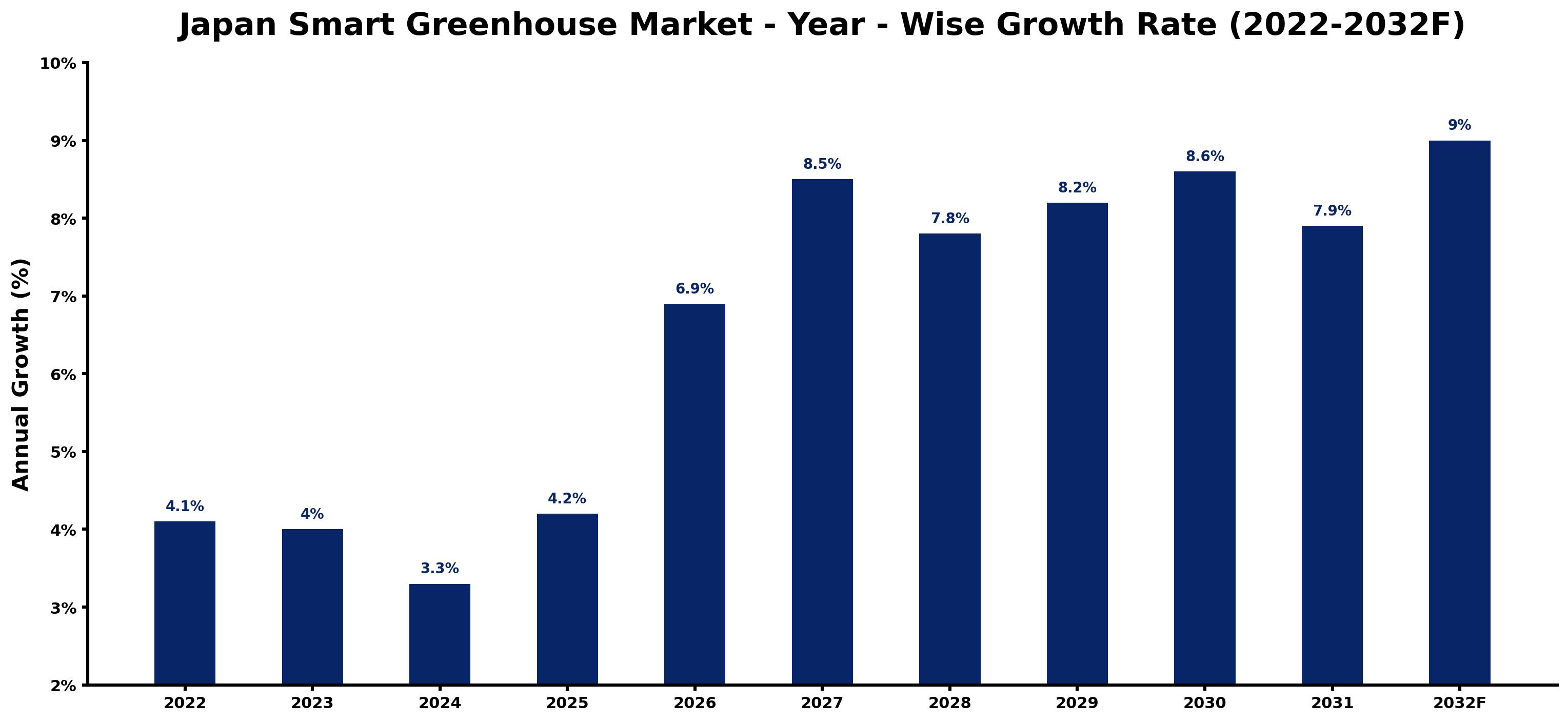
For each year, the table pairs the estimated growth rate with the leading influence on demand, showing how the drivers changed across the period.
| Year | Estimated Annual Growth (%) | Market Rationale |
| 2022 | 4.1 | The market experienced steady growth, reflecting increasing interest in urban agriculture initiatives. |
| 2023 | 4.0 | Growth slowed slightly due to market adjustments and ongoing technology integration efforts. |
| 2024 | 3.3 | The pace of growth continued to slow as the market stabilised amid rising operational costs. |
| 2025 | 4.2 | Growth accelerated as urban agriculture initiatives gained traction across major cities like Tokyo. |
| 2026 | 6.9 | Investment in smart greenhouse technologies is expected to rise, driving demand from commercial growers. |
| 2027 | 8.5 | Demand is projected to rise sharply as more growers adopt advanced agricultural technologies and practices. |
| 2028 | 7.8 | Growth is anticipated to moderate as the market adjusts to new technology adoption rates and competition. |
| 2029 | 8.2 | Demand is expected to surge again as urban farming initiatives expand in metropolitan areas. |
| 2030 | 8.6 | Growth will continue as technological advancements improve greenhouse efficiency and reduce costs. |
| 2031 | 7.9 | The market is projected to see a slight slowdown as saturation begins in some urban areas. |
| 2032 | 9.0 | Demand is expected to peak as urban agriculture reaches new heights in adoption and innovation. |
Note: Market size estimations and growth projections presented in this report are based on 6Wresearch's proprietary forecasting methodology, utilizing the latest available industry data, government publications, and primary research inputs.
Japan Smart Greenhouse Market Synopsis
Smart greenhouses utilise advanced technologies such as sensors, automation, and climate control systems to optimise plant growth. The Japan Smart Greenhouse Market is projected to grow substantially due to urban agriculture initiatives and government support. Key regions like Tokyo and Osaka are leading in installations, while the government aims to increase adoption by 30% by 2025 through subsidies. This growth is further supported by the rising use of LED grow lights in over 70% of new installations, which improve energy efficiency and productivity.
Market Dynamics Impact Analysis (2026–2032)
| Factor | Type | Impact | Primary Segment Affected |
| Urban agriculture initiatives are expanding, increasing demand for smart greenhouses among commercial growers. | Driver | High | Hydroponics |
| Government subsidies and support programs are promoting smart greenhouse technologies, encouraging investment. | Driver | High | Polyethylene |
| The increasing adoption of hydroponics is creating opportunities for suppliers of related technologies. | Opportunity | High | Hydroponics |
| Research institutes are seeking advanced greenhouse solutions for agricultural technology development. | Opportunity | Medium | Research & Educational Institutes |
| High initial investment costs can deter some potential buyers from adopting smart greenhouse technologies. | Restraint | High | Commercial Growers |
| Limited awareness among smaller growers about the benefits of smart greenhouses hampers market growth. | Restraint | Medium | Retail Gardens |
| Compliance with stringent regulations can increase operational costs for producers and suppliers. | Challenge | High | HVAC Systems |
| Capacity constraints in manufacturing can delay the availability of essential components. | Challenge | Medium | LED Grow Lights |
Evaluation of Drivers in Japan Smart Greenhouse Market (2026–2032)
Demand rests on the following drivers, each shown with the segment it touches most.
| Drivers | Primary Segment Affected | Why It Matters (Evidence) |
| Investment in urban agriculture initiatives is rising, leading to increased demand for smart greenhouses. | Hydroponics | In 2023, the Ministry of Agriculture launched a program to promote smart agriculture technologies, boosting investment. |
| Government subsidies are encouraging the adoption of smart greenhouse technologies among growers. | Polyethylene | The Japanese government aims to increase adoption by 30% by 2025 through financial incentives, enhancing market growth. |
| The shift towards sustainable farming practices is driving demand for energy-efficient greenhouse solutions. | LED Grow Lights | The average energy consumption of smart greenhouses is reduced by 20% compared to traditional methods, attracting buyers. |
| Technological advancements in climate control systems are improving greenhouse efficiency and productivity. | HVAC Systems | The average investment in a smart greenhouse setup is around ¥10 million, reflecting the integration of advanced technologies. |
| The rising popularity of hydroponics is creating demand for advanced irrigation systems. | Irrigation System | The use of hydroponics in smart greenhouses is increasing, focusing on sustainability and efficient resource use. |
The average energy consumption of smart greenhouses is reduced by 20% compared to traditional methods, encouraging more installations. The shift towards hydroponics is driving demand for advanced irrigation systems, while technological advancements in climate control systems are improving efficiency and reducing costs. As a result, the market is experiencing a notable increase in orders and installations across major urban areas like Tokyo and Osaka.
Evaluation of Restraints in Japan Smart Greenhouse Market
Several factors work against faster growth; the main ones are summarised below.
| Market Restraint | Primary Segment Affected | Why It Matters (Evidence) |
| High initial investment costs can deter some potential buyers from adopting smart greenhouse technologies. | Commercial Growers | The average investment in a smart greenhouse setup is around ¥10 million, which can be prohibitive for smaller operations. |
| Limited awareness among smaller growers about the benefits of smart greenhouses hampers market growth. | Retail Gardens | Many smaller growers lack knowledge of the advantages, resulting in lower adoption rates compared to larger commercial operations. |
| Compliance with stringent regulations can increase operational costs for producers and suppliers. | HVAC Systems | Producers must adhere to the Electrical Appliance and Material Safety Act, which raises compliance costs significantly. |
| Capacity constraints in manufacturing can delay the availability of essential components. | LED Grow Lights | Manufacturers face challenges in scaling production to meet the growing demand for energy-efficient lighting solutions. |
| Market saturation in urban areas can limit growth opportunities for new entrants. | Polycarbonate | As more greenhouses are established, competition increases, making it harder for newcomers to gain market share. |
Japan Smart Greenhouse Market Challenges
High skills shortages hinder the smart greenhouse sector, as educational institutions fail to align training with technological needs. This issue stems from outdated curricula, causing delays for producers who require skilled workers to implement advanced systems. Buyers face intensified competition from urban farms that swiftly adopt smart greenhouse technologies, driven by government initiatives. This competition can lead to a 15% revenue drop for traditional growers unable to adapt. Rising material costs, dictated by the JIS Z 8401 standard, pressure buyers' budgets, with average investments reaching ¥10 million per setup, resulting in project delays.
Trends in the Japan Smart Greenhouse Market
The shifts below are changing how Japan Smart Greenhouse Market products are bought and supplied.
- Urban Agriculture Growth in Tokyo: Tokyo is experiencing a notable increase in urban agriculture, with numerous smart greenhouses being installed. In 2023, urban farms in Tokyo adopted smart greenhouse technologies, reflecting a growing trend in sustainable food production.
- Hydroponics Adoption in Smart Greenhouses: The use of hydroponics is becoming increasingly popular in smart greenhouses, with a focus on sustainability. Approximately 40% of new installations in urban areas are utilising hydroponic systems, driving demand for related technologies.
- LED Grow Lights Becoming Standard: LED grow lights are now preferred in over 70% of new smart greenhouses, improving energy efficiency. This trend is reshaping the market, as growers seek to reduce energy costs while enhancing plant growth.
- Research Institutes Embracing Smart Technologies: Research and educational institutes are increasingly adopting smart greenhouse technologies for studies. In 2023, several institutes began using these facilities to advance agricultural technology development, indicating a rising interest.
Investment Opportunities in the Japan Smart Greenhouse Market
Several openings in the Japan Smart Greenhouse Market merit attention from investors.
- Partnerships with Local Growers: Local partnerships with commercial growers can facilitate entry into the smart greenhouse market. With over 500 commercial growers in Japan, there is a significant opportunity to supply advanced technologies and services.
- Investment in Hydroponics Technology: The hydroponics segment is rapidly growing, with a projected increase in demand. Suppliers can invest in hydroponics systems to meet the increasing demand from urban farms and commercial growers.
- Expansion of Smart Greenhouse Training Programs: With the government training 1,000 agricultural workers in smart greenhouse technologies, there is an opportunity to develop training materials and services. This initiative reflects a growing need for skilled workers in the sector.
- Focus on Energy-Efficient Solutions: The demand for energy-efficient solutions is rising, with smart greenhouses reducing energy consumption by 20%. Suppliers can concentrate on developing innovative technologies to meet this need and attract more buyers.
Government Initiatives in the Japan Smart Greenhouse Market
The Water Supply Act (1957) sets standards for drinking-water quality and supply, while the Sewerage Act (1958) governs sewerage systems and wastewater treatment. These laws ensure that smart greenhouse operations comply with essential water management practices, impacting producers and buyers alike. The Electrical Appliance and Material Safety Act (1961) regulates the safety of electrical appliances and materials, ensuring compliance in smart greenhouse operations and affecting overall operational costs.
The Agricultural and Forestry Agency oversees the implementation of smart agriculture initiatives, providing funding for research and development. In 2023, the government allocated ¥1 billion for smart greenhouse technologies, supporting innovation and growth in the sector. This funding is crucial for advancing technology adoption and enhancing the capabilities of producers in the market.
Future Insight of the Japan Smart Greenhouse Market
Investment in smart greenhouse technologies will rise, driven by government subsidies aiming for a 30% adoption increase by 2025. This growth will create demand for advanced climate control systems and automation solutions. By 2032, urban areas will see a marked increase in smart greenhouse installations, as research institutes leverage these technologies for agricultural innovation. A training programme for 1,000 agricultural workers will improve workforce capabilities, enhancing operational efficiency and reducing costs for buyers and suppliers.
Market Segmentation Analysis
Japan Smart Greenhouse Market report covers a detailed analysis of the following market segments:
By Type – Hydroponics Lead and Record the Fastest Growth
According to Shubham Padhi, Research Analyst at 6Wresearch, with 68% of type revenue in 2025, Hydroponics was the largest category. Hydroponics holds the largest share as it is the primary method used in smart greenhouses, enabling efficient plant growth without soil. This method is particularly popular among commercial growers, who are increasingly adopting hydroponic systems to maximise yield. Hydroponics are also forecast to expand faster than any other category, at a CAGR of 9.5% over 2026–2032. The hydroponics segment is experiencing rapid growth due to urban agriculture initiatives that promote soil-less farming techniques. With over 500 commercial growers currently using hydroponics, this trend is likely to continue expanding as urban farming becomes more prevalent. Suppliers should focus on hydroponic solutions to meet the growing demand from commercial growers.
By Covering Material Type – Polyethylene Leads, Polycarbonate Expected to Grow Fastest
Polyethylene accounted for 45% of the market by covering material type in 2025. Polyethylene is the leading covering material due to its cost-effectiveness and durability, making it the preferred choice for many greenhouse installations. Its extensive application in urban agriculture initiatives in regions like Tokyo underscores its significance in the market. Polycarbonate is set to record the highest CAGR in this split, 11.2% over 2026–2032. Polycarbonate is experiencing rapid growth, driven by its superior strength and insulation properties, which are increasingly sought after in greenhouse construction. The rising emphasis on energy efficiency in greenhouse operations is further accelerating the demand for polycarbonate materials. Suppliers should focus on promoting polycarbonate solutions to meet the growing demand for energy-efficient greenhouse materials.
By Offering – Hardware Leads, Software & Services Expected to Grow Fastest
In 2025, Hardware led the offering split with a 63% share. Hardware is the dominant offering in the market as it includes essential components necessary for the effective functioning of smart greenhouses. The reliance on hardware for climate control and environmental monitoring solidifies its leading position. Over 2026–2032, Software & Services are expected to post the fastest growth, at a CAGR of 11.7%. Software and services represent the fastest-growing segment, driven by the increasing need for advanced monitoring and control systems in smart greenhouses. The integration of IoT technologies is further accelerating the adoption of software solutions. Suppliers should diversify their offerings to include software and services to capture the growing demand.
By Component – HVAC Systems Lead, Sensor & Control System Expected to Grow Fastest
HVAC Systems took 34% of component revenue in 2025, more than any other category. HVAC systems hold the largest share in the component segment due to their essential role in regulating climate conditions within smart greenhouses. Their importance is underscored by the fact that over 500 commercial growers in Japan rely on these systems to optimise plant health and productivity. Sensor & Control System is projected to grow fastest, at a CAGR of 12.5% during 2026–2032. The rapid growth of sensor and control systems is attributed to their key role in automating processes and ensuring precise monitoring of environmental conditions. As the smart greenhouse sector expands, the demand for advanced sensor technologies will likely increase, further enhancing their market position. Suppliers should focus on developing advanced sensor technologies to meet the growing demands of the smart greenhouse market.
By End User – Commercial Growers Lead, Research & Educational Institutes Expected to Grow Fastest
Commercial Growers held 44% of the Japan Smart Greenhouse Market by end user in 2025. Commercial growers constitute the largest end user group, driving demand for smart greenhouses to maximise agricultural productivity. Their substantial investments in smart technologies highlight the importance of this segment in shaping market trends. The quickest growth will come from Research & Educational Institutes, forecast to expand at a CAGR of 10.6% between 2026 and 2032. Research and educational institutes represent the fastest-growing end user segment, employing smart greenhouses for studies and training purposes. The increasing emphasis on agricultural innovation within these institutions is likely to further boost their demand. Suppliers should customise their offerings to cater to the specific requirements of research and educational institutions.
Key Attractiveness of the Report
- 10 Years of Market Numbers
- Historical Data Starting from 2022 to 2025
- Base Year 2025
- Forecast Data until 2032
- Key Performance Indicators Impacting the Market
- Major Upcoming Developments and Projects
Key Highlights of the Report:
- Japan Smart Greenhouse Market Outlook
- Market Size of Japan Smart Greenhouse Market, 2025
- Forecast of Japan Smart Greenhouse Market, 2032
- Historical Data and Forecast of Japan Smart Greenhouse Revenues & Volume for the Period 2022-2032
- Japan Smart Greenhouse Market Trend Evolution
- Japan Smart Greenhouse Market Drivers and Challenges
- Japan Smart Greenhouse Price Trends
- Japan Smart Greenhouse Porter's Five Forces
- Japan Smart Greenhouse Industry Life Cycle
- Historical Data and Forecast of Japan Smart Greenhouse Market Revenues & Volume By Type for the Period 2022-2032
- Historical Data and Forecast of Japan Smart Greenhouse Market Revenues & Volume By Hydroponics for the Period 2022-2032
- Historical Data and Forecast of Japan Smart Greenhouse Market Revenues & Volume By Non-Hydroponics for the Period 2022-2032
- Historical Data and Forecast of Japan Smart Greenhouse Market Revenues & Volume By Covering Material Type for the Period 2022-2032
- Historical Data and Forecast of Japan Smart Greenhouse Market Revenues & Volume By Polyethylene for the Period 2022-2032
- Historical Data and Forecast of Japan Smart Greenhouse Market Revenues & Volume By Polycarbonate for the Period 2022-2032
- Historical Data and Forecast of Japan Smart Greenhouse Market Revenues & Volume By Others for the Period 2022-2032
- Historical Data and Forecast of Japan Smart Greenhouse Market Revenues & Volume By Offering for the Period 2022-2032
- Historical Data and Forecast of Japan Smart Greenhouse Market Revenues & Volume By Hardware for the Period 2022-2032
- Historical Data and Forecast of Japan Smart Greenhouse Market Revenues & Volume By Software & Services for the Period 2022-2032
- Historical Data and Forecast of Japan Smart Greenhouse Market Revenues & Volume By Component for the Period 2022-2032
- Historical Data and Forecast of Japan Smart Greenhouse Market Revenues & Volume By HVAC Systems for the Period 2022-2032
- Historical Data and Forecast of Japan Smart Greenhouse Market Revenues & Volume By LED Grow Lights for the Period 2022-2032
- Historical Data and Forecast of Japan Smart Greenhouse Market Revenues & Volume By Irrigation System for the Period 2022-2032
- Historical Data and Forecast of Japan Smart Greenhouse Market Revenues & Volume By Valves & Pumps for the Period 2022-2032
- Historical Data and Forecast of Japan Smart Greenhouse Market Revenues & Volume By Sensor & Control System for the Period 2022-2032
- Historical Data and Forecast of Japan Smart Greenhouse Market Revenues & Volume By Others for the Period 2022-2032
- Historical Data and Forecast of Japan Smart Greenhouse Market Revenues & Volume By End User for the Period 2022-2032
- Historical Data and Forecast of Japan Smart Greenhouse Market Revenues & Volume By Commercial Growers for the Period 2022-2032
- Historical Data and Forecast of Japan Smart Greenhouse Market Revenues & Volume By Research & Educational Institutes for the Period 2022-2032
- Historical Data and Forecast of Japan Smart Greenhouse Market Revenues & Volume By Retail Gardens for the Period 2022-2032
- Historical Data and Forecast of Japan Smart Greenhouse Market Revenues & Volume By Others for the Period 2022-2032
- Japan Smart Greenhouse Import Export Trade Statistics
- Market Opportunity Assessment By Type
- Market Opportunity Assessment By Covering Material Type
- Market Opportunity Assessment By Offering
- Market Opportunity Assessment By Component
- Market Opportunity Assessment By End User
- Japan Smart Greenhouse Top Companies Market Share
- Japan Smart Greenhouse Competitive Benchmarking By Technical and Operational Parameters
- Japan Smart Greenhouse Company Profiles
- Japan Smart Greenhouse Key Strategic Recommendations
Market Covered
The report covers the following segments.
By Type
- Hydroponics
- Non-Hydroponics
By Covering Material Type
- Polyethylene
- Polycarbonate
- Others
By Offering
- Hardware
- Software & Services
By Component
- HVAC Systems
- LED Grow Lights
- Irrigation System
- Valves & Pumps
- Sensor & Control System
- Others
By End User
- Commercial Growers
- Research & Educational Institutes
- Retail Gardens
- Others































