Japan Smart Grid AI Market Size & Growth Rate
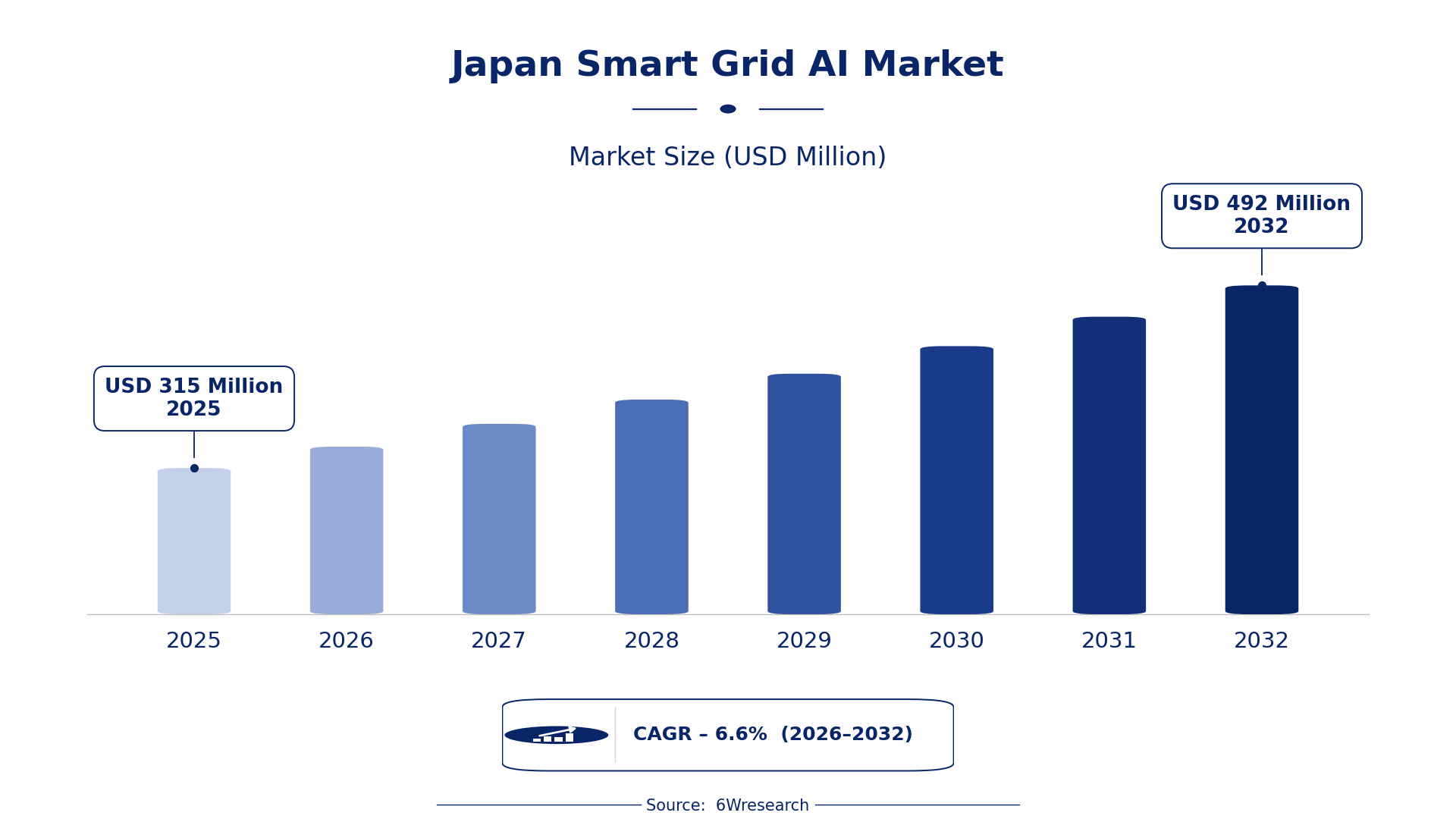
According to 6Wresearch internal database and industry insights, the Japan Smart Grid AI Market was valued at USD 315 Million in 2025 and is projected to reach USD 492 Million by 2032, growing at a CAGR of approximately 6.6% during 2026–2032.
Japan Smart Grid AI Market Highlights
| Report Metric | Details |
| Report Name | Japan Smart Grid AI Market (2026-2032) |
| Market Size 2025 | USD 315 Million |
| Market Size 2032 | USD 492 Million |
| Absolute Growth 2025–2032 | USD 177 Million |
| CAGR 2026–2032 | 6.6% |
| Peak Annual Growth | 8.7% in 2027 |
| Forecast Period | 2026–2032 |
| Historical Data | 2022–2025 |
| Base Year | 2025 |
| Leading AI Application Area, 2025 | Load Prediction AI (38% share) |
| Leading Feature Type, 2025 | Demand Forecasting (41% share) |
| Leading Data Source, 2025 | Smart Meters (46% share) |
| Leading End User, 2025 | Utility Companies (47% share) |
| Fastest-Growing AI Application Area | Fault Detection AI (8.4% CAGR) |
| Fastest-Growing Feature Type | Grid Anomaly Alerts (9.3% CAGR) |
| Fastest-Growing Data Source | Sensor Networks (9.4% CAGR) |
| Fastest-Growing End User | Energy Infrastructure Firms (8.6% CAGR) |
| Growing Sector | Energy Management |
| Key End Users | Utility Companies, Energy Infrastructure Firms, Green Energy Providers |
Japan Smart Grid AI Market Year-wise Growth Rate and Key Drivers (2022–2032)
This graph illustrates the annual growth rates of the market from 2022 to 2032, highlighting a steady upward trajectory and projected market expansion over the forecast period.
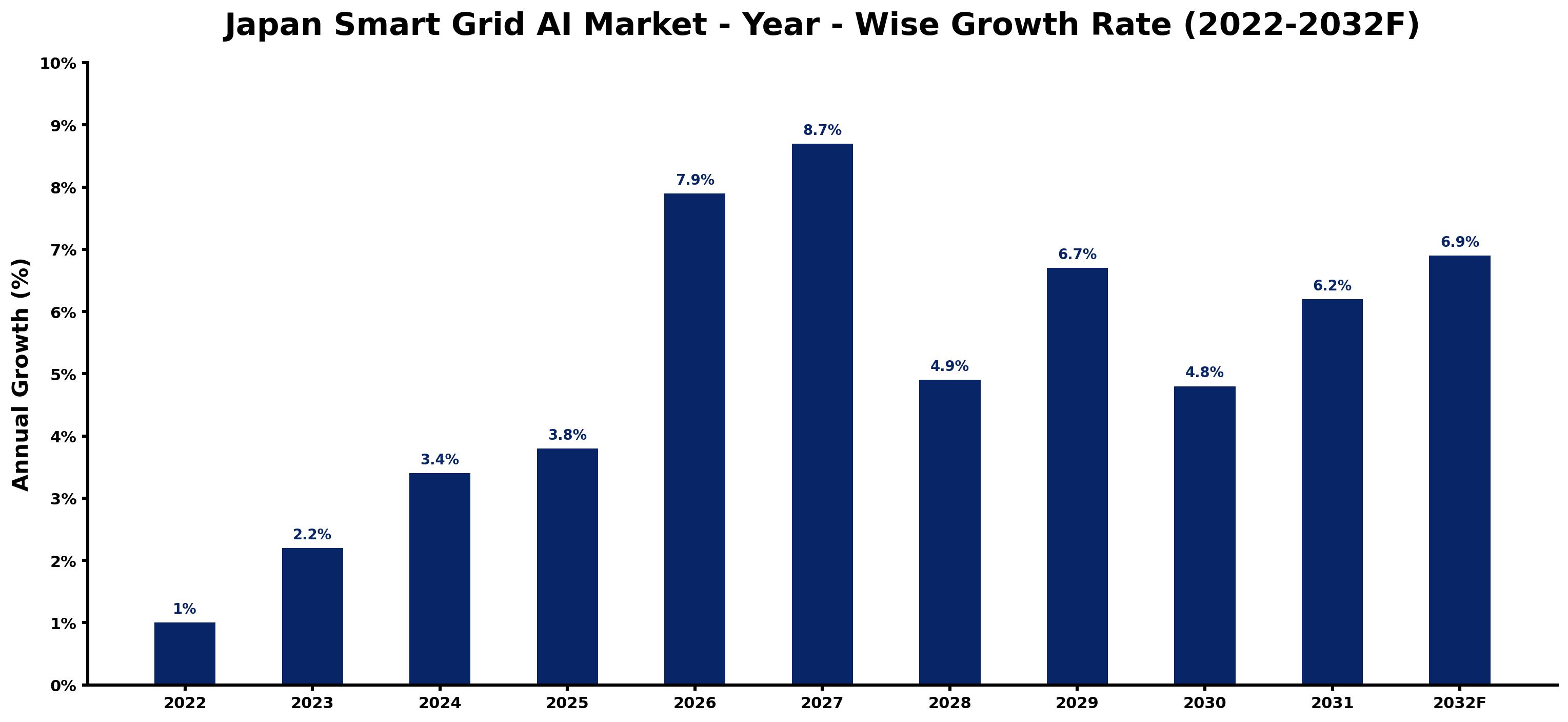
The following figures match every annual growth estimate with the main market development of that year, giving the reasoning behind each rise or slowdown.
| Year | Estimated Annual Growth (%) | Market Rationale |
| 2022 | 1.0 | The market exhibited steady growth due to initial investments in smart grid technologies. |
| 2023 | 2.2 | Growth accelerated as utility companies increased their focus on AI-driven solutions. |
| 2024 | 3.4 | Demand continued to rise with advancements in load prediction capabilities. |
| 2025 | 3.8 | The market reached a historical peak as utility companies expanded AI applications. |
| 2026 | 7.9 | Growth is expected to surge as investments in renewable energy integration gain momentum. |
| 2027 | 8.7 | The peak annual growth will be driven by heightened demand for fault detection systems. |
| 2028 | 4.9 | Growth is expected to slow slightly as market maturation begins to influence expansion rates. |
| 2029 | 6.7 | Demand will increase again as energy infrastructure firms adopt more AI technologies. |
| 2030 | 4.8 | Growth is projected to decelerate as the market stabilises after rapid expansion in previous years. |
| 2031 | 6.2 | A renewed focus on energy efficiency will boost growth rates once more. |
| 2032 | 6.9 | The market is expected to continue growing as new smart grid projects are initiated. |
Note: Market size estimations and growth projections presented in this report are based on 6Wresearch's proprietary forecasting methodology, utilizing the latest available industry data, government publications, and primary research inputs.
Japan Smart Grid AI Market Synopsis
Smart Grid AI refers to advanced technologies that improve electricity grid efficiency through machine learning. In Japan, over 30 million smart meters are installed, facilitating load prediction and fault detection. The Japan Smart Grid AI Market is growing due to increased investments in AI technologies, with approximately 200 billion yen allocated in 2023. Utility companies and energy infrastructure firms are key drivers, supported by measures like the Semiconductor and Digital Industry Strategy, which promotes technology adoption and sustainability in energy management.
Market Dynamics Impact Analysis (2026–2032)
| Factor | Type | Impact | Primary Segment Affected |
| Increasing investments in AI technologies by utility companies | Driver | High | Load Prediction AI |
| Growing focus on renewable energy integration | Driver | High | Renewable Energy AI |
| Rising demand for efficient energy management solutions | Opportunity | High | Demand Forecasting |
| Expansion of smart grid initiatives in urban areas | Opportunity | Medium | Grid Anomaly Alerts |
| High initial costs of AI implementation | Restraint | High | Fault Detection AI |
| Limited awareness among smaller utility providers | Restraint | Medium | Customer Behavior AI |
| Challenges in data integration from diverse sources | Challenge | High | Sensor Networks |
| Shortage of skilled professionals in AI technologies | Challenge | Medium | Smart Meters |
Evaluation of Drivers in Japan Smart Grid AI Market (2026–2032)
The following drivers explain most of the expected growth.
| Drivers | Primary Segment Affected | Why It Matters (Evidence) |
| Increased investment in AI technologies by utility companies | Load Prediction AI | Japan's energy sector invested approximately 200 billion yen in AI technologies in 2023, leading to improved forecasting capabilities. |
| Growing adoption of renewable energy sources | Renewable Energy AI | With renewable sources accounting for 18% of the energy mix in 2022, utility companies are integrating AI to manage supply effectively. |
| Demand for real-time monitoring solutions | Smart Meters | Over 30 million smart meters installed as of 2023 provide critical data for AI analytics. |
| Need for improved grid reliability | Fault Detection AI | AI technologies are expected to enhance grid reliability by identifying issues proactively, benefiting utility companies. |
| Focus on sustainability initiatives | Demand Forecasting | Japan aims to reduce greenhouse gas emissions by 46% by 2030, driving demand for smart grid solutions. |
Purchasing is picking up as utility companies increasingly invest in AI technologies to improve grid efficiency. In 2023, Japan's energy sector allocated approximately 200 billion yen for AI advancements, boosting load prediction capabilities. The integration of renewable energy sources, which accounted for 18% of the energy mix in 2022, is further driving demand for AI solutions. The installation of over 30 million smart meters provides critical data for better fault detection and real-time monitoring.
Evaluation of Restraints in Japan Smart Grid AI Market
Below are the constraints most often cited by buyers and suppliers, with the segment each affects.
| Market Restraint | Primary Segment Affected | Why It Matters (Evidence) |
| High initial costs associated with AI implementation | Fault Detection AI | Utility companies face upfront investments averaging 200 billion yen, deterring smaller providers from adopting AI technologies. |
| Limited awareness of smart grid technologies among smaller utilities | Customer Behavior AI | Many smaller utility providers lack knowledge about AI benefits, hindering market growth. |
| Challenges in integrating diverse data sources | Sensor Networks | Data from various sources can be difficult to harmonise, complicating AI analytics and decision-making. |
| Shortage of skilled professionals in AI | Smart Meters | The lack of qualified personnel impacts the ability of companies to implement and maintain AI systems effectively. |
| Regulatory hurdles in technology adoption | Renewable Energy AI | Compliance with various standards can slow down the adoption of new AI technologies in the energy sector. |
Japan Smart Grid AI Market Challenges
Competition among utility companies results in fragmented efforts in smart grid development, impeding collaboration and delaying progress for energy providers. Regulatory complexities, particularly concerning the JIS Q 10002 standard, create compliance costs that can extend project timelines for suppliers by as much as 20%. Rising operational costs linked to infrastructure upgrades strain budgets, compelling energy companies to cut back on investments in new technologies. Disruptions in the supply chain for critical components can postpone project rollouts, affecting the timely implementation of smart grid solutions and ultimately service reliability.
Trends in the Japan Smart Grid AI Market
Several trends are reshaping the Japan Smart Grid AI Market; the most important are set out below.
- Energy Infrastructure Firms Increasing AI Adoption: Energy infrastructure firms are increasingly embracing AI technologies to improve operational efficiency, particularly in the Tokyo metropolitan area, where investments in smart grid solutions are substantial. In 2023, over 30 million smart meters were installed.
- Tokyo Leading Smart Grid AI Deployment: The Tokyo metropolitan area is emerging as a centre for smart grid AI technologies, with considerable investments in smart meters and sensor networks. In 2023, over 30 million smart meters were installed, enabling real-time data analysis.
- Smart Grid Association Promoting Standards: The Smart Grid Association of Japan is actively advocating for industry standards to accelerate the adoption of smart grid technologies. This initiative seeks to improve energy efficiency, aiming for a 50% renewable energy mix by 2030.
- Shift Towards Renewable Energy Integration: Japan's energy sector is increasingly prioritising the integration of renewable sources into the grid, with 18% of the energy mix derived from renewables in 2022. This shift is driving demand for AI technologies that optimise energy distribution.
Investment Opportunities in the Japan Smart Grid AI Market
Below are the investment opportunities with the strongest case in the Japan Smart Grid AI Market.
- Investment Gap for Smaller Utilities: With over 30 million smart meters installed, there is an opportunity for AI solutions targeting smaller utility companies, which can improve their operational efficiency. Collaborating with local partners can facilitate market entry.
- Need for Advanced Energy Management Solutions: As Japan aims for a 46% reduction in greenhouse gas emissions by 2030, there is a pressing need for advanced AI technologies in energy management. Utility companies are prime candidates for investment in these solutions.
- Growing Market for Renewable Energy AI: With renewable energy sources expected to reach 50% of the energy mix by 2030, investments in AI technologies for integration are essential. Energy infrastructure firms can benefit from partnerships to develop these solutions.
- Expansion of Smart Grid Initiatives: The Smart Grid Association of Japan supports industry standards, creating opportunities for companies to invest in smart grid technologies. Engaging with this association can provide valuable insights and access to the market.
Government Initiatives in the Japan Smart Grid AI Market
The Semiconductor and Digital Industry Strategy, introduced in June 2021, strengthens existing laws by focusing on securing domestic semiconductor manufacturing. This initiative supports the development of smart grid technologies by ensuring a reliable supply chain for critical components, benefiting utility companies in their AI implementations.
In 2023, the New Energy and Industrial Technology Development Organization (NEDO) allocated 50 billion yen to fund smart grid projects. This agency plays a role in promoting technology adoption and supporting industry advancements for energy providers.
Future Insight of the Japan Smart Grid AI Market
The Tokyo Smart City Project will drive the integration of AI in grid management, setting a precedent for future initiatives. By 2032, Japan's energy sector aims for a 50% share of renewable sources, which will increase demand for smart grid AI technologies. The total installed capacity of renewable energy is expected to reach 150 GW, necessitating advanced grid solutions. AI applications are anticipated to improve operational efficiency, compelling suppliers to innovate continuously and meet evolving market demands.
Market Segmentation Analysis
Japan Smart Grid AI Market report covers a detailed analysis of the following market segments:
By AI Application Area – Load Prediction AI Leads, Fault Detection AI Expected to Grow Fastest
According to Saurav Kr Singh, Senior Research Analyst at 6Wresearch, Load Prediction AI took 38% of ai application area revenue in 2025, more than any other category. Load Prediction holds the largest share as it is essential for accurately forecasting energy demand, which is critical for optimising grid performance. The deployment of over 30 million smart meters in Japan supports this technology by providing real-time data for effective management. Fault Detection AI is projected to grow fastest, at a CAGR of 8.4% during 2026–2032. Fault Detection is experiencing rapid growth because it identifies and resolves grid issues proactively, which is vital for maintaining system reliability. The energy sector's investment of approximately 200 billion yen in AI technologies is a key factor driving this expansion. Suppliers should focus on enhancing fault detection capabilities to meet the growing needs of utility companies.
By Feature Type – Demand Forecasting Leads, Grid Anomaly Alerts Expected to Grow Fastest
Demand Forecasting accounted for 41% of the market by feature type in 2025. Demand Forecasting is the leading feature type, crucial for effective planning and resource allocation in the energy sector. The government's target of 50% renewable energy by 2030 highlights the importance of accurate demand predictions for successful implementation. Over 2026–2032, Grid Anomaly Alerts are expected to post the fastest growth, at a CAGR of 9.3%. Grid Anomaly Alerts are growing quickly as they provide operators with real-time notifications about potential issues, improving grid reliability. The establishment of the Smart Grid Forum in 2023 indicates a strong focus on enhancing real-time monitoring capabilities. Buyers should invest in technologies that offer real-time anomaly detection to improve operational efficiency.
By Data Source – Smart Meters Lead, Sensor Networks Expected to Grow Fastest
Smart Meters held 46% of the Japan Smart Grid AI Market by data source in 2025. Smart Meters are the primary data source due to their role in collecting data for real-time monitoring and management of energy usage. Their extensive installed base is essential for the effective operation of smart grid applications. The quickest growth will come from Sensor Networks, forecast to expand at a CAGR of 9.4% between 2026 and 2032. Sensor Networks are experiencing the fastest growth as they provide critical data for analytics, enhancing decision-making processes. The integration of sensor networks with smart meter systems plays a significant role in this trend. Suppliers should prioritise the development of sensor network technologies to capitalise on this growth opportunity.
By End User – Utility Companies Lead, Energy Infrastructure Firms Expected to Grow Fastest
With 47% of end user revenue in 2025, Utility Companies was the largest category. Utility Companies dominate the market as the main users of smart grid technologies, employing these solutions to improve service delivery and operational efficiency. Their substantial investments in smart grid initiatives, particularly in the Kanto region, reinforce their leading position. Energy Infrastructure Firms are set to record the highest CAGR in this split, 8.6% over 2026–2032. Energy Infrastructure Firms are rapidly expanding as they increasingly adopt AI for operational efficiency, driven by the necessity to modernise outdated infrastructure. The growing emphasis on sustainability and efficiency in energy management is a key factor in this trend. Suppliers should tailor their products to address the specific requirements of energy infrastructure firms to capture this emerging market.
Key Attractiveness of the Report
- 10 Years of Market Numbers
- Historical Data Starting from 2022 to 2025
- Base Year 2025
- Forecast Data until 2032
- Key Performance Indicators Impacting the Market
- Major Upcoming Developments and Projects
Key Highlights of the Report:
- Japan Smart Grid AI Market Outlook
- Market Size of Japan Smart Grid AI Market, 2025
- Forecast of Japan Smart Grid AI Market, 2032
- Historical Data and Forecast of Japan Smart Grid AI Revenues & Volume for the Period 2022-2032F
- Japan Smart Grid AI Market Trend Evolution
- Japan Smart Grid AI Market Drivers and Challenges
- Japan Smart Grid AI Price Trends
- Japan Smart Grid AI Porter's Five Forces
- Japan Smart Grid AI Industry Life Cycle
- Historical Data and Forecast of Japan Smart Grid AI Market Revenues & Volume By AI Application Area for the Period 2022-2032F
- Historical Data and Forecast of Japan Smart Grid AI Market Revenues & Volume By Load Prediction AI for the Period 2022-2032F
- Historical Data and Forecast of Japan Smart Grid AI Market Revenues & Volume By Fault Detection AI for the Period 2022-2032F
- Historical Data and Forecast of Japan Smart Grid AI Market Revenues & Volume By Renewable Energy AI for the Period 2022-2032F
- Historical Data and Forecast of Japan Smart Grid AI Market Revenues & Volume By Customer Behavior AI for the Period 2022-2032F
- Historical Data and Forecast of Japan Smart Grid AI Market Revenues & Volume By Feature Type for the Period 2022-2032F
- Historical Data and Forecast of Japan Smart Grid AI Market Revenues & Volume By Demand Forecasting for the Period 2022-2032F
- Historical Data and Forecast of Japan Smart Grid AI Market Revenues & Volume By Grid Anomaly Alerts for the Period 2022-2032F
- Historical Data and Forecast of Japan Smart Grid AI Market Revenues & Volume By Solar/Wind Balancing for the Period 2022-2032F
- Historical Data and Forecast of Japan Smart Grid AI Market Revenues & Volume By Usage Pattern Recognition for the Period 2022-2032F
- Historical Data and Forecast of Japan Smart Grid AI Market Revenues & Volume By Data Source for the Period 2022-2032F
- Historical Data and Forecast of Japan Smart Grid AI Market Revenues & Volume By Smart Meters for the Period 2022-2032F
- Historical Data and Forecast of Japan Smart Grid AI Market Revenues & Volume By Sensor Networks for the Period 2022-2032F
- Historical Data and Forecast of Japan Smart Grid AI Market Revenues & Volume By Weather + Grid Data for the Period 2022-2032F
- Historical Data and Forecast of Japan Smart Grid AI Market Revenues & Volume By Consumption Data for the Period 2022-2032F
- Historical Data and Forecast of Japan Smart Grid AI Market Revenues & Volume By End User for the Period 2022-2032F
- Historical Data and Forecast of Japan Smart Grid AI Market Revenues & Volume By Utility Companies for the Period 2022-2032F
- Historical Data and Forecast of Japan Smart Grid AI Market Revenues & Volume By Energy Infrastructure Firms for the Period 2022-2032F
- Historical Data and Forecast of Japan Smart Grid AI Market Revenues & Volume By Green Energy Providers for the Period 2022-2032F
- Historical Data and Forecast of Japan Smart Grid AI Market Revenues & Volume By Smart Billing Platforms for the Period 2022-2032F
- Japan Smart Grid AI Import Export Trade Statistics
- Market Opportunity Assessment By AI Application Area
- Market Opportunity Assessment By Feature Type
- Market Opportunity Assessment By Data Source
- Market Opportunity Assessment By End User
- Japan Smart Grid AI Top Companies Market Share
- Japan Smart Grid AI Competitive Benchmarking By Technical and Operational Parameters
- Japan Smart Grid AI Company Profiles
- Japan Smart Grid AI Key Strategic Recommendations
Market Covered
This report examines the market across the segments below.
By AI Application Area
- Load Prediction AI
- Fault Detection AI
- Renewable Energy AI
- Customer Behavior AI
By Feature Type
- Demand Forecasting
- Grid Anomaly Alerts
- Solar/Wind Balancing
- Usage Pattern Recognition
By Data Source
- Smart Meters
- Sensor Networks
- Weather + Grid Data
- Consumption Data
By End User
- Utility Companies
- Energy Infrastructure Firms
- Green Energy Providers
- Smart Billing Platforms































