Japan Smart Grid Instrumentation Market Size & Growth Rate
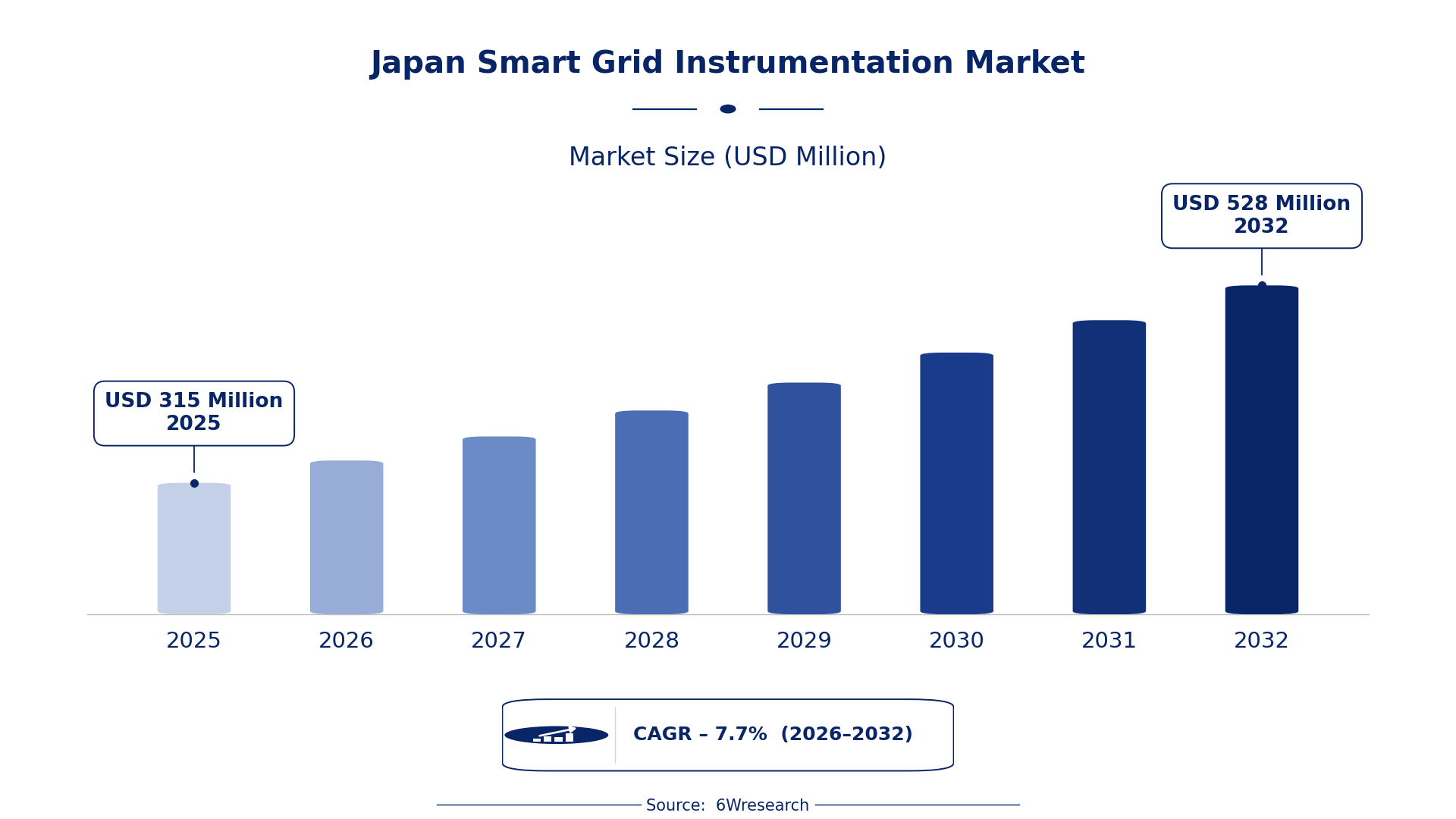
According to 6Wresearch internal database and industry insights, the Japan Smart Grid Instrumentation Market was valued at USD 315 Million in 2025 and is projected to reach USD 528 Million by 2032, growing at a CAGR of approximately 7.7% during 2026–2032.
Japan Smart Grid Instrumentation Market Highlights
| Report Metric | Details |
| Report Name | Japan Smart Grid Instrumentation Market (2026-2032) |
| Market Size 2025 | USD 315 Million |
| Market Size 2032 | USD 528 Million |
| Absolute Growth 2025–2032 | USD 213 Million |
| CAGR 2026–2032 | 7.7% |
| Peak Annual Growth | 8.7% in 2032 |
| Forecast Period | 2026–2032 |
| Historical Data | 2022–2025 |
| Base Year | 2025 |
| Leading Instrument Type, 2025 | Smart Energy Meters (43% share) |
| Leading Functionality, 2025 | Two-Way Communication (37% share) |
| Leading Deployment Zone, 2025 | Residential/Commercial (33% share) |
| Leading End User, 2025 | Grid Operators (43% share) |
| Fastest-Growing Instrument Type | Remote Terminal Units (11.0% CAGR) |
| Fastest-Growing Functionality | Real-Time Grid Control (10.0% CAGR) |
| Fastest-Growing Deployment Zone | Substations (9.4% CAGR) |
| Fastest-Growing End User | Transmission Companies (10.1% CAGR) |
| Growing Sector | Transmission Companies |
| Key End Users | Grid Operators, Transmission Companies, Energy Reliability Firms, Power Distribution Firms |
Japan Smart Grid Instrumentation Market Year-wise Growth Rate and Key Drivers (2022–2032)
This graph illustrates the annual growth rates of the market from 2022 to 2032, highlighting a steady upward trajectory and projected market expansion over the forecast period.
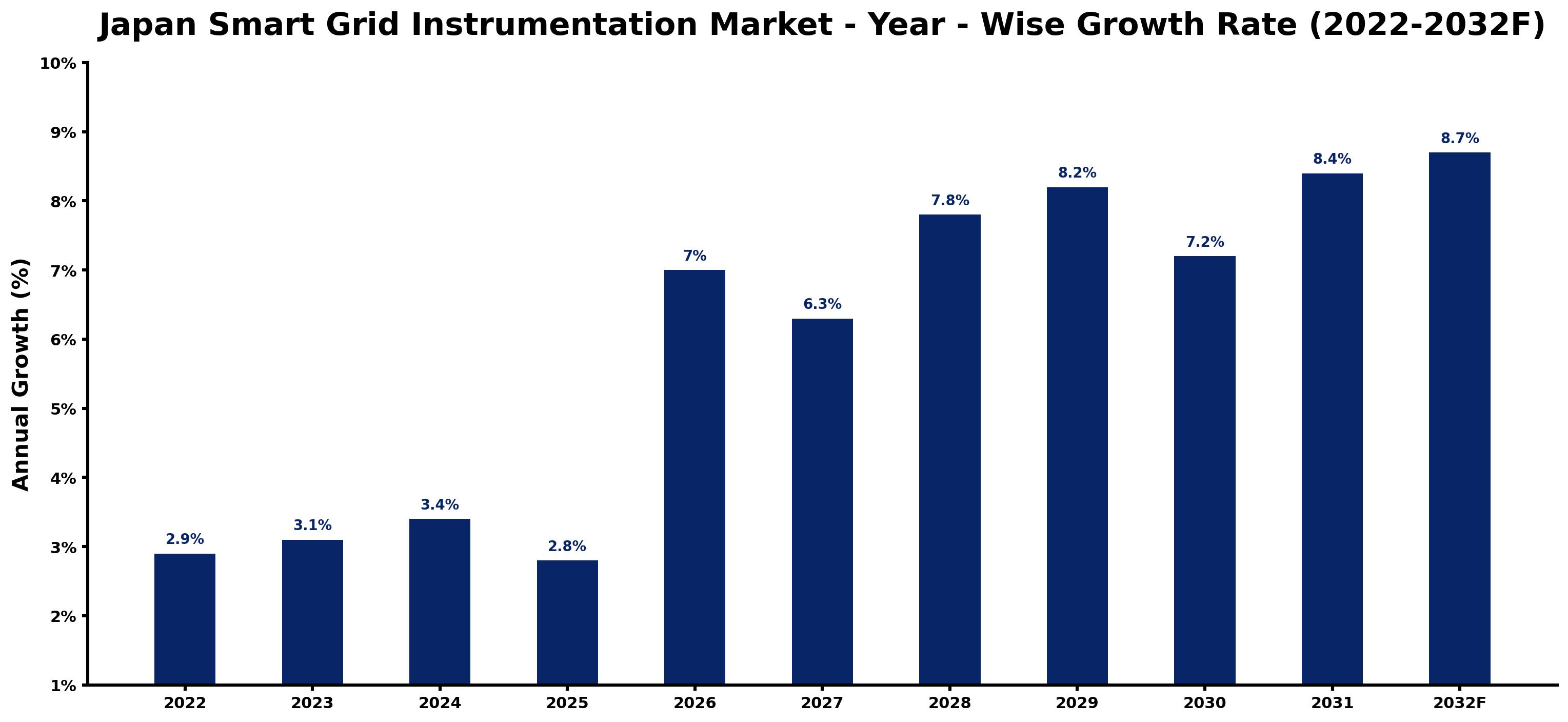
The yearly estimates that follow link every growth rate to its principal driver, so readers can see why the pace changed in each period.
| Year | Estimated Annual Growth (%) | Market Rationale |
| 2022 | 2.9 | The market experienced steady demand from urban energy users, reflecting ongoing investments in infrastructure. |
| 2023 | 3.1 | Growth was driven by increased smart meter installations in urban areas, improving energy monitoring capabilities. |
| 2024 | 3.4 | Demand rose as more energy firms adopted ISO 50001 for energy management, improving operational performance. |
| 2025 | 2.8 | Growth slowed slightly due to market saturation in urban installations, yet demand remained strong overall. |
| 2026 | 7.0 | The market is expected to accelerate as government initiatives boost investments in smart grid technologies. |
| 2027 | 6.3 | A slower growth rate reflects the maturation of the smart grid sector, with ongoing projects still generating demand. |
| 2028 | 7.8 | Rising demand for real-time grid control solutions is anticipated to drive market growth significantly. |
| 2029 | 8.2 | Increased adoption of Phasor Measurement Units in substations is expected to improve grid stability and monitoring. |
| 2030 | 7.2 | Growth is projected to slow as the market reaches a more stable phase, with continued investment in technology. |
| 2031 | 8.4 | Demand is expected to rise as new projects in urban areas increase the need for smart grid solutions. |
| 2032 | 8.7 | The market is projected to peak as the push for renewable energy drives further investments in smart grid infrastructure. |
Note: Market size estimations and growth projections presented in this report are based on 6Wresearch's proprietary forecasting methodology, utilizing the latest available industry data, government publications, and primary research inputs.
Japan Smart Grid Instrumentation Market Synopsis
Smart Grid Instrumentation improves the efficiency and reliability of electrical grids through advanced technologies. It integrates hardware and software solutions for monitoring energy consumption and managing grid stability. The Japan Smart Grid Instrumentation Market is expanding due to the government's target of achieving 100% renewable energy by 2050 and the increasing deployment of smart energy meters, with over 10 million units installed as of 2023. Ongoing investments in energy infrastructure and the need for real-time monitoring further drive demand for these solutions.
Market Dynamics Impact Analysis (2026–2032)
| Factor | Type | Impact | Primary Segment Affected |
| Government initiatives promoting renewable energy and smart grid technologies | Driver | High | Smart Energy Meters |
| Increased urban energy consumption necessitating efficient grid management | Driver | High | Remote Terminal Units |
| Growing need for real-time monitoring solutions in substations | Opportunity | Medium | Phasor Measurement Units |
| Rising demand for load balancing solutions among residential users | Opportunity | Medium | Load Balancing |
| Market saturation in urban areas limiting new installations | Restraint | High | Smart Energy Meters |
| High initial investment costs for advanced smart grid technologies | Restraint | Medium | Remote Terminal Units |
| Competition from alternative energy management solutions | Challenge | High | Phasor Measurement Units |
| Technological integration challenges for existing infrastructure | Challenge | Medium | Voltage Regulators |
Evaluation of Drivers in Japan Smart Grid Instrumentation Market (2026–2032)
The table below links each growth driver to the segment it affects and the evidence for it.
| Drivers | Primary Segment Affected | Why It Matters (Evidence) |
| Government initiatives promoting renewable energy | Smart Energy Meters | These initiatives drive demand for smart energy solutions, with over 10 million smart meters deployed as of 2023, enhancing monitoring capabilities for consumers. |
| Increased urban energy consumption | Remote Terminal Units | Urban areas are adopting smart grid technologies, leading to a rise in demand for remote monitoring and control solutions to manage energy distribution effectively. |
| Real-time data requirements for grid stability | Phasor Measurement Units | The need for real-time monitoring systems is growing, as substations increasingly deploy phasor measurement units to ensure reliable energy supply. |
| Technological advancements in energy management | Voltage Regulators | Innovations in voltage regulation technology are enhancing grid reliability, prompting energy firms to invest in advanced voltage regulators for better performance. |
| Consumer demand for energy efficiency | Two-Way Communication | Rising consumer awareness is driving the adoption of two-way communication systems, enabling real-time data exchange and improved energy management. |
Behind the steady rise in orders is Japan's commitment to achieving 100% renewable energy by 2050, which is driving investments in smart grid technologies. As urban energy users adopt advanced solutions, demand for instrumentation increases. The push for grid stability prompts energy firms to invest in monitoring systems that improve operational reliability. Growing consumer awareness of energy efficiency leads to increased interest in smart grid solutions, with over 10 million smart meters deployed as of 2023.
Evaluation of Restraints in Japan Smart Grid Instrumentation Market
Several factors work against faster growth; the main ones are summarised below.
| Market Restraint | Primary Segment Affected | Why It Matters (Evidence) |
| A shortage of skilled technicians | Smart Energy Meters | This shortage hampers the deployment of smart grid technologies, delaying projects for energy firms that rely on timely installations. |
| Regulatory hurdles | Remote Terminal Units | Complex compliance requirements can extend project timelines by up to six months for suppliers. |
| Fluctuating prices of raw materials | Phasor Measurement Units | Rising costs can inflate project budgets by 15% and deter investment in smart grid solutions. |
| Competition from alternative energy sources | Voltage Regulators | This pressure forces producers to innovate rapidly, risking market share if they fail to adapt to evolving technologies. |
| Market saturation in urban areas | Two-Way Communication | This saturation leads to slower growth rates as demand stabilises. |
Japan Smart Grid Instrumentation Market Challenges
A lack of qualified technicians hampers the rollout of smart grid technologies, delaying installations by up to six months for energy firms reliant on timely execution. Stringent regulatory frameworks complicate compliance, leading to project delays and cost increases of around 10% for suppliers. Buyers face escalating expenses due to fluctuating prices of essential materials, which can inflate project budgets by 15% and deter investments in smart grid solutions. Competitive pressures from alternative energy sources push producers to innovate rapidly, risking their market position if they fail to adapt to technological changes.
Trends in the Japan Smart Grid Instrumentation Market
Several trends are reshaping the Japan Smart Grid Instrumentation Market; the most important are set out below.
- Shift towards Real-Time Monitoring Solutions: Grid Operators are increasingly adopting real-time monitoring technologies to improve operational efficiency. As of 2023, over 10 million smart meters have been deployed, facilitating this shift.
- Transition to Enhanced Voltage Regulation: The Smart Grid Association of Japan is promoting advanced voltage regulation technologies. This initiative is projected to increase demand for Voltage Regulators significantly by 2025.
- Emerging Focus on Energy Efficiency: Residential/Commercial sectors are prioritising energy-efficient solutions to meet consumer demand. This trend is supported by government initiatives aimed at achieving 100% renewable energy by 2050.
- Growing Adoption of Phasor Measurement Units: Substations are increasingly utilising Phasor Measurement Units for real-time monitoring. This trend is expected to improve grid stability and operational reliability.
Investment Opportunities in the Japan Smart Grid Instrumentation Market
The following opportunities in the Japan Smart Grid Instrumentation Market pair current demand with a clear way in.
- Residential/Commercial Sector Needs Smart Energy Solutions: With over 10 million smart meters already deployed, the demand for advanced energy management solutions is clear. Collaborating with local energy firms can facilitate entry into this market.
- Investment in Real-Time Monitoring Technologies: The push for real-time monitoring presents a strong opportunity, with the market expected to grow substantially. Partnering with Grid Operators can help suppliers tap into this demand.
- Supply of Advanced Voltage Regulation Technologies: As the Smart Grid Association of Japan promotes these technologies, there is a growing need for suppliers to meet this demand. Engaging with local distributors can streamline market entry.
- Expansion of Phasor Measurement Units in Substations: The increasing adoption of these units creates a gap for suppliers. Establishing joint ventures with local manufacturers can enhance market presence.
Government Initiatives in the Japan Smart Grid Instrumentation Market
The Hydrogen Society Promotion Act (2024; METI) supports low-carbon hydrogen supply chains, adding to the existing framework of energy policies. This act complements the Electrical Appliance and Material Safety Act (1961; METI), which regulates the safety of electrical appliances, ensuring compliance and safety in smart grid technologies for buyers and producers.
The Energy Agency of Japan oversees initiatives for grid modernization and efficiency, approving funding for smart grid projects. In 2023, the agency allocated ¥1 billion for research and development, boosting innovation in smart grid instrumentation.
Future Insight of the Japan Smart Grid Instrumentation Market
New smart meter installations will emerge as a key focus area, driven by urban development initiatives. By 2032, the integration of advanced monitoring technologies will enhance grid efficiency and reliability. The implementation of ISO 50001 standards will standardise energy management practices, improving operational consistency for energy firms. With Japan's energy consumption anticipated to reach approximately 900 TWh by 2032, the demand for smart grid solutions will grow, creating opportunities for both buyers and suppliers.
Market Segmentation Analysis
Japan Smart Grid Instrumentation Market report covers a detailed analysis of the following market segments:
By Instrument Type – Smart Energy Meters Lead, Remote Terminal Units Expected to Grow Fastest
According to Saurav Kr Singh, Senior Research Analyst at 6Wresearch, the largest instrument type category in 2025 was Smart Energy Meters, at 43% of revenue. Smart Energy Meters dominate Japan's market because they are essential for monitoring energy consumption across various sectors. Their widespread installation, with over 10 million units, particularly in urban areas like Tokyo, underscores their importance in enhancing energy efficiency. Remote Terminal Units are projected to grow fastest, at a CAGR of 11.0% during 2026–2032. Remote Terminal Units are rapidly gaining traction as they are crucial for remote control and monitoring of grid operations. The increasing complexity of energy distribution systems necessitates their adoption for improved operational efficiency. This trend indicates that suppliers should focus on developing advanced Remote Terminal Units to meet rising demand.
By Functionality – Two-Way Communication Leads, Real-Time Grid Control Expected to Grow Fastest
Two-Way Communication held 37% of the Japan Smart Grid Instrumentation Market by functionality in 2025. Two-Way Communication leads the functionality segment as it enables real-time data exchange between devices, essential for effective grid management. This capability is particularly important in densely populated regions like Tokyo, where efficient energy distribution is crucial. The quickest growth will come from Real-Time Grid Control, forecast to expand at a CAGR of 10.0% between 2026 and 2032. Real-Time Grid Control is the fastest-growing functionality because it is vital for immediate responses to changing grid conditions. The focus on enhancing grid reliability and efficiency is accelerating its adoption among operators. Suppliers should prioritise solutions that improve Real-Time Grid Control to align with market needs.
By Deployment Zone – Residential/Commercial Leads, Substations Expected to Grow Fastest
With 33% of deployment zone revenue in 2025, Residential/Commercial was the largest category. Residential/Commercial zones represent the largest deployment area since they are the primary users of smart energy solutions. The high concentration of consumers in urban centres like Tokyo drives the demand for smart grid technologies. Substations are set to record the highest CAGR in this split, 9.4% over 2026–2032. Substations are the fastest-growing deployment zone due to their critical role in energy distribution and the increasing need for enhanced monitoring capabilities. Ongoing investments in grid infrastructure are propelling this growth. This suggests that suppliers should target Substations for new product developments and upgrades.
By End User – Grid Operators Lead, Transmission Companies Expected to Grow Fastest
Grid Operators accounted for 43% of the market by end user in 2025. Grid Operators hold the largest share as they are the primary users responsible for managing the grid's efficiency and reliability. Their pivotal role in overseeing energy distribution makes them key stakeholders in smart grid investments. Over 2026–2032, Transmission Companies are expected to post the fastest growth, at a CAGR of 10.1%. Transmission Companies are witnessing the fastest growth as they are essential for energy transmission and are increasingly adopting smart technologies. The demand for efficient energy transfer is driving their rapid expansion. This highlights an opportunity for suppliers to tailor solutions specifically for Transmission Companies.
Key Attractiveness of the Report
- 10 Years of Market Numbers
- Historical Data Starting from 2022 to 2025
- Base Year 2025
- Forecast Data until 2032
- Key Performance Indicators Impacting the Market
- Major Upcoming Developments and Projects
Key Highlights of the Report:
- Japan Smart Grid Instrumentation Market Outlook
- Market Size of Japan Smart Grid Instrumentation Market, 2025
- Forecast of Japan Smart Grid Instrumentation Market, 2032
- Historical Data and Forecast of Japan Smart Grid Instrumentation Revenues & Volume for the Period 2022-2032F
- Japan Smart Grid Instrumentation Market Trend Evolution
- Japan Smart Grid Instrumentation Market Drivers and Challenges
- Japan Smart Grid Instrumentation Price Trends
- Japan Smart Grid Instrumentation Porter's Five Forces
- Japan Smart Grid Instrumentation Industry Life Cycle
- Historical Data and Forecast of Japan Smart Grid Instrumentation Market Revenues & Volume By Instrument Type for the Period 2022-2032F
- Historical Data and Forecast of Japan Smart Grid Instrumentation Market Revenues & Volume By Smart Energy Meters for the Period 2022-2032F
- Historical Data and Forecast of Japan Smart Grid Instrumentation Market Revenues & Volume By Remote Terminal Units for the Period 2022-2032F
- Historical Data and Forecast of Japan Smart Grid Instrumentation Market Revenues & Volume By Phasor Measurement Units for the Period 2022-2032F
- Historical Data and Forecast of Japan Smart Grid Instrumentation Market Revenues & Volume By Voltage Regulators for the Period 2022-2032F
- Historical Data and Forecast of Japan Smart Grid Instrumentation Market Revenues & Volume By Functionality for the Period 2022-2032F
- Historical Data and Forecast of Japan Smart Grid Instrumentation Market Revenues & Volume By Two-Way Communication for the Period 2022-2032F
- Historical Data and Forecast of Japan Smart Grid Instrumentation Market Revenues & Volume By Real-Time Grid Control for the Period 2022-2032F
- Historical Data and Forecast of Japan Smart Grid Instrumentation Market Revenues & Volume By Grid Stability Monitoring for the Period 2022-2032F
- Historical Data and Forecast of Japan Smart Grid Instrumentation Market Revenues & Volume By Load Balancing for the Period 2022-2032F
- Historical Data and Forecast of Japan Smart Grid Instrumentation Market Revenues & Volume By Deployment Zone for the Period 2022-2032F
- Historical Data and Forecast of Japan Smart Grid Instrumentation Market Revenues & Volume By Residential/Commercial for the Period 2022-2032F
- Historical Data and Forecast of Japan Smart Grid Instrumentation Market Revenues & Volume By Substations for the Period 2022-2032F
- Historical Data and Forecast of Japan Smart Grid Instrumentation Market Revenues & Volume By Transmission Networks for the Period 2022-2032F
- Historical Data and Forecast of Japan Smart Grid Instrumentation Market Revenues & Volume By Transformer Stations for the Period 2022-2032F
- Historical Data and Forecast of Japan Smart Grid Instrumentation Market Revenues & Volume By End User for the Period 2022-2032F
- Historical Data and Forecast of Japan Smart Grid Instrumentation Market Revenues & Volume By Grid Operators for the Period 2022-2032F
- Historical Data and Forecast of Japan Smart Grid Instrumentation Market Revenues & Volume By Transmission Companies for the Period 2022-2032F
- Historical Data and Forecast of Japan Smart Grid Instrumentation Market Revenues & Volume By Energy Reliability Firms for the Period 2022-2032F
- Historical Data and Forecast of Japan Smart Grid Instrumentation Market Revenues & Volume By Power Distribution Firms for the Period 2022-2032F
- Japan Smart Grid Instrumentation Import Export Trade Statistics
- Market Opportunity Assessment By Instrument Type
- Market Opportunity Assessment By Functionality
- Market Opportunity Assessment By Deployment Zone
- Market Opportunity Assessment By End User
- Japan Smart Grid Instrumentation Top Companies Market Share
- Japan Smart Grid Instrumentation Competitive Benchmarking By Technical and Operational Parameters
- Japan Smart Grid Instrumentation Company Profiles
- Japan Smart Grid Instrumentation Key Strategic Recommendations
Market Covered
Segments analysed in this report are listed below.
By Instrument Type
- Smart Energy Meters
- Remote Terminal Units
- Phasor Measurement Units
- Voltage Regulators
By Functionality
- Two-Way Communication
- Real-Time Grid Control
- Grid Stability Monitoring
- Load Balancing
By Deployment Zone
- Residential/Commercial
- Substations
- Transmission Networks
- Transformer Stations
By End User
- Grid Operators
- Transmission Companies
- Energy Reliability Firms
- Power Distribution Firms































