Japan Smart Hatchery Solutions Market Size & Growth Rate
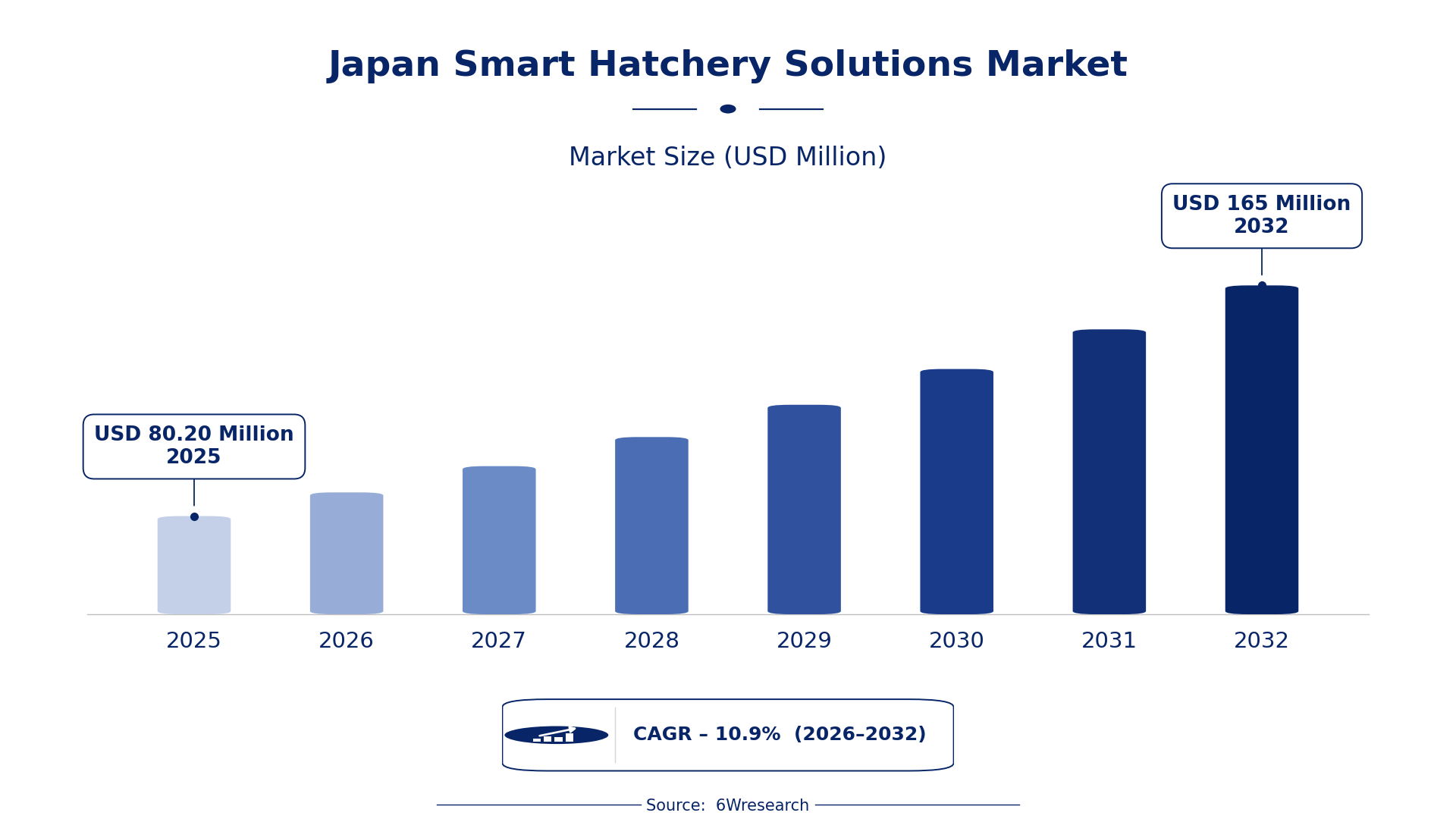
According to 6Wresearch internal database and industry insights, the Japan Smart Hatchery Solutions Market was valued at USD 80.20 Million in 2025 and is projected to reach USD 165 Million by 2032, growing at a CAGR of approximately 10.9% during 2026–2032.
Japan Smart Hatchery Solutions Market Highlights
| Report Metric | Details |
| Report Name | Japan Smart Hatchery Solutions Market (2026-2032) |
| Market Size 2025 | USD 80.20 Million |
| Market Size 2032 | USD 165 Million |
| Absolute Growth 2025–2032 | USD 84.80 Million |
| CAGR 2026–2032 | 10.9% |
| Peak Annual Growth | 12.4% in 2032 |
| Forecast Period | 2026–2032 |
| Historical Data | 2022–2025 |
| Base Year | 2025 |
| Leading Hatchery Type, 2025 | AI-Temperature Control (40% share) |
| Leading Smart System Feature, 2025 | Optimal Incubation Cycles (50% share) |
| Leading Animal Type, 2025 | Poultry (45% share) |
| Leading End User, 2025 | Commercial Poultry Farms (42% share) |
| Fastest-Growing Hatchery Type | IoT Hatch Monitoring (15.9% CAGR) |
| Fastest-Growing Smart System Feature | Remote Health Tracking (15.8% CAGR) |
| Fastest-Growing Animal Type | Chicken (15.6% CAGR) |
| Fastest-Growing End User | Agribusiness Operators (14.7% CAGR) |
| Growing Sector | Commercial Poultry Farming |
| Key End Users | Commercial Poultry Farms, Agribusiness Operators, Agricultural Cooperatives |
Japan Smart Hatchery Solutions Market Year-wise Growth Rate and Key Drivers (2022–2032)
This graph illustrates the annual growth rates of the market from 2022 to 2032, highlighting a steady upward trajectory and projected market expansion over the forecast period.
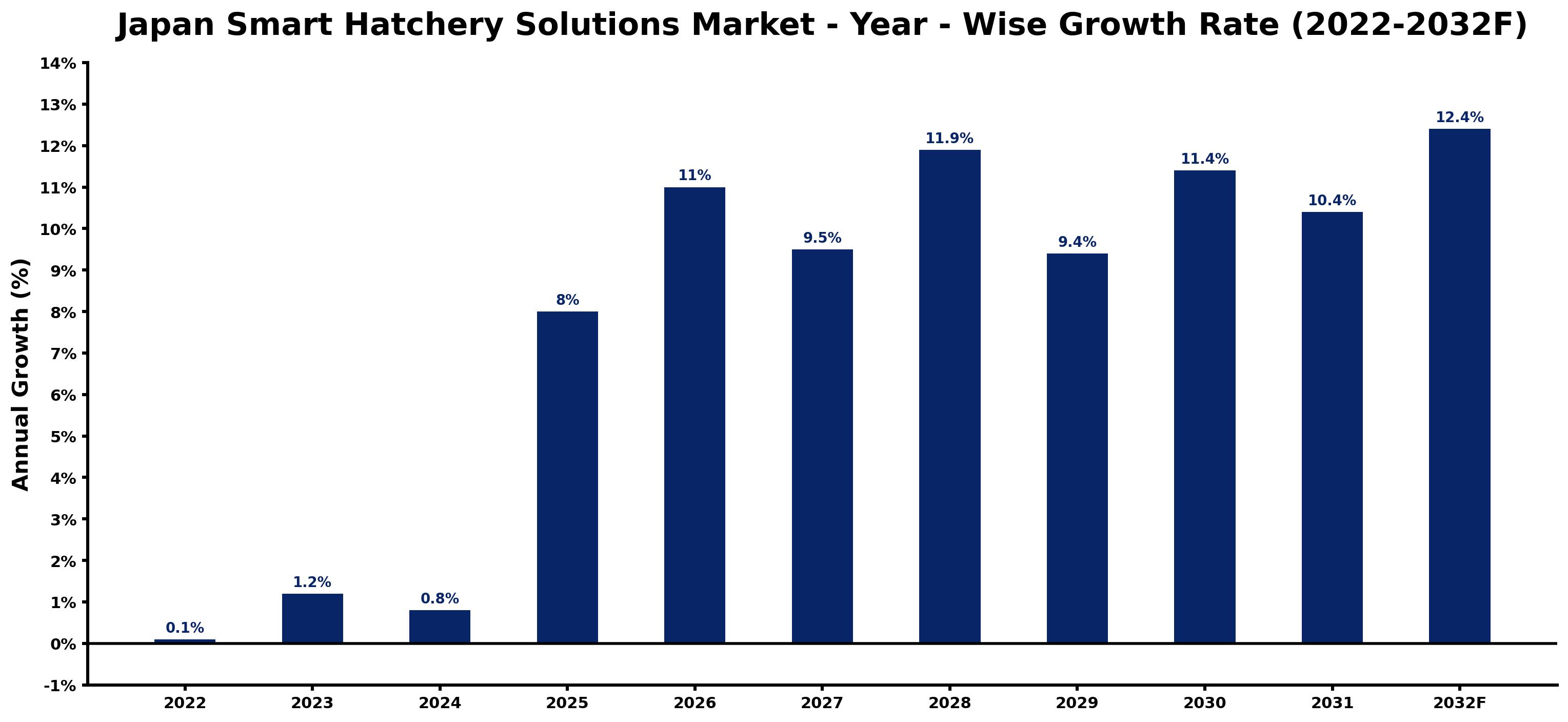
For each year, the table pairs the estimated growth rate with the leading influence on demand, showing how the drivers changed across the period.
| Year | Estimated Annual Growth (%) | Market Rationale |
| 2022 | 0.1 | The market showed minimal growth due to initial adoption phases in hatchery technology. |
| 2023 | 1.2 | Demand increased as poultry farms began integrating basic smart solutions into operations. |
| 2024 | 0.8 | Growth slowed as farms faced challenges in fully implementing advanced technologies. |
| 2025 | 8.0 | A surge in adoption occurred as farms invested in modernisation and efficiency improvements. |
| 2026 | 11.0 | Rapid growth is anticipated due to increased investments in smart technologies. |
| 2027 | 9.5 | Growth is expected to slow as the market stabilises after initial adoption. |
| 2028 | 11.9 | Demand will rise again as more farms adopt IoT technologies for improved monitoring. |
| 2029 | 9.4 | The growth rate is projected to moderate as the market matures. |
| 2030 | 11.4 | Demand will increase again with further advancements in digital farming technologies. |
| 2031 | 10.4 | Growth is expected to slow as the market stabilises, reflecting a competitive environment. |
| 2032 | 12.4 | The peak growth rate will be realised as smart solutions become standard in hatcheries. |
Note: Market size estimations and growth projections presented in this report are based on 6Wresearch's proprietary forecasting methodology, utilizing the latest available industry data, government publications, and primary research inputs.
Japan Smart Hatchery Solutions Market Synopsis
Smart Hatchery Solutions employ advanced technologies such as AI and IoT to optimise hatchery operations, focusing on egg incubation and monitoring. The Japan Smart Hatchery Solutions Market is expanding due to increasing demand from commercial poultry farms and agribusiness operators aiming to modernise their operations. The launch of a new programme in 2023 to enhance digital farming technologies is further driving this growth, alongside the integration of IoT technologies in hatcheries.
Market Dynamics Impact Analysis (2026–2032)
| Factor | Type | Impact | Primary Segment Affected |
| Increasing adoption of AI and IoT technologies | Driver | High | AI-Temperature Control |
| Rising poultry population and production demands | Driver | High | Commercial Poultry Farms |
| Growing interest in digital farming solutions | Opportunity | Medium | Agribusiness Operators |
| Rising investments in hatchery automation | Opportunity | Medium | IoT Hatch Monitoring |
| High initial investment costs for smart solutions | Restraint | High | Automated Egg Handling |
| Compliance with stringent quality standards | Restraint | Medium | Digital Embryo Tracking |
| Limited access to advanced technologies in rural areas | Challenge | High | Poultry |
| Need for skilled workforce to operate smart systems | Challenge | Medium | Commercial Poultry Farms |
Evaluation of Drivers in Japan Smart Hatchery Solutions Market (2026–2032)
These are the developments adding the most demand over the forecast period.
| Drivers | Primary Segment Affected | Why It Matters (Evidence) |
| Integration of AI technologies | AI-Temperature Control | This integration is expected to enhance operational efficiency by 20%, encouraging farms to adopt these systems for better results. |
| Growth in poultry population | Commercial Poultry Farms | With approximately 150 million poultry, farms are investing in smart solutions to meet rising production demands. |
| Expansion of IoT technologies | IoT Hatch Monitoring | Real-time data availability enhances hatchery management, driving demand for these systems. |
| Increasing focus on hatch rate optimisation | Optimal Incubation Cycles | The average hatch rate for chickens is around 85%, motivating farms to invest in technologies that improve this metric. |
| Government support for agritech innovations | Agribusiness Operators | Funding initiatives stimulate the adoption of smart solutions in the poultry sector. |
Most of the extra volume comes from a notable increase in the poultry population, which is approximately 150 million. This growth prompts farms to invest in smart hatchery solutions to meet rising production demands. The integration of AI technologies is expected to enhance operational efficiency by 20%, encouraging more farms to adopt these systems. The expansion of IoT technologies provides real-time data, improving hatchery management.
Evaluation of Restraints in Japan Smart Hatchery Solutions Market
Several factors work against faster growth; the main ones are summarised below.
| Market Restraint | Primary Segment Affected | Why It Matters (Evidence) |
| High initial investment costs for smart solutions | Automated Egg Handling | The average investment in smart hatchery technology is estimated at ¥50 million per farm, which can deter smaller operations. |
| Compliance with stringent quality standards | Digital Embryo Tracking | The Japanese hatchery industry is regulated by the Animal Health and Welfare Agency, requiring adherence to strict standards. |
| Limited access to advanced technologies in rural areas | Poultry | Many rural poultry farms struggle to access the latest smart technologies, limiting their operational improvements. |
| Need for skilled workforce to operate smart systems | Commercial Poultry Farms | A shortage of skilled workers capable of managing advanced hatchery technologies can hinder adoption. |
| Market competition leading to price pressures | IoT Hatch Monitoring | As more players enter the market, price competition may affect profitability for existing operators. |
Japan Smart Hatchery Solutions Market Challenges
Producers face annual costs of approximately ¥10 million due to compliance with Animal Health and Welfare Agency standards, which delays necessary upgrades in hatchery technology. Many hatcheries still rely on outdated systems, resulting in a 20% decrease in operational efficiency and higher production costs for buyers. Buyers encounter difficulties in sourcing smart hatchery solutions, as the average investment of ¥50 million per farm deters smaller operations from modernising. Skills shortages among the workforce impede the adoption of advanced systems, leading to a 15% increase in labour costs for producers who depend on manual processes.
Trends in the Japan Smart Hatchery Solutions Market
The following changes are redrawing the Japan Smart Hatchery Solutions Market.
- Shift from Traditional to Smart Hatchery Systems: Since 2023, poultry farms in the Kanto region have increasingly adopted smart hatchery solutions, with a 20% rise in IoT integration. This shift improves operational efficiency and reduces labour costs.
- Transition to Automated Egg Handling: In 2024, automated egg handling systems gained traction, improving efficiency by up to 15%. This trend is evident in commercial poultry farms, where streamlined operations are becoming standard.
- Emergence of Digital Embryo Tracking: Digital embryo tracking technology is gaining traction in Japan, with adoption rates increasing by 25% in 2025. This advancement allows hatcheries to monitor embryo development more effectively.
- Prioritisation of Optimal Incubation Cycles: In 2026, optimal incubation cycles became a focal point for hatcheries, with 50% of farms implementing these systems. This prioritisation aims to maximise hatch rates and improve productivity.
Investment Opportunities in the Japan Smart Hatchery Solutions Market
The following areas offer the clearest openings for investors and suppliers in the Japan Smart Hatchery Solutions Market.
- Timing for Investment in Smart Solutions: With the average investment in smart hatchery technology at ¥50 million, now is the right time for operators to invest in these systems to improve productivity.
- Growing Demand from Agribusiness Operators: Agribusiness operators are increasingly seeking smart hatchery solutions to modernise operations, creating opportunities for suppliers to enter this market with new technologies.
- Supply of IoT Monitoring Systems: The rising integration of IoT technologies presents a chance to supply monitoring systems that provide real-time data, essential for hatchery management and efficiency.
- Entry through Partnerships with Agricultural Cooperatives: Collaborating with agricultural cooperatives can facilitate market entry for new suppliers, utilising existing networks to distribute smart hatchery solutions effectively.
Government Initiatives in the Japan Smart Hatchery Solutions Market
The Economic Security Promotion Act, enacted in 2022, complements existing regulations by reinforcing supply-chain resilience for critical products, including smart hatchery solutions. This law mandates that producers adhere to stringent quality standards, ensuring that hatchery operations meet the necessary safety and efficiency benchmarks. The integration of these regulations improves the overall reliability of hatchery technologies, building greater trust among buyers and operators in the poultry sector.
Agricultural cooperatives leverage government funding initiatives to implement smart hatchery solutions effectively. These cooperatives receive financial support for adopting IoT technologies, which facilitate real-time monitoring and management of hatcheries. By utilising these funds, they can improve operational efficiency and increase hatch rates, benefiting both producers and consumers in the poultry market.
Future Insight of the Japan Smart Hatchery Solutions Market
Investment in smart hatchery solutions will increase by 2032, driven by government funding programmes that support digital farming technologies. This change will create demand for IoT-integrated systems, which will improve operational efficiency in hatcheries. The average hatch rate is expected to rise above 85% as automated systems become more prevalent. As agricultural cooperatives strengthen their distribution networks, suppliers will benefit from better market access and enhanced collaboration opportunities.
Market Segmentation Analysis
Japan Smart Hatchery Solutions Market report covers a detailed analysis of the following market segments:
By Hatchery Type – AI-Temperature Control Leads, IoT Hatch Monitoring Expected to Grow Fastest
According to Saurav Kr Singh, Senior Research Analyst at 6Wresearch, in 2025, AI-Temperature Control led the hatchery type split with a 40% share. AI-Temperature Control is crucial for maintaining optimal incubation conditions, essential for achieving high hatch rates in commercial poultry farming. With Japan's average hatch rate of around 85%, this technology plays a vital role in the success of hatchery operations. The quickest growth will come from IoT Hatch Monitoring, forecast to expand at a CAGR of 15.9% between 2026 and 2032. The rapid expansion of IoT Hatch Monitoring stems from its capacity to provide real-time data for effective hatchery management, which enhances operational efficiency. As the market increasingly adopts IoT technologies, this segment's growth trajectory is expected to continue rising. This trend suggests that suppliers should focus on developing IoT solutions to meet the growing demand for improved monitoring capabilities in hatcheries.
By Smart System Feature – Optimal Incubation Cycles Lead, Remote Health Tracking Expected to Grow Fastest
Optimal Incubation Cycles took 50% of smart system feature revenue in 2025, more than any other category. Optimal Incubation Cycles dominate the market as they are critical for maximizing hatch rates, making them a priority for hatchery operators. The average incubation period for chicken eggs in Japan is 21 days, highlighting the need for effective cycle management. Remote Health Tracking is projected to grow fastest, at a CAGR of 15.8% during 2026–2032. Remote Health Tracking is the fastest-growing feature, as it allows hatcheries to monitor conditions from afar, reducing the need for on-site personnel. This capability aligns with the trend towards automation and efficiency in hatchery operations. Buyers will benefit from investing in smart systems that offer remote monitoring capabilities to improve operational efficiency.
By Animal Type – Poultry Leads, Chicken Expected to Grow Fastest
With 45% of animal type revenue in 2025, Poultry was the largest category. Poultry is the leading animal type in hatcheries, reflecting its dominance in Japan's poultry farming sector, which supports a population of approximately 150 million birds. This widespread presence ensures a steady demand for hatchery solutions tailored for poultry. Chicken is set to record the highest CAGR in this split, 15.6% over 2026–2032. Chicken is the fastest-growing segment within poultry, as it is the most common poultry type in Japan, driving demand for specialised hatchery solutions. The focus on chicken production aligns with consumer preferences and market trends. Suppliers should tailor their offerings to cater specifically to the chicken segment to capitalise on its growth potential.
By End User – Commercial Poultry Farms Lead, Agribusiness Operators Expected to Grow Fastest
Commercial Poultry Farms held 42% of the Japan Smart Hatchery Solutions Market by end user in 2025. Commercial Poultry Farms represent the largest end-user segment, as they are the primary consumers of smart hatchery solutions in Japan's poultry industry. The average size of these farms, around 10,000 birds, necessitates efficient hatchery operations. Over 2026–2032, Agribusiness Operators are expected to post the fastest growth, at a CAGR of 14.7%. Agribusiness Operators are the fastest-growing end-user group, as they increasingly adopt smart solutions to modernise their operations and improve productivity. The government's support for agritech innovations further fuels this trend. Suppliers must engage with agribusiness operators to explore new opportunities in the evolving market.
Key Attractiveness of the Report
- 10 Years of Market Numbers
- Historical Data Starting from 2022 to 2025
- Base Year 2025
- Forecast Data until 2032
- Key Performance Indicators Impacting the Market
- Major Upcoming Developments and Projects
Key Highlights of the Report:
- Japan Smart Hatchery Solutions Market Outlook
- Market Size of Japan Smart Hatchery Solutions Market, 2025
- Forecast of Japan Smart Hatchery Solutions Market, 2032
- Historical Data and Forecast of Japan Smart Hatchery Solutions Revenues & Volume for the Period 2022-2032F
- Japan Smart Hatchery Solutions Market Trend Evolution
- Japan Smart Hatchery Solutions Market Drivers and Challenges
- Japan Smart Hatchery Solutions Price Trends
- Japan Smart Hatchery Solutions Porter's Five Forces
- Japan Smart Hatchery Solutions Industry Life Cycle
- Historical Data and Forecast of Japan Smart Hatchery Solutions Market Revenues & Volume By Hatchery Type for the Period 2022-2032F
- Historical Data and Forecast of Japan Smart Hatchery Solutions Market Revenues & Volume By AI-Temperature Control for the Period 2022-2032F
- Historical Data and Forecast of Japan Smart Hatchery Solutions Market Revenues & Volume By Automated Egg Handling for the Period 2022-2032F
- Historical Data and Forecast of Japan Smart Hatchery Solutions Market Revenues & Volume By IoT Hatch Monitoring for the Period 2022-2032F
- Historical Data and Forecast of Japan Smart Hatchery Solutions Market Revenues & Volume By Digital Embryo Tracking for the Period 2022-2032F
- Historical Data and Forecast of Japan Smart Hatchery Solutions Market Revenues & Volume By Smart System Feature for the Period 2022-2032F
- Historical Data and Forecast of Japan Smart Hatchery Solutions Market Revenues & Volume By Optimal Incubation Cycles for the Period 2022-2032F
- Historical Data and Forecast of Japan Smart Hatchery Solutions Market Revenues & Volume By Cracking/Rejection Sensors for the Period 2022-2032F
- Historical Data and Forecast of Japan Smart Hatchery Solutions Market Revenues & Volume By Remote Health Tracking for the Period 2022-2032F
- Historical Data and Forecast of Japan Smart Hatchery Solutions Market Revenues & Volume By Hatch Success Prediction for the Period 2022-2032F
- Historical Data and Forecast of Japan Smart Hatchery Solutions Market Revenues & Volume By Animal Type for the Period 2022-2032F
- Historical Data and Forecast of Japan Smart Hatchery Solutions Market Revenues & Volume By Poultry for the Period 2022-2032F
- Historical Data and Forecast of Japan Smart Hatchery Solutions Market Revenues & Volume By Chicken, Duck for the Period 2022-2032F
- Historical Data and Forecast of Japan Smart Hatchery Solutions Market Revenues & Volume By Multi-Species for the Period 2022-2032F
- Historical Data and Forecast of Japan Smart Hatchery Solutions Market Revenues & Volume By Livestock, Reptiles for the Period 2022-2032F
- Historical Data and Forecast of Japan Smart Hatchery Solutions Market Revenues & Volume By End User for the Period 2022-2032F
- Historical Data and Forecast of Japan Smart Hatchery Solutions Market Revenues & Volume By Commercial Poultry Farms for the Period 2022-2032F
- Historical Data and Forecast of Japan Smart Hatchery Solutions Market Revenues & Volume By Agribusiness Operators for the Period 2022-2032F
- Historical Data and Forecast of Japan Smart Hatchery Solutions Market Revenues & Volume By Smart Agri Solutions for the Period 2022-2032F
- Historical Data and Forecast of Japan Smart Hatchery Solutions Market Revenues & Volume By Bio-Farm Tech Providers for the Period 2022-2032F
- Japan Smart Hatchery Solutions Import Export Trade Statistics
- Market Opportunity Assessment By Hatchery Type
- Market Opportunity Assessment By Smart System Feature
- Market Opportunity Assessment By Animal Type
- Market Opportunity Assessment By End User
- Japan Smart Hatchery Solutions Top Companies Market Share
- Japan Smart Hatchery Solutions Competitive Benchmarking By Technical and Operational Parameters
- Japan Smart Hatchery Solutions Company Profiles
- Japan Smart Hatchery Solutions Key Strategic Recommendations
Market Covered
The study includes the following segmentation.
By Hatchery Type
- AI-Temperature Control
- Automated Egg Handling
- IoT Hatch Monitoring
- Digital Embryo Tracking
By Smart System Feature
- Optimal Incubation Cycles
- Cracking/Rejection Sensors
- Remote Health Tracking
- Hatch Success Prediction
By Animal Type
- Poultry
- Chicken
- Duck
- Multi-Species
- Livestock
- Reptiles
By End User
- Commercial Poultry Farms
- Agribusiness Operators
- Smart Agri Solutions
- Bio-Farm Tech Providers































