Japan Smart Highway Infrastructure Market Size & Growth Rate
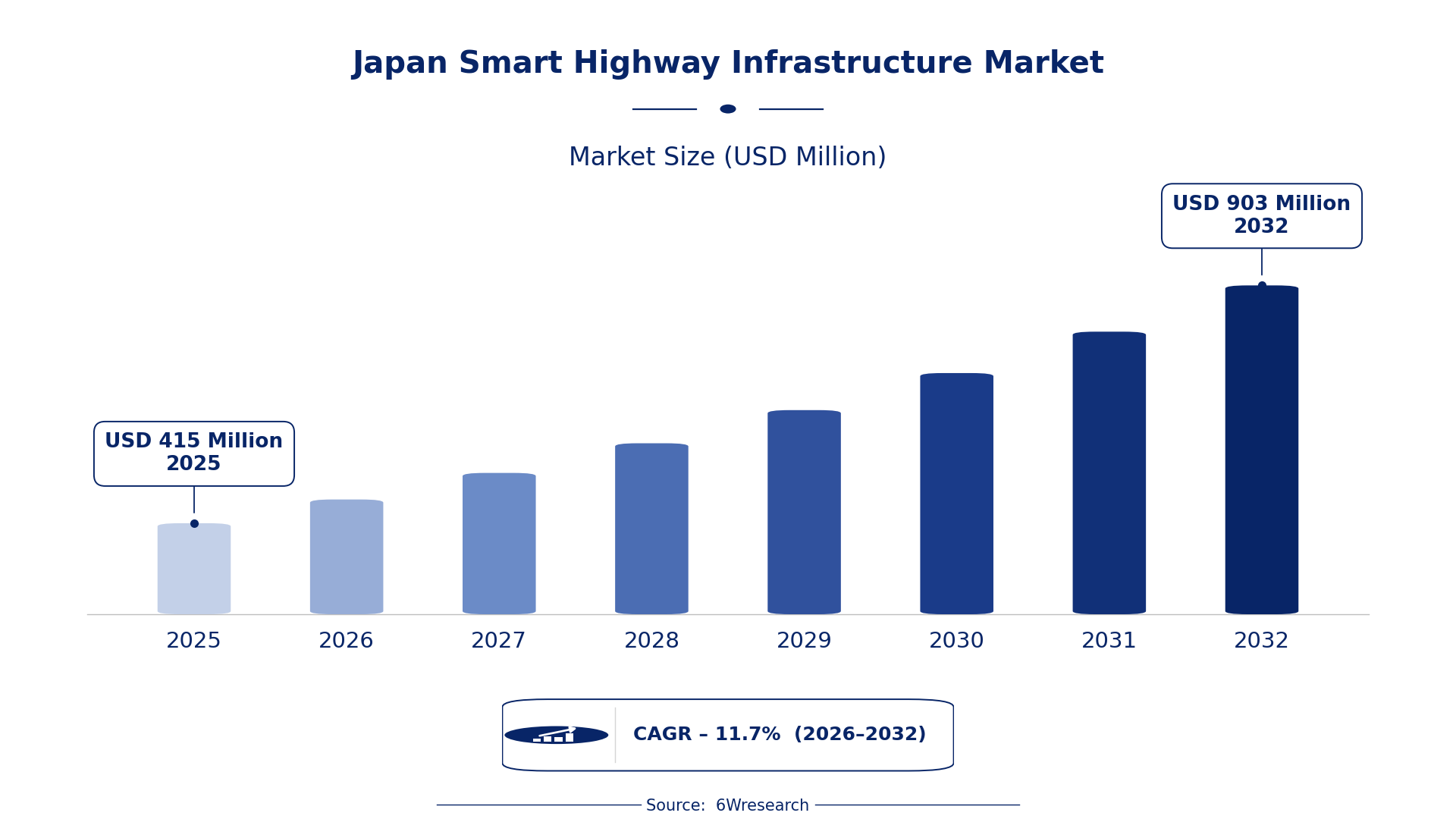
According to 6Wresearch internal database and industry insights, the Japan Smart Highway Infrastructure Market was valued at USD 415 Million in 2025 and is projected to reach USD 903 Million by 2032, growing at a CAGR of approximately 11.7% during 2026–2032.
Japan Smart Highway Infrastructure Market Highlights
| Report Metric | Details |
| Report Name | Japan Smart Highway Infrastructure Market (2026-2032) |
| Market Size 2025 | USD 415 Million |
| Market Size 2032 | USD 903 Million |
| Absolute Growth 2025–2032 | USD 488 Million |
| CAGR 2026–2032 | 11.7% |
| Peak Annual Growth | 12.3% in 2028 |
| Forecast Period | 2026–2032 |
| Historical Data | 2022–2025 |
| Base Year | 2025 |
| Leading Infrastructure Element, 2025 | Sensorized Pavements (43% share) |
| Leading Smart Feature, 2025 | Traffic + Weight Detection (55% share) |
| Leading Tech Integration, 2025 | IoT + AI (43% share) |
| Leading End User, 2025 | Road Infrastructure Bodies (54% share) |
| Fastest-Growing Infrastructure Element | Smart Signaling Systems (15.8% CAGR) |
| Fastest-Growing Smart Feature | Adaptive Traffic Control (15.6% CAGR) |
| Fastest-Growing Tech Integration | Lidar/Cameras (16.2% CAGR) |
| Fastest-Growing End User | Urban Transport Authorities (15.7% CAGR) |
| Growing Sector | Urban Transport Infrastructure |
| Key End Users | Urban Transport Authorities, Road Infrastructure Bodies, Smart Highway Developers |
Japan Smart Highway Infrastructure Market Year-wise Growth Rate and Key Drivers (2022–2032)
This graph illustrates the annual growth rates of the market from 2022 to 2032, highlighting a steady upward trajectory and projected market expansion over the forecast period.
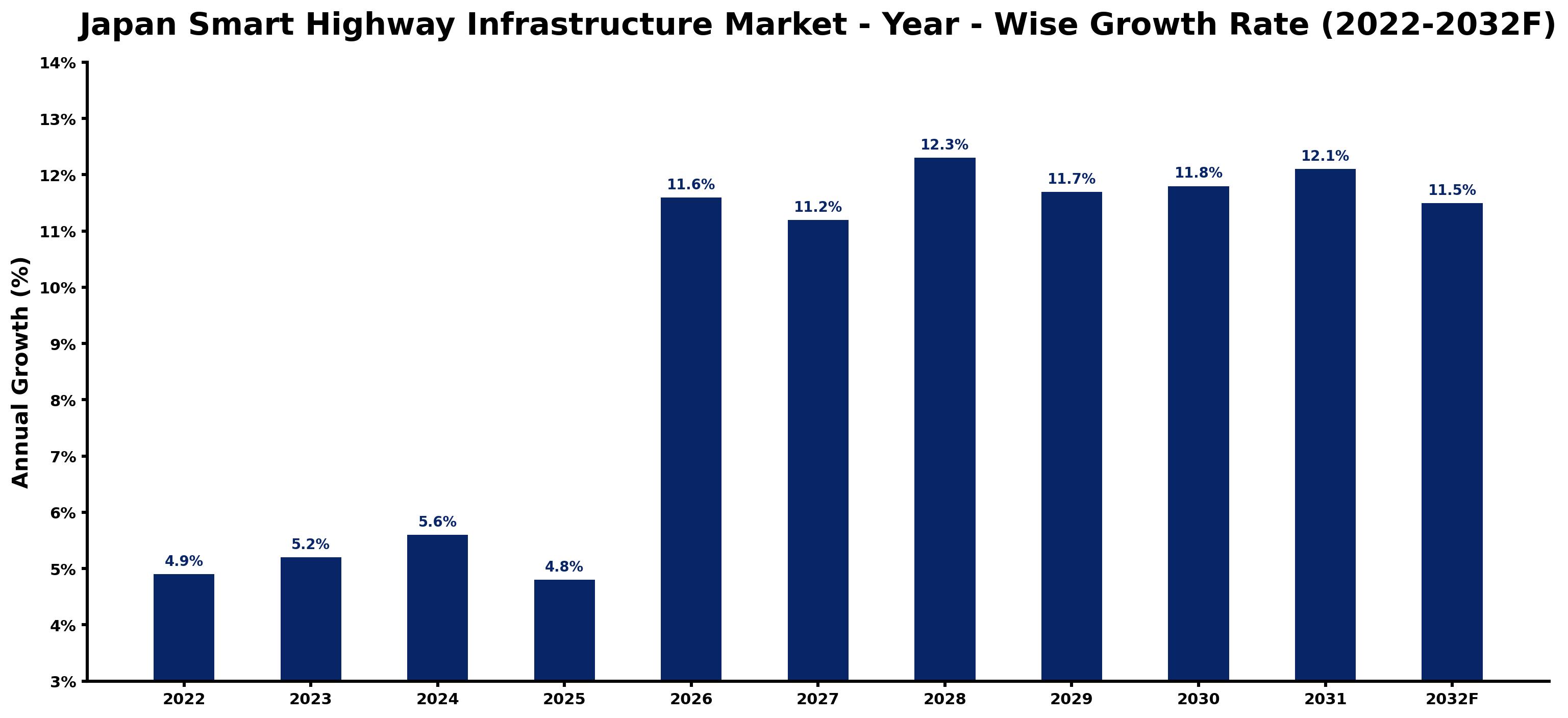
Below, each year's estimated growth is shown next to the factor that most influenced it.
| Year | Estimated Annual Growth (%) | Market Rationale |
| 2022 | 4.9 | The market experienced steady growth due to ongoing modernization efforts. |
| 2023 | 5.2 | Demand increased as urban transport authorities pushed for smart technologies. |
| 2024 | 5.6 | Growth accelerated with the implementation of new smart signaling systems. |
| 2025 | 4.8 | Market growth slowed slightly as some projects faced delays in execution. |
| 2026 | 11.6 | Investment surged following the launch of major smart highway initiatives. |
| 2027 | 11.2 | Growth moderated as the market began to stabilise after rapid expansion. |
| 2028 | 12.3 | The peak growth year is driven by extensive deployment of smart features. |
| 2029 | 11.7 | Growth decelerates as many projects reach completion and stabilise. |
| 2030 | 11.8 | Demand rises again as urban mobility strategies gain traction. |
| 2031 | 12.1 | Continued investment in smart infrastructure supports steady growth. |
| 2032 | 11.5 | Market growth slows slightly as saturation in major urban areas occurs. |
Note: Market size estimations and growth projections presented in this report are based on 6Wresearch's proprietary forecasting methodology, utilizing the latest available industry data, government publications, and primary research inputs.
Japan Smart Highway Infrastructure Market Synopsis
Smart Highway Infrastructure in Japan incorporates advanced technologies to improve road safety and efficiency. Key components include sensorized pavements and smart signaling systems, which improve traffic management and support electric vehicle infrastructure. The Japan Smart Highway Infrastructure Market is expanding due to increasing investments from urban transport authorities and road infrastructure bodies, alongside initiatives like the Smart City Strategy, which aims to improve urban mobility through smart infrastructure by 2030.
Market Dynamics Impact Analysis (2026–2032)
| Factor | Type | Impact | Primary Segment Affected |
| Increasing investment in smart technologies | Driver | High | Smart Signaling Systems |
| Growing urban population demanding efficient transport solutions | Driver | High | Sensorized Pavements |
| Expansion of EV infrastructure development | Opportunity | High | EV Charging + Wi-Fi |
| Rising focus on sustainable urban mobility | Opportunity | High | Smart Poles |
| High installation costs of advanced systems | Restraint | Medium | Solar Road Panels |
| Limited deployment of energy harvesting technologies | Restraint | Medium | Energy Harvesting |
| Challenges in integrating new technologies with existing infrastructure | Challenge | High | Adaptive Traffic Control |
| Shortage of skilled workforce for smart infrastructure projects | Challenge | Medium | IoT + AI |
Evaluation of Drivers in Japan Smart Highway Infrastructure Market (2026–2032)
The table below links each growth driver to the segment it affects and the evidence for it.
| Drivers | Primary Segment Affected | Why It Matters (Evidence) |
| Investment in smart signaling systems | Smart Signaling Systems | The Tokyo Metropolitan Government plans to implement smart signaling systems by 2025, increasing demand for these technologies. |
| Urban population growth | Sensorized Pavements | With approximately 14 million residents in Tokyo, there is a pressing need for efficient traffic management solutions. |
| Development of EV infrastructure | EV Charging + Wi-Fi | The allocation of ¥50 billion for smart transport infrastructure improvements is driving demand for supporting technologies. |
| Focus on sustainability initiatives | Smart Poles | Urban renewal projects in 10 major cities are integrating smart poles to improve urban infrastructure. |
| Adoption of JIS standards for smart technologies | Adaptive Traffic Control | The implementation of JIS standards is set to standardise and promote the use of adaptive traffic control systems. |
Much of the new demand traces back to substantial investments in smart technologies, particularly in urban areas. The implementation of smart signaling systems will drive demand for these technologies. Urban renewal projects across 10 major cities are integrating smart poles, improving urban infrastructure and connectivity. The allocation of ¥50 billion for smart transport infrastructure improvements will further stimulate demand for solutions that enhance traffic management and safety. Additionally, the adoption of JIS standards for sensorized pavements is expected to facilitate better data analysis capabilities, encouraging more investments in smart highway technologies.
Evaluation of Restraints in Japan Smart Highway Infrastructure Market
The key brakes on demand, and where they bite hardest, are shown below.
| Market Restraint | Primary Segment Affected | Why It Matters (Evidence) |
| High installation costs of advanced systems | Solar Road Panels | The limited use of solar road panels is attributed to their high installation costs, which deter widespread adoption. |
| Limited deployment of energy harvesting technologies | Energy Harvesting | Energy harvesting technologies remain in experimental phases, resulting in minimal deployment across highways. |
| Integration challenges with existing infrastructure | Adaptive Traffic Control | Integrating new adaptive traffic control systems with current infrastructure poses technical challenges, limiting their effectiveness. |
| Shortage of skilled workforce | IoT + AI | The lack of skilled professionals in smart infrastructure technologies limits project execution and innovation. |
| Regulatory hurdles in technology adoption | Smart Signaling Systems | Compliance with existing regulations can delay the adoption of new smart signaling technologies. |
Japan Smart Highway Infrastructure Market Challenges
In Osaka, the recent smart highway project has revealed a skills gap, as only 30% of engineers possess the required expertise in advanced road technologies. This gap arises from insufficient training programmes, delaying project timelines and increasing costs for urban transport authorities. Technological integration presents another challenge, with only 1,200 km of expressways currently equipped with smart technologies, limiting efficiency improvements for road infrastructure bodies. Supply chain issues have emerged, with 25% of materials for smart signaling systems experiencing delays, impacting delivery schedules for producers and raising project costs by 15%.
Trends in the Japan Smart Highway Infrastructure Market
The trends below show where the Japan Smart Highway Infrastructure Market is heading.
- Urban Transport Authorities Prioritising Smart Technologies: Urban transport authorities are increasingly prioritising smart technologies to improve traffic management. The Tokyo Metropolitan Government's plan to implement smart signaling systems by 2025 supports this shift, aiming to enhance urban mobility.
- Shift Towards Sustainable Infrastructure: A growing focus on sustainability is apparent in urban transport initiatives. The Smart City Strategy aims to improve urban mobility through smart infrastructure by 2030, driving the adoption of eco-friendly technologies.
- Integration of IoT and AI in Traffic Management: The integration of IoT and AI technologies is transforming traffic management systems. JIS standards for sensorized pavements are being implemented to facilitate this integration, improving data analysis capabilities.
- Expansion of EV Charging Infrastructure: The push for EV charging solutions is accelerating, with a target to install 20,000 stations by 2025. This initiative reflects the rising demand for electric vehicle support in urban areas.
Investment Opportunities in the Japan Smart Highway Infrastructure Market
The following opportunities in the Japan Smart Highway Infrastructure Market pair current demand with a clear way in.
- Local Partnerships for Smart Technology Implementation: Collaborating with local authorities is essential for implementing smart technologies in urban areas. Urban transport authorities are seeking partnerships, supported by a ¥50 billion allocation for smart transport improvements.
- Supply of Smart Signaling Systems: There is a growing opportunity to supply smart signaling systems, particularly as the Tokyo Metropolitan Government implements these by 2025. Suppliers can enter through local partnerships and compliance with JIS standards.
- Investment in EV Charging Solutions: The demand for EV charging solutions is surging, with the aim to install 20,000 stations by 2025. Companies can enter this market by collaborating with urban transport authorities.
- Development of Adaptive Traffic Control Systems: Investment in adaptive traffic control systems is vital as cities modernise. Urban transport authorities are looking for solutions to improve traffic flow and safety.
Government Initiatives in the Japan Smart Highway Infrastructure Market
The Hydrogen Society Promotion Act, enacted in 2024, supports low-carbon hydrogen supply chains, providing price-gap support for producers. This law encourages the development of technologies that can integrate hydrogen into smart highway systems, benefiting producers and buyers alike.
In 2023, Japan allocated ¥50 billion for smart transport infrastructure improvements, overseen by the Ministry of Land, Infrastructure, Transport and Tourism. This funding aims to improve urban mobility through advanced technologies, benefiting urban transport authorities and infrastructure developers.
Future Insight of the Japan Smart Highway Infrastructure Market
Urban transport authorities will experience a shift in smart highway development by 2032, driven by the implementation of smart signaling systems in Tokyo by 2025, which will streamline traffic management for millions. The allocation of ¥50 billion for smart transport infrastructure improvements will create new opportunities for suppliers. Research into energy harvesting technologies will improve sustainability, promoting efficient resource use in urban areas. By 2030, advancements in smart highway infrastructure will support electric vehicle adoption, further transforming urban mobility.
Market Segmentation Analysis
Japan Smart Highway Infrastructure Market report covers a detailed analysis of the following market segments:
By Infrastructure Element – Sensorized Pavements Lead, Smart Signaling Systems Expected to Grow Fastest
According to Saurav Kr Singh, Senior Research Analyst at 6Wresearch, Sensorized Pavements held 43% of the Japan Smart Highway Infrastructure Market by infrastructure element in 2025. Sensorized pavements hold the largest share in the market due to their essential function in real-time traffic monitoring and road condition assessment across Japan's expressway network. With over 1,200 km of expressways already equipped with this technology, it plays a crucial role in enhancing road safety and efficiency. The quickest growth will come from Smart Signaling Systems, forecast to expand at a CAGR of 15.8% between 2026 and 2032. Smart signaling systems are experiencing rapid growth as a result of the Tokyo Metropolitan Government's initiative to implement these systems by 2025. This focus on adaptive traffic management is expected to drive swift expansion in urban areas, further solidifying the lead of sensorized pavements. Suppliers should prioritise developing sensorized pavements to meet the increasing demand from road infrastructure bodies.
By Smart Feature – Traffic + Weight Detection Leads, Adaptive Traffic Control Expected to Grow Fastest
Traffic + Weight Detection took 55% of smart feature revenue in 2025, more than any other category. Traffic and weight detection systems lead the market as they are vital for monitoring vehicle loads and traffic patterns, providing essential data for infrastructure management. Their importance is underscored by the increasing need for efficient traffic management solutions in urban environments. Adaptive Traffic Control is set to record the highest CAGR in this split, 15.6% over 2026–2032. Adaptive traffic control is witnessing the fastest growth due to its capability to improve traffic management through real-time data, aligning with urban transport authorities' goals for enhanced mobility. This technology's implementation in major cities is expected to drive rapid adoption. Buyers should invest in adaptive traffic control solutions to optimise traffic flow and enhance urban mobility.
By Tech Integration – IoT + AI Leads, Lidar/Cameras Expected to Grow Fastest
The largest tech integration category in 2025 was IoT + AI, at 43% of revenue. IoT technologies are at the forefront of the market as they are critical for data analysis and system integration, facilitating smarter highway infrastructure. Their application across various smart features enhances operational efficiency and supports timely decision-making processes. Lidar/Cameras are projected to grow fastest, at a CAGR of 16.2% during 2026–2032. Lidar and camera technologies are rapidly growing due to their effectiveness in vehicle detection and traffic analysis, which are essential for modern smart highways. As cities increasingly adopt these technologies, their market share is projected to rise significantly. Suppliers must focus on integrating Lidar and camera technologies to meet the demands of advancing smart highway systems.
By End User – Road Infrastructure Bodies Lead, Urban Transport Authorities Expected to Grow Fastest
In 2025, Road Infrastructure Bodies led the end user split with a 54% share. Road infrastructure bodies are the primary users of smart highway technologies, employing these systems to enhance safety and efficiency on national roadways. Their crucial role in infrastructure development ensures a consistent demand for advanced solutions in this sector. Over 2026–2032, Urban Transport Authorities are expected to post the fastest growth, at a CAGR of 15.7%. Urban transport authorities represent the fastest-growing segment as they are key stakeholders in implementing smart infrastructure projects, motivated by Japan's Smart City Strategy. Their emphasis on urban mobility improvements will accelerate the adoption of smart technologies. Buyers should engage with urban transport authorities to align their solutions with the strategic goals of smart city initiatives.
Key Attractiveness of the Report
- 10 Years of Market Numbers
- Historical Data Starting from 2022 to 2025
- Base Year 2025
- Forecast Data until 2032
- Key Performance Indicators Impacting the Market
- Major Upcoming Developments and Projects
Key Highlights of the Report:
- Japan Smart Highway Infrastructure Market Outlook
- Market Size of Japan Smart Highway Infrastructure Market, 2025
- Forecast of Japan Smart Highway Infrastructure Market, 2032
- Historical Data and Forecast of Japan Smart Highway Infrastructure Revenues & Volume for the Period 2022-2032F
- Japan Smart Highway Infrastructure Market Trend Evolution
- Japan Smart Highway Infrastructure Market Drivers and Challenges
- Japan Smart Highway Infrastructure Price Trends
- Japan Smart Highway Infrastructure Porter's Five Forces
- Japan Smart Highway Infrastructure Industry Life Cycle
- Historical Data and Forecast of Japan Smart Highway Infrastructure Market Revenues & Volume By Infrastructure Element for the Period 2022-2032F
- Historical Data and Forecast of Japan Smart Highway Infrastructure Market Revenues & Volume By Sensorized Pavements for the Period 2022-2032F
- Historical Data and Forecast of Japan Smart Highway Infrastructure Market Revenues & Volume By Smart Signaling Systems for the Period 2022-2032F
- Historical Data and Forecast of Japan Smart Highway Infrastructure Market Revenues & Volume By Smart Poles for the Period 2022-2032F
- Historical Data and Forecast of Japan Smart Highway Infrastructure Market Revenues & Volume By Solar Road Panels for the Period 2022-2032F
- Historical Data and Forecast of Japan Smart Highway Infrastructure Market Revenues & Volume By Smart Feature for the Period 2022-2032F
- Historical Data and Forecast of Japan Smart Highway Infrastructure Market Revenues & Volume By Traffic + Weight Detection for the Period 2022-2032F
- Historical Data and Forecast of Japan Smart Highway Infrastructure Market Revenues & Volume By Adaptive Traffic Control for the Period 2022-2032F
- Historical Data and Forecast of Japan Smart Highway Infrastructure Market Revenues & Volume By EV Charging + Wi-Fi for the Period 2022-2032F
- Historical Data and Forecast of Japan Smart Highway Infrastructure Market Revenues & Volume By Energy Harvesting for the Period 2022-2032F
- Historical Data and Forecast of Japan Smart Highway Infrastructure Market Revenues & Volume By Tech Integration for the Period 2022-2032F
- Historical Data and Forecast of Japan Smart Highway Infrastructure Market Revenues & Volume By IoT + AI for the Period 2022-2032F
- Historical Data and Forecast of Japan Smart Highway Infrastructure Market Revenues & Volume By Lidar/Cameras for the Period 2022-2032F
- Historical Data and Forecast of Japan Smart Highway Infrastructure Market Revenues & Volume By Renewable + Connectivity for the Period 2022-2032F
- Historical Data and Forecast of Japan Smart Highway Infrastructure Market Revenues & Volume By Smart Grids for the Period 2022-2032F
- Historical Data and Forecast of Japan Smart Highway Infrastructure Market Revenues & Volume By End User for the Period 2022-2032F
- Historical Data and Forecast of Japan Smart Highway Infrastructure Market Revenues & Volume By Road Infrastructure Bodies for the Period 2022-2032F
- Historical Data and Forecast of Japan Smart Highway Infrastructure Market Revenues & Volume By Urban Transport Authorities for the Period 2022-2032F
- Historical Data and Forecast of Japan Smart Highway Infrastructure Market Revenues & Volume By Smart Highway Developers for the Period 2022-2032F
- Historical Data and Forecast of Japan Smart Highway Infrastructure Market Revenues & Volume By Green Infra Companies for the Period 2022-2032F
- Japan Smart Highway Infrastructure Import Export Trade Statistics
- Market Opportunity Assessment By Infrastructure Element
- Market Opportunity Assessment By Smart Feature
- Market Opportunity Assessment By Tech Integration
- Market Opportunity Assessment By End User
- Japan Smart Highway Infrastructure Top Companies Market Share
- Japan Smart Highway Infrastructure Competitive Benchmarking By Technical and Operational Parameters
- Japan Smart Highway Infrastructure Company Profiles
- Japan Smart Highway Infrastructure Key Strategic Recommendations
Market Covered
Segments analysed in this report are listed below.
By Infrastructure Element
- Sensorized Pavements
- Smart Signaling Systems
- Smart Poles
- Solar Road Panels
By Smart Feature
- Traffic + Weight Detection
- Adaptive Traffic Control
- EV Charging + Wi-Fi
- Energy Harvesting
By Tech Integration
- IoT + AI
- Lidar/Cameras
- Renewable + Connectivity
- Smart Grids
By End User
- Road Infrastructure Bodies
- Urban Transport Authorities
- Smart Highway Developers
- Green Infra Companies































