Japan Smart Home AI Market Size & Growth Rate
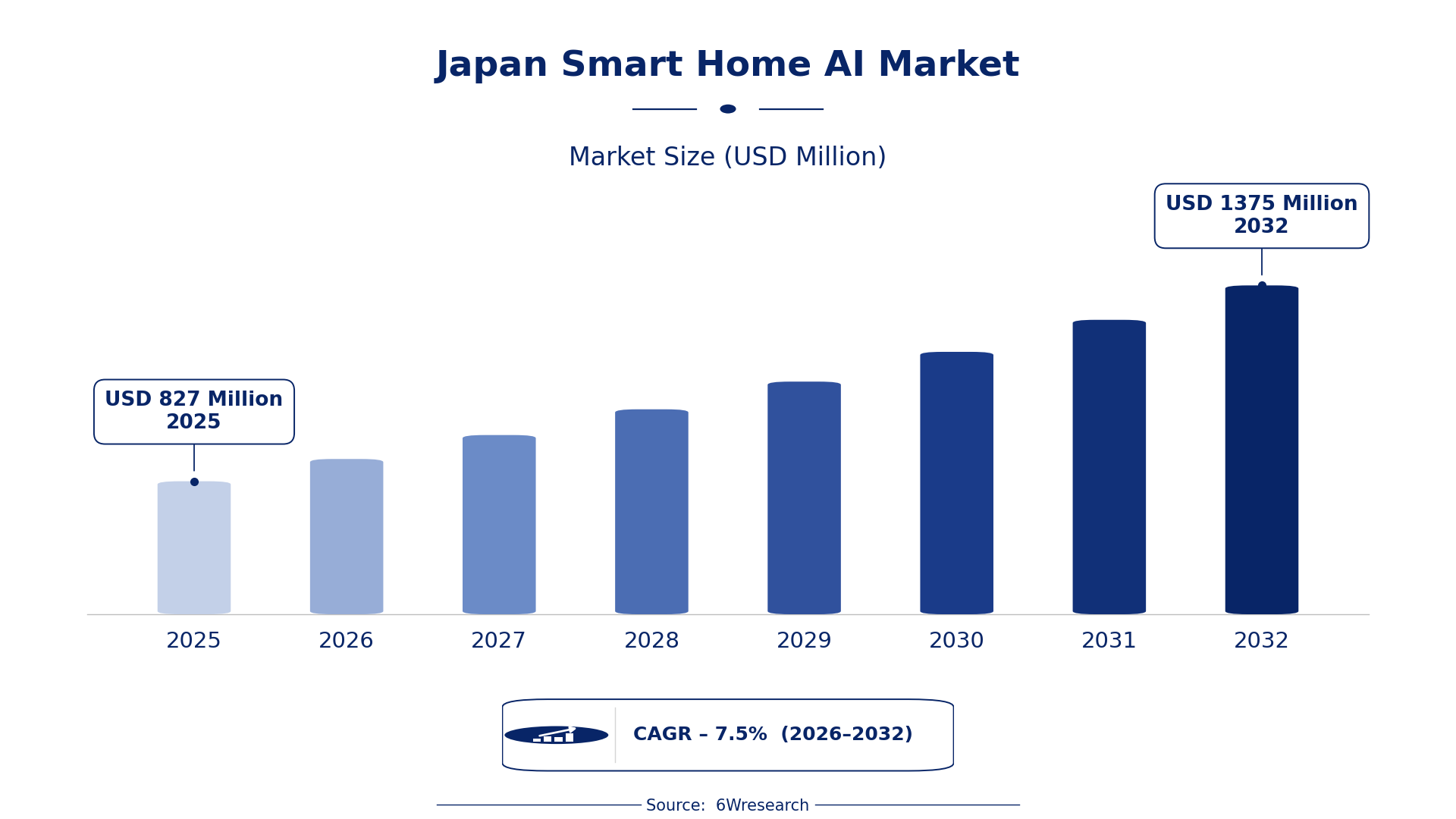
According to 6Wresearch internal database and industry insights, the Japan Smart Home AI Market was valued at USD 827 Million in 2025 and is projected to reach USD 1,375 Million by 2032, growing at a CAGR of approximately 7.5% during 2026–2032.
Japan Smart Home AI Market Highlights
| Report Metric | Details |
| Report Name | Japan Smart Home AI Market (2026-2032) |
| Market Size 2025 | USD 827 Million |
| Market Size 2032 | USD 1,375 Million |
| Absolute Growth 2025–2032 | USD 548 Million |
| CAGR 2026–2032 | 7.5% |
| Peak Annual Growth | 8.2% in 2026 |
| Forecast Period | 2026–2032 |
| Historical Data | 2022–2025 |
| Base Year | 2025 |
| Leading AI Application, 2025 | Voice Control AI (48% share) |
| Leading Smart Feature, 2025 | Command Recognition (47% share) |
| Leading Integration Platform, 2025 | Smart Speakers (33% share) |
| Leading End User, 2025 | Homeowners (41% share) |
| Fastest-Growing AI Application | Energy Optimization AI (10.4% CAGR) |
| Fastest-Growing Smart Feature | Usage Prediction (9.7% CAGR) |
| Fastest-Growing Integration Platform | HVAC (11.0% CAGR) |
| Fastest-Growing End User | Smart Home Users (9.8% CAGR) |
| Growing Sector | Smart Home Technology |
| Key End Users | Homeowners, Smart Home Users, Device Manufacturers, Security System Makers |
Japan Smart Home AI Market Year-wise Growth Rate and Key Drivers (2022–2032)
This graph illustrates the annual growth rates of the market from 2022 to 2032, highlighting a steady upward trajectory and projected market expansion over the forecast period.
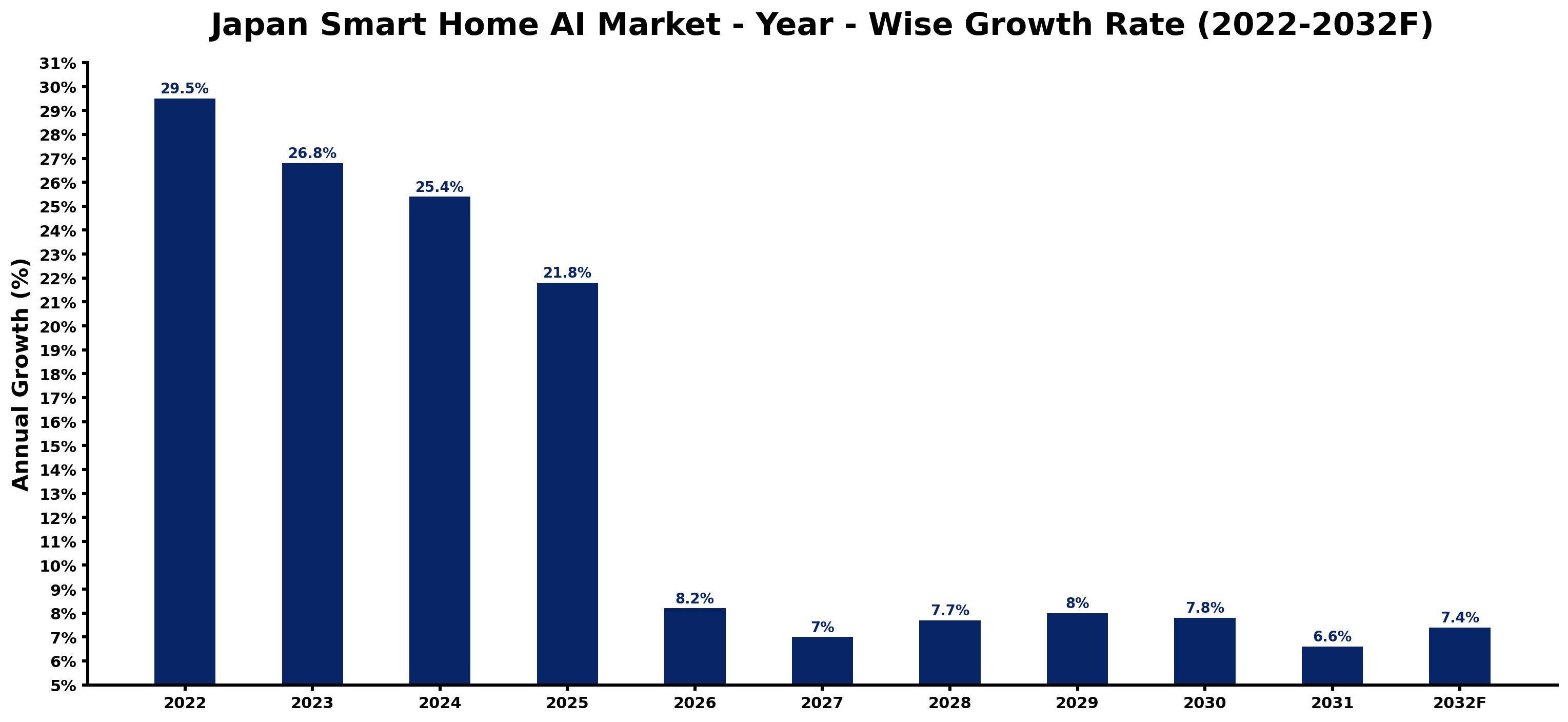
Annual growth estimates for each year appear below with the principal reason behind them, explaining the shifts that set the pace of the market.
| Year | Estimated Annual Growth (%) | Market Rationale |
| 2022 | 29.5 | The market experienced strong demand from tech-savvy homeowners seeking automation solutions. |
| 2023 | 26.8 | Adoption slowed as market saturation began affecting growth rates among early adopters. |
| 2024 | 25.4 | The demand for energy-efficient solutions continued to drive purchases, albeit at a slower pace. |
| 2025 | 21.8 | Growth decelerated further as competition intensified and consumer choices expanded. |
| 2026 | 8.2 | Stabilisation is projected as new technologies emerge and consumer preferences evolve. |
| 2027 | 7.0 | Growth is expected to slow as the market matures and innovation becomes more incremental. |
| 2028 | 7.7 | Investment in energy optimization technologies is anticipated to boost demand. |
| 2029 | 8.0 | The ongoing trend towards smart home integration is likely to drive renewed interest. |
| 2030 | 7.8 | Consumer interest in energy savings is expected to maintain steady growth in smart home adoption. |
| 2031 | 6.6 | The market is anticipated to slow as saturation impacts growth rates across segments. |
| 2032 | 7.4 | Technological advancements in AI are expected to reinvigorate market interest and expansion. |
Note: Market size estimations and growth projections presented in this report are based on 6Wresearch's proprietary forecasting methodology, utilizing the latest available industry data, government publications, and primary research inputs.
Japan Smart Home AI Market Synopsis
Smart Home AI technologies optimise home automation and security through machine learning and data analytics, improving energy management and user interaction. The Japan Smart Home AI Market is thriving, driven by homeowners seeking energy-efficient solutions and convenience. The Tokyo metropolitan area leads in adoption, with 30% of households using smart technology. Growth is fuelled by increased consumer interest in security monitoring and voice command interaction, with over 20 million smart home devices installed as of 2023.
Market Dynamics Impact Analysis (2026–2032)
| Factor | Type | Impact | Primary Segment Affected |
| Growing demand for energy-efficient solutions drives purchases of smart home devices. | Driver | High | Energy Optimization AI |
| The increasing adoption of voice-controlled devices enhances user experience and convenience. | Driver | High | Voice Control AI |
| Investment in smart home technology presents opportunities for new entrants in the market. | Opportunity | High | Smart Home Users |
| The rise in urban residential areas creates demand for enhanced security solutions. | Opportunity | Medium | Smart Cameras |
| High initial costs of smart home devices may deter some potential buyers. | Restraint | High | Homeowners |
| Market saturation in urban areas can limit growth potential for new products. | Restraint | Medium | Smart Home Users |
| Compliance with JIS standards can complicate product development for manufacturers. | Challenge | High | Device Manufacturers |
| The need for continuous updates and maintenance can strain resources for buyers. | Challenge | Medium | Homeowners |
Evaluation of Drivers in Japan Smart Home AI Market (2026–2032)
Key forces behind demand, with the segment each one moves most, are listed below.
| Drivers | Primary Segment Affected | Why It Matters (Evidence) |
| Increased consumer spending on home automation technologies drives demand for smart devices. | Smart Home Users | In 2023, the average household spent approximately ¥10,000 on smart home devices. |
| Growing interest in energy-efficient solutions encourages adoption of energy optimization technologies. | Energy Optimization AI | The average energy savings from using energy optimization AI is estimated at 20%. |
| The popularity of smart speakers as central hubs boosts sales of compatible devices. | Smart Speakers | Smart speakers hold a 50% market share, leading to increased purchases of connected devices. |
| Rising concerns about home security lead to higher demand for smart security systems. | Security AI | Smart cameras are increasingly used in urban residential areas for enhanced security. |
| Advancements in AI improve user interaction and convenience in smart homes. | Voice Control AI | Voice Control AI enables hands-free operation, appealing to tech-savvy consumers. |
Purchasing is picking up as consumer spending on home automation technologies rises, with the average household in Japan investing approximately ¥10,000 annually in smart home devices. Interest in energy-efficient solutions drives demand for energy optimisation technologies, which can save households around 20% on energy costs. The popularity of smart speakers, which hold a 50% market share, boosts sales of compatible devices and improves user experience. Concerns about home security lead to increased demand for smart security systems, with smart cameras gaining traction in urban residential areas. Advances in AI improve user interaction, making smart homes more appealing to tech-savvy consumers.
Evaluation of Restraints in Japan Smart Home AI Market
The table below lists the restraints and the evidence behind each.
| Market Restraint | Primary Segment Affected | Why It Matters (Evidence) |
| High initial costs of smart home devices deter potential buyers. | Homeowners | The average Japanese household spends around ¥10,000 annually, which may be prohibitive for some. |
| Market saturation in urban areas limits growth potential for new products. | Smart Home Users | The Tokyo metropolitan area leads in adoption, with 30% of households already using smart technology. |
| Compliance with JIS standards complicates product development for manufacturers. | Device Manufacturers | Manufacturers must ensure interoperability and safety, increasing development costs. |
| Limited awareness of smart home benefits restricts market growth among certain demographics. | Homeowners | Despite the growing market, many potential users remain unaware of available technologies. |
| Competition among manufacturers leads to price wars, affecting profitability. | Smart Home Users | Intense competition can drive prices down, impacting the financial viability of new entrants. |
Japan Smart Home AI Market Challenges
Integration of smart home devices often fails due to inconsistent technology standards, causing compatibility problems for over 20 million users. This issue exists because JIS standards are not uniformly adopted, resulting in delays in device functionality. Intense competition among technology providers drives aggressive pricing strategies, risking product quality for suppliers. This situation can lead to potential revenue losses estimated at ¥50 billion annually for producers. A lack of skilled technicians in the smart home sector delays installation and maintenance services, extending project completion times for homeowners by up to six months. Supply chain disruptions in component sourcing can prolong lead times for producers, affecting delivery schedules for 10 million users by 2025.
Trends in the Japan Smart Home AI Market
These developments are changing demand patterns in the Japan Smart Home AI Market.
- Shift towards Energy Optimization AI: Homeowners are increasingly prioritising energy-efficient solutions, with energy optimisation AI projected to grow at a CAGR of 10.4%. This trend is reflected in urban areas where energy consumption is a concern.
- Integration of Voice Control in Smart Homes: Smart speakers are becoming the central hub for smart home control, with a 50% market share. This trend enhances user convenience and is likely to drive further adoption of compatible devices across households.
- Increased Focus on Security AI: Urban areas are seeing a rise in smart cameras for enhanced security, reflecting growing concerns about home safety. In 2023, smart cameras gained popularity as essential components of modern security systems.
- Expansion of Smart Home Features in New Homes: By 2025, 25% of new homes are expected to be equipped with smart home features. This trend is driven by initiatives promoting the integration of smart technologies in residential construction.
Investment Opportunities in the Japan Smart Home AI Market
Investors looking at the Japan Smart Home AI Market should consider the following areas.
- Forming Joint Ventures with Local Manufacturers: Establishing joint ventures with local manufacturers can provide access to established distribution channels and consumer bases, particularly as the market is projected to reach ¥1 trillion by 2025.
- Investing in Energy Optimization Technologies: The average energy savings from using energy optimisation AI is estimated at 20%, presenting an opportunity for suppliers targeting environmentally conscious homeowners.
- Developing Smart Home Solutions for Urban Areas: Urban residential areas are increasingly adopting smart technologies, with 30% of households in Tokyo using them. Suppliers can focus on tailored solutions for this demographic to capture market share.
- Certification for JIS Standards: Obtaining JIS certification can improve product credibility and market acceptance. Manufacturers should invest in compliance to meet consumer expectations for safety and interoperability.
Government Initiatives in the Japan Smart Home AI Market
The Long-Term Care Insurance Act supports the integration of smart home technologies for elderly care, encouraging manufacturers to develop products that improve home automation and security for older adults. This act has led to increased funding for nursing care services, promoting the adoption of smart technologies in homes, with financial backing for innovations.
In 2023, the government allocated ¥5 billion to promote smart home technology in rural areas, administered by the Ministry of Internal Affairs and Communications. This funding aims to increase the adoption of smart home devices, improving energy efficiency and security in less urbanised regions.
Future Insight of the Japan Smart Home AI Market
Voice control technology will transform demand for smart home solutions by 2032, supported by the government's focus on energy optimisation. By 2025, 25% of new homes will incorporate smart capabilities, indicating a shift towards modern living standards. The government's ¥5 billion investment in promoting smart home technology in rural areas will improve accessibility for diverse consumers. With average energy savings from AI systems estimated at 20%, households will see notable reductions in utility costs, making smart home investments increasingly appealing.
Market Segmentation Analysis
Japan Smart Home AI Market report covers a detailed analysis of the following market segments:
By AI Application – Voice Control AI Leads, Energy Optimization AI Expected to Grow Fastest
According to Saurav Kr Singh, Senior Research Analyst at 6Wresearch, the largest ai application category in 2025 was Voice Control AI, at 48% of revenue. Voice Control AI holds the largest share as it is widely adopted by consumers seeking hands-free operation of devices. This trend is particularly strong in urban areas, where many households are utilising voice-activated systems for convenience and accessibility. Energy Optimization AI is projected to grow fastest, at a CAGR of 10.4% during 2026–2032. Energy Optimization AI is experiencing rapid growth as homeowners increasingly focus on reducing energy consumption, with average savings of 20% reported. Government initiatives promoting energy-efficient solutions further accelerate this trend, ensuring its continued expansion. Suppliers should prioritise energy optimization features to align with the rising demand for efficiency.
By Smart Feature – Command Recognition Leads, Usage Prediction Expected to Grow Fastest
Command Recognition accounted for 47% of the market by smart feature in 2025. Command Recognition leads the market by effectively interpreting user commands, which is essential for controlling devices in smart homes. Its importance is underscored by the installation of over 20 million smart home devices across Japan, showcasing widespread adoption. Over 2026–2032, Usage Prediction is expected to post the fastest growth, at a CAGR of 9.7%. Usage Prediction is growing quickly as it enhances the optimisation of device usage patterns, leading to improved home efficiency. This growth aligns with the increasing consumer focus on energy management solutions, making it a key area for development. Buyers will gain from features that enhance user experience and efficiency through improved insights into usage patterns.
By Integration Platform – Smart Speakers Lead, HVAC Expected to Grow Fastest
In 2025, Smart Speakers led the integration platform split with a 33% share. Smart Speakers dominate the market as they serve as the central hub for smart home control, facilitating seamless interaction with various devices. Their 50% market share among smart home products highlights their critical role in user engagement and convenience. HVAC is set to record the highest CAGR in this split, 11.0% over 2026–2032. HVAC systems are witnessing the fastest growth due to their integration with climate control systems, which is a priority for energy-conscious homeowners. This integration is crucial as 25% of new homes are expected to incorporate smart features, driving further adoption. Suppliers should focus on ensuring compatibility with HVAC systems to leverage this growing segment.
By End User – Homeowners Lead, Smart Home Users Expected to Grow Fastest
Homeowners took 41% of end user revenue in 2025, more than any other category. Homeowners represent the largest user group, primarily adopting smart home technologies for enhanced convenience and security. Approximately 40% of homeowners have embraced these technologies, highlighting their significance in modern living. The quickest growth will come from Smart Home Users, forecast to expand at a CAGR of 9.8% between 2026 and 2032. Smart Home Users are the fastest-growing demographic, reflecting a strong interest in automation and improved living experiences. The projected increase to 10 million smart home users by 2025 indicates a robust market trend towards automation. Suppliers must tailor their offerings to meet the specific needs of this expanding user base.
Key Attractiveness of the Report
- 10 Years of Market Numbers
- Historical Data Starting from 2022 to 2025
- Base Year 2025
- Forecast Data until 2032
- Key Performance Indicators Impacting the Market
- Major Upcoming Developments and Projects
Key Highlights of the Report:
- Japan Smart Home AI Market Outlook
- Market Size of Japan Smart Home AI Market, 2025
- Forecast of Japan Smart Home AI Market, 2032
- Historical Data and Forecast of Japan Smart Home AI Revenues & Volume for the Period 2022-2032F
- Japan Smart Home AI Market Trend Evolution
- Japan Smart Home AI Market Drivers and Challenges
- Japan Smart Home AI Price Trends
- Japan Smart Home AI Porter's Five Forces
- Japan Smart Home AI Industry Life Cycle
- Historical Data and Forecast of Japan Smart Home AI Market Revenues & Volume By AI Application for the Period 2022-2032F
- Historical Data and Forecast of Japan Smart Home AI Market Revenues & Volume By Voice Control AI for the Period 2022-2032F
- Historical Data and Forecast of Japan Smart Home AI Market Revenues & Volume By Energy Optimization AI for the Period 2022-2032F
- Historical Data and Forecast of Japan Smart Home AI Market Revenues & Volume By Security AI for the Period 2022-2032F
- Historical Data and Forecast of Japan Smart Home AI Market Revenues & Volume By Personal Assistant AI for the Period 2022-2032F
- Historical Data and Forecast of Japan Smart Home AI Market Revenues & Volume By Smart Feature for the Period 2022-2032F
- Historical Data and Forecast of Japan Smart Home AI Market Revenues & Volume By Command Recognition for the Period 2022-2032F
- Historical Data and Forecast of Japan Smart Home AI Market Revenues & Volume By Usage Prediction for the Period 2022-2032F
- Historical Data and Forecast of Japan Smart Home AI Market Revenues & Volume By Face/Object Detection for the Period 2022-2032F
- Historical Data and Forecast of Japan Smart Home AI Market Revenues & Volume By Learning Preferences for the Period 2022-2032F
- Historical Data and Forecast of Japan Smart Home AI Market Revenues & Volume By Integration Platform for the Period 2022-2032F
- Historical Data and Forecast of Japan Smart Home AI Market Revenues & Volume By Smart Speakers for the Period 2022-2032F
- Historical Data and Forecast of Japan Smart Home AI Market Revenues & Volume By HVAC, Lighting for the Period 2022-2032F
- Historical Data and Forecast of Japan Smart Home AI Market Revenues & Volume By Smart Cameras for the Period 2022-2032F
- Historical Data and Forecast of Japan Smart Home AI Market Revenues & Volume By IoT Devices for the Period 2022-2032F
- Historical Data and Forecast of Japan Smart Home AI Market Revenues & Volume By End User for the Period 2022-2032F
- Historical Data and Forecast of Japan Smart Home AI Market Revenues & Volume By Homeowners for the Period 2022-2032F
- Historical Data and Forecast of Japan Smart Home AI Market Revenues & Volume By Smart Home Users for the Period 2022-2032F
- Historical Data and Forecast of Japan Smart Home AI Market Revenues & Volume By Security System Makers for the Period 2022-2032F
- Historical Data and Forecast of Japan Smart Home AI Market Revenues & Volume By Device Manufacturers for the Period 2022-2032F
- Japan Smart Home AI Import Export Trade Statistics
- Market Opportunity Assessment By AI Application
- Market Opportunity Assessment By Smart Feature
- Market Opportunity Assessment By Integration Platform
- Market Opportunity Assessment By End User
- Japan Smart Home AI Top Companies Market Share
- Japan Smart Home AI Competitive Benchmarking By Technical and Operational Parameters
- Japan Smart Home AI Company Profiles
- Japan Smart Home AI Key Strategic Recommendations
Market Covered
Coverage by segment is as follows.
By AI Application
- Voice Control AI
- Energy Optimization AI
- Security AI
- Personal Assistant AI
By Smart Feature
- Command Recognition
- Usage Prediction
- Face/Object Detection
- Learning Preferences
By Integration Platform
- Smart Speakers
- HVAC
- Lighting
- Smart Cameras
- IoT Devices
By End User
- Homeowners
- Smart Home Users
- Security System Makers
- Device Manufacturers































