Japan Smart Home Appliances Market Size & Growth Rate
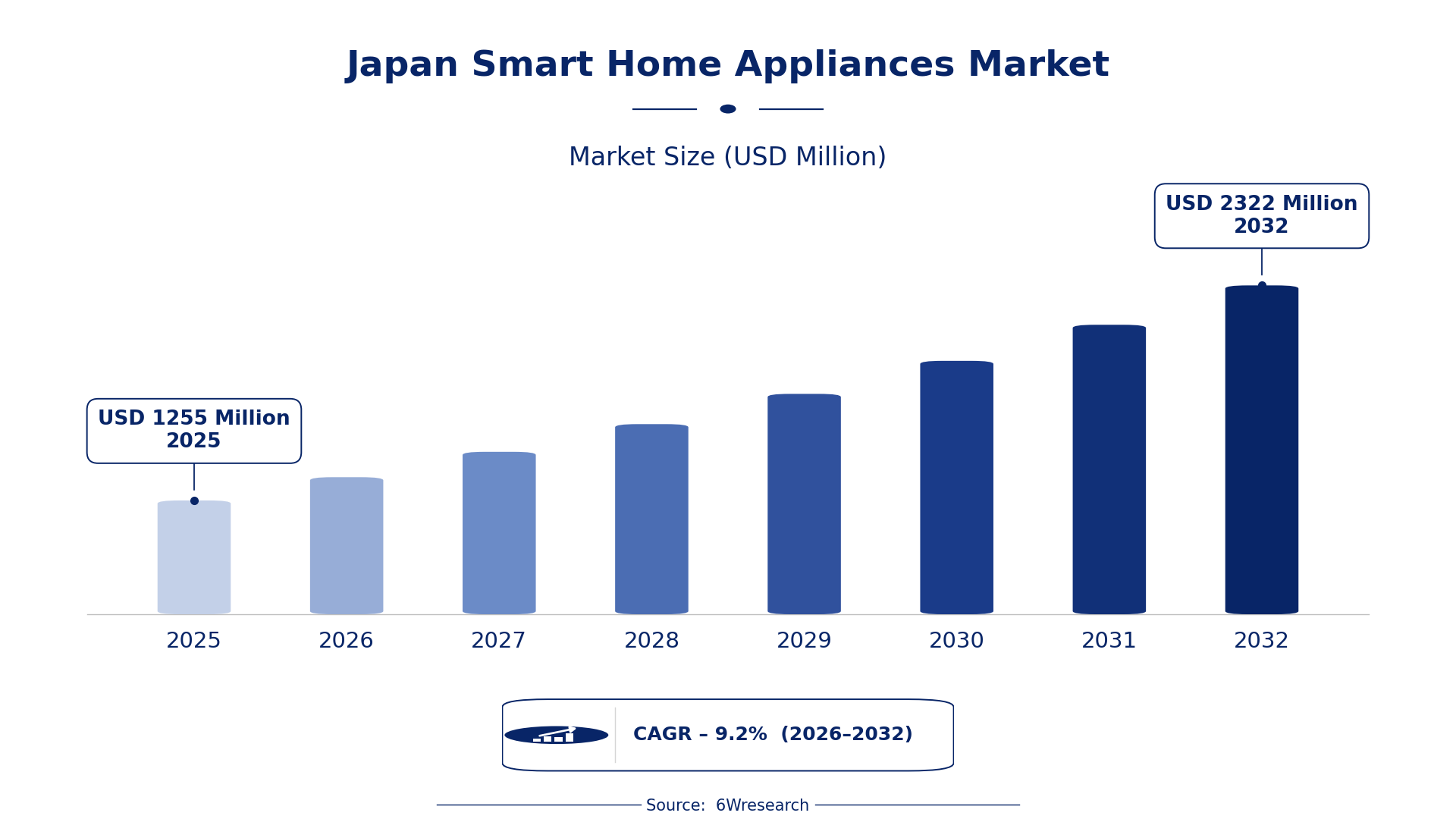
According to 6Wresearch internal database and industry insights, the Japan Smart Home Appliances Market was valued at USD 1,255 Million in 2025 and is projected to reach USD 2,322 Million by 2032, growing at a CAGR of approximately 9.2% during 2026–2032.
Japan Smart Home Appliances Market Highlights
| Report Metric | Details |
| Report Name | Japan Smart Home Appliances Market (2026-2032) |
| Market Size 2025 | USD 1,255 Million |
| Market Size 2032 | USD 2,322 Million |
| Absolute Growth 2025–2032 | USD 1,067 Million |
| CAGR 2026–2032 | 9.2% |
| Peak Annual Growth | 10.6% in 2028 |
| Forecast Period | 2026–2032 |
| Historical Data | 2022–2025 |
| Base Year | 2025 |
| Leading Product Type, 2025 | Smart Refrigerators (46% share) |
| Fastest-Growing Product Type | Smart Ovens (13.6% CAGR) |
| Growing Sector | Smart Home Appliances |
| Key End Users | Homeowners, Property Developers, Retailers |
Japan Smart Home Appliances Market Year-wise Growth Rate and Key Drivers (2022–2032)
This graph illustrates the annual growth rates of the market from 2022 to 2032, highlighting a steady upward trajectory and projected market expansion over the forecast period.
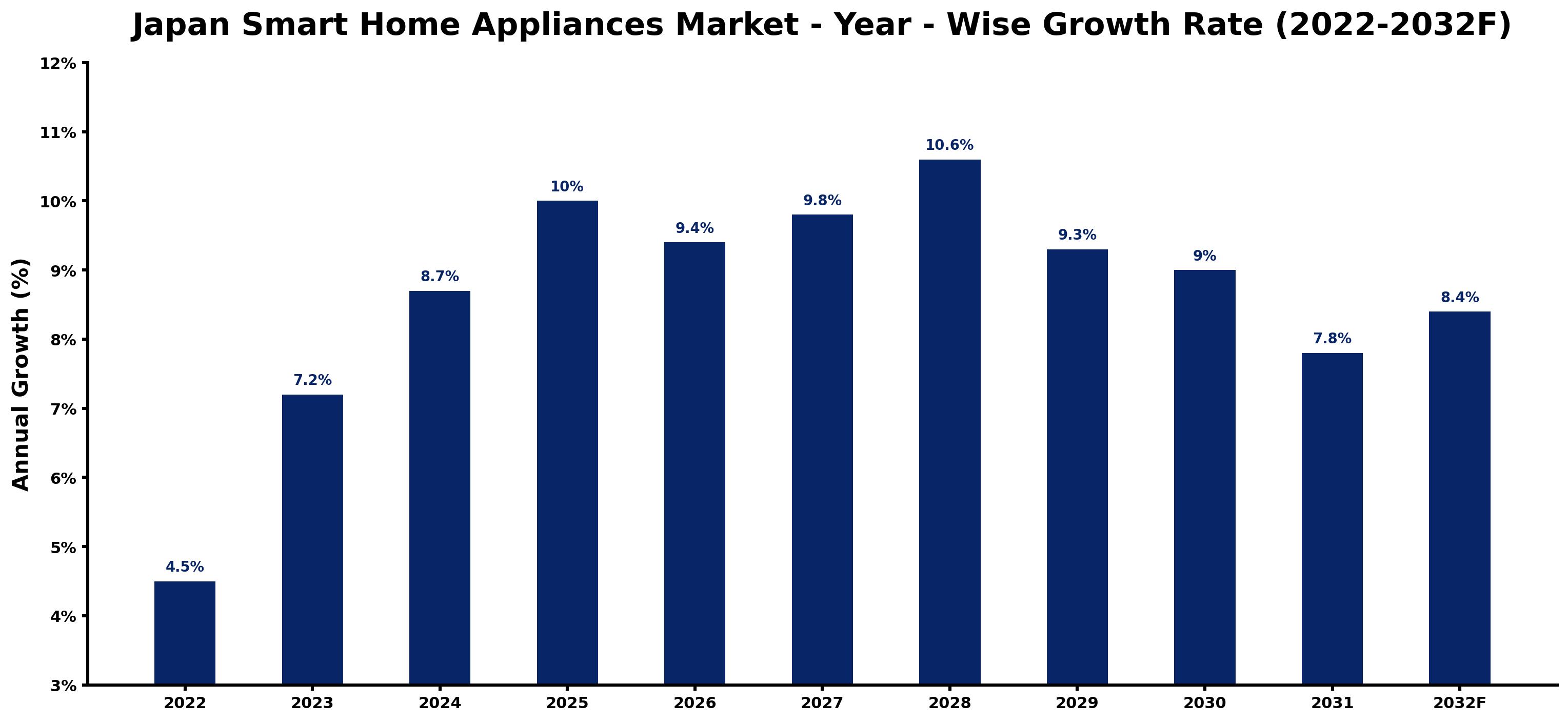
For each year, the table pairs the estimated growth rate with the leading influence on demand, showing how the drivers changed across the period.
| Year | Estimated Annual Growth (%) | Market Rationale |
| 2022 | 4.5 | The market experienced steady growth due to increasing interest in smart technologies. |
| 2023 | 7.2 | Demand accelerated as consumers sought energy-efficient solutions for their homes. |
| 2024 | 8.7 | The introduction of new smart appliance models further stimulated market interest. |
| 2025 | 10.0 | Sales peaked as the adoption of smart home technologies became mainstream. |
| 2026 | 9.4 | Growth is expected to slow slightly as market saturation begins to emerge in urban areas. |
| 2027 | 9.8 | Consumer interest is projected to rebound with new features in smart appliances. |
| 2028 | 10.6 | The market is expected to reach its peak growth as sustainability becomes a priority. |
| 2029 | 9.3 | Growth is projected to moderate as competition intensifies among appliance manufacturers. |
| 2030 | 9.0 | Demand is expected to continue rising, driven by technological advancements and new product launches. |
| 2031 | 7.8 | Growth is projected to slow as the market matures and consumer preferences stabilise. |
| 2032 | 8.4 | A resurgence in demand is expected due to ongoing technological integration. |
Note: Market size estimations and growth projections presented in this report are based on 6Wresearch's proprietary forecasting methodology, utilizing the latest available industry data, government publications, and primary research inputs.
Japan Smart Home Appliances Market Synopsis
Smart Home Appliances automate various household tasks, including smart refrigerators, ovens, and dishwashers. The Japan Smart Home Appliances Market is projected to grow, driven by an ageing population and rising demand for energy-efficient products. With 29.3% of the population aged 65 or older, there is a strong push for technologies that simplify daily tasks and improve energy management.
Market Dynamics Impact Analysis (2026–2032)
| Factor | Type | Impact | Primary Segment Affected |
| Aging population driving demand for convenience and efficiency | Driver | High | Smart Refrigerators |
| Technological advancements enhancing product features | Driver | High | Smart Ovens |
| Growing interest in energy-efficient appliances | Opportunity | High | Smart Dishwashers |
| Expansion of smart home ecosystems in urban areas | Opportunity | Medium | Smart Cookware and Cooktops |
| High initial investment costs limiting consumer adoption | Restraint | High | Smart Refrigerators |
| Market saturation in metropolitan areas slowing growth | Restraint | Medium | Smart Refrigerators |
| Intense competition among manufacturers affecting pricing | Challenge | High | Smart Ovens |
| Supply chain disruptions impacting product availability | Challenge | Medium | Smart Dishwashers |
Evaluation of Drivers in Japan Smart Home Appliances Market (2026–2032)
Below are the drivers that matter most for revenue growth, with supporting evidence.
| Drivers | Primary Segment Affected | Why It Matters (Evidence) |
| Growing consumer interest in energy-efficient solutions | Smart Refrigerators | This trend encourages buyers to invest in appliances that reduce energy consumption, with 29.3% of the population aged 65 or older seeking convenience. |
| Technological advancements in smart appliances | Smart Ovens | New features attract tech-savvy consumers, leading to increased purchases, particularly in urban areas with high disposable incomes. |
| Heightened awareness of sustainability issues | Smart Dishwashers | Consumers are opting for products that contribute to environmental goals, focusing on reducing water and energy usage. |
| Integration of smart appliances into home automation systems | Smart Cookware and Cooktops | As smart home ecosystems expand, buyers are more inclined to purchase interconnected devices for efficient operation. |
| Government initiatives promoting energy efficiency | Smart Scale and Thermometers | Policies aimed at reducing carbon footprints encourage consumers to invest in smart technologies that align with sustainability goals. |
Demand is particularly strong in urban areas, where the ageing population influences purchasing behaviour towards smart home appliances. With 29.3% of the population aged 65 or older, there is a growing preference for products that simplify daily tasks. The demand for smart dishwashers has surged as consumers seek energy-efficient solutions, with sales increasing by 15% in 2023. Technological advancements have introduced appealing features in smart ovens, attracting tech-savvy buyers. Rising awareness of sustainability issues drives interest in smart refrigerators that support environmental goals, further propelling market growth.
Evaluation of Restraints in Japan Smart Home Appliances Market
These are the pressures that could keep growth below its potential.
| Market Restraint | Primary Segment Affected | Why It Matters (Evidence) |
| Supply chain disruptions affecting component availability | Smart Refrigerators | Limited availability of microchips hampers timely delivery schedules, resulting in longer wait times for retailers. |
| Intense competition from international brands | Smart Ovens | Local manufacturers face pressure to lower prices, which can erode profit margins and restrict investment in innovation. |
| Rising material costs impacting production | Smart Dishwashers | Global supply chain disruptions increase production expenses, potentially raising retail prices for consumers. |
| Skills gap due to an ageing workforce | Smart Cookware and Cooktops | Fewer young workers entering the sector lead to delays in product development for manufacturers. |
| Market saturation in urban areas | Smart Scale and Thermometers | As the market matures, growth is expected to slow due to limited new customer acquisition. |
Japan Smart Home Appliances Market Challenges
Japan's declining youth population limits the workforce available for smart home appliance production, which slows innovation for manufacturers. Rising material costs, driven by global supply chain disruptions, increase production expenses for producers, potentially raising retail prices for consumers by 15%. Limited access to essential components, particularly microchips, hampers timely deliveries for suppliers, leading to delays for retailers that can extend beyond three months. Increased competition from foreign brands compels local firms to lower prices, which can diminish profit margins for producers and restrict their investment in new technologies.
Trends in the Japan Smart Home Appliances Market
Buyers and suppliers in the Japan Smart Home Appliances Market are adjusting to the following trends.
- Shift towards Energy-Efficient Appliances: Sales of smart dishwashers increased by 15% in 2023, reflecting a growing preference for sustainable products among environmentally conscious consumers.
- Emergence of Smart Cooking Solutions: Since 2024, smart ovens have gained popularity, with a 13.6% CAGR expected through 2032, driven by consumers seeking convenience and advanced cooking technologies.
- Integration of Smart Home Ecosystems: Home automation systems are increasingly incorporating smart appliances, improving user experience. In 2025, 40% of new homes in urban areas featured integrated smart kitchen solutions.
- Consumer Preference for Connected Devices: As of 2026, consumers are prioritising connected devices that offer efficient integration. This shift is seen in the rising demand for smart refrigerators, which saw a 10% increase in sales.
Investment Opportunities in the Japan Smart Home Appliances Market
The following areas offer the clearest openings for investors and suppliers in the Japan Smart Home Appliances Market.
- Establishing Partnerships with Local Retailers: Now is an ideal time to form partnerships with local retailers to expand market reach. With Japan's population of 124 million, collaboration can improve visibility and sales.
- Investing in Smart Kitchen Facilities: Investing in smart kitchen facilities can meet the growing demand for advanced cooking solutions. Urban areas present significant opportunities due to their large elderly population.
- Focusing on Energy-Efficient Appliances: There is a strong demand for energy-efficient appliances, particularly smart dishwashers. The current trend towards sustainability encourages suppliers to focus on eco-friendly products.
- Enhancing Smart Home Integration: With the rise of smart home ecosystems, suppliers should focus on products that integrate effectively. The increasing consumer interest in automation presents a lucrative entry point.
Government Initiatives in the Japan Smart Home Appliances Market
The GX Basic Policy, adopted in 2023, aims to mobilise about JPY 150 trillion for public-private decarbonisation investments over the next decade. This policy builds upon the existing Electrical Appliance and Material Safety Act, which regulates safety standards for smart appliances, ensuring that manufacturers meet stringent requirements for energy efficiency and safety.
The Consumer Affairs Agency oversees compliance with regulations that prohibit misleading advertising of smart home appliances. This agency ensures that consumers receive accurate information about product features and benefits, building trust in the market.
Future Insight of the Japan Smart Home Appliances Market
By 2032, a shift towards energy-efficient standards will drive suppliers to implement advanced technologies that enhance product performance. The integration of smart home systems will become commonplace, allowing buyers to enjoy improved connectivity and automation. As the elderly population increases, the demand for user-friendly appliances will rise, prompting innovation in design and functionality. New production facilities focusing on sustainable practices will emerge, aligning with environmental goals and attracting eco-conscious consumers.
Market Segmentation Analysis
Japan Smart Home Appliances Market report covers a detailed analysis of the following market segments:
By Product Type – Smart Refrigerators Lead, Smart Ovens Expected to Grow Fastest
According to Summon Dutta, Assistant Manager at 6Wresearch, Smart Refrigerators accounted for 46% of the market by product type in 2025. Smart Refrigerators hold the largest share due to their essential role in food preservation and energy efficiency, appealing to households prioritising convenience. Their prevalence is highlighted by the integration of these appliances in contemporary kitchen designs across urban areas. Smart Ovens are projected to grow fastest, at a CAGR of 13.6% during 2026–2032. Smart Ovens are experiencing rapid growth as consumers seek multifunctional cooking solutions that seamlessly integrate with smart home systems. The increase in home cooking, particularly during recent years, has significantly boosted the demand for these appliances. This indicates that suppliers should focus on enhancing the features of smart ovens to align with the growing consumer interest.
Key Attractiveness of the Report
- 10 Years of Market Numbers
- Historical Data Starting from 2022 to 2025
- Base Year 2025
- Forecast Data until 2032
- Key Performance Indicators Impacting the Market
- Major Upcoming Developments and Projects
Key Highlights of the Report:
- Japan Smart Home Appliances Market Outlook
- Market Size of Japan Smart Home Appliances Market, 2025
- Forecast of Japan Smart Home Appliances Market, 2032
- Historical Data and Forecast of Japan Smart Home Appliances Revenues & Volume for the Period 2022-2032
- Japan Smart Home Appliances Market Trend Evolution
- Japan Smart Home Appliances Market Drivers and Challenges
- Japan Smart Home Appliances Price Trends
- Japan Smart Home Appliances Porter's Five Forces
- Japan Smart Home Appliances Industry Life Cycle
- Historical Data and Forecast of Japan Smart Home Appliances Market Revenues & Volume By Product Type for the Period 2022-2032
- Historical Data and Forecast of Japan Smart Home Appliances Market Revenues & Volume By Smart Ovens for the Period 2022-2032
- Historical Data and Forecast of Japan Smart Home Appliances Market Revenues & Volume By Smart Dishwashers for the Period 2022-2032
- Historical Data and Forecast of Japan Smart Home Appliances Market Revenues & Volume By Smart Refrigerators for the Period 2022-2032
- Historical Data and Forecast of Japan Smart Home Appliances Market Revenues & Volume By Smart Cookware and Cooktops for the Period 2022-2032
- Historical Data and Forecast of Japan Smart Home Appliances Market Revenues & Volume By Smart Scale and Thermometers for the Period 2022-2032
- Historical Data and Forecast of Japan Smart Home Appliances Market Revenues & Volume By Other Product Types for the Period 2022-2032
- Japan Smart Home Appliances Import Export Trade Statistics
- Market Opportunity Assessment By Product Type
- Japan Smart Home Appliances Top Companies Market Share
- Japan Smart Home Appliances Competitive Benchmarking By Technical and Operational Parameters
- Japan Smart Home Appliances Company Profiles
- Japan Smart Home Appliances Key Strategic Recommendations
Market Covered
This report examines the market across the segments below.
By Product Type
- Smart Ovens
- Smart Dishwashers
- Smart Refrigerators
- Smart Cookware and Cooktops
- Smart Scale and Thermometers
- Other Product Types































