Japan Smart Home Connectivity Market Size & Growth Rate
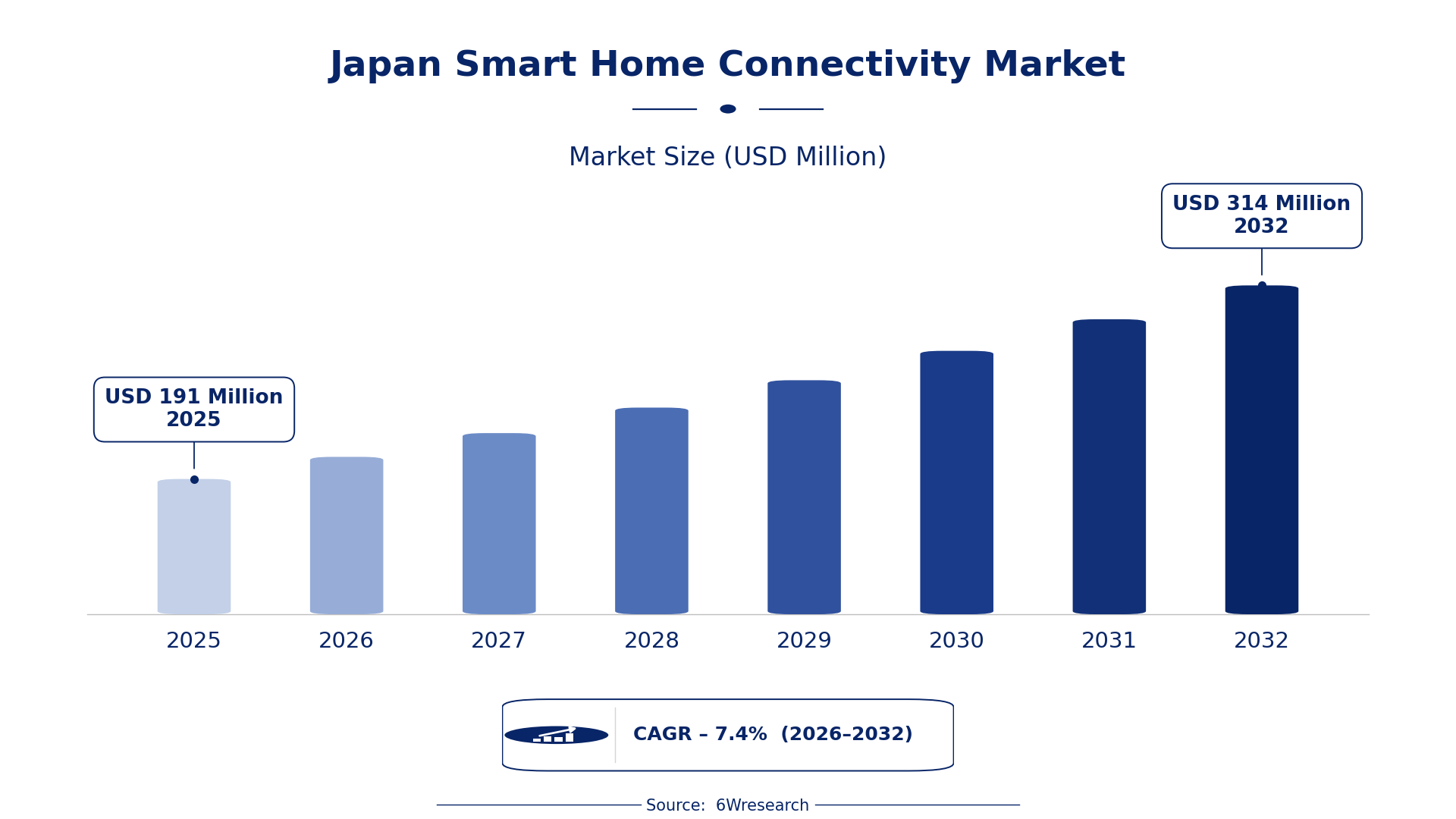
According to 6Wresearch internal database and industry insights, the Japan Smart Home Connectivity Market was valued at USD 191 Million in 2025 and is projected to reach USD 314 Million by 2032, growing at a CAGR of approximately 7.4% during 2026–2032.
Japan Smart Home Connectivity Market Highlights
| Report Metric | Details |
| Report Name | Japan Smart Home Connectivity Market (2026-2032) |
| Market Size 2025 | USD 191 Million |
| Market Size 2032 | USD 314 Million |
| Absolute Growth 2025–2032 | USD 123 Million |
| CAGR 2026–2032 | 7.4% |
| Peak Annual Growth | 8.1% in 2029 |
| Forecast Period | 2026–2032 |
| Historical Data | 2022–2025 |
| Base Year | 2025 |
| Leading Connectivity Type, 2025 | Wi-Fi Mesh Networks (50% share) |
| Leading Supported Devices, 2025 | Smart TVs (45% share) |
| Leading Protocol Type, 2025 | IEEE 802.11ax (44% share) |
| Leading End User, 2025 | Homeowners (48% share) |
| Fastest-Growing Connectivity Type | Zigbee/Z-Wave Hubs (10.4% CAGR) |
| Fastest-Growing Supported Devices | Thermostats (10.6% CAGR) |
| Fastest-Growing Protocol Type | Zigbee (10.9% CAGR) |
| Fastest-Growing End User | IoT Ecosystem Providers (9.8% CAGR) |
| Growing Sector | Smart Home Technology |
| Key End Users | Homeowners, IoT Ecosystem Providers, Smart Home Builders, Consumer Electronics |
Japan Smart Home Connectivity Market Year-wise Growth Rate and Key Drivers (2022–2032)
This graph illustrates the annual growth rates of the market from 2022 to 2032, highlighting a steady upward trajectory and projected market expansion over the forecast period.
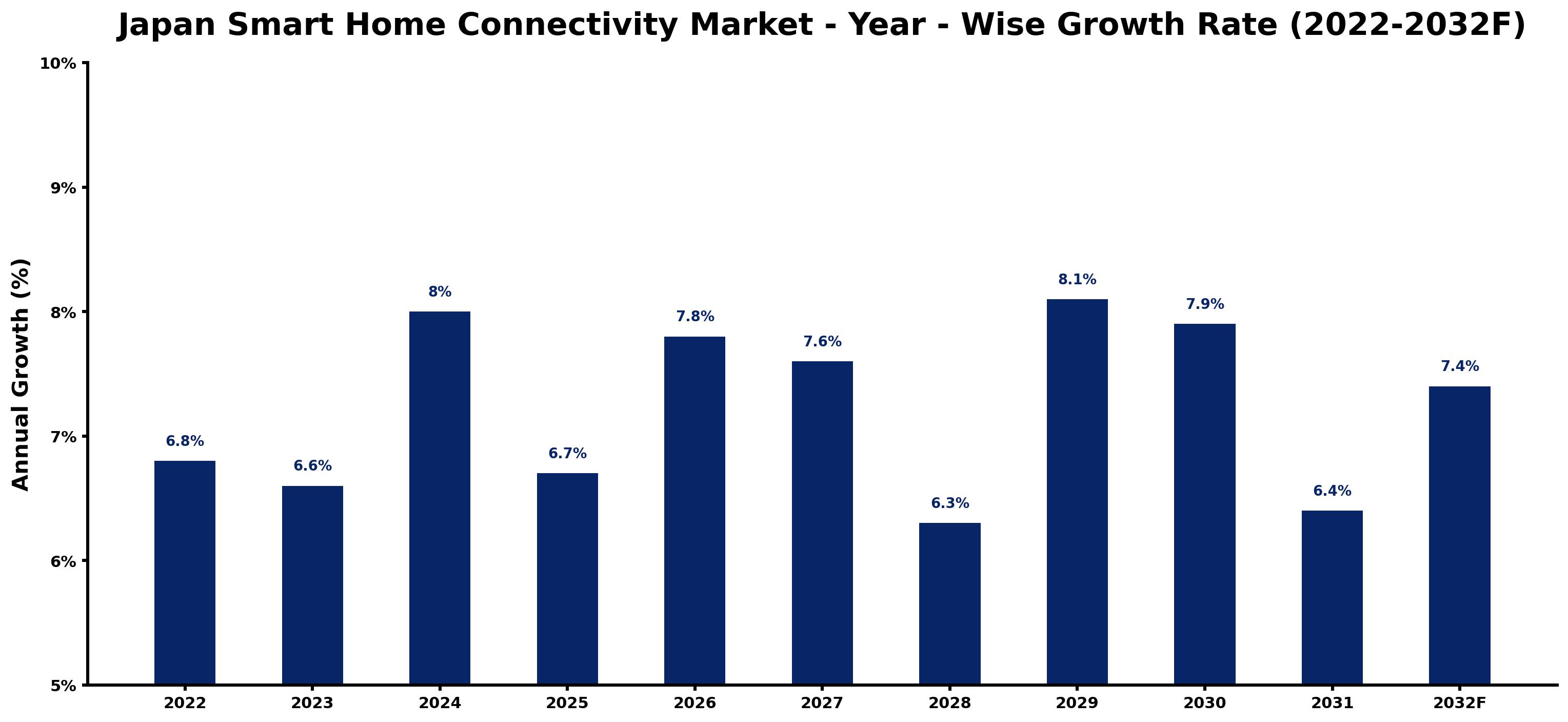
The following figures match every annual growth estimate with the main market development of that year, giving the reasoning behind each rise or slowdown.
| Year | Estimated Annual Growth (%) | Market Rationale |
| 2022 | 6.8 | The market showed steady growth with increasing adoption of smart devices. |
| 2023 | 6.6 | Growth slowed slightly due to market saturation in urban areas. |
| 2024 | 8.0 | Demand surged as more homeowners integrated smart technologies into their residences. |
| 2025 | 6.7 | Competition intensified among device providers, leading to a slowdown in growth. |
| 2026 | 7.8 | Growth is expected to accelerate with rising consumer interest in energy-efficient solutions. |
| 2027 | 7.6 | Economic factors are projected to slow market growth as consumer spending adjusts. |
| 2028 | 6.3 | Demand is anticipated to continue slowing as the market matures and choices expand. |
| 2029 | 8.1 | Growth is expected to peak with advancements in smart home technology. |
| 2030 | 7.9 | Consumer preferences are projected to stabilise, resulting in a slowdown in growth. |
| 2031 | 6.4 | Growth is projected to decelerate as the market reaches a saturation point in urban areas. |
| 2032 | 7.4 | New technological innovations are expected to drive demand again. |
Note: Market size estimations and growth projections presented in this report are based on 6Wresearch's proprietary forecasting methodology, utilizing the latest available industry data, government publications, and primary research inputs.
Japan Smart Home Connectivity Market Synopsis
Smart Home Connectivity encompasses technologies that facilitate remote communication and control of household devices, primarily through wireless protocols. The Japan Smart Home Connectivity Market is growing as homeowners increasingly embrace smart devices for automation, security, and energy management. With a forecast of 1.5 million connected devices by 2025, factors such as the ageing population, energy efficiency initiatives, and local government support are propelling demand in this sector. This expansion offers opportunities for manufacturers and service providers to address the evolving needs and preferences of consumers, particularly in urban areas.
Market Dynamics Impact Analysis (2026–2032)
| Factor | Type | Impact | Primary Segment Affected |
| Increasing adoption of smart devices among homeowners | Driver | High | Smart TVs |
| Growing interest in energy management solutions | Driver | High | Energy Management Devices |
| Expansion of smart home builders integrating IoT technologies | Opportunity | High | Smart Home Builders |
| Rising demand for smart security solutions in urban areas | Opportunity | High | Locks |
| Market saturation in urban areas limiting growth potential | Restraint | Medium | Smart TVs |
| High initial costs of smart home installations | Restraint | Medium | Energy Management Devices |
| Compliance with evolving interoperability standards | Challenge | High | Zigbee/Z-Wave Hubs |
| Capacity constraints in domestic semiconductor manufacturing | Challenge | Medium | Wi-Fi Mesh Networks |
Evaluation of Drivers in Japan Smart Home Connectivity Market (2026–2032)
The factors lifting demand, and the evidence behind each, are summarised below.
| Drivers | Primary Segment Affected | Why It Matters (Evidence) |
| Increased consumer interest in smart home automation | Smart TVs | Consumer Electronics Association Japan reported a 20% increase in smart device sales in 2023, resulting in higher purchases of integrated devices. |
| Government initiatives promoting energy efficiency | Energy Management Devices | The Energy Efficiency and Conservation Act encourages the use of smart energy management devices, driving demand for these solutions. |
| Rising urbanisation leading to higher smart home adoption | Locks | Tokyo, as the leading region for smart home adoption, has an adoption rate of around 15% for smart locks as of 2023. |
| Advancements in wireless communication protocols | Zigbee/Z-Wave Hubs | Zigbee and Z-Wave are the most commonly used protocols, improving connectivity and driving demand for compatible devices. |
| Growing population of elderly homeowners | Thermostats | With 29.3% of Japan's population aged 65 or older, there is increased demand for smart thermostats to improve home comfort. |
Spending rises as consumer interest in smart home automation grows, with a reported 20% increase in smart device sales in 2023. Urbanisation is spurring greater use of smart locks, especially in Tokyo, where the adoption rate is approximately 15%. The ageing population is heightening the demand for smart thermostats to improve home comfort. These elements contribute to a burgeoning market for smart home connectivity solutions.
Evaluation of Restraints in Japan Smart Home Connectivity Market
Below are the constraints most often cited by buyers and suppliers, with the segment each affects.
| Market Restraint | Primary Segment Affected | Why It Matters (Evidence) |
| Market saturation in urban areas limiting growth potential | Smart TVs | As the market matures, urban areas face saturation, resulting in slower growth rates for smart TVs. |
| High initial costs of smart home installations | Energy Management Devices | The upfront investment required for smart energy management devices can deter potential buyers. |
| Compliance with evolving interoperability standards | Zigbee/Z-Wave Hubs | Producers face challenges meeting new interoperability standards, which can delay product launches. |
| Limited availability of skilled technicians for installations | Locks | A shortage of qualified professionals can hinder the installation process for smart locks. |
| Consumer hesitance towards adopting new technologies | Thermostats | Some homeowners remain cautious about integrating new technologies, slowing the adoption of smart thermostats. |
Japan Smart Home Connectivity Market Challenges
In 2023, 29.3% of Japan's population was aged 65 or older, limiting the supply of potential smart home users who may resist adopting new technologies. Competition intensifies as international brands enter the market, compelling local producers to reduce prices, which can compromise quality for buyers seeking reliable products. Rising costs of raw materials, especially semiconductors, have escalated production expenses, increasing prices for consumers in urban areas where smart home adoption is prominent. A shortage of skilled workers hampers the development of advanced smart home solutions, delaying projects and stifling innovation for producers.
Trends in the Japan Smart Home Connectivity Market
The shifts below are changing how Japan Smart Home Connectivity Market products are bought and supplied.
- Tokyo Leading the Way in Energy-Efficient Smart Home Solutions: The city is increasingly adopting energy-efficient smart home solutions, supported by a government program launched in 2023 to promote sustainability. This initiative is expected to lead to a 30% reduction in energy consumption through smart lighting.
- Shift from Traditional to Smart Home Devices: Since 2024, the transition from traditional devices to smart home technologies has accelerated, particularly in urban areas. The average household now has 4 connected devices, highlighting this shift.
- Zigbee Protocol Gaining Popularity: Zigbee has emerged as a leading protocol for smart home connectivity, with a projected CAGR of 10.9% from 2026 to 2032. This growth is driven by its low-power communication capabilities.
- Increased Integration of IoT in New Constructions: The trend of integrating IoT solutions into new residential constructions began in 2023, with smart home builders increasingly adopting these technologies to meet consumer demands.
Investment Opportunities in the Japan Smart Home Connectivity Market
The openings below show where demand in the Japan Smart Home Connectivity Market is visible and how suppliers can enter.
- Rising Demand for Energy Management Devices: The demand for energy management devices is rising, with smart home builders seeking solutions to integrate into their projects. The market is projected to reach 1.5 million connected devices by 2025.
- Smart Lock Solutions for Urban Homeowners: Urban homeowners are increasingly interested in smart lock solutions, with an adoption rate of around 15%. Suppliers can enter this market through partnerships with local builders.
- Expansion of Smart Home Builders: With the Japanese government aiming for 10 million smart homes by 2030, there is a significant opportunity for suppliers to collaborate with smart home builders in urban areas.
- Investment in Smart Lighting Solutions: Smart lighting solutions are estimated to reduce energy consumption by up to 30%. This presents an opportunity for manufacturers targeting energy-conscious consumers.
Government Initiatives in the Japan Smart Home Connectivity Market
The Semiconductor and Digital Industry Strategy, established in June 2021, focuses on securing domestic semiconductor manufacturing, which is essential for smart home device production. This measure ensures that producers can access necessary components, strengthening local manufacturing capabilities. The Economic Security Promotion Act, enacted in 2022, supports supply-chain resilience for critical products, benefiting smart home technology manufacturers by ensuring reliable access to materials and components.
The Ministry of Internal Affairs and Communications funds various projects aimed at promoting smart home technology development. This includes supporting research initiatives and approving standards that ensure interoperability among devices, facilitating smoother integration for buyers and producers.
Future Insight of the Japan Smart Home Connectivity Market
The launch of energy-efficient residential projects will accelerate the integration of smart home technologies by 2032, improving energy management across households. The government's target of 10 million smart homes by 2030 will significantly elevate demand for connected devices, with 1.5 million installations expected by 2025. JIS standards will enhance interoperability, enabling buyers to seamlessly adopt diverse smart home products. As smart sensors gain popularity, suppliers will need to innovate continuously to meet the increasing expectations of consumers.
Market Segmentation Analysis
Japan Smart Home Connectivity Market report covers a detailed analysis of the following market segments:
By Connectivity Type – Wi-Fi Mesh Networks Lead, Zigbee/Z-Wave Hubs Expected to Grow Fastest
According to Saurav Kr Singh, Senior Research Analyst at 6Wresearch, the largest connectivity type category in 2025 was Wi-Fi Mesh Networks, at 50% of revenue. Wi-Fi Mesh Networks dominate the market because they provide seamless internet coverage across large areas in homes, essential for supporting multiple connected devices. This is particularly important in urban regions like Tokyo, where the demand for reliable smart home connectivity is substantial. Over 2026–2032, Zigbee/Z-Wave Hubs are expected to post the fastest growth, at a CAGR of 10.4%. Zigbee/Z-Wave Hubs are growing rapidly as they enable communication between various smart devices using low-power protocols, appealing to energy-conscious consumers. The increasing number of smart devices in homes further drives the demand for these efficient communication solutions. Suppliers should focus on enhancing compatibility with Zigbee/Z-Wave to capitalise on the expanding market.
By Supported Devices – Smart TVs Lead, Thermostats Expected to Grow Fastest
Smart TVs took 45% of supported devices revenue in 2025, more than any other category. Smart TVs lead the market as they integrate with smart home systems for entertainment and control, making them a central feature in many households. Their widespread use is evident in the average household in Japan, which connects multiple smart devices, with TVs being a primary choice. Thermostats are set to record the highest CAGR in this split, 10.6% over 2026–2032. Thermostats are the fastest-growing segment as they are increasingly adopted for smart climate control in homes, enhancing energy efficiency. Government initiatives promoting energy-efficient solutions have accelerated their uptake among homeowners. Buyers should consider investing in smart thermostats to improve energy management and reduce costs.
By Protocol Type – IEEE 802.11ax Leads, Zigbee Expected to Grow Fastest
IEEE 802.11ax accounted for 44% of the market by protocol type in 2025. IEEE 802.11ax holds the largest share as it provides high-speed wireless connectivity for smart devices, crucial for the seamless operation of multiple applications in smart homes. Its widespread adoption is driven by the projected growth in connected devices, expected to reach 1.5 million by 2025. The quickest growth will come from Zigbee, forecast to expand at a CAGR of 10.9% between 2026 and 2032. Zigbee is experiencing rapid growth due to its effectiveness in low-power device communication, which is vital as the number of smart devices increases. This protocol's efficiency aligns with government objectives for smart home development and energy conservation. Suppliers should prioritise developing devices compatible with Zigbee to meet market demands.
By End User – Homeowners Lead, IoT Ecosystem Providers Expected to Grow Fastest
In 2025, Homeowners led the end user split with a 48% share. Homeowners are the primary end-users of smart home connectivity solutions, significantly driving demand for various smart devices and systems. The high adoption rate of smart technologies in residential settings, especially in urban areas, underscores their importance in this market. IoT Ecosystem Providers are projected to grow fastest, at a CAGR of 9.8% during 2026–2032. IoT Ecosystem Providers are rapidly expanding as they integrate various devices and services for smart home solutions, addressing the increasing complexity of consumer needs. Their role is crucial as the market aims to expand towards 10 million smart homes by 2030. Suppliers must engage with IoT Ecosystem Providers to ensure their products align with the changing requirements of smart home solutions.
Key Attractiveness of the Report
- 10 Years of Market Numbers
- Historical Data Starting from 2022 to 2025
- Base Year 2025
- Forecast Data until 2032
- Key Performance Indicators Impacting the Market
- Major Upcoming Developments and Projects
Key Highlights of the Report:
- Japan Smart Home Connectivity Market Outlook
- Market Size of Japan Smart Home Connectivity Market, 2025
- Forecast of Japan Smart Home Connectivity Market, 2032
- Historical Data and Forecast of Japan Smart Home Connectivity Revenues & Volume for the Period 2022-2032F
- Japan Smart Home Connectivity Market Trend Evolution
- Japan Smart Home Connectivity Market Drivers and Challenges
- Japan Smart Home Connectivity Price Trends
- Japan Smart Home Connectivity Porter's Five Forces
- Japan Smart Home Connectivity Industry Life Cycle
- Historical Data and Forecast of Japan Smart Home Connectivity Market Revenues & Volume By Connectivity Type for the Period 2022-2032F
- Historical Data and Forecast of Japan Smart Home Connectivity Market Revenues & Volume By Wi-Fi Mesh Networks for the Period 2022-2032F
- Historical Data and Forecast of Japan Smart Home Connectivity Market Revenues & Volume By Zigbee/Z-Wave Hubs for the Period 2022-2032F
- Historical Data and Forecast of Japan Smart Home Connectivity Market Revenues & Volume By Thread Networks for the Period 2022-2032F
- Historical Data and Forecast of Japan Smart Home Connectivity Market Revenues & Volume By Bluetooth Low Energy for the Period 2022-2032F
- Historical Data and Forecast of Japan Smart Home Connectivity Market Revenues & Volume By Supported Devices for the Period 2022-2032F
- Historical Data and Forecast of Japan Smart Home Connectivity Market Revenues & Volume By Smart TVs, Thermostats for the Period 2022-2032F
- Historical Data and Forecast of Japan Smart Home Connectivity Market Revenues & Volume By Lights, Locks, Alarms for the Period 2022-2032F
- Historical Data and Forecast of Japan Smart Home Connectivity Market Revenues & Volume By Energy Management Devices for the Period 2022-2032F
- Historical Data and Forecast of Japan Smart Home Connectivity Market Revenues & Volume By Wearables, Sensors for the Period 2022-2032F
- Historical Data and Forecast of Japan Smart Home Connectivity Market Revenues & Volume By Protocol Type for the Period 2022-2032F
- Historical Data and Forecast of Japan Smart Home Connectivity Market Revenues & Volume By IEEE 802.11ax for the Period 2022-2032F
- Historical Data and Forecast of Japan Smart Home Connectivity Market Revenues & Volume By Zigbee, Z-Wave for the Period 2022-2032F
- Historical Data and Forecast of Japan Smart Home Connectivity Market Revenues & Volume By IP-Based Protocol for the Period 2022-2032F
- Historical Data and Forecast of Japan Smart Home Connectivity Market Revenues & Volume By BLE 5.0 for the Period 2022-2032F
- Historical Data and Forecast of Japan Smart Home Connectivity Market Revenues & Volume By End User for the Period 2022-2032F
- Historical Data and Forecast of Japan Smart Home Connectivity Market Revenues & Volume By Homeowners for the Period 2022-2032F
- Historical Data and Forecast of Japan Smart Home Connectivity Market Revenues & Volume By IoT Ecosystem Providers for the Period 2022-2032F
- Historical Data and Forecast of Japan Smart Home Connectivity Market Revenues & Volume By Smart Home Builders for the Period 2022-2032F
- Historical Data and Forecast of Japan Smart Home Connectivity Market Revenues & Volume By Consumer Electronics for the Period 2022-2032F
- Japan Smart Home Connectivity Import Export Trade Statistics
- Market Opportunity Assessment By Connectivity Type
- Market Opportunity Assessment By Supported Devices
- Market Opportunity Assessment By Protocol Type
- Market Opportunity Assessment By End User
- Japan Smart Home Connectivity Top Companies Market Share
- Japan Smart Home Connectivity Competitive Benchmarking By Technical and Operational Parameters
- Japan Smart Home Connectivity Company Profiles
- Japan Smart Home Connectivity Key Strategic Recommendations
Market Covered
The report covers the following segments.
By Connectivity Type
- Wi-Fi Mesh Networks
- Zigbee/Z-Wave Hubs
- Thread Networks
- Bluetooth Low Energy
By Supported Devices
- Smart TVs
- Thermostats
- Lights
- Locks
- Alarms
- Energy Management Devices
- Wearables
- Sensors
By Protocol Type
- IEEE 802.11ax
- Zigbee
- Z-Wave
- IP-Based Protocol
- BLE 5.0
By End User
- Homeowners
- IoT Ecosystem Providers
- Smart Home Builders
- Consumer Electronics































