Japan Smart Home Intercom Systems Market Size & Growth Rate
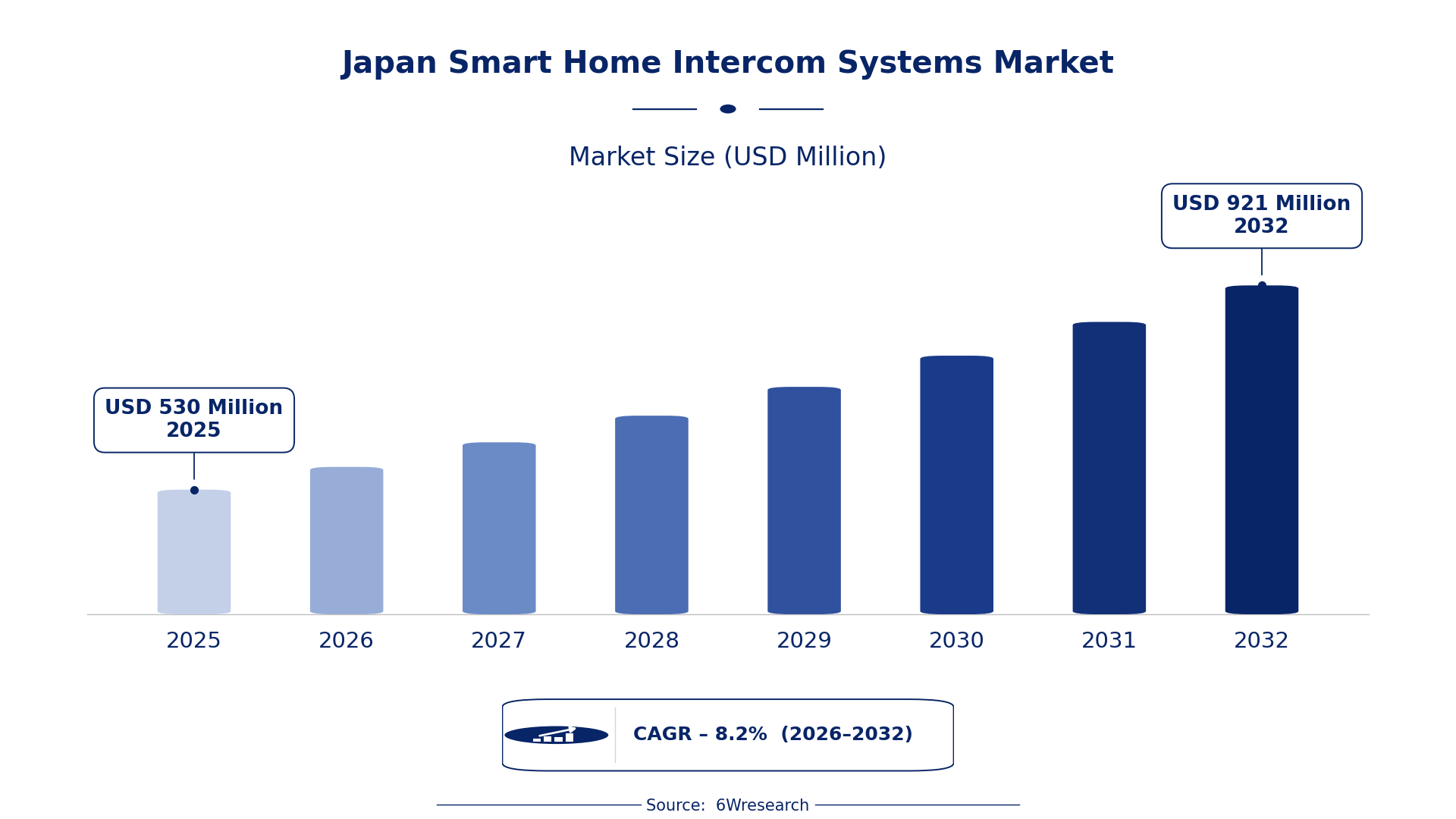
According to 6Wresearch internal database and industry insights, the Japan Smart Home Intercom Systems Market was valued at USD 530 Million in 2025 and is projected to reach USD 921 Million by 2032, growing at a CAGR of approximately 8.2% during 2026–2032.
Japan Smart Home Intercom Systems Market Highlights
| Report Metric | Details |
| Report Name | Japan Smart Home Intercom Systems Market (2026-2032) |
| Market Size 2025 | USD 530 Million |
| Market Size 2032 | USD 921 Million |
| Absolute Growth 2025–2032 | USD 391 Million |
| CAGR 2026–2032 | 8.2% |
| Peak Annual Growth | 9.4% in 2032 |
| Forecast Period | 2026–2032 |
| Historical Data | 2022–2025 |
| Base Year | 2025 |
| Leading System Type, 2025 | Video Intercom (38% share) |
| Leading Feature, 2025 | Two-Way Video & Audio (43% share) |
| Leading Connectivity, 2025 | Wi-Fi (38% share) |
| Leading End User, 2025 | Residential Users (42% share) |
| Fastest-Growing System Type | AI-Enabled Intercoms (11.9% CAGR) |
| Fastest-Growing Feature | Face Recognition (11.5% CAGR) |
| Fastest-Growing Connectivity | Cloud + Edge (11.7% CAGR) |
| Fastest-Growing End User | Smart Apartments (11.3% CAGR) |
| Growing Sector | Residential Users |
| Key End Users | Home Builders, Smart Home Integrators, Residential Users, Smart Apartments |
Japan Smart Home Intercom Systems Market Year-wise Growth Rate and Key Drivers (2022–2032)
This graph illustrates the annual growth rates of the market from 2022 to 2032, highlighting a steady upward trajectory and projected market expansion over the forecast period.
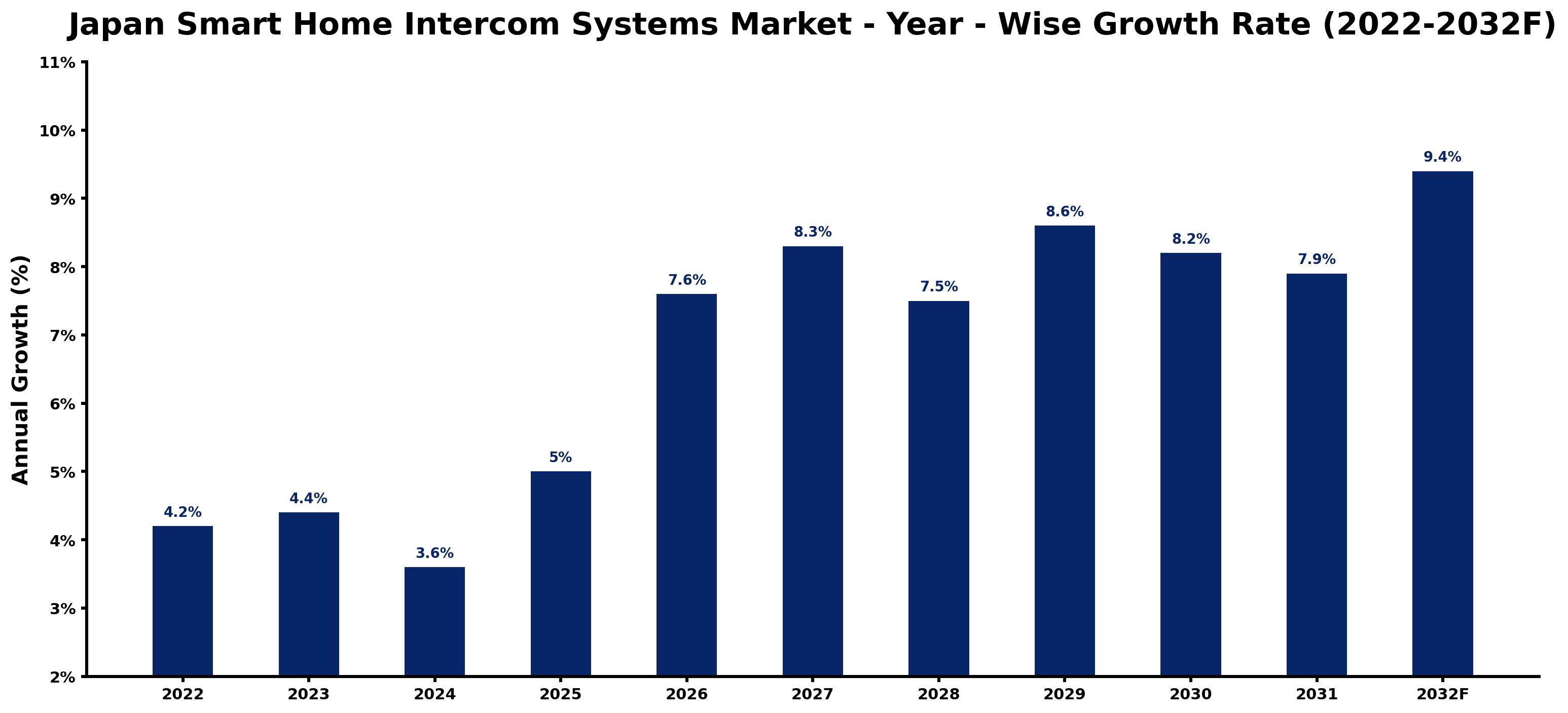
The following figures match every annual growth estimate with the main market development of that year, giving the reasoning behind each rise or slowdown.
| Year | Estimated Annual Growth (%) | Market Rationale |
| 2022 | 4.2 | The market showed solid growth due to increasing interest in smart home technologies. |
| 2023 | 4.4 | Growth accelerated as more households adopted smart devices for improved security features. |
| 2024 | 3.6 | The growth rate slowed slightly as market maturity began to set in. |
| 2025 | 5.0 | A surge in installations occurred as the market reached its historical peak. |
| 2026 | 7.6 | Investment in smart home technology is anticipated to rise, driving higher demand for intercom systems. |
| 2027 | 8.3 | The market is projected to continue expanding with rising consumer interest in advanced features. |
| 2028 | 7.5 | Growth is expected to decelerate as the market stabilises after rapid expansion. |
| 2029 | 8.6 | Demand is projected to surge again as more urban developments integrate smart home features. |
| 2030 | 8.2 | The growth rate is expected to moderate as the market matures further. |
| 2031 | 7.9 | The market will maintain steady growth, supported by ongoing innovations. |
| 2032 | 9.4 | The peak growth rate is projected to be achieved as consumer adoption reaches new heights. |
Note: Market size estimations and growth projections presented in this report are based on 6Wresearch's proprietary forecasting methodology, utilizing the latest available industry data, government publications, and primary research inputs.
Japan Smart Home Intercom Systems Market Synopsis
Smart Home Intercom Systems are advanced communication devices that integrate audio and video capabilities for residential use, improving security and facilitating communication within households. The Japan Smart Home Intercom Systems Market is expanding rapidly, driven by an ageing population and increased urbanisation. In 2023, a notable 60% of consumers expressed interest in video intercom systems, reflecting the demand for improved security features. A ¥10 billion allocation for smart home technology development further stimulates market growth, encouraging innovation and adoption among consumers.
Market Dynamics Impact Analysis (2026–2032)
| Factor | Type | Impact | Primary Segment Affected |
| Growing ageing population driving security needs | Driver | High | Video Intercom |
| Increasing urbanisation leading to smart home adoption | Driver | High | Smart Apartments |
| Rising interest in smart home features among homeowners | Opportunity | High | Residential Users |
| Government initiatives promoting smart home technology | Opportunity | High | Home Builders |
| High initial installation costs for advanced systems | Restraint | High | AI-Enabled Intercoms |
| Limited awareness of smart intercom benefits among consumers | Restraint | Medium | Voice-Only Systems |
| Competition from alternative home security solutions | Challenge | High | App-Based Intercoms |
| Technological integration challenges with existing home systems | Challenge | Medium | Two-Way Video & Audio |
Evaluation of Drivers in Japan Smart Home Intercom Systems Market (2026–2032)
Demand rests on the following drivers, each shown with the segment it touches most.
| Drivers | Primary Segment Affected | Why It Matters (Evidence) |
| Increasing installations of smart home devices | Smart Apartments | In 2023, 40% of new residential buildings in urban areas included smart home features, leading to higher intercom system demand. |
| Growing consumer interest in video intercom systems | Video Intercom | In 2023, 60% of consumers expressed interest in video intercom systems, driving demand for improved security. |
| Rising urban population requiring advanced communication solutions | Residential Users | Japan's population is approximately 125 million, with many seeking modern communication options for homes. |
| Investment in smart home technology development | Home Builders | In 2023, the government allocated ¥10 billion for smart home technology development, encouraging builders to integrate intercoms. |
| Adoption of AI features for improved security | AI-Enabled Intercoms | The growing interest in facial recognition technology is driving demand for AI-enabled intercom systems. |
Much of the new demand traces back to the increasing installations of smart home devices, with 40% of new residential buildings in urban areas including smart features. In 2023, a significant portion of consumers expressed interest in video intercom systems, reflecting a shift towards improved security solutions. The urban population, which is approximately 125 million, increasingly seeks advanced communication options for homes. The adoption of AI features for enhanced security is driving interest in AI-enabled intercom systems.
Evaluation of Restraints in Japan Smart Home Intercom Systems Market
Below are the constraints most often cited by buyers and suppliers, with the segment each affects.
| Market Restraint | Primary Segment Affected | Why It Matters (Evidence) |
| High initial installation costs for advanced systems | AI-Enabled Intercoms | The average cost of a smart intercom system in Japan is around ¥30,000, which may deter some buyers. |
| Limited awareness of smart intercom benefits among consumers | Voice-Only Systems | Many consumers lack knowledge about the advantages of smart intercoms, resulting in lower adoption rates. |
| Competition from alternative home security solutions | App-Based Intercoms | Many other home security options can distract consumers from considering intercom systems. |
| Technological integration challenges with existing home systems | Two-Way Video & Audio | Integrating intercom systems with existing smart home setups can be complex and costly. |
| Market saturation in urban areas | Smart Apartments | With many new developments already incorporating smart features, growth may slow as saturation occurs. |
Japan Smart Home Intercom Systems Market Challenges
Producers face rising installation costs due to a skills gap, with only 25% of the workforce trained in smart home systems, resulting in a 15% increase in expenses for buyers. Distributors encounter higher costs from tariffs on electronic components, which can inflate prices for consumers and reduce overall market competitiveness. Buyers feel pressure as 60% of consumers prefer video intercom systems, compelling suppliers to innovate rapidly or risk losing market share. Regulatory uncertainty arises from the development of JIS standards, which can delay product launches and potentially lead to a 10% revenue loss for unprepared producers.
Trends in the Japan Smart Home Intercom Systems Market
Buyers and suppliers in the Japan Smart Home Intercom Systems Market are adjusting to the following trends.
- Shift from Basic to Advanced Intercom Features: In 2023, the trend towards advanced features like facial recognition in intercom systems gained traction, with 11.5% growth in face recognition technology. This shift improves security and user experience, appealing to tech-savvy consumers.
- Transition from Wired to Wireless Connectivity: The adoption of Wi-Fi as the primary connectivity method for intercoms reflects a shift towards more flexible installations. In 2023, 38% of intercom systems used Wi-Fi, allowing for easier integration into smart homes.
- Emergence of Smart Apartments: Smart apartments are becoming increasingly popular, with a projected annual growth rate of 15%. This trend is driven by urban developments incorporating smart home technologies, creating new opportunities for intercom systems.
- Prioritisation of Video Communication: Since 2023, there has been a notable increase in demand for video intercom systems, with a significant portion of consumers showing interest. This prioritisation improves security and communication within homes.
Investment Opportunities in the Japan Smart Home Intercom Systems Market
Several openings in the Japan Smart Home Intercom Systems Market merit attention from investors.
- Collaborate with Local Home Builders: Now is an ideal time to partner with local home builders to integrate smart intercom systems into new residential projects, especially as 40% of new buildings include smart features.
- Invest in AI-Enabled Intercoms: With the growing interest in facial recognition technology, investing in AI-enabled intercom systems presents a strong opportunity, particularly among tech-savvy residential users.
- Expand Offerings in Urban Areas: Urban areas are experiencing a surge in smart apartment developments, making it a prime opportunity to supply intercom systems tailored for these environments, where demand is projected to grow by 15% annually.
- Target Smart Home Integrators: Focusing on smart home integrators can facilitate entry into the market, as they play a key role in system installation and support, driving demand for advanced intercom solutions.
Government Initiatives in the Japan Smart Home Intercom Systems Market
The Building Energy Efficiency Act, amended in 2022, mandates that all new buildings meet energy standards starting from April 2025. This legislation impacts buyers by ensuring that smart home intercom systems installed in new homes comply with energy efficiency standards, promoting sustainable living.
In 2023, the government allocated ¥10 billion for smart home technology development, overseen by the Digital Agency. This funding supports the advancement of smart home systems, including intercoms, facilitating innovation and adoption among consumers.
Future Insight of the Japan Smart Home Intercom Systems Market
A shift towards smart home integration will drive suppliers to enhance product offerings, responding to evolving consumer demands. Government support for smart home initiatives will stimulate innovation and improve accessibility for buyers. Urban areas will see a notable increase in smart apartment installations, with a projected 15% annual growth, enhancing connectivity and security. The Tokyo Metropolitan Government's smart city initiative will promote seamless technology integration, benefiting both suppliers and consumers in the market.
Market Segmentation Analysis
Japan Smart Home Intercom Systems Market report covers a detailed analysis of the following market segments:
By System Type – Video Intercom Leads, AI-Enabled Intercoms Expected to Grow Fastest
According to Saurav Kr Singh, Senior Research Analyst at 6Wresearch, Video Intercom took 38% of system type revenue in 2025, more than any other category. Video intercom systems dominate the market as they are essential for visual communication and security in residential settings. Their popularity is particularly evident in urban areas like Tokyo, where homeowners prioritise safety and convenience in their living environments. AI-Enabled Intercoms are projected to grow fastest, at a CAGR of 11.9% during 2026–2032. AI-enabled intercoms are witnessing substantial growth due to their incorporation of advanced functionalities that appeal to tech-savvy consumers. The increasing integration of smart technology in urban residential buildings is likely to further fuel this segment's expansion. Suppliers should focus on enhancing video intercom features to meet the growing demand for security and communication solutions.
By Feature – Two-Way Video & Audio Leads, Face Recognition Expected to Grow Fastest
The largest feature category in 2025 was Two-Way Video & Audio, at 43% of revenue. Two-way video and audio capabilities are crucial for effective communication, making them the preferred choice among users. This feature is especially valued for improving security and facilitating interaction with visitors in residential settings. The quickest growth will come from Face Recognition, forecast to expand at a CAGR of 11.5% between 2026 and 2032. Face recognition technology is rapidly gaining traction as it significantly enhances security measures within homes. The growing consumer interest in advanced security features is driving the expansion of this segment. Buyers can anticipate enhanced security options, while suppliers should prioritise advancements in face recognition technologies to align with market needs.
By Connectivity – Wi-Fi Leads, Cloud + Edge Expected to Grow Fastest
In 2025, Wi-Fi led the connectivity split with a 38% share. Wi-Fi is the primary connectivity method for intercom systems, ensuring reliable communication and integration with other smart devices. Its widespread availability in homes makes it the go-to choice for users. Cloud + Edge is set to record the highest CAGR in this split, 11.7% over 2026–2032. Cloud and edge connectivity are rapidly gaining popularity as they support remote access and advanced smart features, appealing to a growing segment of tech-savvy consumers. This trend is expected to accelerate as more households adopt smart home technologies. Suppliers must invest in cloud and edge solutions to stay competitive in the evolving market.
By End User – Residential Users Lead, Smart Apartments Expected to Grow Fastest
Residential Users held 42% of the Japan Smart Home Intercom Systems Market by end user in 2025. Residential users represent the largest segment for intercom systems, motivated by a rising interest in smart home technologies. This group values enhanced security and communication functionalities within their homes, making them key adopters of these systems. Over 2026–2032, Smart Apartments are expected to post the fastest growth, at a CAGR of 11.3%. Smart apartments are emerging as a rapidly growing segment, projected to expand by 15% annually. This trend reflects the increasing integration of smart technology in urban residential environments, attracting more consumers. Suppliers should target the smart apartment sector to leverage the expanding market for technologically integrated living spaces.
Key Attractiveness of the Report
- 10 Years of Market Numbers
- Historical Data Starting from 2022 to 2025
- Base Year 2025
- Forecast Data until 2032
- Key Performance Indicators Impacting the Market
- Major Upcoming Developments and Projects
Key Highlights of the Report:
- Japan Smart Home Intercom Systems Market Outlook
- Market Size of Japan Smart Home Intercom Systems Market, 2025
- Forecast of Japan Smart Home Intercom Systems Market, 2032
- Historical Data and Forecast of Japan Smart Home Intercom Systems Revenues & Volume for the Period 2022-2032F
- Japan Smart Home Intercom Systems Market Trend Evolution
- Japan Smart Home Intercom Systems Market Drivers and Challenges
- Japan Smart Home Intercom Systems Price Trends
- Japan Smart Home Intercom Systems Porter's Five Forces
- Japan Smart Home Intercom Systems Industry Life Cycle
- Historical Data and Forecast of Japan Smart Home Intercom Systems Market Revenues & Volume By System Type for the Period 2022-2032F
- Historical Data and Forecast of Japan Smart Home Intercom Systems Market Revenues & Volume By Video Intercom for the Period 2022-2032F
- Historical Data and Forecast of Japan Smart Home Intercom Systems Market Revenues & Volume By AI-Enabled Intercoms for the Period 2022-2032F
- Historical Data and Forecast of Japan Smart Home Intercom Systems Market Revenues & Volume By Voice-Only Systems for the Period 2022-2032F
- Historical Data and Forecast of Japan Smart Home Intercom Systems Market Revenues & Volume By App-Based Intercoms for the Period 2022-2032F
- Historical Data and Forecast of Japan Smart Home Intercom Systems Market Revenues & Volume By Feature for the Period 2022-2032F
- Historical Data and Forecast of Japan Smart Home Intercom Systems Market Revenues & Volume By Two-Way Video & Audio for the Period 2022-2032F
- Historical Data and Forecast of Japan Smart Home Intercom Systems Market Revenues & Volume By Face Recognition for the Period 2022-2032F
- Historical Data and Forecast of Japan Smart Home Intercom Systems Market Revenues & Volume By Voice Messaging for the Period 2022-2032F
- Historical Data and Forecast of Japan Smart Home Intercom Systems Market Revenues & Volume By Mobile Integration for the Period 2022-2032F
- Historical Data and Forecast of Japan Smart Home Intercom Systems Market Revenues & Volume By Connectivity for the Period 2022-2032F
- Historical Data and Forecast of Japan Smart Home Intercom Systems Market Revenues & Volume By Wi-Fi, Ethernet for the Period 2022-2032F
- Historical Data and Forecast of Japan Smart Home Intercom Systems Market Revenues & Volume By Cloud + Edge for the Period 2022-2032F
- Historical Data and Forecast of Japan Smart Home Intercom Systems Market Revenues & Volume By Mesh/Bluetooth for the Period 2022-2032F
- Historical Data and Forecast of Japan Smart Home Intercom Systems Market Revenues & Volume By Smartphone App for the Period 2022-2032F
- Historical Data and Forecast of Japan Smart Home Intercom Systems Market Revenues & Volume By End User for the Period 2022-2032F
- Historical Data and Forecast of Japan Smart Home Intercom Systems Market Revenues & Volume By Residential Users for the Period 2022-2032F
- Historical Data and Forecast of Japan Smart Home Intercom Systems Market Revenues & Volume By Smart Apartments for the Period 2022-2032F
- Historical Data and Forecast of Japan Smart Home Intercom Systems Market Revenues & Volume By Home Builders for the Period 2022-2032F
- Historical Data and Forecast of Japan Smart Home Intercom Systems Market Revenues & Volume By Smart Home Integrators for the Period 2022-2032F
- Japan Smart Home Intercom Systems Import Export Trade Statistics
- Market Opportunity Assessment By System Type
- Market Opportunity Assessment By Feature
- Market Opportunity Assessment By Connectivity
- Market Opportunity Assessment By End User
- Japan Smart Home Intercom Systems Top Companies Market Share
- Japan Smart Home Intercom Systems Competitive Benchmarking By Technical and Operational Parameters
- Japan Smart Home Intercom Systems Company Profiles
- Japan Smart Home Intercom Systems Key Strategic Recommendations
Market Covered
This report examines the market across the segments below.
By System Type
- Video Intercom
- AI-Enabled Intercoms
- Voice-Only Systems
- App-Based Intercoms
By Feature
- Two-Way Video & Audio
- Face Recognition
- Voice Messaging
- Mobile Integration
By Connectivity
- Wi-Fi
- Ethernet
- Cloud + Edge
- Mesh/Bluetooth
- Smartphone App
By End User
- Residential Users
- Smart Apartments
- Home Builders
- Smart Home Integrators































