Japan Smart Home Sensor AI Market Size & Growth Rate
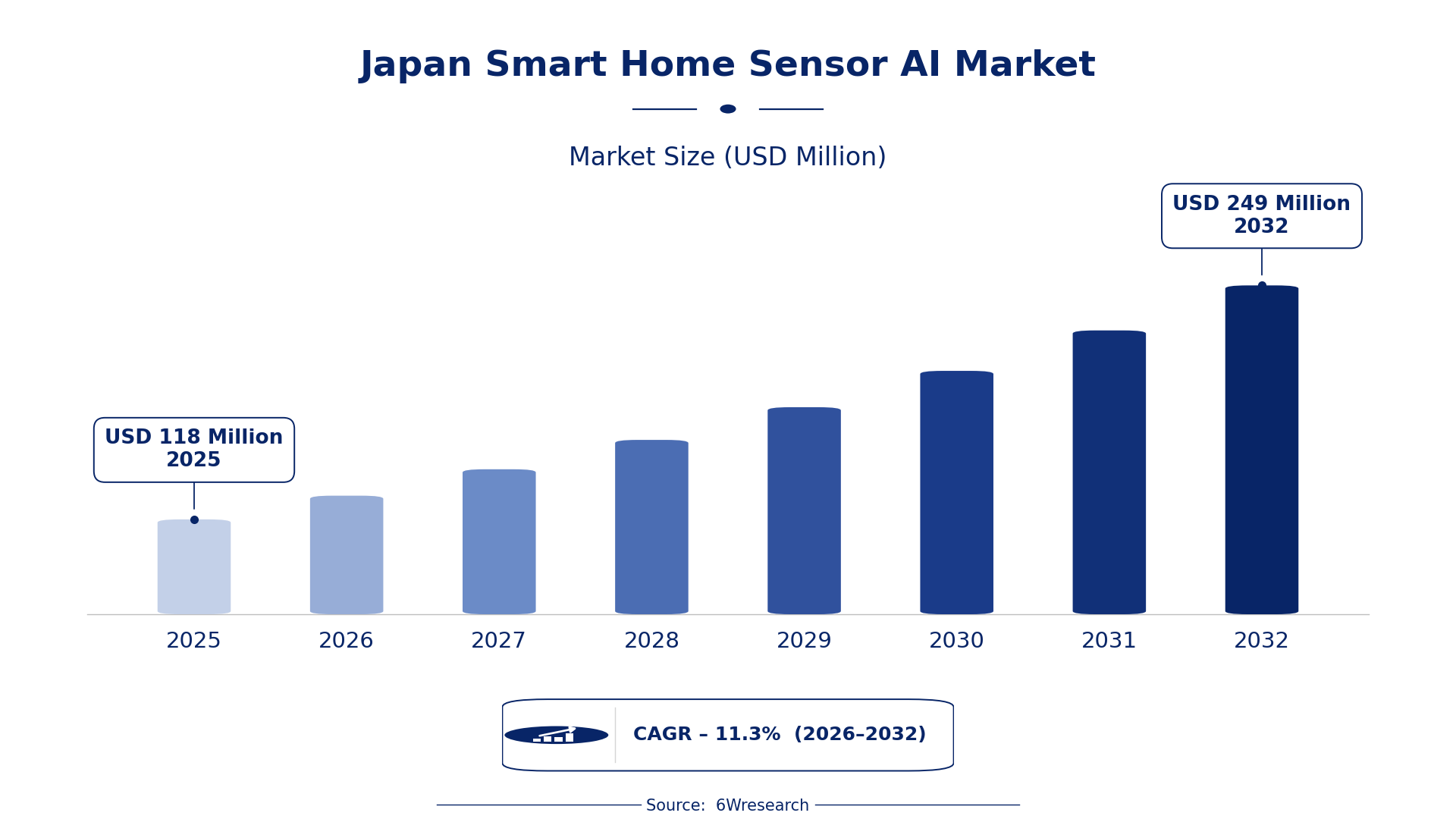
According to 6Wresearch internal database and industry insights, the Japan Smart Home Sensor AI Market was valued at USD 118 Million in 2025 and is projected to reach USD 249 Million by 2032, growing at a CAGR of approximately 11.3% during 2026–2032.
Japan Smart Home Sensor AI Market Highlights
| Report Metric | Details |
| Report Name | Japan Smart Home Sensor AI Market (2026-2032) |
| Market Size 2025 | USD 118 Million |
| Market Size 2032 | USD 249 Million |
| Absolute Growth 2025–2032 | USD 131 Million |
| CAGR 2026–2032 | 11.3% |
| Peak Annual Growth | 12.8% in 2028 |
| Forecast Period | 2026–2032 |
| Historical Data | 2022–2025 |
| Base Year | 2025 |
| Leading Sensor Type, 2025 | Motion Sensors (37% share) |
| Leading AI Feature, 2025 | Occupant Behavior Prediction (40% share) |
| Leading Area of Application, 2025 | Lighting (38% share) |
| Leading End User, 2025 | Homeowners (44% share) |
| Fastest-Growing Sensor Type | Temperature Sensors (16.1% CAGR) |
| Fastest-Growing AI Feature | Adaptive Climate Control (14.5% CAGR) |
| Fastest-Growing Area of Application | Security (13.6% CAGR) |
| Fastest-Growing End User | Smart HVAC Providers (14.8% CAGR) |
| Growing Sector | Smart Home Technology |
| Key End Users | Homeowners, Smart HVAC Providers, Home Automation Firms |
Japan Smart Home Sensor AI Market Year-wise Growth Rate and Key Drivers (2022–2032)
This graph illustrates the annual growth rates of the market from 2022 to 2032, highlighting a steady upward trajectory and projected market expansion over the forecast period.
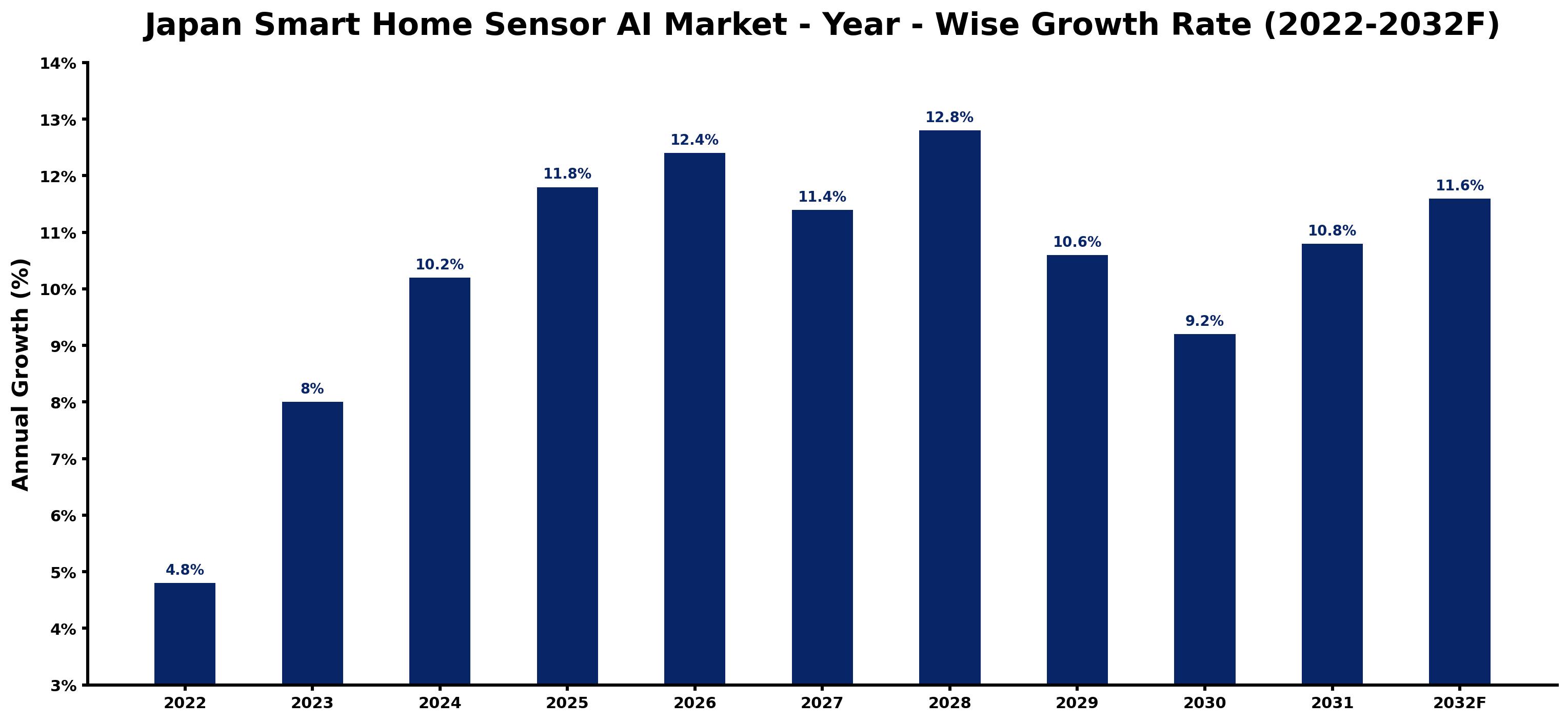
Year by year, the estimates below pair each growth rate with the development that shaped it.
| Year | Estimated Annual Growth (%) | Market Rationale |
| 2022 | 4.8 | The market showed a steady demand for smart home technologies among early adopters. |
| 2023 | 8.0 | Increased awareness of energy efficiency drove higher adoption rates among homeowners. |
| 2024 | 10.2 | The introduction of new smart home products boosted consumer interest and purchases. |
| 2025 | 11.8 | A surge in new housing developments included smart home features, driving market growth. |
| 2026 | 12.4 | Urbanisation is expected to lead to greater demand for integrated smart home solutions. |
| 2027 | 11.4 | Market growth is projected to slow as saturation begins in major urban areas. |
| 2028 | 12.8 | Innovations in AI technology are expected to spur renewed consumer interest and purchases. |
| 2029 | 10.6 | Competition among suppliers is projected to intensify, leading to a slowdown in growth rates. |
| 2030 | 9.2 | Consumer preferences are expected to shift towards energy-efficient solutions, impacting growth rates. |
| 2031 | 10.8 | Increased marketing efforts by suppliers will lead to a rise in consumer awareness. |
| 2032 | 11.6 | The ongoing trend towards smart living solutions will continue to drive adoption. |
Note: Market size estimations and growth projections presented in this report are based on 6Wresearch's proprietary forecasting methodology, utilizing the latest available industry data, government publications, and primary research inputs.
Japan Smart Home Sensor AI Market Synopsis
Smart Home Sensor AI encompasses advanced devices that monitor various environmental factors and user behaviours through artificial intelligence. Their primary applications improve security, optimise energy consumption, and enhance indoor air quality. The Japan Smart Home Sensor AI Market is expanding due to a tech-savvy population and government initiatives aiming for a 30% increase in smart home installations by 2025. With the average household now equipped with three smart sensors, the trend towards smart living solutions is increasingly clear.
Market Dynamics Impact Analysis (2026–2032)
| Factor | Type | Impact | Primary Segment Affected |
| Growing focus on energy efficiency drives demand for smart HVAC systems, with a projected 20% rise in installations by 2025. | Driver | High | HVAC Systems |
| Increased urbanisation leads to higher adoption of air quality sensors, particularly in metropolitan areas like Tokyo and Osaka. | Driver | High | Air Quality Sensors |
| The rising number of homeowners adopting smart technologies presents opportunities for suppliers of smart home sensors. | Opportunity | High | Homeowners |
| The government’s target to increase smart home installations by 30% by 2025 creates new avenues for investment in smart home solutions. | Opportunity | High | Motion Sensors |
| Supply chain disruptions have created shortages of key components, impacting production capabilities for smart home sensor manufacturers. | Restraint | High | Motion Sensors |
| Rising material costs, influenced by global supply chain issues, have led to increased prices for buyers, affecting purchasing decisions. | Restraint | High | Motion Sensors |
| Complex technology limits adoption rates among consumers, hindering market growth as many buyers are hesitant to invest in smart home solutions. | Challenge | Medium | Motion Sensors |
| Slow regulatory updates around smart home standards complicate compliance for producers, delaying product launches and market entry. | Challenge | Medium | Motion Sensors |
Evaluation of Drivers in Japan Smart Home Sensor AI Market (2026–2032)
Below are the drivers that matter most for revenue growth, with supporting evidence.
| Drivers | Primary Segment Affected | Why It Matters (Evidence) |
| Increased adoption of smart HVAC systems improves energy efficiency. | HVAC Systems | Smart HVAC systems are projected to see a 20% increase in installations by 2025, driving demand for related sensors. |
| Rising environmental awareness boosts demand for air quality monitoring. | Air Quality Sensors | Environmental monitoring sensors are increasingly used in urban areas to track air quality, leading to higher sales. |
| The growing number of smart home installations increases sensor demand. | Motion Sensors | With 40% of new homes expected to include smart features in 2023, sensor demand will rise. |
| Technological advancements in AI improve sensor capabilities and attractiveness. | Adaptive Climate Control | Innovations in adaptive climate control are expected to drive a 14.5% CAGR in the coming years. |
| Government initiatives promote smart home technology adoption. | Motion Sensors | The Tokyo Metropolitan Government's program incentivises smart home upgrades, stimulating market growth. |
A broader customer base accounts for much of the growth, as the average household in Japan now has three smart sensors installed, indicating a shift towards greater automation. The rising emphasis on energy efficiency fuels demand for smart HVAC systems, which are projected to see a 20% increase in installations by 2025. Urban areas are experiencing heightened demand for air quality sensors, particularly for pollution monitoring. Advances in AI are improving the functionality of smart home systems, making them more attractive to consumers.
Evaluation of Restraints in Japan Smart Home Sensor AI Market
The table below lists the restraints and the evidence behind each.
| Market Restraint | Primary Segment Affected | Why It Matters (Evidence) |
| Limited consumer awareness of advanced features hinders market penetration. | Occupant Behavior Prediction | Many potential buyers remain unaware of the benefits of occupant behaviour prediction, limiting its adoption. |
| High installation costs can deter potential buyers from adopting smart home technologies. | Air Quality Sensors | The initial investment required for smart home systems can be a barrier for budget-conscious consumers. |
| Regulatory hurdles can slow down the introduction of new smart home products. | Motion Sensors | New products must comply with various standards, which can delay market entry. |
| Supply chain disruptions affect the availability of smart home devices. | Motion Sensors | Recent global supply chain issues have delayed the production and distribution of essential components. |
| Intense competition among suppliers can lead to price wars, impacting profitability. | Motion Sensors | As more players enter the market, price reductions can undermine profit margins for existing suppliers. |
Japan Smart Home Sensor AI Market Challenges
Supply chain disruptions have led to a shortage of key components for smart home sensors, causing production delays that hinder manufacturers' ability to satisfy market demand. Increasing material costs, driven by global supply chain issues, raise prices by up to 15% for buyers, diminishing their purchasing power. Many consumers find the technology complicated, resulting in slower-than-expected adoption rates, which restricts market growth. The slow pace of regulatory updates regarding smart home standards complicates compliance for manufacturers, extending product development timelines and delaying market entry by as much as six months.
Trends in the Japan Smart Home Sensor AI Market
The shifts below are changing how Japan Smart Home Sensor AI Market products are bought and supplied.
- Shift from Traditional to Smart Home Solutions: Homeowners are increasingly opting for smart home solutions, with 40% of new homes expected to include smart features in 2023. This shift reflects a growing preference for convenience and energy efficiency.
- Emergence of AI-Driven Smart Sensors: The introduction of AI-driven smart sensors began in 2023, improving user experience and functionality. These sensors are now integral to modern smart home systems, with a notable increase in consumer adoption.
- Growing Demand for Environmental Monitoring: Urban areas are seeing a rise in demand for environmental monitoring sensors, particularly for air quality tracking. This trend is supported by increasing public awareness of pollution, with more households investing in these technologies.
- Expansion of Government Incentives for Smart Homes: In 2023, the Tokyo Metropolitan Government launched a program to incentivise smart home upgrades. This initiative aims to increase the adoption of smart technologies among homeowners.
Investment Opportunities in the Japan Smart Home Sensor AI Market
Below are the investment opportunities with the strongest case in the Japan Smart Home Sensor AI Market.
- Homeowners Seeking Energy Efficiency: With 40% of new homes expected to include smart features by 2023, there is a growing opportunity for suppliers of energy-efficient smart home technologies. Collaborating with homebuilders can facilitate market entry.
- Smart HVAC Providers Looking for Integration: As smart HVAC systems are projected to see a 20% increase in installations by 2025, suppliers should focus on integrating their products with these systems. Partnering with HVAC providers can improve market reach.
- Increased Focus on Indoor Air Quality: The rising awareness of indoor air quality issues creates a demand for air quality sensors. Suppliers can target urban homeowners by offering advanced monitoring solutions that meet emerging standards.
- Investment in Predictive Water Risk Solutions: With growing concerns about water management, there is an opportunity for suppliers to develop predictive water risk solutions. Collaborating with environmental agencies can facilitate product validation and market entry.
Government Initiatives in the Japan Smart Home Sensor AI Market
The Economic Security Promotion Act of 2022 supports supply-chain resilience for critical products, including smart home technologies, stabilising the industry's framework. Additionally, the Act against Unjustifiable Premiums and Misleading Representations, established in 1962, ensures that consumers are not misled about smart home products. This law mandates clear labelling and advertising, which helps build consumer trust in the market.
The Ministry of Internal Affairs and Communications promotes smart home technologies through various initiatives, with a target to increase installations by 30% by 2025. This includes funding for research and development projects aimed at improving smart home systems, ensuring that producers can innovate and meet consumer demands.
Future Insight of the Japan Smart Home Sensor AI Market
Government initiatives will propel a shift towards smart home technologies, aiming for a 30% increase in installations by 2025. Suppliers will innovate in response, particularly in urban areas where demand for environmental monitoring sensors is on the rise. The introduction of standards like ISO/IEC 30141:2018 will simplify compliance processes, enabling quicker market entry for new products. Buyers will benefit from improved energy efficiency solutions and enhanced living conditions as the market evolves.
Market Segmentation Analysis
Japan Smart Home Sensor AI Market report covers a detailed analysis of the following market segments:
By Sensor Type – Motion Sensors Lead, Temperature Sensors Expected to Grow Fastest
According to Saurav Kr Singh, Senior Research Analyst at 6Wresearch, Motion Sensors took 37% of sensor type revenue in 2025, more than any other category. Motion sensors hold a prominent position in Japan's smart home market, primarily due to their critical role in security and automation applications. Their widespread adoption is evident, with around 40% of new homes expected to feature these sensors in 2023. The quickest growth will come from Temperature Sensors, forecast to expand at a CAGR of 16.1% between 2026 and 2032. Temperature sensors are rapidly gaining traction, primarily driven by the increasing demand for efficient climate control in smart HVAC systems. With a projected 20% increase in installations by 2025, their relevance in energy management is becoming more pronounced. Suppliers should prioritise the development of temperature sensor technologies to meet the rising market demand.
By AI Feature – Occupant Behavior Prediction Leads, Adaptive Climate Control Expected to Grow Fastest
Occupant Behavior Prediction held 40% of the Japan Smart Home Sensor AI Market by ai feature in 2025. Occupant behaviour prediction leads the market as it significantly enhances user experience in smart homes, making it a sought-after feature among homeowners. Its integration into various smart home systems ensures optimal functionality and convenience for users. Over 2026–2032, Adaptive Climate Control is expected to post the fastest growth, at a CAGR of 14.5%. Adaptive climate control is experiencing swift growth due to its direct impact on energy efficiency and user comfort in residential environments. As energy costs rise, homeowners are increasingly valuing this feature for its potential to reduce expenses. Suppliers should focus on improving adaptive climate control capabilities to leverage this expanding market segment.
By Area of Application – Lighting Leads, Security Expected to Grow Fastest
In 2025, Lighting led the area of application split with a 38% share. Lighting is the leading application area, as it is directly managed by smart home systems, providing users with convenience and energy savings. Its widespread integration into homes solidifies its status as a fundamental aspect of smart living solutions in Japan. Security is projected to grow fastest, at a CAGR of 13.6% during 2026–2032. The security application area is growing rapidly, driven by essential home safety and automation needs, with increasing safety concerns fuelling demand. This trend is expected to continue as homeowners seek more advanced security solutions. This indicates that suppliers should invest in advanced security technologies to meet the evolving expectations of homeowners.
By End User – Homeowners Lead, Smart HVAC Providers Expected to Grow Fastest
Homeowners accounted for 44% of the market by end user in 2025. Homeowners represent the largest end-user group, being the primary consumers of smart home technology, and they prioritise enhanced convenience and security. Their high adoption rates underscore the importance of targeting this demographic in marketing strategies. Smart HVAC Providers are set to record the highest CAGR in this split, 14.8% over 2026–2032. Smart HVAC providers are experiencing the fastest growth as they play a crucial role in implementing smart solutions that improve energy efficiency. This sector's expansion reflects the increasing integration of smart technologies in climate control systems. This suggests that suppliers should collaborate closely with smart HVAC providers to enhance their product offerings.
Key Attractiveness of the Report
- 10 Years of Market Numbers
- Historical Data Starting from 2022 to 2025
- Base Year 2025
- Forecast Data until 2032
- Key Performance Indicators Impacting the Market
- Major Upcoming Developments and Projects
Key Highlights of the Report:
- Japan Smart Home Sensor AI Market Outlook
- Market Size of Japan Smart Home Sensor AI Market, 2025
- Forecast of Japan Smart Home Sensor AI Market, 2032
- Historical Data and Forecast of Japan Smart Home Sensor AI Revenues & Volume for the Period 2022-2032F
- Japan Smart Home Sensor AI Market Trend Evolution
- Japan Smart Home Sensor AI Market Drivers and Challenges
- Japan Smart Home Sensor AI Price Trends
- Japan Smart Home Sensor AI Porter's Five Forces
- Japan Smart Home Sensor AI Industry Life Cycle
- Historical Data and Forecast of Japan Smart Home Sensor AI Market Revenues & Volume By Sensor Type for the Period 2022-2032F
- Historical Data and Forecast of Japan Smart Home Sensor AI Market Revenues & Volume By Motion Sensors for the Period 2022-2032F
- Historical Data and Forecast of Japan Smart Home Sensor AI Market Revenues & Volume By Temperature Sensors for the Period 2022-2032F
- Historical Data and Forecast of Japan Smart Home Sensor AI Market Revenues & Volume By Air Quality Sensors for the Period 2022-2032F
- Historical Data and Forecast of Japan Smart Home Sensor AI Market Revenues & Volume By Leakage Sensors for the Period 2022-2032F
- Historical Data and Forecast of Japan Smart Home Sensor AI Market Revenues & Volume By AI Feature for the Period 2022-2032F
- Historical Data and Forecast of Japan Smart Home Sensor AI Market Revenues & Volume By Occupant Behavior Prediction for the Period 2022-2032F
- Historical Data and Forecast of Japan Smart Home Sensor AI Market Revenues & Volume By Adaptive Climate Control for the Period 2022-2032F
- Historical Data and Forecast of Japan Smart Home Sensor AI Market Revenues & Volume By Pollution/CO2 Monitoring for the Period 2022-2032F
- Historical Data and Forecast of Japan Smart Home Sensor AI Market Revenues & Volume By Predictive Water Risk for the Period 2022-2032F
- Historical Data and Forecast of Japan Smart Home Sensor AI Market Revenues & Volume By Area of Application for the Period 2022-2032F
- Historical Data and Forecast of Japan Smart Home Sensor AI Market Revenues & Volume By Lighting, Security for the Period 2022-2032F
- Historical Data and Forecast of Japan Smart Home Sensor AI Market Revenues & Volume By HVAC Systems for the Period 2022-2032F
- Historical Data and Forecast of Japan Smart Home Sensor AI Market Revenues & Volume By Environment Monitoring for the Period 2022-2032F
- Historical Data and Forecast of Japan Smart Home Sensor AI Market Revenues & Volume By Bathrooms/Kitchens for the Period 2022-2032F
- Historical Data and Forecast of Japan Smart Home Sensor AI Market Revenues & Volume By End User for the Period 2022-2032F
- Historical Data and Forecast of Japan Smart Home Sensor AI Market Revenues & Volume By Homeowners for the Period 2022-2032F
- Historical Data and Forecast of Japan Smart Home Sensor AI Market Revenues & Volume By Smart HVAC Providers for the Period 2022-2032F
- Historical Data and Forecast of Japan Smart Home Sensor AI Market Revenues & Volume By Home Automation Firms for the Period 2022-2032F
- Historical Data and Forecast of Japan Smart Home Sensor AI Market Revenues & Volume By Plumbers & Contractors for the Period 2022-2032F
- Japan Smart Home Sensor AI Import Export Trade Statistics
- Market Opportunity Assessment By Sensor Type
- Market Opportunity Assessment By AI Feature
- Market Opportunity Assessment By Area of Application
- Market Opportunity Assessment By End User
- Japan Smart Home Sensor AI Top Companies Market Share
- Japan Smart Home Sensor AI Competitive Benchmarking By Technical and Operational Parameters
- Japan Smart Home Sensor AI Company Profiles
- Japan Smart Home Sensor AI Key Strategic Recommendations
Market Covered
The following segment groups are covered in the report.
By Sensor Type
- Motion Sensors
- Temperature Sensors
- Air Quality Sensors
- Leakage Sensors
By AI Feature
- Occupant Behavior Prediction
- Adaptive Climate Control
- Pollution/CO2 Monitoring
- Predictive Water Risk
By Area of Application
- Lighting
- Security
- HVAC Systems
- Environment Monitoring
- Bathrooms/Kitchens
By End User
- Homeowners
- Smart HVAC Providers
- Home Automation Firms
- Plumbers & Contractors































