Japan Smart Housing Market Size & Growth Rate
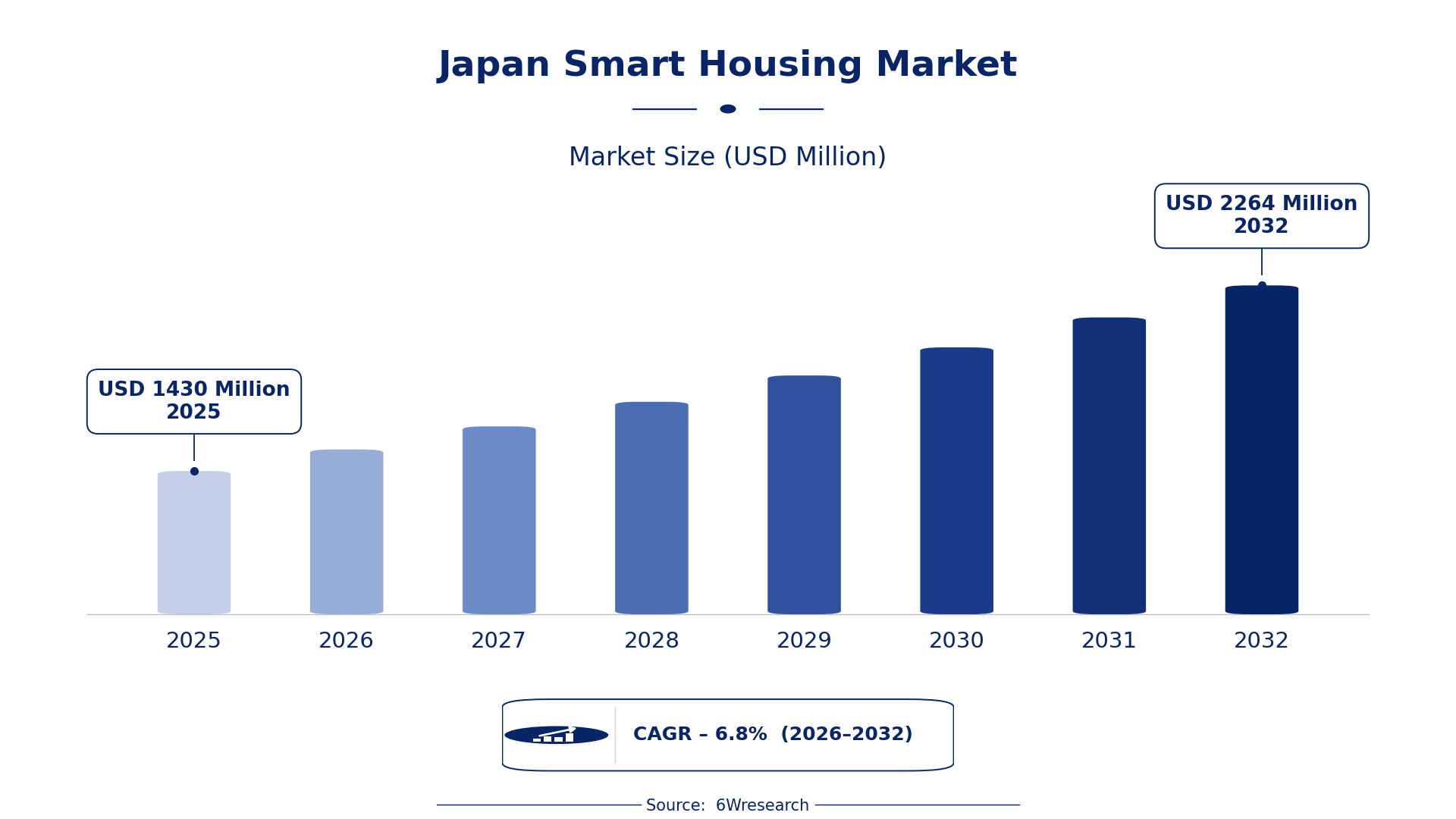
According to 6Wresearch internal database and industry insights, the Japan Smart Housing Market was valued at USD 1,430 Million in 2025 and is projected to reach USD 2,264 Million by 2032, growing at a CAGR of approximately 6.8% during 2026–2032.
Japan Smart Housing Market Highlights
| Report Metric | Details |
| Report Name | Japan Smart Housing Market (2026-2032) |
| Market Size 2025 | USD 1,430 Million |
| Market Size 2032 | USD 2,264 Million |
| Absolute Growth 2025–2032 | USD 834 Million |
| CAGR 2026–2032 | 6.8% |
| Peak Annual Growth | 7.7% in 2032 |
| Forecast Period | 2026–2032 |
| Historical Data | 2022–2025 |
| Base Year | 2025 |
| Leading Housing Type, 2025 | IoT-Enabled Apartments (39% share) |
| Leading Smart Integration, 2025 | Centralized Automation Hub (41% share) |
| Leading Energy System, 2025 | Solar + Smart Meters (40% share) |
| Leading End User, 2025 | Real Estate Developers (51% share) |
| Fastest-Growing Housing Type | Sustainable Villas (10.0% CAGR) |
| Fastest-Growing Smart Integration | AI HVAC + Water Monitoring (9.5% CAGR) |
| Fastest-Growing Energy System | Net-Zero Systems (10.7% CAGR) |
| Fastest-Growing End User | Urban Planners (9.2% CAGR) |
| Growing Sector | Urban Planners |
| Key End Users | Real Estate Developers, Urban Planners, Smart Housing Companies, Assisted Living Groups |
Japan Smart Housing Market Year-wise Growth Rate and Key Drivers (2022–2032)
This graph illustrates the annual growth rates of the market from 2022 to 2032, highlighting a steady upward trajectory and projected market expansion over the forecast period.
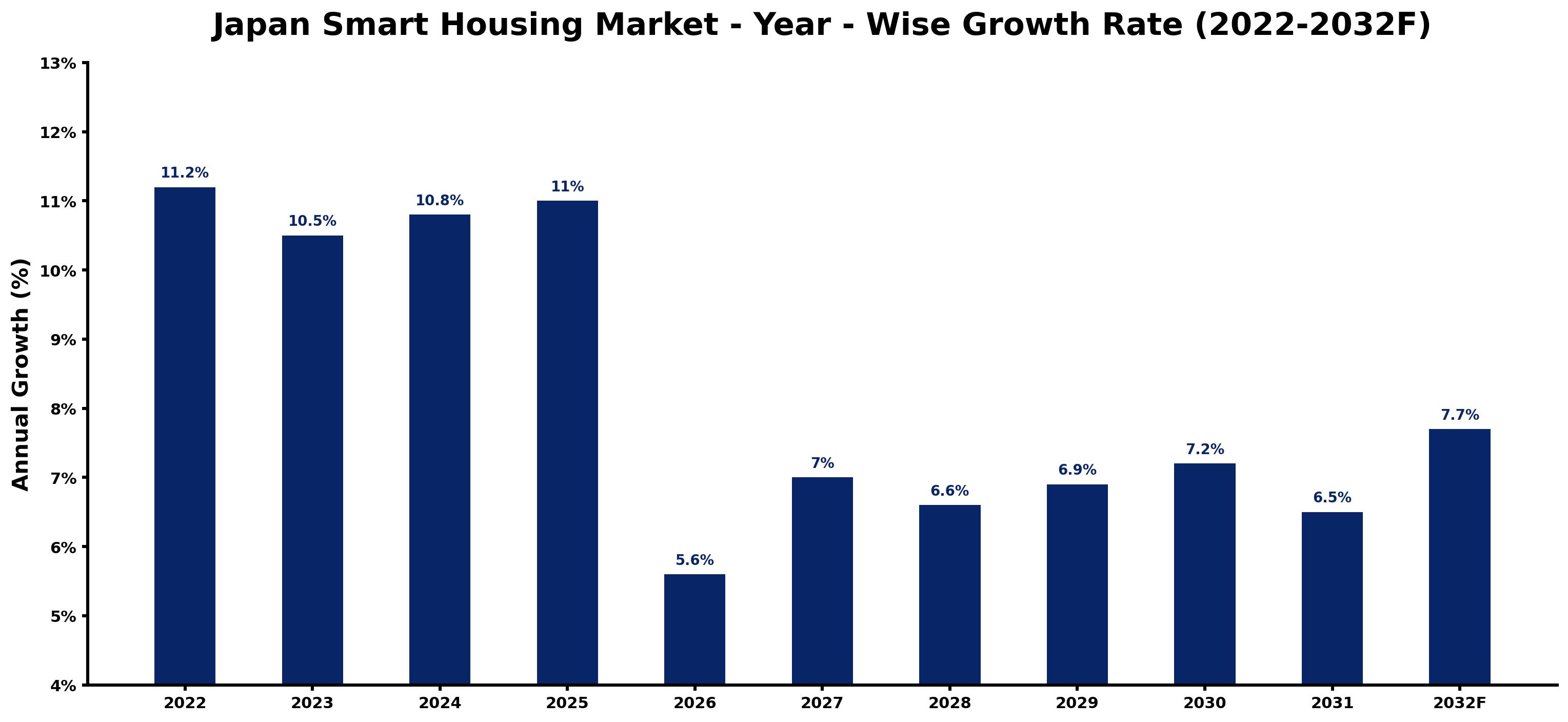
For each year, the table pairs the estimated growth rate with the leading influence on demand, showing how the drivers changed across the period.
| Year | Estimated Annual Growth (%) | Market Rationale |
| 2022 | 11.2 | The market experienced strong demand from urban planners and real estate developers. |
| 2023 | 10.5 | Growth slowed as market adjustments occurred following the previous year's peak. |
| 2024 | 10.8 | Increased investment in smart technologies led to a slight uptick in growth. |
| 2025 | 11.0 | Demand remained robust, driven by ongoing urbanisation and sustainability initiatives. |
| 2026 | 5.6 | Growth slowed due to market maturation and increased competition. |
| 2027 | 7.0 | A resurgence in demand for energy-efficient homes boosted growth rates. |
| 2028 | 6.6 | Market growth decelerated as the focus shifted to enhancing existing smart housing. |
| 2029 | 6.9 | Investment in innovative technologies spurred renewed interest in smart housing. |
| 2030 | 7.2 | Demand for net-zero energy homes increased significantly, driving market growth. |
| 2031 | 6.5 | Growth slowed as the market stabilised following years of rapid expansion. |
| 2032 | 7.7 | The market peaked as advanced technologies became standard in new developments. |
Note: Market size estimations and growth projections presented in this report are based on 6Wresearch's proprietary forecasting methodology, utilizing the latest available industry data, government publications, and primary research inputs.
Japan Smart Housing Market Synopsis
Smart housing integrates advanced technologies like IoT and AI to improve living environments, focusing on energy efficiency and enhanced security. In Japan, the market is expanding due to rising urbanisation, with over 1 million IoT-enabled homes by 2023. The government promotes eco-friendly housing initiatives, targeting net-zero energy homes by 2030, while urban planners and real estate developers drive demand for innovative housing solutions. This combination of factors is expected to sustain growth in the coming years.
Market Dynamics Impact Analysis (2026–2032)
| Factor | Type | Impact | Primary Segment Affected |
| Urbanisation and population density in cities drive demand for smart housing solutions. | Driver | High | IoT-Enabled Apartments |
| Investment in sustainable technologies is increasing among developers. | Driver | High | Sustainable Villas |
| Growing interest in energy-efficient homes creates opportunities for new developments. | Opportunity | High | Net-Zero Systems |
| Demand for smart home technology is rising among urban planners. | Opportunity | High | Centralized Automation Hub |
| High construction costs can limit the affordability of smart housing. | Restraint | High | Modular Smart Homes |
| Regulatory compliance can delay project timelines for developers. | Restraint | Medium | Senior Living Units |
| Supply chain disruptions affect the availability of smart housing materials. | Challenge | Medium | Sustainable Villas |
| Competition among developers can lead to price wars, impacting profitability. | Challenge | High | Real Estate Developers |
Evaluation of Drivers in Japan Smart Housing Market (2026–2032)
The factors lifting demand, and the evidence behind each, are summarised below.
| Drivers | Primary Segment Affected | Why It Matters (Evidence) |
| Increasing urban population density drives demand for smart housing solutions. | IoT-Enabled Apartments | In Tokyo, the population density necessitates more IoT-enabled homes being constructed. |
| Investment in sustainable technologies is rising among developers. | Sustainable Villas | With a target for net-zero energy homes by 2030, developers are investing in eco-friendly housing. |
| Government support for eco-friendly housing initiatives boosts market growth. | Net-Zero Systems | Support for sustainable housing has led to a surge in net-zero system installations. |
| Growing awareness of energy efficiency among consumers drives demand. | Solar + Smart Meters | As of 2023, over 10 million smart meters have been installed, reflecting consumer interest in energy management. |
| Technological advancements in smart home systems improve user experience. | Centralized Automation Hub | The adoption of smart home technologies has reached around 30%, encouraging developers to integrate these features. |
Behind the steady rise in orders sits a growing urban population, with Tokyo's density prompting the construction of more than 1 million IoT-enabled homes. Investment in sustainable technologies is increasing as developers aim for net-zero energy targets by 2030. The adoption rate of smart home technology stands at approximately 30%, reflecting consumer interest in energy efficiency. As urban planners integrate smart technologies into city designs, the market continues to expand rapidly, with substantial investments in housing solutions.
Evaluation of Restraints in Japan Smart Housing Market
These restraints slow adoption and weigh on supplier margins.
| Market Restraint | Primary Segment Affected | Why It Matters (Evidence) |
| High construction costs can limit the affordability of smart housing. | Modular Smart Homes | In 2023, the average cost of constructing smart homes increased, affecting buyer interest. |
| Regulatory compliance can delay project timelines for developers. | Senior Living Units | Strict regulations from the Ministry of Land, Infrastructure, Transport and Tourism can prolong development phases. |
| Supply chain disruptions affect the availability of smart housing materials. | Sustainable Villas | Recent global supply chain issues have caused delays in sourcing eco-friendly materials. |
| Limited access to financing can hinder project initiation. | IoT-Enabled Apartments | Real Estate Developers face challenges securing funding for projects due to market fluctuations. |
| Competition among developers can lead to price wars, impacting profitability. | Real Estate Developers | Increased competition in urban areas has driven down prices, affecting profit margins. |
Japan Smart Housing Market Challenges
Tokyo's rapid urbanisation has intensified competition among real estate developers, leading to price wars that inflate costs for producers and extend project timelines. Many developers struggle to integrate advanced technologies due to insufficient technical expertise, resulting in subpar installations and increased maintenance expenses for buyers. The high costs of sustainable materials, stemming from limited local supply, can elevate construction expenses by up to 20%, complicating competitive pricing for producers. A lack of skilled workers hampers the adoption of smart housing technologies, delaying project completions and restricting buyers' access to modern living environments.
Trends in the Japan Smart Housing Market
Four trends stand out in the Japan Smart Housing Market.
- Shift from Traditional to Smart Housing: Since 2022, Japan has seen a shift towards smart housing solutions, with urban planners increasingly adopting IoT technologies. Over 1 million IoT-enabled homes have been established, reflecting a growing preference for modern living environments.
- Transition from Energy-Intensive to Energy-Efficient Homes: The focus on energy efficiency has intensified, with the government promoting net-zero energy homes. By 2030, Japan aims for a substantial increase in energy-efficient housing, aligning with global sustainability trends.
- Emergence of Modular Smart Home Designs: Modular smart homes have gained traction since 2023, offering flexibility in construction. This trend is evident in urban developments, where efficient designs are increasingly preferred by buyers.
- Prioritisation of Eco-Friendly Housing Solutions: The push for sustainable living has led to a rise in eco-friendly housing initiatives. The Ministry of the Environment's budget of ¥10 billion in 2023 supports various projects promoting green technologies.
Investment Opportunities in the Japan Smart Housing Market
The opportunities below stand out in the Japan Smart Housing Market for new entrants and existing suppliers.
- Smart Home Technologies: With over 1 million IoT-enabled homes, there is a growing demand for smart home technologies. Investing in IoT solutions will cater to urban planners looking to enhance living environments.
- Eco-Friendly Building Materials: As construction costs rise, there is a need for affordable eco-friendly building materials. Partnering with local suppliers can help meet the demand from real estate developers aiming for sustainability.
- Energy Management Solutions: The increasing adoption of smart meters highlights the need for energy management solutions. Targeting urban planners will provide opportunities to supply innovative energy-efficient technologies.
- Sustainable Housing Designs: With a target for net-zero energy homes by 2030, there is a demand for sustainable housing designs. Collaborating with architects and developers can facilitate entry into this growing market.
Government Initiatives in the Japan Smart Housing Market
The Building Energy Efficiency Act, amended in 2022, requires all new buildings to meet energy standards from April 2025. This law compels producers to invest in energy-efficient technologies and materials, ensuring compliance with national sustainability goals. The Semiconductor and Digital Industry Strategy, established in June 2021, aims to secure domestic semiconductor manufacturing, which is vital for smart housing technologies, ensuring a stable supply of essential components for producers.
The Ministry of Land, Infrastructure, Transport and Tourism oversees housing regulations and funds initiatives that promote smart housing development. In 2023, the budget for smart housing initiatives was approximately ¥10 billion, supporting projects that align with eco-friendly housing goals and enhancing urban living through technology.
Future Insight of the Japan Smart Housing Market
Investment in smart housing initiatives will create demand for advanced technologies and sustainable materials, supported by a budget of approximately ¥10 billion. By 2030, the government aims for net-zero energy homes, prompting suppliers to adopt eco-friendly practices and comply with new standards. The push for energy-efficient buildings will encourage buyers to seek out sustainable options. As the number of smart meters installed in homes reaches 10 million, producers must focus on integrating IoT solutions to meet consumer expectations.
Market Segmentation Analysis
Japan Smart Housing Market report covers a detailed analysis of the following market segments:
By Housing Type – IoT-Enabled Apartments Lead, Sustainable Villas Expected to Grow Fastest
According to Saurav Kr Singh, Senior Research Analyst at 6Wresearch, the largest housing type category in 2025 was IoT-Enabled Apartments, at 39% of revenue. IoT-Enabled Apartments dominate the market due to their essential smart features that cater to modern living needs. With over 1 million IoT-enabled homes in Japan, this segment is well-established and widely adopted by urban residents. Sustainable Villas are set to record the highest CAGR in this split, 10.0% over 2026–2032. Sustainable Villas are experiencing rapid growth as eco-friendly living solutions gain traction among environmentally conscious buyers. The government's push for net-zero energy homes by 2030 is a key factor driving this segment's expansion. Suppliers should focus on developing eco-friendly technologies to meet the increasing demand for sustainable living options.
By Smart Integration – Centralized Automation Hub Leads, AI HVAC + Water Monitoring Expected to Grow Fastest
With 41% of smart integration revenue in 2025, Centralized Automation Hub was the largest category. The Centralized Automation Hub holds the largest share by effectively integrating various smart home devices, providing homeowners with a cohesive control system. This technology is particularly vital in urban areas like Tokyo, where the demand for streamlined living solutions is high. The quickest growth will come from AI HVAC + Water Monitoring, forecast to expand at a CAGR of 9.5% between 2026 and 2032. AI HVAC + Water Monitoring is witnessing rapid growth as it focuses on optimising energy use and resource management, crucial in the context of rising energy costs. The increasing emphasis on energy efficiency aligns well with the demand for sustainable living solutions. Suppliers should prioritise the development of integrated systems that enhance energy efficiency and convenience to meet the growing expectations of consumers.
By Energy System – Solar + Smart Meters Lead, Net-Zero Systems Expected to Grow Fastest
Solar + Smart Meters held 40% of the Japan Smart Housing Market by energy system in 2025. Solar + Smart Meters lead the market by promoting renewable energy usage, which aligns closely with Japan's sustainability goals. The installation of over 10 million smart meters by 2023 indicates a robust infrastructure that supports this segment's continued growth. Net-Zero Systems are projected to grow fastest, at a CAGR of 10.7% during 2026–2032. Net-Zero Systems are poised for rapid expansion as they aim for energy self-sufficiency, appealing to consumers keen on reducing energy costs. The government's target for net-zero energy homes by 2030 acts as a strong catalyst for this growth. Suppliers should focus on advancements in energy systems that enable self-sufficiency to take advantage of the rising market demand.
By End User – Real Estate Developers Lead, Urban Planners Expected to Grow Fastest
Real Estate Developers took 51% of end user revenue in 2025, more than any other category. Real Estate Developers dominate the end user segment by driving the construction of smart housing projects, effectively responding to the urban demand for modern living solutions. Their role is critical in shaping the smart housing sector throughout Japan. Over 2026–2032, Urban Planners are expected to post the fastest growth, at a CAGR of 9.2%. Urban Planners are increasingly integrating smart housing concepts into city designs, reflecting a shift towards sustainable urban development. This trend highlights the growing recognition of smart housing's role in improving urban living conditions. Collaboration with urban planners can create new opportunities for suppliers in the expanding smart housing market.
Key Attractiveness of the Report
- 10 Years of Market Numbers
- Historical Data Starting from 2022 to 2025
- Base Year 2025
- Forecast Data until 2032
- Key Performance Indicators Impacting the Market
- Major Upcoming Developments and Projects
Key Highlights of the Report:
- Japan Smart Housing Market Outlook
- Market Size of Japan Smart Housing Market, 2025
- Forecast of Japan Smart Housing Market, 2032
- Historical Data and Forecast of Japan Smart Housing Revenues & Volume for the Period 2022-2032F
- Japan Smart Housing Market Trend Evolution
- Japan Smart Housing Market Drivers and Challenges
- Japan Smart Housing Price Trends
- Japan Smart Housing Porter's Five Forces
- Japan Smart Housing Industry Life Cycle
- Historical Data and Forecast of Japan Smart Housing Market Revenues & Volume By Housing Type for the Period 2022-2032F
- Historical Data and Forecast of Japan Smart Housing Market Revenues & Volume By IoT-Enabled Apartments for the Period 2022-2032F
- Historical Data and Forecast of Japan Smart Housing Market Revenues & Volume By Sustainable Villas for the Period 2022-2032F
- Historical Data and Forecast of Japan Smart Housing Market Revenues & Volume By Modular Smart Homes for the Period 2022-2032F
- Historical Data and Forecast of Japan Smart Housing Market Revenues & Volume By Senior Living Units for the Period 2022-2032F
- Historical Data and Forecast of Japan Smart Housing Market Revenues & Volume By Smart Integration for the Period 2022-2032F
- Historical Data and Forecast of Japan Smart Housing Market Revenues & Volume By Centralized Automation Hub for the Period 2022-2032F
- Historical Data and Forecast of Japan Smart Housing Market Revenues & Volume By AI HVAC + Water Monitoring for the Period 2022-2032F
- Historical Data and Forecast of Japan Smart Housing Market Revenues & Volume By Plug-and-Play IoT for the Period 2022-2032F
- Historical Data and Forecast of Japan Smart Housing Market Revenues & Volume By Health + Motion Alerts for the Period 2022-2032F
- Historical Data and Forecast of Japan Smart Housing Market Revenues & Volume By Energy System for the Period 2022-2032F
- Historical Data and Forecast of Japan Smart Housing Market Revenues & Volume By Solar + Smart Meters for the Period 2022-2032F
- Historical Data and Forecast of Japan Smart Housing Market Revenues & Volume By Net-Zero Systems for the Period 2022-2032F
- Historical Data and Forecast of Japan Smart Housing Market Revenues & Volume By Home Grid & Batteries for the Period 2022-2032F
- Historical Data and Forecast of Japan Smart Housing Market Revenues & Volume By Wireless Sensor Networks for the Period 2022-2032F
- Historical Data and Forecast of Japan Smart Housing Market Revenues & Volume By End User for the Period 2022-2032F
- Historical Data and Forecast of Japan Smart Housing Market Revenues & Volume By Real Estate Developers for the Period 2022-2032F
- Historical Data and Forecast of Japan Smart Housing Market Revenues & Volume By Urban Planners for the Period 2022-2032F
- Historical Data and Forecast of Japan Smart Housing Market Revenues & Volume By Smart Housing Companies for the Period 2022-2032F
- Historical Data and Forecast of Japan Smart Housing Market Revenues & Volume By Assisted Living Groups for the Period 2022-2032F
- Japan Smart Housing Import Export Trade Statistics
- Market Opportunity Assessment By Housing Type
- Market Opportunity Assessment By Smart Integration
- Market Opportunity Assessment By Energy System
- Market Opportunity Assessment By End User
- Japan Smart Housing Top Companies Market Share
- Japan Smart Housing Competitive Benchmarking By Technical and Operational Parameters
- Japan Smart Housing Company Profiles
- Japan Smart Housing Key Strategic Recommendations
Market Covered
Coverage by segment is as follows.
By Housing Type
- IoT-Enabled Apartments
- Sustainable Villas
- Modular Smart Homes
- Senior Living Units
By Smart Integration
- Centralized Automation Hub
- AI HVAC + Water Monitoring
- Plug-and-Play IoT
- Health + Motion Alerts
By Energy System
- Solar + Smart Meters
- Net-Zero Systems
- Home Grid & Batteries
- Wireless Sensor Networks
By End User
- Real Estate Developers
- Urban Planners
- Smart Housing Companies
- Assisted Living Groups































