Japan Smart HVAC Control Market Size & Growth Rate
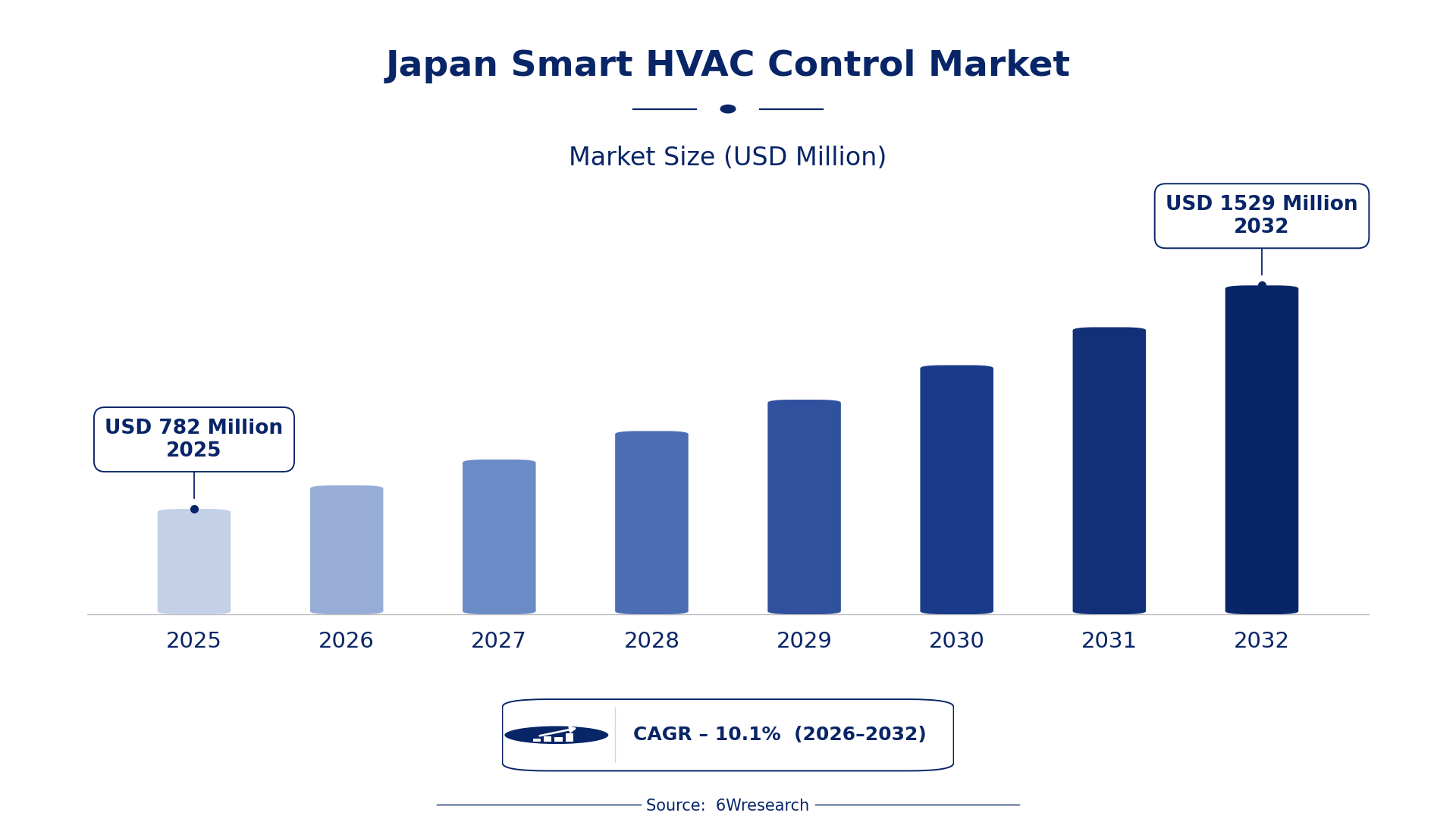
According to 6Wresearch internal database and industry insights, the Japan Smart HVAC Control Market was valued at USD 782 Million in 2025 and is projected to reach USD 1,529 Million by 2032, growing at a CAGR of approximately 10.1% during 2026–2032.
Japan Smart HVAC Control Market Highlights
| Report Metric | Details |
| Report Name | Japan Smart HVAC Control Market (2026-2032) |
| Market Size 2025 | USD 782 Million |
| Market Size 2032 | USD 1,529 Million |
| Absolute Growth 2025–2032 | USD 747 Million |
| CAGR 2026–2032 | 10.1% |
| Peak Annual Growth | 14.0% in 2032 |
| Forecast Period | 2026–2032 |
| Historical Data | 2022–2025 |
| Base Year | 2025 |
| Leading Control Type, 2025 | App-Based Thermostats (49% share) |
| Leading Feature, 2025 | Remote Temperature Setting (45% share) |
| Leading Connectivity, 2025 | Wi-Fi (49% share) |
| Leading End User, 2025 | Residential Users (39% share) |
| Fastest-Growing Control Type | AI Predictive Control (14.7% CAGR) |
| Fastest-Growing Feature | Learning Behavior Patterns (13.8% CAGR) |
| Fastest-Growing Connectivity | Edge AI (13.7% CAGR) |
| Fastest-Growing End User | HVAC Companies (13.9% CAGR) |
| Growing Sector | Residential HVAC |
| Key End Users | Residential Users, HVAC Companies, Smart Home Installers, Smart Buildings |
Japan Smart HVAC Control Market Year-wise Growth Rate and Key Drivers (2022–2032)
This graph illustrates the annual growth rates of the market from 2022 to 2032, highlighting a steady upward trajectory and projected market expansion over the forecast period.
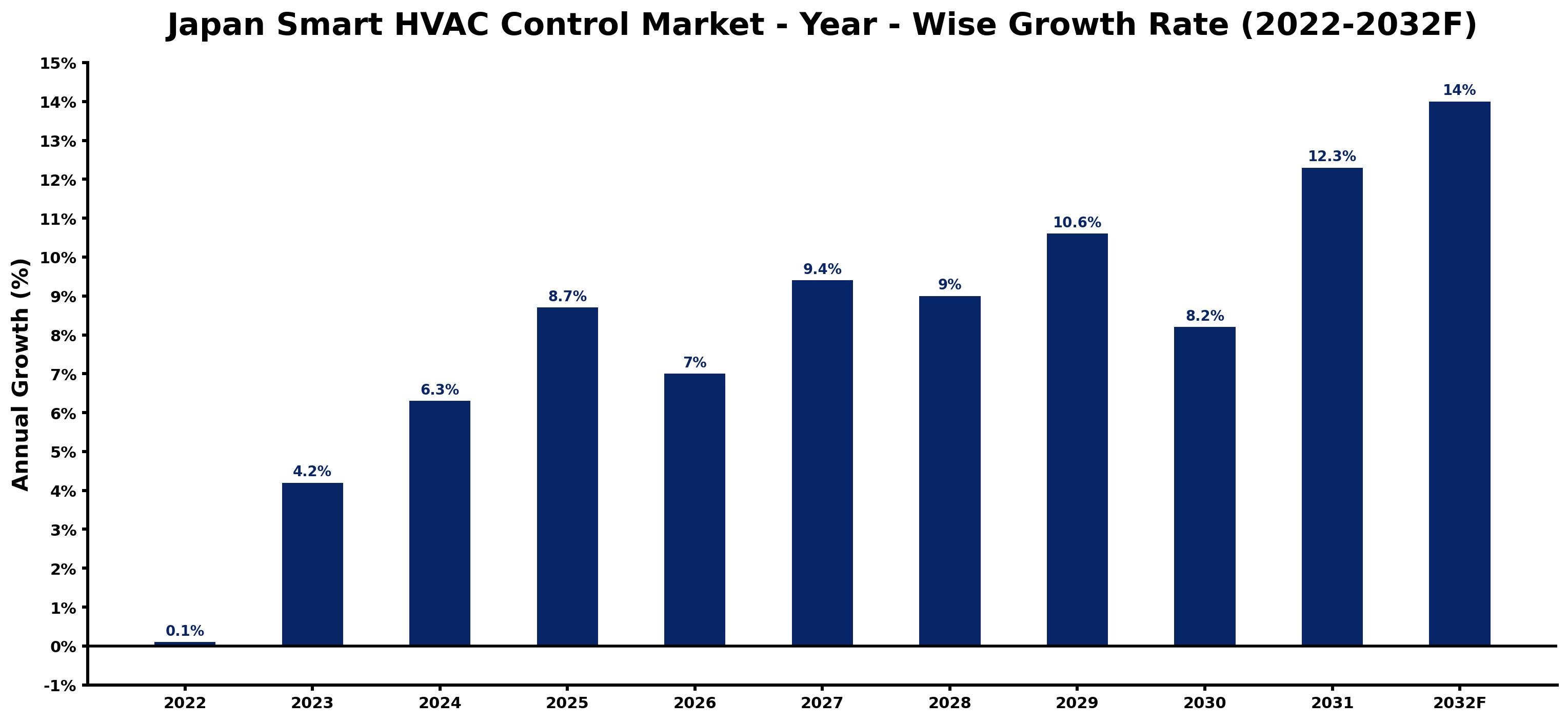
Each row of the following table gives one year's estimated growth and the event or demand shift that explains it.
| Year | Estimated Annual Growth (%) | Market Rationale |
| 2022 | 0.1 | The market experienced minimal growth as initial adoption of smart HVAC technologies began. |
| 2023 | 4.2 | Increased awareness of energy efficiency led to faster growth in smart HVAC installations. |
| 2024 | 6.3 | The rise in smart home projects contributed to a notable uptick in market activity. |
| 2025 | 8.7 | Advancements in smart building technologies boosted demand significantly. |
| 2026 | 7.0 | Growth is expected to slow slightly as the market begins to stabilise after rapid advancements. |
| 2027 | 9.4 | Investment in commercial smart HVAC systems is projected to increase, driving demand further. |
| 2028 | 9.0 | Demand is anticipated to continue growing, although at a slower pace compared to the previous year. |
| 2029 | 10.6 | The adoption of AI predictive control technologies will further accelerate market growth. |
| 2030 | 8.2 | Growth is expected to decelerate as the market adjusts to previous rapid expansions. |
| 2031 | 12.3 | Increased focus on energy efficiency standards will revitalise interest in smart HVAC solutions. |
| 2032 | 14.0 | The market is projected to peak as smart building projects reach new heights, driving substantial demand. |
Note: Market size estimations and growth projections presented in this report are based on 6Wresearch's proprietary forecasting methodology, utilizing the latest available industry data, government publications, and primary research inputs.
Japan Smart HVAC Control Market Synopsis
Smart HVAC control systems optimise heating, ventilation, and air conditioning through advanced technology, integrating sensors and software for improved energy efficiency and indoor air quality. The Japan Smart HVAC Control Market is expanding due to rising awareness of energy efficiency, with residential users and smart building projects driving demand. In 2023, Japan had approximately 10 million smart homes, increasing the need for smart HVAC solutions, while government initiatives further support this growth. The growth is also propelled by urbanisation and the rising number of smart home installations, creating a favourable environment for smart HVAC technologies.
Market Dynamics Impact Analysis (2026–2032)
| Factor | Type | Impact | Primary Segment Affected |
| Growing energy efficiency awareness among consumers | Driver | High | Residential Users |
| Increased smart building projects in urban areas | Driver | High | Smart Buildings |
| Expansion of smart home technology adoption | Opportunity | High | Smart Home Installers |
| Government initiatives promoting energy-efficient upgrades | Opportunity | High | HVAC Companies |
| High initial installation costs of smart HVAC systems | Restraint | Medium | Residential Users |
| Limited awareness of smart HVAC benefits among consumers | Restraint | Medium | Smart Home Installers |
| Competition from traditional HVAC systems | Challenge | High | HVAC Companies |
| Technological integration challenges in existing buildings | Challenge | Medium | Smart Buildings |
Evaluation of Drivers in Japan Smart HVAC Control Market (2026–2032)
Key forces behind demand, with the segment each one moves most, are listed below.
| Drivers | Primary Segment Affected | Why It Matters (Evidence) |
| Rising energy costs | Residential Users | Higher energy prices drive homeowners to invest in smart HVAC systems for cost savings. |
| Government subsidies for energy-efficient upgrades | HVAC Companies | Subsidies encourage HVAC companies to promote smart technologies to consumers. |
| Increased urbanisation and smart city initiatives | Smart Buildings | Urban areas are adopting smart technologies to improve energy management and sustainability. |
| Growing number of smart homes | Smart Home Installers | The rise in smart homes increases demand for integrated HVAC solutions. |
| Technological advancements in AI and IoT | AI Predictive Control | Innovations in AI enable more efficient energy management in HVAC systems. |
Spending rises because rising energy costs compel homeowners to invest in smart HVAC systems for cost savings. In 2023, approximately 10 million smart homes in Japan increased demand for integrated HVAC solutions. The rise in smart homes increases demand for integrated HVAC solutions, while innovations in AI and IoT enable more efficient energy management in HVAC systems, further boosting demand. The average household energy consumption of around 300 kWh per month highlights the urgency for energy-efficient solutions.
Evaluation of Restraints in Japan Smart HVAC Control Market
These are the pressures that could keep growth below its potential.
| Market Restraint | Primary Segment Affected | Why It Matters (Evidence) |
| High initial installation costs of smart HVAC systems | Residential Users | The upfront costs deter some homeowners from investing in smart HVAC solutions. |
| Limited awareness of smart HVAC benefits among consumers | Smart Home Installers | Many consumers are unaware of the advantages of smart HVAC systems, hindering adoption. |
| Competition from traditional HVAC systems | HVAC Companies | Traditional systems remain popular due to lower upfront costs and established market presence. |
| Technological integration challenges in existing buildings | Smart Buildings | Older buildings may require significant retrofitting to accommodate smart HVAC technologies. |
| Slow adoption of AI technologies in HVAC | AI Predictive Control | The integration of AI technologies is still in the early stages, limiting widespread use. |
Japan Smart HVAC Control Market Challenges
Buyers encounter rising installation costs as Japan's minimum wage increases to JPY 1,055 per hour, leading to higher overall project expenses. A shortage of skilled technicians in advanced HVAC technologies delays project timelines, forcing buyers to wait longer for installations. Regulatory pressures from the Ministry of the Environment necessitate compliance with energy efficiency standards, raising costs for suppliers who must adapt their products. High upgrade costs for smart HVAC systems, which account for 30% of total building energy use, deter buyers from making necessary investments.
Trends in the Japan Smart HVAC Control Market
Several trends are reshaping the Japan Smart HVAC Control Market; the most important are set out below.
- Shift from Traditional to Smart HVAC Systems: Residential users are increasingly adopting smart HVAC solutions, with over 20% of new residential buildings equipped with these systems in 2023. This shift reflects a growing preference for energy-efficient technologies.
- Tokyo Leading Smart HVAC Adoption: Tokyo is a major region for smart HVAC adoption, driven by numerous smart building projects. The city's initiatives to promote smart city technologies have resulted in a notable increase in smart HVAC installations.
- Increase in AI Predictive Control Technologies: The adoption of AI predictive control technologies is rising, particularly in commercial HVAC systems. In urban areas, these technologies are increasingly integrated to optimise energy use, improving overall efficiency.
- Growth of Smart Home Technology: The adoption of smart home technology is expected to reach 50% of households by 2025, influencing HVAC demand. This trend indicates a shift towards more integrated and user-friendly HVAC solutions.
Investment Opportunities in the Japan Smart HVAC Control Market
Investors looking at the Japan Smart HVAC Control Market should consider the following areas.
- Supply of Energy-Efficient HVAC Solutions: Investing in energy-efficient HVAC systems presents a strong opportunity, with the average household energy consumption around 300 kWh per month. HVAC companies can tap into this demand by offering advanced solutions.
- Partnerships with Smart Home Installers: Forming partnerships with smart home installers can facilitate entry into the market. With the expected growth in smart homes, collaborating with installers can enhance market reach.
- Investment in AI Technologies: Now is the time to invest in AI technologies for HVAC systems, as urban areas increasingly adopt these innovations. The integration of AI can lead to improved energy management and efficiency.
- Focus on Government Subsidies: With government subsidies supporting energy-efficient upgrades, HVAC companies can utilise this funding to promote smart HVAC solutions. In 2023, these initiatives significantly boosted market activity.
Government Initiatives in the Japan Smart HVAC Control Market
The Building Energy Efficiency Act, amended in 2022, mandates that all new buildings meet energy standards starting in April 2025. This law compels producers to ensure their HVAC systems comply with stringent energy efficiency guidelines, raising overall market standards. The Ministry of the Environment also promotes energy efficiency standards for HVAC systems under the Energy Conservation Act, further enhancing compliance requirements for manufacturers.
In 2023, JPY 5 billion was allocated by the Ministry of Economy, Trade and Industry for promoting energy-efficient technologies in HVAC systems. This funding supports various projects aimed at improving HVAC performance and encourages innovation in the sector, benefiting both producers and buyers.
Future Insight of the Japan Smart HVAC Control Market
By 2032, buyers will benefit from enhanced energy efficiency as smart home technology adoption reaches 50% of households, driving demand for advanced HVAC solutions. The Tokyo Metropolitan Government's initiatives will further promote smart city technologies, creating new opportunities for suppliers. Adoption of ISO 50001 standards will encourage efficient energy management practices, positively impacting both buyers and suppliers. With over 20% of new residential buildings equipped with smart HVAC systems, the market will increasingly focus on sustainable living environments.
Market Segmentation Analysis
Japan Smart HVAC Control Market report covers a detailed analysis of the following market segments:
By Control Type – App-Based Thermostats Lead, AI Predictive Control Expected to Grow Fastest
According to Saurav Kr Singh, Senior Research Analyst at 6Wresearch, with 49% of control type revenue in 2025, App-Based Thermostats was the largest category. App-based thermostats lead the market due to their popularity among residential users who prefer convenient control through mobile applications. This segment's strength is highlighted by the substantial increase in smart homes, estimated at 10 million in Japan in 2023. Over 2026–2032, AI Predictive Control is expected to post the fastest growth, at a CAGR of 14.7%. AI predictive control is rapidly gaining traction as it optimises energy use through advanced algorithms, aligning with Japan's commitment to energy efficiency. The government's focus on energy-saving practices supports the growth of this technology, ensuring its continued relevance. Suppliers should focus on developing app-based solutions while also addressing the rising interest in predictive control technologies.
By Feature – Remote Temperature Setting Leads, Learning Behavior Patterns Expected to Grow Fastest
In 2025, Remote Temperature Setting led the feature split with a 45% share. Remote temperature setting is the leading feature since it allows users to manage HVAC systems conveniently from various locations, significantly enhancing user satisfaction. This capability is particularly beneficial in urban centres like Tokyo, where smart buildings are increasingly prevalent. The quickest growth will come from Learning Behavior Patterns, forecast to expand at a CAGR of 13.8% between 2026 and 2032. Learning behaviour patterns is the fastest-growing feature as it optimises system efficiency by adapting to user habits, which is essential in energy-conscious markets. This trend reflects the ongoing demand for smarter HVAC solutions that cater to individual preferences. Suppliers should focus on developing features that enhance user convenience and energy efficiency to meet market demands.
By Connectivity – Wi-Fi Leads, Edge AI Expected to Grow Fastest
Wi-Fi held 49% of the Japan Smart HVAC Control Market by connectivity in 2025. Wi-Fi is the predominant connectivity option because it is essential for enabling remote control and monitoring of HVAC systems, a key requirement for users. Its widespread adoption is evident in the increasing integration of smart technologies within residential buildings. Edge AI is projected to grow fastest, at a CAGR of 13.7% during 2026–2032. Edge AI is rapidly gaining traction as it allows for localised processing, which reduces latency and improves response times for HVAC systems. The growth of this technology indicates a broader trend towards more efficient and responsive systems in urban environments. Suppliers need to ensure robust Wi-Fi solutions while also exploring Edge AI capabilities to meet evolving connectivity requirements.
By End User – Residential Users Lead, HVAC Companies Expected to Grow Fastest
The largest end user category in 2025 was Residential Users, at 39% of revenue. Residential users represent the largest segment as they are the primary adopters of smart HVAC solutions, driven by the need for energy efficiency and enhanced comfort. With over 20% of new residential buildings equipped with smart HVAC systems, this segment is crucial for market growth. HVAC Companies are set to record the highest CAGR in this split, 13.9% over 2026–2032. HVAC companies are the fastest-growing end user segment as they increasingly integrate smart solutions into their offerings, responding to the rising consumer demand for advanced technologies. This shift underscores the growing collaboration between manufacturers and service providers. Suppliers should engage with HVAC companies to expand their market presence and tailor products to meet the needs of residential users.
Key Attractiveness of the Report
- 10 Years of Market Numbers
- Historical Data Starting from 2022 to 2025
- Base Year 2025
- Forecast Data until 2032
- Key Performance Indicators Impacting the Market
- Major Upcoming Developments and Projects
Key Highlights of the Report:
- Japan Smart HVAC Control Market Outlook
- Market Size of Japan Smart HVAC Control Market, 2025
- Forecast of Japan Smart HVAC Control Market, 2032
- Historical Data and Forecast of Japan Smart HVAC Control Revenues & Volume for the Period 2022-2032F
- Japan Smart HVAC Control Market Trend Evolution
- Japan Smart HVAC Control Market Drivers and Challenges
- Japan Smart HVAC Control Price Trends
- Japan Smart HVAC Control Porter's Five Forces
- Japan Smart HVAC Control Industry Life Cycle
- Historical Data and Forecast of Japan Smart HVAC Control Market Revenues & Volume By Control Type for the Period 2022-2032F
- Historical Data and Forecast of Japan Smart HVAC Control Market Revenues & Volume By App-Based Thermostats for the Period 2022-2032F
- Historical Data and Forecast of Japan Smart HVAC Control Market Revenues & Volume By AI Predictive Control for the Period 2022-2032F
- Historical Data and Forecast of Japan Smart HVAC Control Market Revenues & Volume By Occupancy-Based HVAC for the Period 2022-2032F
- Historical Data and Forecast of Japan Smart HVAC Control Market Revenues & Volume By Voice-Integrated HVAC for the Period 2022-2032F
- Historical Data and Forecast of Japan Smart HVAC Control Market Revenues & Volume By Feature for the Period 2022-2032F
- Historical Data and Forecast of Japan Smart HVAC Control Market Revenues & Volume By Remote Temperature Setting for the Period 2022-2032F
- Historical Data and Forecast of Japan Smart HVAC Control Market Revenues & Volume By Learning Behavior Patterns for the Period 2022-2032F
- Historical Data and Forecast of Japan Smart HVAC Control Market Revenues & Volume By Motion Sensor Integration for the Period 2022-2032F
- Historical Data and Forecast of Japan Smart HVAC Control Market Revenues & Volume By Command-Based Adjustment for the Period 2022-2032F
- Historical Data and Forecast of Japan Smart HVAC Control Market Revenues & Volume By Connectivity for the Period 2022-2032F
- Historical Data and Forecast of Japan Smart HVAC Control Market Revenues & Volume By Wi-Fi for the Period 2022-2032F
- Historical Data and Forecast of Japan Smart HVAC Control Market Revenues & Volume By Edge AI for the Period 2022-2032F
- Historical Data and Forecast of Japan Smart HVAC Control Market Revenues & Volume By Multi-Zone HVAC for the Period 2022-2032F
- Historical Data and Forecast of Japan Smart HVAC Control Market Revenues & Volume By Alexa/Google Assistant for the Period 2022-2032F
- Historical Data and Forecast of Japan Smart HVAC Control Market Revenues & Volume By End User for the Period 2022-2032F
- Historical Data and Forecast of Japan Smart HVAC Control Market Revenues & Volume By Residential Users for the Period 2022-2032F
- Historical Data and Forecast of Japan Smart HVAC Control Market Revenues & Volume By HVAC Companies for the Period 2022-2032F
- Historical Data and Forecast of Japan Smart HVAC Control Market Revenues & Volume By Smart Buildings for the Period 2022-2032F
- Historical Data and Forecast of Japan Smart HVAC Control Market Revenues & Volume By Smart Home Installers for the Period 2022-2032F
- Japan Smart HVAC Control Import Export Trade Statistics
- Market Opportunity Assessment By Control Type
- Market Opportunity Assessment By Feature
- Market Opportunity Assessment By Connectivity
- Market Opportunity Assessment By End User
- Japan Smart HVAC Control Top Companies Market Share
- Japan Smart HVAC Control Competitive Benchmarking By Technical and Operational Parameters
- Japan Smart HVAC Control Company Profiles
- Japan Smart HVAC Control Key Strategic Recommendations
Market Covered
This report examines the market across the segments below.
By Control Type
- App-Based Thermostats
- AI Predictive Control
- Occupancy-Based HVAC
- Voice-Integrated HVAC
By Feature
- Remote Temperature Setting
- Learning Behavior Patterns
- Motion Sensor Integration
- Command-Based Adjustment
By Connectivity
- Wi-Fi
- Edge AI
- Multi-Zone HVAC
- Alexa/Google Assistant
By End User
- Residential Users
- HVAC Companies
- Smart Buildings
- Smart Home Installers































