Japan Smart Infrastructure Sensor Market Size & Growth Rate
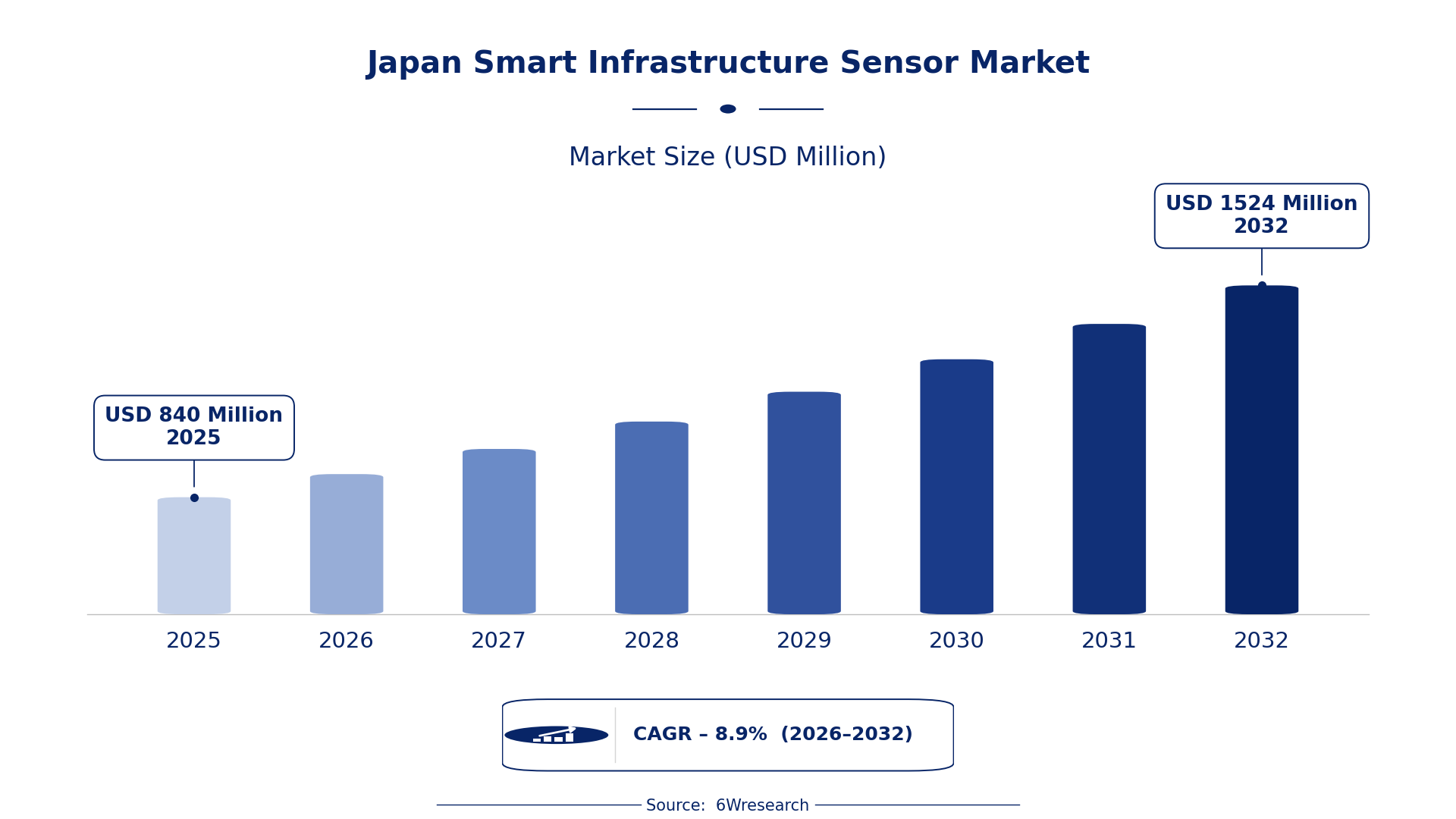
According to 6Wresearch internal database and industry insights, the Japan Smart Infrastructure Sensor Market was valued at USD 840 Million in 2025 and is projected to reach USD 1,524 Million by 2032, growing at a CAGR of approximately 8.9% during 2026–2032.
Japan Smart Infrastructure Sensor Market Highlights
| Report Metric | Details |
| Report Name | Japan Smart Infrastructure Sensor Market (2026-2032) |
| Market Size 2025 | USD 840 Million |
| Market Size 2032 | USD 1,524 Million |
| Absolute Growth 2025–2032 | USD 684 Million |
| CAGR 2026–2032 | 8.9% |
| Peak Annual Growth | 10.3% in 2026 |
| Forecast Period | 2026–2032 |
| Historical Data | 2022–2025 |
| Base Year | 2025 |
| Leading Sensor Type, 2025 | Strain Sensors (48% share) |
| Leading Monitoring Feature, 2025 | Earthquake Resistance (44% share) |
| Leading Infrastructure Type, 2025 | Transportation Structures (47% share) |
| Leading End User, 2025 | Civil Engineers (39% share) |
| Fastest-Growing Sensor Type | Moisture Sensors (12.7% CAGR) |
| Fastest-Growing Monitoring Feature | Water Leak Detection (11.2% CAGR) |
| Fastest-Growing Infrastructure Type | Pipelines & Tunnels (12.2% CAGR) |
| Fastest-Growing End User | Municipal Authorities (11.1% CAGR) |
| Growing Sector | Municipal Authorities |
| Key End Users | Civil Engineers, Municipal Authorities, Infrastructure Developers, Water Authorities |
Japan Smart Infrastructure Sensor Market Year-wise Growth Rate and Key Drivers (2022–2032)
This graph illustrates the annual growth rates of the market from 2022 to 2032, highlighting a steady upward trajectory and projected market expansion over the forecast period.
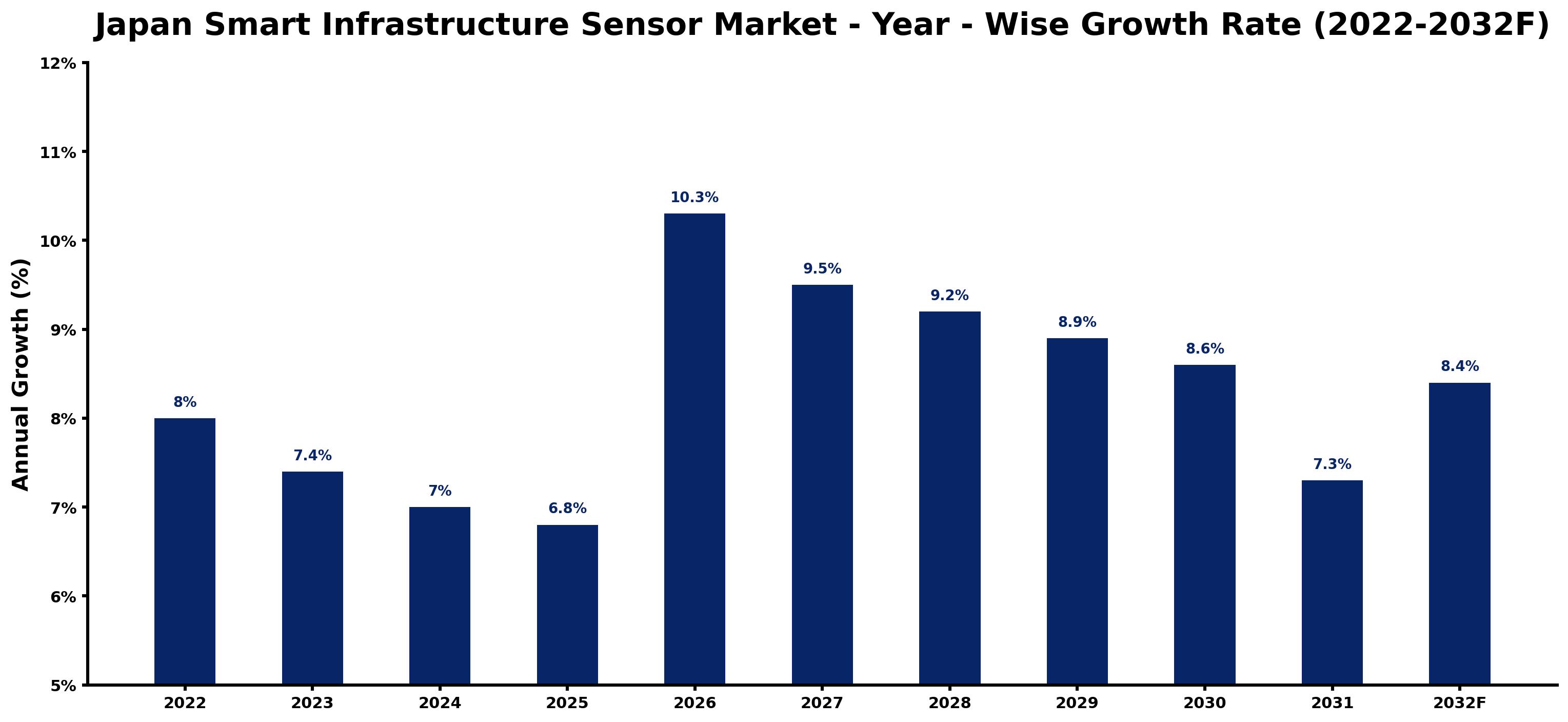
Annual growth estimates for each year appear below with the principal reason behind them, explaining the shifts that set the pace of the market.
| Year | Estimated Annual Growth (%) | Market Rationale |
| 2022 | 8.0 | The market experienced strong growth due to heightened infrastructure investments. |
| 2023 | 7.4 | Growth slowed as projects faced delays in implementation and funding adjustments. |
| 2024 | 7.0 | The market continued to slow as infrastructure projects faced budget constraints. |
| 2025 | 6.8 | Growth decelerated further as economic uncertainties affected infrastructure spending. |
| 2026 | 10.3 | Demand surged with increased investments in earthquake resistance technologies. |
| 2027 | 9.5 | Growth is expected to slow as the market adjusts to new technology standards. |
| 2028 | 9.2 | The market's growth rate is projected to decrease as competition intensifies among suppliers. |
| 2029 | 8.9 | Demand is anticipated to slow as infrastructure projects face regulatory hurdles. |
| 2030 | 8.6 | Growth is expected to moderate as market saturation begins to affect new sensor deployments. |
| 2031 | 7.3 | The market will experience a slowdown as infrastructure budgets face cuts. |
| 2032 | 8.4 | Growth is projected to accelerate again as new government initiatives revitalise infrastructure spending. |
Note: Market size estimations and growth projections presented in this report are based on 6Wresearch's proprietary forecasting methodology, utilizing the latest available industry data, government publications, and primary research inputs.
Japan Smart Infrastructure Sensor Market Synopsis
Smart Infrastructure Sensors are advanced devices designed to monitor the health and performance of infrastructure systems, utilising technologies such as piezoelectric and optical fibres. The Japan Smart Infrastructure Sensor Market is expanding due to ongoing infrastructure development, particularly in earthquake-prone areas, with a focus on government projects and civil engineering applications. Investments in modernization and resilience are on the rise, highlighted by the government's allocation of ¥10 billion for infrastructure improvements in 2023.
Market Dynamics Impact Analysis (2026–2032)
| Factor | Type | Impact | Primary Segment Affected |
| Increased investment in earthquake resistance technologies | Driver | High | Earthquake Resistance |
| Growing urbanisation leading to infrastructure expansion | Driver | High | Transportation Structures |
| Rising need for real-time monitoring solutions | Opportunity | High | Moisture Sensors |
| Emergence of new smart sensor technologies | Opportunity | High | Vibration Sensors |
| High costs of sensor installation and maintenance | Restraint | Medium | Strain Sensors |
| Limited awareness among smaller infrastructure developers | Restraint | Medium | Tilt Sensors |
| Competition from low-cost alternatives | Challenge | High | Pipelines & Tunnels |
| Technological challenges in sensor integration | Challenge | Medium | Buildings |
Evaluation of Drivers in Japan Smart Infrastructure Sensor Market (2026–2032)
The table below links each growth driver to the segment it affects and the evidence for it.
| Drivers | Primary Segment Affected | Why It Matters (Evidence) |
| Increased government funding for infrastructure projects | Transportation Structures | The Tokyo Metropolitan Government invested ¥10 billion in smart sensor technologies, leading to more purchases from civil engineers. |
| Growing urban population necessitating infrastructure upgrades | Earthquake Resistance | With Tokyo's population nearing 14 million, demand for resilient infrastructure solutions has risen. |
| Technological advancements in sensor accuracy and reliability | Moisture Sensors | The introduction of new standards like JIS Z 9901 has improved sensor performance, increasing buyer confidence. |
| Rising awareness of infrastructure safety standards | Vibration Sensors | The Japan Society of Civil Engineers promotes smart technologies, driving demand among infrastructure developers. |
| Increased focus on maintenance strategies | Strain Sensors | The average age of bridges in Japan exceeds 40 years, necessitating real-time monitoring solutions. |
The growing urban population, particularly in Tokyo, necessitates infrastructure upgrades, driving demand for earthquake resistance solutions. Technological advancements have improved sensor accuracy and reliability, boosting buyer confidence. Rising awareness of safety standards has stimulated demand for vibration sensors. The age of bridges in Japan, averaging over 40 years, creates a pressing need for strain sensors to monitor structural integrity.
Evaluation of Restraints in Japan Smart Infrastructure Sensor Market
The main factors holding the market back are set out below.
| Market Restraint | Primary Segment Affected | Why It Matters (Evidence) |
| Compliance with JIS Z 9901 standards can delay project timelines by up to six months for infrastructure developers | Transportation Structures | This regulation requires extensive testing and certification, impacting project schedules. |
| Suppliers struggle to keep pace with rapid technological advancements, resulting in outdated products | Earthquake Resistance | This can lead to buyer dissatisfaction and reduced market competitiveness. |
| The average age of bridges in Japan exceeds 40 years, increasing maintenance costs for municipalities | Strain Sensors | This necessitates investment in monitoring solutions to ensure safety. |
| Skills shortages in advanced sensor technologies hinder suppliers from meeting the growing demand | Moisture Sensors | This causes delays in project completions for contractors and affects infrastructure safety. |
| Regulatory hurdles can slow down the adoption of new sensor technologies | Vibration Sensors | This impacts the timely implementation of essential monitoring systems. |
Japan Smart Infrastructure Sensor Market Challenges
Over 60% of civil engineers in Japan utilise smart sensors, yet JIS Z 9901 standards can delay project timelines by up to six months for infrastructure developers. Many suppliers struggle to keep pace with rapid technological advancements, resulting in products that fail to meet buyer expectations. The average age of bridges in Japan surpasses 40 years, increasing maintenance costs by 25% for municipalities that must invest in monitoring solutions. A shortage of skilled professionals in advanced sensor technologies limits suppliers' capacity to fulfil buyer needs, causing delays in project completions for contractors.
Trends in the Japan Smart Infrastructure Sensor Market
These developments are changing demand patterns in the Japan Smart Infrastructure Sensor Market.
- Shift towards Advanced Monitoring Technologies: Kansai is experiencing a shift towards advanced monitoring technologies in infrastructure projects, with over 1,000 bridges equipped with smart sensors for load monitoring. This trend improves safety and efficiency in civil engineering.
- Transition from Reactive to Proactive Maintenance: In 2023, the Ministry of Land, Infrastructure, Transport and Tourism launched a program to enhance infrastructure resilience, promoting proactive maintenance strategies. This shift will increase sensor adoption across various projects.
- Emerging Focus on Water Leak Detection: Municipal authorities are prioritising water leak detection technologies in urban water systems, prompted by an average annual rainfall of 1,700 mm. This trend is driving innovation in moisture sensor applications.
- Increased Integration of Smart Sensors in Urban Planning: The Tokyo Bay Aqua-Line has implemented smart sensors for real-time monitoring of structural health, reflecting a broader trend towards integrating smart technologies in urban planning.
Investment Opportunities in the Japan Smart Infrastructure Sensor Market
Below are the investment opportunities with the strongest case in the Japan Smart Infrastructure Sensor Market.
- Partnerships with Local Authorities: Now is the time to invest in partnerships with local authorities in the Kansai region, where infrastructure development is booming. This area is projected to see increased sensor deployment, creating opportunities for suppliers.
- Expansion into Transportation Infrastructure: The ongoing Chuo Shinkansen project presents an opportunity to supply advanced monitoring systems, with a projected investment of ¥10 billion. Suppliers can enter through joint ventures with infrastructure developers.
- Focus on Urban Water Management Solutions: With the increasing focus on water leak detection, there is a strong opportunity to supply moisture sensors. Municipal authorities are actively seeking innovative solutions to enhance urban water management.
- Investment in Earthquake Resistance Technologies: The government's allocation of ¥10 billion for infrastructure improvements creates an opportunity to invest in earthquake resistance technologies, particularly in urban areas prone to seismic activity.
Government Initiatives in the Japan Smart Infrastructure Sensor Market
The Economic Security Promotion Act (2022) supports supply-chain resilience for critical products, directly benefiting producers of smart infrastructure sensors by ensuring a stable supply of materials. This measure encourages local manufacturing and reduces dependency on imports, strengthening the market's stability.
The Ministry of Land, Infrastructure, Transport and Tourism oversees the implementation of the Economic Security Promotion Act, which allocates funding for infrastructure modernization projects. This initiative promotes the adoption of smart technologies, allowing municipal authorities to strengthen their infrastructure resilience.
Future Insight of the Japan Smart Infrastructure Sensor Market
The upcoming ¥10 billion investment in infrastructure modernisation will create substantial demand for smart sensors among suppliers. By 2032, advancements in monitoring systems will enhance urban safety, prompting increased adoption across various projects. The Chuo Shinkansen project will set a benchmark for integrating advanced technologies in infrastructure. As urban areas face rising rainfall levels, the focus on moisture detection will expand, driving innovation in sensor applications.
Market Segmentation Analysis
Japan Smart Infrastructure Sensor Market report covers a detailed analysis of the following market segments:
By Sensor Type – Strain Sensors Lead, Moisture Sensors Expected to Grow Fastest
According to Saurav Kr Singh, Senior Research Analyst at 6Wresearch, Strain Sensors took 48% of sensor type revenue in 2025, more than any other category. Strain sensors are essential for monitoring the structural integrity of infrastructure, particularly in a nation with a significant number of aging bridges. Their deployment in over 1,000 bridges across Japan underscores their vital role in civil engineering projects. The quickest growth will come from Moisture Sensors, forecast to expand at a CAGR of 12.7% between 2026 and 2032. The surge in moisture sensors is primarily driven by Japan's average annual rainfall of 1,700 mm, necessitating effective solutions for water damage prevention. Urban areas are increasingly prioritising these sensors to mitigate moisture-related risks in infrastructure. Suppliers need to focus on developing moisture sensors to address the growing urban demand.
By Monitoring Feature – Earthquake Resistance Leads, Water Leak Detection Expected to Grow Fastest
In 2025, Earthquake Resistance led the monitoring feature split with a 44% share. Earthquake resistance features are vital for assessing infrastructure resilience against seismic activity, especially in a country prone to earthquakes. The Tokyo Metropolitan Government's investments in earthquake resistance technologies underscore the importance of this monitoring feature. Water Leak Detection is set to record the highest CAGR in this split, 11.2% over 2026–2032. Water leak detection is gaining traction as municipalities prioritise maintaining pipeline integrity and preventing damage, particularly in urban settings. The Ministry of the Environment's promotion of water leak detection technologies further accelerates this segment's growth. Buyers will increasingly seek advanced water leak detection solutions to protect urban infrastructure.
By Infrastructure Type – Transportation Structures Lead, Pipelines & Tunnels Expected to Grow Fastest
Transportation Structures accounted for 47% of the market by infrastructure type in 2025. Transportation structures are a major application area for smart sensors in Japan, reflecting the country's extensive network of roads and railways. This sector's focus on safety and efficiency drives the demand for monitoring technologies. Pipelines & Tunnels are projected to grow fastest, at a CAGR of 12.2% during 2026–2032. Pipelines and tunnels are becoming increasingly important for monitoring subsurface structures, particularly as urbanisation intensifies. The need for effective monitoring solutions in these areas is underscored by ongoing infrastructure projects. Suppliers must tailor their products to meet the specific needs of pipeline and tunnel monitoring.
By End User – Civil Engineers Lead, Municipal Authorities Expected to Grow Fastest
The largest end user category in 2025 was Civil Engineers, at 39% of revenue. Civil engineers are the primary users of smart infrastructure sensors, utilising them for project planning and ensuring safety in construction. Their crucial involvement in infrastructure projects significantly elevates the demand for these technologies. Over 2026–2032, Municipal Authorities are expected to post the fastest growth, at a CAGR of 11.1%. Municipal authorities are rapidly embracing smart infrastructure solutions to enhance urban safety and improve operational efficiency, reflecting a shift towards more integrated management of public resources. This increasing responsibility drives their swift adoption of these technologies. Suppliers should engage with municipal authorities to align their products with the changing requirements of urban infrastructure.
Key Attractiveness of the Report
- 10 Years of Market Numbers
- Historical Data Starting from 2022 to 2025
- Base Year 2025
- Forecast Data until 2032
- Key Performance Indicators Impacting the Market
- Major Upcoming Developments and Projects
Key Highlights of the Report:
- Japan Smart Infrastructure Sensor Market Outlook
- Market Size of Japan Smart Infrastructure Sensor Market, 2025
- Forecast of Japan Smart Infrastructure Sensor Market, 2032
- Historical Data and Forecast of Japan Smart Infrastructure Sensor Revenues & Volume for the Period 2022-2032F
- Japan Smart Infrastructure Sensor Market Trend Evolution
- Japan Smart Infrastructure Sensor Market Drivers and Challenges
- Japan Smart Infrastructure Sensor Price Trends
- Japan Smart Infrastructure Sensor Porter's Five Forces
- Japan Smart Infrastructure Sensor Industry Life Cycle
- Historical Data and Forecast of Japan Smart Infrastructure Sensor Market Revenues & Volume By Sensor Type for the Period 2022-2032F
- Historical Data and Forecast of Japan Smart Infrastructure Sensor Market Revenues & Volume By Strain Sensors for the Period 2022-2032F
- Historical Data and Forecast of Japan Smart Infrastructure Sensor Market Revenues & Volume By Tilt Sensors for the Period 2022-2032F
- Historical Data and Forecast of Japan Smart Infrastructure Sensor Market Revenues & Volume By Moisture Sensors for the Period 2022-2032F
- Historical Data and Forecast of Japan Smart Infrastructure Sensor Market Revenues & Volume By Vibration Sensors for the Period 2022-2032F
- Historical Data and Forecast of Japan Smart Infrastructure Sensor Market Revenues & Volume By Monitoring Feature for the Period 2022-2032F
- Historical Data and Forecast of Japan Smart Infrastructure Sensor Market Revenues & Volume By Bridge Load Monitoring for the Period 2022-2032F
- Historical Data and Forecast of Japan Smart Infrastructure Sensor Market Revenues & Volume By Earthquake Resistance for the Period 2022-2032F
- Historical Data and Forecast of Japan Smart Infrastructure Sensor Market Revenues & Volume By Water Leak Detection for the Period 2022-2032F
- Historical Data and Forecast of Japan Smart Infrastructure Sensor Market Revenues & Volume By Early Fault Detection for the Period 2022-2032F
- Historical Data and Forecast of Japan Smart Infrastructure Sensor Market Revenues & Volume By Infrastructure Type for the Period 2022-2032F
- Historical Data and Forecast of Japan Smart Infrastructure Sensor Market Revenues & Volume By Transportation Structures for the Period 2022-2032F
- Historical Data and Forecast of Japan Smart Infrastructure Sensor Market Revenues & Volume By Buildings for the Period 2022-2032F
- Historical Data and Forecast of Japan Smart Infrastructure Sensor Market Revenues & Volume By Pipelines & Tunnels for the Period 2022-2032F
- Historical Data and Forecast of Japan Smart Infrastructure Sensor Market Revenues & Volume By Industrial Foundations for the Period 2022-2032F
- Historical Data and Forecast of Japan Smart Infrastructure Sensor Market Revenues & Volume By End User for the Period 2022-2032F
- Historical Data and Forecast of Japan Smart Infrastructure Sensor Market Revenues & Volume By Civil Engineers for the Period 2022-2032F
- Historical Data and Forecast of Japan Smart Infrastructure Sensor Market Revenues & Volume By Municipal Authorities for the Period 2022-2032F
- Historical Data and Forecast of Japan Smart Infrastructure Sensor Market Revenues & Volume By Water Authorities for the Period 2022-2032F
- Historical Data and Forecast of Japan Smart Infrastructure Sensor Market Revenues & Volume By Infrastructure Developers for the Period 2022-2032F
- Japan Smart Infrastructure Sensor Import Export Trade Statistics
- Market Opportunity Assessment By Sensor Type
- Market Opportunity Assessment By Monitoring Feature
- Market Opportunity Assessment By Infrastructure Type
- Market Opportunity Assessment By End User
- Japan Smart Infrastructure Sensor Top Companies Market Share
- Japan Smart Infrastructure Sensor Competitive Benchmarking By Technical and Operational Parameters
- Japan Smart Infrastructure Sensor Company Profiles
- Japan Smart Infrastructure Sensor Key Strategic Recommendations
Market Covered
Coverage by segment is as follows.
By Sensor Type
- Strain Sensors
- Tilt Sensors
- Moisture Sensors
- Vibration Sensors
By Monitoring Feature
- Bridge Load Monitoring
- Earthquake Resistance
- Water Leak Detection
- Early Fault Detection
By Infrastructure Type
- Transportation Structures
- Buildings
- Pipelines & Tunnels
- Industrial Foundations
By End User
- Civil Engineers
- Municipal Authorities
- Water Authorities
- Infrastructure Developers































