Japan Smart Inventory Management Market Size & Growth Rate
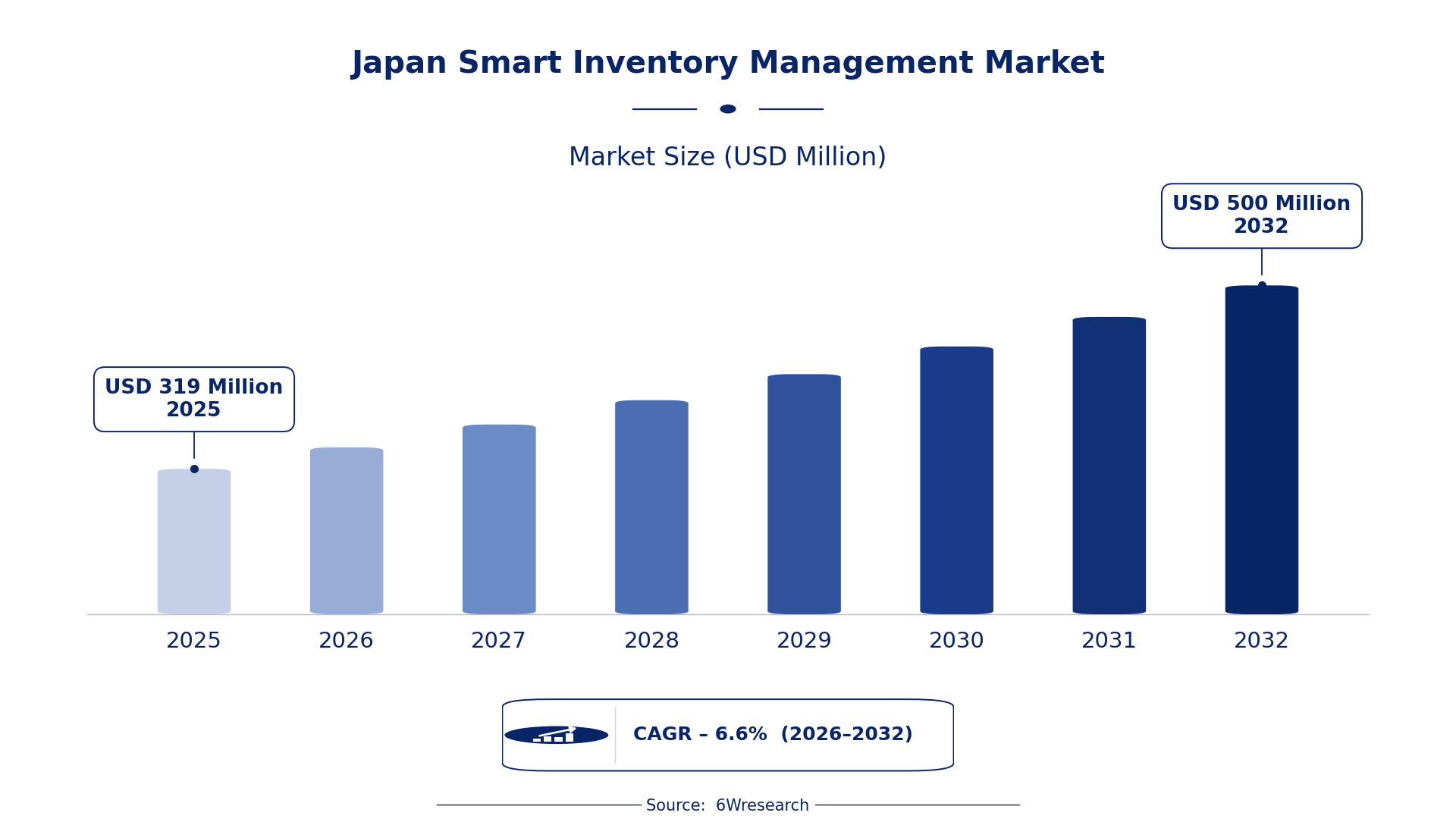
According to 6Wresearch internal database and industry insights, the Japan Smart Inventory Management Market was valued at USD 319 Million in 2025 and is projected to reach USD 500 Million by 2032, growing at a CAGR of approximately 6.6% during 2026–2032.
Japan Smart Inventory Management Market Highlights
| Report Metric | Details |
| Report Name | Japan Smart Inventory Management Market (2026-2032) |
| Market Size 2025 | USD 319 Million |
| Market Size 2032 | USD 500 Million |
| Absolute Growth 2025–2032 | USD 181 Million |
| CAGR 2026–2032 | 6.6% |
| Peak Annual Growth | 7.5% in 2027 |
| Forecast Period | 2026–2032 |
| Historical Data | 2022–2025 |
| Base Year | 2025 |
| Leading Solution Type, 2025 | RFID-Based Systems (37% share) |
| Leading Smart Feature, 2025 | Auto Stock Update (40% share) |
| Leading Industry Usage, 2025 | Warehousing (35% share) |
| Leading End User, 2025 | Logistics Companies (45% share) |
| Fastest-Growing Solution Type | AI Reorder Prediction (10.2% CAGR) |
| Fastest-Growing Smart Feature | Demand Forecasting (8.6% CAGR) |
| Fastest-Growing Industry Usage | Supermarkets (8.5% CAGR) |
| Fastest-Growing End User | FMCG Firms (8.7% CAGR) |
| Growing Sector | logistics |
| Key End Users | logistics companies, retail firms, FMCG firms, inventory managers |
Japan Smart Inventory Management Market Year-wise Growth Rate and Key Drivers (2022–2032)
This graph illustrates the annual growth rates of the market from 2022 to 2032, highlighting a steady upward trajectory and projected market expansion over the forecast period.
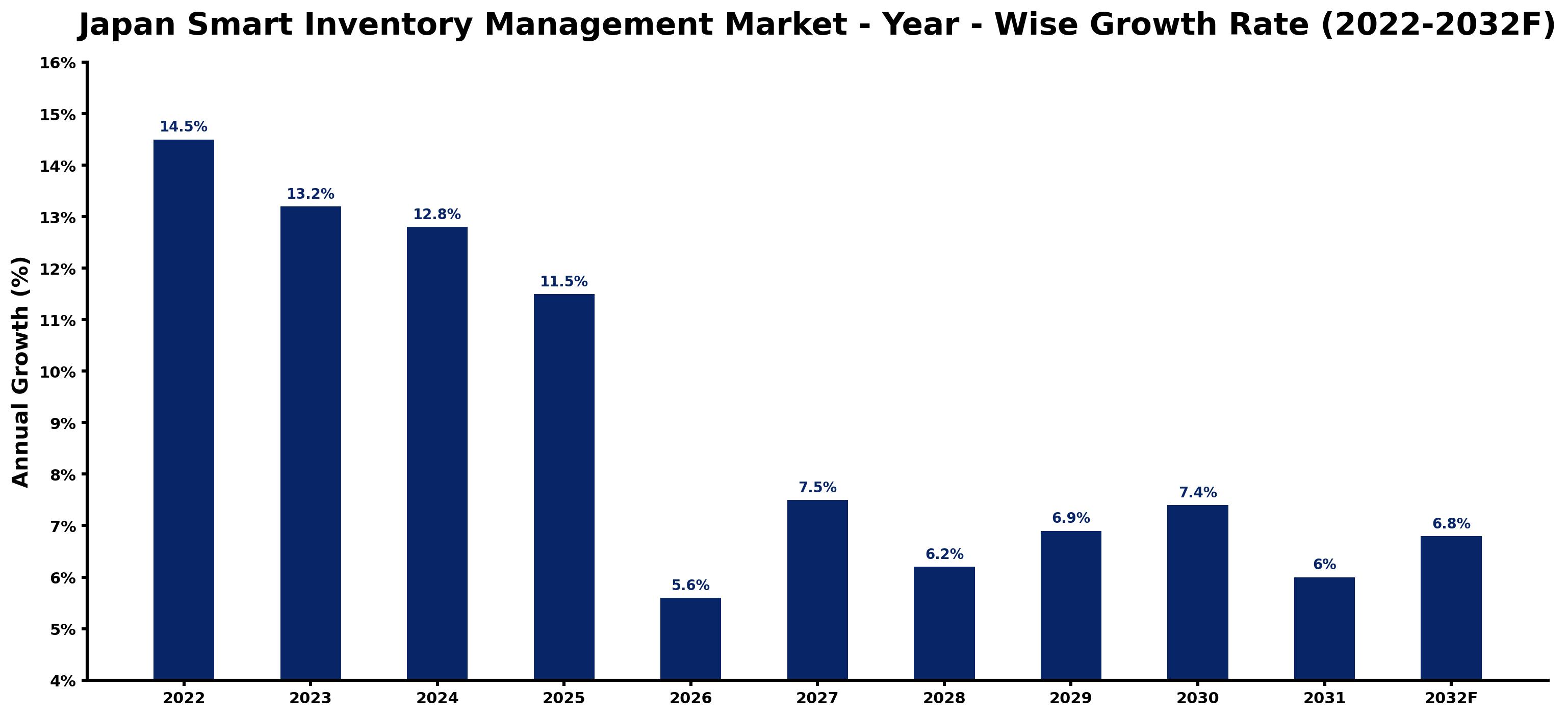
For each year, the table pairs the estimated growth rate with the leading influence on demand, showing how the drivers changed across the period.
| Year | Estimated Annual Growth (%) | Market Rationale |
| 2022 | 14.5 | Demand surged due to increased adoption of smart inventory technologies across sectors. |
| 2023 | 13.2 | Growth slowed as the market began to stabilise after a strong previous year. |
| 2024 | 12.8 | Continued investment in logistics technology supported ongoing market expansion. |
| 2025 | 11.5 | The market maintained growth as businesses focused on improving inventory efficiency. |
| 2026 | 5.6 | Growth is expected to slow as the market adjusts to previous high levels of demand. |
| 2027 | 7.5 | Demand is projected to accelerate again as companies seek to optimise supply chain operations. |
| 2028 | 6.2 | Growth is expected to slow due to market saturation in certain inventory management solutions. |
| 2029 | 6.9 | Demand will increase as more businesses recognise the benefits of smart systems. |
| 2030 | 7.4 | Growth is projected to pick up as technology adoption in retail continues to rise. |
| 2031 | 6.0 | Market growth is expected to slow as competition intensifies among providers. |
| 2032 | 6.8 | Demand will rise as logistics companies expand their operations and technology use. |
Note: Market size estimations and growth projections presented in this report are based on 6Wresearch's proprietary forecasting methodology, utilizing the latest available industry data, government publications, and primary research inputs.
Japan Smart Inventory Management Market Synopsis
Smart Inventory Management utilises technologies like RFID, AI, and IoT to optimise inventory processes, improving stock accuracy and reducing waste. The Japan Smart Inventory Management Market is expanding due to rising demand from logistics and retail sectors, driven by technological advancements and increasing investments in smart solutions. The logistics sector, valued at approximately 15 trillion JPY, plays a key part in this growth, with initiatives promoting smart logistics enhancing operational efficiency.
Market Dynamics Impact Analysis (2026–2032)
| Factor | Type | Impact | Primary Segment Affected |
| Increased adoption of RFID technology in retail | Driver | High | RFID-Based Systems |
| Growing demand for AI-driven inventory solutions | Driver | High | AI Reorder Prediction |
| Rising need for real-time shelf monitoring in urban areas | Opportunity | High | Real-Time Shelf Monitoring |
| Expansion of distribution hubs in the Kansai region | Opportunity | Medium | Distribution Hubs |
| High initial investment costs for smart inventory systems | Restraint | High | IoT-Connected Scanners |
| Limited awareness of technology benefits among smaller firms | Restraint | Medium | Computer Vision Tools |
| Supply chain disruptions affecting technology deployment | Challenge | High | AI Reorder Prediction |
| Intense competition among technology providers | Challenge | Medium | RFID-Based Systems |
Evaluation of Drivers in Japan Smart Inventory Management Market (2026–2032)
The following drivers explain most of the expected growth.
| Drivers | Primary Segment Affected | Why It Matters (Evidence) |
| Adoption of RFID technology | RFID-Based Systems | RFID technology adoption in retail reached 40% in 2023, driving demand for efficient inventory tracking. |
| Demand for AI-driven solutions | AI Reorder Prediction | Government innovation initiatives support the integration of AI technologies in inventory management, increasing their adoption. |
| Growth in e-commerce | IoT-Connected Scanners | The surge in e-commerce has driven demand for smart inventory solutions, particularly in distribution centers. |
| Investment in logistics technology | Computer Vision Tools | Annual investment in logistics technology in Japan exceeds 1 trillion JPY, boosting demand for advanced inventory management. |
| Need for improved supply chain efficiency | Auto Stock Update | The average supermarket in Japan stocks over 10,000 SKUs, necessitating efficient inventory management solutions. |
Spending rises because the adoption of advanced technologies is reshaping inventory management, particularly in logistics. E-commerce has surged, creating a heightened need for smart inventory solutions in distribution centres. Investments in logistics technology exceed 1 trillion JPY, promoting advanced inventory management systems. Supermarkets, with an average of over 10,000 SKUs, require effective auto stock updates to maintain optimal levels.
Evaluation of Restraints in Japan Smart Inventory Management Market
The following restraints limit how fast demand can grow.
| Market Restraint | Primary Segment Affected | Why It Matters (Evidence) |
| High initial investment costs for smart systems | IoT-Connected Scanners | The average initial investment for smart inventory systems can exceed 10 million JPY, deterring smaller firms. |
| Limited awareness of technology benefits | Computer Vision Tools | Many smaller firms lack understanding of the advantages of automated inventory checks, slowing adoption. |
| Supply chain disruptions | AI Reorder Prediction | Ongoing supply chain issues have delayed the deployment of AI solutions, affecting inventory management efficiency. |
| Intense competition among providers | RFID-Based Systems | High competition has led to price wars, impacting profitability for technology providers. |
| Regulatory compliance challenges | Auto Stock Update | Compliance with ISO 28000 standards complicates the implementation of smart inventory systems. |
Japan Smart Inventory Management Market Challenges
Compliance with ISO 28000 creates hurdles for logistics operators in Japan, delaying system upgrades and reducing operational efficiency for retailers. Intense competition among suppliers forces them to cut prices, which can lead to lower investment in advanced technologies and stifle innovation for buyers. Rising costs associated with integrating AI and IoT technologies burden smaller retailers, often causing them to defer upgrades and negatively impacting their inventory accuracy. Outdated infrastructure in the Tokyo metropolitan area results in supply chain disruptions, increasing lead times for distributors and causing stock shortages for end users.
Trends in the Japan Smart Inventory Management Market
Four trends stand out in the Japan Smart Inventory Management Market.
- Shift towards AI-Driven Inventory Solutions: The growing adoption of AI technologies is reshaping inventory management, particularly in logistics. As of 2023, AI-driven solutions are increasingly integrated into operations, improving efficiency and accuracy.
- Transition from Manual to Automated Systems: Since 2022, businesses have been moving from manual inventory checks to automated systems. This shift has been driven by the need for real-time data accuracy, particularly in urban retail environments.
- Emergence of Real-Time Data Integration: Real-time data integration is becoming essential for supermarkets, with over 10,000 SKUs managed. This trend is supported by the increasing adoption of IoT-connected scanners in distribution centres.
- Focus on Supply Chain Resilience: The Economic Security Promotion Act, enacted in 2022, has prompted firms to improve supply chain resilience. This focus is driving investments in smart inventory management technologies.
Investment Opportunities in the Japan Smart Inventory Management Market
Investors looking at the Japan Smart Inventory Management Market should consider the following areas.
- Expansion of Distribution Hubs in Kansai: The Kansai region is improving its distribution capabilities, creating a demand for smart inventory systems. With logistics valued at 15 trillion JPY, this presents a prime investment opportunity.
- Increasing Demand for Real-Time Shelf Monitoring: As urban areas see a rise in demand for real-time shelf monitoring, suppliers can capitalise on this trend. The market for these systems is expanding, driven by the need for efficiency.
- Growth in E-commerce Fulfilment Centres: The surge in e-commerce is creating a gap in inventory management solutions for fulfilment centres. Investing in smart inventory systems can meet this growing need effectively.
- Investment in AI Technologies: With government support for AI technologies, there is a prime opportunity to supply AI-driven inventory solutions. This is particularly relevant for logistics companies looking to optimise operations.
Government Initiatives in the Japan Smart Inventory Management Market
The Building Energy Efficiency Act mandates energy standards for new buildings, impacting inventory management systems by requiring integration with energy-efficient technologies. Additionally, the Economic Security Promotion Act supports supply-chain resilience, encouraging firms to adopt smart inventory solutions for critical products.
The Ministry of Economy, Trade and Industry has allocated 1 trillion JPY for logistics technology improvements by 2025. This funding aims to improve supply chain efficiency and support the adoption of smart inventory management systems.
Future Insight of the Japan Smart Inventory Management Market
Retailers will increasingly implement smart inventory systems, leading to improved stock accuracy and efficiency in urban areas. Demand for real-time shelf monitoring systems will rise, encouraging suppliers to create more effective solutions. Government innovation programmes will facilitate the integration of AI technologies, driving logistics efficiency. The logistics sector will benefit from advancements in IoT technologies, optimising operations and lowering costs for buyers.
Market Segmentation Analysis
Japan Smart Inventory Management Market report covers a detailed analysis of the following market segments:
By Solution Type – RFID-Based Systems Lead, AI Reorder Prediction Expected to Grow Fastest
According to Saurav Kr Singh, Senior Research Analyst at 6Wresearch, RFID-Based Systems accounted for 37% of the market by solution type in 2025. RFID-Based Systems dominate the market due to their ability to efficiently track inventory in real-time, which is crucial for logistics operations. The Tokyo metropolitan area serves as a major hub for warehousing, further driving the demand for these systems. AI Reorder Prediction is set to record the highest CAGR in this split, 10.2% over 2026–2032. AI Reorder Prediction is experiencing rapid growth as it assists businesses in anticipating stock needs based on historical consumption patterns, thus reducing waste. The increasing investment in logistics technology, exceeding 1 trillion JPY annually, supports this trend. Suppliers must enhance their offerings to include advanced predictive features to meet the rising demand for efficient inventory management solutions.
By Smart Feature – Auto Stock Update Leads, Demand Forecasting Expected to Grow Fastest
Auto Stock Update held 40% of the Japan Smart Inventory Management Market by smart feature in 2025. Auto Stock Update is the leading feature because it ensures that inventory levels are automatically adjusted, which is essential for maintaining stock accuracy in retail environments. This capability is particularly vital for supermarkets managing extensive inventories of over 10,000 SKUs. Over 2026–2032, Demand Forecasting is expected to post the fastest growth, at a CAGR of 8.6%. Demand Forecasting is growing quickly as it enables businesses to accurately predict future inventory needs based on market trends, allowing them to respond effectively to changing consumer behaviours. The government's logistics efficiency initiatives set for 2025 further support this growth. Buyers should invest in advanced forecasting technologies to improve inventory management and reduce operational costs.
By Industry Usage – Warehousing Leads, Supermarkets Expected to Grow Fastest
Warehousing took 35% of industry usage revenue in 2025, more than any other category. Warehousing commands the largest share as it is essential for efficiently managing large inventories, particularly in densely populated areas like the Tokyo metropolitan region. Investments in logistics infrastructure, spurred by events such as the Tokyo 2020 Olympics, have solidified this sector's significance. Supermarkets are projected to grow fastest, at a CAGR of 8.5% during 2026–2032. Supermarkets are experiencing the fastest growth due to their necessity to manage a wide variety of products effectively in a competitive marketplace. The surge in e-commerce has also intensified the demand for smart inventory solutions in this industry. Suppliers should customise their offerings to cater specifically to the operational needs of supermarkets to capitalise on this expanding market.
By End User – Logistics Companies Lead, FMCG Firms Expected to Grow Fastest
In 2025, Logistics Companies led the end user split with a 45% share. Logistics Companies represent the largest segment of users for inventory management technologies, as they require precise tracking and management of goods throughout the supply chain. Their pivotal role in the logistics sector, valued at approximately 15 trillion JPY, underscores their significance in this market. The quickest growth will come from FMCG Firms, forecast to expand at a CAGR of 8.7% between 2026 and 2032. FMCG Firms are swiftly adopting smart inventory solutions due to their reliance on accurate inventory management for fast-moving consumer goods. The average turnover of over 1 billion JPY for these firms illustrates their substantial influence on market growth. Suppliers should tailor their solutions to address the unique inventory management challenges faced by FMCG firms.
Key Attractiveness of the Report
- 10 Years of Market Numbers
- Historical Data Starting from 2022 to 2025
- Base Year 2025
- Forecast Data until 2032
- Key Performance Indicators Impacting the Market
- Major Upcoming Developments and Projects
Key Highlights of the Report:
- Japan Smart Inventory Management Market Outlook
- Market Size of Japan Smart Inventory Management Market, 2025
- Forecast of Japan Smart Inventory Management Market, 2032
- Historical Data and Forecast of Japan Smart Inventory Management Revenues & Volume for the Period 2022-2032F
- Japan Smart Inventory Management Market Trend Evolution
- Japan Smart Inventory Management Market Drivers and Challenges
- Japan Smart Inventory Management Price Trends
- Japan Smart Inventory Management Porter's Five Forces
- Japan Smart Inventory Management Industry Life Cycle
- Historical Data and Forecast of Japan Smart Inventory Management Market Revenues & Volume By Solution Type for the Period 2022-2032F
- Historical Data and Forecast of Japan Smart Inventory Management Market Revenues & Volume By RFID-Based Systems for the Period 2022-2032F
- Historical Data and Forecast of Japan Smart Inventory Management Market Revenues & Volume By AI Reorder Prediction for the Period 2022-2032F
- Historical Data and Forecast of Japan Smart Inventory Management Market Revenues & Volume By Computer Vision Tools for the Period 2022-2032F
- Historical Data and Forecast of Japan Smart Inventory Management Market Revenues & Volume By IoT-Connected Scanners for the Period 2022-2032F
- Historical Data and Forecast of Japan Smart Inventory Management Market Revenues & Volume By Smart Feature for the Period 2022-2032F
- Historical Data and Forecast of Japan Smart Inventory Management Market Revenues & Volume By Auto Stock Update for the Period 2022-2032F
- Historical Data and Forecast of Japan Smart Inventory Management Market Revenues & Volume By Demand Forecasting for the Period 2022-2032F
- Historical Data and Forecast of Japan Smart Inventory Management Market Revenues & Volume By Real-Time Shelf Monitoring for the Period 2022-2032F
- Historical Data and Forecast of Japan Smart Inventory Management Market Revenues & Volume By Location + Quantity Sync for the Period 2022-2032F
- Historical Data and Forecast of Japan Smart Inventory Management Market Revenues & Volume By Industry Usage for the Period 2022-2032F
- Historical Data and Forecast of Japan Smart Inventory Management Market Revenues & Volume By Warehousing for the Period 2022-2032F
- Historical Data and Forecast of Japan Smart Inventory Management Market Revenues & Volume By Retail Stores for the Period 2022-2032F
- Historical Data and Forecast of Japan Smart Inventory Management Market Revenues & Volume By Supermarkets for the Period 2022-2032F
- Historical Data and Forecast of Japan Smart Inventory Management Market Revenues & Volume By Distribution Hubs for the Period 2022-2032F
- Historical Data and Forecast of Japan Smart Inventory Management Market Revenues & Volume By End User for the Period 2022-2032F
- Historical Data and Forecast of Japan Smart Inventory Management Market Revenues & Volume By Logistics Companies for the Period 2022-2032F
- Historical Data and Forecast of Japan Smart Inventory Management Market Revenues & Volume By FMCG Firms for the Period 2022-2032F
- Historical Data and Forecast of Japan Smart Inventory Management Market Revenues & Volume By Inventory Managers for the Period 2022-2032F
- Historical Data and Forecast of Japan Smart Inventory Management Market Revenues & Volume By Supply Chain Integrators for the Period 2022-2032F
- Japan Smart Inventory Management Import Export Trade Statistics
- Market Opportunity Assessment By Solution Type
- Market Opportunity Assessment By Smart Feature
- Market Opportunity Assessment By Industry Usage
- Market Opportunity Assessment By End User
- Japan Smart Inventory Management Top Companies Market Share
- Japan Smart Inventory Management Competitive Benchmarking By Technical and Operational Parameters
- Japan Smart Inventory Management Company Profiles
- Japan Smart Inventory Management Key Strategic Recommendations
Market Covered
The following segment groups are covered in the report.
By Solution Type
- RFID-Based Systems
- AI Reorder Prediction
- Computer Vision Tools
- IoT-Connected Scanners
By Smart Feature
- Auto Stock Update
- Demand Forecasting
- Real-Time Shelf Monitoring
- Location + Quantity Sync
By Industry Usage
- Warehousing
- Retail Stores
- Supermarkets
- Distribution Hubs
By End User
- Logistics Companies
- FMCG Firms
- Inventory Managers
- Supply Chain Integrators































