Japan Smart Irrigation AI Market Size & Growth Rate
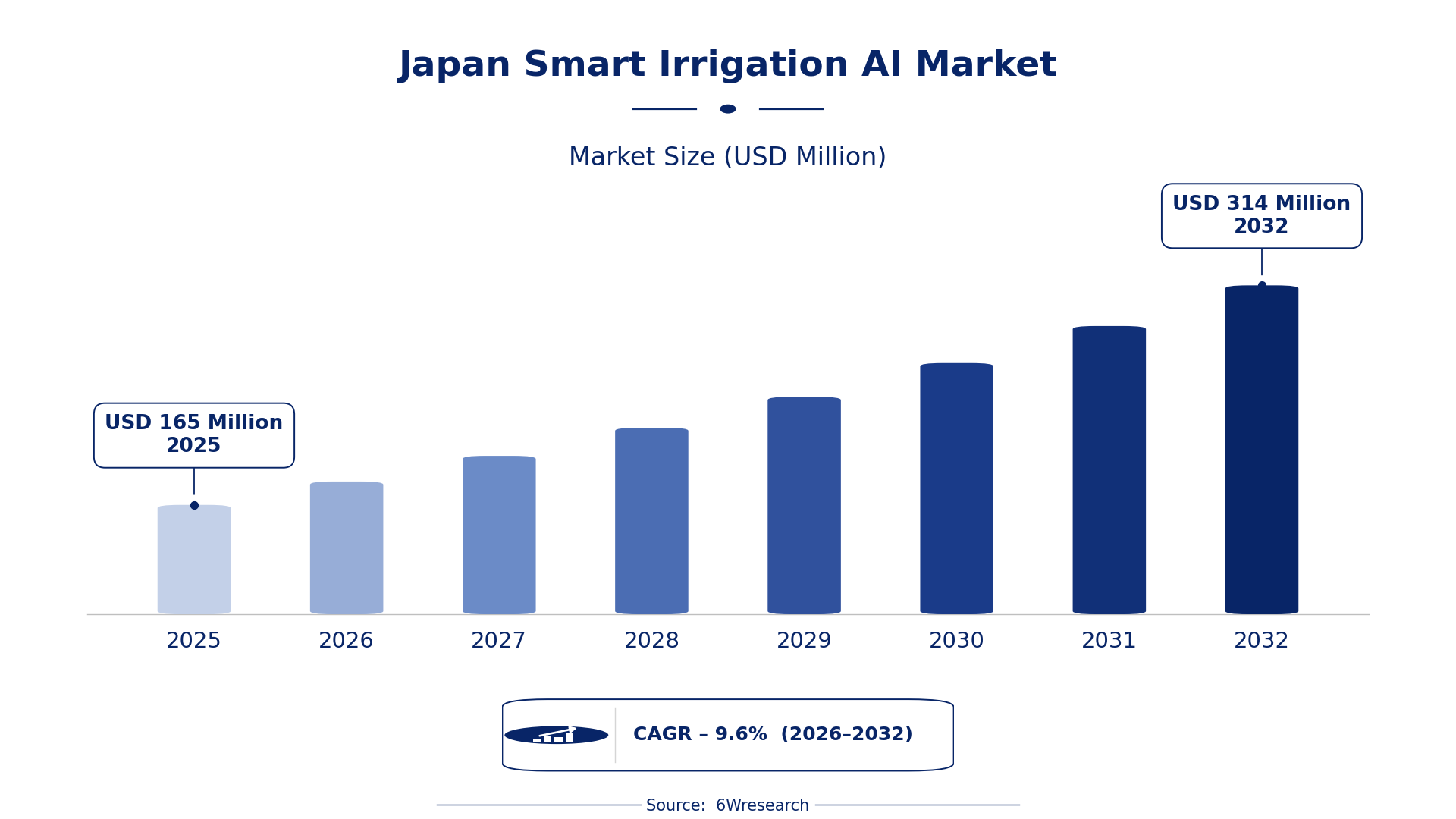
According to 6Wresearch internal database and industry insights, the Japan Smart Irrigation AI Market was valued at USD 165 Million in 2025 and is projected to reach USD 314 Million by 2032, growing at a CAGR of approximately 9.6% during 2026–2032.
Japan Smart Irrigation AI Market Highlights
| Report Metric | Details |
| Report Name | Japan Smart Irrigation AI Market (2026-2032) |
| Market Size 2025 | USD 165 Million |
| Market Size 2032 | USD 314 Million |
| Absolute Growth 2025–2032 | USD 149 Million |
| CAGR 2026–2032 | 9.6% |
| Peak Annual Growth | 15.5% in 2032 |
| Forecast Period | 2026–2032 |
| Historical Data | 2022–2025 |
| Base Year | 2025 |
| Leading AI Function, 2025 | Weather Forecast AI (44% share) |
| Leading Controlled Element, 2025 | Water Volume Scheduling (44% share) |
| Leading Connectivity, 2025 | Cloud + Sensors (43% share) |
| Leading End User, 2025 | Smart Farms (40% share) |
| Fastest-Growing AI Function | Soil Moisture AI (13.3% CAGR) |
| Fastest-Growing Controlled Element | Water Use Optimization (12.6% CAGR) |
| Fastest-Growing End User | AgriTech Companies (12.9% CAGR) |
| Growing Sector | agriculture |
| Key End Users | AgriTech companies, smart farms, precision farmers, irrigation consultants |
Japan Smart Irrigation AI Market Year-wise Growth Rate and Key Drivers (2022–2032)
This graph illustrates the annual growth rates of the market from 2022 to 2032, highlighting a steady upward trajectory and projected market expansion over the forecast period.
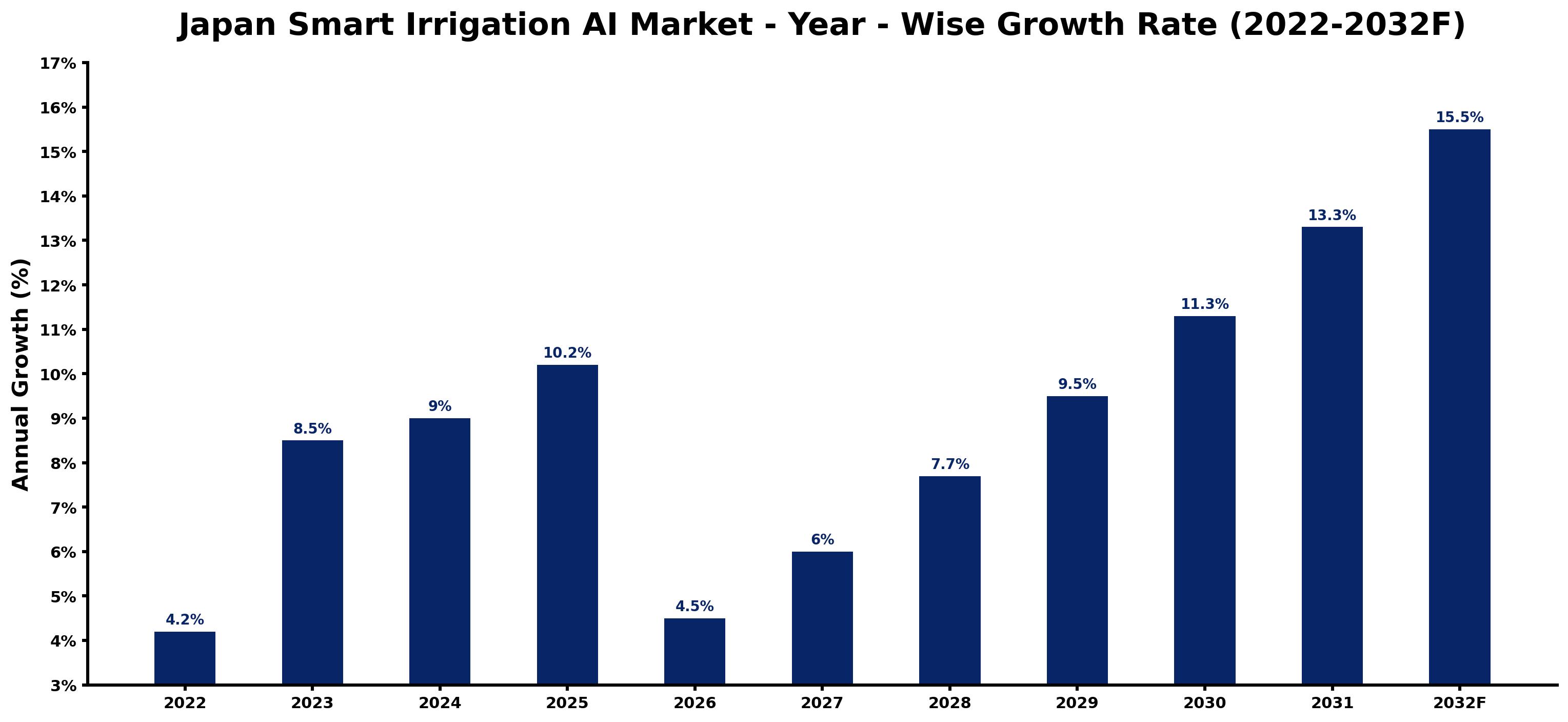
Year by year, the estimates below pair each growth rate with the development that shaped it.
| Year | Estimated Annual Growth (%) | Market Rationale |
| 2022 | 4.2 | The market exhibited steady growth, supported by increasing awareness of smart irrigation benefits. |
| 2023 | 8.5 | Demand accelerated as more AgriTech companies adopted AI-driven solutions for efficiency. |
| 2024 | 9.0 | The adoption rate continued to rise, driven by technological advancements in irrigation systems. |
| 2025 | 10.2 | Growth peaked as Japan's agricultural output reached approximately 8 trillion yen, boosting investments. |
| 2026 | 4.5 | The growth rate is expected to slow due to market saturation in certain regions and technologies. |
| 2027 | 6.0 | Increased focus on sustainability will lead to renewed interest in smart irrigation solutions. |
| 2028 | 7.7 | The market is projected to expand as more farmers recognise the benefits of AI in irrigation management. |
| 2029 | 9.5 | Demand is expected to surge as precision farming techniques gain traction among agricultural producers. |
| 2030 | 11.3 | Technological innovations in AI will stimulate market growth across various segments. |
| 2031 | 13.3 | Growing investments in agricultural technology will enhance the adoption of smart irrigation systems. |
| 2032 | 15.5 | The market is expected to peak as the government promotes advanced irrigation technologies. |
Note: Market size estimations and growth projections presented in this report are based on 6Wresearch's proprietary forecasting methodology, utilizing the latest available industry data, government publications, and primary research inputs.
Japan Smart Irrigation AI Market Synopsis
Smart Irrigation AI optimises agricultural irrigation processes through AI, sensors, and data analytics, improving crop yield and conserving water. The Japan Smart Irrigation AI Market is expanding, driven by the agricultural sector's output of about 8 trillion yen and government support for smart agriculture initiatives. With an adoption rate of around 30%, demand is fuelled by AgriTech companies and smart farms focusing on sustainable practices.
Market Dynamics Impact Analysis (2026–2032)
| Factor | Type | Impact | Primary Segment Affected |
| Increasing adoption of precision farming techniques | Driver | High | Soil Moisture AI |
| Government support for smart agriculture initiatives | Driver | High | Water Volume Scheduling |
| Rising interest in sustainable farming practices | Opportunity | High | Smart Farms |
| Growing number of smart farms in Japan | Opportunity | Medium | AgriTech Companies |
| High initial investment costs for smart irrigation systems | Restraint | High | Water Use Optimization |
| Limited awareness among traditional farmers about AI benefits | Restraint | Medium | Precision Farmers |
| Technological integration challenges in existing systems | Challenge | High | Cloud + Sensors |
| Competition from traditional irrigation methods | Challenge | Medium | Image-Based AI |
Evaluation of Drivers in Japan Smart Irrigation AI Market (2026–2032)
The main growth drivers and the segments they affect most are set out below.
| Drivers | Primary Segment Affected | Why It Matters (Evidence) |
| Rising agricultural output | Water Volume Scheduling | Japan's agricultural sector output reached about 8 trillion yen, prompting farmers to invest in efficient irrigation. |
| Government initiatives promoting smart agriculture | Soil Moisture AI | Support for technology adoption by the Ministry of Agriculture, Forestry and Fisheries is increasing demand for smart irrigation solutions. |
| Growing number of smart farms | Smart Farms | The demand for AI-driven irrigation technologies is expanding with over 500 smart farms operating in Japan. |
| Increasing focus on sustainability | Water Use Optimization | Precision farming techniques are utilised in 40% of operations, driving the need for effective water management solutions. |
| Technological advancements in AI | Cloud + Sensors | The adoption rate of smart irrigation technologies is around 30%, reflecting the growing interest in AI solutions. |
A wider customer base explains much of the growth, as Japan's agricultural sector output reached about 8 trillion yen, prompting farmers to invest in efficient irrigation systems. Increased support for technology adoption is driving demand for smart irrigation solutions. The number of smart farms is growing, with over 500 currently operating in Japan. Precision farming techniques are utilised in 40% of operations, highlighting the need for effective water management solutions. The adoption rate of smart irrigation technologies is around 30%, reflecting the rising interest in AI solutions.
Evaluation of Restraints in Japan Smart Irrigation AI Market
The main factors holding the market back are set out below.
| Market Restraint | Primary Segment Affected | Why It Matters (Evidence) |
| High initial investment costs for smart irrigation systems | Water Use Optimization | Farmers face substantial upfront costs, which may deter adoption of advanced irrigation technologies. |
| Limited awareness among traditional farmers about AI benefits | Precision Farmers | Many traditional farmers lack knowledge of AI's advantages, hindering market growth. |
| Technological integration challenges in existing systems | Cloud + Sensors | Integrating new technologies with legacy systems can be complex and costly for farmers. |
| Competition from traditional irrigation methods | Image-Based AI | Farmers may prefer established methods over newer, unproven technologies, slowing adoption. |
| Regulatory hurdles in technology adoption | Soil Moisture AI | Compliance with existing agricultural regulations complicates the implementation of new technologies. |
Japan Smart Irrigation AI Market Challenges
Smart Irrigation AI faces a lack of advanced technology adoption, with only 30% of farmers using these systems, which limits efficiency and crop yield for buyers. Suppliers struggle with sourcing quality components, as the reliance on imported agricultural technology reached 200 million USD in 2022, causing delays in product availability. Increased competition from traditional irrigation methods persists, as many farmers remain hesitant to invest in new systems, resulting in stagnant growth for suppliers. Regulatory hurdles exist, with compliance to the JIS Z 8401 standard complicating the integration of new technologies, which can lead to increased costs for producers.
Trends in the Japan Smart Irrigation AI Market
Below are the shifts with the largest effect on the Japan Smart Irrigation AI Market.
- Shift from Traditional to Smart Irrigation: In recent years, Japan has seen a shift towards smart irrigation systems, with over 500 smart farms operating as of 2023. This change reflects a growing recognition of the need for efficient water management, supported by the average water usage efficiency of 70%.
- Transition to AI-Driven Solutions: The adoption of AI-driven solutions in agriculture is gaining momentum, particularly with government initiatives launched to improve productivity and sustainability across the sector. This aims to increase smart technology adoption significantly.
- Emergence of Precision Farming Techniques: Precision farming techniques are being increasingly adopted, with 40% of Japan's agricultural operations utilising these methods. This trend highlights the demand for data-driven irrigation solutions that optimise resource use and improve crop yields.
- Growing Focus on Sustainability: The agricultural sector is prioritising sustainability, as evidenced by government support for AI in agriculture. This initiative aims to improve resource efficiency, with 2 billion yen allocated for agricultural technology innovations in 2023.
Investment Opportunities in the Japan Smart Irrigation AI Market
The openings below show where demand in the Japan Smart Irrigation AI Market is visible and how suppliers can enter.
- AgriTech Companies Seeking Advanced Solutions: With an increasing number of AgriTech companies in Japan, there is an opportunity to supply advanced smart irrigation technologies. The market is expanding, with the adoption rate of around 30%, making partnerships with local firms advantageous.
- Smart Farms Expanding Their Operations: Smart farms are actively seeking effective irrigation solutions to enhance efficiency. With over 500 smart farms operating, suppliers can enter this market through local partnerships or joint ventures to meet growing demands.
- Investment in Sustainable Agriculture Technologies: The Japanese government allocated 2 billion yen for agricultural technology innovations in 2023, creating opportunities for suppliers of smart irrigation solutions. Collaborating with local agricultural cooperatives can facilitate market entry.
- Increasing Demand for Water Use Optimization: As the average water usage efficiency in Japanese agriculture is 70%, there is a clear need for water use optimisation technologies. Suppliers can target precision farmers looking to improve their irrigation practices.
Government Initiatives in the Japan Smart Irrigation AI Market
The 'New Robot Strategy' launched in 2015 aims to expand robot use in agriculture, encouraging farmers to implement smart irrigation systems that ensure efficient water usage. This strategy promotes compliance with the JIS Z 8401 standard, which governs smart irrigation systems, ensuring quality and effectiveness in irrigation practices.
In 2023, Japan allocated 2 billion yen for agricultural technology innovations, administered by the Ministry of Agriculture, Forestry and Fisheries. This funding supports projects that facilitate the adoption of smart irrigation technologies, enabling farmers to improve their operational efficiency and sustainability.
Future Insight of the Japan Smart Irrigation AI Market
The policy-driven shift towards sustainable farming will prompt suppliers to innovate in smart irrigation technologies. By 2032, the integration of AI and IoT will likely boost water use efficiency beyond the current average of 70%, resulting in reduced operational costs for buyers. Increased government funding for agricultural technology innovations, amounting to 2 billion yen in 2023, will facilitate the development of advanced irrigation systems. The establishment of collaborative platforms like the Smart Agriculture Consortium will foster partnerships among stakeholders, leading to improved product offerings.
Market Segmentation Analysis
Japan Smart Irrigation AI Market report covers a detailed analysis of the following market segments:
By AI Function – Weather Forecast AI Leads, Soil Moisture AI Expected to Grow Fastest
According to Saurav Kr Singh, Senior Research Analyst at 6Wresearch, with 44% of ai function revenue in 2025, Weather Forecast AI was the largest category. Weather Forecast AI holds the largest share as it provides precise weather predictions crucial for irrigation scheduling. This technology is widely relied upon by farmers managing Japan's 1.3 million hectares of irrigated land, ensuring efficient water usage. Soil Moisture AI is set to record the highest CAGR in this split, 13.3% over 2026–2032. Soil Moisture AI is growing quickly due to its effectiveness in monitoring soil moisture levels, which is vital for optimal irrigation. The increasing number of smart farms, now over 500, significantly drives this adoption. Suppliers should focus on enhancing Soil Moisture AI capabilities to meet the rising demand from smart farms.
By Controlled Element – Water Volume Scheduling Leads, Water Use Optimization Expected to Grow Fastest
Water Volume Scheduling held 44% of the Japan Smart Irrigation AI Market by controlled element in 2025. Water Volume Scheduling leads the market by effectively controlling water application based on specific crop needs, making it essential for efficient irrigation. This method is widely implemented across Japan's agricultural practices, where water efficiency is paramount. Over 2026–2032, Water Use Optimization is expected to post the fastest growth, at a CAGR of 12.6%. Water Use Optimization is experiencing rapid growth as it directly improves overall water efficiency, which is increasingly critical in Japan's water-scarce environment. The government's allocation of 2 billion yen for agricultural technology innovations in 2023 supports this trend. Buyers are encouraged to invest in Water Use Optimization technologies to enhance water efficiency and reduce operational costs.
By Connectivity – Cloud + Sensors Lead and Record the Fastest Growth
The largest connectivity category in 2025 was Cloud + Sensors, at 43% of revenue. Cloud + Sensors dominate the connectivity segment as they enable remote monitoring and control, which is essential for modern irrigation systems. This integration is crucial for the over 500 smart farms in Japan, facilitating effective irrigation management. Its lead should widen, with a projected CAGR of 11.5% during 2026–2032, the highest in this split. Cloud + Sensors also represent the fastest-growing connectivity solution due to their ability to streamline data collection and management processes. As the agricultural sector increasingly adopts digital solutions, this segment's growth is expected to accelerate further. Suppliers must ensure robust Cloud + Sensors solutions to cater to the expanding needs of smart farms.
By End User – Smart Farms Lead, AgriTech Companies Expected to Grow Fastest
In 2025, Smart Farms led the end user split with a 40% share. Smart Farms account for the largest share as they utilise advanced technologies for efficient irrigation practices, significantly impacting Japan's agricultural productivity. With an agricultural population of approximately 1.4 million, smart farms play a pivotal role in driving technology adoption. The quickest growth will come from AgriTech Companies, forecast to expand at a CAGR of 12.9% between 2026 and 2032. AgriTech Companies are the fastest-growing end user group, as they develop tailored solutions for smart irrigation, responding to the rising demand for sustainable farming practices. Government initiatives, such as the 'Smart Agriculture Promotion Strategy', further fuel this growth. Suppliers should collaborate with AgriTech Companies to create tailored solutions that meet the evolving needs of the agricultural sector.
Key Attractiveness of the Report
- 10 Years of Market Numbers
- Historical Data Starting from 2022 to 2025
- Base Year 2025
- Forecast Data until 2032
- Key Performance Indicators Impacting the Market
- Major Upcoming Developments and Projects
Key Highlights of the Report:
- Japan Smart Irrigation AI Market Outlook
- Market Size of Japan Smart Irrigation AI Market, 2025
- Forecast of Japan Smart Irrigation AI Market, 2032
- Historical Data and Forecast of Japan Smart Irrigation AI Revenues & Volume for the Period 2022-2032F
- Japan Smart Irrigation AI Market Trend Evolution
- Japan Smart Irrigation AI Market Drivers and Challenges
- Japan Smart Irrigation AI Price Trends
- Japan Smart Irrigation AI Porter's Five Forces
- Japan Smart Irrigation AI Industry Life Cycle
- Historical Data and Forecast of Japan Smart Irrigation AI Market Revenues & Volume By AI Function for the Period 2022-2032F
- Historical Data and Forecast of Japan Smart Irrigation AI Market Revenues & Volume By Weather Forecast AI for the Period 2022-2032F
- Historical Data and Forecast of Japan Smart Irrigation AI Market Revenues & Volume By Soil Moisture AI for the Period 2022-2032F
- Historical Data and Forecast of Japan Smart Irrigation AI Market Revenues & Volume By Image-Based AI for the Period 2022-2032F
- Historical Data and Forecast of Japan Smart Irrigation AI Market Revenues & Volume By Historical Pattern AI for the Period 2022-2032F
- Historical Data and Forecast of Japan Smart Irrigation AI Market Revenues & Volume By Controlled Element for the Period 2022-2032F
- Historical Data and Forecast of Japan Smart Irrigation AI Market Revenues & Volume By Water Volume Scheduling for the Period 2022-2032F
- Historical Data and Forecast of Japan Smart Irrigation AI Market Revenues & Volume By Zone-Specific Flow Control for the Period 2022-2032F
- Historical Data and Forecast of Japan Smart Irrigation AI Market Revenues & Volume By Crop Hydration Assessment for the Period 2022-2032F
- Historical Data and Forecast of Japan Smart Irrigation AI Market Revenues & Volume By Water Use Optimization for the Period 2022-2032F
- Historical Data and Forecast of Japan Smart Irrigation AI Market Revenues & Volume By Connectivity for the Period 2022-2032F
- Historical Data and Forecast of Japan Smart Irrigation AI Market Revenues & Volume By Cloud + Sensors for the Period 2022-2032F
- Historical Data and Forecast of Japan Smart Irrigation AI Market Revenues & Volume By LoRa + IoT for the Period 2022-2032F
- Historical Data and Forecast of Japan Smart Irrigation AI Market Revenues & Volume By Drones + Imaging for the Period 2022-2032F
- Historical Data and Forecast of Japan Smart Irrigation AI Market Revenues & Volume By Machine Learning Models for the Period 2022-2032F
- Historical Data and Forecast of Japan Smart Irrigation AI Market Revenues & Volume By End User for the Period 2022-2032F
- Historical Data and Forecast of Japan Smart Irrigation AI Market Revenues & Volume By Smart Farms for the Period 2022-2032F
- Historical Data and Forecast of Japan Smart Irrigation AI Market Revenues & Volume By Precision Farmers for the Period 2022-2032F
- Historical Data and Forecast of Japan Smart Irrigation AI Market Revenues & Volume By AgriTech Companies for the Period 2022-2032F
- Historical Data and Forecast of Japan Smart Irrigation AI Market Revenues & Volume By Irrigation Consultants for the Period 2022-2032F
- Japan Smart Irrigation AI Import Export Trade Statistics
- Market Opportunity Assessment By AI Function
- Market Opportunity Assessment By Controlled Element
- Market Opportunity Assessment By Connectivity
- Market Opportunity Assessment By End User
- Japan Smart Irrigation AI Top Companies Market Share
- Japan Smart Irrigation AI Competitive Benchmarking By Technical and Operational Parameters
- Japan Smart Irrigation AI Company Profiles
- Japan Smart Irrigation AI Key Strategic Recommendations
Market Covered
Coverage by segment is as follows.
By AI Function
- Weather Forecast AI
- Soil Moisture AI
- Image-Based AI
- Historical Pattern AI
By Controlled Element
- Water Volume Scheduling
- Zone-Specific Flow Control
- Crop Hydration Assessment
- Water Use Optimization
By Connectivity
- Cloud + Sensors
- LoRa + IoT
- Drones + Imaging
- Machine Learning Models
By End User
- Smart Farms
- Precision Farmers
- AgriTech Companies
- Irrigation Consultants































