Japan Smart Irrigation Systems Market Size & Growth Rate
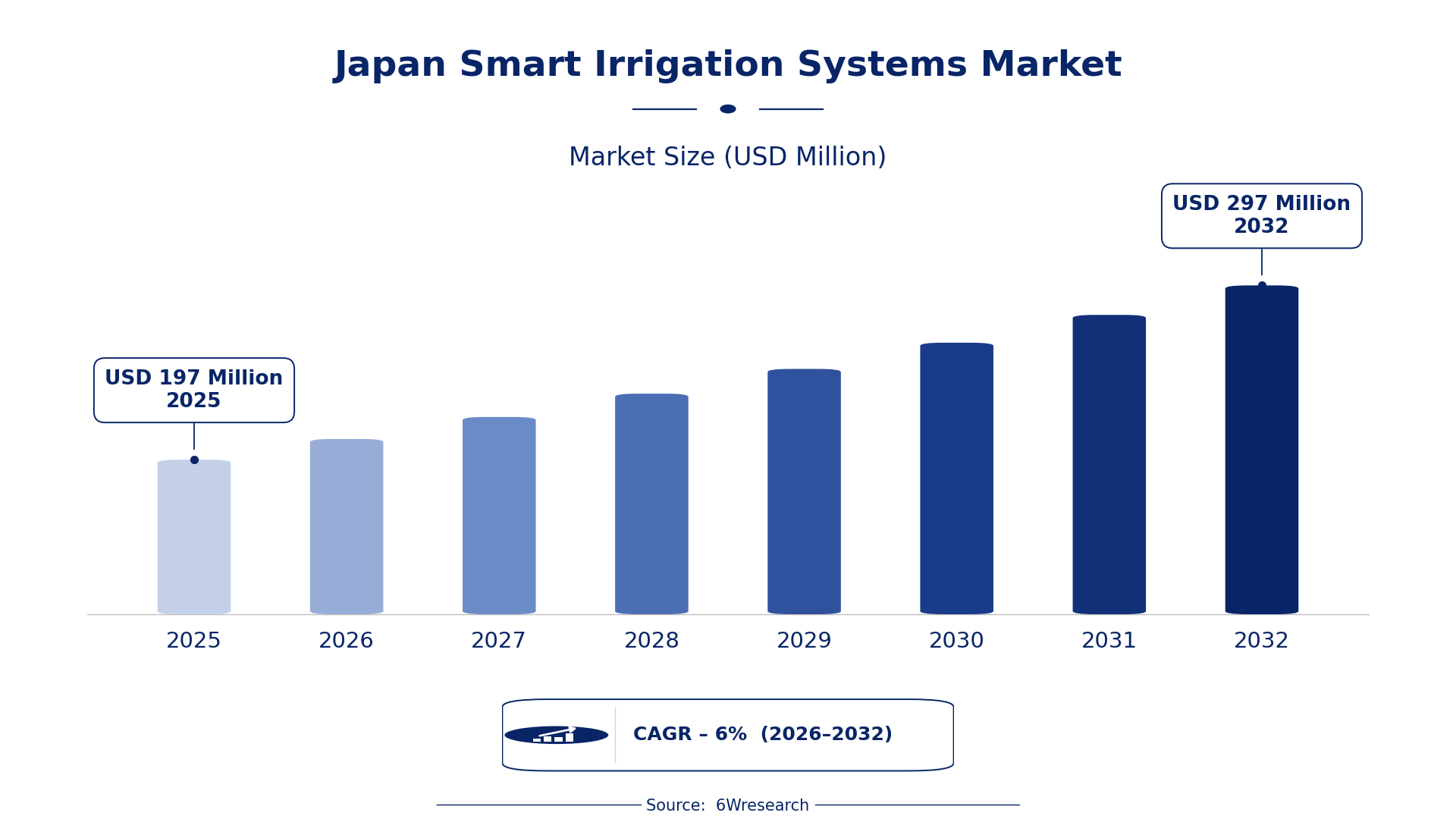
According to 6Wresearch internal database and industry insights, the Japan Smart Irrigation Systems Market was valued at USD 197 Million in 2025 and is projected to reach USD 297 Million by 2032, growing at a CAGR of approximately 6% during 2026–2032.
Japan Smart Irrigation Systems Market Highlights
| Report Metric | Details |
| Report Name | Japan Smart Irrigation Systems Market (2026-2032) |
| Market Size 2025 | USD 197 Million |
| Market Size 2032 | USD 297 Million |
| Absolute Growth 2025–2032 | USD 100 Million |
| CAGR 2026–2032 | 6% |
| Peak Annual Growth | 7.3% in 2032 |
| Forecast Period | 2026–2032 |
| Historical Data | 2022–2025 |
| Base Year | 2025 |
| Leading System Type, 2025 | Drip Smart Systems (37% share) |
| Leading Feature, 2025 | Sensor-Guided Flow (51% share) |
| Leading Control Type, 2025 | App-Based (40% share) |
| Leading End User, 2025 | Fruit & Vegetable Farms (43% share) |
| Fastest-Growing System Type | Soil-Linked Controllers (8.6% CAGR) |
| Fastest-Growing Feature | Moisture Sensor Feedback (8.1% CAGR) |
| Fastest-Growing Control Type | AI Decision Engine (8.8% CAGR) |
| Fastest-Growing End User | Agri Cooperatives (7.8% CAGR) |
| Growing Sector | Agriculture |
| Key End Users | Farmers, Agri Cooperatives, Landscape Contractors, Commercial Agri Firms |
Japan Smart Irrigation Systems Market Year-wise Growth Rate and Key Drivers (2022–2032)
This graph illustrates the annual growth rates of the market from 2022 to 2032, highlighting a steady upward trajectory and projected market expansion over the forecast period.
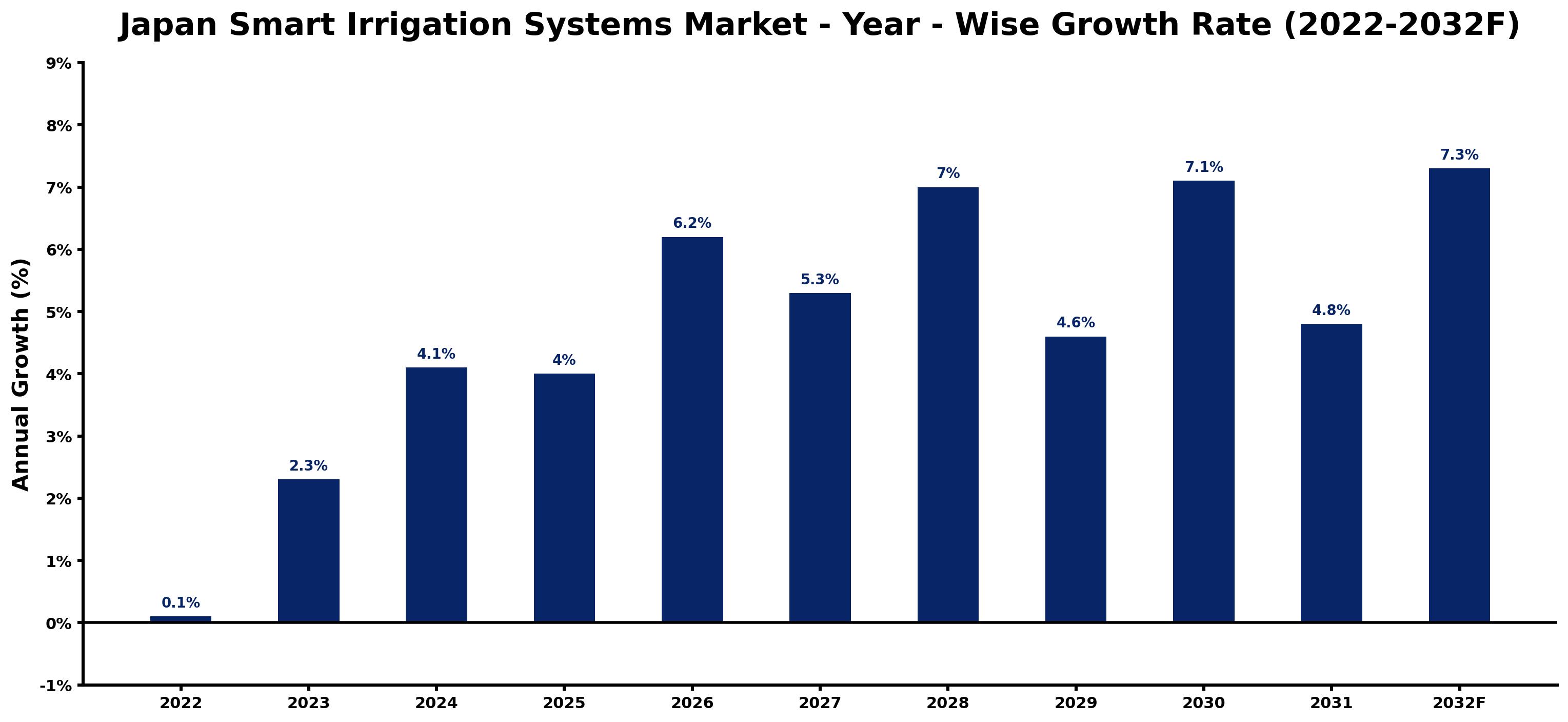
Annual growth estimates for each year appear below with the principal reason behind them, explaining the shifts that set the pace of the market.
| Year | Estimated Annual Growth (%) | Market Rationale |
| 2022 | 0.1 | The market experienced minimal growth as adoption rates were still low. |
| 2023 | 2.3 | Increased awareness of water conservation led to faster growth than before. |
| 2024 | 4.1 | The introduction of new technologies boosted growth rates. |
| 2025 | 4.0 | Growth slowed as market saturation began to affect new installations. |
| 2026 | 6.2 | Rising investments in agricultural technology will spur demand for smart systems. |
| 2027 | 5.3 | Growth will slow as some farmers hesitate to upgrade existing systems. |
| 2028 | 7.0 | The introduction of AI decision engines will revitalise interest in smart irrigation. |
| 2029 | 4.6 | Growth will slow slightly as market maturity begins to set in. |
| 2030 | 7.1 | Increased focus on sustainability will lead to renewed interest in smart irrigation. |
| 2031 | 4.8 | Growth will slow as the market stabilises after rapid advancements. |
| 2032 | 7.3 | Peak growth is driven by the need for advanced irrigation solutions. |
Note: Market size estimations and growth projections presented in this report are based on 6Wresearch's proprietary forecasting methodology, utilizing the latest available industry data, government publications, and primary research inputs.
Japan Smart Irrigation Systems Market Synopsis
Smart irrigation systems optimise water usage in agriculture and landscaping through advanced technology, including sensors and controllers. In Japan, over 4 million hectares of farmland utilise these systems, with Hokkaido leading in adoption. The Japan Smart Irrigation Systems Market is expanding due to rising investments in agricultural technology, the push for sustainable practices, and government support for water-saving technologies, which are increasingly critical for farmers and cooperatives.
Market Dynamics Impact Analysis (2026–2032)
| Factor | Type | Impact | Primary Segment Affected |
| Increased focus on sustainable agriculture practices | Driver | High | Drip Smart Systems |
| Growing investments in agricultural technology | Driver | High | Soil-Linked Controllers |
| Rising demand for efficient water management solutions | Opportunity | High | Commercial Agri Firms |
| Expansion of agri cooperatives supporting technology adoption | Opportunity | Medium | Agri Cooperatives |
| High initial investment costs for smart systems | Restraint | High | Sprinkler IoT Systems |
| Limited awareness among smaller farmers about benefits | Restraint | Medium | Drip Smart Systems |
| Technological integration challenges in existing systems | Challenge | High | Sensor-Guided Flow |
| Regulatory compliance costs for new installations | Challenge | Medium | Soil-Linked Controllers |
Evaluation of Drivers in Japan Smart Irrigation Systems Market (2026–2032)
These are the developments adding the most demand over the forecast period.
| Drivers | Primary Segment Affected | Why It Matters (Evidence) |
| Growing adoption of precision agriculture techniques | Soil-Linked Controllers | The demand for soil-linked controllers is rising among tech-savvy farmers, enhancing crop yield by 20%. |
| Increased emphasis on water conservation | Drip Smart Systems | Japan's agricultural sector aims for a 50% reduction in water usage by 2030, driving smart irrigation adoption. |
| Government subsidies for smart irrigation technologies | Sprinkler IoT Systems | The government encourages water-saving technologies through subsidies, boosting installations across the country. |
| Technological advancements in AI and sensors | AI Decision Engine | Integration of AI decision engines into modern systems improves efficiency and decision-making. |
| Growing interest in smart solutions for urban projects | Weather Synced | The industry in Japan, valued at approximately 2 trillion yen, increasingly adopts weather-synced systems. |
Spending rises because Hokkaido leads in smart irrigation adoption, with over 4 million hectares of farmland utilising these systems. The Japanese agricultural sector aims for a 50% reduction in water usage by 2030, prompting farmers to invest in efficient solutions. The integration of AI decision engines into irrigation systems improves efficiency, driving larger commercial agri firms to adopt these technologies. Urban projects increasingly favour smart irrigation solutions for efficient water management.
Evaluation of Restraints in Japan Smart Irrigation Systems Market
The following restraints limit how fast demand can grow.
| Market Restraint | Primary Segment Affected | Why It Matters (Evidence) |
| High initial investment costs for smart systems | Sprinkler IoT Systems | The high upfront costs deter smaller farmers from adopting smart irrigation solutions, limiting market growth. |
| Limited awareness among smaller farmers about benefits | Drip Smart Systems | Many smaller farmers lack knowledge of smart irrigation advantages, hindering widespread adoption. |
| Technological integration challenges in existing systems | Sensor-Guided Flow | Integrating new technologies with existing irrigation setups poses challenges, affecting adoption rates. |
| Regulatory compliance costs for new installations | Soil-Linked Controllers | Compliance with regulations increases installation costs, discouraging some farmers from upgrading. |
| Market saturation limiting new installations | Sprinkler IoT Systems | As the market matures, fewer new installations occur, slowing overall growth. |
Japan Smart Irrigation Systems Market Challenges
Producers face high costs as advanced irrigation technology can exceed 10 million yen, limiting access for small farms. Supply issues arise from shipping delays, which can postpone installations and hinder timely adoption of efficient practices for farmers. Skills shortages restrict the effective use of smart irrigation, with only 30% of large farms currently utilising these technologies, impacting overall agricultural productivity. Competition intensifies as the sector, valued at 2 trillion yen, attracts investment, making it difficult for producers to secure necessary funding for technology upgrades.
Trends in the Japan Smart Irrigation Systems Market
The following changes are redrawing the Japan Smart Irrigation Systems Market.
- Shift in Focus from Traditional to Smart Irrigation: Fruit and vegetable farms are increasingly adopting smart irrigation systems, with 30% adoption among large farms in Japan. This shift is driven by the need for efficient water management.
- Transition to AI-Driven Irrigation Solutions: Since 2026, AI decision engines have gained traction, with an estimated 20% of new systems incorporating this technology. This transition improves irrigation efficiency and optimises water usage.
- Increasing Use of Weather-Synced Systems in Urban Projects: Beginning in 2023, urban landscaping projects have increasingly adopted weather-synced irrigation systems. This trend reflects a growing emphasis on sustainability in public and private spaces.
- Growing Adoption of Moisture Sensor Feedback Systems: Moisture sensor feedback systems are becoming standard in Japanese agriculture, with a 20% increase in crop yield reported. This trend highlights the importance of precision agriculture.
Investment Opportunities in the Japan Smart Irrigation Systems Market
The following opportunities in the Japan Smart Irrigation Systems Market pair current demand with a clear way in.
- Agri Cooperatives Seeking Advanced Solutions: Agri cooperatives are actively looking for smart irrigation technologies, with a projected market gap of 1 billion yen. Partnering with local firms can help meet this demand.
- Commercial Agri Firms Investing in Smart Technologies: With an estimated 30% adoption level among large farms, commercial agri firms are investing in smart irrigation solutions. Establishing joint ventures can facilitate market entry.
- Growing Demand for AI Decision Engines: The integration of AI decision engines is expected to rise, with a significant increase in demand. Suppliers should focus on developing these technologies to capture market share.
- Urban Projects Needing Efficient Systems: Urban landscaping projects are increasingly adopting smart irrigation, with a market potential of 2 trillion yen. Collaborating with contractors can provide entry points.
Government Initiatives in the Japan Smart Irrigation Systems Market
The Water Supply Act sets standards for drinking-water quality and supply, ensuring that smart irrigation systems comply with water management regulations. This law complements older measures by providing a clearer framework for sustainable water use in agriculture.
The Ministry of Agriculture, Forestry and Fisheries approves funding for agricultural technology advancements, including smart irrigation systems. In 2023, the government allocated 1 billion yen to support these initiatives, benefiting farmers and cooperatives.
Future Insight of the Japan Smart Irrigation Systems Market
New smart irrigation projects will emerge by 2032, driven by government subsidies for water-saving technologies. The integration of sensor-guided systems will become standard, improving operational efficiency for farmers. Urban landscaping will adopt weather-synced systems, reflecting a shift towards efficient water management. By 2030, the agricultural sector aims for a 50% reduction in water usage, indicating a transformative change in irrigation practices.
Market Segmentation Analysis
Japan Smart Irrigation Systems Market report covers a detailed analysis of the following market segments:
By System Type – Drip Smart Systems Lead, Soil-Linked Controllers Expected to Grow Fastest
According to Saurav Kr Singh, Senior Research Analyst at 6Wresearch, Drip Smart Systems accounted for 37% of the market by system type in 2025. Drip Smart Systems hold the largest share as they provide efficient water delivery directly to crops, which is essential for enhancing agricultural productivity in Japan. Their widespread use in regions like Hokkaido showcases their effectiveness in conserving water while maximising crop yields. Soil-Linked Controllers are set to record the highest CAGR in this split, 8.6% over 2026–2032. Soil-Linked Controllers are experiencing rapid growth due to their capability to monitor soil moisture levels accurately, which is increasingly important for sustainable farming. The push towards reducing water usage by 50% by 2030 further accelerates the demand for these advanced systems. Suppliers should focus on improving the features of Soil-Linked Controllers to meet the rising market demand.
By Feature – Sensor-Guided Flow Leads, Moisture Sensor Feedback Expected to Grow Fastest
With 51% of feature revenue in 2025, Sensor-Guided Flow was the largest category. Sensor-Guided Flow is the leading feature as it ensures that water is delivered based on real-time data, which is crucial for effective irrigation management. This feature is particularly advantageous in diverse agricultural settings, allowing farmers to optimise water usage according to varying soil conditions. The quickest growth will come from Moisture Sensor Feedback, forecast to expand at a CAGR of 8.1% between 2026 and 2032. Moisture Sensor Feedback is the fastest-growing feature because it enables farmers to adjust their watering practices based on precise soil conditions, significantly boosting crop yields. The increasing focus on efficient resource management in agriculture is driving the adoption of this technology. Buyers should prioritise systems with Moisture Sensor Feedback to improve their irrigation efficiency and crop performance.
By Control Type – App-Based Leads, AI Decision Engine Expected to Grow Fastest
In 2025, App-Based led the control type split with a 40% share. App-Based control is the dominant type as it provides a user-friendly interface for managing irrigation systems, appealing to a wide range of farmers. This ease of operation is particularly beneficial for smaller farms that need effective solutions for irrigation management. AI Decision Engine is projected to grow fastest, at a CAGR of 8.8% during 2026–2032. AI Decision Engines are the fastest-growing control type as they enhance irrigation scheduling, delivering efficiencies that traditional methods cannot match. As agricultural technology advances, the integration of such systems will become essential for maintaining competitive advantage. Suppliers should invest in developing advanced control technologies to attract a growing base of tech-savvy farmers.
By End User – Fruit & Vegetable Farms Lead, Agri Cooperatives Expected to Grow Fastest
Fruit & Vegetable Farms took 43% of end user revenue in 2025, more than any other category. Fruit & Vegetable Farms are the largest end user group as they rely heavily on efficient irrigation for crop production, making them prime candidates for smart irrigation systems. The average size of these farms, about 1.5 hectares, allows for manageable implementation of advanced technologies. Over 2026–2032, Agri Cooperatives are expected to post the fastest growth, at a CAGR of 7.8%. Agri Cooperatives are the fastest-growing end user segment as they support multiple farmers with shared resources, facilitating the adoption of smart irrigation solutions. Their collective purchasing power enables them to invest in advanced technologies that individual farmers might find challenging. Suppliers should target Agri Cooperatives to expand their market reach and drive adoption of smart irrigation systems.
Key Attractiveness of the Report
- 10 Years of Market Numbers
- Historical Data Starting from 2022 to 2025
- Base Year 2025
- Forecast Data until 2032
- Key Performance Indicators Impacting the Market
- Major Upcoming Developments and Projects
Key Highlights of the Report:
- Japan Smart Irrigation Systems Market Outlook
- Market Size of Japan Smart Irrigation Systems Market, 2025
- Forecast of Japan Smart Irrigation Systems Market, 2032
- Historical Data and Forecast of Japan Smart Irrigation Systems Revenues & Volume for the Period 2022-2032F
- Japan Smart Irrigation Systems Market Trend Evolution
- Japan Smart Irrigation Systems Market Drivers and Challenges
- Japan Smart Irrigation Systems Price Trends
- Japan Smart Irrigation Systems Porter's Five Forces
- Japan Smart Irrigation Systems Industry Life Cycle
- Historical Data and Forecast of Japan Smart Irrigation Systems Market Revenues & Volume By System Type for the Period 2022-2032F
- Historical Data and Forecast of Japan Smart Irrigation Systems Market Revenues & Volume By Drip Smart Systems for the Period 2022-2032F
- Historical Data and Forecast of Japan Smart Irrigation Systems Market Revenues & Volume By Sprinkler IoT Systems for the Period 2022-2032F
- Historical Data and Forecast of Japan Smart Irrigation Systems Market Revenues & Volume By Soil-Linked Controllers for the Period 2022-2032F
- Historical Data and Forecast of Japan Smart Irrigation Systems Market Revenues & Volume By Satellite-Aided Systems for the Period 2022-2032F
- Historical Data and Forecast of Japan Smart Irrigation Systems Market Revenues & Volume By Feature for the Period 2022-2032F
- Historical Data and Forecast of Japan Smart Irrigation Systems Market Revenues & Volume By Sensor-Guided Flow for the Period 2022-2032F
- Historical Data and Forecast of Japan Smart Irrigation Systems Market Revenues & Volume By Scheduled Watering for the Period 2022-2032F
- Historical Data and Forecast of Japan Smart Irrigation Systems Market Revenues & Volume By Moisture Sensor Feedback for the Period 2022-2032F
- Historical Data and Forecast of Japan Smart Irrigation Systems Market Revenues & Volume By Crop-Wide Monitoring for the Period 2022-2032F
- Historical Data and Forecast of Japan Smart Irrigation Systems Market Revenues & Volume By Control Type for the Period 2022-2032F
- Historical Data and Forecast of Japan Smart Irrigation Systems Market Revenues & Volume By App-Based for the Period 2022-2032F
- Historical Data and Forecast of Japan Smart Irrigation Systems Market Revenues & Volume By Weather Synced for the Period 2022-2032F
- Historical Data and Forecast of Japan Smart Irrigation Systems Market Revenues & Volume By Embedded Microcontrollers for the Period 2022-2032F
- Historical Data and Forecast of Japan Smart Irrigation Systems Market Revenues & Volume By AI Decision Engine for the Period 2022-2032F
- Historical Data and Forecast of Japan Smart Irrigation Systems Market Revenues & Volume By End User for the Period 2022-2032F
- Historical Data and Forecast of Japan Smart Irrigation Systems Market Revenues & Volume By Fruit & Vegetable Farms for the Period 2022-2032F
- Historical Data and Forecast of Japan Smart Irrigation Systems Market Revenues & Volume By Landscape Contractors for the Period 2022-2032F
- Historical Data and Forecast of Japan Smart Irrigation Systems Market Revenues & Volume By Agri Cooperatives for the Period 2022-2032F
- Historical Data and Forecast of Japan Smart Irrigation Systems Market Revenues & Volume By Commercial Agri Firms for the Period 2022-2032F
- Japan Smart Irrigation Systems Import Export Trade Statistics
- Market Opportunity Assessment By System Type
- Market Opportunity Assessment By Feature
- Market Opportunity Assessment By Control Type
- Market Opportunity Assessment By End User
- Japan Smart Irrigation Systems Top Companies Market Share
- Japan Smart Irrigation Systems Competitive Benchmarking By Technical and Operational Parameters
- Japan Smart Irrigation Systems Company Profiles
- Japan Smart Irrigation Systems Key Strategic Recommendations
Market Covered
The study includes the following segmentation.
By System Type
- Drip Smart Systems
- Sprinkler IoT Systems
- Soil-Linked Controllers
- Satellite-Aided Systems
By Feature
- Sensor-Guided Flow
- Scheduled Watering
- Moisture Sensor Feedback
- Crop-Wide Monitoring
By Control Type
- App-Based
- Weather Synced
- Embedded Microcontrollers
- AI Decision Engine
By End User
- Fruit & Vegetable Farms
- Landscape Contractors
- Agri Cooperatives
- Commercial Agri Firms































