Japan Smart Laundry Solutions Market Size & Growth Rate
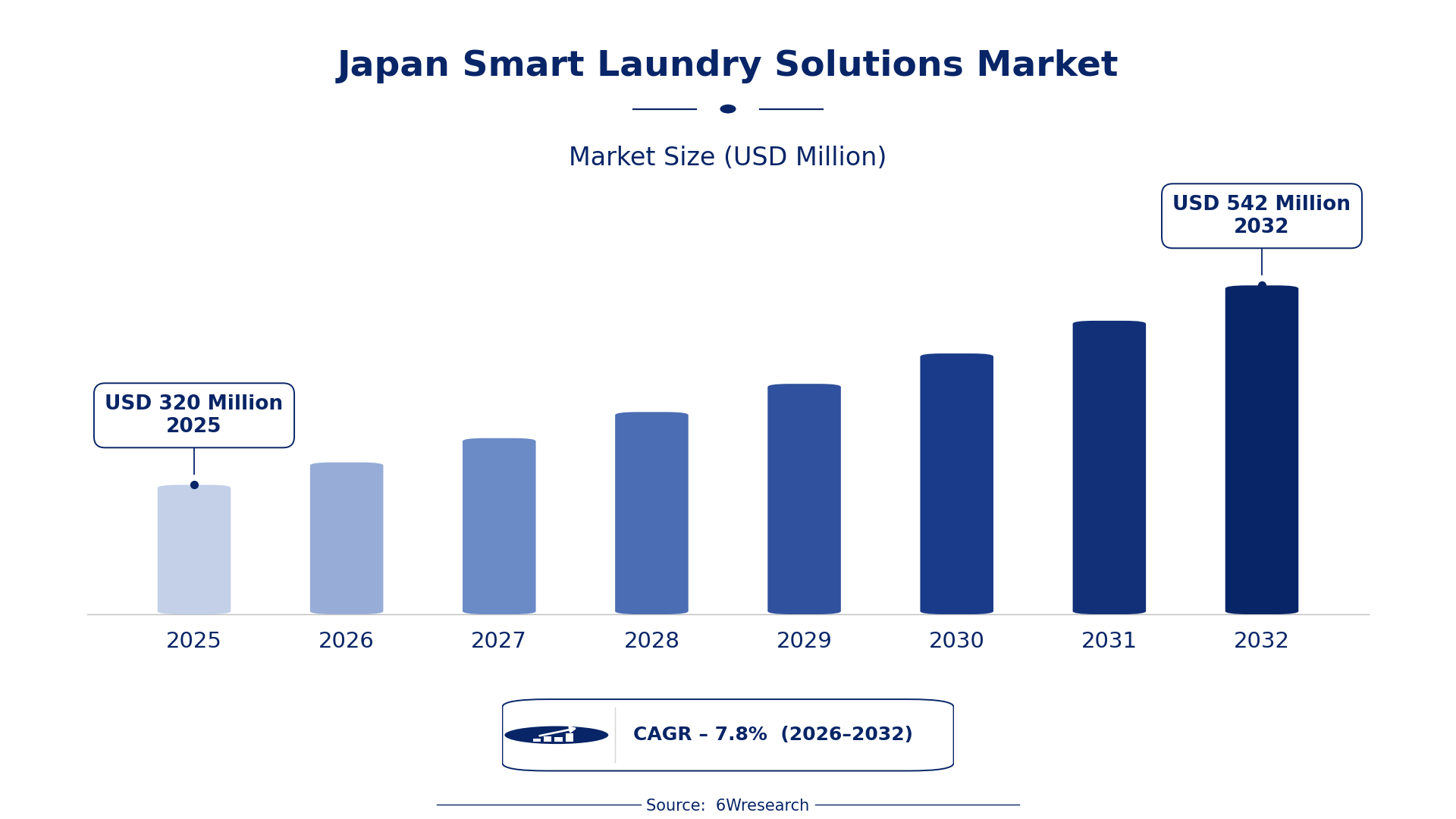
According to 6Wresearch internal database and industry insights, the Japan Smart Laundry Solutions Market was valued at USD 320 Million in 2025 and is projected to reach USD 542 Million by 2032, growing at a CAGR of approximately 7.8% during 2026–2032.
Japan Smart Laundry Solutions Market Highlights
| Report Metric | Details |
| Report Name | Japan Smart Laundry Solutions Market (2026-2032) |
| Market Size 2025 | USD 320 Million |
| Market Size 2032 | USD 542 Million |
| Absolute Growth 2025–2032 | USD 222 Million |
| CAGR 2026–2032 | 7.8% |
| Peak Annual Growth | 9.1% in 2032 |
| Forecast Period | 2026–2032 |
| Historical Data | 2022–2025 |
| Base Year | 2025 |
| Leading Laundry Product Type, 2025 | AI Washing Machines (46% share) |
| Leading Smart Functionality, 2025 | Load + Detergent Detection (45% share) |
| Leading Integration Feature, 2025 | App-Controlled (45% share) |
| Leading End User, 2025 | Residential Owners (43% share) |
| Fastest-Growing Laundry Product Type | Smart Dryers (11.6% CAGR) |
| Fastest-Growing Smart Functionality | Auto Moisture Sensing (10.2% CAGR) |
| Fastest-Growing Integration Feature | Wi-Fi Enabled (10.8% CAGR) |
| Fastest-Growing End User | Appliance Retailers (10.3% CAGR) |
| Growing Sector | Appliance Retailers |
| Key End Users | Residential Owners, Appliance Retailers, High-End Home Market, Apartment Complexes |
Japan Smart Laundry Solutions Market Year-wise Growth Rate and Key Drivers (2022–2032)
This graph illustrates the annual growth rates of the market from 2022 to 2032, highlighting a steady upward trajectory and projected market expansion over the forecast period.
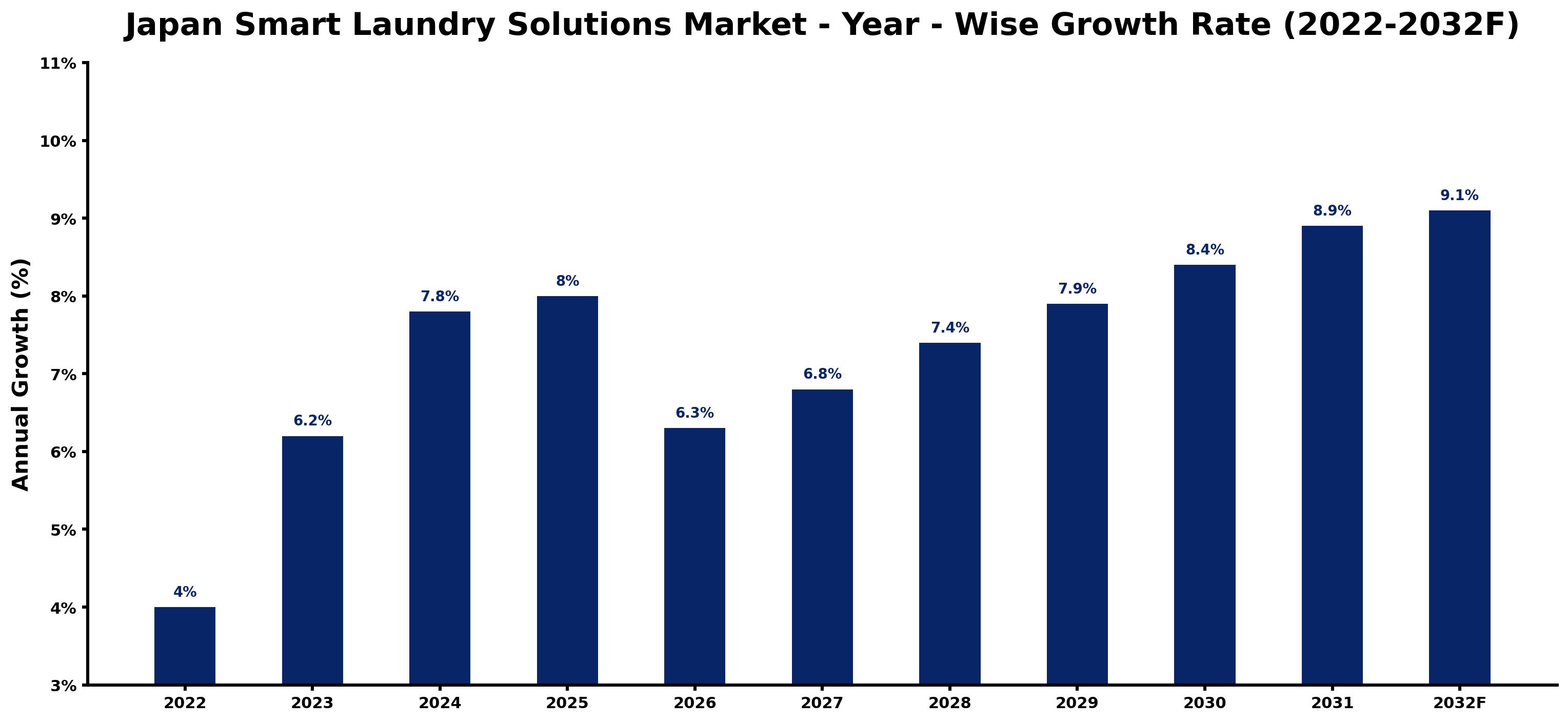
The table below sets out the estimated growth rate for each year and the main factor behind it.
| Year | Estimated Annual Growth (%) | Market Rationale |
| 2022 | 4.0 | The market experienced steady growth due to increasing urbanisation and household demand for efficient appliances. |
| 2023 | 6.2 | Demand accelerated as smart washing machines gained popularity in urban households, particularly in Tokyo and Osaka. |
| 2024 | 7.8 | The introduction of new energy-efficient models further stimulated interest and purchases among consumers. |
| 2025 | 8.0 | Growth peaked as consumers prioritised advanced features and smart home integration in laundry solutions. |
| 2026 | 6.3 | Growth is expected to slow slightly as the market adjusts to high adoption rates and competitive pricing. |
| 2027 | 6.8 | An increase in smart home technologies will revitalise interest in laundry solutions, boosting demand among residential users. |
| 2028 | 7.4 | The market is projected to rebound as consumer awareness of energy efficiency continues to rise across urban areas. |
| 2029 | 7.9 | Demand will surge with the introduction of new features in smart dryers, attracting more buyers in high-humidity regions. |
| 2030 | 8.4 | The market is expected to expand as more households integrate smart appliances into their daily routines and lifestyles. |
| 2031 | 8.9 | Consumer interest in sustainability will drive higher sales of energy-efficient laundry solutions among eco-conscious buyers. |
| 2032 | 9.1 | The market is projected to peak as advanced technologies and AI features become mainstream in residential applications. |
Note: Market size estimations and growth projections presented in this report are based on 6Wresearch's proprietary forecasting methodology, utilizing the latest available industry data, government publications, and primary research inputs.
Japan Smart Laundry Solutions Market Synopsis
Smart Laundry Solutions utilise advanced technologies to improve efficiency and convenience in laundry tasks, including AI washing machines and smart dryers that optimise processes and reduce energy consumption. The Japan Smart Laundry Solutions Market is growing due to urbanisation, increased demand from residential users, and government initiatives promoting energy-efficient appliances. The trend of smart home integration further drives this growth, presenting opportunities for manufacturers and retailers to meet changing consumer preferences.
Market Dynamics Impact Analysis (2026–2032)
| Factor | Type | Impact | Primary Segment Affected |
| Growing urban population drives demand for energy-efficient appliances. | Driver | High | AI Washing Machines |
| Increased focus on smart home integration enhances user convenience. | Driver | High | Smart Dryers |
| Emerging trends in smart home technologies create new market opportunities. | Opportunity | High | Smart Laundry Lockers |
| Rising disposable income among consumers supports premium product purchases. | Opportunity | Medium | Smart Dryers |
| High initial costs of smart appliances may deter some consumers. | Restraint | High | AI Washing Machines |
| Limited awareness of smart laundry solutions restricts market growth. | Restraint | Medium | Smart Dryers |
| Compliance with energy efficiency standards can increase production costs. | Challenge | High | AI Washing Machines |
| Capacity constraints in manufacturing may delay product availability. | Challenge | Medium | Smart Dryers |
Evaluation of Drivers in Japan Smart Laundry Solutions Market (2026–2032)
The following drivers explain most of the expected growth.
| Drivers | Primary Segment Affected | Why It Matters (Evidence) |
| Urbanisation drives demand for efficient laundry solutions among residential users. | AI Washing Machines | Approximately 30% of new appliances feature Wi-Fi connectivity, enhancing user convenience and encouraging purchases. |
| Rising energy costs prompt consumers to invest in energy-saving solutions. | Smart Dryers | In regions with high humidity, the demand for smart dryers is increasing due to their efficiency, with sales rising by over 20%. |
| Consumer preference for sustainability boosts the adoption of energy-efficient appliances. | Smart Dryers | Government initiatives promoting energy-efficient models encourage consumers to make sustainable choices, leading to a 15% increase in sales. |
| The growing interest in smart home technologies enhances the appeal of integrated laundry solutions. | App-Controlled | With over 30% of new appliances featuring smart functionalities, consumers are increasingly seeking convenience in laundry tasks. |
| Technological advancements in AI and automation are reshaping laundry processes. | AI Washing Machines | The introduction of AI-driven features is expected to increase market penetration by 25% in urban households. |
The strongest pull on demand comes from urbanisation, particularly as more households seek efficient laundry solutions. Approximately 30% of new appliances feature Wi-Fi connectivity, which improves user convenience and encourages purchases. Rising energy costs prompt consumers to invest in energy-saving appliances, especially in humid regions where smart dryers are becoming essential. The growing interest in smart home technologies is driving demand for integrated laundry solutions, creating a competitive market environment. The introduction of AI-driven features is expected to increase market penetration by 25% in urban households, enhancing the appeal of smart laundry appliances.
Evaluation of Restraints in Japan Smart Laundry Solutions Market
The following restraints limit how fast demand can grow.
| Market Restraint | Primary Segment Affected | Why It Matters (Evidence) |
| Limited consumer awareness restricts the market's growth potential. | Smart Dryers | Many consumers remain unaware of the benefits of smart laundry solutions, hindering market expansion and limiting sales by approximately 10%. |
| Supply chain disruptions can delay the availability of smart appliances. | Smart Dryers | Global supply chain issues have affected the timely production of new models, causing delays of several weeks for retailers. |
| The average lifespan of washing machines impacts replacement cycles. | AI Washing Machines | With a lifespan of around 10 years, consumers may delay purchasing new models, affecting market turnover rates. |
| High initial costs deter potential buyers from investing in smart laundry solutions. | Smart Dryers | Smart appliances can be 20% more expensive than conventional models, limiting access for many households. |
| Competition among brands can lead to price reductions that affect quality. | AI Washing Machines | As numerous brands enter the market, price reductions may compromise the quality of products available to consumers. |
Japan Smart Laundry Solutions Market Challenges
Buyers face high costs when acquiring smart laundry solutions, with prices up to 20% above traditional models, limiting options for many households. Suppliers encounter production delays due to reliance on specific components, which can extend delivery times for retailers by up to four weeks. Increased competition from various brands entering the market results in aggressive pricing strategies, potentially compromising product quality for producers. Workforce skills shortages hinder the development of advanced technologies, resulting in slower innovation rates that affect suppliers' ability to meet evolving market demands.
Trends in the Japan Smart Laundry Solutions Market
Below are the shifts with the largest effect on the Japan Smart Laundry Solutions Market.
- Shift Towards Smart Home Integration: Residential owners are increasingly adopting smart laundry solutions, with over 30% of new appliances featuring Wi-Fi capabilities. This trend reflects a growing preference for convenience and connectivity in home appliances, especially in urban areas.
- Transition from Traditional to AI-Driven Appliances: In urban areas, AI washing machines are gaining traction, with a projected increase in adoption rates of 20% by 2030. This shift highlights the demand for automation and efficiency in laundry tasks, driven by consumer preferences.
- Emergence of Energy-Efficient Technologies: The Japanese government promotes energy-efficient appliances, resulting in a 15% increase in smart dryer sales. This initiative aligns with consumer preferences for sustainability and reduced energy consumption, particularly in urban households.
- Growing Interest in Remote-Controlled Laundry Solutions: App-controlled laundry appliances are becoming popular, particularly among tech-savvy consumers. This trend is evidenced by the increasing number of households integrating smart home technologies, with an expected growth rate of 10%.
Investment Opportunities in the Japan Smart Laundry Solutions Market
The opportunities below stand out in the Japan Smart Laundry Solutions Market for new entrants and existing suppliers.
- Expansion of Smart Laundry Solutions in Urban Areas: Tokyo's dense population presents opportunities for smart laundry solutions, with a projected market growth of USD 542 million by 2032. Manufacturers should focus on urban residential complexes to meet this demand effectively.
- Investing in Energy-Efficient Appliance Development: The growing emphasis on sustainability creates opportunities for manufacturers to invest in energy-efficient technologies. Appliance retailers can benefit from stocking these products, appealing to eco-conscious consumers and increasing sales by 15%.
- Partnerships for Smart Home Integration: Collaborating with smart home technology providers can improve product offerings and expand market reach. Retailers in urban areas should consider joint ventures to attract more customers and enhance their competitive edge.
- Development of AI Technologies for Laundry Solutions: Investing in AI technologies can lead to advanced laundry solutions that improve efficiency. Research funding from the government supports advancements in this sector, creating opportunities for manufacturers to innovate.
Government Initiatives in the Japan Smart Laundry Solutions Market
The AI Promotion Act, established in 2025, creates a national framework for AI research and development, benefiting producers of smart laundry solutions. This measure encourages innovation and supports the integration of AI technologies in household appliances, improving their efficiency and user convenience. The government allocated USD 10 million for research into AI technologies in home appliances, directly impacting the availability of smart laundry solutions in the market.
The Digital Agency facilitates the digital transformation of industries, including home appliances, promoting standards that manufacturers must adhere to. The Ministry of Economy, Trade and Industry (METI) approves initiatives for smart appliance development, including funding for research into AI technologies, which directly impacts the availability and promotion of smart laundry solutions in the market, with a budget of USD 5 million.
Future Insight of the Japan Smart Laundry Solutions Market
By 2032, policy-driven shifts will reshape the market, as government initiatives promote energy-efficient appliances and smart technologies. Suppliers will likely invest in advanced features, anticipating that 30% of new appliances will incorporate smart functionalities. The push for integrated solutions will drive buyers to seek appliances that streamline laundry processes, improving convenience. Research funding for AI technologies will lead to more sophisticated designs, enhancing both efficiency and user experience in smart laundry solutions.
Market Segmentation Analysis
Japan Smart Laundry Solutions Market report covers a detailed analysis of the following market segments:
By Laundry Product Type – AI Washing Machines Lead, Smart Dryers Expected to Grow Fastest
According to Saurav Kr Singh, Senior Research Analyst at 6Wresearch, in 2025, AI Washing Machines led the laundry product type split with a 46% share. The leading sub-segment consists of washing machines that optimise washing processes, appealing to residential users who value efficiency. Urban households in Tokyo increasingly prefer these appliances due to their advanced functionalities and energy-saving capabilities. Over 2026–2032, Smart Dryers are expected to post the fastest growth, at a CAGR of 11.6%. The surge in demand for smart dryers is attributed to their ability to improve drying efficiency, especially in areas with high humidity. Recent data shows a significant increase in installations of these dryers in urban settings, indicating a shift in consumer preferences. Suppliers should prioritise the development of smart dryers to meet the rising demand in urban regions.
By Smart Functionality – Load + Detergent Detection Leads, Auto Moisture Sensing Expected to Grow Fastest
Load + Detergent Detection accounted for 45% of the market by smart functionality in 2025. Load and detergent detection technology holds the largest share as it optimises washing based on load size, making it essential for efficient laundry processes. This functionality is particularly valued by households aiming to reduce water and detergent waste. Auto Moisture Sensing is projected to grow fastest, at a CAGR of 10.2% during 2026–2032. Auto moisture sensing is experiencing the fastest growth due to its ability to improve drying accuracy and efficiency, which is increasingly sought after in modern appliances. The trend towards energy-efficient solutions is driving this segment's rapid expansion. Manufacturers need to prioritise the integration of auto moisture sensing in new products to meet consumer expectations for efficiency.
By Integration Feature – App-Controlled Leads, Wi-Fi Enabled Expected to Grow Fastest
The largest integration feature category in 2025 was App-Controlled, at 45% of revenue. App-controlled features lead the market as they allow users to operate laundry appliances remotely, catering to the tech-savvy consumer base in Japan. This functionality is particularly appealing in urban areas where convenience is paramount. The quickest growth will come from Wi-Fi Enabled, forecast to expand at a CAGR of 10.8% between 2026 and 2032. Wi-Fi enabled appliances are growing rapidly, driven by the increasing consumer demand for connectivity and smart home integration. Over 30% of new appliances now feature Wi-Fi capabilities, indicating a shift towards more connected solutions. Suppliers must invest in Wi-Fi technology to stay competitive and meet the rising consumer expectations for connectivity.
By End User – Residential Owners Lead, Appliance Retailers Expected to Grow Fastest
Residential Owners held 43% of the Japan Smart Laundry Solutions Market by end user in 2025. Residential owners form the largest segment as they are the primary consumers of smart laundry solutions, particularly in urban environments. The average household size of 2.3 persons drives the need for efficient laundry appliances that cater to their daily needs. Appliance Retailers are set to record the highest CAGR in this split, 10.3% over 2026–2032. Appliance retailers are experiencing the fastest growth due to the rising sales of smart laundry products in urban markets. The presence of over 1,500 retailers in Japan underscores the expanding reach of these solutions to consumers. Retailers must enhance their product lines to take advantage of the increasing consumer interest in smart laundry solutions.
Key Attractiveness of the Report
- 10 Years of Market Numbers
- Historical Data Starting from 2022 to 2025
- Base Year 2025
- Forecast Data until 2032
- Key Performance Indicators Impacting the Market
- Major Upcoming Developments and Projects
Key Highlights of the Report:
- Japan Smart Laundry Solutions Market Outlook
- Market Size of Japan Smart Laundry Solutions Market, 2025
- Forecast of Japan Smart Laundry Solutions Market, 2032
- Historical Data and Forecast of Japan Smart Laundry Solutions Revenues & Volume for the Period 2022-2032F
- Japan Smart Laundry Solutions Market Trend Evolution
- Japan Smart Laundry Solutions Market Drivers and Challenges
- Japan Smart Laundry Solutions Price Trends
- Japan Smart Laundry Solutions Porter's Five Forces
- Japan Smart Laundry Solutions Industry Life Cycle
- Historical Data and Forecast of Japan Smart Laundry Solutions Market Revenues & Volume By Laundry Product Type for the Period 2022-2032F
- Historical Data and Forecast of Japan Smart Laundry Solutions Market Revenues & Volume By AI Washing Machines for the Period 2022-2032F
- Historical Data and Forecast of Japan Smart Laundry Solutions Market Revenues & Volume By Smart Dryers for the Period 2022-2032F
- Historical Data and Forecast of Japan Smart Laundry Solutions Market Revenues & Volume By Laundry Robots for the Period 2022-2032F
- Historical Data and Forecast of Japan Smart Laundry Solutions Market Revenues & Volume By Smart Laundry Lockers for the Period 2022-2032F
- Historical Data and Forecast of Japan Smart Laundry Solutions Market Revenues & Volume By Smart Functionality for the Period 2022-2032F
- Historical Data and Forecast of Japan Smart Laundry Solutions Market Revenues & Volume By Load + Detergent Detection for the Period 2022-2032F
- Historical Data and Forecast of Japan Smart Laundry Solutions Market Revenues & Volume By Auto Moisture Sensing for the Period 2022-2032F
- Historical Data and Forecast of Japan Smart Laundry Solutions Market Revenues & Volume By Folding + Sorting for the Period 2022-2032F
- Historical Data and Forecast of Japan Smart Laundry Solutions Market Revenues & Volume By RFID-Based Storage for the Period 2022-2032F
- Historical Data and Forecast of Japan Smart Laundry Solutions Market Revenues & Volume By Integration Feature for the Period 2022-2032F
- Historical Data and Forecast of Japan Smart Laundry Solutions Market Revenues & Volume By App-Controlled for the Period 2022-2032F
- Historical Data and Forecast of Japan Smart Laundry Solutions Market Revenues & Volume By Wi-Fi Enabled for the Period 2022-2032F
- Historical Data and Forecast of Japan Smart Laundry Solutions Market Revenues & Volume By Vision + AI for the Period 2022-2032F
- Historical Data and Forecast of Japan Smart Laundry Solutions Market Revenues & Volume By Cloud Interface for the Period 2022-2032F
- Historical Data and Forecast of Japan Smart Laundry Solutions Market Revenues & Volume By End User for the Period 2022-2032F
- Historical Data and Forecast of Japan Smart Laundry Solutions Market Revenues & Volume By Residential Owners for the Period 2022-2032F
- Historical Data and Forecast of Japan Smart Laundry Solutions Market Revenues & Volume By Appliance Retailers for the Period 2022-2032F
- Historical Data and Forecast of Japan Smart Laundry Solutions Market Revenues & Volume By High-End Home Market for the Period 2022-2032F
- Historical Data and Forecast of Japan Smart Laundry Solutions Market Revenues & Volume By Apartment Complexes for the Period 2022-2032F
- Japan Smart Laundry Solutions Import Export Trade Statistics
- Market Opportunity Assessment By Laundry Product Type
- Market Opportunity Assessment By Smart Functionality
- Market Opportunity Assessment By Integration Feature
- Market Opportunity Assessment By End User
- Japan Smart Laundry Solutions Top Companies Market Share
- Japan Smart Laundry Solutions Competitive Benchmarking By Technical and Operational Parameters
- Japan Smart Laundry Solutions Company Profiles
- Japan Smart Laundry Solutions Key Strategic Recommendations
Market Covered
The study includes the following segmentation.
By Laundry Product Type
- AI Washing Machines
- Smart Dryers
- Laundry Robots
- Smart Laundry Lockers
By Smart Functionality
- Load + Detergent Detection
- Auto Moisture Sensing
- Folding + Sorting
- RFID-Based Storage
By Integration Feature
- App-Controlled
- Wi-Fi Enabled
- Vision + AI
- Cloud Interface
By End User
- Residential Owners
- Appliance Retailers
- High-End Home Market
- Apartment Complexes































