Japan Smart Livestock Farming Market Size & Growth Rate
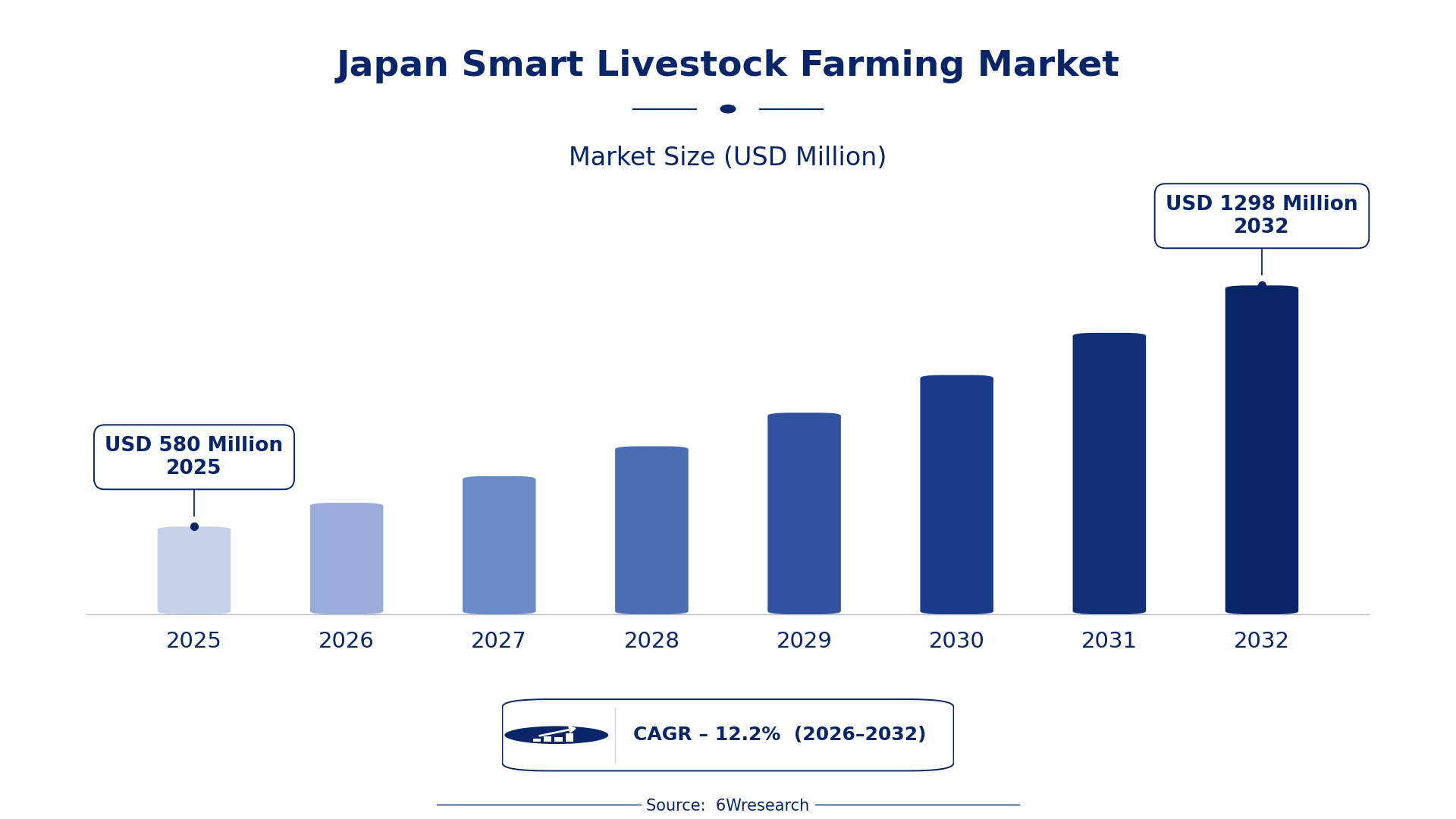
According to 6Wresearch internal database and industry insights, the Japan Smart Livestock Farming Market was valued at USD 580 Million in 2025 and is projected to reach USD 1,298 Million by 2032, growing at a CAGR of approximately 12.2% during 2026–2032.
Japan Smart Livestock Farming Market Highlights
| Report Metric | Details |
| Report Name | Japan Smart Livestock Farming Market (2026-2032) |
| Market Size 2025 | USD 580 Million |
| Market Size 2032 | USD 1,298 Million |
| Absolute Growth 2025–2032 | USD 718 Million |
| CAGR 2026–2032 | 12.2% |
| Peak Annual Growth | 13.3% in 2031 |
| Forecast Period | 2026–2032 |
| Historical Data | 2022–2025 |
| Base Year | 2025 |
| Leading Animal Monitoring Type, 2025 | RFID Ear Tags (50% share) |
| Leading Smart Feature, 2025 | Health & Movement Monitoring (42% share) |
| Leading Tracking Mechanism, 2025 | RFID + IoT (43% share) |
| Leading End User, 2025 | Cattle Farms (44% share) |
| Fastest-Growing Animal Monitoring Type | Smart Feeding Systems (17.6% CAGR) |
| Fastest-Growing Smart Feature | Automated Diet Adjustment (16.6% CAGR) |
| Fastest-Growing Tracking Mechanism | Sensor Feedback (16.9% CAGR) |
| Fastest-Growing End User | Dairy & Pig Farms (15.9% CAGR) |
| Growing Sector | livestock farming |
| Key End Users | cattle farms, dairy farms, pig farms, meat producers |
Japan Smart Livestock Farming Market Year-wise Growth Rate and Key Drivers (2022–2032)
This graph illustrates the annual growth rates of the market from 2022 to 2032, highlighting a steady upward trajectory and projected market expansion over the forecast period.
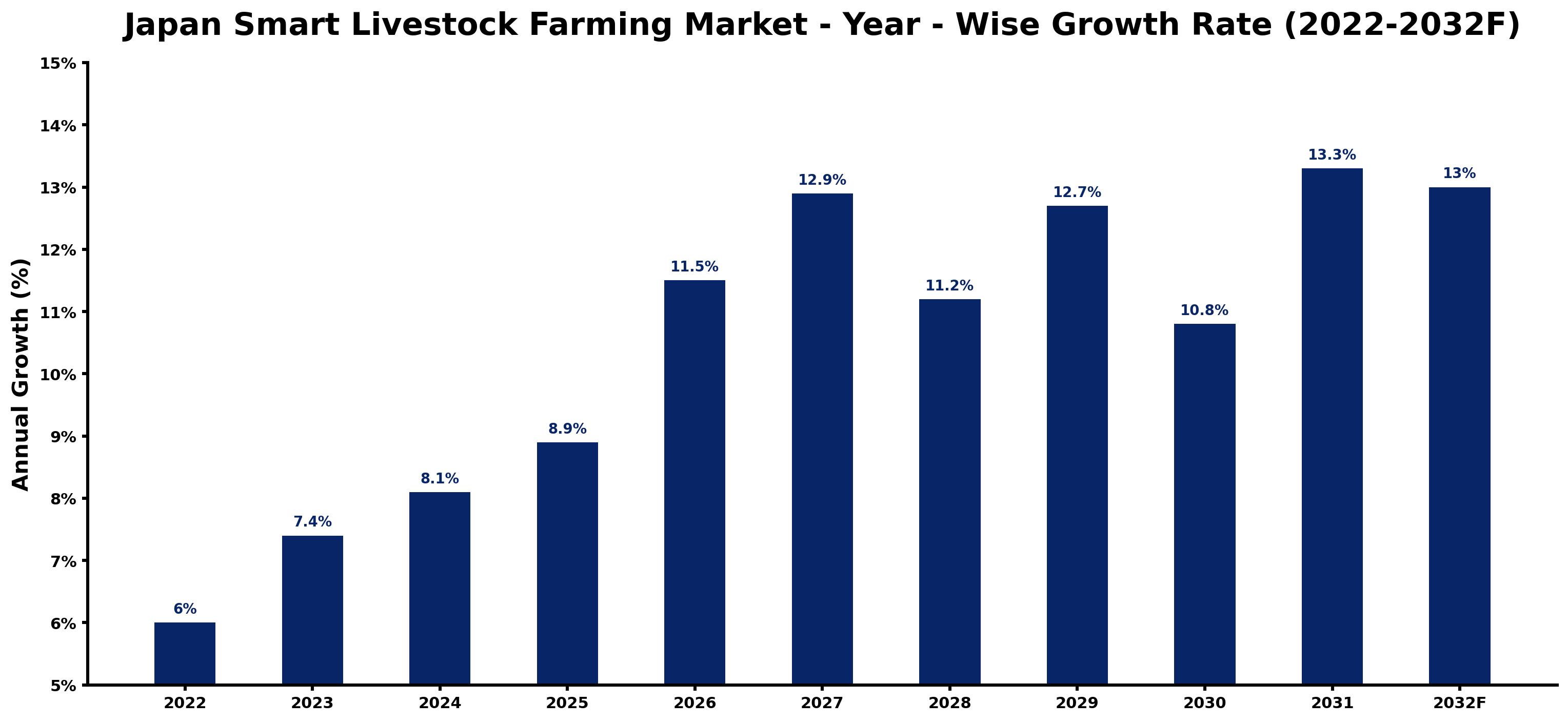
The following figures match every annual growth estimate with the main market development of that year, giving the reasoning behind each rise or slowdown.
| Year | Estimated Annual Growth (%) | Market Rationale |
| 2022 | 6.0 | The market experienced steady growth due to increased adoption of smart technologies in livestock management. |
| 2023 | 7.4 | Demand for efficient livestock management solutions accelerated growth compared to the previous year. |
| 2024 | 8.1 | Technological advancements in animal monitoring systems contributed to a faster growth rate than in 2023. |
| 2025 | 8.9 | The introduction of new smart farming technologies led to peak growth in this year. |
| 2026 | 11.5 | Increased investment in smart livestock solutions is expected to drive demand higher than in 2025. |
| 2027 | 12.9 | Adoption of advanced monitoring technologies will continue to expand among farms. |
| 2028 | 11.2 | Growth is projected to slow slightly, reflecting a maturation phase in technology adoption among farms. |
| 2029 | 12.7 | Demand is expected to surge again as new innovations in smart farming emerge. |
| 2030 | 10.8 | Growth is projected to moderate, indicating a stabilisation in the adoption of existing technologies. |
| 2031 | 13.3 | The market is expected to peak due to advancements in smart livestock farming technologies. |
| 2032 | 13.0 | Growth is projected to slow as the market begins to stabilise after reaching its peak. |
Note: Market size estimations and growth projections presented in this report are based on 6Wresearch's proprietary forecasting methodology, utilizing the latest available industry data, government publications, and primary research inputs.
Japan Smart Livestock Farming Market Synopsis
Smart livestock farming utilises IoT and AI technologies to improve livestock management efficiency, focusing on health monitoring, feeding optimisation, and movement tracking. In Japan, approximately 4 million cattle farms are increasingly adopting these technologies, supported by government initiatives and a national strategy aiming for a 30% productivity increase by 2030. The demand is driven by domestic farms seeking to boost productivity and reduce operational costs, alongside growing investment in smart farming solutions.
Market Dynamics Impact Analysis (2026–2032)
| Factor | Type | Impact | Primary Segment Affected |
| Increased adoption of IoT and AI technologies in livestock management | Driver | High | RFID Ear Tags |
| Government support for smart farming initiatives | Driver | High | Smart Feeding Systems |
| Growing demand for efficient livestock management solutions | Opportunity | High | Cattle Farms |
| Rising interest in sustainable farming practices | Opportunity | Medium | Dairy & Pig Farms |
| High initial investment costs for smart farming technologies | Restraint | High | AI Weight Estimation |
| Limited awareness and understanding of smart farming benefits among farmers | Restraint | Medium | Remote Monitoring Collars |
| Challenges in integrating new technologies with existing farming practices | Challenge | High | Health & Movement Monitoring |
| Dependence on reliable internet connectivity for IoT solutions | Challenge | Medium | Automated Diet Adjustment |
Evaluation of Drivers in Japan Smart Livestock Farming Market (2026–2032)
Key forces behind demand, with the segment each one moves most, are listed below.
| Drivers | Primary Segment Affected | Why It Matters (Evidence) |
| Rising demand for productivity improvements in livestock farming | RFID Ear Tags | Approximately 4 million cattle farms in Japan are adopting RFID technology to improve tracking and management. |
| Government initiatives promoting smart farming technologies | Smart Feeding Systems | The Ministry of Agriculture, Forestry and Fisheries supports the integration of smart feeding systems to boost efficiency. |
| Technological advancements in livestock monitoring solutions | AI Weight Estimation | AI applications are expanding in the Hokkaido region, providing accurate weight monitoring without handling. |
| Increased focus on animal welfare and health tracking | Remote Monitoring Collars | Health monitoring is vital for ensuring animal well-being, leading to higher adoption rates. |
| Demand for cost-effective farming solutions | Health & Movement Monitoring | Farmers seek to reduce operational costs through efficient livestock management practices. |
Much of the new demand traces back to the approximately 4 million cattle farms in Japan that are increasingly adopting smart technologies for tracking livestock. In the Hokkaido region, AI applications are expanding, allowing for accurate weight estimation without the need for handling. The focus on animal welfare drives the adoption of remote monitoring collars, enabling real-time health tracking of livestock. As farmers seek cost-effective solutions, health and movement monitoring systems become essential for optimising management practices.
Evaluation of Restraints in Japan Smart Livestock Farming Market
These restraints slow adoption and weigh on supplier margins.
| Market Restraint | Primary Segment Affected | Why It Matters (Evidence) |
| High initial investment costs for smart farming technologies | AI Weight Estimation | Many farmers find the upfront costs of implementing AI solutions prohibitive, limiting adoption. |
| Limited awareness of smart farming benefits among farmers | Remote Monitoring Collars | A lack of understanding regarding the advantages of these technologies hinders widespread use. |
| Challenges in integrating new technologies with existing practices | Health & Movement Monitoring | Farmers may struggle to adapt their operations to incorporate new monitoring systems effectively. |
| Dependence on reliable internet connectivity for IoT solutions | Automated Diet Adjustment | In rural areas, inconsistent internet access can disrupt the functionality of IoT-based systems. |
| Regulatory compliance requirements for new technologies | Smart Feeding Systems | Compliance with JIS standards can complicate the adoption process for smart feeding solutions. |
Japan Smart Livestock Farming Market Challenges
Regulatory compliance with JIS standards for livestock monitoring equipment complicates market entry for producers, causing delays that can extend product launches by several months. Rising operational costs burden buyers, as average dairy farms producing 600 litres of milk daily face feed price increases that can elevate expenses by 15%. Limited access to advanced technology hampers productivity for over 1.5 million workers in the livestock sector, as many operations struggle to invest in smart farming solutions. Inconsistent adoption of RFID technology leads to tracking discrepancies, jeopardising animal welfare across numerous farms.
Trends in the Japan Smart Livestock Farming Market
Several trends are reshaping the Japan Smart Livestock Farming Market; the most important are set out below.
- Shift from Traditional to Smart Livestock Management: The transition to smart livestock management is becoming more common as farms adopt IoT and AI technologies. In 2023, over 200,000 dairy farms in Japan implemented smart technologies, improving productivity and efficiency.
- Emergence of Health Monitoring Solutions: Health monitoring solutions are becoming increasingly important for livestock welfare. The adoption of remote monitoring collars has surged, with many farms prioritising animal well-being through real-time health tracking.
- Growing Integration of AI in Livestock Farming: AI applications in livestock farming are gaining traction, particularly in the Hokkaido region. This trend is reflected in the increasing demand for accurate weight estimation, improving operational efficiency.
- Rise of Automated Feeding Systems: Automated feeding systems are being embraced by dairy and pig farms, driven by the need for efficiency. The market for smart feeding systems is projected to grow at a CAGR of 17.6%.
Investment Opportunities in the Japan Smart Livestock Farming Market
The following opportunities in the Japan Smart Livestock Farming Market pair current demand with a clear way in.
- Cattle Farms Seeking Efficiency Improvements: Cattle farms are increasingly looking for smart solutions to improve productivity. With the livestock sector valued at approximately $40 billion, there is a notable opportunity to invest in smart technologies.
- Dairy & Pig Farms Adopting Smart Solutions: The current demand for efficient livestock management solutions presents an opportunity for suppliers. Dairy and pig farms are likely to invest in technologies that optimise feeding and health monitoring.
- Investment in Health Monitoring Technologies: Health monitoring technologies are in high demand as farms prioritise animal welfare. Investing in remote monitoring solutions can cater to the growing market for livestock health management.
- Expansion of Smart Feeding Systems in Rural Areas: Rural areas are increasingly adopting smart feeding systems to improve operational efficiency. Suppliers can enter this market by partnering with local agricultural cooperatives.
Government Initiatives in the Japan Smart Livestock Farming Market
The Semiconductor and Digital Industry Strategy, introduced in June 2021, supports Japan's semiconductor manufacturing capabilities, which indirectly aids the development of smart livestock technologies. This measure complements existing laws by encouraging innovation in agricultural technology and ensuring a stable supply chain for essential components.
In 2022, the Economic Security Promotion Act was enacted to strengthen supply-chain resilience for critical products. The Ministry of Agriculture, Forestry and Fisheries oversees initiatives that promote smart farming technologies, ensuring that producers can access necessary resources and support.
Future Insight of the Japan Smart Livestock Farming Market
Investment in smart farming technologies will increase, driving demand for advanced monitoring systems in the livestock sector. By 2032, the national strategy aims for a 30% productivity increase, particularly in regions like Hokkaido where AI applications are expanding. Over 200,000 dairy farms are projected to adopt smart technologies, enhancing operational efficiency. Suppliers must innovate to meet the evolving needs of buyers focused on improving productivity and ensuring animal welfare.
Market Segmentation Analysis
Japan Smart Livestock Farming Market report covers a detailed analysis of the following market segments:
By Animal Monitoring Type – RFID Ear Tags Lead, Smart Feeding Systems Expected to Grow Fastest
According to Saurav Kr Singh, Senior Research Analyst at 6Wresearch, the largest animal monitoring type category in 2025 was RFID Ear Tags, at 50% of revenue. RFID Ear Tags are crucial for tracking and managing livestock, making them indispensable for farmers. Their extensive use is evident from the approximately 4 million cattle farms in Japan that rely on this technology for effective livestock oversight. The quickest growth will come from Smart Feeding Systems, forecast to expand at a CAGR of 17.6% between 2026 and 2032. Smart Feeding Systems are experiencing rapid growth due to their ability to automate feeding processes, significantly improving operational efficiency. This surge is bolstered by the national strategy aiming for a 30% productivity increase by 2030. Suppliers should focus on developing automated solutions to meet the increasing demand for efficiency in livestock management.
By Smart Feature – Health & Movement Monitoring Leads, Automated Diet Adjustment Expected to Grow Fastest
In 2025, Health & Movement Monitoring led the smart feature split with a 42% share. Health & Movement Monitoring is vital for ensuring animal welfare, making it a preferred choice among livestock farmers. Its adoption is reflected in over 200,000 dairy farms in Japan that utilise smart technologies for improved management. Automated Diet Adjustment is projected to grow fastest, at a CAGR of 16.6% during 2026–2032. Automated Diet Adjustment is gaining traction as it optimises nutrition based on real-time data, which is critical for farms striving to enhance productivity. This trend aligns with the industry's emphasis on operational efficiency. Buyers will benefit from investing in advanced monitoring solutions that prioritise animal health and productivity.
By Tracking Mechanism – RFID + IoT Leads, Sensor Feedback Expected to Grow Fastest
RFID + IoT took 43% of tracking mechanism revenue in 2025, more than any other category. RFID + IoT integrates tracking and data collection, providing a comprehensive solution for livestock management. This method is widely adopted across Japan's cattle farms, ensuring effective monitoring of livestock conditions. Over 2026–2032, Sensor Feedback is expected to post the fastest growth, at a CAGR of 16.9%. Sensor Feedback is rapidly gaining popularity as it offers real-time data for monitoring livestock conditions, essential for timely decision-making. The increasing focus on data-driven farming practices fuels this segment's growth. Suppliers must concentrate on creating integrated tracking solutions to address the evolving needs of livestock farmers.
By End User – Cattle Farms Lead, Dairy & Pig Farms Expected to Grow Fastest
With 44% of end user revenue in 2025, Cattle Farms was the largest category. Cattle Farms are the primary users of smart farming technologies, leveraging these solutions to enhance productivity and management. The large number of cattle farms in Japan underscores their pivotal role in the market. Dairy & Pig Farms are set to record the highest CAGR in this split, 15.9% over 2026–2032. Dairy & Pig Farms are emerging as significant users of smart technologies, driven by the need for productivity improvements in these sectors. Their growing adoption reflects a broader trend towards efficiency in livestock farming. Suppliers should tailor their offerings to meet the specific requirements of dairy and pig farms as they increasingly adopt smart farming technologies.
Key Attractiveness of the Report
- 10 Years of Market Numbers
- Historical Data Starting from 2022 to 2025
- Base Year 2025
- Forecast Data until 2032
- Key Performance Indicators Impacting the Market
- Major Upcoming Developments and Projects
Key Highlights of the Report:
- Japan Smart Livestock Farming Market Outlook
- Market Size of Japan Smart Livestock Farming Market, 2025
- Forecast of Japan Smart Livestock Farming Market, 2032
- Historical Data and Forecast of Japan Smart Livestock Farming Revenues & Volume for the Period 2022-2032F
- Japan Smart Livestock Farming Market Trend Evolution
- Japan Smart Livestock Farming Market Drivers and Challenges
- Japan Smart Livestock Farming Price Trends
- Japan Smart Livestock Farming Porter's Five Forces
- Japan Smart Livestock Farming Industry Life Cycle
- Historical Data and Forecast of Japan Smart Livestock Farming Market Revenues & Volume By Animal Monitoring Type for the Period 2022-2032F
- Historical Data and Forecast of Japan Smart Livestock Farming Market Revenues & Volume By RFID Ear Tags for the Period 2022-2032F
- Historical Data and Forecast of Japan Smart Livestock Farming Market Revenues & Volume By Smart Feeding Systems for the Period 2022-2032F
- Historical Data and Forecast of Japan Smart Livestock Farming Market Revenues & Volume By AI Weight Estimation for the Period 2022-2032F
- Historical Data and Forecast of Japan Smart Livestock Farming Market Revenues & Volume By Remote Monitoring Collars for the Period 2022-2032F
- Historical Data and Forecast of Japan Smart Livestock Farming Market Revenues & Volume By Smart Feature for the Period 2022-2032F
- Historical Data and Forecast of Japan Smart Livestock Farming Market Revenues & Volume By Health & Movement Monitoring for the Period 2022-2032F
- Historical Data and Forecast of Japan Smart Livestock Farming Market Revenues & Volume By Automated Diet Adjustment for the Period 2022-2032F
- Historical Data and Forecast of Japan Smart Livestock Farming Market Revenues & Volume By Image-Based Growth Prediction for the Period 2022-2032F
- Historical Data and Forecast of Japan Smart Livestock Farming Market Revenues & Volume By Heart Rate & Activity Logs for the Period 2022-2032F
- Historical Data and Forecast of Japan Smart Livestock Farming Market Revenues & Volume By Tracking Mechanism for the Period 2022-2032F
- Historical Data and Forecast of Japan Smart Livestock Farming Market Revenues & Volume By RFID + IoT for the Period 2022-2032F
- Historical Data and Forecast of Japan Smart Livestock Farming Market Revenues & Volume By Sensor Feedback for the Period 2022-2032F
- Historical Data and Forecast of Japan Smart Livestock Farming Market Revenues & Volume By Vision Sensors for the Period 2022-2032F
- Historical Data and Forecast of Japan Smart Livestock Farming Market Revenues & Volume By GPS + Mobile Sync for the Period 2022-2032F
- Historical Data and Forecast of Japan Smart Livestock Farming Market Revenues & Volume By End User for the Period 2022-2032F
- Historical Data and Forecast of Japan Smart Livestock Farming Market Revenues & Volume By Cattle Farms for the Period 2022-2032F
- Historical Data and Forecast of Japan Smart Livestock Farming Market Revenues & Volume By Dairy & Pig Farms for the Period 2022-2032F
- Historical Data and Forecast of Japan Smart Livestock Farming Market Revenues & Volume By Meat Producers for the Period 2022-2032F
- Historical Data and Forecast of Japan Smart Livestock Farming Market Revenues & Volume By Livestock Consultants for the Period 2022-2032F
- Japan Smart Livestock Farming Import Export Trade Statistics
- Market Opportunity Assessment By Animal Monitoring Type
- Market Opportunity Assessment By Smart Feature
- Market Opportunity Assessment By Tracking Mechanism
- Market Opportunity Assessment By End User
- Japan Smart Livestock Farming Top Companies Market Share
- Japan Smart Livestock Farming Competitive Benchmarking By Technical and Operational Parameters
- Japan Smart Livestock Farming Company Profiles
- Japan Smart Livestock Farming Key Strategic Recommendations
Market Covered
Segments analysed in this report are listed below.
By Animal Monitoring Type
- RFID Ear Tags
- Smart Feeding Systems
- AI Weight Estimation
- Remote Monitoring Collars
By Smart Feature
- Health & Movement Monitoring
- Automated Diet Adjustment
- Image-Based Growth Prediction
- Heart Rate & Activity Logs
By Tracking Mechanism
- RFID + IoT
- Sensor Feedback
- Vision Sensors
- GPS + Mobile Sync
By End User
- Cattle Farms
- Dairy & Pig Farms
- Meat Producers
- Livestock Consultants































