Japan Smart Locker Systems Market Size & Growth Rate
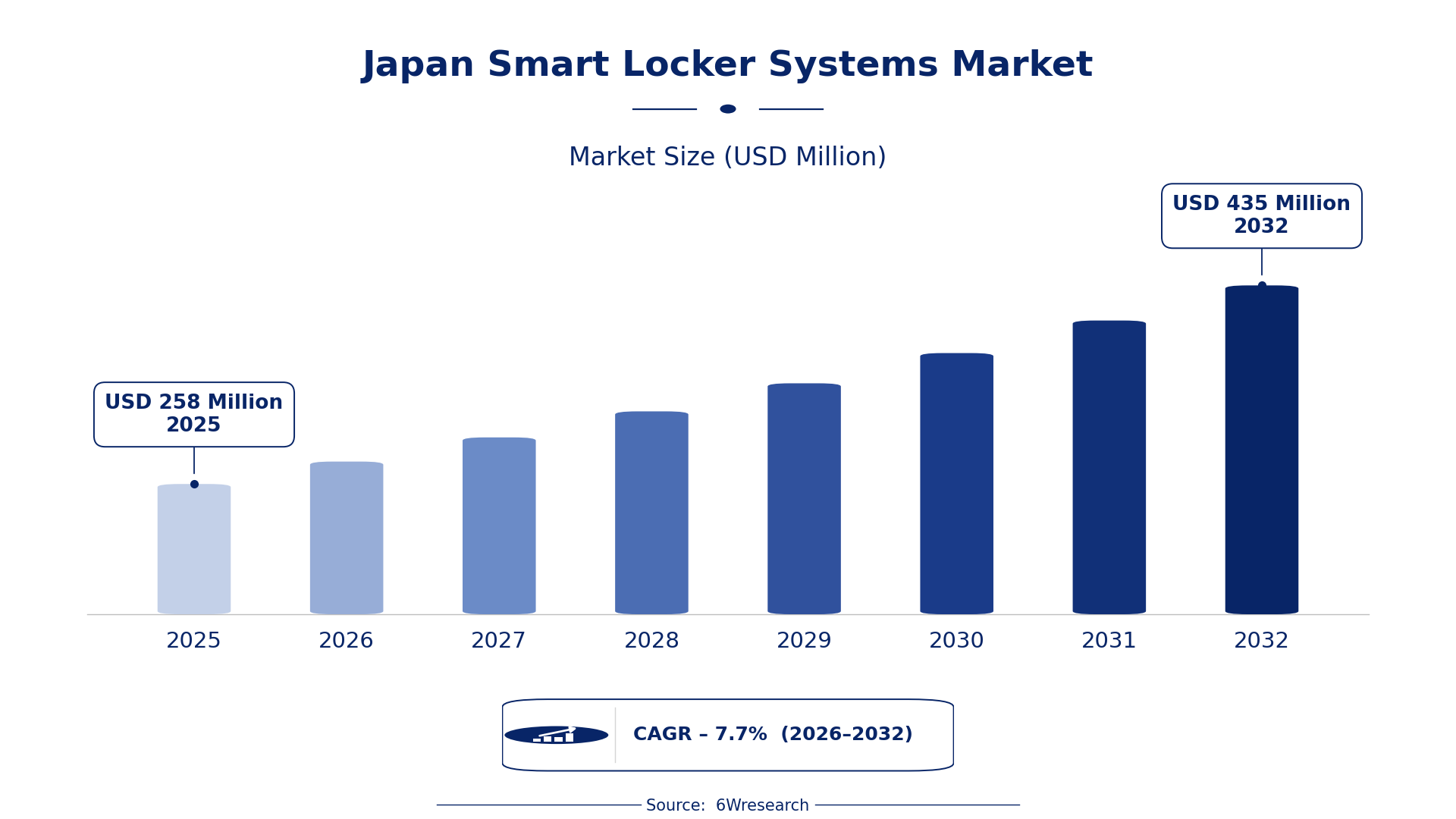
According to 6Wresearch internal database and industry insights, the Japan Smart Locker Systems Market was valued at USD 258 Million in 2025 and is projected to reach USD 435 Million by 2032, growing at a CAGR of approximately 7.7% during 2026–2032.
Japan Smart Locker Systems Market Highlights
| Report Metric | Details |
| Report Name | Japan Smart Locker Systems Market (2026-2032) |
| Market Size 2025 | USD 258 Million |
| Market Size 2032 | USD 435 Million |
| Absolute Growth 2025–2032 | USD 177 Million |
| CAGR 2026–2032 | 7.7% |
| Peak Annual Growth | 9.7% in 2026 |
| Forecast Period | 2026–2032 |
| Historical Data | 2022–2025 |
| Base Year | 2025 |
| Leading Locker Type, 2025 | Parcel Lockers (40% share) |
| Leading Smart Functionality, 2025 | OTP/QR Access (40% share) |
| Leading Authentication Type, 2025 | IoT Lock + Scanner (43% share) |
| Leading End User, 2025 | E-Commerce Businesses (36% share) |
| Fastest-Growing Locker Type | Temperature-Controlled (10.7% CAGR) |
| Fastest-Growing Smart Functionality | Cold/Warm Storage Monitoring (10.0% CAGR) |
| Fastest-Growing End User | Grocery Stores (9.9% CAGR) |
| Growing Sector | Grocery Stores |
| Key End Users | E-Commerce Businesses, Grocery Stores, Smart Campus Solutions, Residential Societies |
Japan Smart Locker Systems Market Year-wise Growth Rate and Key Drivers (2022–2032)
This graph illustrates the annual growth rates of the market from 2022 to 2032, highlighting a steady upward trajectory and projected market expansion over the forecast period.
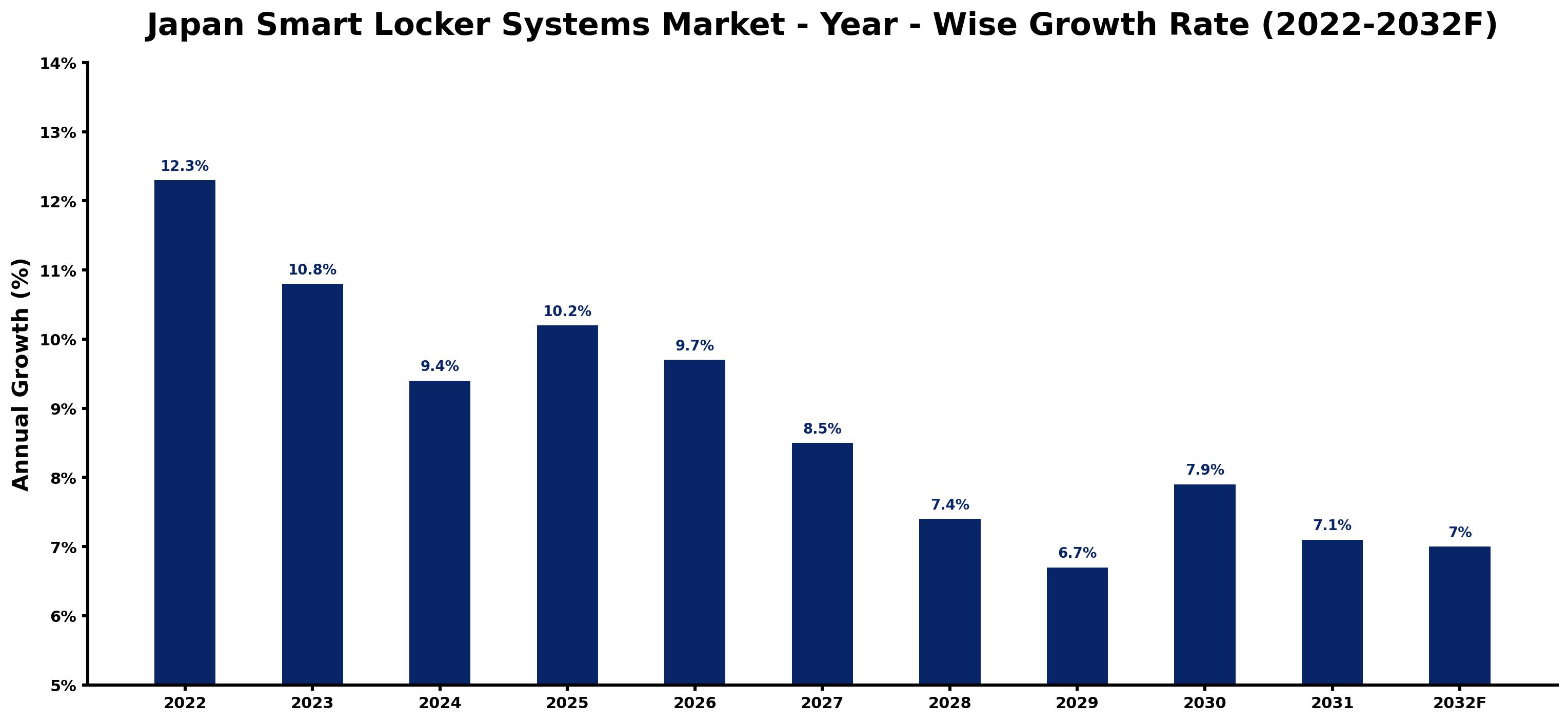
For each year, the table pairs the estimated growth rate with the leading influence on demand, showing how the drivers changed across the period.
| Year | Estimated Annual Growth (%) | Market Rationale |
| 2022 | 12.3 | The market experienced strong demand due to the booming e-commerce sector. |
| 2023 | 10.8 | Growth slowed as the market adjusted to a higher base from the previous year. |
| 2024 | 9.4 | Demand continued to rise, albeit at a slower pace, as urban installations increased. |
| 2025 | 10.2 | Growth accelerated again as more facilities adopted smart locker systems. |
| 2026 | 9.7 | The market is expected to see a slowdown as saturation begins in major urban areas. |
| 2027 | 8.5 | Demand growth will continue to slow as competition intensifies among providers. |
| 2028 | 7.4 | The market is projected to maintain steady growth, reflecting ongoing urbanisation trends. |
| 2029 | 6.7 | Growth will slow further as market maturity sets in and new installations stabilise. |
| 2030 | 7.9 | Demand is expected to rise again as technology adoption increases in urban areas. |
| 2031 | 7.1 | The market will see a slight slowdown as growth stabilises at a new level. |
| 2032 | 7.0 | Growth will continue at a steady pace, supported by ongoing urban development. |
Note: Market size estimations and growth projections presented in this report are based on 6Wresearch's proprietary forecasting methodology, utilizing the latest available industry data, government publications, and primary research inputs.
Japan Smart Locker Systems Market Synopsis
Smart locker systems are automated storage solutions that provide secure access to packages and personal items, utilising IoT and biometric technology. The Japan Smart Locker Systems Market is expanding, driven by the booming e-commerce sector, which reached ¥19 trillion in 2022. Urban areas are seeing a surge in installations, with over 1,000 smart lockers in Tokyo alone, leading to increased demand for secure and convenient storage solutions.
Market Dynamics Impact Analysis (2026–2032)
| Factor | Type | Impact | Primary Segment Affected |
| Rising e-commerce activity drives demand for secure package delivery solutions. | Driver | High | Parcel Lockers |
| Temperature-controlled lockers are essential for grocery deliveries, ensuring product integrity. | Driver | High | Temperature-Controlled |
| Increasing urban population density creates a need for more smart locker installations. | Opportunity | High | Parcel Lockers |
| The Tokyo Smart City initiative promotes the integration of smart lockers in urban planning. | Opportunity | Medium | Parcel Lockers |
| High installation costs can limit adoption rates in smaller facilities. | Restraint | High | Battery-Operated Lockers |
| Limited awareness of advanced smart locker features may hinder market growth. | Restraint | Medium | Biometric Lockers |
| Competition among providers can lead to price wars, affecting profitability. | Challenge | High | Temperature-Controlled |
| Technological integration challenges may delay adoption in some sectors. | Challenge | Medium | Parcel Lockers |
Evaluation of Drivers in Japan Smart Locker Systems Market (2026–2032)
The main growth drivers and the segments they affect most are set out below.
| Drivers | Primary Segment Affected | Why It Matters (Evidence) |
| Increasing e-commerce sales drive demand for parcel lockers. | Parcel Lockers | Japan's e-commerce market reached ¥19 trillion in 2022, leading to higher demand for secure delivery solutions. |
| Rising need for temperature-controlled storage in grocery sectors. | Temperature-Controlled | 30% of grocery store deliveries require temperature-controlled lockers to maintain product quality. |
| Urbanisation increases the need for smart locker installations. | Parcel Lockers | With a population density of 6,000 people per square kilometer, urban areas require more storage solutions. |
| Technological advancements improve locker functionality and appeal. | Biometric Lockers | The integration of biometric systems is being tested in 5 major hospitals for secure storage. |
| Government initiatives support smart logistics infrastructure development. | Battery-Operated Lockers | The Ministry of Internal Affairs and Communications promotes smart logistics solutions to improve urban infrastructure. |
Behind the steady rise in orders sits the booming e-commerce sector, which reached ¥19 trillion in 2022, driving demand for parcel lockers. Urban areas with high population density are pushing the need for smart locker installations. Technological advancements, such as IoT integration, are improving locker functionality, appealing to buyers. Funding of ¥500 million for smart infrastructure projects supports market growth. Temperature-controlled lockers are essential for grocery deliveries, creating additional demand in the retail sector.
Evaluation of Restraints in Japan Smart Locker Systems Market
The key brakes on demand, and where they bite hardest, are shown below.
| Market Restraint | Primary Segment Affected | Why It Matters (Evidence) |
| High installation costs can deter smaller businesses from adopting smart lockers. | Battery-Operated Lockers | The initial investment for smart locker systems can be prohibitive for smaller facilities. |
| Limited awareness of advanced features may slow market penetration. | Biometric Lockers | Many potential users are unaware of the benefits of biometric systems, hindering adoption. |
| Intense competition can lead to price wars, impacting profitability for providers. | Temperature-Controlled | As more players enter the market, pricing pressures may affect margins for existing providers. |
| Technological integration challenges can delay deployment in certain sectors. | Parcel Lockers | Complexity in integrating new technologies may slow down the adoption process. |
| Market saturation in urban areas may limit growth potential. | Parcel Lockers | As installations increase, the market may face diminishing returns in already saturated regions. |
Japan Smart Locker Systems Market Challenges
Buyers face delays in accessing smart locker systems due to a shortage of skilled technicians, which can extend installation timelines by up to three months. Suppliers struggle with compliance to ISO 27001 standards, causing project delays of around 20% and impacting delivery schedules for clients. Technology integration challenges arise as many existing lockers lack compatibility with newer features, leading to increased costs for suppliers, estimated at ¥100 million annually. Cost pressures from government initiatives for smart infrastructure can strain budgets, forcing suppliers to absorb up to 15% in additional expenses, impacting their profitability.
Trends in the Japan Smart Locker Systems Market
The trends below show where the Japan Smart Locker Systems Market is heading.
- Shift from Traditional to Smart Locker Systems: Urban areas in Japan are increasingly adopting smart locker systems, with over 1,000 installations in Tokyo as of 2023. This shift reflects the growing need for secure package delivery solutions, improving convenience for users.
- Emergence of Temperature-Controlled Lockers: Temperature-controlled lockers are becoming essential for grocery deliveries, with 30% of grocery store deliveries requiring them. This trend is changing how perishable goods are stored and delivered in urban environments.
- Integration of IoT in Smart Lockers: The integration of IoT technology in smart lockers is gaining traction, with many facilities adopting IoT lock and scanner systems. This change enhances remote management capabilities, increasing operational efficiency.
- Growing Adoption of Biometric Systems: Biometric lockers are being tested in major hospitals for secure patient item storage. This trend reflects a heightened focus on security and convenience in sensitive environments.
Investment Opportunities in the Japan Smart Locker Systems Market
The openings below show where demand in the Japan Smart Locker Systems Market is visible and how suppliers can enter.
- E-Commerce Businesses: E-commerce businesses are increasingly seeking smart locker solutions, with over 50% of major e-commerce businesses using parcel lockers. Partnering with logistics providers can facilitate entry into this growing segment.
- Grocery Stores: Grocery stores require temperature-controlled lockers for deliveries, with 30% of grocery deliveries needing them. Investing in these solutions can meet the rising demand in urban areas.
- Residential Societies: Residential societies are adopting smart lockers for secure community storage, driven by urbanisation trends. Collaborating with property developers can open new opportunities in this sector.
- Smart Campus Solutions: Educational institutions are integrating smart lockers for package management, with 20 universities already adopting them. Entering this market segment can provide growth potential.
Government Initiatives in the Japan Smart Locker Systems Market
The Economic Security Promotion Act (2022) supports supply-chain resilience for designated critical products and materials, impacting producers of smart locker systems by ensuring a stable supply of essential components. The Battery Industry Strategy (METI, August 2022) targets 150 GWh of domestic battery manufacturing capacity by 2030, which may benefit the battery-operated locker segment by providing more local resources.
The Ministry of Internal Affairs and Communications funds smart logistics initiatives, allocating ¥500 million for infrastructure projects that include smart locker systems. This funding aids buyers in accessing advanced technologies and improving operational efficiency in urban settings.
Future Insight of the Japan Smart Locker Systems Market
The integration of IoT technology will reshape demand for smart locker systems by 2032, enabling real-time monitoring and improved user experiences. The Tokyo Smart City initiative will drive the expansion of smart lockers, increasing accessibility in urban areas. Government funding for smart infrastructure projects will stimulate innovation and adoption of advanced features. Biometric systems tested in hospitals will set new standards for security and influence designs across various sectors.
Market Segmentation Analysis
Japan Smart Locker Systems Market report covers a detailed analysis of the following market segments:
By Locker Type – Parcel Lockers Lead, Temperature-Controlled Expected to Grow Fastest
According to Saurav Kr Singh, Senior Research Analyst at 6Wresearch, Parcel Lockers accounted for 40% of the market by locker type in 2025. Parcel lockers are the most widely adopted solution in Japan, particularly in urban areas where secure package delivery is essential. The Tokyo metropolitan area alone has over 1,000 installations, reflecting their popularity among e-commerce businesses. Temperature-Controlled is set to record the highest CAGR in this split, 10.7% over 2026–2032. Temperature-controlled lockers are experiencing rapid growth due to the increasing demand for secure storage of perishable goods in grocery stores. Approximately 30% of grocery store deliveries require these specialised lockers to maintain product quality. Suppliers should focus on expanding temperature-controlled locker offerings to meet the growing needs of grocery retailers.
By Smart Functionality – OTP/QR Access Leads, Cold/Warm Storage Monitoring Expected to Grow Fastest
In 2025, OTP/QR Access led the smart functionality split with a 40% share. OTP/QR access is extensively used for secure entry in various applications, especially in densely populated urban areas where convenience is essential. E-commerce businesses particularly favour this method, as it ensures quick and reliable access to packages for their customers. Cold/Warm Storage Monitoring is projected to grow fastest, at a CAGR of 10.0% during 2026–2032. Cold/warm storage monitoring is gaining traction as grocery retailers increasingly prioritise the integrity of perishable items. This functionality is crucial for maintaining optimal temperatures, driving its rapid adoption in the market. Suppliers should prioritise the development of advanced storage monitoring solutions tailored to the grocery sector.
By Authentication Type – IoT Lock + Scanner Leads and Records the Fastest Growth
IoT Lock + Scanner took 43% of authentication type revenue in 2025, more than any other category. IoT lock and scanner systems are crucial for effective remote management and monitoring, making them the preferred choice for smart locker applications. Their capability to enhance security and streamline operations is especially valued in both residential and commercial environments. The same category is also set to grow fastest, at a CAGR of 11.3% during 2026–2032. The IoT lock and scanner segment is expected to see swift growth due to its blend of convenience and security, appealing to a diverse user base. This ongoing demand will reinforce its dominance as the leading authentication type. Suppliers must focus on advancing IoT functionalities to capitalise on the expanding market opportunities.
By End User – E-Commerce Businesses Lead, Grocery Stores Expected to Grow Fastest
With 36% of end user revenue in 2025, E-Commerce Businesses was the largest category. E-commerce businesses are the primary users of smart locker systems, utilising them for efficient parcel delivery solutions. With Japan's e-commerce market reaching ¥19 trillion in 2022, the demand for these lockers continues to rise. The quickest growth will come from Grocery Stores, forecast to expand at a CAGR of 9.9% between 2026 and 2032. Grocery stores are rapidly adopting smart lockers for secure storage of groceries, driven by the need for efficient logistics in urban areas. This trend is further supported by the increasing number of temperature-controlled deliveries. Suppliers should tailor their products to meet the specific needs of grocery retailers to capitalise on this growth.
Key Attractiveness of the Report
- 10 Years of Market Numbers
- Historical Data Starting from 2022 to 2025
- Base Year 2025
- Forecast Data until 2032
- Key Performance Indicators Impacting the Market
- Major Upcoming Developments and Projects
Key Highlights of the Report:
- Japan Smart Locker Systems Market Outlook
- Market Size of Japan Smart Locker Systems Market, 2025
- Forecast of Japan Smart Locker Systems Market, 2032
- Historical Data and Forecast of Japan Smart Locker Systems Revenues & Volume for the Period 2022-2032F
- Japan Smart Locker Systems Market Trend Evolution
- Japan Smart Locker Systems Market Drivers and Challenges
- Japan Smart Locker Systems Price Trends
- Japan Smart Locker Systems Porter's Five Forces
- Japan Smart Locker Systems Industry Life Cycle
- Historical Data and Forecast of Japan Smart Locker Systems Market Revenues & Volume By Locker Type for the Period 2022-2032F
- Historical Data and Forecast of Japan Smart Locker Systems Market Revenues & Volume By Parcel Lockers for the Period 2022-2032F
- Historical Data and Forecast of Japan Smart Locker Systems Market Revenues & Volume By Temperature-Controlled for the Period 2022-2032F
- Historical Data and Forecast of Japan Smart Locker Systems Market Revenues & Volume By Biometric Lockers for the Period 2022-2032F
- Historical Data and Forecast of Japan Smart Locker Systems Market Revenues & Volume By Battery-Operated Lockers for the Period 2022-2032F
- Historical Data and Forecast of Japan Smart Locker Systems Market Revenues & Volume By Smart Functionality for the Period 2022-2032F
- Historical Data and Forecast of Japan Smart Locker Systems Market Revenues & Volume By OTP/QR Access for the Period 2022-2032F
- Historical Data and Forecast of Japan Smart Locker Systems Market Revenues & Volume By Cold/Warm Storage Monitoring for the Period 2022-2032F
- Historical Data and Forecast of Japan Smart Locker Systems Market Revenues & Volume By Fingerprint/Face Unlock for the Period 2022-2032F
- Historical Data and Forecast of Japan Smart Locker Systems Market Revenues & Volume By Long-Life + Low Power Usage for the Period 2022-2032F
- Historical Data and Forecast of Japan Smart Locker Systems Market Revenues & Volume By Authentication Type for the Period 2022-2032F
- Historical Data and Forecast of Japan Smart Locker Systems Market Revenues & Volume By IoT Lock + Scanner for the Period 2022-2032F
- Historical Data and Forecast of Japan Smart Locker Systems Market Revenues & Volume By Touchscreen + App for the Period 2022-2032F
- Historical Data and Forecast of Japan Smart Locker Systems Market Revenues & Volume By AI Camera + Biometrics for the Period 2022-2032F
- Historical Data and Forecast of Japan Smart Locker Systems Market Revenues & Volume By Mobile App for the Period 2022-2032F
- Historical Data and Forecast of Japan Smart Locker Systems Market Revenues & Volume By End User for the Period 2022-2032F
- Historical Data and Forecast of Japan Smart Locker Systems Market Revenues & Volume By E-Commerce Businesses for the Period 2022-2032F
- Historical Data and Forecast of Japan Smart Locker Systems Market Revenues & Volume By Grocery Stores for the Period 2022-2032F
- Historical Data and Forecast of Japan Smart Locker Systems Market Revenues & Volume By Smart Campus Solutions for the Period 2022-2032F
- Historical Data and Forecast of Japan Smart Locker Systems Market Revenues & Volume By Residential Societies for the Period 2022-2032F
- Japan Smart Locker Systems Import Export Trade Statistics
- Market Opportunity Assessment By Locker Type
- Market Opportunity Assessment By Smart Functionality
- Market Opportunity Assessment By Authentication Type
- Market Opportunity Assessment By End User
- Japan Smart Locker Systems Top Companies Market Share
- Japan Smart Locker Systems Competitive Benchmarking By Technical and Operational Parameters
- Japan Smart Locker Systems Company Profiles
- Japan Smart Locker Systems Key Strategic Recommendations
Market Covered
This report examines the market across the segments below.
By Locker Type
- Parcel Lockers
- Temperature-Controlled
- Biometric Lockers
- Battery-Operated Lockers
By Smart Functionality
- OTP/QR Access
- Cold/Warm Storage Monitoring
- Fingerprint/Face Unlock
- Long-Life + Low Power Usage
By Authentication Type
- IoT Lock + Scanner
- Touchscreen + App
- AI Camera + Biometrics
- Mobile App
By End User
- E-Commerce Businesses
- Grocery Stores
- Smart Campus Solutions
- Residential Societies































