Japan Smart Logistics Software Market Size & Growth Rate
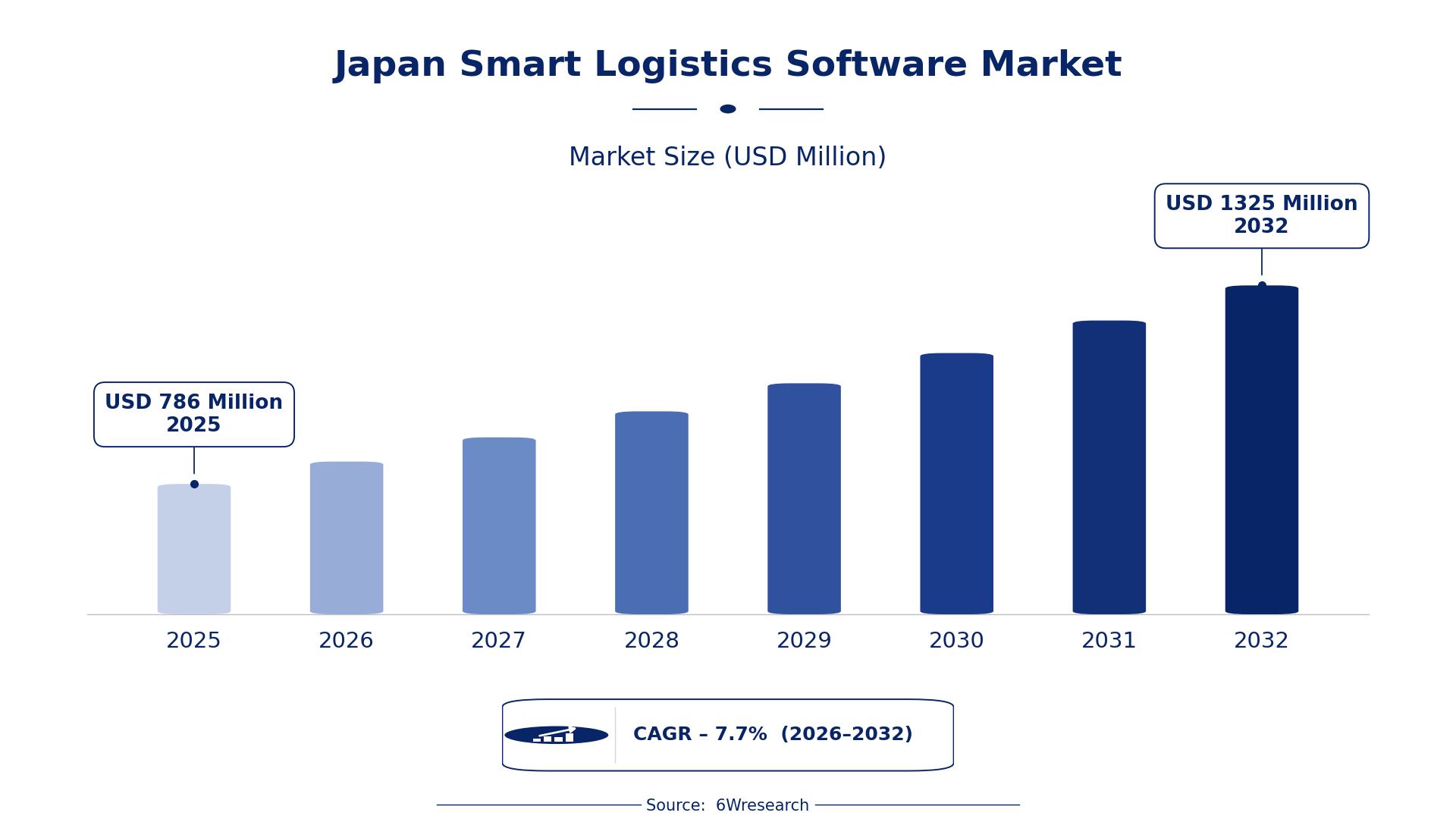
According to 6Wresearch internal database and industry insights, the Japan Smart Logistics Software Market was valued at USD 786 Million in 2025 and is projected to reach USD 1,325 Million by 2032, growing at a CAGR of approximately 7.7% during 2026–2032.
Japan Smart Logistics Software Market Highlights
| Report Metric | Details |
| Report Name | Japan Smart Logistics Software Market (2026-2032) |
| Market Size 2025 | USD 786 Million |
| Market Size 2032 | USD 1,325 Million |
| Absolute Growth 2025–2032 | USD 539 Million |
| CAGR 2026–2032 | 7.7% |
| Peak Annual Growth | 8.2% in 2029 |
| Forecast Period | 2026–2032 |
| Historical Data | 2022–2025 |
| Base Year | 2025 |
| Leading Software Type, 2025 | Route Optimization AI (47% share) |
| Leading Smart Feature, 2025 | Real-Time Traffic Adjustment (44% share) |
| Leading Integration Platform, 2025 | GPS + Predictive Models (50% share) |
| Leading End User, 2025 | Logistics Companies (41% share) |
| Fastest-Growing Software Type | Inventory AI Modules (10.9% CAGR) |
| Fastest-Growing Smart Feature | Demand-Based Reallocation (9.9% CAGR) |
| Fastest-Growing Integration Platform | ERP Systems (11.7% CAGR) |
| Fastest-Growing End User | Supply Chain Managers (10.2% CAGR) |
| Growing Sector | logistics |
| Key End Users | logistics companies, supply chain managers, e-commerce firms, transport aggregators |
Japan Smart Logistics Software Market Year-wise Growth Rate and Key Drivers (2022–2032)
This graph illustrates the annual growth rates of the market from 2022 to 2032, highlighting a steady upward trajectory and projected market expansion over the forecast period.
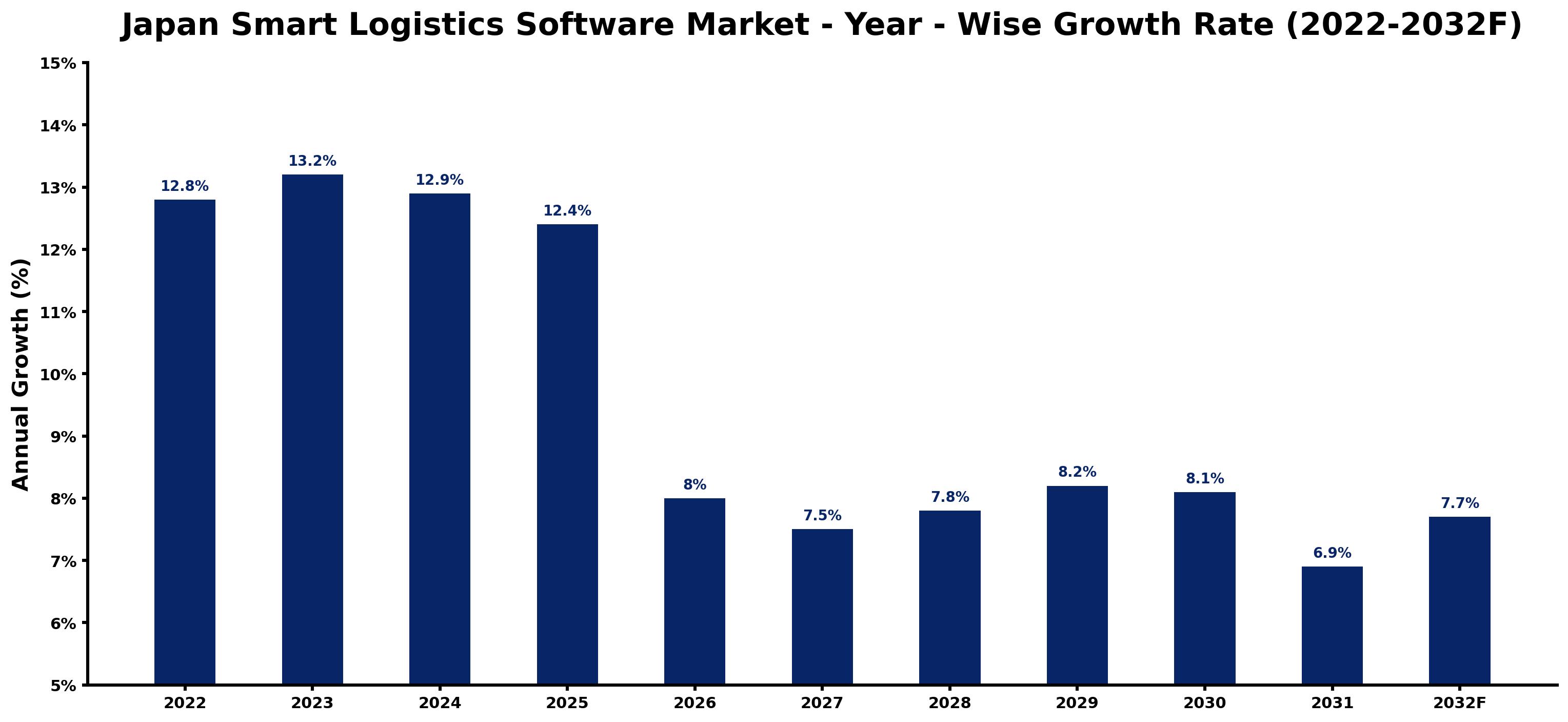
The yearly estimates that follow link every growth rate to its principal driver, so readers can see why the pace changed in each period.
| Year | Estimated Annual Growth (%) | Market Rationale |
| 2022 | 12.8 | The market showed strong growth due to rising e-commerce demand and logistics optimisation needs. |
| 2023 | 13.2 | Growth accelerated as logistics firms adopted advanced software solutions for efficiency. |
| 2024 | 12.9 | Growth slowed slightly as firms adjusted to market saturation and operational challenges. |
| 2025 | 12.4 | The market continued to grow, albeit at a slower pace, reflecting a stabilisation in demand. |
| 2026 | 8.0 | Growth is expected to decelerate further as companies reassess their software investments amid economic factors. |
| 2027 | 7.5 | A continued slowdown is anticipated as firms focus on maximising existing software capabilities. |
| 2028 | 7.8 | Growth is expected to rebound as digital transformation initiatives gain traction across sectors. |
| 2029 | 8.2 | The peak growth year will be driven by investments in smart logistics technologies. |
| 2030 | 8.1 | Growth will moderate slightly as the market begins to stabilise after peak demand. |
| 2031 | 6.9 | The market will continue to grow, albeit at a slower rate, reflecting maturity in adoption. |
| 2032 | 7.7 | Growth is projected to accelerate again as new technologies and solutions are integrated into operations. |
Note: Market size estimations and growth projections presented in this report are based on 6Wresearch's proprietary forecasting methodology, utilizing the latest available industry data, government publications, and primary research inputs.
Japan Smart Logistics Software Market Synopsis
Smart Logistics Software optimises logistics operations through data analysis and automation, improving efficiency in supply chain management. The rise of real-time tracking and inventory management solutions is propelling growth, underpinned by a robust manufacturing sector and increasing demand from logistics companies and e-commerce businesses.
Market Dynamics Impact Analysis (2026–2032)
| Factor | Type | Impact | Primary Segment Affected |
| Growing demand for real-time tracking solutions | Driver | High | Live Delivery Visibility |
| Increased investment in logistics technology | Driver | High | Route Optimization AI |
| Rising e-commerce sales creating logistics needs | Opportunity | High | Logistics Companies |
| Investment in infrastructure improvements by the government | Opportunity | Medium | Fleet Efficiency Tools |
| High logistics costs affecting profitability | Restraint | High | Last-Mile Tracking |
| Market saturation limiting new entrants | Restraint | Medium | Inventory AI Modules |
| High implementation costs for advanced systems | Challenge | High | Route Optimization AI |
| Technological complexity hindering adoption | Challenge | Medium | Route Optimization AI |
Evaluation of Drivers in Japan Smart Logistics Software Market (2026–2032)
The following drivers explain most of the expected growth.
| Drivers | Primary Segment Affected | Why It Matters (Evidence) |
| Rising e-commerce demand | Logistics Companies | The e-commerce market in Japan is projected to reach ¥20 trillion by 2025, driving logistics software adoption for order fulfilment. |
| Increased focus on operational efficiency | Route Optimization AI | With logistics costs averaging around 8% of GDP, firms are investing in software to reduce expenses and improve routing. |
| Demand for real-time analytics | Live Delivery Visibility | Real-time tracking is required by 75% of consumers in Japan, prompting logistics firms to upgrade their software capabilities. |
| Government investment in logistics infrastructure | Fleet Efficiency Tools | The Japanese government has invested ¥10 billion in logistics improvements, encouraging firms to adopt advanced software solutions. |
| Integration with IoT technologies | GPS + Predictive Models | Fleet management software is increasingly combined with IoT, improving tracking and operational efficiency. |
Purchasing is picking up as logistics companies respond to the growing e-commerce market, projected to reach ¥20 trillion by 2025. The average logistics cost in Japan is around 8% of GDP, prompting firms to invest in route optimisation software to reduce expenses. Real-time tracking is required by 75% of consumers, driving the adoption of live delivery visibility solutions. Integration with IoT technologies is becoming common, further boosting operational efficiency in logistics.
Evaluation of Restraints in Japan Smart Logistics Software Market
These are the pressures that could keep growth below its potential.
| Market Restraint | Primary Segment Affected | Why It Matters (Evidence) |
| High logistics costs impacting profitability | Last-Mile Tracking | Last-mile delivery accounts for 30% of total logistics costs, straining budgets and limiting software investment. |
| Market saturation limiting growth opportunities | Inventory AI Modules | With over 100 logistics companies using smart software, new entrants face challenges in gaining market share. |
| Complexity of implementation for advanced systems | Route Optimization AI | The need for specialised skills to implement advanced logistics software can delay adoption and increase costs. |
| Resistance to change among traditional firms | Route Optimization AI | Established companies may hesitate to adopt new technologies, fearing disruption to existing operations. |
| Limited budget for software upgrades | Route Optimization AI | Many logistics firms are constrained by tight budgets, affecting their ability to invest in new solutions. |
Japan Smart Logistics Software Market Challenges
Last-mile delivery constitutes 30% of total logistics costs in Japan, placing financial pressure on buyers who require timely shipments. Rising labour costs, with the national minimum wage set at JPY 1,055 per hour, elevate operational expenses for logistics firms, potentially delaying service delivery. Competition intensifies as over 100 logistics companies implement smart software solutions, making it difficult for smaller firms to retain market share. Skills shortages persist, as the logistics sector employs over 1.5 million individuals, limiting the workforce's ability to effectively implement advanced technologies.
Trends in the Japan Smart Logistics Software Market
Buyers and suppliers in the Japan Smart Logistics Software Market are adjusting to the following trends.
- Shift from Traditional to Smart Logistics Solutions: Since 2023, logistics firms in Japan have increasingly embraced smart logistics software to boost efficiency. With adoption rates at 60% among major firms, this trend illustrates a broader digital transformation within the industry.
- Transition from Manual to Automated Processes: The logistics sector is shifting towards automation, decreasing reliance on manual processes. This change is particularly noticeable in Tokyo, where many firms are adopting automated inventory management systems to streamline operations.
- Emergence of Real-Time Data Analytics: Real-time data analytics is becoming crucial for logistics operations, with 75% of consumers demanding tracking. This trend is transforming service delivery, prompting firms to invest in advanced analytics capabilities.
- Prioritisation of Sustainability in Logistics: The Tokyo Metropolitan Government is backing green logistics initiatives, indicating a move towards sustainable practices. This includes investments in eco-friendly delivery methods and technologies.
Investment Opportunities in the Japan Smart Logistics Software Market
The following opportunities in the Japan Smart Logistics Software Market pair current demand with a clear way in.
- Gap in Real-Time Tracking Solutions: With a significant percentage of consumers demanding real-time tracking, logistics companies must invest in advanced tracking solutions. This presents an opportunity for software providers to meet this growing need in urban areas like Tokyo.
- Investment in Fleet Management Software: The logistics sector is increasingly focusing on fleet efficiency tools, driven by the need to optimise operations. Logistics companies are looking for solutions that integrate IoT technologies to improve performance.
- Demand for Inventory Management Solutions: As e-commerce sales rise, there is a growing need for inventory AI modules. Supply chain managers are seeking solutions to improve stock management and demand forecasting.
- Expansion of Infrastructure Support: The Japanese government's investment of ¥10 billion in logistics infrastructure presents opportunities for technology providers. Collaborating with local firms can facilitate entry into this expanding market.
Government Initiatives in the Japan Smart Logistics Software Market
The Logistics Efficiency Improvement Program launched in 2023 aims to enhance operational efficiency across the logistics sector. This initiative builds on the Industrial Standardization Act, which governs product and test standards, ensuring compliance and quality in logistics operations. The program encourages the adoption of smart logistics software by providing guidelines and support for implementation.
The Digital Agency oversees the implementation of digital transformation initiatives in logistics. It funds projects aimed at improving logistics efficiency and supports the adoption of common system standards among firms, facilitating the integration of smart logistics software into existing operations.
Future Insight of the Japan Smart Logistics Software Market
The Logistics Efficiency Improvement Program will drive a policy shift, prompting suppliers to modernise their operations. By 2032, the demand for real-time analytics will lead logistics firms to significantly upgrade their software capabilities. The integration of fleet management software with IoT technologies will further streamline operations and improve service quality.
Market Segmentation Analysis
Japan Smart Logistics Software Market report covers a detailed analysis of the following market segments:
By Software Type – Route Optimization AI Leads, Inventory AI Modules Expected to Grow Fastest
According to Saurav Kr Singh, Senior Research Analyst at 6Wresearch, Route Optimization AI held 47% of the Japan Smart Logistics Software Market by software type in 2025. Route Optimization holds the largest share due to its essential role in improving routing efficiency and reducing costs for logistics operations. This technology is particularly vital for logistics companies operating in competitive regions such as Tokyo and Osaka, where operational efficiency is crucial. Inventory AI Modules are set to record the highest CAGR in this split, 10.9% over 2026–2032. The rapid growth of Inventory Modules stems from the increasing need for precise stock level management and effective demand forecasting among logistics firms. With the e-commerce market projected to reach ¥20 trillion by 2025, the demand for these solutions is expected to surge significantly. Suppliers should prioritise the development of features in Inventory Modules to meet the rising demand from logistics firms.
By Smart Feature – Real-Time Traffic Adjustment Leads, Demand-Based Reallocation Expected to Grow Fastest
The largest smart feature category in 2025 was Real-Time Traffic Adjustment, at 44% of revenue. Real-Time Traffic Adjustment leads the market as it significantly enhances routing efficiency, making it indispensable for logistics operations. Its widespread adoption among logistics companies highlights its importance in optimising delivery times and reducing operational costs. Over 2026–2032, Demand-Based Reallocation is expected to post the fastest growth, at a CAGR of 9.9%. Demand-Based Reallocation is witnessing rapid growth as it plays a crucial role in supporting inventory management, which is increasingly vital in today's fast-paced market. The growing emphasis on real-time analytics in logistics is driving the adoption of this feature. Buyers will gain advantages from solutions that integrate advanced demand-based reallocation features to improve their inventory management processes.
By Integration Platform – GPS + Predictive Models Lead, ERP Systems Expected to Grow Fastest
In 2025, GPS + Predictive Models led the integration platform split with a 50% share. GPS combined with Predictive Models is the leading integration platform as it is essential for location tracking and route planning, both critical for logistics efficiency. This combination is widely utilised among logistics companies to enhance their operational performance. ERP Systems are projected to grow fastest, at a CAGR of 11.7% during 2026–2032. The growth of ERP Systems is accelerating due to their seamless integration with logistics software, streamlining operations for supply chain managers. This trend is particularly pertinent given the increasing complexity of logistics operations in Japan. Suppliers should ensure compatibility of their solutions with ERP Systems to effectively address the needs of logistics firms.
By End User – Logistics Companies Lead, Supply Chain Managers Expected to Grow Fastest
Logistics Companies took 41% of end user revenue in 2025, more than any other category. Logistics Companies dominate the market as they are the primary users of smart logistics solutions, leveraging these technologies to enhance their operational capabilities. With over 1.5 million people employed in the logistics sector, the demand for such solutions remains robust. The quickest growth will come from Supply Chain Managers, forecast to expand at a CAGR of 10.2% between 2026 and 2032. Supply Chain Managers represent the fastest-growing end user group, utilising software to improve operational efficiency in response to the changing logistics landscape. Their increasing reliance on data-driven decision-making is a significant factor in this growth. Providers should tailor their offerings to align with the specific needs of supply chain managers to capture this expanding segment.
Key Attractiveness of the Report
- 10 Years of Market Numbers
- Historical Data Starting from 2022 to 2025
- Base Year 2025
- Forecast Data until 2032
- Key Performance Indicators Impacting the Market
- Major Upcoming Developments and Projects
Key Highlights of the Report:
- Japan Smart Logistics Software Market Outlook
- Market Size of Japan Smart Logistics Software Market, 2025
- Forecast of Japan Smart Logistics Software Market, 2032
- Historical Data and Forecast of Japan Smart Logistics Software Revenues & Volume for the Period 2022-2032F
- Japan Smart Logistics Software Market Trend Evolution
- Japan Smart Logistics Software Market Drivers and Challenges
- Japan Smart Logistics Software Price Trends
- Japan Smart Logistics Software Porter's Five Forces
- Japan Smart Logistics Software Industry Life Cycle
- Historical Data and Forecast of Japan Smart Logistics Software Market Revenues & Volume By Software Type for the Period 2022-2032F
- Historical Data and Forecast of Japan Smart Logistics Software Market Revenues & Volume By Route Optimization AI for the Period 2022-2032F
- Historical Data and Forecast of Japan Smart Logistics Software Market Revenues & Volume By Inventory AI Modules for the Period 2022-2032F
- Historical Data and Forecast of Japan Smart Logistics Software Market Revenues & Volume By Last-Mile Tracking for the Period 2022-2032F
- Historical Data and Forecast of Japan Smart Logistics Software Market Revenues & Volume By Fleet Efficiency Tools for the Period 2022-2032F
- Historical Data and Forecast of Japan Smart Logistics Software Market Revenues & Volume By Smart Feature for the Period 2022-2032F
- Historical Data and Forecast of Japan Smart Logistics Software Market Revenues & Volume By Real-Time Traffic Adjustment for the Period 2022-2032F
- Historical Data and Forecast of Japan Smart Logistics Software Market Revenues & Volume By Demand-Based Reallocation for the Period 2022-2032F
- Historical Data and Forecast of Japan Smart Logistics Software Market Revenues & Volume By Live Delivery Visibility for the Period 2022-2032F
- Historical Data and Forecast of Japan Smart Logistics Software Market Revenues & Volume By Fuel + Maintenance Analytics for the Period 2022-2032F
- Historical Data and Forecast of Japan Smart Logistics Software Market Revenues & Volume By Integration Platform for the Period 2022-2032F
- Historical Data and Forecast of Japan Smart Logistics Software Market Revenues & Volume By GPS + Predictive Models for the Period 2022-2032F
- Historical Data and Forecast of Japan Smart Logistics Software Market Revenues & Volume By ERP Systems for the Period 2022-2032F
- Historical Data and Forecast of Japan Smart Logistics Software Market Revenues & Volume By App + Dashboard for the Period 2022-2032F
- Historical Data and Forecast of Japan Smart Logistics Software Market Revenues & Volume By IoT + Cloud for the Period 2022-2032F
- Historical Data and Forecast of Japan Smart Logistics Software Market Revenues & Volume By End User for the Period 2022-2032F
- Historical Data and Forecast of Japan Smart Logistics Software Market Revenues & Volume By Logistics Companies for the Period 2022-2032F
- Historical Data and Forecast of Japan Smart Logistics Software Market Revenues & Volume By Supply Chain Managers for the Period 2022-2032F
- Historical Data and Forecast of Japan Smart Logistics Software Market Revenues & Volume By E-Commerce Firms for the Period 2022-2032F
- Historical Data and Forecast of Japan Smart Logistics Software Market Revenues & Volume By Transport Aggregators for the Period 2022-2032F
- Japan Smart Logistics Software Import Export Trade Statistics
- Market Opportunity Assessment By Software Type
- Market Opportunity Assessment By Smart Feature
- Market Opportunity Assessment By Integration Platform
- Market Opportunity Assessment By End User
- Japan Smart Logistics Software Top Companies Market Share
- Japan Smart Logistics Software Competitive Benchmarking By Technical and Operational Parameters
- Japan Smart Logistics Software Company Profiles
- Japan Smart Logistics Software Key Strategic Recommendations
Market Covered
Segments analysed in this report are listed below.
By Software Type
- Route Optimization AI
- Inventory AI Modules
- Last-Mile Tracking
- Fleet Efficiency Tools
By Smart Feature
- Real-Time Traffic Adjustment
- Demand-Based Reallocation
- Live Delivery Visibility
- Fuel + Maintenance Analytics
By Integration Platform
- GPS + Predictive Models
- ERP Systems
- App + Dashboard
- IoT + Cloud
By End User
- Logistics Companies
- Supply Chain Managers
- E-Commerce Firms
- Transport Aggregators































