Japan Smart Manufacturing Equipment Market Size & Growth Rate
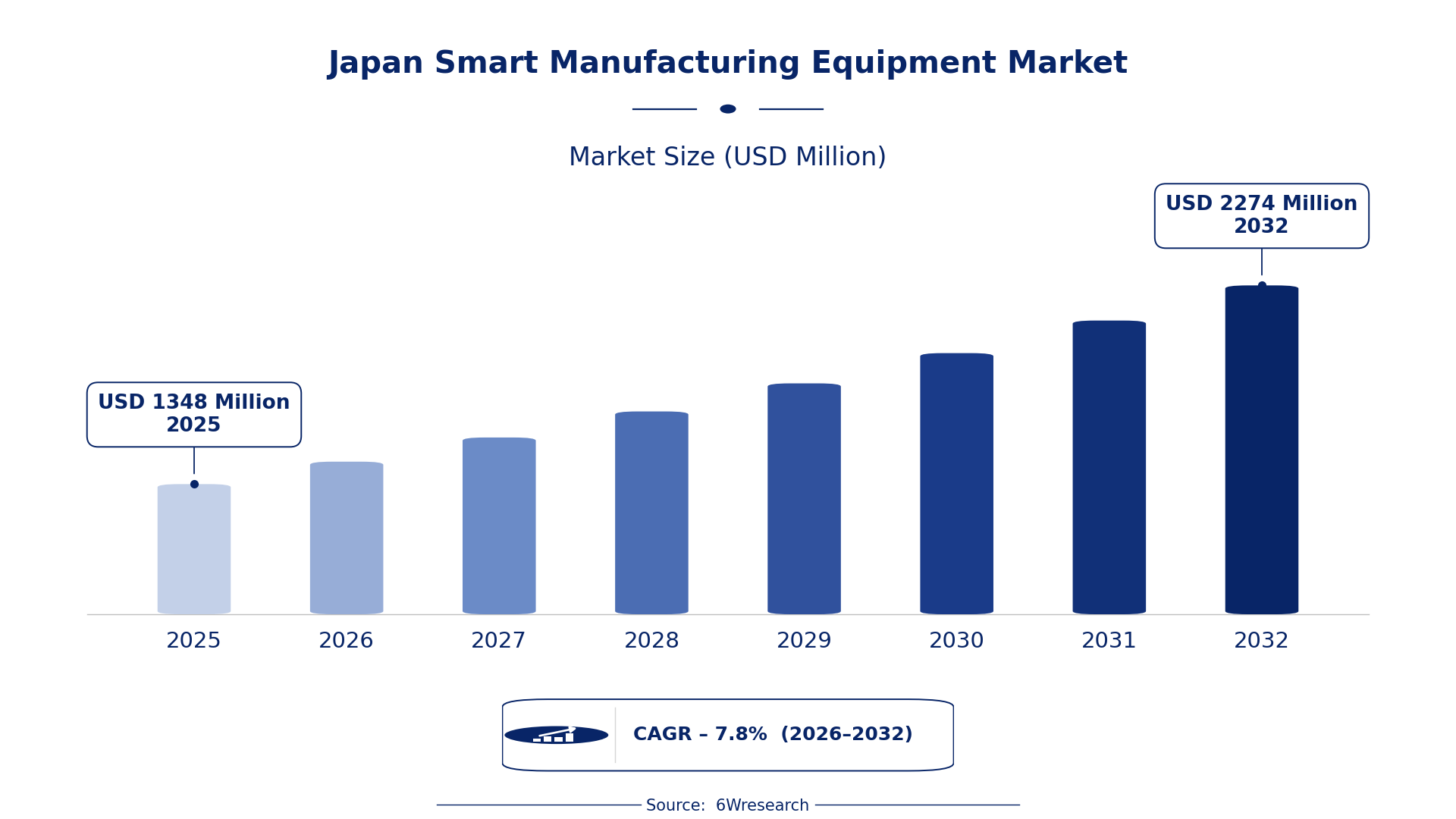
According to 6Wresearch internal database and industry insights, the Japan Smart Manufacturing Equipment Market was valued at USD 1,348 Million in 2025 and is projected to reach USD 2,274 Million by 2032, growing at a CAGR of approximately 7.8% during 2026–2032.
Japan Smart Manufacturing Equipment Market Highlights
| Report Metric | Details |
| Report Name | Japan Smart Manufacturing Equipment Market (2026-2032) |
| Market Size 2025 | USD 1,348 Million |
| Market Size 2032 | USD 2,274 Million |
| Absolute Growth 2025–2032 | USD 926 Million |
| CAGR 2026–2032 | 7.8% |
| Peak Annual Growth | 8.1% in 2031 |
| Forecast Period | 2026–2032 |
| Historical Data | 2022–2025 |
| Base Year | 2025 |
| Leading Equipment Type, 2025 | CNC Machines (40% share) |
| Leading Smart Feature, 2025 | Predictive Maintenance (46% share) |
| Leading Control Technology, 2025 | IoT + AI Monitoring (49% share) |
| Leading End User, 2025 | Automotive OEMs (50% share) |
| Fastest-Growing Equipment Type | 3D Printers with AI (11.8% CAGR) |
| Fastest-Growing Control Technology | Vision Sensors + ML (11.9% CAGR) |
| Fastest-Growing End User | Industrial Robotics (10.4% CAGR) |
| Growing Sector | Industrial Robotics |
| Key End Users | Automotive OEMs, Heavy Manufacturing, Industrial Robotics, Aerospace Plants |
Japan Smart Manufacturing Equipment Market Year-wise Growth Rate and Key Drivers (2022–2032)
This graph illustrates the annual growth rates of the market from 2022 to 2032, highlighting a steady upward trajectory and projected market expansion over the forecast period.
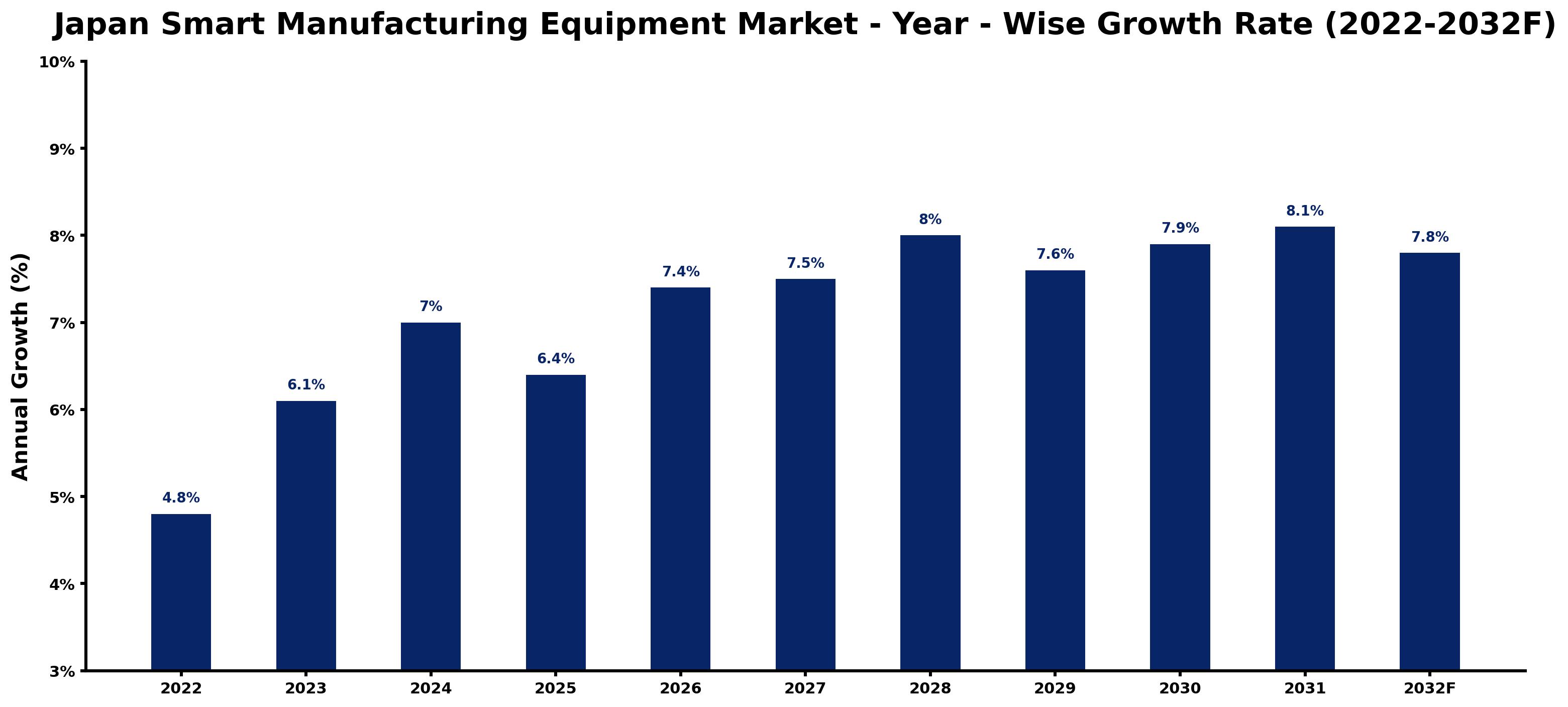
The following figures match every annual growth estimate with the main market development of that year, giving the reasoning behind each rise or slowdown.
| Year | Estimated Annual Growth (%) | Market Rationale |
| 2022 | 4.8 | The market showed steady growth due to rising interest in automation technologies. |
| 2023 | 6.1 | Demand accelerated as manufacturers sought to improve production efficiency through advanced solutions. |
| 2024 | 7.0 | Growth continued as companies invested in upgrading their production capabilities and technologies. |
| 2025 | 6.4 | The market experienced a slowdown as some sectors adjusted to new technological advancements. |
| 2026 | 7.4 | Investment in smart technologies is expected to increase, driving demand for advanced equipment solutions. |
| 2027 | 7.5 | Continued investment in automation technologies will support market expansion and innovation. |
| 2028 | 8.0 | The adoption of AI and IoT technologies will further boost market growth and operational efficiency. |
| 2029 | 7.6 | Growth is projected to slow slightly as the market matures and competition intensifies among suppliers. |
| 2030 | 7.9 | Demand is expected to surge again as new technologies gain traction in the manufacturing sector. |
| 2031 | 8.1 | The market is projected to peak with substantial investments in smart manufacturing solutions and technologies. |
| 2032 | 7.8 | Growth is anticipated to slow as the market stabilises after reaching a peak in demand. |
Note: Market size estimations and growth projections presented in this report are based on 6Wresearch's proprietary forecasting methodology, utilizing the latest available industry data, government publications, and primary research inputs.
Japan Smart Manufacturing Equipment Market Synopsis
Smart Manufacturing Equipment includes advanced machinery and systems that incorporate digital technologies to optimise manufacturing processes. The automotive sector serves as a primary user, driving demand as manufacturers invest in automation and efficiency improvements. Japan's manufacturing output reached approximately 1.5 trillion USD in 2022, with IoT technology adoption hitting 70% by 2023. The Society 5.0 initiative promotes smart manufacturing, stimulating innovation and competitiveness across various industries, particularly in automotive and heavy manufacturing.
Market Dynamics Impact Analysis (2026–2032)
| Factor | Type | Impact | Primary Segment Affected |
| Rising investment in automation technologies | Driver | High | CNC Machines |
| Increased demand for quality control systems | Driver | High | Quality Control AI |
| Growing need for flexible production solutions | Opportunity | High | Flexible Manufacturing Units |
| High adoption rate of IoT technologies in manufacturing | Opportunity | High | IoT + AI Monitoring |
| High initial costs of smart manufacturing equipment | Restraint | Medium | 3D Printers with AI |
| Limited skilled workforce for advanced technologies | Restraint | Medium | Industrial Robotics |
| Competition from lower-cost manufacturing countries | Challenge | High | Automotive OEMs |
| Rapid technological changes and obsolescence | Challenge | Medium | Smart Welding Equipment |
Evaluation of Drivers in Japan Smart Manufacturing Equipment Market (2026–2032)
These are the developments adding the most demand over the forecast period.
| Drivers | Primary Segment Affected | Why It Matters (Evidence) |
| Increased automation in production processes | CNC Machines | Japan's automotive sector is investing heavily, with a projected output of 1 trillion USD by 2025. |
| Demand for real-time data analysis | IoT + AI Monitoring | The adoption rate of IoT technologies in manufacturing reached 70% by 2023, prompting more purchases of monitoring systems. |
| Focus on improving production efficiency | Flexible Manufacturing Units | Flexible units are essential for adapting to changing market demands in electronics, enhancing production capabilities. |
| Need for stringent quality control | Quality Control AI | Quality Control AI systems are mandated by many Japanese manufacturing standards to ensure compliance and quality assurance. |
| Investment in AI technologies | 3D Printers with AI | Japan's investment in AI technologies for manufacturing was projected to exceed 500 million USD in 2023. |
The strongest pull on demand comes from increased automation in production processes, particularly in the automotive sector, projected to generate 1 trillion USD by 2025. The need for real-time data analysis is rising, as IoT adoption in manufacturing reached 70% by 2023, prompting purchases of IoT + AI Monitoring systems. Stringent quality control drives the integration of Quality Control AI systems, mandated by Japanese manufacturing standards. Investment in AI technologies, projected to exceed 500 million USD in 2023, supports the growth of 3D Printers with AI, enabling faster production and innovation in the sector.
Evaluation of Restraints in Japan Smart Manufacturing Equipment Market
These are the pressures that could keep growth below its potential.
| Market Restraint | Primary Segment Affected | Why It Matters (Evidence) |
| Rising operational costs due to compliance with Japanese Industrial Standards can increase expenses for manufacturers. | CNC Machines | Adhering to these standards requires investments in technology and training, impacting overall profitability. |
| Intense competition from both domestic and international suppliers drives down prices, affecting profit margins. | Smart Welding Equipment | Manufacturers must continuously innovate and reduce costs to maintain market share, which can limit investment in new technologies. |
| Delays in upgrading production lines due to high initial costs can hinder competitiveness. | Flexible Manufacturing Units | Many manufacturers find it challenging to allocate funds exceeding 500 million USD for new equipment, affecting their operational capabilities. |
| Supply chain disruptions, particularly in sourcing IoT components, can lead to production delays. | IoT + AI Monitoring | Manufacturers reliant on timely delivery of components may face setbacks in implementing smart manufacturing solutions. |
| Limited access to skilled workforce for operating advanced manufacturing technologies can restrict growth. | 3D Printers with AI | The shortage of trained personnel can delay the adoption of innovative equipment and technologies in production processes. |
Japan Smart Manufacturing Equipment Market Challenges
Buyers in the automotive sector face rising operational costs due to compliance with Japanese Industrial Standards, which can require technology investments that contribute to Japan's 1.5 trillion USD manufacturing output. Suppliers encounter intense competition from both local and international firms, resulting in price pressures that can significantly reduce profit margins. Many manufacturers experience delays in upgrading production lines because the initial costs of smart manufacturing equipment can exceed 500 million USD, impacting their competitiveness. Supply chain disruptions, particularly in sourcing IoT components, can lead to production delays, affecting delivery schedules for manufacturers reliant on timely equipment enhancements.
Trends in the Japan Smart Manufacturing Equipment Market
The trends below show where the Japan Smart Manufacturing Equipment Market is heading.
- Shift from Traditional to Smart Manufacturing: The Society 5.0 initiative commenced in 2016, promoting the integration of digital technologies in manufacturing. By 2023, Japan's investment in smart manufacturing technologies is expected to surpass 500 million USD, indicating a shift towards automation.
- Transition from Manual to Automated Quality Control: The adoption of Quality Control AI systems gained traction in 2021, ensuring compliance with stringent manufacturing standards. As of 2023, 70% of manufacturers have implemented AI-driven quality control processes, improving product reliability and efficiency.
- Emergence of Real-Time Data Analytics: Real-time data analytics became prominent in 2020, with IoT + AI Monitoring systems gaining popularity. By 2023, the adoption rate of IoT technologies in manufacturing reached 70%, enabling manufacturers to optimise operations and decision-making.
- Prioritisation of Flexible Manufacturing Solutions: The demand for Flexible Manufacturing Units surged in 2021, driven by the need for adaptability in production processes. By 2023, these units are increasingly utilised in Japan's electronics sector, supporting diverse manufacturing needs.
Investment Opportunities in the Japan Smart Manufacturing Equipment Market
Several openings in the Japan Smart Manufacturing Equipment Market merit attention from investors.
- Partnerships for Technology Integration: Now is an opportune moment for partnerships, as the market for smart manufacturing equipment is expanding. The automotive sector, a major user, is investing heavily in these technologies, creating opportunities for suppliers to collaborate and innovate.
- Investment in AI-Driven Solutions: With Japan's investment in AI technologies projected to exceed 500 million USD, there is a gap in advanced manufacturing solutions. Suppliers can target automotive OEMs, forming local partnerships to enter the market effectively.
- Expansion of Robotics in Manufacturing: The growing demand for robotics solutions presents an opportunity for suppliers to provide advanced automation technologies. As the automotive sector continues to expand, investments in robotics will likely increase, driving further growth.
- Focus on Quality Control Innovations: With the rising need for stringent quality control, suppliers can invest in AI-driven quality assurance technologies. The automotive sector mandates compliance with high standards, creating a promising market for innovative solutions.
Government Initiatives in the Japan Smart Manufacturing Equipment Market
The GX Basic Policy, adopted in 2023, aims to mobilise about JPY 150 trillion for public-private decarbonisation investments over the next decade. This initiative strengthens the framework established by the Industrial Standardization Act, ensuring that smart manufacturing equipment meets quality and safety requirements.
The Ministry of Economy, Trade and Industry (METI) is responsible for approving funding for smart manufacturing initiatives. As of 2023, METI supports various projects aimed at advancing the adoption of cutting-edge technologies in manufacturing, benefiting both producers and buyers.
Future Insight of the Japan Smart Manufacturing Equipment Market
The Society 5.0 initiative will facilitate the rollout of advanced robotics systems in factories, boosting productivity and efficiency. By 2032, Japan's investment in AI technologies for manufacturing is expected to surpass 600 million USD, enabling further operational improvements. The adoption of flexible manufacturing units will increase, allowing for greater adaptability in production processes. As the Tokyo region solidifies its position as a hub for advanced technologies, suppliers will provide buyers with improved access to cutting-edge solutions.
Market Segmentation Analysis
Japan Smart Manufacturing Equipment Market report covers a detailed analysis of the following market segments:
By Equipment Type – CNC Machines Lead, 3D Printers with AI Expected to Grow Fastest
According to Saurav Kr Singh, Senior Research Analyst at 6Wresearch, in 2025, CNC Machines led the equipment type split with a 40% share. CNC Machines play a vital role in precision manufacturing, widely used in Japan's automotive sector. Their importance in automating production processes ensures they maintain the largest share in the market. 3D Printers with AI is set to record the highest CAGR in this split, 11.8% over 2026–2032. The rapid adoption of 3D Printers stems from their ability to facilitate quick prototyping and bespoke production. As manufacturers increasingly seek agility in their operations, this segment is poised for remarkable growth. Suppliers must enhance the capabilities of 3D Printers to cater to the growing demand for flexible manufacturing solutions.
By Smart Feature – Predictive Maintenance Leads and Records the Fastest Growth
Predictive Maintenance took 46% of smart feature revenue in 2025, more than any other category. Predictive Maintenance is essential for minimising downtime and reducing maintenance costs, making it a top priority for manufacturers in Japan. The widespread implementation of this feature aligns with the country's push for efficiency in smart manufacturing. Its lead should widen, with a projected CAGR of 10.3% during 2026–2032, the highest in this split. As Predictive Maintenance is also the fastest-growing smart feature, its continued integration into manufacturing processes will likely lead to even greater efficiency gains. This dual role reinforces its importance in the market. Buyers must invest in predictive maintenance technologies to maintain competitive advantage and operational efficiency.
By Control Technology – IoT + AI Monitoring Leads, Vision Sensors + ML Expected to Grow Fastest
The largest control technology category in 2025 was IoT + AI Monitoring, at 49% of revenue. IoT combined with monitoring technologies is essential for real-time data gathering and analysis, crucial for modern manufacturing. Its extensive use across various industries, particularly in automotive, reinforces its leading position in control technology. Vision Sensors + ML is projected to grow fastest, at a CAGR of 11.9% during 2026–2032. Vision Sensors are experiencing rapid growth due to their efficiency in quality inspection and automation processes. As manufacturers focus on improving quality assurance, this technology is expected to see significant advancements. Suppliers should prioritise the development of vision sensor technologies to meet the escalating demand for quality control in manufacturing.
By End User – Automotive OEMs Lead, Industrial Robotics Expected to Grow Fastest
With 50% of end user revenue in 2025, Automotive OEMs was the largest category. Automotive OEMs are the primary users of smart manufacturing technologies, significantly shaping market trends. Their focus on innovation and efficiency ensures they remain the dominant end user segment. Over 2026–2032, Industrial Robotics are expected to post the fastest growth, at a CAGR of 10.4%. Industrial Robotics is witnessing rapid growth as manufacturers increasingly implement robotic solutions to optimise production automation. This shift towards automation reflects the industry's broader trend of enhancing operational efficiency. Suppliers should tailor their products to meet the specific needs of automotive OEMs and the industrial robotics sector to capitalise on emerging market opportunities.
Key Attractiveness of the Report
- 10 Years of Market Numbers
- Historical Data Starting from 2022 to 2025
- Base Year 2025
- Forecast Data until 2032
- Key Performance Indicators Impacting the Market
- Major Upcoming Developments and Projects
Key Highlights of the Report:
- Japan Smart Manufacturing Equipment Market Outlook
- Market Size of Japan Smart Manufacturing Equipment Market, 2025
- Forecast of Japan Smart Manufacturing Equipment Market, 2032
- Historical Data and Forecast of Japan Smart Manufacturing Equipment Revenues & Volume for the Period 2022-2032F
- Japan Smart Manufacturing Equipment Market Trend Evolution
- Japan Smart Manufacturing Equipment Market Drivers and Challenges
- Japan Smart Manufacturing Equipment Price Trends
- Japan Smart Manufacturing Equipment Porter's Five Forces
- Japan Smart Manufacturing Equipment Industry Life Cycle
- Historical Data and Forecast of Japan Smart Manufacturing Equipment Market Revenues & Volume By Equipment Type for the Period 2022-2032F
- Historical Data and Forecast of Japan Smart Manufacturing Equipment Market Revenues & Volume By CNC Machines for the Period 2022-2032F
- Historical Data and Forecast of Japan Smart Manufacturing Equipment Market Revenues & Volume By Smart Welding Equipment for the Period 2022-2032F
- Historical Data and Forecast of Japan Smart Manufacturing Equipment Market Revenues & Volume By Flexible Manufacturing Units for the Period 2022-2032F
- Historical Data and Forecast of Japan Smart Manufacturing Equipment Market Revenues & Volume By 3D Printers with AI for the Period 2022-2032F
- Historical Data and Forecast of Japan Smart Manufacturing Equipment Market Revenues & Volume By Smart Feature for the Period 2022-2032F
- Historical Data and Forecast of Japan Smart Manufacturing Equipment Market Revenues & Volume By Predictive Maintenance for the Period 2022-2032F
- Historical Data and Forecast of Japan Smart Manufacturing Equipment Market Revenues & Volume By Quality Control AI for the Period 2022-2032F
- Historical Data and Forecast of Japan Smart Manufacturing Equipment Market Revenues & Volume By Adaptive Workflow for the Period 2022-2032F
- Historical Data and Forecast of Japan Smart Manufacturing Equipment Market Revenues & Volume By Real-Time Feedback Loop for the Period 2022-2032F
- Historical Data and Forecast of Japan Smart Manufacturing Equipment Market Revenues & Volume By Control Technology for the Period 2022-2032F
- Historical Data and Forecast of Japan Smart Manufacturing Equipment Market Revenues & Volume By IoT + AI Monitoring for the Period 2022-2032F
- Historical Data and Forecast of Japan Smart Manufacturing Equipment Market Revenues & Volume By Vision Sensors + ML for the Period 2022-2032F
- Historical Data and Forecast of Japan Smart Manufacturing Equipment Market Revenues & Volume By Edge + Cloud Integration for the Period 2022-2032F
- Historical Data and Forecast of Japan Smart Manufacturing Equipment Market Revenues & Volume By AI Slicing Software for the Period 2022-2032F
- Historical Data and Forecast of Japan Smart Manufacturing Equipment Market Revenues & Volume By End User for the Period 2022-2032F
- Historical Data and Forecast of Japan Smart Manufacturing Equipment Market Revenues & Volume By Automotive OEMs for the Period 2022-2032F
- Historical Data and Forecast of Japan Smart Manufacturing Equipment Market Revenues & Volume By Heavy Manufacturing for the Period 2022-2032F
- Historical Data and Forecast of Japan Smart Manufacturing Equipment Market Revenues & Volume By Industrial Robotics for the Period 2022-2032F
- Historical Data and Forecast of Japan Smart Manufacturing Equipment Market Revenues & Volume By Aerospace Plants for the Period 2022-2032F
- Japan Smart Manufacturing Equipment Import Export Trade Statistics
- Market Opportunity Assessment By Equipment Type
- Market Opportunity Assessment By Smart Feature
- Market Opportunity Assessment By Control Technology
- Market Opportunity Assessment By End User
- Japan Smart Manufacturing Equipment Top Companies Market Share
- Japan Smart Manufacturing Equipment Competitive Benchmarking By Technical and Operational Parameters
- Japan Smart Manufacturing Equipment Company Profiles
- Japan Smart Manufacturing Equipment Key Strategic Recommendations
Market Covered
The study includes the following segmentation.
By Equipment Type
- CNC Machines
- Smart Welding Equipment
- Flexible Manufacturing Units
- 3D Printers with AI
By Smart Feature
- Predictive Maintenance
- Quality Control AI
- Adaptive Workflow
- Real-Time Feedback Loop
By Control Technology
- IoT + AI Monitoring
- Vision Sensors + ML
- Edge + Cloud Integration
- AI Slicing Software
By End User
- Automotive OEMs
- Heavy Manufacturing
- Industrial Robotics
- Aerospace Plants































