Japan Smart Manufacturing Robot Market Size & Growth Rate
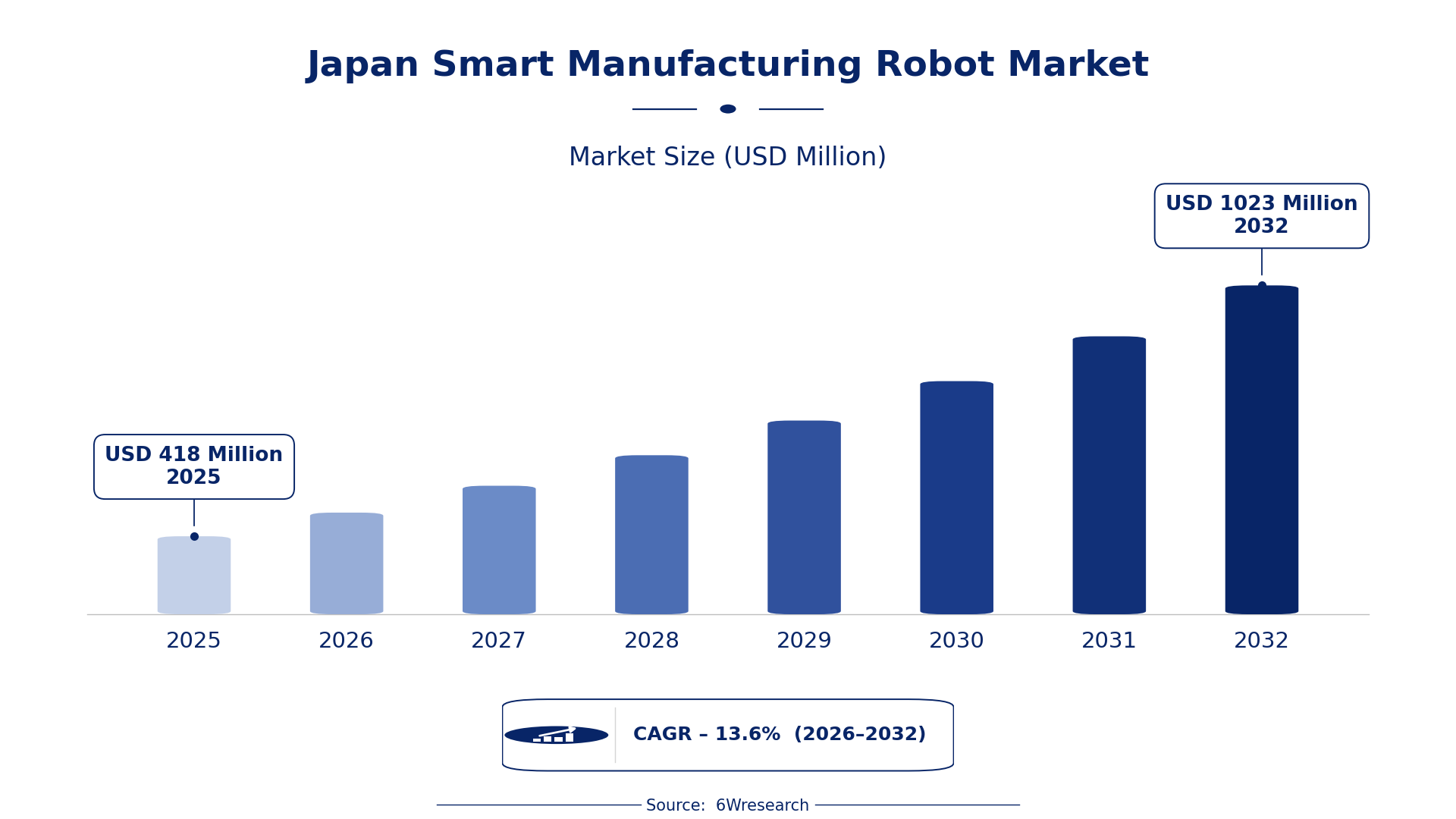
According to 6Wresearch internal database and industry insights, the Japan Smart Manufacturing Robot Market was valued at USD 418 Million in 2025 and is projected to reach USD 1,023 Million by 2032, growing at a CAGR of approximately 13.6% during 2026–2032.
Japan Smart Manufacturing Robot Market Highlights
| Report Metric | Details |
| Report Name | Japan Smart Manufacturing Robot Market (2026-2032) |
| Market Size 2025 | USD 418 Million |
| Market Size 2032 | USD 1,023 Million |
| Absolute Growth 2025–2032 | USD 605 Million |
| CAGR 2026–2032 | 13.6% |
| Peak Annual Growth | 16.4% in 2026 |
| Forecast Period | 2026–2032 |
| Historical Data | 2022–2025 |
| Base Year | 2025 |
| Leading Robot Type, 2025 | Collaborative Robots (46% share) |
| Leading Application Area, 2025 | Assembly + Packaging (41% share) |
| Leading Intelligence Feature, 2025 | Safe Human Interaction (42% share) |
| Leading End User, 2025 | Automotive Plants (51% share) |
| Fastest-Growing Application Area | Metal Fabrication (16.4% CAGR) |
| Fastest-Growing Intelligence Feature | Vision-Guided AI (17.8% CAGR) |
| Fastest-Growing End User | Electronics Assembly (17.7% CAGR) |
| Growing Sector | Automotive |
| Key End Users | Automotive Plants, Electronics Assembly, Smart Factories |
Japan Smart Manufacturing Robot Market Year-wise Growth Rate and Key Drivers (2022–2032)
This graph illustrates the annual growth rates of the market from 2022 to 2032, highlighting a steady upward trajectory and projected market expansion over the forecast period.
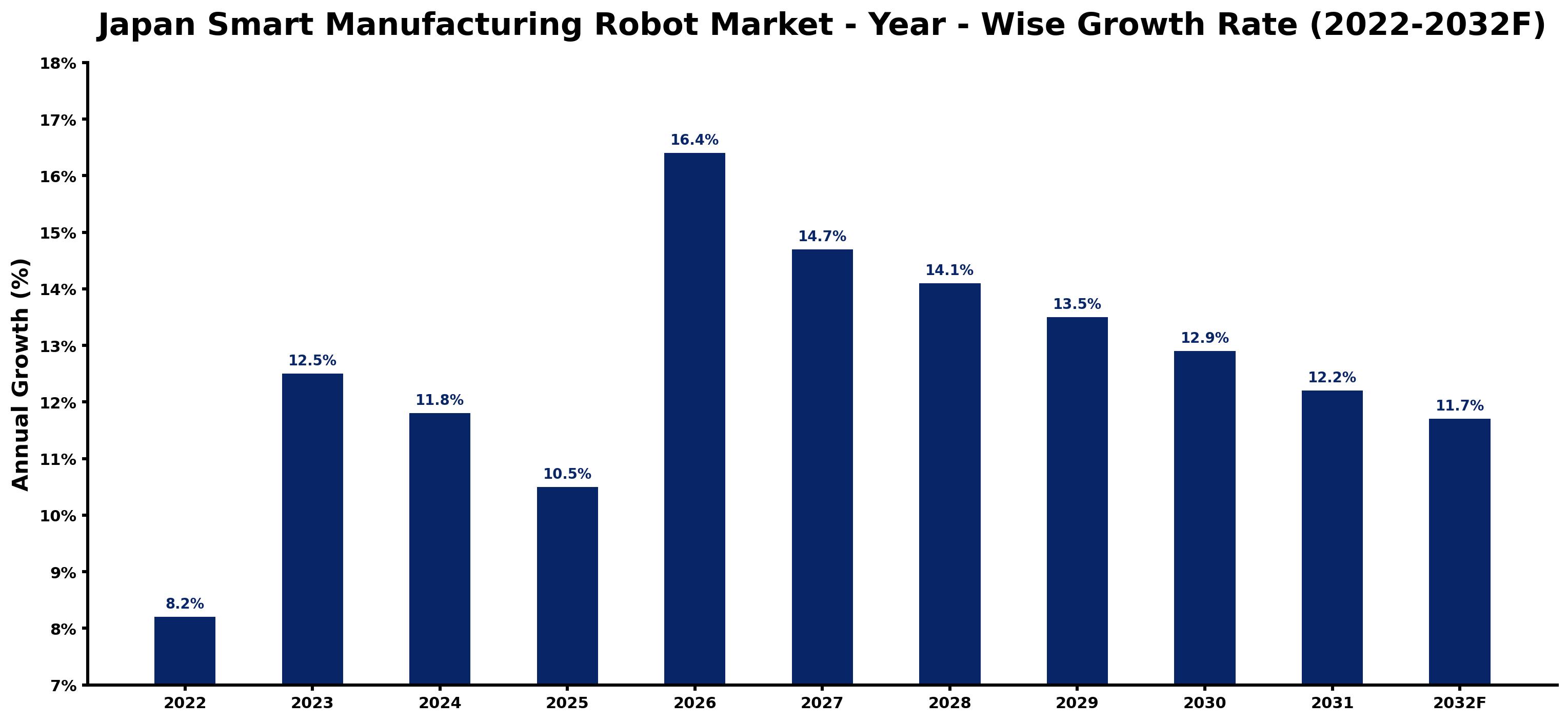
The yearly estimates that follow link every growth rate to its principal driver, so readers can see why the pace changed in each period.
| Year | Estimated Annual Growth (%) | Market Rationale |
| 2022 | 8.2 | The market experienced steady growth due to ongoing automation trends in manufacturing. |
| 2023 | 12.5 | Demand surged as businesses sought to improve productivity and efficiency. |
| 2024 | 11.8 | Growth slowed as companies faced challenges in integrating new technologies. |
| 2025 | 10.5 | The market continued to grow, driven by rising investments in smart factories. |
| 2026 | 16.4 | Demand accelerated sharply as advanced robotics gained wider acceptance. |
| 2027 | 14.7 | Growth moderated as market saturation began to influence new installations. |
| 2028 | 14.1 | The market is expected to maintain a healthy pace, supported by ongoing technological advancements. |
| 2029 | 13.5 | Growth will continue to slow as competition intensifies among manufacturers. |
| 2030 | 12.9 | The market is projected to show signs of stabilisation as demand levels off. |
| 2031 | 12.2 | Growth will decelerate further as the focus shifts to operational efficiency. |
| 2032 | 11.7 | The market is expected to grow steadily as new technologies are adopted. |
Note: Market size estimations and growth projections presented in this report are based on 6Wresearch's proprietary forecasting methodology, utilizing the latest available industry data, government publications, and primary research inputs.
Japan Smart Manufacturing Robot Market Synopsis
Smart manufacturing robots are advanced machines designed to improve manufacturing processes through increased efficiency and precision. The Japan Smart Manufacturing Robot Market is expanding due to strong demand from industries aiming to automate processes, particularly in assembly and material handling. The automotive sector accounts for around 40% of total demand, with over 1,000 smart factories across the country driving this growth. This trend is supported by ongoing investments in advanced robotics and automation technologies, which improve productivity and operational capabilities across various sectors.
Market Dynamics Impact Analysis (2026–2032)
| Factor | Type | Impact | Primary Segment Affected |
| Growing adoption of collaborative robots in assembly lines | Driver | High | Collaborative Robots |
| Increasing demand for automation in automotive manufacturing | Driver | High | Automotive Plants |
| Expansion of smart factories requiring advanced robotics | Opportunity | High | Smart Factories |
| Rising demand for precision in electronics assembly | Opportunity | High | Electronics Assembly |
| High initial investment costs for automation technologies | Restraint | High | Factory Automation |
| Challenges in workforce training for new technologies | Restraint | Medium | Factory Automation |
| Intense competition among robotics manufacturers | Challenge | High | Collaborative Robots |
| Supply chain disruptions affecting component availability | Challenge | Medium | AI Welding Robots |
Evaluation of Drivers in Japan Smart Manufacturing Robot Market (2026–2032)
Key forces behind demand, with the segment each one moves most, are listed below.
| Drivers | Primary Segment Affected | Why It Matters (Evidence) |
| Increased efficiency in manufacturing processes | Assembly + Packaging | This drives demand as manufacturers seek to reduce production time and costs, with approximately 1,500 robots installed per automotive facility. |
| Rising investments in smart factories | Smart Factories | These investments lead to higher demand for automation solutions, with over 1,000 smart factories operating nationwide. |
| Growth in collaborative robot adoption | Collaborative Robots | Collaborative robots improve productivity, with a projected growth rate of 15% by 2025 in assembly lines. |
| Demand for precision in manufacturing | Electronics Assembly | Precision tasks in electronics assembly drive the need for advanced robotics, with over 60% of plants utilizing smart robots. |
| Technological advancements in robotics | AI Welding Robots | Innovations in robotics improve speed and accuracy, leading to increased adoption in welding processes. |
Much of the new demand traces back to the automotive sector, which accounts for approximately 40% of the market's total demand. The average installed base of robots in automotive plants is about 1,500 units, prompting manufacturers to invest in automation technologies. Over 60% of electronics assembly plants in Japan utilise smart manufacturing robots, reflecting a shift towards precision and efficiency. The Tokyo region serves as a hub for robotics innovation, driving further advancements in manufacturing processes. Investments in smart factories are expected to improve operational capabilities, leading to increased adoption of advanced robotics across various sectors.
Evaluation of Restraints in Japan Smart Manufacturing Robot Market
The table below lists the restraints and the evidence behind each.
| Market Restraint | Primary Segment Affected | Why It Matters (Evidence) |
| High initial investment costs for automation technologies | Factory Automation | These costs deter smaller manufacturers from adopting smart robots, impacting overall market growth with investments averaging USD 418 million in 2025. |
| Challenges in workforce training for new technologies | Factory Automation | A lack of skilled workers delays the implementation of automation solutions, affecting productivity in various sectors. |
| Supply chain disruptions affecting component availability | AI Welding Robots | Disruptions lead to delays in robot production, impacting delivery schedules and increasing costs for manufacturers. |
| Intense competition among robotics manufacturers | Collaborative Robots | This competition can lead to price wars, reducing profit margins for suppliers and affecting market stability. |
| Regulatory compliance costs for safety standards | Smart Factories | Compliance with standards like ISO 10218 increases operational costs for manufacturers, influencing their investment decisions. |
Japan Smart Manufacturing Robot Market Challenges
High labour costs in Japan, with the national minimum wage at JPY 1,055 per hour, compel buyers to accelerate automation investments, increasing their capital expenditures. A shortage of skilled workers hampers the effective deployment of smart manufacturing robots, causing production delays for manufacturers and impacting delivery timelines. The complexity of integrating advanced technologies raises operational costs for producers, who struggle to meet global competitiveness standards. Local suppliers confront fierce competition from emerging markets, forcing them to lower prices, which may compromise quality and service for buyers.
Trends in the Japan Smart Manufacturing Robot Market
These developments are changing demand patterns in the Japan Smart Manufacturing Robot Market.
- Rise of Smart Factories: Japan is experiencing a rise in smart factories, with over 1,000 facilities adopting robotics for full automation. This shift is projected to improve productivity and operational efficiency across industries.
- Integration of AI in Robotics: The integration of AI technologies in robotics is transforming manufacturing processes. The AI Promotion Act, effective in 2025, aims to establish a national framework for AI development, driving innovation and efficiency.
- Focus on Safety Standards: The emphasis on safety standards, particularly ISO 10218, is shaping the robotics market. Compliance is essential for manufacturers, ensuring safe operation in collaborative environments and improving overall productivity.
- Shift towards Collaborative Robots: The adoption of collaborative robots is increasing in assembly lines, with a projected growth rate of 15% by 2025. This trend is particularly strong in the automotive sector, where efficiency is a top priority.
Investment Opportunities in the Japan Smart Manufacturing Robot Market
Investors looking at the Japan Smart Manufacturing Robot Market should consider the following areas.
- Investment in Automotive Automation: The automotive sector is seeking advanced automation solutions, with a projected demand growth of 40%. Investing in robotics for assembly lines can yield substantial returns for suppliers, particularly in the automotive hubs of Japan.
- Expansion in Electronics Manufacturing: With over 60% of electronics assembly plants using smart robots, there is a growing need for precision automation. Suppliers can enter this market by partnering with local manufacturers to meet rising demands.
- Development of Smart Factories: The rise of smart factories presents opportunities for suppliers of advanced robotics. With over 1,000 smart factories in Japan, investing in automation technologies can lead to substantial market gains for forward-thinking suppliers.
- Collaborative Robots in Assembly Lines: The increasing adoption of collaborative robots in assembly lines creates a demand for suppliers. With a growth rate of 15% expected by 2025, this is a prime opportunity for investment in robotics solutions.
Government Initiatives in the Japan Smart Manufacturing Robot Market
The New Robot Strategy, introduced in 2015, aims to expand robot use across various sectors, including manufacturing and agriculture. This strategy builds on previous initiatives, providing greater support for robotics integration in production processes and promoting innovation in automation technologies. The strategy is projected to benefit smart manufacturing robot buyers by facilitating easier access to advanced technologies and encouraging investment in automation.
The Industrial Standardization Act, administered by the Ministry of Economy, Trade and Industry (METI), approves funding for automation projects. This initiative supports SMEs in adopting smart manufacturing technologies, focusing on improving productivity and competitiveness in the market. By facilitating funding for automation, METI helps ensure that smaller manufacturers can integrate smart robots into their operations, enhancing their efficiency.
Future Insight of the Japan Smart Manufacturing Robot Market
By 2032, the integration of advanced technologies will significantly alter demand for smart manufacturing robots, driven by the 'Robot Revolution Initiative' that encourages automation in manufacturing. The Ministry of Economy, Trade and Industry's support program will facilitate automation adoption among SMEs, improving their productivity. Collaborative robots are projected to see substantial growth, reflecting a shift towards adaptable manufacturing processes. With an average of 1,500 robots installed per automotive facility, this trend will improve operational capabilities across multiple sectors.
Market Segmentation Analysis
Japan Smart Manufacturing Robot Market report covers a detailed analysis of the following market segments:
By Robot Type – Collaborative Robots Lead and Record the Fastest Growth
According to Saurav Kr Singh, Senior Research Analyst at 6Wresearch, Collaborative Robots took 46% of robot type revenue in 2025, more than any other category. Collaborative robots hold the largest share as they effectively work alongside human operators, significantly enhancing productivity in various tasks. Their integration into assembly lines exemplifies their critical role in improving operational efficiency across industries. Its lead should widen, with a projected CAGR of 15.4% during 2026–2032, the highest in this split. The growth of collaborative robots will continue to accelerate due to their increasing adoption in assembly lines, with a projected growth rate of 15% by 2025. This trend is further supported by national initiatives that encourage the use of robotics in manufacturing. Suppliers should focus on developing collaborative robots to meet the rising demand in the manufacturing sector.
By Application Area – Assembly + Packaging Leads, Metal Fabrication Expected to Grow Fastest
In 2025, Assembly + Packaging led the application area split with a 41% share. The assembly and packaging segment leads the market as it is crucial for improving efficiency in production lines. This area benefits from the high volume of automated processes that are essential for both automotive and electronics manufacturing. The quickest growth will come from Metal Fabrication, forecast to expand at a CAGR of 16.4% between 2026 and 2032. Metal fabrication is experiencing rapid growth driven by the rising demand for precision tasks in metalworking, which is increasingly being automated. The need for accuracy in this sector is prompting significant investments in advanced robotic solutions. Buyers in the metal fabrication industry should consider investing in advanced robots to improve precision and productivity.
By Intelligence Feature – Safe Human Interaction Leads, Vision-Guided AI Expected to Grow Fastest
With 42% of intelligence feature revenue in 2025, Safe Human Interaction was the largest category. Safe human interaction is essential for collaborative robots, ensuring safety in shared workspaces and facilitating cooperation between machines and human workers. This feature is crucial for maintaining operational efficiency in busy manufacturing environments. Over 2026–2032, Vision-Guided AI is expected to post the fastest growth, at a CAGR of 17.8%. Vision-guided technology is becoming increasingly vital as it enhances the accuracy of tasks requiring visual feedback, making it essential for sectors that demand high precision. The integration of this technology is expected to rise as manufacturers seek to optimise their processes. Suppliers should prioritise the development of vision-guided technologies to address the growing need for precision in manufacturing.
By End User – Automotive Plants Lead, Electronics Assembly Expected to Grow Fastest
Automotive Plants held 51% of the Japan Smart Manufacturing Robot Market by end user in 2025. Automotive plants are the largest consumers of smart manufacturing robots, accounting for a substantial portion of the market demand. The average installed base of approximately 1,500 units per facility highlights the sector's reliance on automation for assembly processes. Electronics Assembly is set to record the highest CAGR in this split, 17.7% over 2026–2032. Electronics assembly is witnessing rapid growth as robots are extensively utilised for precision tasks, driven by high production volumes and stringent quality requirements. The adoption of smart manufacturing robots is crucial for efficiently meeting these demands. Buyers in the electronics assembly sector should explore automation solutions to enhance production efficiency and maintain competitiveness.
Key Attractiveness of the Report
- 10 Years of Market Numbers
- Historical Data Starting from 2022 to 2025
- Base Year 2025
- Forecast Data until 2032
- Key Performance Indicators Impacting the Market
- Major Upcoming Developments and Projects
Key Highlights of the Report:
- Japan Smart Manufacturing Robot Market Outlook
- Market Size of Japan Smart Manufacturing Robot Market, 2025
- Forecast of Japan Smart Manufacturing Robot Market, 2032
- Historical Data and Forecast of Japan Smart Manufacturing Robot Revenues & Volume for the Period 2022-2032F
- Japan Smart Manufacturing Robot Market Trend Evolution
- Japan Smart Manufacturing Robot Market Drivers and Challenges
- Japan Smart Manufacturing Robot Price Trends
- Japan Smart Manufacturing Robot Porter's Five Forces
- Japan Smart Manufacturing Robot Industry Life Cycle
- Historical Data and Forecast of Japan Smart Manufacturing Robot Market Revenues & Volume By Robot Type for the Period 2022-2032F
- Historical Data and Forecast of Japan Smart Manufacturing Robot Market Revenues & Volume By Collaborative Robots for the Period 2022-2032F
- Historical Data and Forecast of Japan Smart Manufacturing Robot Market Revenues & Volume By AI Welding Robots for the Period 2022-2032F
- Historical Data and Forecast of Japan Smart Manufacturing Robot Market Revenues & Volume By Pick-and-Place Robots for the Period 2022-2032F
- Historical Data and Forecast of Japan Smart Manufacturing Robot Market Revenues & Volume By Mobile Manufacturing Robots for the Period 2022-2032F
- Historical Data and Forecast of Japan Smart Manufacturing Robot Market Revenues & Volume By Application Area for the Period 2022-2032F
- Historical Data and Forecast of Japan Smart Manufacturing Robot Market Revenues & Volume By Assembly + Packaging for the Period 2022-2032F
- Historical Data and Forecast of Japan Smart Manufacturing Robot Market Revenues & Volume By Metal Fabrication for the Period 2022-2032F
- Historical Data and Forecast of Japan Smart Manufacturing Robot Market Revenues & Volume By Material Handling for the Period 2022-2032F
- Historical Data and Forecast of Japan Smart Manufacturing Robot Market Revenues & Volume By Autonomous Navigation for the Period 2022-2032F
- Historical Data and Forecast of Japan Smart Manufacturing Robot Market Revenues & Volume By Intelligence Feature for the Period 2022-2032F
- Historical Data and Forecast of Japan Smart Manufacturing Robot Market Revenues & Volume By Safe Human Interaction for the Period 2022-2032F
- Historical Data and Forecast of Japan Smart Manufacturing Robot Market Revenues & Volume By Pattern Recognition for the Period 2022-2032F
- Historical Data and Forecast of Japan Smart Manufacturing Robot Market Revenues & Volume By Vision-Guided AI for the Period 2022-2032F
- Historical Data and Forecast of Japan Smart Manufacturing Robot Market Revenues & Volume By Sensor Fusion + Mapping for the Period 2022-2032F
- Historical Data and Forecast of Japan Smart Manufacturing Robot Market Revenues & Volume By End User for the Period 2022-2032F
- Historical Data and Forecast of Japan Smart Manufacturing Robot Market Revenues & Volume By Smart Factories for the Period 2022-2032F
- Historical Data and Forecast of Japan Smart Manufacturing Robot Market Revenues & Volume By Automotive Plants for the Period 2022-2032F
- Historical Data and Forecast of Japan Smart Manufacturing Robot Market Revenues & Volume By Electronics Assembly for the Period 2022-2032F
- Historical Data and Forecast of Japan Smart Manufacturing Robot Market Revenues & Volume By Factory Automation for the Period 2022-2032F
- Japan Smart Manufacturing Robot Import Export Trade Statistics
- Market Opportunity Assessment By Robot Type
- Market Opportunity Assessment By Application Area
- Market Opportunity Assessment By Intelligence Feature
- Market Opportunity Assessment By End User
- Japan Smart Manufacturing Robot Top Companies Market Share
- Japan Smart Manufacturing Robot Competitive Benchmarking By Technical and Operational Parameters
- Japan Smart Manufacturing Robot Company Profiles
- Japan Smart Manufacturing Robot Key Strategic Recommendations
Market Covered
The following segment groups are covered in the report.
By Robot Type
- Collaborative Robots
- AI Welding Robots
- Pick-and-Place Robots
- Mobile Manufacturing Robots
By Application Area
- Assembly + Packaging
- Metal Fabrication
- Material Handling
- Autonomous Navigation
By Intelligence Feature
- Safe Human Interaction
- Pattern Recognition
- Vision-Guided AI
- Sensor Fusion + Mapping
By End User
- Smart Factories
- Automotive Plants
- Electronics Assembly
- Factory Automation































