Japan Smart Manufacturing Solutions Market Size & Growth Rate
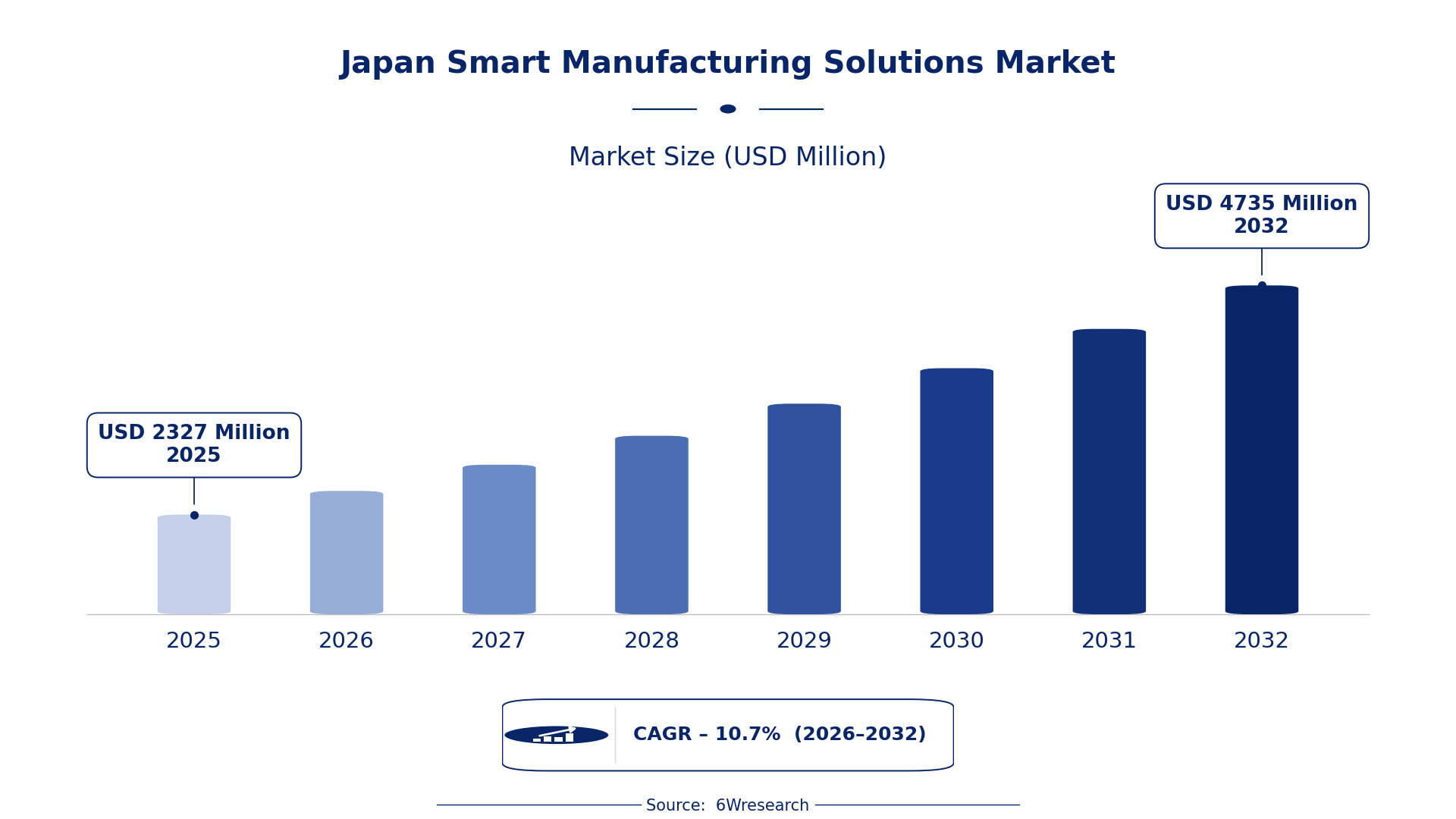
According to 6Wresearch internal database and industry insights, the Japan Smart Manufacturing Solutions Market was valued at USD 2,327 Million in 2025 and is projected to reach USD 4,735 Million by 2032, growing at a CAGR of approximately 10.7% during 2026–2032.
Japan Smart Manufacturing Solutions Market Highlights
| Report Metric | Details |
| Report Name | Japan Smart Manufacturing Solutions Market (2026-2032) |
| Market Size 2025 | USD 2,327 Million |
| Market Size 2032 | USD 4,735 Million |
| Absolute Growth 2025–2032 | USD 2,408 Million |
| CAGR 2026–2032 | 10.7% |
| Peak Annual Growth | 11.8% in 2032 |
| Forecast Period | 2026–2032 |
| Historical Data | 2022–2025 |
| Base Year | 2025 |
| Leading Solution Type, 2025 | Digital Twin Software (40% share) |
| Leading Core Feature, 2025 | Real-Time Simulation (43% share) |
| Leading Integration Platform, 2025 | Cloud + IoT Platforms (38% share) |
| Leading End User, 2025 | OEMs & Assemblers (43% share) |
| Fastest-Growing Solution Type | Predictive Maintenance AI (16.1% CAGR) |
| Fastest-Growing Core Feature | Downtime Reduction (14.0% CAGR) |
| Fastest-Growing Integration Platform | ML + Sensor Data (16.3% CAGR) |
| Fastest-Growing End User | Industrial Clients (14.8% CAGR) |
| Growing Sector | manufacturing |
| Key End Users | OEMs, assemblers, industrial clients, manufacturers |
Japan Smart Manufacturing Solutions Market Year-wise Growth Rate and Key Drivers (2022–2032)
This graph illustrates the annual growth rates of the market from 2022 to 2032, highlighting a steady upward trajectory and projected market expansion over the forecast period.
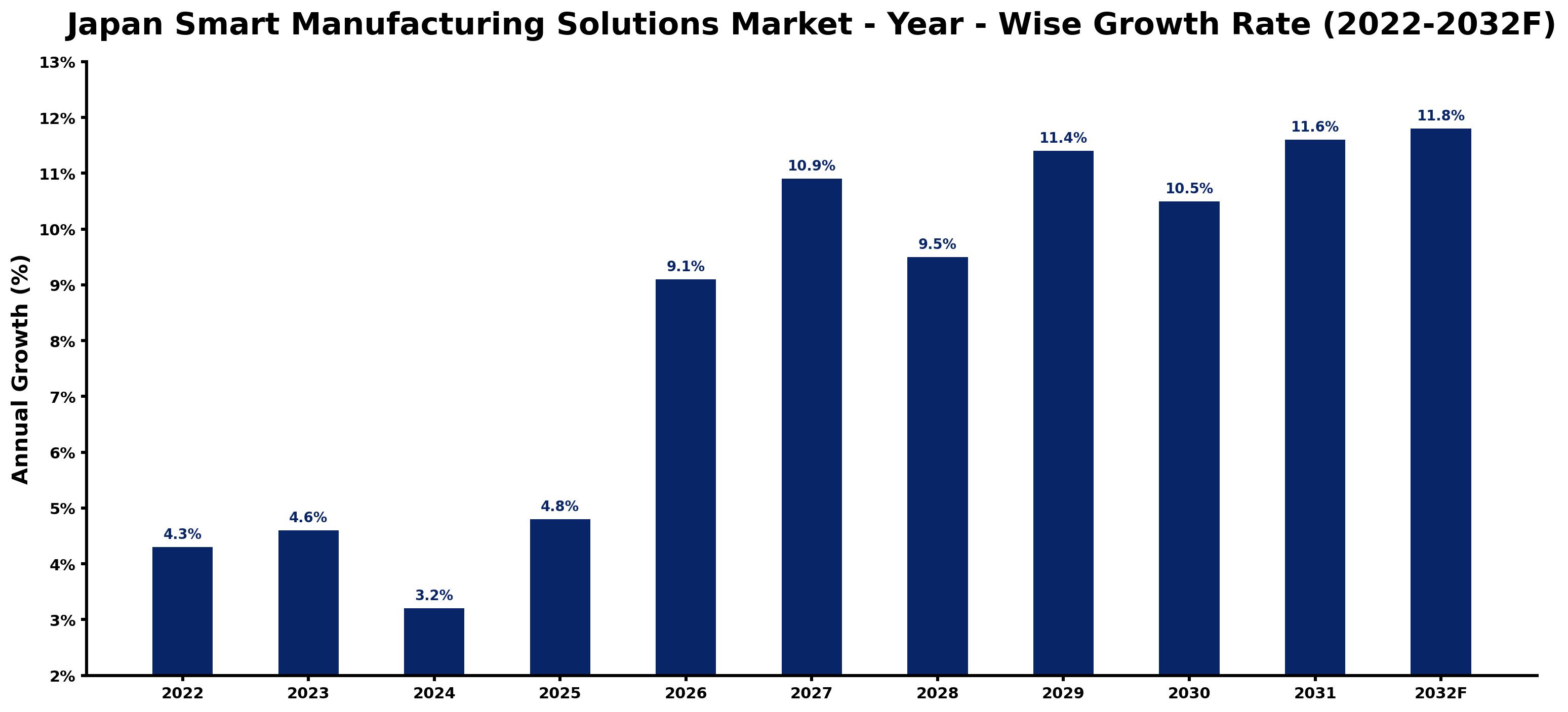
Below, each year's estimated growth is shown next to the factor that most influenced it.
| Year | Estimated Annual Growth (%) | Market Rationale |
| 2022 | 4.3 | The market showed steady growth as manufacturers began adopting smart technologies. |
| 2023 | 4.6 | Demand increased as more companies integrated AI and IoT into their operations. |
| 2024 | 3.2 | Growth slowed as firms faced challenges in implementing advanced solutions. |
| 2025 | 4.8 | The market rebounded with heightened interest in digital twin technologies. |
| 2026 | 9.1 | Investment surged as the Semiconductor and Digital Industry Strategy is projected to take effect. |
| 2027 | 10.9 | Adoption accelerated with rising demand for predictive maintenance solutions. |
| 2028 | 9.5 | Growth slowed slightly as companies focused on refining existing technologies. |
| 2029 | 11.4 | Demand rose again as industrial clients sought efficiency improvements. |
| 2030 | 10.5 | Growth decelerated as the market matured and competition intensified. |
| 2031 | 11.6 | The market expanded as more firms embraced automation and AI solutions. |
| 2032 | 11.8 | Demand peaked with increased investments in advanced manufacturing technologies. |
Note: Market size estimations and growth projections presented in this report are based on 6Wresearch's proprietary forecasting methodology, utilizing the latest available industry data, government publications, and primary research inputs.
Japan Smart Manufacturing Solutions Market Synopsis
Smart Manufacturing Solutions incorporate advanced technologies like AI and IoT to improve operational efficiency in manufacturing. These solutions optimize production processes, reduce downtime, and improve visibility. The Japan Smart Manufacturing Solutions Market is expanding due to rising adoption among OEMs and assemblers, particularly in the automotive and electronics sectors. With over 80% of manufacturers expected to implement digital twin technologies by 2025, substantial investments in AI and automation are driving this growth.
Market Dynamics Impact Analysis (2026–2032)
| Factor | Type | Impact | Primary Segment Affected |
| Growing adoption of digital twin technologies among manufacturers | Driver | High | Digital Twin Software |
| Investment in AI for predictive maintenance solutions | Driver | High | Predictive Maintenance AI |
| Increasing demand for real-time production visibility | Opportunity | High | Production Visibility |
| Investment in automation technologies by small and medium enterprises | Opportunity | Medium | Smart MES |
| Challenges in integrating new technologies into existing systems | Restraint | High | Workflow Optimization AI |
| Shortage of skilled workforce for advanced manufacturing systems | Restraint | Medium | Real-Time Simulation |
| High initial investment costs for smart manufacturing solutions | Challenge | High | Predictive Maintenance AI |
| Rapid technological changes requiring constant updates | Challenge | Medium | Smart MES |
Evaluation of Drivers in Japan Smart Manufacturing Solutions Market (2026–2032)
Demand rests on the following drivers, each shown with the segment it touches most.
| Drivers | Primary Segment Affected | Why It Matters (Evidence) |
| Increased adoption of digital twin technologies | Digital Twin Software | Over 80% of manufacturers are projected to adopt these technologies by 2025, improving simulation capabilities. |
| Growing investment in AI for predictive maintenance | Predictive Maintenance AI | Investment in AI for manufacturing is expected to reach ¥1 trillion by 2025, driving demand for maintenance solutions. |
| Rising focus on production visibility | Production Visibility | Manufacturers are increasingly seeking solutions for tracking performance, leading to higher purchases of visibility tools. |
| Support for automation in SMEs | Smart MES | Subsidies for small and medium enterprises are promoting the adoption of smart solutions. |
| Demand for efficiency in production workflows | Workflow Optimization AI | As manufacturers aim to reduce downtime, more are investing in workflow optimization technologies. |
Purchasing is picking up as Tokyo and Aichi lead the adoption of smart manufacturing solutions. Over 80% of manufacturers are projected to implement digital twin technologies by 2025, improving operational efficiency. Investment in AI for predictive maintenance is set to reach ¥1 trillion by 2025, prompting OEMs and assemblers to acquire more advanced solutions. The push for production visibility has led to increased demand for tools that track performance, with the installed base of industrial robots exceeding 400,000 units as of 2023.
Evaluation of Restraints in Japan Smart Manufacturing Solutions Market
The main factors holding the market back are set out below.
| Market Restraint | Primary Segment Affected | Why It Matters (Evidence) |
| Integration challenges with legacy systems | Workflow Optimization AI | Many manufacturers struggle to integrate new technologies with existing systems, hindering adoption rates. |
| Limited availability of skilled workforce | Real-Time Simulation | The shortage of skilled workers capable of operating advanced manufacturing technologies restricts implementation. |
| High initial costs for smart manufacturing solutions | Predictive Maintenance AI | The upfront investment required for smart solutions deters some manufacturers from adopting them. |
| Rapid technological advancements necessitating constant updates | Smart MES | Manufacturers face challenges in keeping up with fast-paced technology changes, causing delays in implementation. |
| Concerns over data security and privacy | Digital Twin Software | Manufacturers are cautious about potential data breaches, which can slow down the adoption of digital solutions. |
Japan Smart Manufacturing Solutions Market Challenges
Manufacturers in Japan confront rising costs as raw material prices have increased by 15% over the past year, squeezing budgets and shrinking profit margins. A skills gap persists, with over 40% of companies struggling to find qualified personnel, which delays project timelines and hampers technological advancements. Competition escalates as foreign firms adopt smart manufacturing solutions more rapidly, putting local businesses at risk of losing market share. Buyers face extended lead times, with 30% of manufacturers unable to meet demand, resulting in potential lost sales and dissatisfied customers.
Trends in the Japan Smart Manufacturing Solutions Market
The following changes are redrawing the Japan Smart Manufacturing Solutions Market.
- Shift from Traditional to Smart Manufacturing: The transition from traditional manufacturing methods to smart solutions is occurring, particularly in Tokyo, where over 80% of manufacturers are adopting digital twin technologies by 2025. This shift improves operational efficiency and competitiveness.
- Emergence of Predictive Maintenance Solutions: Since 2022, predictive maintenance solutions have gained traction, especially in Aichi, where investment in AI technologies is projected to reach ¥1 trillion by 2025. This trend is reshaping maintenance practices across industries.
- Focus on Production Visibility Improvements: Starting in 2023, manufacturers are increasingly prioritising production visibility tools. The installed base of industrial robots in Japan has surpassed 400,000 units, facilitating better tracking and management of manufacturing processes.
- Adoption of Automation in SMEs: The push for automation among small and medium enterprises began in 2022, driven by government subsidies. This trend is expected to see a rise in smart manufacturing solution adoption, enhancing overall efficiency.
Investment Opportunities in the Japan Smart Manufacturing Solutions Market
Where to invest in the Japan Smart Manufacturing Solutions Market: the main openings are set out below.
- Tokyo as a Hub for Smart Manufacturing: With over 80% of manufacturers adopting digital twin technologies by 2025, there is a gap in supply for these solutions. Companies can partner with local firms to enter this growing market.
- Investment in Predictive Maintenance Technologies: The projected ¥1 trillion investment in AI for manufacturing by 2025 presents a significant opportunity for suppliers of predictive maintenance solutions. Collaborating with OEMs and assemblers can facilitate market entry.
- Expansion of Automation Solutions in SMEs: Subsidies for small and medium enterprises create a demand for automation technologies. Suppliers can enter this segment by forming joint ventures with local businesses.
- Growing Demand for Production Visibility Tools: As manufacturers seek to improve operational visibility, there is a gap in the market for advanced tracking solutions. Companies can invest in developing these technologies to meet rising demand.
Government Initiatives in the Japan Smart Manufacturing Solutions Market
The Semiconductor and Digital Industry Strategy, established in June 2021, aims to secure domestic semiconductor production while promoting advanced manufacturing technologies. The Economic Security Promotion Act of 2022 further supports supply-chain resilience for critical products, improving the competitiveness of Japan's manufacturing sector.
In 2023, ¥200 billion was allocated for advanced manufacturing technologies, administered by the Ministry of Economy, Trade and Industry (METI). This funding supports initiatives that enhance automation and smart manufacturing practices across various sectors.
Future Insight of the Japan Smart Manufacturing Solutions Market
Investment in AI for manufacturing is projected to reach ¥1 trillion by 2025, driving demand for advanced technologies. By 2030, initiatives will aim to digitise 50% of factories, enhancing operational efficiency for suppliers. The adoption of predictive maintenance technologies will rise by 30% in the next five years, enabling buyers to streamline their operations. Support from the Ministry of Economy, Trade and Industry will promote automation, allowing manufacturers to enhance their competitiveness in the global market.
Market Segmentation Analysis
Japan Smart Manufacturing Solutions Market report covers a detailed analysis of the following market segments:
By Solution Type – Digital Twin Software Leads, Predictive Maintenance AI Expected to Grow Fastest
According to Saurav Kr Singh, Senior Research Analyst at 6Wresearch, the largest solution type category in 2025 was Digital Twin Software, at 40% of revenue. Digital Twin Software holds the largest share as it enables real-time simulation of manufacturing processes, crucial for optimising production efficiency. The automotive sector, a major user of these solutions, relies on this technology to enhance operational performance. Predictive Maintenance AI is projected to grow fastest, at a CAGR of 16.1% during 2026–2032. Predictive Maintenance is experiencing rapid growth due to its ability to anticipate equipment failures, thereby reducing unexpected downtimes. The projected 30% increase in adoption of predictive maintenance technologies over the next five years indicates strong future demand for this solution. Suppliers should focus on developing predictive maintenance solutions to meet the rising demand from manufacturers.
By Core Feature – Real-Time Simulation Leads, Downtime Reduction Expected to Grow Fastest
Real-Time Simulation took 43% of core feature revenue in 2025, more than any other category. Real-Time Simulation is the leading feature as it provides immediate feedback on production scenarios, enabling timely adjustments in manufacturing processes. This capability is particularly vital in the automotive industry, where efficiency and precision are essential for success. The quickest growth will come from Downtime Reduction, forecast to expand at a CAGR of 14.0% between 2026 and 2032. Downtime Reduction is the fastest-growing feature as it plays a critical role in maintaining operational efficiency, especially in high-demand manufacturing environments. The increasing emphasis on sustainability and energy efficiency further propels this growth. Buyers will increasingly seek solutions that prioritise downtime reduction to improve overall productivity and cost-effectiveness.
By Integration Platform – Cloud + IoT Platforms Lead, ML + Sensor Data Expected to Grow Fastest
In 2025, Cloud + IoT Platforms led the integration platform split with a 38% share. Cloud + IoT Platforms dominate the market by facilitating essential data collection and connectivity for modern manufacturing environments. Their ability to integrate various smart technologies makes them indispensable for manufacturers aiming for efficiency. Over 2026–2032, ML + Sensor Data is expected to post the fastest growth, at a CAGR of 16.3%. ML + Sensor Data is witnessing rapid growth as it supports analytics, providing valuable insights for informed decision-making. The transition towards data-driven manufacturing is accelerating the adoption of this integration platform. Suppliers must enhance their analytics capabilities to cater to the increasing demand for ML and sensor data integration.
By End User – OEMs & Assemblers Lead, Industrial Clients Expected to Grow Fastest
With 43% of end user revenue in 2025, OEMs & Assemblers was the largest category. OEMs & Assemblers represent the largest user group of smart manufacturing solutions, primarily due to their direct involvement in production processes. Their substantial investment in advanced technologies to improve efficiency drives the market forward. Industrial Clients are set to record the highest CAGR in this split, 14.8% over 2026–2032. Industrial Clients are the fastest-growing segment as they increasingly adopt smart solutions to enhance their operational capabilities. This broad category is expanding as more sectors recognise the benefits of smart manufacturing. Manufacturers should tailor their offerings to meet the specific needs of industrial clients to capitalise on this growing market opportunity.
Key Attractiveness of the Report
- 10 Years of Market Numbers
- Historical Data Starting from 2022 to 2025
- Base Year 2025
- Forecast Data until 2032
- Key Performance Indicators Impacting the Market
- Major Upcoming Developments and Projects
Key Highlights of the Report:
- Japan Smart Manufacturing Solutions Market Outlook
- Market Size of Japan Smart Manufacturing Solutions Market, 2025
- Forecast of Japan Smart Manufacturing Solutions Market, 2032
- Historical Data and Forecast of Japan Smart Manufacturing Solutions Revenues & Volume for the Period 2022-2032F
- Japan Smart Manufacturing Solutions Market Trend Evolution
- Japan Smart Manufacturing Solutions Market Drivers and Challenges
- Japan Smart Manufacturing Solutions Price Trends
- Japan Smart Manufacturing Solutions Porter's Five Forces
- Japan Smart Manufacturing Solutions Industry Life Cycle
- Historical Data and Forecast of Japan Smart Manufacturing Solutions Market Revenues & Volume By Solution Type for the Period 2022-2032F
- Historical Data and Forecast of Japan Smart Manufacturing Solutions Market Revenues & Volume By Digital Twin Software for the Period 2022-2032F
- Historical Data and Forecast of Japan Smart Manufacturing Solutions Market Revenues & Volume By Predictive Maintenance AI for the Period 2022-2032F
- Historical Data and Forecast of Japan Smart Manufacturing Solutions Market Revenues & Volume By Smart MES for the Period 2022-2032F
- Historical Data and Forecast of Japan Smart Manufacturing Solutions Market Revenues & Volume By Workflow Optimization AI for the Period 2022-2032F
- Historical Data and Forecast of Japan Smart Manufacturing Solutions Market Revenues & Volume By Core Feature for the Period 2022-2032F
- Historical Data and Forecast of Japan Smart Manufacturing Solutions Market Revenues & Volume By Real-Time Simulation for the Period 2022-2032F
- Historical Data and Forecast of Japan Smart Manufacturing Solutions Market Revenues & Volume By Downtime Reduction for the Period 2022-2032F
- Historical Data and Forecast of Japan Smart Manufacturing Solutions Market Revenues & Volume By Production Visibility for the Period 2022-2032F
- Historical Data and Forecast of Japan Smart Manufacturing Solutions Market Revenues & Volume By Adaptive Scheduling for the Period 2022-2032F
- Historical Data and Forecast of Japan Smart Manufacturing Solutions Market Revenues & Volume By Integration Platform for the Period 2022-2032F
- Historical Data and Forecast of Japan Smart Manufacturing Solutions Market Revenues & Volume By Cloud + IoT Platforms for the Period 2022-2032F
- Historical Data and Forecast of Japan Smart Manufacturing Solutions Market Revenues & Volume By ML + Sensor Data for the Period 2022-2032F
- Historical Data and Forecast of Japan Smart Manufacturing Solutions Market Revenues & Volume By ERP + PLC Interface for the Period 2022-2032F
- Historical Data and Forecast of Japan Smart Manufacturing Solutions Market Revenues & Volume By AI-Powered Dashboards for the Period 2022-2032F
- Historical Data and Forecast of Japan Smart Manufacturing Solutions Market Revenues & Volume By End User for the Period 2022-2032F
- Historical Data and Forecast of Japan Smart Manufacturing Solutions Market Revenues & Volume By OEMs & Assemblers for the Period 2022-2032F
- Historical Data and Forecast of Japan Smart Manufacturing Solutions Market Revenues & Volume By Industrial Clients for the Period 2022-2032F
- Historical Data and Forecast of Japan Smart Manufacturing Solutions Market Revenues & Volume By Smart Manufacturing for the Period 2022-2032F
- Historical Data and Forecast of Japan Smart Manufacturing Solutions Market Revenues & Volume By Production Lines for the Period 2022-2032F
- Japan Smart Manufacturing Solutions Import Export Trade Statistics
- Market Opportunity Assessment By Solution Type
- Market Opportunity Assessment By Core Feature
- Market Opportunity Assessment By Integration Platform
- Market Opportunity Assessment By End User
- Japan Smart Manufacturing Solutions Top Companies Market Share
- Japan Smart Manufacturing Solutions Competitive Benchmarking By Technical and Operational Parameters
- Japan Smart Manufacturing Solutions Company Profiles
- Japan Smart Manufacturing Solutions Key Strategic Recommendations
Market Covered
Segments analysed in this report are listed below.
By Solution Type
- Digital Twin Software
- Predictive Maintenance AI
- Smart MES
- Workflow Optimization AI
By Core Feature
- Real-Time Simulation
- Downtime Reduction
- Production Visibility
- Adaptive Scheduling
By Integration Platform
- Cloud + IoT Platforms
- ML + Sensor Data
- ERP + PLC Interface
- AI-Powered Dashboards
By End User
- OEMs & Assemblers
- Industrial Clients
- Smart Manufacturing
- Production Lines































