Japan Smart Manufacturing XR Market Size & Growth Rate
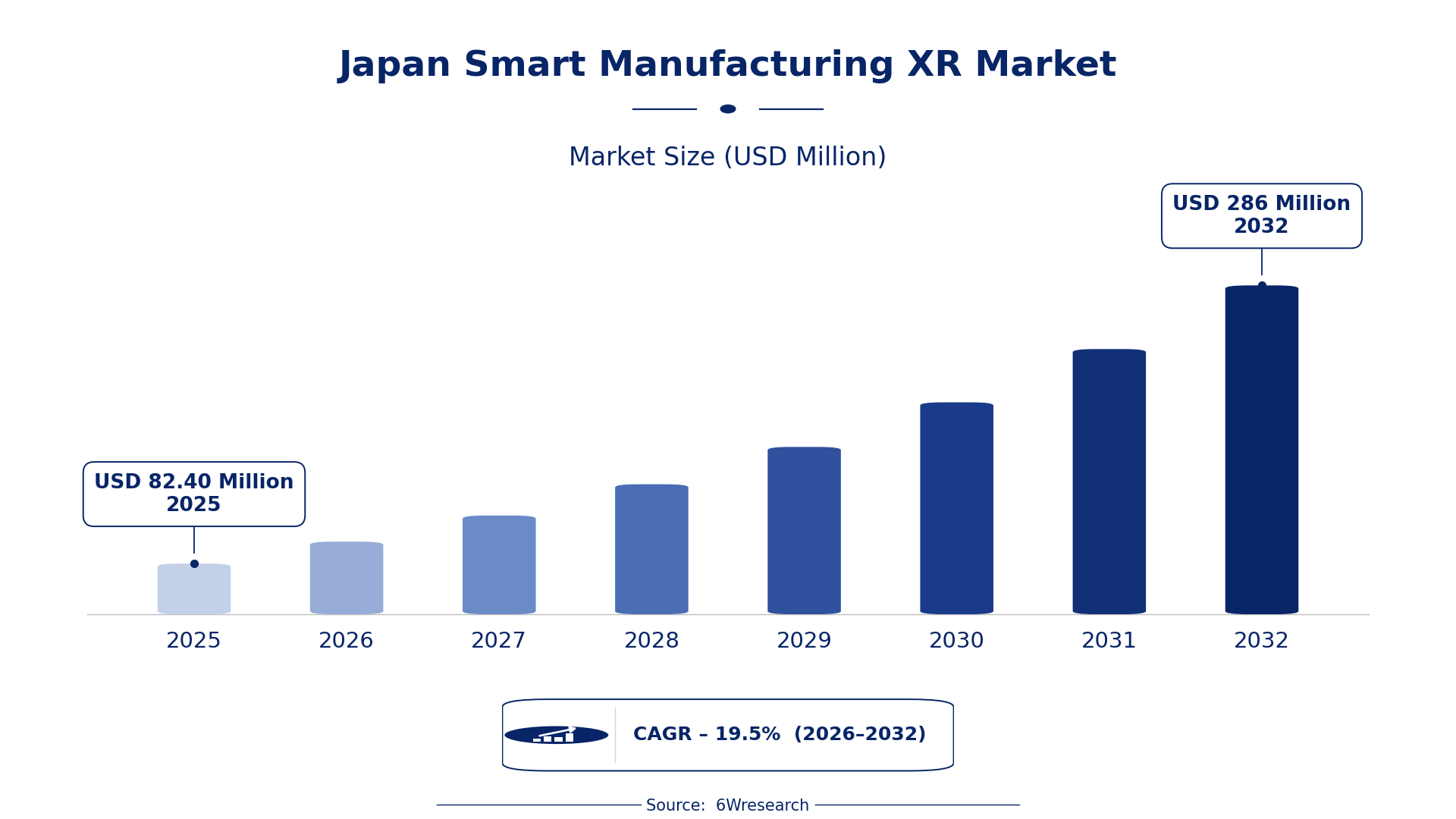
According to 6Wresearch internal database and industry insights, the Japan Smart Manufacturing XR Market was valued at USD 82.40 Million in 2025 and is projected to reach USD 286 Million by 2032, growing at a CAGR of approximately 19.5% during 2026–2032.
Japan Smart Manufacturing XR Market Highlights
| Report Metric | Details |
| Report Name | Japan Smart Manufacturing XR Market (2026-2032) |
| Market Size 2025 | USD 82.40 Million |
| Market Size 2032 | USD 286 Million |
| Absolute Growth 2025–2032 | USD 203.60 Million |
| CAGR 2026–2032 | 19.5% |
| Peak Annual Growth | 25.4% in 2026 |
| Forecast Period | 2026–2032 |
| Historical Data | 2022–2025 |
| Base Year | 2025 |
| Leading XR Type, 2025 | AR for Maintenance (35% share) |
| Leading Application Focus, 2025 | Step-by-Step Visual Guide (45% share) |
| Leading Hardware Interface, 2025 | AR Glasses/Tablet (43% share) |
| Leading End User, 2025 | Automotive Plants (49% share) |
| Fastest-Growing XR Type | VR for Training (20.6% CAGR) |
| Fastest-Growing Application Focus | Worker Immersion (24.9% CAGR) |
| Fastest-Growing Hardware Interface | VR Headsets + Sim Software (25.5% CAGR) |
| Fastest-Growing End User | Industrial Training Orgs (23.9% CAGR) |
| Growing Sector | automotive manufacturing |
| Key End Users | automotive plants, industrial training organisations, maintenance teams |
Japan Smart Manufacturing XR Market Year-wise Growth Rate and Key Drivers (2022–2032)
This graph illustrates the annual growth rates of the market from 2022 to 2032, highlighting a steady upward trajectory and projected market expansion over the forecast period.
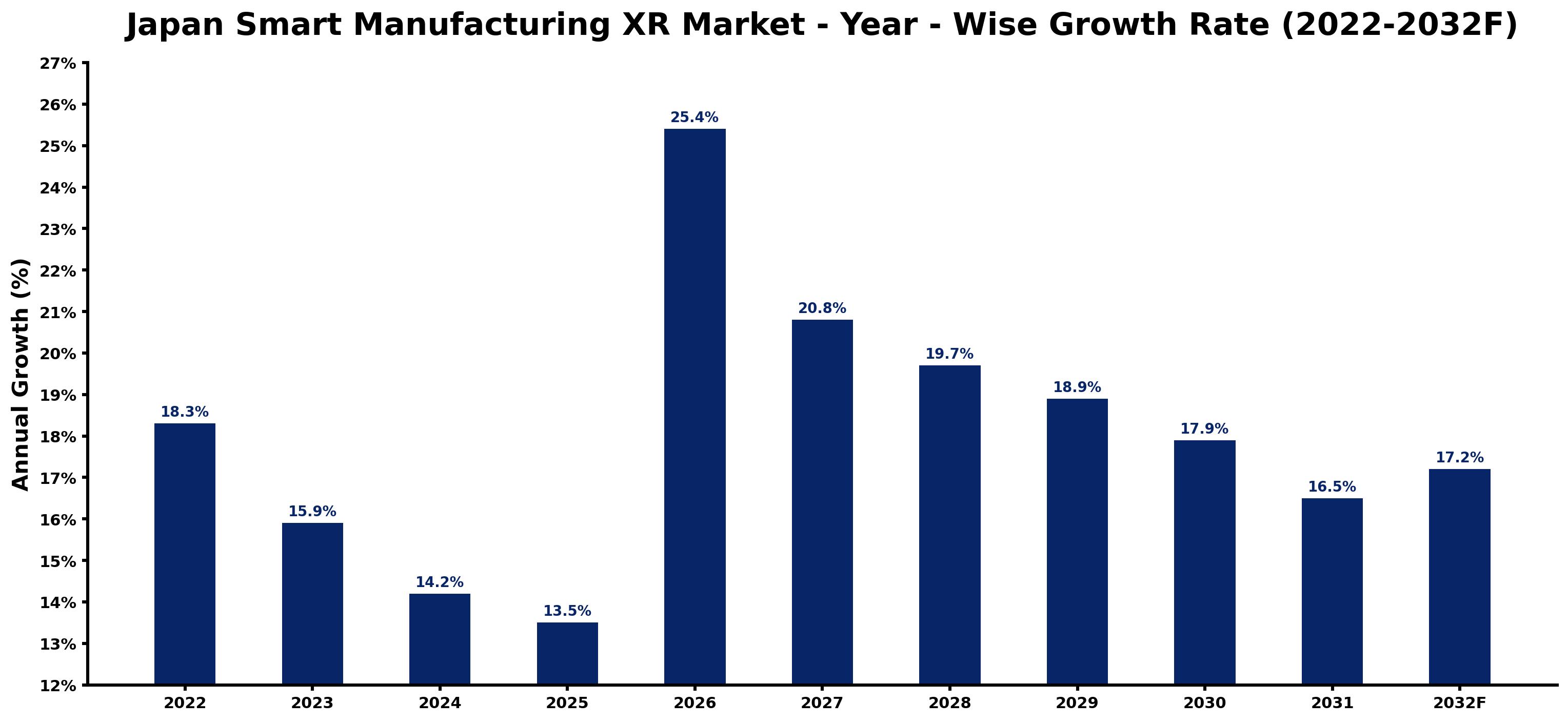
Each row of the following table gives one year's estimated growth and the event or demand shift that explains it.
| Year | Estimated Annual Growth (%) | Market Rationale |
| 2022 | 18.3 | The market experienced strong growth due to high demand in the automotive sector. |
| 2023 | 15.9 | Growth slowed as companies adjusted to new technologies and market conditions. |
| 2024 | 14.2 | Demand continued to rise, but at a reduced rate as investments stabilised. |
| 2025 | 13.5 | The market growth decelerated further as adoption rates began to normalise. |
| 2026 | 25.4 | The market surged as investments in XR technologies were implemented. |
| 2027 | 20.8 | Growth is expected to slow as the market matures and competition intensifies. |
| 2028 | 19.7 | Demand is projected to rise but at a more moderate pace as saturation approaches. |
| 2029 | 18.9 | The market is expected to maintain growth as new applications for XR technologies emerge. |
| 2030 | 17.9 | Growth is projected to decelerate slightly as the market reaches a more stable phase. |
| 2031 | 16.5 | The market will continue to grow, driven by ongoing innovation and adoption. |
| 2032 | 17.2 | Demand is projected to rise as new technologies improve manufacturing processes. |
Note: Market size estimations and growth projections presented in this report are based on 6Wresearch's proprietary forecasting methodology, utilizing the latest available industry data, government publications, and primary research inputs.
Japan Smart Manufacturing XR Market Synopsis
The Japan Smart Manufacturing XR Market integrates augmented reality, virtual reality, and mixed reality technologies to optimise manufacturing processes. These technologies support maintenance, training simulations, and assembly line optimisation, particularly in Japan's automotive and electronics sectors. The market is expanding due to rising investments in digital transformation initiatives, with the automotive industry valued at approximately 80 trillion JPY. Government support for smart manufacturing further stimulates demand, leading to growth in the sector.
Market Dynamics Impact Analysis (2026–2032)
| Factor | Type | Impact | Primary Segment Affected |
| Increased investment in digital transformation initiatives | Driver | High | XR for Simulation |
| Growing adoption of AR technology in maintenance | Driver | High | AR for Maintenance |
| Rising demand for immersive training solutions | Opportunity | High | VR for Training |
| Expansion of automotive manufacturing capabilities | Opportunity | High | Automotive Plants |
| High initial costs of XR technology implementation | Restraint | Medium | XR for Simulation |
| Limited awareness of XR benefits among smaller manufacturers | Restraint | Medium | AR for Maintenance |
| Shortage of skilled workforce to implement XR solutions | Challenge | High | VR for Training |
| Compliance with evolving industry standards and regulations | Challenge | Medium | Automotive Plants |
Evaluation of Drivers in Japan Smart Manufacturing XR Market (2026–2032)
The table below links each growth driver to the segment it affects and the evidence for it.
| Drivers | Primary Segment Affected | Why It Matters (Evidence) |
| Increased automation in manufacturing processes | XR for Simulation | This trend is supported by Japan's manufacturing output expected to grow by 2% annually through 2025. |
| Rising demand for real-time data visualisation | AR for Maintenance | This demand is supported by AR technology improving maintenance efficiency by 30% in factories. |
| Growing emphasis on workforce training and development | VR for Training | VR training programs have shown a 40% increase in knowledge retention among workers, improving workforce capabilities. |
| Investment in smart manufacturing technologies | MR for Assembly | The Ministry of Economy, Trade and Industry promotes smart manufacturing initiatives, increasing XR adoption. |
| Demand for enhanced assembly line optimisation | XR for Simulation | Automotive plants are increasingly using XR technologies for assembly and quality control, improving production processes. |
Buyers are adding capacity as the automotive industry values smart manufacturing at approximately 80 trillion JPY. The installed base of AR devices in manufacturing is projected to reach 1 million units by 2025, which will improve operational capabilities. As a result, manufacturers are increasingly adopting XR technologies to optimise processes and improve productivity.
Evaluation of Restraints in Japan Smart Manufacturing XR Market
These are the pressures that could keep growth below its potential.
| Market Restraint | Primary Segment Affected | Why It Matters (Evidence) |
| High initial costs associated with XR technology implementation | XR for Simulation | The high costs deter smaller manufacturers from adopting these technologies, limiting market growth. |
| Limited awareness of XR benefits among smaller manufacturers | AR for Maintenance | Many smaller firms lack knowledge about XR advantages, hindering widespread adoption. |
| Shortage of skilled workforce to implement XR solutions | VR for Training | A lack of trained personnel affects the effective integration of XR technologies in training. |
| Compliance with evolving industry standards and regulations | Automotive Plants | Manufacturers face challenges in meeting standards, which can delay XR technology adoption. |
| Integration challenges with existing manufacturing systems | MR for Assembly | Difficulties in integrating XR with legacy systems can slow down implementation efforts. |
Japan Smart Manufacturing XR Market Challenges
In Japan, manufacturers struggle with a shortage of skilled workers trained in XR applications, delaying projects and increasing training costs by 40% for employers. Supply chain disruptions impede the timely procurement of essential hardware, leading to production delays that can cost manufacturers millions. Local companies face fierce competition from international firms, forcing them to lower prices and tighten margins, which restricts their capacity to invest in new technologies. The slow adoption of advanced technologies limits operational efficiency; without widespread AR implementation, factories miss out on a potential 30% boost in maintenance productivity.
Trends in the Japan Smart Manufacturing XR Market
Below are the shifts with the largest effect on the Japan Smart Manufacturing XR Market.
- Shift towards Immersive Training Solutions: The automotive sector is increasingly adopting immersive training solutions, with VR training programs showing a 40% increase in knowledge retention. This trend is reshaping workforce development in manufacturing facilities across Japan.
- Transition from Traditional to Smart Manufacturing: The government launched a programme in 2023 to promote digital transformation in factories, driving the adoption of XR technologies in production environments. This initiative is vital for improving operational efficiency.
- Emergence of AR for Maintenance: AR technology is becoming a standard in maintenance processes, improving efficiency by 30%. This shift is particularly evident in automotive plants, where real-time guidance is essential.
- Focus on Worker Immersion: Worker immersion techniques are gaining traction, with the fastest-growing application focus being on immersive training experiences. This trend is essential for improving skill retention in manufacturing.
Investment Opportunities in the Japan Smart Manufacturing XR Market
Investors looking at the Japan Smart Manufacturing XR Market should consider the following areas.
- Timing for Investment in XR Technologies: With the installed base of AR devices projected to reach 1 million units by 2025, now is an opportune time to invest in XR technologies. Automotive plants are particularly in need of these solutions to improve productivity.
- Expansion of XR Applications in Automotive Manufacturing: The automotive sector is rapidly adopting XR technologies due to the need for efficiency. Companies can enter this market through partnerships with local manufacturers to gain expertise.
- Growing Demand for Training Solutions: As workforce training becomes increasingly important, there is a clear opportunity for XR providers. Industrial training organisations are seeking effective solutions to develop skills.
- Entry into Smart Manufacturing Initiatives: The government's push for smart manufacturing creates opportunities for XR technology suppliers. Collaborating with local partners can facilitate market entry and compliance with standards.
Government Initiatives in the Japan Smart Manufacturing XR Market
The AI Promotion Act encourages manufacturers to adopt AI-driven XR solutions to improve efficiency and productivity. This legislation promotes collaboration between industries and research institutions, advancing innovation in XR applications. The act aims to support projects that integrate advanced technologies, ensuring competitiveness in the global market.
The Ministry of Economy, Trade and Industry oversees the funding and approval of smart manufacturing initiatives. This includes support for projects that integrate XR technologies into production processes, helping manufacturers modernise and improve operational capabilities. The ministry's initiatives aim to increase the adoption of advanced technologies, ensuring competitiveness in the global market.
Future Insight of the Japan Smart Manufacturing XR Market
By 2032, investment in digital transformation will drive demand for XR technologies in manufacturing. The government's push for smart manufacturing initiatives will facilitate faster adoption, with AR installations expected to reach 1 million units. As ISO 9001 standards adapt to include XR practices, suppliers will need to update their offerings to meet new compliance criteria. VR training programmes will become commonplace, improving workforce skills and knowledge retention by 40%.
Market Segmentation Analysis
Japan Smart Manufacturing XR Market report covers a detailed analysis of the following market segments:
By XR Type – AR for Maintenance Leads, VR for Training Expected to Grow Fastest
According to Saurav Kr Singh, Senior Research Analyst at 6Wresearch, AR for Maintenance held 35% of the Japan Smart Manufacturing XR Market by xr type in 2025. AR for Maintenance holds the largest share as it is extensively used in providing real-time guidance for equipment repair and upkeep. The projected installed base of AR devices in manufacturing reaching 1 million units by 2025 highlights the strong demand for this technology. The quickest growth will come from VR for Training, forecast to expand at a CAGR of 20.6% between 2026 and 2032. The rapid adoption of VR for Training is driven by its ability to offer immersive training experiences, which have shown a 40% increase in knowledge retention among workers. This effectiveness ensures that VR will continue to gain traction in workforce training. Suppliers should focus on developing tailored VR training solutions to capitalise on this growing demand.
By Application Focus – Step-by-Step Visual Guide Leads, Worker Immersion Expected to Grow Fastest
Step-by-Step Visual Guide took 45% of application focus revenue in 2025, more than any other category. The Step-by-Step Visual Guide holds the largest share as it simplifies complex tasks through visual aids, making it indispensable in training settings. This approach is particularly effective in automotive plants where accuracy is paramount for operational success. Worker Immersion is projected to grow fastest, at a CAGR of 24.9% during 2026–2032. Worker Immersion is witnessing rapid growth due to its ability to fully engage workers in training scenarios, leading to better skill retention. This trend aligns with the industry's focus on improving training outcomes and operational efficiency. Buyers should consider adopting immersive training solutions to enhance workforce efficiency and skill acquisition.
By Hardware Interface – AR Glasses/Tablet Leads, VR Headsets + Sim Software Expected to Grow Fastest
The largest hardware interface category in 2025 was AR Glasses/Tablet, at 43% of revenue. AR Glasses/Tablet lead the market by providing hands-free access to critical information during maintenance, essential for maintaining efficiency in the automotive sector. Their widespread use in facilities aiming for streamlined operations highlights their significance. Over 2026–2032, VR Headsets + Sim Software is expected to post the fastest growth, at a CAGR of 25.5%. VR Headsets + Sim Software are experiencing swift growth as they offer integrated software for comprehensive training experiences, making them suitable for organisations focused on workforce development. This indicates a shift towards more engaging and effective training methodologies. Suppliers need to focus on developing integrated VR solutions to cater to the increasing demand for effective training tools.
By End User – Automotive Plants Lead, Industrial Training Orgs Expected to Grow Fastest
In 2025, Automotive Plants led the end user split with a 49% share. Automotive Plants dominate the market by utilising XR technologies for assembly and quality control, which are crucial for sustaining high production standards. The automotive sector's substantial valuation at approximately 80 trillion JPY reinforces this trend. Industrial Training Orgs are set to record the highest CAGR in this split, 23.9% over 2026–2032. Industrial Training Orgs are the fastest-growing segment as they harness XR for skill development, addressing the rising demand for skilled labour in manufacturing. This growth reflects a broader commitment to investing in employee training and development. Buyers should seek collaborations with training organisations to improve their workforce capabilities through XR technologies.
Key Attractiveness of the Report
- 10 Years of Market Numbers
- Historical Data Starting from 2022 to 2025
- Base Year 2025
- Forecast Data until 2032
- Key Performance Indicators Impacting the Market
- Major Upcoming Developments and Projects
Key Highlights of the Report:
- Japan Smart Manufacturing XR Market Outlook
- Market Size of Japan Smart Manufacturing XR Market, 2025
- Forecast of Japan Smart Manufacturing XR Market, 2032
- Historical Data and Forecast of Japan Smart Manufacturing XR Revenues & Volume for the Period 2022-2032F
- Japan Smart Manufacturing XR Market Trend Evolution
- Japan Smart Manufacturing XR Market Drivers and Challenges
- Japan Smart Manufacturing XR Price Trends
- Japan Smart Manufacturing XR Porter's Five Forces
- Japan Smart Manufacturing XR Industry Life Cycle
- Historical Data and Forecast of Japan Smart Manufacturing XR Market Revenues & Volume By XR Type for the Period 2022-2032F
- Historical Data and Forecast of Japan Smart Manufacturing XR Market Revenues & Volume By AR for Maintenance for the Period 2022-2032F
- Historical Data and Forecast of Japan Smart Manufacturing XR Market Revenues & Volume By VR for Training for the Period 2022-2032F
- Historical Data and Forecast of Japan Smart Manufacturing XR Market Revenues & Volume By MR for Assembly for the Period 2022-2032F
- Historical Data and Forecast of Japan Smart Manufacturing XR Market Revenues & Volume By XR for Simulation for the Period 2022-2032F
- Historical Data and Forecast of Japan Smart Manufacturing XR Market Revenues & Volume By Application Focus for the Period 2022-2032F
- Historical Data and Forecast of Japan Smart Manufacturing XR Market Revenues & Volume By Step-by-Step Visual Guide for the Period 2022-2032F
- Historical Data and Forecast of Japan Smart Manufacturing XR Market Revenues & Volume By Worker Immersion for the Period 2022-2032F
- Historical Data and Forecast of Japan Smart Manufacturing XR Market Revenues & Volume By Hands-Free Instruction for the Period 2022-2032F
- Historical Data and Forecast of Japan Smart Manufacturing XR Market Revenues & Volume By Factory Layout Optimization for the Period 2022-2032F
- Historical Data and Forecast of Japan Smart Manufacturing XR Market Revenues & Volume By Hardware Interface for the Period 2022-2032F
- Historical Data and Forecast of Japan Smart Manufacturing XR Market Revenues & Volume By AR Glasses/Tablet for the Period 2022-2032F
- Historical Data and Forecast of Japan Smart Manufacturing XR Market Revenues & Volume By VR Headsets + Sim Software for the Period 2022-2032F
- Historical Data and Forecast of Japan Smart Manufacturing XR Market Revenues & Volume By Mixed Reality Headgear for the Period 2022-2032F
- Historical Data and Forecast of Japan Smart Manufacturing XR Market Revenues & Volume By CAD/AR Sync for the Period 2022-2032F
- Historical Data and Forecast of Japan Smart Manufacturing XR Market Revenues & Volume By End User for the Period 2022-2032F
- Historical Data and Forecast of Japan Smart Manufacturing XR Market Revenues & Volume By Maintenance Teams for the Period 2022-2032F
- Historical Data and Forecast of Japan Smart Manufacturing XR Market Revenues & Volume By Industrial Training Orgs for the Period 2022-2032F
- Historical Data and Forecast of Japan Smart Manufacturing XR Market Revenues & Volume By Automotive Plants for the Period 2022-2032F
- Historical Data and Forecast of Japan Smart Manufacturing XR Market Revenues & Volume By Product Design Units for the Period 2022-2032F
- Japan Smart Manufacturing XR Import Export Trade Statistics
- Market Opportunity Assessment By XR Type
- Market Opportunity Assessment By Application Focus
- Market Opportunity Assessment By Hardware Interface
- Market Opportunity Assessment By End User
- Japan Smart Manufacturing XR Top Companies Market Share
- Japan Smart Manufacturing XR Competitive Benchmarking By Technical and Operational Parameters
- Japan Smart Manufacturing XR Company Profiles
- Japan Smart Manufacturing XR Key Strategic Recommendations
Market Covered
The following segment groups are covered in the report.
By XR Type
- AR for Maintenance
- VR for Training
- MR for Assembly
- XR for Simulation
By Application Focus
- Step-by-Step Visual Guide
- Worker Immersion
- Hands-Free Instruction
- Factory Layout Optimization
By Hardware Interface
- AR Glasses/Tablet
- VR Headsets + Sim Software
- Mixed Reality Headgear
- CAD/AR Sync
By End User
- Maintenance Teams
- Industrial Training Orgs
- Automotive Plants
- Product Design Units































