Japan Smart Material Handling Robots Market Size & Growth Rate
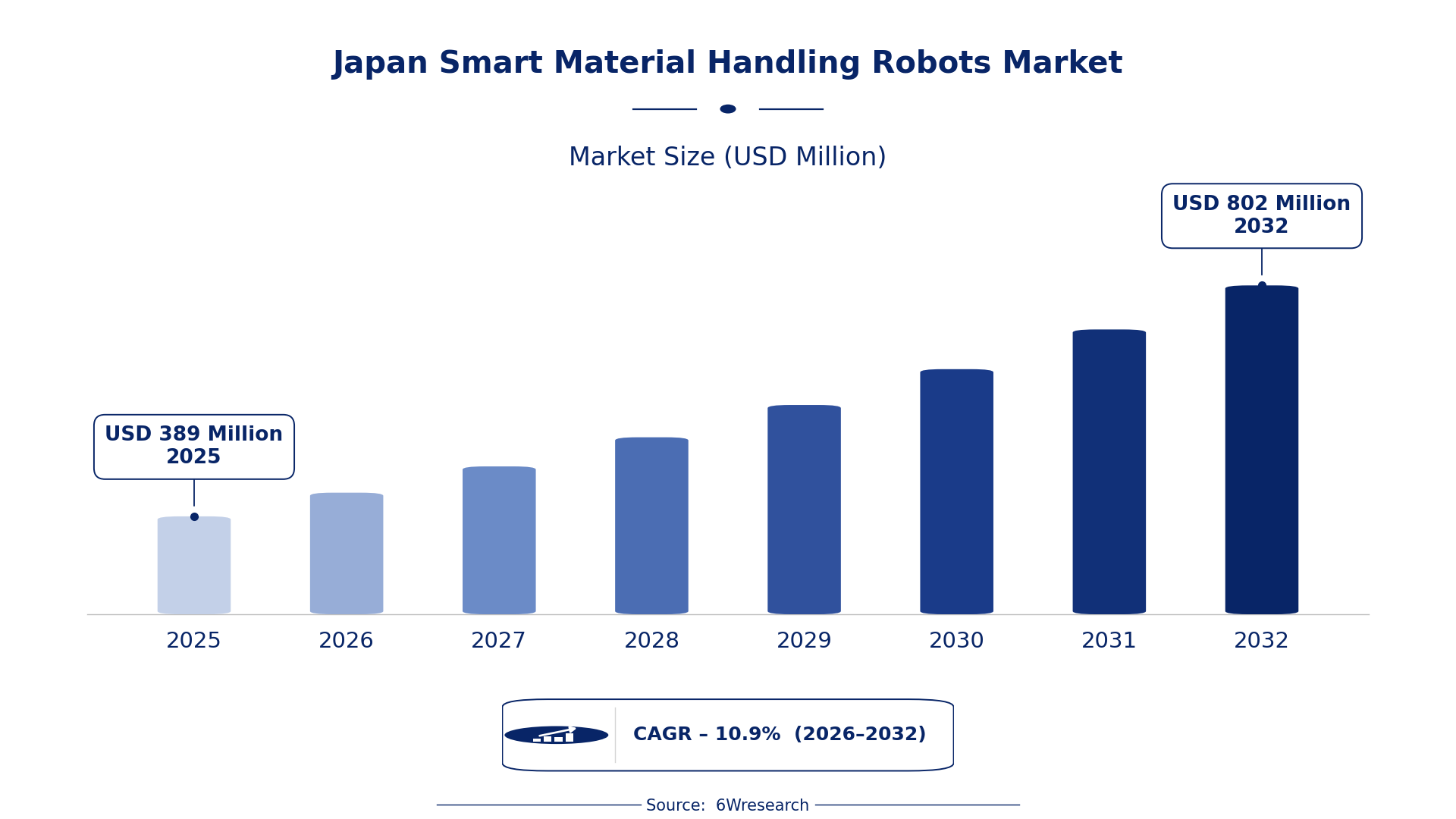
According to 6Wresearch internal database and industry insights, the Japan Smart Material Handling Robots Market was valued at USD 389 Million in 2025 and is projected to reach USD 802 Million by 2032, growing at a CAGR of approximately 10.9% during 2026–2032.
Japan Smart Material Handling Robots Market Highlights
| Report Metric | Details |
| Report Name | Japan Smart Material Handling Robots Market (2026-2032) |
| Market Size 2025 | USD 389 Million |
| Market Size 2032 | USD 802 Million |
| Absolute Growth 2025–2032 | USD 413 Million |
| CAGR 2026–2032 | 10.9% |
| Peak Annual Growth | 16.8% in 2032 |
| Forecast Period | 2026–2032 |
| Historical Data | 2022–2025 |
| Base Year | 2025 |
| Leading Robot Type, 2025 | Autonomous Mobile Robots (39% share) |
| Leading Smart Feature, 2025 | Path Optimization AI (44% share) |
| Leading Navigation Tech, 2025 | Lidar + SLAM (48% share) |
| Leading End User, 2025 | Logistics Centers (40% share) |
| Fastest-Growing Robot Type | Collaborative Loaders (17.2% CAGR) |
| Fastest-Growing Smart Feature | AI-Based Object Sorting (15.1% CAGR) |
| Fastest-Growing End User | E-commerce Fulfillment (15.0% CAGR) |
| Growing Sector | Logistics |
| Key End Users | Logistics Centers, Manufacturing Plants, E-commerce Fulfillment |
Japan Smart Material Handling Robots Market Year-wise Growth Rate and Key Drivers (2022–2032)
This graph illustrates the annual growth rates of the market from 2022 to 2032, highlighting a steady upward trajectory and projected market expansion over the forecast period.

The table below sets out the estimated growth rate for each year and the main factor behind it.
| Year | Estimated Annual Growth (%) | Market Rationale |
| 2022 | 0.1 | The market showed minimal growth due to initial investments in automation technologies. |
| 2023 | 2.5 | Demand accelerated as logistics centers began adopting smart material handling solutions. |
| 2024 | 3.2 | Growth increased as automation investments in manufacturing gained momentum. |
| 2025 | 4.5 | The market reached its historical peak as companies embraced robotics for efficiency. |
| 2026 | 8.2 | Growth is projected to rise as public and private sectors invest heavily in automation. |
| 2027 | 10.4 | Demand is expected to surge with rising adoption of collaborative robots in manufacturing plants. |
| 2028 | 9.2 | Growth is anticipated to slow slightly as the market adjusts to previous rapid expansions. |
| 2029 | 12.0 | Increased e-commerce activities will drive further demand for smart robots. |
| 2030 | 8.7 | Growth is expected to moderate as logistics centers optimise existing automation systems. |
| 2031 | 11.2 | Demand is projected to rebound with new investments in advanced robotics technologies. |
| 2032 | 16.8 | The market is expected to peak as investments in AI-driven solutions materialise. |
Note: Market size estimations and growth projections presented in this report are based on 6Wresearch's proprietary forecasting methodology, utilizing the latest available industry data, government publications, and primary research inputs.
Japan Smart Material Handling Robots Market Synopsis
Smart material handling robots are automated systems designed to transport, sort, and manage materials in various environments. The Japan Smart Material Handling Robots Market is growing as logistics centres and manufacturing plants increasingly adopt these technologies. Growth is driven by rising automation investments, a focus on operational efficiency, and government initiatives aimed at integrating AI and robotics into operations. With strong demand from domestic users, the sector is set for substantial expansion.
Market Dynamics Impact Analysis (2026–2032)
| Factor | Type | Impact | Primary Segment Affected |
| Rising automation investments in logistics and manufacturing facilities | Driver | High | Autonomous Mobile Robots |
| Growing e-commerce sector demanding efficient order processing solutions | Driver | High | Sorting Robots |
| Increasing demand for collaborative robots in manufacturing | Opportunity | Medium | Collaborative Loaders |
| Expansion of logistics centers in urban areas like Tokyo | Opportunity | High | Logistics Centers |
| High initial investment costs for smart robot implementation | Restraint | High | Robotic Forklifts |
| Shortage of skilled workforce to operate and maintain robots | Restraint | Medium | Collaborative Loaders |
| Compliance with safety regulations and standards | Challenge | High | Sorting Robots |
| Rapid technological advancements requiring constant upgrades | Challenge | Medium | Autonomous Mobile Robots |
Evaluation of Drivers in Japan Smart Material Handling Robots Market (2026–2032)
The main growth drivers and the segments they affect most are set out below.
| Drivers | Primary Segment Affected | Why It Matters (Evidence) |
| Increased automation investments in logistics and manufacturing sectors | Autonomous Mobile Robots | Japan's manufacturing sector invested heavily in automation technologies, reaching JPY 150 trillion in 2023. |
| Growing e-commerce activities driving demand for efficient solutions | Sorting Robots | The rise in online shopping has led to a notable increase in demand for smart robots in fulfillment centers. |
| Expansion of logistics centers in urban areas | Logistics Centers | The Tokyo region has a high concentration of logistics centers utilizing smart robots for efficient operations. |
| Adoption of collaborative robots for improved productivity | Collaborative Loaders | Collaborative robots are increasingly used in manufacturing plants, improving operational efficiency by 12%. |
| Focus on sustainability and efficiency in operations | Robotic Forklifts | Japan targets a 46% cut in greenhouse-gas emissions by 2030, driving automation. |
Several shifts outside the market lift sales. The logistics sector is experiencing increased automation investments, with Japan's manufacturing sector investing JPY 150 trillion in 2023. The rise in e-commerce activities has created a demand for efficient sorting solutions, particularly in fulfillment centers, leading to a notable increase in smart robot usage. Urban areas are expanding logistics centers, which are adopting smart robots for improved efficiency. Collaborative robots are increasingly being integrated into manufacturing plants, driving demand as companies seek to boost productivity.
Evaluation of Restraints in Japan Smart Material Handling Robots Market
These restraints slow adoption and weigh on supplier margins.
| Market Restraint | Primary Segment Affected | Why It Matters (Evidence) |
| High initial investment costs for smart robot systems | Robotic Forklifts | Many companies face challenges in justifying the initial costs of implementing smart robots. |
| Shortage of skilled workforce for operating and maintaining robots | Collaborative Loaders | The lack of trained personnel can hinder the effective use of advanced robotics. |
| Compliance with stringent safety regulations | Sorting Robots | Manufacturers must navigate complex regulations, which can delay robot deployment. |
| Integration challenges with existing systems and processes | Logistics Centers | Many logistics centers struggle to integrate new robots with legacy systems. |
| Market competition leading to price pressures | Autonomous Mobile Robots | Intense competition can drive down prices, affecting profitability for manufacturers. |
Japan Smart Material Handling Robots Market Challenges
Producers of smart material handling robots face challenges with outdated technology, as many systems lack advanced AI integration, causing production delays of up to six months. Buyers in logistics encounter rising operational costs due to minimum wages increasing to JPY 1,055 per hour in October 2024, forcing them to rethink their automation strategies. Navigating evolving regulatory standards complicates technology adoption, extending project timelines for buyers by at least three months. Supply chain disruptions further hinder producers, with delays in component deliveries impacting their ability to fulfil orders on schedule.
Trends in the Japan Smart Material Handling Robots Market
The shifts below are changing how Japan Smart Material Handling Robots Market products are bought and supplied.
- Shift from Manual to Automated Handling in Logistics: The Tokyo region is experiencing a shift from manual handling to automated systems in logistics centres, with a 30% increase in smart robot adoption reported in 2023.
- Transition from Traditional Warehousing to Smart Warehousing: The New Robot Strategy promotes the transition to smart warehousing, aiming for 50% of warehouses to adopt automation technologies by 2025.
- E-commerce Fulfillment Prioritised over Traditional Retail: E-commerce fulfillment is prioritising automation, with a 15% growth in smart robots used for order processing in 2023, reflecting changing consumer habits.
- Lidar + SLAM Gaining Popularity in Navigation Tech: Lidar + SLAM technology is becoming the preferred navigation method for autonomous robots, with a 12% increase in adoption among logistics centres in 2023.
Investment Opportunities in the Japan Smart Material Handling Robots Market
The opportunities below stand out in the Japan Smart Material Handling Robots Market for new entrants and existing suppliers.
- Growing Demand for Collaborative Robots: With a projected growth rate for collaborative loaders, manufacturers should invest in developing these robots for improved productivity in factories.
- Investment in Smart Warehousing Technologies: The logistics sector is projected to grow, with JPY 150 trillion targeted for decarbonisation investments over ten years, creating opportunities for automation suppliers.
- Expansion of Logistics Centers in Urban Areas: Urban regions like Tokyo are expanding logistics centres, creating a demand for smart material handling robots to improve efficiency and reduce costs.
- Partnerships for Robotics Development: Local partnerships can facilitate entry into the market, especially in urban logistics hubs, where demand for automated solutions is high.
Government Initiatives in the Japan Smart Material Handling Robots Market
The New Robot Strategy established in 2015 aims to expand the use of robots across various sectors, including manufacturing and logistics. This strategy has led to increased funding for robotics research and development, promoting innovation and efficiency in the industry. The AI Promotion Act of 2025 further supports this growth by establishing a national framework for AI research and development, ensuring that Japan remains at the forefront of technological advancements.
An investment of JPY 150 trillion over ten years aims to integrate AI and robotics in logistics operations. The Ministry of Economy, Trade and Industry oversees this initiative, promoting the adoption of smart technologies in logistics and manufacturing sectors.
Future Insight of the Japan Smart Material Handling Robots Market
Investment in decarbonisation will create a robust pipeline for smart material handling robots, stimulating demand from various sectors. By 2032, Japan's logistics sector will see a marked increase in automation, improving efficiency and reducing operational costs. The government's commitment to robotics R&D will facilitate advancements, enabling producers to deploy more sophisticated systems. Collaborative robots will become standard in manufacturing environments, optimising workflows and boosting overall productivity.
Market Segmentation Analysis
Japan Smart Material Handling Robots Market report covers a detailed analysis of the following market segments:
By Robot Type – Autonomous Mobile Robots Lead, Collaborative Loaders Expected to Grow Fastest
According to Saurav Kr Singh, Senior Research Analyst at 6Wresearch, in 2025, Autonomous Mobile Robots led the robot type split with a 39% share. Autonomous Mobile Robots hold the largest share in Japan due to their extensive use in transporting goods autonomously, especially in logistics centres. Their ability to streamline operations is highly valued by major logistics players in regions like Tokyo. Over 2026–2032, Collaborative Loaders are expected to post the fastest growth, at a CAGR of 17.2%. Collaborative Loaders are rapidly gaining traction as they are designed to work alongside human workers, which is increasingly important in modern logistics. The focus on automation and efficiency within the sector drives this growth, ensuring a widening gap between this segment and others. Suppliers should prioritise the development of collaborative solutions to align with the increasing demand in logistics.
By Smart Feature – Path Optimization AI Leads, AI-Based Object Sorting Expected to Grow Fastest
The largest smart feature category in 2025 was Path Optimization AI, at 44% of revenue. Path Optimization AI holds a substantial share due to its critical role in enhancing the efficiency of smart material handling robots, particularly in logistics operations. Its application in optimising routes is vital for reducing operational costs and improving performance in facilities like distribution centres. The quickest growth will come from AI-Based Object Sorting, forecast to expand at a CAGR of 15.1% between 2026 and 2032. AI-Based Object Sorting is rapidly gaining traction as it plays a crucial role in improving sorting efficiency, which is essential for meeting the demands of fast-paced logistics environments. As e-commerce continues to expand, the necessity for effective sorting solutions will drive its growth further. Suppliers should prioritise the development of advanced sorting technologies to meet the increasing demands of the logistics sector.
By Navigation Tech – Lidar + SLAM Leads and Records the Fastest Growth
Lidar + SLAM held 48% of the Japan Smart Material Handling Robots Market by navigation tech in 2025. Lidar + SLAM technology is the leading navigation solution for autonomous robots, providing precise navigation capabilities essential for safe operation in complex environments. Its widespread adoption in logistics operations underscores its importance in enhancing efficiency and reliability. The same category is also set to grow fastest, at a CAGR of 12.8% during 2026–2032. Lidar + SLAM is also the fastest-growing navigation technology, with its effectiveness in improving navigation capabilities being increasingly recognised. Ongoing advancements in this technology will likely broaden its application across various sectors. Suppliers need to focus on enhancing navigation technologies to maintain a competitive edge in the market.
By End User – Logistics Centers Lead, E-commerce Fulfillment Expected to Grow Fastest
With 40% of end user revenue in 2025, Logistics Centers was the largest category. Logistics Centers represent the largest segment of smart robot users, utilising these systems to enhance operational efficiency in material handling and transport. The high concentration of logistics facilities in urban areas like Tokyo significantly fuels the demand for these automated solutions. E-commerce Fulfillment is projected to grow fastest, at a CAGR of 15.0% during 2026–2032. E-commerce Fulfillment is the fastest-growing end user, as companies increasingly implement robots for efficient order processing to meet rising consumer demands. The surge in online shopping necessitates the integration of automation in fulfilment operations to keep pace with market needs. Suppliers should strategically target e-commerce businesses to leverage the growing demand for automation in fulfilment processes.
Key Attractiveness of the Report
- 10 Years of Market Numbers
- Historical Data Starting from 2022 to 2025
- Base Year 2025
- Forecast Data until 2032
- Key Performance Indicators Impacting the Market
- Major Upcoming Developments and Projects
Key Highlights of the Report:
- Japan Smart Material Handling Robots Market Outlook
- Market Size of Japan Smart Material Handling Robots Market, 2025
- Forecast of Japan Smart Material Handling Robots Market, 2032
- Historical Data and Forecast of Japan Smart Material Handling Robots Revenues & Volume for the Period 2022-2032F
- Japan Smart Material Handling Robots Market Trend Evolution
- Japan Smart Material Handling Robots Market Drivers and Challenges
- Japan Smart Material Handling Robots Price Trends
- Japan Smart Material Handling Robots Porter's Five Forces
- Japan Smart Material Handling Robots Industry Life Cycle
- Historical Data and Forecast of Japan Smart Material Handling Robots Market Revenues & Volume By Robot Type for the Period 2022-2032F
- Historical Data and Forecast of Japan Smart Material Handling Robots Market Revenues & Volume By Autonomous Mobile Robots for the Period 2022-2032F
- Historical Data and Forecast of Japan Smart Material Handling Robots Market Revenues & Volume By Robotic Forklifts for the Period 2022-2032F
- Historical Data and Forecast of Japan Smart Material Handling Robots Market Revenues & Volume By Collaborative Loaders for the Period 2022-2032F
- Historical Data and Forecast of Japan Smart Material Handling Robots Market Revenues & Volume By Sorting Robots for the Period 2022-2032F
- Historical Data and Forecast of Japan Smart Material Handling Robots Market Revenues & Volume By Smart Feature for the Period 2022-2032F
- Historical Data and Forecast of Japan Smart Material Handling Robots Market Revenues & Volume By Path Optimization AI for the Period 2022-2032F
- Historical Data and Forecast of Japan Smart Material Handling Robots Market Revenues & Volume By Load Detection for the Period 2022-2032F
- Historical Data and Forecast of Japan Smart Material Handling Robots Market Revenues & Volume By Safe Human Interaction for the Period 2022-2032F
- Historical Data and Forecast of Japan Smart Material Handling Robots Market Revenues & Volume By AI-Based Object Sorting for the Period 2022-2032F
- Historical Data and Forecast of Japan Smart Material Handling Robots Market Revenues & Volume By Navigation Tech for the Period 2022-2032F
- Historical Data and Forecast of Japan Smart Material Handling Robots Market Revenues & Volume By Lidar + SLAM for the Period 2022-2032F
- Historical Data and Forecast of Japan Smart Material Handling Robots Market Revenues & Volume By Weight + Vision Sensors for the Period 2022-2032F
- Historical Data and Forecast of Japan Smart Material Handling Robots Market Revenues & Volume By Proximity Sensors for the Period 2022-2032F
- Historical Data and Forecast of Japan Smart Material Handling Robots Market Revenues & Volume By Camera + AI for the Period 2022-2032F
- Historical Data and Forecast of Japan Smart Material Handling Robots Market Revenues & Volume By End User for the Period 2022-2032F
- Historical Data and Forecast of Japan Smart Material Handling Robots Market Revenues & Volume By Logistics Centers for the Period 2022-2032F
- Historical Data and Forecast of Japan Smart Material Handling Robots Market Revenues & Volume By Manufacturing Plants for the Period 2022-2032F
- Historical Data and Forecast of Japan Smart Material Handling Robots Market Revenues & Volume By Smart Warehouses for the Period 2022-2032F
- Historical Data and Forecast of Japan Smart Material Handling Robots Market Revenues & Volume By E-commerce Fulfillment for the Period 2022-2032F
- Japan Smart Material Handling Robots Import Export Trade Statistics
- Market Opportunity Assessment By Robot Type
- Market Opportunity Assessment By Smart Feature
- Market Opportunity Assessment By Navigation Tech
- Market Opportunity Assessment By End User
- Japan Smart Material Handling Robots Top Companies Market Share
- Japan Smart Material Handling Robots Competitive Benchmarking By Technical and Operational Parameters
- Japan Smart Material Handling Robots Company Profiles
- Japan Smart Material Handling Robots Key Strategic Recommendations
Market Covered
This report examines the market across the segments below.
By Robot Type
- Autonomous Mobile Robots
- Robotic Forklifts
- Collaborative Loaders
- Sorting Robots
By Smart Feature
- Path Optimization AI
- Load Detection
- Safe Human Interaction
- AI-Based Object Sorting
By Navigation Tech
- Lidar + SLAM
- Weight + Vision Sensors
- Proximity Sensors
- Camera + AI
By End User
- Logistics Centers
- Manufacturing Plants
- Smart Warehouses
- E-commerce Fulfillment































