Japan Smart Material Handling Systems Market Size & Growth Rate
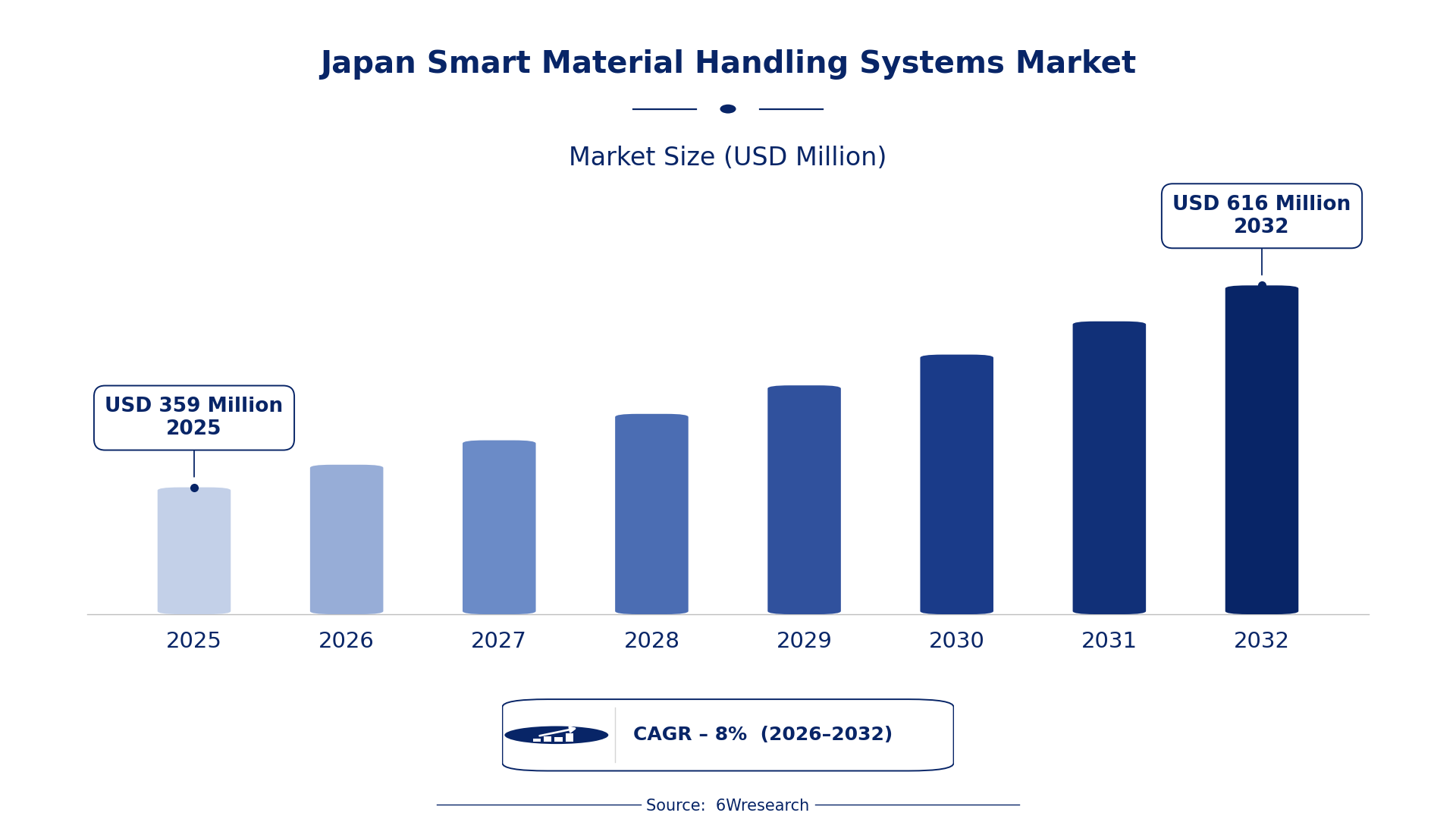
According to 6Wresearch internal database and industry insights, the Japan Smart Material Handling Systems Market was valued at USD 359 Million in 2025 and is projected to reach USD 616 Million by 2032, growing at a CAGR of approximately 8% during 2026–2032.
Japan Smart Material Handling Systems Market Highlights
| Report Metric | Details |
| Report Name | Japan Smart Material Handling Systems Market (2026-2032) |
| Market Size 2025 | USD 359 Million |
| Market Size 2032 | USD 616 Million |
| Absolute Growth 2025–2032 | USD 257 Million |
| CAGR 2026–2032 | 8% |
| Peak Annual Growth | 8.7% in 2032 |
| Forecast Period | 2026–2032 |
| Historical Data | 2022–2025 |
| Base Year | 2025 |
| Leading System Type, 2025 | AGV Conveyor Systems (46% share) |
| Leading Smart Feature, 2025 | Intelligent Route Planning (42% share) |
| Leading Control Platform, 2025 | IoT + HMI (48% share) |
| Leading End User, 2025 | Logistics Operators (54% share) |
| Fastest-Growing System Type | AI-Powered Palletizers (11.8% CAGR) |
| Fastest-Growing Smart Feature | Object Identification (10.6% CAGR) |
| Fastest-Growing Control Platform | Sensor Fusion + AI (12.1% CAGR) |
| Fastest-Growing End User | Distribution Warehouses (10.4% CAGR) |
| Growing Sector | Logistics and Warehousing |
| Key End Users | Logistics Operators, Shipping Yards, Distribution Warehouses, Retail Chains |
Japan Smart Material Handling Systems Market Year-wise Growth Rate and Key Drivers (2022–2032)
This graph illustrates the annual growth rates of the market from 2022 to 2032, highlighting a steady upward trajectory and projected market expansion over the forecast period.
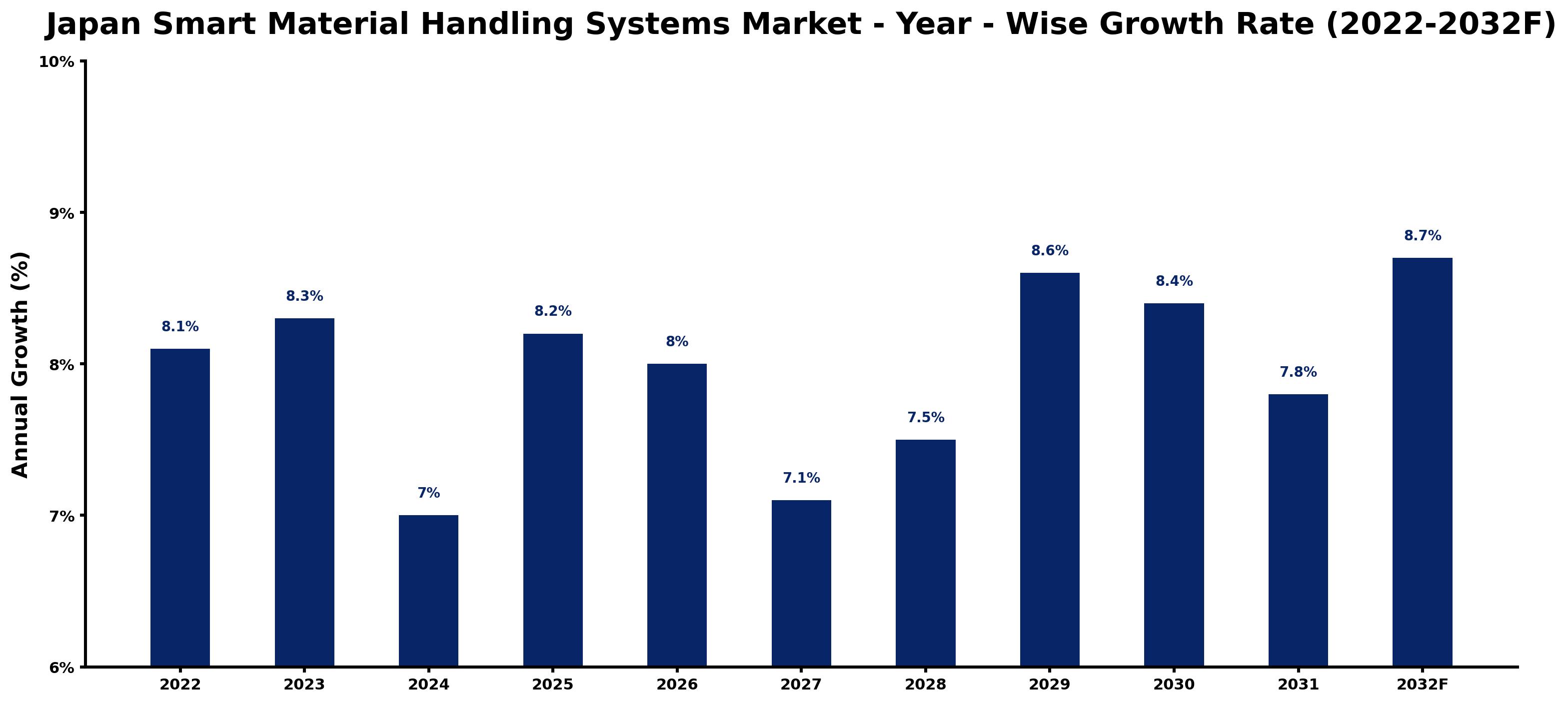
For each year, the table pairs the estimated growth rate with the leading influence on demand, showing how the drivers changed across the period.
| Year | Estimated Annual Growth (%) | Market Rationale |
| 2022 | 8.1 | Demand from logistics operators remained strong, driving system adoption across sectors. |
| 2023 | 8.3 | Increased investments in automation technologies boosted growth in smart material handling systems. |
| 2024 | 7.0 | Growth slowed as companies reassessed their technology investments amid economic uncertainty. |
| 2025 | 8.2 | Logistics operators expanded their operations, leading to a resurgence in system demand. |
| 2026 | 8.0 | Market growth is expected to decelerate as supply chain challenges impact procurement timelines for buyers. |
| 2027 | 7.1 | Demand is projected to continue rising, but at a slower pace due to market saturation in some areas. |
| 2028 | 7.5 | Technological advancements are expected to revitalise interest, prompting renewed investments in smart systems. |
| 2029 | 8.6 | Logistics operators will increase automation levels, driving further demand for advanced systems. |
| 2030 | 8.4 | Growth is projected to moderate as the market stabilises, reflecting a more mature adoption phase. |
| 2031 | 7.8 | Demand is expected to remain steady, with operators focusing on optimising existing systems rather than new purchases. |
| 2032 | 8.7 | A surge in eco-friendly initiatives will lead to increased investments in smart material handling systems. |
Note: Market size estimations and growth projections presented in this report are based on 6Wresearch's proprietary forecasting methodology, utilizing the latest available industry data, government publications, and primary research inputs.
Japan Smart Material Handling Systems Market Synopsis
Smart Material Handling Systems utilise advanced robotics, AI, and IoT to improve efficiency in logistics and warehousing. These systems automate goods movement, optimise operations, and streamline inventory management. The Japan Smart Material Handling Systems Market is expanding due to robust demand from logistics operators, substantial investments in automation, and government initiatives promoting smart logistics. With a logistics sector valued at approximately 12 trillion yen, the market is projected to grow, driven by technological advancements and a focus on sustainability.
Market Dynamics Impact Analysis (2026–2032)
| Factor | Type | Impact | Primary Segment Affected |
| Growing demand from logistics operators for automation solutions | Driver | High | Logistics Operators |
| Increased investments in smart technologies by shipping yards | Driver | High | Shipping Yards |
| Rising need for efficient inventory management solutions | Opportunity | High | Distribution Warehouses |
| Government initiatives promoting smart logistics systems | Opportunity | Medium | Logistics Operators |
| High initial investment costs for smart systems | Restraint | High | Distribution Warehouses |
| Limited awareness of smart technologies among small operators | Restraint | Medium | Logistics Operators |
| Competition from traditional material handling methods | Challenge | High | Shipping Yards |
| Supply chain disruptions affecting technology adoption | Challenge | Medium | Distribution Warehouses |
Evaluation of Drivers in Japan Smart Material Handling Systems Market (2026–2032)
The main growth drivers and the segments they affect most are set out below.
| Drivers | Primary Segment Affected | Why It Matters (Evidence) |
| Increased automation in logistics operations | Logistics Operators | With Japan's logistics sector valued at approximately 12 trillion yen, operators are investing in smart systems to improve efficiency. |
| Government funding for logistics modernization | Shipping Yards | The allocation of 5 billion yen in 2023 for logistics initiatives encourages shipping yards to adopt advanced technologies. |
| Rising demand for eco-friendly solutions | Distribution Warehouses | Japan targets a 46% cut in greenhouse-gas emissions by 2030, prompting warehouses to invest in smart systems. |
| Technological advancements in AI and robotics | Distribution Warehouses | The integration of AI-powered palletizers in distribution warehouses is increasing throughput and reducing operational costs. |
| Growing population density in urban areas | Shipping Yards | With an average density of 11,000 people/km² in major logistics regions, smart systems are essential for efficient operations. |
Behind the steady rise in orders sits the increasing automation demand from logistics operators. In 2022, Japan's logistics sector was valued at approximately 12 trillion yen, prompting operators to invest in smart material handling systems for improved efficiency. Japan's commitment to a 46% reduction in greenhouse-gas emissions by 2030 is driving distribution warehouses to implement eco-friendly solutions. Advancements in AI and robotics are facilitating the integration of smart systems, increasing throughput and reducing operational costs.
Evaluation of Restraints in Japan Smart Material Handling Systems Market
Several factors work against faster growth; the main ones are summarised below.
| Market Restraint | Primary Segment Affected | Why It Matters (Evidence) |
| High initial investment costs for smart systems | Distribution Warehouses | The average cost of implementing smart material handling systems can be prohibitive, limiting adoption among smaller warehouses. |
| Limited awareness of smart technologies among small operators | Logistics Operators | Many small logistics operators lack knowledge about the benefits of smart systems, hindering their adoption. |
| Competition from traditional material handling methods | Shipping Yards | Resistance to change in established practices can slow the transition to smart systems. |
| Supply chain disruptions affecting technology adoption | Distribution Warehouses | Ongoing global supply chain issues can delay the procurement of smart systems, impacting operational efficiency. |
| Regulatory compliance challenges for new technologies | Logistics Operators | Navigating complex regulations can slow down the implementation of advanced material handling systems. |
Japan Smart Material Handling Systems Market Challenges
Buyers in the logistics sector face increased supply chain costs, with disruptions inflating operational expenses by up to 15%. Suppliers encounter fierce competition, leading to price wars that can reduce earnings by 10% annually. Many suppliers are reluctant to adopt new technologies, causing delays in efficiency improvements and increasing operational costs for buyers by 20%. Integration issues with smart systems can raise training expenses by 30%, complicating operations for logistics firms and hindering their ability to adapt swiftly.
Trends in the Japan Smart Material Handling Systems Market
The shifts below are changing how Japan Smart Material Handling Systems Market products are bought and supplied.
- Shift towards Eco-Friendly Solutions: Japan's logistics sector is increasingly adopting eco-friendly smart material handling systems. In 2023, government funding of 5 billion yen for logistics modernisation supports this trend, promoting a more sustainable industry.
- Transition from Manual to Automated Systems: Logistics operators are moving from manual handling to automated systems. In 2022, over 1,200 distribution warehouses employed smart systems, reflecting a notable shift in operational practices.
- Emergence of AI-Powered Technologies: AI-powered palletizers are becoming essential in Japan's logistics sector. The integration of these systems is expected to increase throughput by 20% in distribution warehouses by 2025.
- Prioritisation of Inventory Management Efficiency: The focus on efficient inventory management is rising among logistics operators. By 2025, the Japanese retail market is expected to adopt smart systems in 70% of its operations.
Investment Opportunities in the Japan Smart Material Handling Systems Market
The following opportunities in the Japan Smart Material Handling Systems Market pair current demand with a clear way in.
- Timing for Investment in Smart Systems: With the logistics sector valued at 12 trillion yen, now is the ideal time for investment in smart material handling systems. Distribution warehouses are seeking advanced solutions to improve efficiency.
- Entry through Local Partnerships: Forming joint ventures with local logistics operators can facilitate entry into the market. This approach allows for better understanding of regional needs and compliance with local regulations.
- Gap in Eco-Friendly Solutions: As Japan targets a 46% reduction in greenhouse-gas emissions by 2030, there is a gap in eco-friendly smart systems. Shipping yards are looking for sustainable solutions to meet regulatory requirements.
- Growing Demand from Distribution Warehouses: Distribution warehouses are increasingly seeking smart systems to optimise operations. Investing in IoT and AI technologies can effectively meet this rising demand.
Government Initiatives in the Japan Smart Material Handling Systems Market
The Green Growth Strategy Through Achieving Carbon Neutrality in 2050, updated in 2021, adds a focus on smart logistics to existing regulations. This strategy encourages logistics operators to adopt eco-friendly technologies, aligning with Japan's broader environmental goals.
The Ministry of Land, Infrastructure, Transport and Tourism promotes smart logistics initiatives, providing funding for projects that improve operational efficiency. Logistics operators benefit from these schemes by receiving financial support to implement advanced technologies.
Future Insight of the Japan Smart Material Handling Systems Market
Retail chains will adopt smart systems in 70% of their operations by 2025, transforming logistics practices. By 2032, advancements in automated technologies will enhance warehouse operations and improve inventory management. The government's JPY 150 trillion decarbonisation investment will modernise infrastructure, creating opportunities for suppliers to innovate. Continued promotion of best practices will enable buyers to benefit from increased efficiency and reliability in logistics.
Market Segmentation Analysis
Japan Smart Material Handling Systems Market report covers a detailed analysis of the following market segments:
By System Type – AGV Conveyor Systems Lead, AI-Powered Palletizers Expected to Grow Fastest
According to Saurav Kr Singh, Senior Research Analyst at 6Wresearch, the largest system type category in 2025 was AGV Conveyor Systems, at 46% of revenue. AGV Conveyor Systems hold a substantial market share as they are essential for automating material transport in warehouses, which enhances operational efficiency. Their extensive deployment in over 1,200 distribution warehouses across Japan demonstrates their critical role in the logistics sector. AI-Powered Palletizers are set to record the highest CAGR in this split, 11.8% over 2026–2032. AI-Powered Palletizers are experiencing rapid growth due to their ability to automate the stacking of products on pallets, significantly increasing throughput. As logistics operators increasingly seek to streamline their processes, the demand for these systems will likely continue to rise. Suppliers should focus on developing advanced automation technologies to meet the growing needs of logistics operators.
By Smart Feature – Intelligent Route Planning Leads, Object Identification Expected to Grow Fastest
Intelligent Route Planning accounted for 42% of the market by smart feature in 2025. Intelligent Route Planning is the leading feature as it effectively optimises paths for material transport, thus reducing time and costs in logistics operations. Its crucial role in logistics hubs like the Tokyo metropolitan area highlights its importance in enhancing operational efficiency. Object Identification is projected to grow fastest, at a CAGR of 10.6% during 2026–2032. Object Identification is witnessing rapid growth because it enhances accuracy in sorting and handling materials, which is vital for managing logistics complexities. With the retail market expected to adopt smart systems in 70% of its operations by 2025, demand for this feature will likely surge. Buyers should prioritise smart features that improve operational efficiency and accuracy in their logistics processes.
By Control Platform – IoT + HMI Leads, Sensor Fusion + AI Expected to Grow Fastest
In 2025, IoT + HMI led the control platform split with a 48% share. IoT + HMI is the dominant control platform as it integrates human-machine interfaces for better control and monitoring, essential for effective system management. This integration is particularly advantageous in Japan's advanced logistics sector, where technology is pivotal. The quickest growth will come from Sensor Fusion + AI, forecast to expand at a CAGR of 12.1% between 2026 and 2032. Sensor Fusion + AI is the fastest-growing platform because it combines data from multiple sensors for improved decision-making, crucial for optimising logistics operations. As companies invest in modernising their logistics, this platform is expected to see increased adoption. Suppliers must enhance their control platform offerings to align with technological advancements in the logistics sector.
By End User – Logistics Operators Lead, Distribution Warehouses Expected to Grow Fastest
With 54% of end user revenue in 2025, Logistics Operators was the largest category. Logistics Operators represent the largest end-user group as they are the primary users of smart systems, utilising them for efficient operations across Japan's logistics landscape. The sector's valuation at approximately 12 trillion yen underscores the significance of these operators in the market. Over 2026–2032, Distribution Warehouses are expected to post the fastest growth, at a CAGR of 10.4%. Distribution Warehouses are experiencing the fastest growth as they heavily rely on automation for inventory and order fulfilment, driven by the need for improved efficiency. With government support for logistics modernisation, this segment is poised for rapid expansion. Buyers in distribution warehouses should invest in automation solutions to enhance their operational capabilities.
Key Attractiveness of the Report
- 10 Years of Market Numbers
- Historical Data Starting from 2022 to 2025
- Base Year 2025
- Forecast Data until 2032
- Key Performance Indicators Impacting the Market
- Major Upcoming Developments and Projects
Key Highlights of the Report:
- Japan Smart Material Handling Systems Market Outlook
- Market Size of Japan Smart Material Handling Systems Market, 2025
- Forecast of Japan Smart Material Handling Systems Market, 2032
- Historical Data and Forecast of Japan Smart Material Handling Systems Revenues & Volume for the Period 2022-2032F
- Japan Smart Material Handling Systems Market Trend Evolution
- Japan Smart Material Handling Systems Market Drivers and Challenges
- Japan Smart Material Handling Systems Price Trends
- Japan Smart Material Handling Systems Porter's Five Forces
- Japan Smart Material Handling Systems Industry Life Cycle
- Historical Data and Forecast of Japan Smart Material Handling Systems Market Revenues & Volume By System Type for the Period 2022-2032F
- Historical Data and Forecast of Japan Smart Material Handling Systems Market Revenues & Volume By AGV Conveyor Systems for the Period 2022-2032F
- Historical Data and Forecast of Japan Smart Material Handling Systems Market Revenues & Volume By Sensorized Cranes for the Period 2022-2032F
- Historical Data and Forecast of Japan Smart Material Handling Systems Market Revenues & Volume By AI-Powered Palletizers for the Period 2022-2032F
- Historical Data and Forecast of Japan Smart Material Handling Systems Market Revenues & Volume By Smart Bin Systems for the Period 2022-2032F
- Historical Data and Forecast of Japan Smart Material Handling Systems Market Revenues & Volume By Smart Feature for the Period 2022-2032F
- Historical Data and Forecast of Japan Smart Material Handling Systems Market Revenues & Volume By Intelligent Route Planning for the Period 2022-2032F
- Historical Data and Forecast of Japan Smart Material Handling Systems Market Revenues & Volume By Load Stability Control for the Period 2022-2032F
- Historical Data and Forecast of Japan Smart Material Handling Systems Market Revenues & Volume By Object Identification for the Period 2022-2032F
- Historical Data and Forecast of Japan Smart Material Handling Systems Market Revenues & Volume By Capacity & Weight Alerts for the Period 2022-2032F
- Historical Data and Forecast of Japan Smart Material Handling Systems Market Revenues & Volume By Control Platform for the Period 2022-2032F
- Historical Data and Forecast of Japan Smart Material Handling Systems Market Revenues & Volume By IoT + HMI for the Period 2022-2032F
- Historical Data and Forecast of Japan Smart Material Handling Systems Market Revenues & Volume By Sensor Fusion + AI for the Period 2022-2032F
- Historical Data and Forecast of Japan Smart Material Handling Systems Market Revenues & Volume By Camera + ML for the Period 2022-2032F
- Historical Data and Forecast of Japan Smart Material Handling Systems Market Revenues & Volume By RFID + IoT for the Period 2022-2032F
- Historical Data and Forecast of Japan Smart Material Handling Systems Market Revenues & Volume By End User for the Period 2022-2032F
- Historical Data and Forecast of Japan Smart Material Handling Systems Market Revenues & Volume By Logistics Operators for the Period 2022-2032F
- Historical Data and Forecast of Japan Smart Material Handling Systems Market Revenues & Volume By Shipping Yards for the Period 2022-2032F
- Historical Data and Forecast of Japan Smart Material Handling Systems Market Revenues & Volume By Distribution Warehouses for the Period 2022-2032F
- Historical Data and Forecast of Japan Smart Material Handling Systems Market Revenues & Volume By Retail Chains for the Period 2022-2032F
- Japan Smart Material Handling Systems Import Export Trade Statistics
- Market Opportunity Assessment By System Type
- Market Opportunity Assessment By Smart Feature
- Market Opportunity Assessment By Control Platform
- Market Opportunity Assessment By End User
- Japan Smart Material Handling Systems Top Companies Market Share
- Japan Smart Material Handling Systems Competitive Benchmarking By Technical and Operational Parameters
- Japan Smart Material Handling Systems Company Profiles
- Japan Smart Material Handling Systems Key Strategic Recommendations
Market Covered
Coverage by segment is as follows.
By System Type
- AGV Conveyor Systems
- Sensorized Cranes
- AI-Powered Palletizers
- Smart Bin Systems
By Smart Feature
- Intelligent Route Planning
- Load Stability Control
- Object Identification
- Capacity & Weight Alerts
By Control Platform
- IoT + HMI
- Sensor Fusion + AI
- Camera + ML
- RFID + IoT
By End User
- Logistics Operators
- Shipping Yards
- Distribution Warehouses
- Retail Chains































